
Available online: https://edupediapublications.org/journals/index.php/IJR/ P a g e | 1
BER Analysis Based On Convolutional Coded Ofdm For Digital
Audio Broadcasting System
Merugu Ashok & Basavaraja Pg Scholar 1 Assistant Professor2
Department Of Ece,Nova College Of Engineering And Technology
ABSTRACT Wireless communications is a
primary constituent of communication domain which supports wide range of wireless technologies ranging from small to ultra-large distances. High data rates, low complexity and interference-free system are the requirements of modern communication systems; OFDM model satisfies all the requirements with ease and became the best alternative for applications like 3GPP, 4G-LTE, Wi-Fi and WiMAX. Coded OFDM is designedto meet the desired requirements of DAB application with high accuracy. The convolutional channel based multimedia signal broadcasting scheme is proposed in this work. It is shown in the experimental results that the turbo codes prove to be better when the input data is a low data rate signal. However, for high data rate signal like speech and image convolutional codes proves a better choice.
Keywords: Coded OFDM, Convolutional coding, BER analysis, Efficiency
1. INTRODUCTION In Wireless technologies
the telecommunications industry is in the midst of
a veritable explosion. Once exclusively satellite, military and cellular technologies are now commercially driven by ever more demanding consumers, who are ready for seamless communication from their home to car, to their office, or even for outdoor activities. With this increased demand there exists a need to transmit information wirelessly, quickly, and accurately. To address this need, different technologies are combined by communications engineer which are suitable for high rate transmission with forward error correction techniques. These are particularly important as wireless communications channels are far more hostile as opposed to wire alternatives, and the need for mobility proves
especially challenging for reliable
Available online: https://edupediapublications.org/journals/index.php/IJR/ P a g e | 2 which are orthogonal to each other. Some of the
advantages of OFDM are its efficient spectral usage by allowing overlapping in the frequency domain and its multi-path delay spread tolerance. The other significant advantage is modulation and demodulation can be done using IFFT and FFT operations, which are computationally efficient.
2. BACKGROUND
(A) OFDM Orthogonal Frequency Division
Multiplexing (OFDM) is a multicarrier
transmission technique, in which the available spectrum is divided into many carriers, each carrier is modulated by a low rate data stream. OFDM is similar to FDMA in that the multiple user access is achieved by subdividing the available bandwidth into multiple channels, that are then allocated to users. However, OFDM uses the spectrum much more efficiently by spacing the channels much closer together. It is achieved by making all the carriers orthogonal to one another, preventing interference between the closely spaced carriers.
(B) Coded OFDM Coded Orthogonal Frequency Division Multiplexing (COFDM) is same as OFDM but in COFDM forward error correction is applied to the signal before transmission. This is to overcome errors in the transmission due to
lost carriers from channel noise, frequency selective fading and other propagation effects. For this discussion the terms COFDM and OFDM are used interchangeably, as the main focus of this paper is on OFDM, but it is assumed that any practical system will use forward error correction, thus would be COFDM.
3. PROPOSED METHOD
II. SYSTEM MODEL OF MULTIMEDIA SIGNNAL USING CODED OFDM
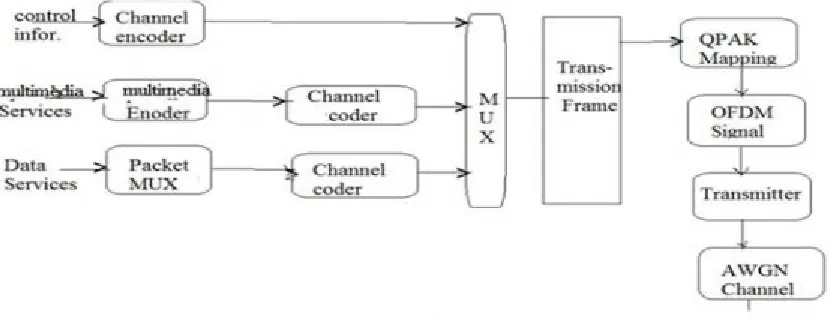
A) A Simplified DAB Block Diagram Block diagram of the multimedia signal Broadcasting transmission system is shown in Fig. 1. A simple sign is encoded and channel encoder is connected to it. After channel coding the bit streams are QPSK mapped. The information is then gone to OFDM generator. The high information rate bit stream is separated into "N" parallel information surges of low information rate and separately regulated on to orthogonal subcarriers which is
acknowledged utilizing IFFT calculation.
Available online: https://edupediapublications.org/journals/index.php/IJR/ P a g e | 3 B. DAB Transmission Modes Four transmission
modes are present inDAB system , each with its own set of parameters, shown in Table-I [12]. In this paper for simulation Transmission Mode-I is selected.
III. CHANNEL CODING A) Convolutional
Encoding & Viterbi Decoding A convolutional encoder comprises of a M-stage shift register with "k" inputs, endorsed associations with "n" modulo-2 adders and multiplexer that serializes the yields of the adders. Here the encoder chose has k=1, i.e; the info succession touches base on a solitary information line. Subsequently the code rate is given by r = 1/n. In an encoder with a M stage shift enroll, the memory of the coder approaches M message bits and K = (M+1) movements are required before a message bit that has entered the movement register can at long last exit. This parameter K is alluded to as the
Available online: https://edupediapublications.org/journals/index.php/IJR/ P a g e | 4 B) Parallel Concatenated Convolutional Turbo
Coding & Decoding Parallel Concatenated Convolutional turbo code (PCC turbo code) comprises of two or more Recursive Systematic Convolutional (RSC) coders working in parallel [8]. The reason for interleaver is to offer each
encoder an irregular variant of the data bringing about equality bits from each RSC that are free.On the receiving side there are same number of decoders as on the encoder side, each working on the same information and an independent set of parity bits.
Figure 3: Turbo coder and decoder[8]
In this work, to give same code rate to turbo encoder as on account of convolutional encoder, a parallel connection of two indistinguishable RSC encoders are utilized which gives a code rate of ѿ. One such turbo encoder is appeared in Fig. 3, where the quantity of registers in each RSC encoder=2. Henceforth the limitation length K=3. Generator polynomials are 7 and 5 in octal arrangement. The number 7 indicates the input polynomial. π is the arbitrary interleaver. Reenactment is completed for different estimations of requirement length, generator
Available online: https://edupediapublications.org/journals/index.php/IJR/ P a g e | 5 The inputs are data bits and called uk. The yields are
code bits. Of these, the yield of first encoder, yk1, s is
known as the precise piece, and it is the same as the
information bit. The second yield bit, yk1, p is the
principal equality bit which is recursive deliberate
piece. An interleaver, indicated by Type equation
here., is put in the middle of the two encoders to
guarantee that the information got by the second
encoder is measurably autonomous. The third yield
bit, yk 2, p is the second equality bit which is
additionally a recursive deliberate piece. The fourth
yield yk 2, s is deterministically reshuffling adaptation
of yk 2, s , which is not transmitted. For decoding, the
Viterbi Algorithm is not suited to generate the
A-Posteriori-Probability (APP) or soft decision output
for each decoded bit. Here Maximum-A-Posteriori
(MAP) algorithm is used for computing the metrics.
Block diagram of turbo decoder is shown in Fig. 4.
In Fig. 4, DEC1 and DEC2 are 2 APP decoders. ʌ and ʌ
-1 are random interleaver and de-interleaver
respectively [14]. The symbol vector sent for each
time are described by yk=(yk1, s, yk1, p, yk2, p). The
goal is to take these and make a guess about the
transmitted vector and hence code bits which in turn
Available online: https://edupediapublications.org/journals/index.php/IJR/ P a g e | 6 APPLICATIONS
DAB - OFDM forms the basis for the Digital
Audio Broadcasting (DAB) standard in the European market.
ADSL
- OFDM forms the basis for the global ADSL (asymmetric digital subscriber line) standard.
Wireless Local Area Networks
- development is ongoing for wireless pointto-point and pointto-point-to-multipointto-point configurations using OFDM technology.
In a supplement to the IEEE 802.11 standard,
the IEEE 802.11 working group published IEEE 802.11a, which outlines the use of OFDM in the 5GHz band.
CONCLUSION In this Bit Error Rate (BER)
performances of Convolutional coding is evaluated under high data rate signals like speech and image by varying different modulation scheme using AWGN channel. This algorithm utilizes the average value of the instantaneous Signal to noise ratio (SNR) of the subcarriers in the sub-band as the switching parameter. Turbo codes acts better in low data rate scenario while convolutional codes acts better in high data rate. Convolutional codes are better choice over turbo
codes in multimedia data transmission
applications like speech and image.
REFERENCES
Available online: https://edupediapublications.org/journals/index.php/IJR/ P a g e | 7 [2] Henrik Schulze, Christian Luders, “Theory
and Applications of OFDM and CDMA”, John Wiley & Sons, Ltd. England, 2005.
[3] Simon Haykin, “Communication Systems”, 4th Edition, John Wiley & Sons, Inc. England, 2001.
[4] BernadSklar, “Digital Communications– Fundamentals and Applications”, 2nd Edition Pearson Education (Singapore) Pte. Ltd., 2001
[5] Zimmerman G., Rosenberg M. and Dostert S., “Theoretical Bit Error Rate for Uncoded and Coded Data Transmission in Digital Audio
Broadcasting”, Proc. IEEE International
Conference on Communications, Vol. 1, pp. 297-301, June 1996.
[6] Thomas May and Hermann Rohling, “Turbo
Decoding of Convolutional Codes in
Differentially Modulated OFDM Transmission
System”, Proc. IEEE 49th Vehicular Technology Conference, Vol. 3, pp-1891-1895, July 1999.
[7] Hanjong Kim, “Turbo Coded Orthogonal Frequency Division Multiplexing for Digital Audio Broadcasting”, Proc. IEEE International Conference on Communications, Vol. 1, pp. 420-424, 2000.
[8] A. Burr, “Turbo-Codes: The Ultimate Error Control Codes?”, Electronics & Communication Engineering Journal, Vol. 13, pp. 155-165, August 2001.
[9] R. Maerkle and C-E. W. Sudenberg, “Turbo Codes for Hybrid In Band On Channel Digital Audio Broadcasting”, Porc. IEEE Global Telecommunication Conference, Vol. 2, pp. 941-945, 2001.
![Figure 3: Turbo coder and decoder[8]](https://thumb-us.123doks.com/thumbv2/123dok_us/7749598.1270238/4.612.65.490.238.393/figure-turbo-coder-and-decoder.webp)
