ISSN 2286-4822 www.euacademic.org
Impact Factor: 3.1 (UIF)
DRJI Value: 5.9 (B+)
Managerial Effectiveness: A Comparative Study
between Managers of Private and Public
Undertakings
AMJAD ALI1 Department of Humanities and Social Sciences
National Institute of Technology Rourkela, Odisha India BHASWATI PATNAIK Department of Humanities and Social Sciences National Institute of Technology Rourkela, Odisha India
Abstract:
Managerial Effectiveness is fast becoming a competitive advantage for organisations, especially in the context of high demand for and, therefore, continuous migration of competent managers from one organisation to another. Organisations, therefore, have started investing in retaining competent managers and putting in place systems for developing new cadre of effective managers. It is in wake of these contextual factors that the present study on Managerial Effectiveness has been conducted. Managerial Effectiveness is often defined in terms of output - what a manager achieves. The present study was aimed to understand different perspectives on managerial effectiveness between private and public undertakings. The study was carried out in different private and public organizations located in Delhi and its NCR (National Capital Region). Data were collected from 100 managers (50 managers from private and 50 from public undertakings). Managerial Effectiveness Scale developed by Dhar, Dhar and Jain (2006) was used to assess the managerial effectiveness
of the managers on different factors of the construct of managerial effectiveness. Analysis of the data was done using t-test. Results revealed significant difference between managers of private and public undertakings on Managerial Effectiveness dimensions. The findings imply that the organizations in both the sectors need to understand and manage Managerial Effectiveness and provide them with suitable functional, interpersonal and personal freedom to utilize their full potentials so that their level of performance in the organization could be enhanced. Results are explained in the light of present scenario in existing private and public undertakings.
Key words: Managerial Effectiveness, Manager, Private, Public, Undertakings.
Introduction
Effectiveness, whether it is organization or manager specific, is universally accepted as a major goal for modern management. Unfortunately, there is a lack of consensus and considerable disagreement on what is meant by effectiveness. How it is defined and measured largely depends on the theoretical orientation of the researcher. Organizational theorists and researchers have commonly used employee satisfaction, effort, or commitment (Cummings 1980; Goodman & Pennings 1977) as the key to enhancing effectiveness, whereas those in policy look to strategic planning and structure interactions as a solution to increasing effectiveness (Rumelt 1974). Also many with a financial perspective equate profit with effectiveness (Kirchoff 1977).
Hennessey 1985; Martinko & Gardner 1985: 1990; Luthans, Welsh & Taylor 1988; Cammock, Nilakant & Dakin 1995; Willcocks, 1992; 1997; Barker 2000). Van der Velde, Jansen and Vinkenburg (1999), drawing strongly on the work of writers such as Thornton (1980), Foti (1990), Shipper (1991), Bass and Yammarino (1993), Atwater and Yammarino (1992) and Tsui and Ashford (1994), assert there is a link between actual managerial success and the perceptions that subordinates, peers and superiors have concerning the behaviours they respectively associate with managerial effectiveness or managerial ineffectiveness. However, they argue that the respective judgments of subordinates, peers, superiors and managers on what constitutes effective managerial behaviour often differ.
Though, it is difficult to define managerial effectiveness in concrete terms. A number of experts of management have perceived it from their own frame of reference. However decisions about effectiveness are bound to be situational as well as contingent upon the definitions and perspectives of those making the judgment.
develop management skills and behaviour, which can be applied across the situations and contexts (Page et al. 2003). Managerial effectiveness has also been articulated as the ability of a manager to carry out the activities required for his position while achieving the results both current and in terms of developing further potential (Gupta 1996).
However, managerial effectiveness is often defined in terms of output - what a manager achieves. This result oriented definition leads us to look for the factors that contribute towards the “results”. Studies find three factors to be responsible for the results that an organisation achieves through its managers. These are; (a) the efforts and ability of the managers, (b) the environment in which the managers and the organisation operates, and (c) the efforts and ability of the subordinates. Thus, the managers’ ability is the key element in achieving the desired results.
According to Campbell (1970) managerial effectiveness should reflect in organizational effectiveness as well. Even if it does not, the effectiveness of the individuals by itself should be a matter of concern; because performing well is a prerequisite to any subsequent positive organizational dynamics.
Sayeed (2002) defined managerial effectiveness as a function of behaviour as well as technical management process. It is a leader’s ability to achieve desired results. How well he applies his skills and abilities in guiding and directing others determines whether he can meet those results effectively. If he can, his achievements are poised to help the organization gain a competitive edge against rival organizations heading into the future.
2008; Rastogi and Dave 2004), culture (Pathak et al. 2009; Smith and Schwartz 1997; Vallabh 2010) and human resource development practices (Narayan and Rangnekar 2008; Ravichandran 2011).
A review of literature shows that managerial effectiveness has been studied with three perspectives:
Traditional/ Conventional perspectives
Organisational level competency based perspective, and
Individual level competency based perspective.
The Traditional model emphasizes the ability to set and achieve goals (Bartol and Martin 1991) where it implicitly assumed that managerial effectiveness leads to organizational effectiveness.
The Organizational competency based approach implies that there is long term future orientation that accounts for both external and internal influences on the organizations. From these analyses a vision is created for the future of the organization, goals are set that will achieve the vision and plans are developed to achieve these strategic goals. Here the organization tries to create the system and environment with the help of skills and characteristics of managers that lead them to achieve strategic intents.
The Individual competency based approach to managerial effectiveness focuses upon the individual rather than the organization. The purpose of this approach is to develop transferable (generic) management skills that are applicable across different circumstances both nationally and internationally. But this competency based perspective on managerial effectiveness has been heavily criticized on the ground of the contingencies and the contexts.
productivity of any organization can be increased by the effective management of three dimensions and specially by managing the conceptual and human dimensions of management. All managers need to work with and through subordinates to optimize organizational performance. Therefore, certain behavioural skills are required of individuals if they are to be effective as managers.
Managers have many resources at their disposal and the quality of work is dependent on how well these resources have been utilized. The performance of a manager can be measured by the extent to which goal that is important to the group and organizations are met through the productive efforts of subordinates (Herbert 1976). In other words effective management is the culmination of synergy of effectiveness of individual managers in the organization (Sen and Saxena 1999). Das (1987) identified the characteristics of an efficient branch manager as setting an example by personal qualities, job knowledge, and business acumen and management ability. Miles (1992) suggested that constructive use of authority entails the ability to formulate clear goals and to determine what steps are necessary to achieve those including getting people to do what is necessary for achieving the targets. Misumi (1989), Misumi and Peterson (1985) defined the ideal manager in Japan in terms of both performance and maintenance orientations, namely a manager who leads a group towards goal attainment and preserves its social stability. Just as there had been controversy and many arguments were raised that a good leader should have certain characteristics similar arguments are there for managerial effectiveness.
Managerial effectiveness may include a list of qualities or skills associated with effective managers. Whetton and Cameron's definition focuses on these skills: "verbal communication, managing time and stress, managing individual decisions, recognizing, defining and solving problems, motivating and influencing others, delegating, setting goals and articulating a vision, self-awareness, team building and managing conflict." This list shows how a manager must have a wide range of skills and must effectively multi-task. These skills can be summarized as planning, delegating, troubleshooting and using interpersonal skills to get people to achieve goals.
Gupta (1996) has developed a 16-factor scale to measure managerial effectiveness. These factors are tapping three important aspects of effectiveness: activities of his position, achieving the results, and developing further potential. The managerial effectiveness has been measured by experts in several different ways at different times. Some models focus on individual competencies of managerial effectiveness while most of the studies have taken performance measure and superior’s appraisal rather than self report measures while deciding the effectiveness of a manager.
Analoui (1997, 1999) identified eight sets of behavioural influences (parameters of effectiveness) which to a large degree determine the degree of the effectiveness of senior managers. Given the crucial role of the senior managers in the formulation and implementation of company institutions/policies, how effective they are and how to improve their effectiveness are becoming increasingly important (Analoui 1999, 2007).
Model of Managerial Effectiveness:
present model which assesses and constitute our measuring scale. The entire study is based up on these dimensions such as functional, interpersonal and personal effectiveness and their components, and found to have positive relations with managerial effectiveness (Dhar, Dhar and Jain 2006).
Functional Effectiveness:
The effectiveness of managers that play a large part in how well your entire organization function. It is assessed to determine how well it can help organization to achieve its strategic objectives. Trends such as globalization, technological advances and deregulation mean that organization must be better, faster and more competitive to survive and thrive today. Other important trends include growing workforce diversity and changes in the nature of work, such as the movement toward a service society and a growing emphasis on human capital.
Interpersonal Effectiveness:
sustaining competitive advantage of organizations, there is a growing need for managers to understand and sharpen the essential skills required to foster willingness among their people to contribute to the organization.
Organizations are essentially groups of individuals constructed to strive for specific goals. The success and growth of organizations depend significantly on the individual's ability to work well at the interpersonal level as well as in and with groups. Even the individual's success and growth in organizations depend significantly on his/her ability to work well with others.
The importance of team work has been recognized since long. However, the challenges faced by organizations in recent times have made the need to understand the conditions that make interactions between individuals and groups effective extremely important. Interpersonal effectiveness is required to develop critical teams which play roles that are extremely important.
Personal Effectiveness:
Comparison between Private and Public Undertakings:
The main distinction between the private sector and the public sector is principally their ownership. Private sectors are owned by shareholders or entrepreneurs while public sectors are jointly owned by members of political communities. Public agencies are funded by taxation whereas private agencies are funded by the pay of their consumers. Public sectors are controlled by political forces and private sectors are controlled by market forces.
When comparing the public and private sector, there is some commonality on the issues of resources and appropriate staffing, but otherwise, based on the work of Analoui (1995, 1997, 1999), the public sector seems to have problems with time and workload issues while the private sector companies surveyed are concerned by various people management skills (Chanzi, 2009).
In the opinion of Profiroiu, the performance in the public sector implies a relationship between objectives, means and results, so performance is the result of the simultaneous pursuit of efficiency, effectiveness and a corresponding budget (Profiroiu 2001).
Chanzi (2009) in his study on senior managers identified significant difference between private and public undertakings on managerial effectiveness and apprehended some possible development direction for the effectiveness of future senior manager (SMs) in the public sector.
Objectives of the Study
The present study is aimed to analyze the perception of managers on their managerial effectiveness in the organized public and private undertakings in India. It recognizes the various factors involved in the managerial effectiveness of managers in private and public undertakings. In the present research our focus was given to explore the significant difference between Managers of Private and Public Undertakings on their;
Functional Effectiveness
Interpersonal Effectiveness
Personal Effectiveness, and
Overall Managerial Effectiveness dimensions.
Hypotheses of the Study
In the light of available literature related to the present study, following hypotheses were formulated;
H1: Managers of private undertakings would perceive their better Functional Effectiveness as compared to the managers of public undertakings.
H2: Managers of private undertakings would perceive their better Interpersonal Effectiveness as compared to the managers of public undertakings.
H3: Managers of private undertakings would perceive their better Personal Effectiveness as compared to the managers of public undertakings.
H4: Managers of private undertakings would perceive their better Overall Organizational Effectiveness as compared to the managers of public undertakings.
Design of the Study:
information for the collection of relevant evidence with minimal expenditure of effort and time. It depends mainly on the research objectives and hypotheses. Keeping in view the objectives and hypotheses of present research two group measures designs has been used in this endeavour.
Methodology
Participants:
The sample of present research consisted of a total of (N=100) Managers, 50 each from private and public undertakings. All the respondents were selected through purposive sampling method from different parts of Delhi and its NCR (National Capital Region). The age of the sample ranged from 30 to 55 years. The data was collected from following private and public undertakings, Reliance, Kingfisher, Britannia, Ultratech, Hero Honda and MTNL, BSNL, NDPL, BHEL, GAIL, etc.
Instrument:
Managerial Effectiveness Scale: Managerial Effectiveness Scale developed by Dhar, Dhar and Jain (2006) was used to assess the managerial effectiveness of the managers on different factors of the construct of managerial effectiveness. This scale contains 29 items. Each item of this scale was rated on 7 point rating scale ranging from strongly disagree to strongly agree with a score 1 to 7 (1-strongly disagree, 2-moderately disagree, 3-slightly disagree, 4-neither agree nor disagree, 5-slightly agree, 6-moderately agree and 7-strongly agree). The scale measures three important factors of managerial effectiveness such as;
1. Functional effectiveness
2. Interpersonal effectiveness, and 3. Personal effectiveness
Prophecy Formula on the data collected from the sample. The reliability coefficient was found to be 0.96. Besides face validity, as all items of the scale were related to the concept of Managerial Effectiveness, the scale has high content validity on account of being 0.98. Norms of the scale are available on the sample working in private and public organizations. These norms should be regarded as reference points of interpreting the Managerial Effectiveness scores.
Statistical Analysis
In the present investigation t-test has been computed to analyze the significance of difference between two groups of sample on overall Managerial Effectiveness. Statistical Package for Social Science (SPSS) version 16.0 is used for tabulation and analysis.
Result and Discussion
Variable Group N Mean SD t- value
(df=98) *P Functional
Effectiveness
Private 50 63.00 9.03
4.46 <0.01
Public 50 54.58 9.80
Table 1 : Means, SDs and t-value of managers of private and public undertakings on Functional Effectiveness dimension of Managerial Effectiveness.
*significant at 0.01 level
The mean and SD in the case of managers of private undertakings for Functional Effectiveness dimension was found to be 63.00 and 9.03 while in the case of managers of public undertakings the mean and SD was found to be 54.58 and 9.80 respectively. The t-value between the two means was found to be 4.46 which was significant at 0.01 level.
measured in the present study. Thus, the first hypothesis (H1) of the present study that “Managers of private undertakings would perceive their better Functional Effectiveness as compared to the managers of public undertakings” has been proved.
Variable Group N Mean SD t- value
(df=98) *P Interpersonal
Effectiveness
Private 50 50.10 8.55
6.94 <0.01
Public 50 37.80 9.15
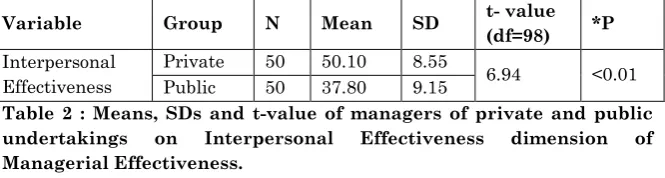
Table 2 : Means, SDs and t-value of managers of private and public undertakings on Interpersonal Effectiveness dimension of Managerial Effectiveness.
*significant at 0.01 level
The mean and SD in the case of managers of private undertakings for Interpersonal Effectiveness dimension was found to be 50.10 and 8.55 while in the case of managers of public undertakings it was found to be 37.80 and 9.15 respectively. The t-value between the two means was found to be 6.94 which was significant at 0.01 level.
The Mean and SD in the case of Private undertakings is found to be higher as compared to the Public undertakings on Interpersonal Effectiveness. The Value obtained through t-test is significant on 0.01 level for both the groups on the variable measured in the present study. Thus, the second hypothesis (H2) of the present study that “Managers of private undertakings would perceive their better Interpersonal Effectiveness as compared to the managers of public undertakings” has been proved.
Variable Group N Mean SD t- value
(df=98) *P Personal
Effectiveness
Private 50 30.70 4.96
9.57 <0.01
Public 50 20.20 5.94
*significant at 0.01 level
The mean and SD in the case of managers of private undertakings for Personal Effectiveness dimension was found to be 30.70 and 4.96 while in the case of managers of public undertakings the mean and SD was found to be 20.20 and 5.94 respectively. The t-value between the two means was found to be 9.57 which was significant at 0.01 level.
The Mean and SD in the case of Private undertakings is found to be higher as compared to the Public undertakings on Personal Effectiveness. The Value obtained through t-test is significant on 0.01 level for both the groups on the variable measured in the present study. Thus, the third hypothesis (H3) of the present study that “Managers of private undertakings would perceive their better Personal Effectiveness as compared to the managers of public undertakings” has been proved.
Variable Group N Mean SD t- value
(df=98) *P Overall
Managerial Effectiveness
Private 50 162.06 22.82
6.59 <0.01
Public 50 122.76 35.45
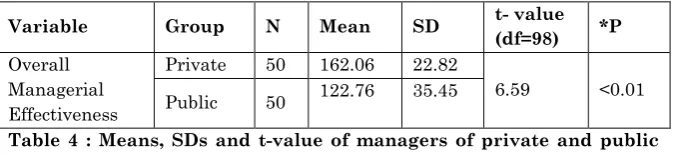
Table 4 : Means, SDs and t-value of managers of private and public undertakings on Overall Managerial Effectiveness.
*significant at 0.01 level
The mean and SD in the case of managers of private undertakings for Overall Managerial Effectiveness dimension was found to be 162.06 and 22.82 while in the case of managers of public undertakings the mean and SD was found to be 122.76 and 35.45 respectively. The t-value between the two means was found to be 6.59 which was significant at 0.01 level.
hypothesis (H4) of the present study that “Managers of private undertakings would perceive their better Overall Managerial Effectiveness as compared to the managers of public undertakings” has been proved.
Conclusions
Generally, managerial effectiveness is considered a core issue in the field of management. The main objective of this research endeavor was to analyze significant difference between managers of private and public undertakings on managerial effectiveness and their dimensions. The results revealed that managers of private undertakings are found to be better on all the measured dimensions and on overall organizational effectiveness. Hence, managers of private undertakings perceived better managerial effectiveness as compared to their counterpart of public undertakings. Analoui (1995, 1997, 1999) and Chanzi (2009) provided direct or indirect support to the present findings.
From the above discussions, it is possible to draw some tentative implications for public sector reforms. Although there are some common factors relating to overall organizational effectiveness in both sectors, there appears to be overshadowed by differences between them. However, there appears to be a need to address different functional, interpersonal and personal effectiveness for the public sector managers. In contrast, for the public sector managers, the principal concerns are ineffective leadership and lack of people-management skills. Finally, the differences identified between the two sectors might indicate a possible developing direction for future managerial effectiveness in the public sector, such as the emphasis placed on teamwork, communication, conflict resolution and goal settings.
in bringing out the significant differences between managers of private and public undertakings in Indian settings. The knowledge of the differences may be utilized by the organizations regarding the enhancement of effectiveness at the individual level according to the specific needs.
The future academic endeavours might make use of the present study as stepping stone for further exploratory and confirmatory research toward a more complete understanding of the effectiveness considerations in particular and the related organizational dynamics in general.
BIBLIOGRAPHY:
Analoui, F. 1997. “How effective are senior managers in the Romanian public sector?” Journal of Management Development 16(7): 502-516.
Analoui, F. 1999. “Eight parameters of managerial effectiveness: a study of senior managers in Ghana.”
Journal of Management Development 18(4): 362-389.
Analoui, F. 2007. Strategic Human Resource Management. London: Thompson Learning.
Atwater, L. and Yammarino, F. 1992. “Does self-other agreement on leadership perceptions moderate the validity of leadership and performance predictions?”
Personnel Psychology 45(1): 141-64.
Bamel, U.K., Rangnekar, S. and Rastogi, R. 2011. “Managerial effectiveness in Indian organizations: re-examining an instrument in an Indian context.” Research and Practice
inHuman Resource Management 19(1): 69–78.
Barker, L. 2000. “Effective leadership within hospice and specialist palliative care units.” Journal of Management in Medicine 14(5/6): 291-309.
Personnel Psychology 44(1): 1–26.
Bartol, K. and Martin, S. 1991. Management. New York: McGraw-Hill.
Bass, B.M. and Yammarino, F. 1993. “Congruence of self and others’ leadership ratings of naval officers for understanding successful performance.” Applied Psychology: An International Review 40(4): 437-454. Cammock, P., Nilakant, V. and Dakin, S. 1995. “Developing a
lay model of managerial effectiveness: a social constructionist perspective.” Journal of Management Studies 32(4): 443-447.
Campbell, J.P. 1970. Managerial Behaviour, Performance and
Effectiveness. New York, McGraw Hill Book Company.
Chanzi, B. 2009. “Comparison of public and private sector managerial effectiveness in China.” Journal of
Management Development 28(6): 533-541.
Cummings, L.L. 1980. “Productivity challenge: A behavioural perspective.” Proceedings of the Academy of Inter-disciplinary Sciences. Las Vegas.
Das, G.S. 1987. “Conflict Management styles of efficient- Branch Managers: As perceived by others.” ASC Journal of Management 17(1): 30-38.
Dhar, U., Dhar, S. and Jain, P. 2006. Managerial Effectiveness Scale. National Psychological Corporation, Agra, India. Foti, R. 1990. “The role of cognitive categories in supervisor
versus self-ratings.” Paper presented at the Annual Meeting of the Academy of Management San Francisco, USA, August.
Goodman, P. S. and Pennings, J. M. 1977. New perspectives on organizational effectiveness. San Francisco: Jossey-Bass. Gupta, S. 1996. “Managerial Effectiveness: Conceptual
Framwork and Scale development.” Indian journal of industrial Relations 31(3): 392-409.
Kirchoff, B. 1977. “Organizational effectiveness measurement and policy research.” Academy of Management Review 1: 347-355.
Kumar, N., Rose, R.C. and Subramaniam. 2008. “The effects of personality and cultural intelligence on international assignment effectiveness: a review.” Journal of Social Sciences 4(4): 320–328.
Langford, V. 1979. “Managerial effectiveness: a review of the literature.” In Perspectives on Managerial Effectiveness, edited by R. Bennet and M. Brodie, 66–79. Thorne: Thames Valley Regional Management Center.
Luthans, F. Rosenkrantz, S.A. and Hennessey, H. 1985. “What do successful managers really do?” Journal of Applied Behavioural Science 21: 255-270.
Luthans, F., Welsh, D. and Taylor, L. 1988. “A descriptive model of managerial effectiveness.” Group and Organisation Studies 13(2): 148-162.
Margerison, C. 1981. “Where’d you learn to be manager?”
Supervisory Management 26(2): 40–53.
Martinko, M.J. and Gardner, L. 1985. “Beyond structured observation: methodological issues and new directions.”
Academy of Management Review 10: 676-695.
Martinko, M.J. and Gardner, W.L. 1990. “Structured observation of managerial work: a replication and synthesis.” Journal of Management Studies 27(3): 329-357.
Miles, M. 1992. The effective Manager: Semi tough. Mc Graw Hill.
Misumi, J. 1989. “Research on Leadership and Group Decision in Japanese Organisations.” Applied Psychology: An International Review 38: 321-336.
Narayan, S.N. and Rangnekar, S. 2008. “An empirical study of organizational climate and HRD climate and job involvement as predictors of managerial effectiveness.”
Proceedings ofGlogift. Hoboken, NJ: Stevens Institute of Technology, 146–160.
Page, C., Wilson, M., Meyer, D. and Inkson, K. 2003. “It’s the situation I’m in’: the importance of managerial context to effectiveness.” Journal of Management Development
22(10): 841–862.
Pathak, R.D., Chauhan, V.S., Dhar, U. and Gramberg, B.V. 2009. “Managerial effectiveness as a function of culture and tolerance of ambiguity: a cross-cultural study of India and Fiji.” International Employment Relations Review 15(1): 73–119.
Rastogi, R. and Dave, V. 2004. “Managerial effectiveness: a function of personality type and organizational components.” Singapore Management Review 26(2): 79– 87.
Ravichandran, A. 2011. “Organizational structure, HR practices and its outcomes: a conceptual model.” International
Conference on Technology and Business Management.
Available at:
http://www.trikal.org/ictbm11/pdf/HRM/D1223-done.pdf, Accessed on 5 September.
Rumelt, R. P. 1974. Strategy, structure and economic
performance. Boston: Graduate School of Business,
Harvard University.
Sayeed, O.B. 2002. “Occupational Needs and Managerial Effectiveness: an empirical study.” Indian Journal of Industrial Relations 38(1): 22-40.
Sen, S. And Sexena, S. 1999. “Managerial Effectiveness: Managing with a Difference.” Personnel Today 20(2): 5-11.
420–427.
Smith, P.B. and Schwartz, S.H. 1997. “Values.” In Handbook of Cross-Cultural Psychology, edited by J.W. Berry, M.H. Segall and K. Kagitcibasi, 77–118. Needham, MA: Allyn & Bacon.
Srivastava, M. and Sinha, A.K. 2007. “Individual characteristic for managerial effectiveness in a competitive environment: an exploration.” Conference on Global Competition & Competitiveness of Indian Corporate, Indian Institute of Management, Kozhikode, 119–131.
Thorton, G.E. and Zorich, S. 1980. “Training to improve observer accuracy.” Journal of Applied Psychology 65: 351-354.
Tsui, A. and Ashford, S. 1994. “Adaptive self-regulation: a process views of managerial effectiveness.” Journal of
Management 20(1): 93-121.
Vallabh, P. 2010. “Workplace spirituality – relationship with organizational culture and organizational effectiveness.”
AIMS International Conference on Value-based
Management, 11–13 August, 881–885.
Van der Velde, M.E.G., Jansen, G.W.E. and Vinkenburg, C.J. 1999. “Managerial activities among top and middle managers: self versus other perceptions.” Journal of
Applied management Studies, 8(2): 161-164.
Willcocks, S.G. 1992. “Managerial effectiveness and the public sector: a health service example.” International Journal of Public Administration 5(5): 4-10.
Willcocks, S.G. 1997. “Managerial effectiveness in the NHS: a possible framework for considering the effectiveness of the clinical director.” Journal of Management in Medicine 11(3): 181-189.
from Aligarh Muslim University, Aligarh, India. He has been extensively involved in research and innovation in the area concern. His area of interests includes Organizational Commitment, Organizational Climate and Culture, Managerial Effectiveness, etc.