Available online: https://edupediapublications.org/journals/index.php/IJR/ P a g e | 37
RFID based advanced technology for security in small
homes using IOT
Puhshadapu Paparao & Ch.Lakshmi Prasad
1PG Student, Dept. OfECE,Universal College of Engg& Tech. Perecherla, Guntur, A P, India 522438. 2Assistant Professor, ECE Dept. Universal College of Engg& Tech. Perecherla, Guntur, A P, India 522438.
Abstract: RFID card-based Access Control System is a state-of-the-art, compact and extremely versatile Smart card-based Access Management System which provides a single-box solution for Club, office management etc. to monitor and manage Access Rights of the Users such as Members, Employees, Patients etc. The aim of most auto-ID systems is to increase efficiency, avoid the human errors which may cause any trespassing in authorized area. There are a host of technologies that fall under the auto-ID. Here the system has been designed and implemented which are used to avoid the human errors by using Smart card methodology. This project aimed to develop a wireless system to detect and allow only the authorized persons.
Index Terms: RFID, Contactless smart card, Microcontroller(AtmelSAM3X8E ARM Cortex-M3 CPU),Internet of Things Wireless sensors, Security, Automatic Identification and Data Capture (AIDC).
I.INTRODUCTION
Security is one of main concern in today’s life, till date numerous state of art type of technologies have been implemented for security purposes. Some technologies are not widely used due to cost factor and difficult implementation. For achieving the objective of security purposes, the object and person is to be labeled and codified whenever there is other redundant object/person present in the working cell
for which security is provided. For such technologies automatic identification and data capture is used. Automatic Identification and Data Capture (AIDC) refers to the methods of automatically identifying objects, collecting data about them, and entering that data directly into computer systems (i.e. without human involvement). Technologies typically considered as part of AIDC include bar codes, Radio Frequency Identification (RFID)(1), biometrics, magnetic stripes, smart cards, and recognition. When we think of card technologies mainly there are three technologies-Smart cards, Magnetic stripe and Barcode.
Figure 1: Magnetic Strip Card.
Available online: https://edupediapublications.org/journals/index.php/IJR/ P a g e | 38 microprocessor, read only memory, RAM and
electrically erasable programmable read only memory.
Figure 2:A sample Barcode.
Magnetic Stripe technology is one of the most universal methods in Automatic Identification and Data Capture(AIDC) industry The technology is embedded in credit cards, ID cards,
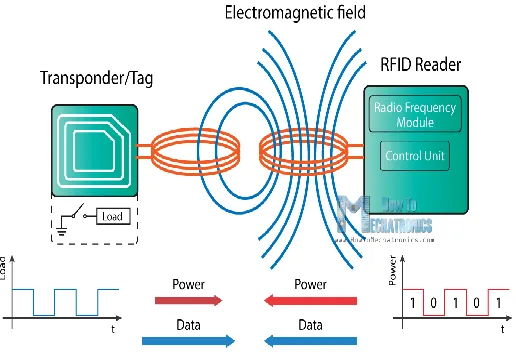
Figure 3: RFID Basic Operation.
ATM cards, security control of selected rooms or buildings, time and attendance cards, factory floor data collection cards, driver's licenses, mass transits tickets, airline tickets and many more. Magnetic stripe is basically a row of tiny magnets. The data entered is encoded to the media by setting the polarities of these magnets. In order to do this, a
reader must detect the changes in the polarity in the magnets. A barcode is an optical machine-readable representation of data, which shows certain data on certain products. Barcodes can be read by optical scanners called barcode readers, or scanned from an image by special software.
The contact less smart card or RFID technology overcome the demerits of bar codes ,dirty or damaged bar code is difficult to read also barcodes can store a limited amount of information. Barcode must be changed as every time when information are modified. Barcode and barcode reader require line of sight communication. Another advantage of RFID system is that they don‟t require line of sight communication RFID tags can be read very quickly. Also the tags can be read in all types of environment such as dirt, ice, snow, fog and other harsh conditions.
Existing System:
In the previous design the Smart card is interfaced with the controller to sense the information of the Smart card tag. The Smart card tag can be used by anyone and there are possibilities of misusing the cards.
Proposed system:
There has been rising demand for secure system that must be dependable and quick respond for the industries and company. RFID (Radio Frequency Identification) is one of the consistent and fast means of identify the material object.
Available online: https://edupediapublications.org/journals/index.php/IJR/ P a g e | 39 with Arduino. Arduino makes the circuit and
programming a lot easier to understand.
Paper is based upon security access and control system using RFID and Arduino with GSM module. Some of the sensors are used like IR, Gas Sensor for leakage detection. Security access system is very convenient to use at home, office and commercial buildings.
Block Diagram:
Figure 4: The Block Diagram of Proposed Method.
The proposed scheme is to develop an intelligent security system using RFID reader and tags to stop entries of unwanted persons in a critical area where only few persons are given permission to come inside. For this we are going to use RFID reader and passive tags, microcontroller (Arduino ARM), dc motors, IR sensors. In this system the RFID reader is to be fixed to the door through which we want to stop unauthorized persons. RFID reader is connected to microcontroller which is connected to motors. When a person with valid tag comes in the range of RFID reader the reader detects the tag, sends signal to microcontroller, then the microcontroller turns on the motor to open the door. After the person passes through door another motor closes the door. RFID systems operates from very low frequency(VLF) to extremely high frequency(EHF).RFID system operating in low frequency range make use of electromagnetic wave propagation to communicate their data and commands, these use passive tags. RFID systems operating in low frequency range operates on principle of near field coupling between tag and reader. Faraday‟s principle of electromagnetic induction is the basis of near field coupling (2). In near field RFID system, electromagnetic waves are transmitted by reader or interrogator which propagates outwards with spherical wave front. Tags placed within field collect some energy. Then exchange of data between tag and reader takes place. The amount of energy available at any particular point is related to distance from the transmitter as expressed as 1/d (2) where d is distance from the transmitter.
RFID tag
A Radio Frequency Identification Tag (RFID tag) is an electronic tag that exchanges data with a RFID reader through radio waves. Most RFID tags are
IR SENSOR
GAS SENSOR
RFIDSEN SOR
POWER SUPPLY
Atmel SAM3X8E
ARM Cort
ex-M3 CPU
(Arduino Duo)
LCD
Available online: https://edupediapublications.org/journals/index.php/IJR/ P a g e | 40 made up of at least two main parts. The first is an
antenna, which receives radio frequency (RF) waves. The second is an integrated circuit (IC), which is used for processing and storing data, as well as modulating and demodulating the radio waves received/sent by the antenna. A RFID tag is also known as a RFID chip. Tag is the basic building block of RFID. It consists of small silicon chip and an antenna. Silicon chip is used to store the data and antenna is used to energize the chip and communicate with reader.
RFID reader or interrogator
RFID systems can be classified by the type of tag and reader. A Passive Reader Active Tag (PRAT) system has a passive reader which only receives radio signals from active tags (battery operated, transmit only). The reception range of a PRAT system reader can be adjusted from 1–2,000 feet (0–600 m) allowing flexibility in applications such as asset protection and supervision. An Active Reader Passive Tag (ARPT) system has an active reader, which transmits interrogator signals and also receives authentication replies from passive tags. An Active Reader Active Tag (ARAT) system uses active tags awoken with an interrogator signal from the active reader. A variation of this system could also use a Battery-Assisted Passive (BAP) tag which acts like a passive tag but has a small battery to power the tag's return reporting signal. Fixed readers are set up to create a specific interrogation zone which can be tightly controlled. This allows a highly defined reading area for when tags go in and out of the interrogation zone. Mobile readers may be hand-held or mounted on carts or vehicles. The RFID reader sends a pulse of radio energy to the tag and listens for tag’s response. The tag detects this energy and sends back a response that
contains the tag’s serial number and other information as well. Implemented RFID reader having frequency of 125 KHz for this design. It reads the tags and output their information to the microcontroller.
Power conversion circuits
Power conversion circuits allow individual modules to make use of existing power supplies.
Microcontroller
Microcontroller to be used is Arduino ARM
(AtmelSAM3X8E ARM Cortex-M3 CPU). Based on
the ARM® Cortex®-M3 processor, the Microchip's SAM3X8E runs at 84MHz and features 512KB of flash memory in 2 x 256KB banks and 100KB of SRAM in 64KB +32KB banks, with an additional 4KB as NFC (NAND Flash controller) SRAM.
Its highly-integrated peripheral set for connectivity and communication includes Ethernet, dual CAN, High Speed USB MiniHost and device with on-chip PHY, high-speed SD/SDIO/MMC, and multiple USARTs, SPIs, TWIs (I2C), and one I2S.The SAM3X8E also features a 12-bit ADC/DAC, temperature sensor, 32-bit timers, PWM timer and RTC. The 16-bit external bus interface supports SRAM, PSRAM, NOR and NAND Flash with error code correction. The Microchip QTouch Library is available for the SAM3X8E for easy implementation of buttons, sliders and wheels. The device operates from 1.62V to 3.6V and is available in 144-pin QFP and BGA packages.
Gas Sensor
Available online: https://edupediapublications.org/journals/index.php/IJR/ P a g e | 41 (SnO2). When the sensor when flammable gases are
present in the environment in which the sensors conductivity with increasing concentration of combustible gas in the air increases. Use a simple circuit to convert the changes in conductivity and output signal that corresponds to the concentration of the gas.
MQ-2 gas sensor higher sensitivity to liquefied petroleum gas, propane, hydrogen, detection of gas and other combustible vapors are ideal. This sensor can detect a variety of flammable gas, is a low-cost sensor for many applications.
Character Configuration
*Good sensitivity to Combustible gas in wide range
* High sensitivity to LPG, Propane and Hydrogen
* Long life and low cost
* Simple drive circuit
Application
* Domestic gas leakage detector
* Industrial Combustible gas detector
* Portable gas detector
IR Sensor
This is a multipurpose infrared sensor which can be used for obstacle sensing, line sensing, etc. and also as an encoder sensor. The sensor provides a digital output. The sensor outputs a logic one (+3.5V) at the digital output when an object is placed in front of the sensor and logic zero (0V), when there is no object in front of the sensor. An Onboard RED LED is used to indicate the presence of an object. This IR OBSTACLE SENSOR is designed to work with
almost all ARDUINO boards and
MICROCONTROLLERs - AVR, PIC, 8051, ARM etc. Operating Voltage: 5V Adjustable Range using Preset (Potentiometer on board) Since the sensor module works on INFRARED, for obstacles with reflective surfaces (white colored), the maximum range will be higher and for non-reflective surfaces (black colored), and the maximum range will be lower. This can in turn be used for detecting white/black lines (in line follower ROBOTs) or bright/dark objects (in object identification ROBOTs)
Useful for various Robotic Applications, Room Visitor Counter Systems, etc.
Features:
· Adjustable Range using Preset (Using Potentiometer On board)
· Operating Voltage: 5V DC
· Digital Output : Logic one (+3.5V DC)
Logic zero (0V DC)
· Mounting Hole of 2.5mm diameter for Easy Mounting.
· This can in turn be used for detecting white/black lines (in line follower ROBOTs) or bright/dark objects (in object identification ROBOTs)
· Useful for various Robotic Applications, Room Visitor Counter Systems, etc.
· Compatible with ARDUINO, RASPBERRY PI, ARM, AVR, PIC, 8051, etc.
· LED Status indicators to indicate the Obstacle (RED LED) status.
Available online: https://edupediapublications.org/journals/index.php/IJR/ P a g e | 42 Here RFID reader and passive tag are the main
components used. Each passive tag has different serial number stored in chip inside the tag. The serial number is given by manufacturer. We have stored serial number information in programming; I have used here three passive tags.
Corresponding to each serial number, I have stored names of person allowed to enter the room, when they will place there card in field of reader, then door opens and name is displayed in LCD display(either valid or invalid). One card is access denied. When this card will be shown the the door does not open and “Invalid‟ message is displayed in LCD display. Here we used CO2 Sensor and IR sensor for the purpose of to detect the gas presence inside the home and human presence.
Figure: Project Implementation.
Available online: https://edupediapublications.org/journals/index.php/IJR/ P a g e | 43 Figure: Detection of Unknown one.
VI. CONCLUSION
Access security to unique identification was achieved using the RFID technique. Proper identification was possible with the help of specific 12-character (8 bit each) code embedded in RFID tags. The capture range of RFID reader was seen to be 7 cm maximum which is very convenient in application environment. Unauthorized cards were rejected with hundred percent accuracy and zero error. The door opening and closing arrangement has been successfully synchronized with RFID reading process. Such that door opens and closes with high degree of precision. Door opening and closing sequence was successfully mated with optical IR sensors to give precise results. The RFID based entry system could play a vital role in providing sensitive environments at low cost.
VII. REFERENCES
[1] Wen Yao, Chao-Hsien Chu and Zang Li, “The Use of RFID in Healthcare: Benefits and Barriers”, International Conference on RFID-Technology and Applications, June 2010,pp. 128-134
[2] Thomas McCoy, R J Bullock, PV Brennan “RFID
for Airport Security and Efficiency”, IEEE paper.pp.8/1 -8/7.
[3] Hazura H., Mardiana B., Fauziyah S.,
ZahariahM.,Hanim A.R., Siti Normi.Z, “RFID Based Laboratory Management System”, ICCTD.2009, pp.289-291.
[4] T.S. Lim, S.C. Sim and M.M. Mansor, “RFID based attendance system”, ISIEA 2009, pp. 778-782. [5] Debiao He SheraliZeadally "An Analysis of RFID Authentication Schemes for Internet of Things in
Healthcare nvironment Using Elliptic Curve
Cryptography" <em>IEEE INTERNET OF THINGS JOURNAL</em> vol. 2 no. 1 FEBRUARY 2015. [6] P. Tuyls L. Batina "RFID-tags for anti-counterfeiting" <em>Proc. Topics Cryptol.(CT-RSA)</em> pp. 115-131 2006.
[7] C. Schnorr "Efficient identification and signatures
for smart cards" <em>Proc. Adv.
Cryptol.(CRYPT089)</em> pp. 239-252 1989.
[8] Y. Lee L. Batina I. Verbauwhede "Untraceable RFID authentication protocols: Revision of EC-RAC" <em>Proc. IEEE Int. Conf. RFID</em> pp. 178-185 2009.
[9] Ton van
DeursenSasaRadomirovic<em>Untraceable RFID
protocols are not trivially composable: Attacks on the revision of EC-RAC</em>.
[10] J. Wolkerstorfer "Is elliptic-curve cryptography suitable to secure RFID tags?" <em>Proc. Workshop RFID Light-Weight Cryptogr.</em> 2005.
[11] Yalin Chen Jue-Sam Chou Cheng-Lun Wu Chi-Fong Lin <em>Identifying Large-Scale RFID Tags Using Non-Cryptographic Approach</em>.
[12] Mandeep Kaur Manjeet Sandhu Neeraj Mohan Parvinder S. Sandhu <em>RFID technology Principles Advantages Limitations & Its Applications</em>. [13] Patrik Fuhrer Dominique Guinard<em>Building a Smart Hospital using RFID technologies</em>.
[14] Elisabeth Ilie-ZudorZsoltKemeny Peter Egri Laszlo Monostori<em>The RFID technology and its current applications</em>.
[15] Trupti Lotlikar Rohan Kankapurkar Anand