SELECTION FOR INCREASED MUTATION RATES WITH
FERTILITY DIFFERENCES BETWEEN MATINGS
K. E. HOLSINGER, M. W. FELDMAN AND L. ALTENBERG Department of Biological Sciences, Stanford University, Stanford, Calqornia 94305-2493
Manuscript received June 14, 1985
Revised copy accepted November 21, 1985
ABSTRACT
Previous studies of mutation modification have considered models in which selection is a result of viability differences that are sex symmetric. T h e results of a numerical study of a model in which selection is a result of fertility differ- ences between mated pairs demonstrate that the type of selection t o which a population is subject can have a significant impact on the evolution of various parameters of the genetic system. When the fertility of matings between individ- uals with different genotypes exceeds the fertility of a t least some of the matings between individuals with the same genotype, selection may favor increased rates of mutation, in contrast to the results from all exisitng constant viability models with random mating and infinite population size. Increased mutation rates are most frequently favored when forward and back mutation occur a t approxi- mately equal rates and when the modifying locus is loosely linked t o the selected
iocus. We present one example in which selection favors increased rates of mutation even though the selection scheme is reducible t o one of differential viability between the sexes.
HE genetic system of an organism may be defined as all those features
T
that control the expression of hereditary variability in the population,but especially its breeding system and cytogenetic characteristics. It has been recognized for many years that various features of the genetic system are themselves under hereditary control and that their characteristics may evolve
in response to selection. C. D. DARLINGTON, for example, argued that selection
results in genetic systems that control the variability in natural populations in a way that is beneficial to those populations. On that basis he explained much of the great variety in chromosome number and morphology as a consequence of selection for certain patterns of population variability (see especially DAR- LINGTON 1939, 1958). Others, including in particular KENNETH MATHER (1943, 1953), adopted and extended these ideas, concluding that the genetic system of an organism is a result of the balance between selection for imme-
diate adaptation and long-range flexibility (see also THODAY 1953; GRANT
1958; STEBBINS 1958). In recent years the genetic system has been understood
to include such properties as mutation and recombination rates, level and type
of inbreeding, sex-ratio and sex determination, as well as level of gametic
dispersal (e.g., see MAYNARD SMITH 1978).
910 K. E. HOLSINGER, M. W. FELDMAN AND L. ALTENBERG
Much of the recent discussion of the evolution of genetic systems takes as
its point of departure a model proposed by NEI (1967, 1969) for the genetic
control of recombination. This model took two linked genes to be under
selection while the linkage between them was controlled by a third selectively
neutral locus. Some special examples of viability selection regimes in NEI’S
model were used by FELDMAN (1972), who phrased the evolutionary question
as one of initial increase. When the modifier locus is fixed on an allele, e.g.,
M I , such that M l M l produces a recombination fraction T I , and the population
is near an equilibrium (that depends on r , ) of the two-locus system, it has been
shown that an initially rare modifying allele M2, producing a heterozygote
recombination fraction r2, will invade the population if r2
<
T I and will be lost if r2>
r l .Subsequently, there have been a number of studies of the evolution of
neutral modifiers in terms of the initial increase of a new modifying allele that
affects recombination rate (FELDMAN 1972; FELDMAN and BALKAU 1972; KAR-
LIN and MCGREGOR 1974; TEAGUE 1976; CHARLESWORTH, CHARLESWORTH
and STROBECK 1977, 1979; FELDMAN, CHRISTIANSEN and BROOKS 1980; HOL- SINGER and FELDMAN 1982, 1983a), mutation rate (KARLIN and MCGREGOR
1974; GILLESPIE 198 la,b; HOLSINGER and FELDMAN 1983b; LIBERMAN and
FELDMAN 1985), migration rate (BALKAU and FELDMAN 1973; KARLIN and MCGREGOR 1974; TEAGUE 19’77; ASMUSSEN 1983) and level of segregation
distortion (PROUT, BUNDGAARD and BRYANT 1973; HARTL 1975; THOMSON
and FELDMAN 1976; LIBERMAN 1976).
A general result derived from these models is what we call the “reduction
principle.” This assumes that there is random mating, viability selection on the major loci that is the same in both sexes, a single modified parameter (for example recombination or mutation, but not both) and initial homozygosity at the modifier locus. Then, the principle states that a new allele at the modifier locus, introduced near an equilibrium (of the major loci) that is a function of
the modified parameter, will increase when rare if it reduces the rate of the
process it modifies. For mutation, a more general form of the reduction prin-
ciple has recently been proved by LIBERMAN and FELDMAN (1985), who dem-
onstrated that a new allele at a locus that controls the mutation rate at a locus
undergoing viability selection will increase when rare only if it reduces the
average mutation rate at that locus (see also HOLSINGER and FELDMAN 1983b).
Exceptions to this general rule have been demonstrated when the modifier modifies its own transmission, as with segregation modifiers, when mating is
not at random [for recombination modifiers, see CHARLESWORTH, CHARLES-
WORTH and STROBECK (1979) and HOLSINGER and FELDMAN (1983a); for mu-
tation modifiers see HOLSINGER and FELDMAN (1983b)], when selection varies
from generation to generation (CHARLESWORTH 1976; GILLESPIE 198 1 a) or
when the population size is finite (GILLESPIE 1981b).
randomly mating population at a locus subject to viability selection that is the same in each sex. In this case the dynamical system describing how genotype frequencies change from generation to generation can be reduced to recursions describing gamete frequency changes. T h e parental and offspring types are gamete types. T h e genotype at the modifier locus completely determines the fidelity with which gametes are transmitted from parent to offspring; one genotype may allow no mutation at the selected locus, and another may allow some fraction of the alleles at the selected locus to mutate to another allele. In this case, the genotype at the modifier locus completely determines the fidelity of transmission, and we expect selection for reduced mutation rates, as
has been demonstrated (KARLIN and MCGREGOR 1974; HOLSINGER and FELD-
MAN 198313; LIBERMAN and FELDMAN 1985). On the other hand, if both mu-
tation and recombination were acting on the selected loci, a modifier that affected recombination alone would not completely control the fidelity of par- ent-to-offspring transmission. This is a case where reduction may be violated (FELDMAN, CHRISTIANSEN and BROOKS 1980).
When reproduction occurs entirely by self-fertilization, the dynamical system
cannot be reduced to gamete frequency changes. T h e parental and offspring
types, therefore, are genotypes, not gamete types. T h e genotype at the modi- fier locus no longer completely determines the fidelity of transmission. T o see this, consider an individual that is heterozygous at the selected locus and has a modifier genotype that allows no mutation at the selected locus. Even though the gamete types will be perfectly transmitted, the genotype at the selected locus will not be. T h e heterozygote parent will leave both homozygous and heterozygous progeny. Thus, we expect that there can be selection for in- creased mutation rates under certain circumstances, as has been demonstrated (HOLSINGER and FELDMAN 1983b).
When selection occurs as a result of fertility differences between matings, the genotype at a locus controlling mutation or recombination rates does not completely control the transmission from parent to offspring. That is, we must study the dynamics in terms of genotypes, but the genotype of an offspring may be different from that of either of its parents. Thus, we might also expect departures from the reduction principle in this case. We present here the
results of a numerical study of genetic modification of mutation rate when the
major locus is under fertility selection. We show that, with constant fertilities and random mating, selection for increased mutation rate may occur. This includes one example that can be reduced to a viability selection scheme in which the viabilities differ between the sexes. In addition, selection for in- creased rates of mutation is more likely to occur if forward and back mutation rates are equal than if the mutation rate in one direction is much greater. Finally, selection for increased rates of mutation occurs more frequently when
the modifying locus is only loosely linked to the locus whose mutation rate it
controls than when it is tightly linked. These results differ markedly from the known theory when selection is a result of viability differences.
THE MODEL
Consider two loci with two alleles each: Ala and M / m . Selection acts through
912 K . E. HOLSINGER, M. W. FELDMAN AND L. ALTENBERG
depends only on the parental genotypes at the A locus, i.e., the M locus is
selectively neutral. T h e genotype at the M locus determines the mutation rate
at the A locus. In M M genotypes the mutation rate from A to a is and from
a to A is v I . T h e corresponding rates for Mm and mm are ~ 2 , U P and ~ 3 v3, ,
respectively. If all v, = 0, the model is one of unidirectional mutation; if p, =
U,, we call it symmetric mutation. Recombination occurs between the A and M
loci with frequency r.
Imagine that the population is at a stable equilibrium, x*, with A and a in
a mutation-selection balance and the modifier locus fixed on one allele, e.g.,
M. A small amount of the alternative mutation-controlling allele, m , is intro-
duced, and we are interested in whether this new allele increases in frequency
when rare. This corresponds to a local stability analysis of x * in the full ten-
dimensional genotype-frequency space. For the stability of x* to the introduc-
tion of m , an evaluation of the largest eigenvalue of a very complicated 4x4
matrix is required. We have, therefore, chosen to study this problem numer- ically.
Iterations of the recursions described in the APPENDIX were begun with
random initial frequencies, except that the modifying locus was fixed on the
allele that corresponded to a mutation rate of p1 at the selected locus. Itera-
tions were allowed to continue until the maximum absolute deviation between
two successive sets of genotype frequencies was less than A random
perturbation from this state on the order of 1% was made to simulate the introduction of a new allele at the modifying locus. Iterations were then al- lowed to continue for a predetermined number of generations, sufficient to
determine whether or not the new allele was being eliminated. Between 5,000
and 25,000 iterations were usually required, but occasionally as many as 100,000 iterations were necessary to be certain of the fate of the new allele.
Each iteration required a total of approximately 1000 floating point operations,
and a single run of 5000 iterations required approximately 1% hr on a PDP
11/34 computer. T h e mutation rates were chosen to be unrealistically large
so that changes in frequencies could be detected within this time. All compu-
tations were in double precision (approximately 17 decimal digits of accuracy).
In view of the time involved, only a relatively small number (approximately 80) fertility matrices could be studied. Nevertheless, since we report a variety of different dynamic behaviors from this set, it seems unlikely that the quali- tative conclusions of the study would be altered by consideration of a greater number.
For simplicity, only cases in which p1
>
p2>
p3 or p1<
11.2<
p3 wereconsidered. Since we are concerned only with initial properties, when pl is the
initial mutation rate, p~g does not play a role; that is, in order to determine the
direction in which selection will initially tend to move the population, consid-
eration of the mutation rate in the rare homozygote is unnecessary.
RESULTS
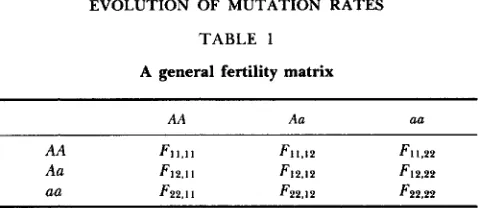
In the following discussion it will be useful to consider a general fertility
TABLE 1
A general fertility matrix
AA Aa aa
as a sum of a male virility component, mkl, and a female fecundity component,
J,,
then the model is one of additive fertilities. Similarly, if the Frj,kl7s can beexpressed as the product of mkl’s and Jj’s, the model is one of multiplicative
fertilities. Finally, if Frj,kl = Fk1.g the model is said to be sex symmetric. BODMER
( 1 965) and FELDMAN, CHRISTIANSEN and LIBERMAN (1 983) pointed out that any fertility selection model can be changed into a dynamically equivalent
model with sex symmetry by letting Fg,kl = FM,G = (Fg,kl
+
Fkl,rj)/2.Additive fertilities: BODMER (1 965) pointed out that an additive fertility model for selection at one locus with two alleles is dynamically equivalent to a model in which viability selection acts in one sex only, the other sex being
selectively neutral. FELDMAN, CHRISTIANSEN and LIBERMAN ( 1 983) extended
this principle to an arbitrary number of alleles at an arbitrary number of loci.
Thus, if a new allele is introduced at a mutation modifying locus with additive fertility selection, we would expect it to increase when rare only if it reduces the mutation rate at that locus. Numerical study of ten randomly chosen ad- ditive fertility matrices did not produce any counterexamples.
Multiplicative fertilities: BODMER (1 965) also noted that a multiplicative
fertility model for selection at one locus with two alleles is dynamically equiv- alent to a viability selection model in which the viabilities differ between the
sexes. This principle can be extended to an arbitrary number of alleles at an
arbitrary number of loci. Let the genotype of an individual be written as
ri/
y j , where y i is the haplotype received from the mother, and y j is the haplotype
received from the father. T h e mating ri/yj X yk/y1 has fertilityjj mu, and this
is the only selection in the system. Now consider a similar model in which
genotype y i / y j has viability vg in females and wg in males. In the viability model,
the frequency of the mating y,/y, X Yk/yI is vgggwklgklfif&, where gg is the
frequency of genotype y i / y j in newly formed zygotes (assumed to be equal
between the sexes),
wf =
z g vggg, and W, = z k l WkIgkl. Thus, the proportionsamong zygotes produced in this model are the same as in fertility selection
model with Fg,& = vljwkl. Therefore, by assigning the relative viabilities J j to
the females of the viability selection model and mkl to the males of the viability
selection model, we establish the equivalence between the viability selection model with different viabilities in the two sexes and the multiplicative fertility model.
Since any multiplicative fertility selection scheme can be reduced to a via- bility selection scheme, albeit with different viabilities in the two sexes, it might have been expected that there would always be selection for reduced rates of
914 K . E. HOLSINGER, M. W. FELDMAN AND L. ALTENBERG
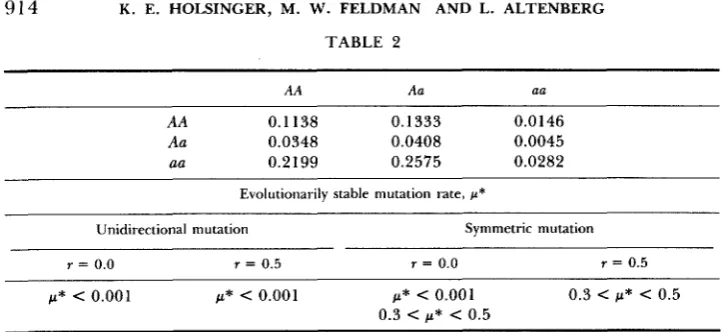
TABLE 2
AA Aa aa
AA 0.1138 0.1333 0.0 146
Aa 0.0348 0.0408 0.0045
ea 0.2199 0.2575 0.0282
Evolutionarily stable mutation rate, p*
Unidirectional mutation Symmetric mutation
r = 0.0 r = 0.5 r = 0.0 r = 0.5
p* < 0.001 p* < 0.001 p* < 0.001 0 . 3 < p* < 0 .5 0.3 < p* < 0.5
T h e values for p* are based on the fate of alleles at the modifying locus for certain initial mutation rates and are for perturbations from the polymorphic mutation-selection balance only. If only alleles that decrease the mutation rate are favored when p1 = 0.001, then p* < 0.001. If
alleles that increase the mutation rate are favored when pI = 0.001, but alleles that decrease the mutation rate a r e favored when p , = 0.01, then 0.001 < p* < 0.01. A similar interpretation applies to 0.3 < p* < 0.5. p* = 0.5 implies that alleles that alter the mutation rate when pl =
0.5 are eliminated. When two values for p* appear in the same column, the evolutionarily stable mutation rate depends on the mutation rate initially present in the population. Refer to the text for further explanation.
expectation that was found in a set of ten randomly selected multiplicative fertility matrices. There are two stable mutation-selection balance equilibria that have been found numerically for this matrix. One is a mutation-selection balance near fixation on the AA genotype. T h e other is a mutation-selection
balance near a complete polymorphism. In the first case, selection always favors
alleles at the modifying locus that reduce the mutation rate at the selected
locus. Thus, the evolutionarily stable mutation rate, p * , is 0.0 when the pop-
ulation is near fixation on the selected locus. In the second case, selection favors alleles at the modifying locus that increase the mutation rate when
= 0.3 and that decrease it if p l = 0.5, for r = 0.5 and symmetric mutation.
Thus, p* for symmetric mutation with a modifier locus that is unlinked to the
selected locus is between 0.3 and 0.5 when the population is near a complete
polymorphism at the selected locus.
With r = 0.0 and symmetric mutation, the evolutionarily stable mutation
rate depends on the mutation rate already present in the population. If pI 5
0.1, for example, only alleles that decrease the mutation rate are favored by
selection, and p* = 0. If p1 = 0.3, however, only alleles that increase the
mutation rate are favored, and 0.3
<
p*<
0.5.Sex-symmetric fertilities: In the more general case when sex-symmetric fer- tilities are considered, selection for increased rates of mutation can also occur.
When it occurs, there appears always to be a value of the mutation rate
intermediate between 0 and 1 that is evolutionarily stable. T h e value of the
evolutionarily stable mutation rate depends in a complex manner on the struc- ture of the fertility matrix, the type of mutation and the recombination fraction between the selected locus and the modifier locus.
915
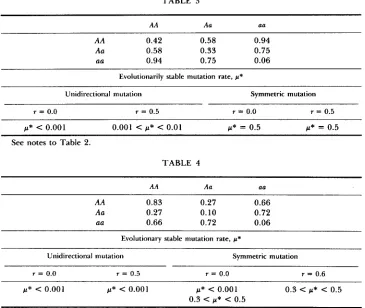
TABLE 3
AA 0.42 0.58 0.94
Aa 0.58 0.33 0.75
aa 0.94 0.75 0.06
Evolutionarily stable mutation rate, p*
Unidirectional mutation Symmetric mutation
r = 0.0 r = 0.5 r = 0.0 r = 0.5
1(* c 0.001 0.001 c U* c 0.01 U* = 0.5 U* = 0.5 See notes to Table 2.
TABLE 4
AA Aa aa
AA 0.83 0.27 0.66
Aa 0.27 0.10 0.72
aa 0.66 0.72 0.06
Evolutionary stable mutation rate, p*
Unidirectional mutation Symmetric mutation
r = 0.0 r = 0.5 r = 0.0 r = 0.6
p* < 0.001 p* < 0.001 p* c 0.001 0 .3 C p* < 0.5 0.3 < w* C 0.5
See notes for Table 2. The results in Table 4 are for perturbations from the polymorphic inutation-selection balance only. p* = 0 if perturbations are made from the mutation-selection balance near fixation on A.
for the evolutionarily stable mutation rate. All matings between individuals of
different genotypes were more fertile than were matings between individuals
of the same genotype in four of these six matrices, e.g., the fertility matrix in
Table 3. Matings between individuals of different genotypes were more fertile
than all except one of the matings between individuals of the same genotype
in the remaining two matrices. In one of these (Table 4) a homozygote X
homozygote mating was the most fertile of all. In this instance, again, there
are two stable mutation-selection balance equilibria. For perturbations from the one near fixation on AA, selection always favors reduced mutation. For perturbations from the one near complete polymorphism, selection favors in-
creased mutation when pI
<
0.5 and decreased mutation when>
0.5, forboth r = 0.0 and r = 0.5 with symmetric mutation. This suggests that the
evolutionarily stable mutation rate can be different from zero only if matings between individuals of different genotypes are more fertile than at least some of the matings between individuals of the same genotype. Although this may be a necessary condition, it is clearly not sufficient.
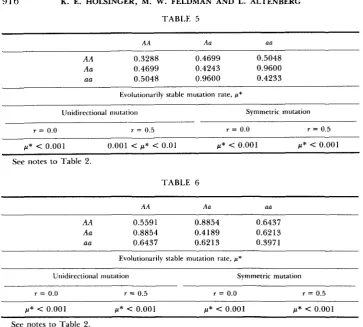
916 K. E. HOLSINGER, M. W. FELDMAN AND L. ALTENBERG
T A B L E 4
A A Aa aa
AA 0.3288 0.4699 0.5048
Aa 0.4699 0.4243 0.9600
aa 0.5048 0.9600 0.4233
~
Evolutionarily stable mutation rate, p"
Unidirectional mut.ition Symmetric mutation
r = 0.0 r = 0.5 r = 0.0 r = 0.5
p* < 0.001 0.001 < p* c 0.01 p* < 0.001 p* < 0.001
See notes to Table 2.
T A B L E 6
AA Aa aa
AA 0.5591 0.8854 0.6437
Aa 0.8854 0.4 189 0.6213
aa 0.6437 0.6213 0.3971
Evolutionarily stable mutation rate, p*
Unidirectional mutation Symmetric mutation
r = 0.0 r = 0.5 r = 0.0 r = 0.5
p* < 0.001 /d* < 0.001 p* < 0.001 p* < 0.001 See notes to Table 2.
that all matings between individuals of different genotypes be more fertile than all matings between individuals of the same genotype. An intermediate value for the evolutionarily stable mutation rate was found for only six of these 15 matrices. Thus, the evolutionarily stable mutation rate for unidirectional mu-
tation is between 0.001 and 0.01 for the fertility matrix in Table 5 when r =
0.5 and is 0.0 for the fertility matrix in Table 6, regardless of the type of
mutation or the recombination fraction between the modifier and the selected loci.
T h e fertility matrix in Table 5 also illustrates that the type of mutation can
have an effect on the value of the evolutionarily stable mutation rate. Thus,
when the modifying and selected loci are unlinked, the evolutionarily stable
mutation rate is 0.0 for symmetric mutation and between 0.001 and 0.01 for
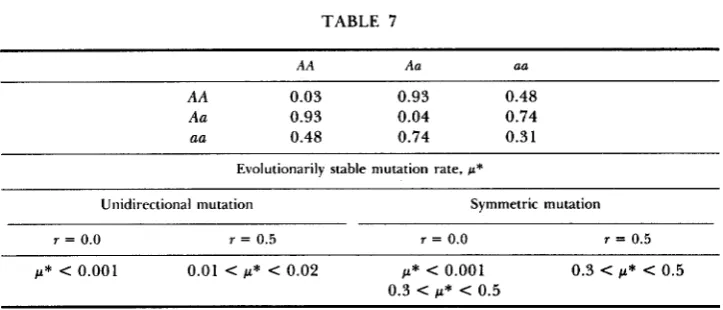
unidirectional mutation. With the fertility matrix in Table
7,
however, theevolutionarily stable mutation rate is between 0.0 1 and 0.02 for unidirectional
mutation and is 0.5 for symmetric mutation when the modifying and selected
loci are unlinked. In general, the evolutionarily stable mutation rate is higher with symmetric mutation than with unidirectional mutation. T h e one exception
we found was with the fertility matrix in Table 5.
TABLE 7
AA Aa a a
AA 0.03 0.93 0.48
Aa 0.93 0.04 0.74
aa 0.48 0.74 0.3 1
Evolutionarily stable mutation rate, w*
Unidirectional mutation Symmetric mutation
r = 0.0 r = 0.5 r = 0.0 r = 0.5
p* c 0.001 0.01 c p* c 0.02 p* c 0.001 0.3 C p* C 0.5
0.3 < p* < 0.5
~~
See notes to Table 2.
mutation rate depends on the recombination fraction. With complete linkage,
the evolutionarily stable mutation rate is 0.0 for both unidirectional and sym-
metric mutation. (With symmetric mutation and r = 0.0, p* = 0.0 only if the
mutation rate originally present in the population is not too great.) With free
recombination, the evolutionarily stable mutation rate is between 0.0 1 and
0.02 for unidirectional mutation and is 0.5 for symmetric mutation. In all cases
examined, the evolutionarily stable mutation rate increases, or at least does not decline, as the linkage between the modifying and selected loci is weak- ened.
DISCUSSION
Several examples now exist to illustrate that the mating system of an orga- nism can have a dramatic impact on the fate of alleles at a neutral locus that controls mutation or recombination rates at other loci subject to viability se- lection. Thus, with random mating, only alleles at a modifier locus that reduce the recombination rate between two loci subject to viability selection are fa-
vored by selection (FELDMAN 1972; FELDMAN, CHRISTIANSEN and BROOKS
1980). Similarly, only alleles that reduce the mutation rate at a viability selected
locus are favored with random mating (KARLIN and MCGREGOR 1974; HOL-
SINGER and FELDMAN 1983b; LIBERMAN and FELDMAN 1985). However, both of these results can be reversed for certain viability regimes when the popu- lation reproduces by a mixture of self-fertilization and random mating (CHARLESWORTH, CHARLESWORTH and STROBECK 1979; HOLSINGER and FELD-
MAN 1983a,b).
We have demonstrated here that the type of selection to which a population is subject can also have an important impact on the evolution of mutation rates and, we conjecture, on the evolution of other parameters of the the genetic system as well. Specifically, when selection is a result of fertility differences or viability differences that are not sex symmetric, the evolutionarily stable mu- tation rate need not be zero as it is in all constant viability, infinite population
size models with random mating that have been studied to date (KARLIN and
918 K. E. HOLSINGER, M. W. FELDMAN AND L. ALTENBERG
ERMAN and FELDMAN 1985). If the fertility of matings between individuals with different genotypes is greater than that of some of the matings between indi- viduals with the same genotype, the evolutionarily stable mutation rate may be
at some value intermediate between 0 and 1.
Although the dynamics of mutation modification are quite complex, certain
general patterns have emerged. T h e evolutionarily stable mutation rate will
apparently be different from zero only if all matings between individuals with different genotypes are more fertile than at least some of the matings between individuals with the same genotype. This is analogous to the result for complete
self-fertilization with viability selection (HOLSINGER and FELDMAN 1983b). In
that case the evolutionary stable mutation rate was positive for some patterns of overdominance. In these situations, mutation increases the frequency of the most viable genotype. Mutation in the model considered here increases (or at least does not decrease) the diversity of genotypes produced from any mating. When matings between different genotypes are more fertile than matings be-
tween the same genotypes, individuals with a high mutation rate will tend to
have offspring that are more fecund than those of individuals with lower mutation rates. This condition, however, is only necessary, not sufficient. Fur-
thermore, the evolutionarily stable mutation rate is more likely to be different
from zero if the linkage between the modifying locus and the selected locus is loose rather than tight and if the mutation is symmetric rather than unidirec- tional. We did illustrate one example in which the evolutionarily stable muta- tion rate was higher for unidirectional mutation than for symmetric mutation. T h e type of mutation-selection balance at the selected locus may also deter- mine the evolutionarily stable mutation rate. If the mutation-selected balance is near a fixation state at the selected locus, the evolutionarily stable mutation rate is zero. If the mutation-selection balance is near a polymorphic state, the evolutionarily stable mutation rate may be different from zero.
When selection is a result of viability differences between genotypes, the
mean fitness is a decreasing function of the mutation rate (KARLIN and Mc-
GREGOR 1974; HOLSINGER and FELDMAN 1983b), so that selection for de- creased mutation rate corresponds to increasing the mean fitness, regardless of linkage. T h e analogous principle does not hold when selection is a result of
fertility differences between matings, at least for tight linkage. For the fertility
matrix in Table
2
with symmetric mutation and pl = 0.5, the mean fertility is0.0875. With pl = 0.02, the mean fertility is 0.0858, yet only alleles that
decrease the mutation rate are favored when r = 0. This may not be too
surprising when we realize that the mean fertility does not necessarily increase
from generation to generation in fertility selection models (POLLAK 1978).
Clearly, these results suggest that evolutionists should interpret carefully the results of population genetic models with purely sex-symmetric viability selec- tion, bearing in mind that the predictions could be reversed if a different sort of selection scheme were modeled. It was already known that the dynamics and equilibrium structure of fertility models could be quite different from
those of viability selection models (HADELER and LIBERMAN 1975; FELDMAN,
919
selection and sex-asymmetric viability selection can cause at least some of the parameters of the genetic system to evolve in a direction opposite to that predicted from consideration of sex-symmetric viability selection alone. It is natural to speculate that modifiers of linkage between major genes under
fertility selection (FELDMAN and LIBERMAN 1985) may also evolve to increase
recombination.
This research was supported in part by National Institutes of Health grants GM28016 and
G M 10452.
LITERATURE CITED
ALTENBERG, L., 1984 A generalization of theory on the evolution of modifier genes. Ph.D.
ASMUSSEN, M. A., 1983 Evolution of dispersal in density regulated populations: a haploid model.
BALKAU, B. J. and M. W. FELDMAN, 1973 Selection for migration modification. Genetics 7 4
BODMER, W. F., 1965 Differential fertility in population genetics models. Genetics 51: 41 1-424.
CHARLESWORTH, B., 1976 Recombination modification in a fluctuating environment. Genetics
Effects of selfing on selection
Selection for recombination in Dissertation, Stanford University, Stanford, California.
Theor. Pop. Biol. 23: 281-299.
17 1-1 74.
83: 181-195.
CHARLESWORTH, D., B. CHARLESWORTH and C. STROBECK, 1977
CHARLESWORTH, D., B. CHARLESWORTH and C. STROBECK, 1979
DARLINGTON, C. D., 1939
for recombination. Genetics 93: 237-244.
partially self-fertilizing populations. Genetics 93: 237-244.
bridge, England. DARLINGTON, C. D., 1958
FELDMAN, M. W., 1972
FELDMAN, M. W. and B. BALKAU, 1972
FELDMAN, M. W., F. B. CHRISTIANSEN and L. D. BROOKS, 1980
FELDMAN, M. W., F. B. CHRISTIANSEN and U. LIBERMAN, 1983
FELDMAN, M. W. and U. LIBERMAN, 1985
GILLESPIE, J. H., 1981a
GILLESPIE, J. H., 1981b
The Evolution of Genetic Systems. Cambridge University Press, Cam-
The Evolution of Genetic Systems. Ed. 2. Basic Books, New York. Selection for linkage modification. I. Random mating populations. Theor.
Some results in the theory of three gene loci. pp. 357-
Evolution of recombination in a Pop. Biol. 3: 324-346.
383. In: Pofiulution Dynumics, Edited by T. N. E. GREVILLE. Academic Press, New York.
constant environment. Proc. Natl. Acad. Sci. USA 77: 4838-4841.
O n some models of fertility
A symmetric two-locus fertility model. Genetics 109:
Mutation modification in a random environment. Evolution 35: 468-
selection. Genetics 105: 1003-1010.
229-253.
476.
Evolution of the mutation rate at a heterotic locus. Proc. Natl. Acad. Sci. USA 7 8 2452-2454.
GRANT, V., 1958 T h e regulation of recombination in plants. Cold Spring Harbor Symp. Quant.
Selection models with fertility differences. J. Math. Biol. Biol. 23: 337-363.
2: 33-39.
HADELER, K. P. and U. LIBERMAN, 1975
920
HOISINGER, K. E. and M. W. FELDMAN, 1982
K. E. HOLSINGER, M. W. FELDMAN AND L. ALTENBERG
T h e evolution of recombination in permanent translocation heterozygotes. Theor. Pop. Biol. 22: 278-297.
HOLSINGER, K. E. and M. W. FELDMAN, 1983a Linkage modification with mixed random mating
Modifiers of mutation rate: evolutionary optimum
Towards a theory of the evolution of modifier genes. Theor. and selfing: a numerical study. Genetics 103: 323-333.
HOLSINCER, K. E. and M. W. FELDMAN, 198313
with complete selfing. Proc. Natl. Acad. Sci. USA 80: 6732-6734.
Pop. Biol. 5: 59-103.
Pop. Biol. 10: 127-132.
LIBERMAN, U. and M. W. FELDMAN, 1985
ciple. Theor. Pop. Biol. In press. KARLIN, S. and J. MCGRECOR, 1974
LIBERMAN, U , 1976 Modifier theory of meiotic drive: is Mendelian segregation stable. Theor.
Modifiers of mutation rate: a general reduction prin-
MATHER, K., 1943 MATHER, K . , 1953
MAYNARD, SMITH, J . , 1978
land. NEI, M., 1967
NEI, M., 1969
Polygenic inheritance and natural selection. Biol. Rev. 18: 32-64.
T h e genetical structure of populations. Soc. Exp. Biol. Semin. Ser. 7: 66-95.
The Evolution of Sex. Cambridge University Press, Cambridge, Eng-
Modification of linkage intensity by natural selection. Genetics 57: 625-642.
Linkage modification and sex differences in recombination. Genetics 63: 681-
With selection for fecundity the mean fitness does not necessarily increase.
Population genetics of modifiers of meiotic drive. I. T h e solution of a special case and some general implications. Theor. Pop. Biol. 4:
Longevity, habitat, and release of genetic variability in the higher plants.
A result on the selection of recombination altering mechanisms. J. Theor.
A model of migration modification. Theor. Pop. Biol. 12: 86-94. 699.
POLLAK, E., 1978
Genetics 90: 383-389.
PROUT, T., J. BUNDCAARD and S. BRYANT, 1973
446-465.
SI'E:HRINS, G. L., 1958
Cold Spring Harbor Symp. Quant. Biol. 23: 365-378.
Biol. 59: 25-32.
T E A C U E , R., 1976
TEACUE, R., 1977
THODAY, J. M., 1953
THOMSON, G. J. and M. W. FELDMAN, 1976
Components of fitness. Symp. Soc. Exp. Biol. 7: 96-113.
Population genetics of meiotic drive. 111. Equilibrium analysis of a general model for the genetic control of segregation distortion. Theor. Pop. Biol.
10: 10-25.
Communicating editor: B. S. WEIR
APPENDIX: DESCRIPTION OF THE RECURSIONS USED IN THE NUMERICAL STUDY
To write explicit recursions for how the genotype frequencies in o n e generation depend on those in t h e preceding generation would require calculation o f t h e frequency o f 100
different possible niatings a n d an analysis o f the frequency o f each o f the ten genotypes produced by each mating. W e used t h e following indirect method for determining how genotype frequencies in o n e generation depend o n those in t h e preceding generation:
1 . Calculate (for given r , g,, a n d v,) t h e segregation table according t o the formulas in T a b l e 8 . Let R,,k b e t h e fraction o f gametes o f type k produced by genotype ~ J Y , . Consider the mating between a female of genotype y , / ~ , a n d a male o f genotype Yk/Yl. A fraction
.I
B
$
E
4
3
;
2
s
M S E Y m B w e 4 Em
--
a
01
2 1
z
*E
.s
*k
x
E
E I
e I
E I
+
-e
v
h v
3
0 0 91mc
I m 0 + m :INs
s mf
h
L
-e
v
I 3
2 e v
+
f a hI $
4
0 0 I Q 4 + m 0 - m I E l m I ;m 2 E3
+
h
v
s +
- 1
v
3
7
:
b h:
9 eI 3 I
3 v
v
h h
h
-
2 II
a
- -
3 ve
v
L ea -E 3
$1
I+
4
s , m . I 1 . ( + / I I 0 . I I O . I O O 0v
+
Ik
9 a
e
3
v
h
f
+
I-
a e v h
%
s +
Iz m
9+ I m
z + m k E l m 0 0 0h
h
- 1 3 x
e 2 2
I I
e
v
e
v
k 2 r :
r:
r:
$ 2r:
E Efi
i 4 3 4
fi
3 4
fi
4 g
fi
922
where xB is the frequency of the genotype y,/~, (assumed equal between the sexes), and its fertility is F+.
2. For each possible mating calculate the fraction of progeny that are of each genotype ;ind accumulate these genotypic proportions across the possible matings, assigning to each mating a weight corresponding to the frequency with which it occurs multiplied by its fertility.
K . E. HOLSINGER, M. W. FELDMAN AND L. ALTENBERG