An Iterative Multiuser Detector for Turbo-Coded
DS-CDMA Systems
Emmanuel Oluremi Bejide
Department of Electrical Engineering, University of Cape Town, Private Bag, Rondebosch 7701, South Africa Email:[email protected]
Fambirai Takawira
School of Electrical, Electronic & Computer Engineering, University of KwaZulu-Natal, Durban 4041, South Africa Email:[email protected]
Received 1 October 2003; Revised 9 October 2004
We propose an iterative multiuser detector for turbo-coded synchronous and asynchronous direct-sequence CDMA (DS-CDMA) systems. The receiver is derived from the maximum a posteriori (MAP) estimation of the single user’s transmitted data, condi-tioned on information about the estimate of the multiple-access interference (MAI) and the received signal from the channel. This multiple-access interference is reconstructed by making hard decisions on the users’ detected bits at the preceding iteration. The complexity of the proposed receiver increases linearly with the number of users. The proposed detection scheme is compared with a previously developed one. The multiuser detector proposed in this paper has a better performance when the transmitted powers of all active users are equal in the additive white Gaussian noise (AWGN) channel. Also, the detector is found to be resilient against the near-far effect.
Keywords and phrases:iterative decoding, multiuser detection, wireless communication, code-division multiple access, turbo codes.
1. INTRODUCTION
A significant amount of work has been done on the devel-opment of multiuser detectors (MUD) for CDMA since the publication of the novel work of Verd ´u [1]. The main focus of work on MUD development has been the search for sub-optimal detectors because the optimum receiver of [1] has an implementation complexity that increases exponentially with the number of users.
Suboptimal detectors that have been reported in the lit-erature can be classified as linear or nonlinear detectors [2]. In linear multiuser detection, linear filters are used in pro-cessing the received signal in order to extract the signal of the user of interest and suppress the multiple-access interference. Nonlinear multiuser detection involves the subtraction of the estimate of the multiple-access interference from the received signal [2,3].
Realizing that error correction coding alone cannot re-move the effects of the multiple-access interference eff ec-tively, a lot of emphasis is now being placed on designing multiuser detectors for channel-coded CDMA systems. A pi-oneering work in this respect is the work of Giallorenzi and Wilson [4] where the optimum detector of [1] is combined with convolutional decoding. The complexity of the receiver
of [4] increases exponentially with the product of the num-ber of users and the constraint length of the convolutional encoder. Some suboptimal implementations of the receiver of [4] were proposed in [5].
The advent of turbo codes [6] and the generalization of the “turbo principle” in many aspects of digital com-munication [7] have inspired the development of many “it-erative” multiuser detectors. In [8], the “super-trellis” of the joint convolutional-coded and the time-varying CDMA-coded system was traced based on the maximum a posteriori (MAP) criterion. This is in contrast to the work of [4] where the Viterbi algorithm was used. The work of [8] has the same prohibitive complexity as the receiver designed in [4].
b1
Turbo encoder Spreader Modulator
b2 Turbo encoder
Spreader Modulator
bK
Turbo encoder Spreader Modulator s1(t)
s2(t)
S(t) n(t)
r(t)
sK(t)
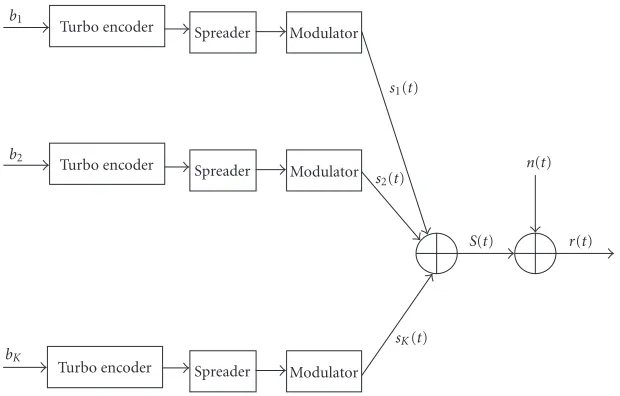
Figure1: A turbo-coded CDMA transmission system.
the received signal. The partial interference canceller of [12] was combined with turbo decoding in [13]. In a nutshell, it-erative interference cancellation (and some of its variants) has received a wide acceptance. This could possibly be due to its low level of complexity.
Our work is different from the work of [9] in that we avoided a direct subtraction of the estimated multiple-access interference from the received signal. Rather we used the es-timated multiple-access interference as added information in the MAP estimation of the transmitted bits of our user of terest. The motivation for this is that the multiple-access in-terference estimation error could lead to erroneous detection if subtracted directly from the received signal. The proposed iterative multiuser detector has a complexity that is linear with the number of users.
The rest of this paper is organized as follows. InSection 2, the CDMA system model is presented. The proposed itera-tive multiuser detector is developed inSection 3. The perfor-mance of the proposed detector is investigated by simulation for the AWGN channel inSection 4.Section 5concludes the paper.
2. SYSTEM MODEL
Turbo-coded synchronous and asynchronous BPSK mod-ulated DS-CDMA systems are considered in this paper (Figure 1). The systems transmit over the AWGN channel. In a multiple-access system, the signal transmitted by a userk
can be represented as
sk(t)=
2Pkak(t)ck(t) cos
ωct
, (1)
whereck(t)∈ {−1, +1}is the signal that represents the code bits of userk.ak(t) is the signature waveform of userkof a period equal to the coded bit intervalTb, and it is given by
ak(t)=√1
N
N−1
m=0
ak[m] rect
t−mTc
, (2)
where rect(t) denotes the rectangular chip waveform,Nis the processing gain,Tcdenotes the chip duration (Tc =Tb/N).
Pkis the power of the transmitted coded bit of userk.Pk =
REb/Tb, whereRis the coding rate andEbis the energy of the uncoded information bit.ωcis the carrier frequency.
For the synchronous system, the overall transmitted sig-nal on a common channel in a multiple-access context with
Kactive users can be expressed as
S(t)=
K
k=1
2Pkak(t)ck(t) cos
ωct
. (3)
When transmitted over an AWGN channel, the received sig-nal can be expressed as
r(t)=
K
k=1
2Pkak(t)ck(t) cos
ωct
+n(t), (4)
wheren(t) represents the AWGN with a double-sided power spectral density ofN0/2.
Without loss of generality, userhis taken as the user of interest. The received signal at the output of a filter that is matched to the signature waveform of userhis given by [14]
Uh= Tb
0 r(t)
2
Tbah
(t) cosωct
dt
=PhTbch(t) + K
k=1
k=h
PkTbck(t)Rh,k
+ Tb
0 n
(t)
2
Tbah
(t) cosωct
dt.
(5)
hand userk. The matched filter outputs are sufficient statis-tics in detecting the transmitted signal of userh[15].
For the asynchronous system, the output of the transmit-ter of a given userkis still as stated in equation (1). The re-ceived signal in an AWGN channel can be expressed as
r(t)=
K
k=1
2Pkak
t−τk
ck
t−τk
cosωct+ϕk
+n(t),
(6)
whereϕkis the phase shift of the signal of userkwith respect to a reference andτkis the time delay of the signal of userk with respect to a reference, 0≤τk≤Tb. In this case user 1’s signal could be selected as that reference and 0≤ϕk≤2π.
If we again take userhas our user of interest and ifr(t) is detected by a filter matched to the signature sequence of user
h, then the output of the matched filter can be expressed as
Uh= Tb
0 r(t)
2
Tbah
(t) cosωct
dt
=PhTbch,0
+ K
k=1
k=h
Pk
Tb
ck,−1Rh,k
τh,k
+ck,0Rh,k
τh,k
cosφh,k
+ Tb
0 n(t)
2
Tbah(t) cos
ωct
dt,
(7)
where φh,k = ϕh −ϕk.Rh,k(τh,k) = τh,k
0 ak(t−τh,k)ah(t)dt andRh,k(τh,k)=
Tb
τh,kak(t−τh,k)ah(t)dt.τh,kis the time delay
of the signal of user k with respect to the signal of user h
(i.e.,τh,k = τk−τh).ch,0represents the bit of userhat the
present instance whileck,−1represents the bit of userkat the
immediately past instance.
The turbo codes considered in this paper are composed of two recursive systematic convolutional codes (RSC) sepa-rated by a random interleaver. The coding rate is 1/3 except when variable coding rates are applied.
3. THE ITERATIVE MULTIUSER DETECTOR
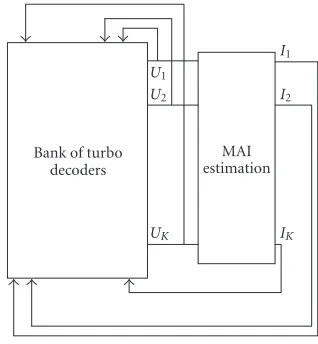
Figure 2illustrates the concept of the detector that is devel-oped in this section. The estimate of the MAI is not sub-tracted directly from the received signal. The philosophy be-hind this approach is that the estimation noise in the esti-mated MAI can bias the resultant decision statistics after the cancellation adversely. Therefore, a maximum a posteriori (MAP) estimation of the transmitted bits of the user of in-terest, given the received baseband signal and the estimate of the MAI, is done in this section. In doing this, the following parameter definitions are made. In all the definitions below, a sequence refers to components that are due to the message bit and the parity bits.
Let s represent the immediately previous state on the trellis and let srepresent the present state. Let the code bit of user h at instance j that is desired to be estimated be
Bank of turbo decoders
U1 U2
UK
MAI estimation
I1
I2
IK
Figure2: The proposed architecture.
represented as ch,j. Furthermore let the received sequence (the matched filter’s output of the user of interest) be rep-resented byY, let the received sequence associated with the immediately previous transition be represented byYj−I, let the received sequence associated with the present transition be represented byYj, and let the received sequence associ-ated with the transition immediately after the present transi-tion be represented byYj+1. Parameter jdenotes the present
instance.
The MAP algorithm performs the estimation by select-ing the value of the code bit that maximizes the probabil-ityP(ch,j|Y,I). The log-likelihood ratioL(ch,j|Y,I), stated in equation (8), is a reliable tool for this selection.Iis the se-quence of the estimated MAI. The MAI is estimated by re-constructing the second term of equation (5) by using the hard decisions on the detected bits of all other users on the channel. Let the following definition also be made about the sequence of the estimated MAI. Let the sequence of the esti-mated MAI associated with the immediately previous transi-tion be represented byIj−1, let the sequence of the estimated
MAI associated with the present transition be represented byIj, and let the sequence of the estimated MAI associated with the transition immediately after the present transition be represented byIj+1. Therefore,
Lch j|Y,I
=ln P
ch,j=+1|Y,I
Pch,j= −1|Y,I
=ln
ch,j=+1, (s,s)P
s,s,Y,I
ch,j=−1, (s,s)P
s,s,Y,I
.
(8)
P(s,s,Y,I) can be simplified using the Bayes’ rule as
Ps,s,Y,I=PYj−1,Yj,Yj+1,Ij−1,Ij,Ij+1,s,s
=PYj+1,Ij+1|s·Ps,Yj,Ij|Yj−1,Ij−1,s
·PYj−1,Ij−1,s
=βj(s)γj
s,sαj−1
s,
whereαj−1(s),βj(s), andγj(s,s) are defined as
αj−1
s=PYj−1,Ij−1,s
,
βj(s)=P
Yj+1,Ij+1|s
,
γj
s,s=Ps,Yj,Ij|s.
(10)
It can be easily shown by using the procedure similar to the one used in [16,17] that
αj(s)=
alls αj−1
sγj
s,s, (11)
βj
s=
alls
βj+1(s)γj+1
s,s, (12)
γj
s,s=PYj,Ij|Xh j
·Pch,j
, (13)
αj−1(s) is the forward recursion coefficient,βj(s) is the back-ward recursion coefficient, andγj(s,s) is the transition co-efficient. Xh j represents the code symbol of user hat the instance j. Implementing the MAP recursive algorithm as stated in equations (11) and (12) leads to a numerically un-stable algorithm [15,17]. To ensure stability, these quanti-ties must be normalized as αj(s) = αj(s)/
allsαj(s) and
βj(s)=βj(s)/
allsαj(s).
The log-likelihood ratio can, thus, be calculated from
Lch,j|Y,I
=ln
ch,j=+1, (s,s)αj−1
s βj(s)γj
s,s
ch,j=−1, (s,s)αj−1
s βj(s)γjs,s .
(14) The estimated MAI sequence and the received signal se-quence are not independent variables. They are mutually cor-related. As the number of users increases, the two sequences can be taken to have a probability density function (PDF) that is jointly Gaussian. The joint PDF of the received se-quence and the sese-quence of the estimated MAI given the transmitted coded sequence is therefore given as [18]
PYj,Ij|Xh j = n l=1 1 2πσ1σ2
√
1−r2
· exp −
Yjl−Xh jl 2
σ2 1
−2r
Yjl−Xh jl
Ijl
σ1σ2
+ I 2 jl σ2 2
1/2(1−r2)
=A·B
n l=1
exp 2YjlXh jl
σ12
+2r
Yjl−Xh jl
Ijl
σ1σ2
1/2(1−r2) , (15)
whereXh jlis thelth element of the symbol of userhat in-stance j (it is straightforward to understand that Xh j1 = ch j), Yjl is the lth element of the channel information at the jth instance, A = 1/2πσ1σ2
√
1−r2, and B =
n
l=1{[exp((−Y2jl−Xh jl2 )/σ12−I2jl/σ22)]1/2(1−r
2)
}.r stands for the value of the correlation between the received signal and the estimate of the MAI,σ2
1stands for the variance of the
re-ceived signal, andσ2
2 stands for the variance of the estimate
of the MAI.nis the number of bits in the codeword (mes-sage bit plus the parity bits). The variances are defined as
σ12 = E[(Y−E[Y])2] andσ22 = E[(I−E[I])2].r is given
asr =(E[YI]−E[Y]E[I])/σ1σ2. The variances and the
cor-relationrare computed over the coding frame length. These quantities are recomputed at each iteration. From [16], it is shown that
Pch,j
= exp −Le
ch,j
/2! 1 + exp −Lech,j!
·exp "
ch,jLe
ch,j
2 #
=Djexp "c
h,jLe
ch,j
2 #
,
(16)
whereLe(c
h,j) =∆ ln(P(ch,j = +1)/P(ch,j = −1)) andDj = (exp[−Le(c
h,j)/2]/(1 + exp[−Le(ch,j)])). Since γj(s,s) =
P(Yj,Ij|Xh j)·P(ch,j), substituting the expressions of
P(Yj,Ij|Xh j) from equation (15) and the expression of
P(ch,j) from above into equation (13) gives a new expression forγj(s,s) as
γj
s,s=ABDjexp "c
h,jLe
ch,j 2 # · n l=1
exp 2YjlXh jl
σ2 1
1/2(1−r2)
·
exp 2r
Yjl−Xh jl
Ijl
σ1σ2
1/2(1−r2) .
(17)
Sinceγj(s,s) appears both in the numerator and the denom-inator of equation (14), factorsA,B, andDjwill be cancelled out as they are independent ofch,j.γj(s,s) can then be rep-resented by
γj
s,s∼exp "
ch,jLe
ch,j 2 # · n l=1
exp 2YjlXh jl
σ2 1
1/2(1−r2)
·
exp 2r
Yjl−Xh jl
Ijl
σ1σ2
1/2(1−r2) .
r(t)
Matched filter
MUX Yj1Yj2
Yj1 Yj1
Decoder 1 Int.
Decoder 2 Deint. Deint.
Ij1 Ij3 Ij2
MUX
Estimated MAI
Figure3: Functional diagram of the proposed iterative multiuser detector.
For the case of a turbo coding with coding rate 1/3 that is considered in this paper,γj(s,s) can be represented as
γj
s,s∼exp $c
h,jLe
ch,j
2 %
· exp 2Yj1ch,j
σ2 1
+2rYj1Ij1
σ1σ2
−2rch,jIj1 σ1σ2
1/2(1−r2)
· exp 2Yj pXh j p
σ2 1
+2rYj pIj p
σ1σ2
−2rXh j pIj p σ1σ2
1/2(1−r2)
=exp $c
h,jLe
ch,j
2 %
· exp 2Yj1ch,j
σ2 1
+2rYj1Ij1
σ1σ2
−2rch,jIj1 σ1σ2
1/2(1−r2)
·χej
s,s,
(19)
whereχe
j(s,s)=(exp(2Yj pXh j p/σ12+2rYj pIj p/σ1σ2−2rXh j pIj p/
σ1σ2))1/2(1−r
2)
.
Notationpdenotes the parity component. The log likeli-hood ratio of equation (14) can then be simplified as
Lch,j|Y,I
=Lech,j
+ 2Yj1 1−r2σ2
1
− 2rIj1 1−r2σ
1σ2
+ ln
(s,s)
ch,j=+1
αj−1
sχe j
s,s βj(s)
(s,s)
ch,j=−1
αj−1
sχe j
s,s βj(s) .
(20)
This log-likelihood ratio (taken for each user) is the reliable information that is used in the estimation of the multiple-access interference sequence.
A detailed functional diagram of the iterative receiver is illustrated inFigure 3. The MAP decoder is adapted to esti-mate the coded bit instead of the information bit. That is, after the parity information has been used to estimate the message bit, the parity bit is also estimated at each decoder
with the aid of the message information component. This is done in order to avoid reencoding the decoded information sequence before the interference estimation.
After the hard decision has been made, each bit is re-spread and multiplied by the transmitted power of the in-terfering users. This power should have been estimated by an algorithm that is, however, not a subject of this paper. The estimated interference on the user of interest is the summa-tion of all the respread estimated signals from all other users:
UMAI=
K
k=1
k=j
PkTbck(t)Rh,k, (21)
ck(t) is the hard tentative decision bit of userk.
The estimated interference is input into the two compo-nent decoders through a multiplexer. The multiplexer en-sures that the estimated interference bit due to interfering information bits is sent to both decoders (with the sequence sent to the second decoder interleaved). The estimated inter-ference due to the interfering parity bits is sent to the appro-priate component decoder.
4. PERFORMANCE DISCUSSION
1.00E+ 00 1.00E−01 1.00E−02 1.00E−03 1.00E−04 1.00E−05 1.00E−06
BER
0 1 2 3
SNR (dB) Turbo IC (6 iter.)
Conv IC (5 iter.) Conv IC (8 iter.) Single user (6 iter.) Turbo IC (5 iter.)
Conv IC (4 iter.) Turbo IC (3 iter.) Conv IC (6 iter.) Conv IC (7 iter.) Turbo IC (1 iter.) Figure4: Comparison of the performance of the “turbo IC” and the conventional iterative interference canceller. Cross-correlation =0.25,K=10, frame length=200.
It should be noted, though, that in the conventional receiver, the estimated MAI sequence is subtracted from the output of the matched filter at each iteration. In the proposed receiver, the output of the matched filter remains unchanged and the MAI estimate is used as added information in the decoding algorithm.
4.1. Simulation results inK-symmetric AWGN channel
The component encoder used in all simulations in this sub-section is the recursive systematic convolutional encoder with generator polynomial (7, 5)octal. Each encoder is
sepa-rated by a random interleaver. The coding rate is 1/3. The simulations are performed for frame lengths of 200. The signal-to-noise ratio is defined asEb/N0.
For the synchronous system, we consider a synchronous CDMA channel with equal cross-correlation Rh,k between users. This is equivalent to the K-symmetric channel that was discussed in [19] and used in [11, 20, 21]. The K -symmetric channel model permits the comparison of per-formance of receivers with changes in cross-correlation val-ues. The cross-correlation between adjacent users in a DS-CDMA system is typically low. If the orthogonal Hadamard code is used, a cross-correlation value of zero could be ob-tained [19]. Using the Gold code generated from polyno-mials of ordermfor instance, a maximum cross-correlation value of (2(m+1)/2+ 1)/(2m−1) is obtained when the value of m is odd and (2(m+2)/2 + 1)/(2m −1) is obtained when the value ofmis even [22]. This translates to a maximum cross-correlation value of 0.29 for a system with a process-ing gain of 31; 0.27 for a system with a processprocess-ing gain of 63; and 0.13 for a system with a processing gain of 127. There-fore, for practical synchronous DS-CDMA applications, the value of the cross-correlation between adjacent signals is not expected to be very high. In our simulations therefore, cross-correlation values of 0.25, 0.3, and 0.35 are used.
1.00E+ 00
1.00E−01
1.00E−02
1.00E−03
1.00E−04
BER
0 0.5 1 1.5 2 2.5 3
SNR (dB) Conv. iter. IC (1 iter.) Conv. iter. IC (3 iter.)
Turbo IC (1 iter.) Turbo IC (3 iter.) Figure5: Comparison of the performance of the “turbo IC” and the conventional iterative interference canceller. Cross-correlation = 0.3,K=10, frame length=200.
1.00E+ 00
1.00E−01
1.00E−02
1.00E−03
1.00E−04
1.00E−05
BER
1 2 3
SNR (dB) 15 users
10 users Single user
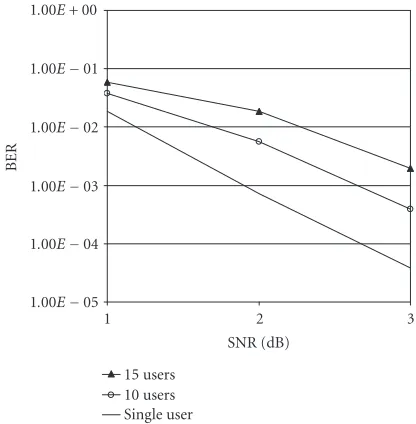
Figure6: Performance of the “turbo IC” with various numbers of users. Cross-correlation=0.3, frame length=200, 3 iterations.
Figures4and5show the comparison of the bit error rate performance of the iterative receiver developed in this pa-per and the conventional iterative interference canceller. The number of users is ten and all users have an equal power transmission. For a low cross-correlation value of 0.25, the performance of our system is better than the performance of the conventional interference canceller. The margin of im-provement in the performance of our system becomes more obvious at a higher value of cross-correlation (0.3). In fact at a cross-correlation value of 0.3, the performance of the con-ventional iterative interference canceller breaks down. This same phenomenon is observed in [11] for the conventional interference canceller with weighted MAI estimate.
1.00E+ 00 1.00E−01
1.00E−02
1.00E−03
1.00E−04
1.00E−05 1.00E−06
BER
0 0.5 1 1.5 2 2.5 3 3.5 4 4.5 5 5.5 6 6.5 SNR (dB)
1 iter. (near-far, 3.01 dB) 3 iter. (no near-far) 1 iter. (no near-far)
1 iter. (near-far, 4.8 dB) 3 iter. (near-far, 3.01 dB) 3 iter. (near-far, 4.8 dB) Figure 7: Performance of the “turbo IC” in near-far scenarios. Cross-correlation=0.3, frame length=200.
value of 0.3. The low sensitivity of the multiuser detector to channel loading is evident from the small degradation in sys-tem performance when the number of users was increased to 15. In the figures, SNR=Eb/N0in dB.
4.2. Near-far performance
The performance of the “turbo IC” in the near-far scenario is studied in this section. To perform this study, we use ten users out of which five users transmit at powers that are 3.01 dB and 4.8 dB stronger than the other five. Our user of interest is taken to be among the five “weaker” users in both cases. The cross-correlation between users is taken to be 0.3 and the frame length is 200.
Figure 7shows that the performance of the user of inter-est improves in the near-far scenario when compared with the equal-power scenario. This same phenomenon in which the performance of the user of interest in the near-far sce-nario (when the user of interest is one of the weaker transmit-ters) is better than in the equal-power scenario was observed in [9,21]. After three iterations, it can be noticed that there is only a slight degradation in the performance of the “turbo IC” as the difference in SNR between the signals of the strong and the weak interferers increases from 0 dB to 3.01 dB and finally to 4.8 dB.
4.3. Performance with variable coding rate
The performance of the proposed iterative receiver with var-ious coding rates, for systems with the same processing gain, is presented in this subsection. The variable coding rates are achieved with the aid of puncturing mechanisms.
Puncturing is a useful way of providing variable classes of service to different users in a wireless system. In transmit-ting multimedia information for instance, different data rates
1.00E+ 00
1.00E−01
1.00E−02
1.00E−03
1.00E−04
1.00E−05
1.00E−06
BER
0 2 3 5 6 8 9 11 12 14 15 SNR (dB)
Rate=2/3 Rate=1/2 Rate=1/3
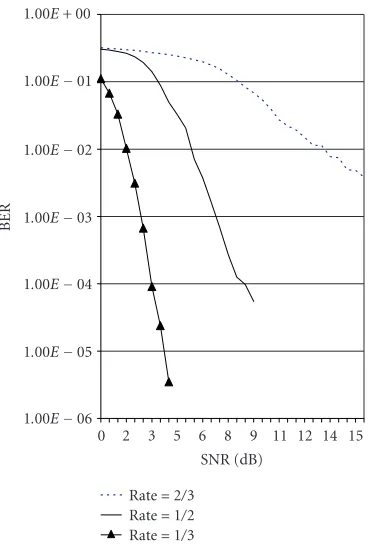
Figure8: Performance of the “turbo IC” with various coding rates. Cross-correlation=0.3, frame length=200,K=10, 5 iterations.
might be required for different types of signals. Puncturing can also be employed to differentiate classes of service by al-lowing users to transmit at different bit rates [23]. To inves-tigate the effect of variable coding rate transmission on the developed system, we ran simulations for coding rates of 1/3, 1/2, and 2/3. As it can be observed fromFigure 8, a trade-offwill have to be made between high data rates and error rate performance when puncturing is employed. It should be mentioned though that we did not try to select optimum puncturing pattern for this work. We used a uniform pattern where an equal number of parity bits were transmitted from either of the constituent encoders.
4.4. Performance in the asynchronous DS-CDMA system
We investigate the performance of the developed multiuser detector in the asynchronous DS-CDMA system in this sec-tion. Random spreading codes are used in this simulasec-tion. Figure 9shows the bit error rate performance of the devel-oped system in a turbo-coded system having a component encoder with generator polynomial (7, 5)octal. The
frame-length is 200, and the processing gains are 15 and 31, respec-tively. The number of users is ten and the number of itera-tions is three.
1.00E+ 00
1.00E−01
1.00E−02
1.00E−03
1.00E−04
1.00E−05
1.00E−06
BER
0 0.5 1 1.5 2 2.5 3 3.5 4 4.5 5 SNR (dB)
Turbo IC (PG=31) Conv. iter. IC (PG=31)
Turbo IC (PG=15) Conv. iter. IC (PG=15) Figure9: Performance of the “turbo IC” in the asynchronous DS-CDMA system for different processing gains.
5. CONCLUSION
In this paper, a low-complexity iterative interference can-celler for turbo-coded CDMA systems has been presented. The receiver was investigated in both the synchronous and the asynchronous CDMA systems. The developed receiver was compared with the receiver of [9] under various cross-correlation conditions in the AWGN channel. The perfor-mance of the proposed detector is found to be superior to that of the receiver of [9].
As the cross-correlation between users in a synchronous CDMA systems increases from 0.25 to 0.3, we observed the breakdown in performance of the detector of [9]. Our pro-posed receiver, however, continues to perform in this range of cross-correlation values, though there was some perfor-mance degradation. The proposed receiver is also found to be resilient against the near-far effect. Results when using the developed system in channel resources management (as it could be required in multimedia transmission) through vari-able coding rates are also presented.
The complexity of the proposed receiver is linear with the number of users. This level of complexity of the proposed re-ceiver and its performance makes the proposed rere-ceiver suit-able for use in CDMA systems.
ACKNOWLEDGMENTS
This work is partially funded by Telkom SA and the Alca-tel SA under the Center of Excellence programme. Dr Bejide participated in this work while he was working on his Ph.D. degree at the University of KwaZulu-Natal.
REFERENCES
[1] S. Verd ´u, “Minimum probability of error for asynchronous Gaussian multiple-access channels,”IEEE Trans. Inform. The-ory, vol. 32, no. 1, pp. 85–96, 1986.
[2] S. Moshavi, “Multi-user detection for DS-CDMA communi-cations,” IEEE Commun. Mag., vol. 34, no. 10, pp. 124–136, 1996.
[3] S. Verd ´u, Multiuser Detection, Cambridge University Press, Cambridge, UK, 1998.
[4] T. R. Giallorenzi and S. G. Wilson, “Multiuser ML se-quence estimator for convolutionally coded asynchronous DS-CDMA systems,” IEEE Trans. Commun., vol. 44, no. 8, pp. 997–1008, 1996.
[5] T. R. Giallorenzi and S. G. Wilson, “Suboptimum multiuser receivers for convolutionally coded asynchronous DS-CDMA systems,”IEEE Trans. Commun., vol. 44, no. 9, pp. 1183–1196, 1996.
[6] C. Berrou, A. Glavieux, and P. Thitimajshima, “Near Shannon limit error-correcting coding and decoding: Turbo-codes. 1,” in Proc. IEEE International Conference on Communications (ICC ’93), vol. 2, pp. 1064–1070, Geneva, Switzerland, May 1993.
[7] J. Hagenauer, “The turbo principle: tutorial and state of the art,” inProc. International Symposium on Turbo Codes and Related Topics, pp. 1–11, Brest, France, September 1997. [8] P. D. Alexander, M. C. Reed, J. A. Asenstorfer, and C. B.
Schlegel, “Iterative multiuser interference reduction: turbo CDMA,”IEEE Trans. Commun., vol. 47, no. 7, pp. 1008–1014, 1999.
[9] P. D. Alexander, A. J. Grant, and M. C. Reed, “Iterative detec-tion in code-division multiple-access with error control cod-ing,”European Transactions on Telecommunications, vol. 9, no. 5, pp. 419–425, 1998.
[10] M. M. K. Howlader and B. D. Woerner, “Iterative interfer-ence cancellation and decoding for DS-CDMA systems,” in
Proc. IEEE 50th Vehicular Technology Conference (VTC ’99), vol. 3, pp. 1815–1819, Amsterdam, The Netherlands, Septem-ber 1999.
[11] R. W. Kerr, P. S. Guinand, and M. Moher, “An iterative multi-user decoder with soft-interference cancellation,” in Proc. IEEE International Conference on Communications (ICC ’99), vol. 1, pp. 46–50, Vancouver, BC, Canada, June 1999. [12] D. Divsalar, M. K. Simon, and D. Raphaeli, “Improved parallel
interference cancellation for CDMA,”IEEE Trans. Commun., vol. 46, no. 2, pp. 258–268, 1998.
[13] K. Wu and C. Wang, “An iterative multiuser receiver using partial parallel interference cancellation for turbo-coded DS-CDMA systems,” inProc. IEEE Global Telecommunications Conference (GLOBECOM ’01), vol. 1, pp. 244–248, San An-tonio, Tex, USA, November 2001.
[14] S. Haykin,Digital Communications, John Wiley & Sons, New York, NY, USA, 1988.
[15] Z. Qin, K. C. Teh, and E. Gunawan, “Iterative multiuser de-tection for asynchronous CDMA with concatenated convolu-tional coding,” IEEE J. Select. Areas Commun., vol. 19, no. 9, pp. 1784–1792, 2001.
[16] J. Hagenauer, E. Offer, and L. Papke, “Iterative decoding of binary block and convolutional codes,” IEEE Trans. Inform. Theory, vol. 42, no. 2, pp. 429–445, 1996.
[17] W. E. Ryan, “A turbo code tutorial,”http://www.eccpage.com/ turbo2c.ps.
[19] M. Moher, “An iterative multiuser decoder for near-capacity communications,” IEEE Trans. Commun., vol. 46, no. 7, pp. 870–880, 1998.
[20] J. Hsu and C. Wang, “A low-complexity iterative multiuser receiver for turbo-coded DS-CDMA systems,” IEEE J. Select. Areas Commun., vol. 19, no. 9, pp. 1775–1783, 2001. [21] X. Wang and H. V. Poor, “Iterative (turbo) soft interference
cancellation and decoding for coded CDMA,” IEEE Trans. Commun., vol. 47, no. 7, pp. 1046–1061, 1999.
[22] D. V. Sarwate and M. B. Pursley, “Crosscorrelation properties of pseudorandom and related sequences,”Proc. IEEE, vol. 68, no. 5, pp. 593–619, 1980.
[23] F. Mo, S. C. Kwatra, and J. Kim, “Analysis of puncturing pat-tern for high rate turbo codes,” inProc. IEEE Military Com-munications Conference (MILCOM ’99), vol. 1, pp. 547–550, Atlantic City, NJ, USA, October–November 1999.
Emmanuel Oluremi Bejide received the B.S. (with honors) and the M.S. degrees in electrical and electronic engineering from the Obafemi Awolowo University, Ile-Ife, Nigeria, in 1995 and 1999, respectively. He received a Ph.D. degree in electronic engi-neering from the University of KwaZulu-Natal, South Africa, in 2004. From 1997 to 1999, he worked as a Graduate Assis-tant at the Obafemi Awolowo University. At
present, he is a Lecturer at the Electrical Engineering Department, the University of Cape Town. He teaches graduate and undergrad-uate courses on general aspects of communication engineering and wireless communications. His research interests focus on ad-vanced CDMA systems with specific focus on system-level design of multiuser detectors for the channel coding (with emphasis on turbo and turbo-like codes), the uncoded CDMA systems, space-time block (STB) -coded multiple-antenna systems, and multirate CDMA systems. He also has research interests in wireless ad hoc and sensor networks. He has published many papers in these ar-eas. He served as a reviewer for the IEEE Transactions on Vehic-ular Technology, EURASIP Journal on Applied Signal Processing, and the IEEE AFRICON Conference in 2004. He is a Track Organ-iser/Moderator for the International Conference on Telecommuni-cations (ICT) in 2005.
Fambirai Takawirareceived the B.S. degree in electrical engineering (first-class honors) from Manchester University, Manchester, UK, in 1981, and the Ph.D. degree from Cambridge University, Cambridge, UK, in 1984. He is currently the Head of the School of Electrical, Electronic & Computer Engi-neering, the University of KwaZulu-Natal, Durban, South Africa. His research inter-ests include digital communication systems