Team-based Learning: A Novel Approach to Teaching Engineering
Subjects
V. Najdanovic-Visak
Lecturer in Chemical Engineering
Engineering Department, Lancaster University Lancaster, United Kingdom
E-mail: [email protected]
ABSTRACT
Team-based learning (TBL) is a pedagogical strategy similar to the flipped classroom model which promotes the benefits of small-group teaching in a large group setting, thereby enhancing students’ engagement by increasing their accountability within peer group, and encouraging peer-to-peer learning. Although initially developed for a business school environment, TBL has recently been increasingly used within medical education. Reports on its implementation in engineering and science education are much scarcer. The aim of this work is to discuss the experience and impact of implementation of the TBL in a large group setting within year-one engineering module in Engineering Department at Lancaster.
Conference Key Areas: Engineering Education Research, Attractiveness of Engineering Education
1 INTRODUCTION
In recent years, both Europe and USA experience an increase number of students in engineering fields. At the institutional level, this is usually not accompanied by the increases in teaching resources, thus challenging student-teacher relationships as well as the way of teaching and learning, resulting in teaching engineering subjects by presenting a large amount of information to large numbers of students, which in turn promotes passive learning. Pedagogical strategies to overcome passive learning and enhance student engagement include collaborative learning [1],[2], problem-based learning [3] and enquiry problem-based learning [4].
Evidence suggests that problem-based learning (PBL) is the most widely used alternative strategy offering various benefits such as increased retention of information, an integrated knowledge base, the development of lifelong learning skills, an exposure to real-life experience at an earlier stage in the curriculum, increased student-faculty interactions, and an increase in overall motivation [5]. However, the effective implementation of the PBL in large classes, such as first-year introductory modules with typically more than one hundred students, is challenging because one tutor supervises only one group of six to ten students.
In recent years, team-based learning (TBL) has emerged as a pedagogical strategy which promotes the benefits of small-group teaching in a large group setting, thereby enhancing students’ engagement by increasing their accountability within their peer group, and encouraging peer-to-peer learning [6]. On the contrary to the traditional approach of teaching engineering subjects by presenting a large amount of information to large number of students, TBL focuses on student learning using course concepts to solve problems. TBL was originally developed for a business school environment has since been progressively used within medical and pharmaceutical education.
Despite its potential, reports on its implementation in engineering education are very scarce. Increased in-class discussion, peer-learning and attendance, as well as improved course effectiveness and students’ perception based on student evaluation was evidenced for the mechanical design elements module [7], [8]. Also, report from Monash University [9] showed that carefully engineered team-based learning was used to develop team work, collaboration, lateral thinking and problem solving as well as, the often necessary, conflict resolution. Two recent studies [10], [11] demonstrated a clear advantage of team-based learning in engineering course over informal active learning strategy. Furthermore, discussion of the experience, evaluation and lessons learned from the implementation of the TBL within module on Fundamentals of Process Engineering was discussed lately.
Team-based learning consists of four essential practices [6]: 1) permanent teams (5-7 members), 2) Readiness Assurance Process, 3) In-class activities and assignments, and, 4) peer assessment and feedback system.
students to use course content to solve problems in teams. In addition, peer assessment is essential elements of TBL aiming to avoid potential “free-riders”, enhance ability to work together effectively and motivate students to help each other.
Fig. 1. TBL – Implementation phases
1.1 Permanent teams
In TBL, one instructor simultaneously facilitates many small teams, typically 20 or more. Teams need to be large enough (typically 5 – 7 members) in order to guarantee sufficient intellectual resources to solve complex problems. It is important that instructor creates teams to get balanced and diverse teams with wide range of skills. Due to the fact that team cohesion is enhanced by time, it is essential to have permanent groups which can become high-performance learning teams.
1.2 Readiness assurance process
Readiness assurance process (RAP) is designed to motivate students and guarantee their preparation for the application problems. RAP consists of an individual and team readiness assurance tests (iRAT and tRAT). These tests are usually a multiple choice questions testing students’ understanding of the main concepts, addressing the lower Bloom’s levels of learning (knowledge, comprehension and application). iRAT might be organised as online out-of-class quiz. After, students re-take the exact same test as a team (tRAT) by coming to consensus on their answers, which assures mutual transfer of knowledge between teammates and motivation through competition with other teams.
1.3 In class application assignments
Application assignments are designed for students to put course content to use by working in teams on progressively more difficult questions, addressing higher Bloom’s levels of learning (abilities to analyse, evaluate and create) according to the so-called ‘4S’ strategy created by Michaelsen et al. [6]:
1) Significant problem – The application exercise should be meaningful and complex enough to motivate student to generate fruitful discussions within teams.
2) Same problem – All teams should work on the exact same problem which allows teams to compare their answers with answers of other teams.
3) Specific choice – Specific answer simulates a read world situation in professional environment.
4) Simultaneous reporting – Teams should report their answers simultaneously in order to encourage accountability and prevent answer drift.
1.4 Peer assessment
2 IMPLEMENTATION AND DATA COLLECTION 2.1 Implementation
Process Engineering Fundamentals is a first-year module compulsory for all engineering student (courses: chemical, nuclear, mechanical and electrical and electronics engineering), delivered at Lancaster, enrolling approximately 152 students in 2017. It an eight credit module comprising two 50-minute lectures each week in an amphitheatre and one two-hour practical session in computer room (for ten weeks). During 2016/17, students were divided into 24 teams of 6-7 members. The module was divided in three units: 1) process variables; 2) mass balances for processes without and with chemical reactions; and 3) single and multiple phase systems. The sequence of activities shown in Fig. 1 was followed for each unit. One or two traditional lectures were delivered to explain the main concepts and students were directed to individual study using previously prepared reading material which was accessible via Moodle. Next, students were asked to do online out-of-class multiple choice individual readiness assurance test in order to guarantee their preparation and understanding of main concepts. Subsequent in-class session was dedicated to Team Readiness Assurance Test which is the same test as iRAT with different numbers for students to solve within teams sharing knowledge. The resolution of test was divulgated immediately after and “mini-lecture” was given to emphasize the most difficult points. During the following sessions of the same unit, student teams were working on progressively more demanding application tasks. Thus, the same problem is distributed to all teams and responses from them are received simultaneously using active (real-time) quiz activities set in Moodle.
Assessment was performed according to following distribution: - Exam 60%;
- Average of three iRATs 20%; - Average of three tRATs 10%;
- Average of in-class application exercises 10%.
Both scores for team activities (tRAT and application exercises) were adjusted for each member of a team according to peer assessment using the so-called Fink method [6].
2.2 Data collection
Total of 107 students (48.6%) responded to the anonymous questionnaire comprising nine statements shown in Table 1 with Likert scale ranging from 1 (strongly disagree) to 5 (strongly agree). In addition, two open-ended questions on positive and negative aspects of their experiences were included.
Table 1.Statements on the questionnaire.
Statement
S1 The pre-session reading was useful in preparing for team activities.
S2 I found individual readiness assurance tests (iRAT) useful to prepare for application exercises. S3 I found team readiness assurance tests (tRAT) useful to prepare for application exercises. S4 Application exercises allowed me to apply concepts learned in pre-session readings and RAT process. S5 I learn better engineering subjects from TBL than from traditional lectures.
S6 I would prefer traditional lecturing for Process Engineering Fundamentals module S7 Team work as a method of learning is an effective method to acquire knowledge.
concepts.
S9 I enhanced my learning due to interactions with my teammates.
2.3 Results and discussion
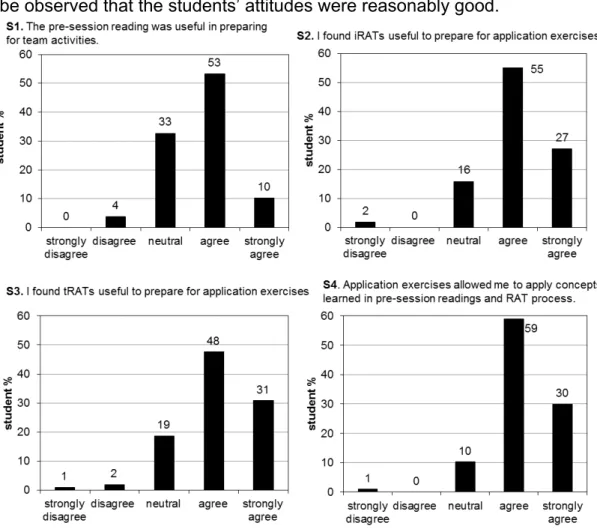
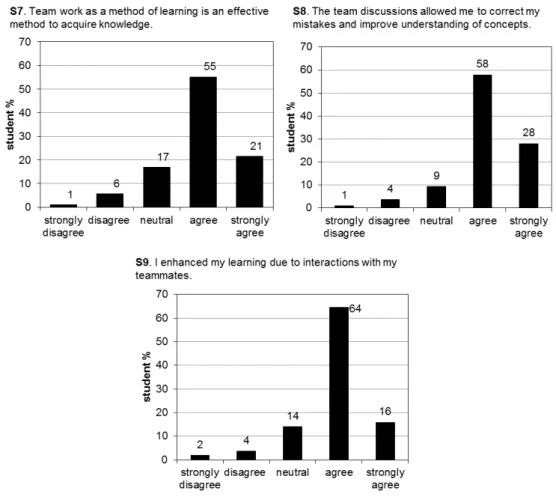
Nine statements were divided into three categories: i) Readiness assurance process (statements S1 to S4); ii) Perception of TBL vs. traditional teaching (statements S5 and S6); and, iii) Perception of significance of team work (statements S7, S8 and S9). The obtained results for each category are presented in Figures 2, 3 and 4. It can be observed that the students’ attitudes were reasonably good.
Fig. 2. Response to the statements in the readiness assurance process category.
Fig. 4. Response to the statements in the perception of significance of team work category.
The comparison of the average scores for the statements in the readiness assurance process category (Fig. 2) comprising four elements (pre-session readings, iRATs, tRATs and application exercises suggests that high percentage of the students agreed or strongly agreed that these activities allowed them to prepare and apply acquired concepts, ranging from 63% for S1 to 89% for S4. It also seems that the pre-session readings were the least useful activities compared to iRATs, tRATs and application exercises. The scores on the perception of TBL vs. traditional teaching category (Fig. 3) suggest that almost half of students agree or strongly agree that their preferred lecturing style is team-based learning for an engineering module and for Process Engineering Fundamentals. However, it should be noted that high percentage of students exhibited a neutral statement – 37% and 31% for statements S5 and S6, respectively. Agree and strongly agree statements dominated in the perception of significance of team work category, demonstrating students’ awareness that team work is important for their professional development. Furthermore, 86% of students agree or strongly agree the team discussions allowed them to correct mistakes and improve understanding of concepts while 80% agree or strongly agree that their learning was enhanced due to interactions with teammates. Interestingly, comparison of three categories shows that students are very positive in respect to all TBL activities and their learning is enhanced but they are somewhat hesitant to prefer TBL format over traditional teaching – 23% would prefer traditional and while 31% are neutral. This might be due to the fact that students encountered TBL for the first time and it takes some time to adapt.
“I was able to identify where my working differed from others in my group, and therefore learn from my mistakes.”
“When we reached different answers, the group could discuss their methods to identify problems and find the correct answer.”
“If you get something wrong your group can help you see where you went wrong.” “I could observe other people’s thought process and understand what knowledge they had based to solve a certain problem.”
Many students mentioned that their engagement was enhanced due to the TBL. Some comments include:
“It was very engaging and it kept everyone on their toes.”
“Made you attend more because it would make you feel guilty having not.” “More engaging than the standard lectures.”
“It’s a change of teaching style, it keeps us more interested for longer.”
“It made the lectures a huge amount more enjoyable, so I actually wanted to come to the lectures, rather than just feel I ought to. It was also very useful for cementing the information we had learnt.”
It is also apparent that students enjoyed all elements of the readiness assurance process, stating that answering multiple questions on each topic is helpful to consolidate what is learnt in lectures.
The most listed negative aspects were about choosing the team, peer assessment and engagement of teammates. Some students stated that they were against the teams created by instructor as they found difficult and intimidating to work with new people. Many concerns were raised about peer assessment. Students showed a lot of doubts about objectivity of peer assessment:
“Grade is dependent on our groups and can be changed solely on if someone likes you or not.”
“Our grades are affected by other people’s opinions of us. If you’re weaker at Chemistry then your grades will be affected which I feel is unfair.”
“I feel that peer assessment becomes a personality test and it is how other people view you as a person.”
“Bit worried about other people mocking me.”
Many students pointed out the problems associated with participation: sometimes members of the team didn’t turn up, putting team at disadvantage, some people were less involved in the group discussion or were not focused.
3 SUMMARY AND ACKNOWLEDGMENTS
This work was supported by the teaching development grant from the Faculty of Science and Technology, Lancaster University (2016).
REFERENCES
[1] Cabrera, A.F., Colbeck, C.L., Terenzini, P.T. (2001), Developing performance indicators for assessing classroom teaching practices and student learning: The case of engineering, Res. High. Educ., Vol. 42, pp. 327-352.
[2] Maceiras, R., Cancela, A., Urréjola, S., Sánchez, A., (2011) Experience of cooperative learning in engineering., Eur. J. Eng. Ed., Vol. 36, pp. 13-19.
[3] Harris, A.T., Briscoe-Andrews, A. S., (2008), Development of a problem-based learning elective in “green engineering”, Educ. Chem. Eng., Vol. 3, pp.15–21.
[4] Glassey, J., Novakovic, K., Parr, M., (2013), Enquiry based learning in chemical engineering curriculum supported by computer aided delivery, Educ. Chem. Eng., Vol. 8, pp. 87–93.
[5] Klegeris, A., Hurren, H. (2011), Impact of problem-based learning in a large classroom setting: student perception and problem-solving skills, Adv. Physiol. Educ., Vol. 35, pp. 408-415.
[6] Michaelsen, L.K., Knight, A.B., Fink, L.D., (2004). Team-based learning: A transformative use of small groups in higher education. Sterling VA: Stylus.
[7] Van der Loos, H.F.M., Machiel, H.F., Ostafichuk, P.M., 2009. Case Study: Application of Team-based Learning to a Mechanical Engineering Design Course Traditionally Taught in Lecture Format, in Bergendahl, M.N., Grimheden, M., Leifer, L., Skogstad, P., Ion B. (Eds.), ICED 09 - the 17th International Conference on Engineering Design 10: 171-181.
[8] Ostafichuk, P.M., Van der Loos, H.F.M., Sibley, J., (2012), Using Team-based Learning to Improve Learning and the Student Experience in a Mechanical Design Course, in Proceedings of the ASME International Mechanical Engineering Congress and Exposition 6: 405-412.
[9] Price A., Chew, M.T., Rimington, R., Demidenko, S., (2010), Meeting Engineering Learning Objectives through Team Based Creative Robot Construction, in IEEE Instrumentation and Measurement Technology Conference edited by IEEE, 835-840.
[10
] Lamm, M.H., Dorneich, M., Rover, D.T., (2014), Team-based learning inengineering classroom: feedback form and content adds value to the learning experience. ASSE Proceedings, Iowa City.
[11