Available Online atwww.ijcsmc.com
International Journal of Computer Science and Mobile Computing
A Monthly Journal of Computer Science and Information Technology
ISSN 2320–088X
IJCSMC, Vol. 3, Issue. 1, January 2014, pg.233 – 243
REVIEW ARTICLE
A Review of Numerous Facial Recognition
Techniques in Image Processing
A.Swaminathan
1, N.Kumar
2, M.Ramesh Kumar
3 1M.E Student, 2,3Asst Professor,
1, 2, 3
Department of Computer Science & Engineering,
1, 2, 3
Veltech Multitech Dr.Rangarajan Dr.Sakunthala Engineering College, Chennai, India
[email protected] 1, [email protected] 2, [email protected] 3
Abstract: Recognizing faces in images is an emerging trend of research in image processing streams. There were various systems proposed in this stream. Human emotions and intentions are communicated more often by changes in one or two discrete facial features. Given a single image, the goal of face detection is to identify all image regions which contain a face regardless of its three-dimensional position, orientation, and lighting conditions. Such a problem is challenging because faces are no rigid and have a high degree of variability in size, shape, colour, and texture. Numerous techniques have been developed to detect faces in a single image, and the purpose of this paper is to categorize and evaluate these algorithms. We also discuss relevant issues such as data collection, evaluation metrics, and benchmarking. After analysing these algorithms and identifying their limitations, we conclude with several promising directions for future research.
Keywords—Face detection; face recognition; object recognition; view-based recognition; statistical pattern recognition; machine learning
I.INTRODUCTION
a pattern classifier, the dimension of the feature space is extremely large (i.e., the number of pixels in normalized training images). The classes of face and no face images are decidedly characterized by multimodal distribution functions and effective decision boundaries are likely to be nonlinear in the image space. To be effective, either classifier must be able to extrapolate from a modest number of training samples or be efficient when dealing with a very large number of these high-dimensional training samples.
II. MULTISTATE MODELS FOR FACE AND FACIAL COMPONENTS
A. Multi- state face model
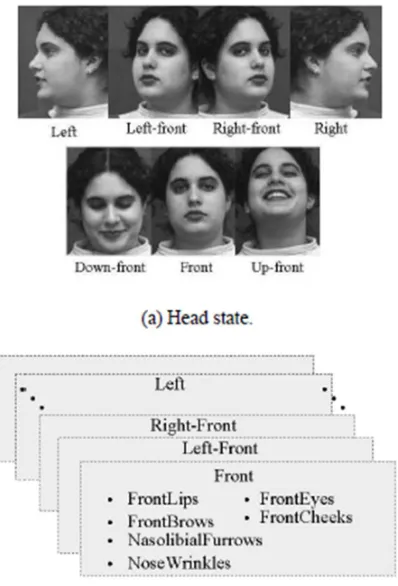
Head orientation is a significant factor that affects the appearance of a face. Based on the head orientation, seven head states are defined in Figure 1. To develop more robust facial expression recognition system, head state will be considered. For the different head states, facial components, such as lips, appear very differently, requiring specific facial component models. For example, the facial component models for a front face include Front Lips, Front Eyes (left and right), Front Cheeks (left and right), Nasolabial Furrows, and Nose wrinkles. The right face includes only the component models Side Lips, Right eye, Right brow, and Right cheek. In our current system, we assume the face images are nearly front view with possible in plane head rotations.
Figure 1 Multi-state face model B. Multi-state face component models
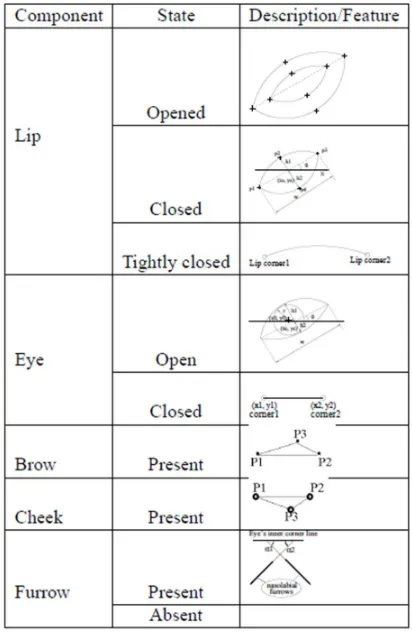
eye. There is one state for brow and cheek. Present and absent are used to model states of the transient facial features. The multistate component models for different components are described in Table 1.
III.FACIAL FEATURE EXTRACTION
Contraction of the facial muscles produces changes in both the direction and magnitude of the motion on the skin surface and in the appearance of permanent and transient facial features. Examples of permanent features are the lips, eyes, and any furrows that have become permanent with age. Transient features include any facial lines and furrows that are not present at rest. We assume that the first frame is in a neutral expression. After initializing the templates of the permanent features in the first frame, both permanent and transient features can be tracked and detected in the whole image sequence regardless of the states of facial components. The tracking results show that our method is robust for tracking facial features even when there is large out of plane head rotation.
Table 1 Multi-state facial component models of a front face
A. Permanent features
is automatically tracked by feature point tracking. Then, the lip shape and color information are used to determine the lip state and state transitions. The detailed lip tracking method can be found in paper [4].
Eye features: Most eye trackers developed so far are for open eyes and simply track the eye locations. However, for recognizing facial action units, we need to recognize the state of eyes, whether they are open or closed, and the parameters of an eye model, the location and radius of the iris, and the corners and height of the open eye. As shown in Table 1, the eye model consists of "open" and "closed". The iris provides important information about the eye state. If the eye is open, part of the iris normally will be visible. Otherwise, the eye is closed. For the different states, specific eye templates and different algorithms are used to obtain eye features. For an open eye, we assume the outer contour of the eye is symmetrical about the perpendicular bisector to the line connecting two eye corners. The template, illustrated in Table 1, is composed of a circle with three parameters (x0;y0r)and two parabolic arcs with six parameters (xc;ych1;2w;).This is the same eye template as Yuille’s except for two points located at the center of the whites [5].For a closed eye, the template is reduced to 4 parameters for each of the eye corners. The default eye state is open. Locating the open eye template in the first frame, the eye’s inner corner is tracked accurately by feature point tracking. We found that the outer corners are hard to track and less stable than the inner corners, so we assume the outer corners are on the line that connects the inner corners. Then, the outer corners can be obtained by the eye width, which is calculated from the first frame. Intensity and edge information are used to detect an iris because the iris provides important information about the eye state. A half circle iris mask is used to obtain correct iris edges. If the iris is detected, the eye is open and the iris center is the iris mask center (x0; y0). In an image sequence, the eyelid contours are tracked for open eyes by feature point tracking. For a closed eye, we do not need to track the eyelid contours. A line connects the inner and an outer corner of the eye is used as the eye boundary. The detailed eye feature tracking techniques can be found in paper [14].Brow and cheek features: Features in the brow and cheek areas are also important to facial expression analysis. For the brow and cheek, one state is used respectively, a triangular template with six parameters (x1;y1), (x2;y2), and (x3;y3)is used to model the position of brow or cheek. Both brow and cheek are tracked by feature point tracking. A modified version of the gradient tracking algorithm [6] is used to track these points for the whole image sequence.
B. Transient features
Facial motion produces transient features. Wrinkles and furrows appear perpendicular to the motion direction of the activated muscle. These transient features provide crucial information for the recognition of action units. Contraction of the corrugator muscle, for instance, produces vertical furrows between the brows, which is coded in FACS as AU 4, while contraction of the medial portion of the frontalis muscle (AU 1) causes horizontal wrinkling in the center of the forehead. Some of these lines and furrows may become permanent with age. Permanent crows feet wrinkles around the outside corners of the eyes, which is characteristic of AU 6 when transient, are common in adults but not in infants. When lines and furrows become permanent facial features, contraction of the corresponding muscles produces changes in their appearance, such as deepening or lengthening. The presence or absence of the furrows in a face image can be determined by geometric feature analysis [9, 8], or by Eigen analysis [7, 10]. Kwon and Lobo [8] detect furrows by snake to classify pictures of people into different age groups. Lien [9] detected whole face horizontal, vertical and diagonal edges for face expression recognition. In our system, we currently detect nasolabial furrows, nose wrinkles, and crows feet wrinkles. We define them in two states: present and absent. Compared to the neutral frame, the wrinkle state is present if the wrinkles appear, deepen, or lengthen. Otherwise, it is absent. After obtaining the permanent facial features, the areas with furrows related to different AUs can be decided by the permanent facial feature locations. We define the nasolabial furrow area as the area between eye’s inner corners line and lip corners line. The nose wrinkle area is a square between two eye inner corners. The crow’s feet wrinkle areas are beside the eye outer corners. We use canny edge detector to detect the edge information in these areas. For nose wrinkles and crows feet wrinkles, we compare the edge pixel numbers Elf current frame with the edge pixel numbers E0of the first frame in the wrinkle areas. If E=0 large than the threshold T, the furrows are present. Otherwise, the furrows are absent. For the nasolabial furrows, we detect the continued diagonal edges.
IV.FACE IMAGE DATABASES AND PERFORMANCEEVALUATION
when the methods use the same test set. One issue is that researchers have different interpretations of what a “successful detection “is. Another issue is that different training sets are used, particularly, for appearance-based methods. We conclude this section with a discussion of these issues.
A. Face Image Database
Although many face detection methods have been proposed, less attention has been paid to the development of an image database for face detection research. The FERET database consists of monochrome images taken in different frontal views and in left and right profiles [10]. Only the upper torso of an individual (mostly head and necks) appears in an image on a uniform and uncluttered background. The FERET database has been used to assess the strengthens and weaknesses of different face recognition approaches [10]. Since each image consists of an individual on a uniform and uncluttered background, it is not suitable for face detection benchmarking. This is similar to many databases that were created for the development and testing of face recognition algorithms. Turk and Pent land created a face database of 16 people [11] (available at ftp://whitechapel.media.mit.edu/pub/images/). The images are taken in frontal view with slight variability in head orientation (tilted upright, right, and left) on a cluttered background. The face database from AT&T Cambridge Laboratories (formerly known as the Olivetti database) consists of 10 different images for forty distinct subjects. (Available at http://www.uk.research.att.com/facedatabase.html) [12].
Figure 2 Sample images in Sung and Poggio’s data set
The images were taken at different times, varying the lighting facial expressions, and facial details (glasses). The Harvard database consists of cropped, masked frontal face images taken from a wide variety of light sources [13]. It was used by Hallinan for a study on face recognition under the effect of varying illumination conditions. With 16 individuals, the Yale face database (available at http://cvc.yale.edu/) contains10 frontal images per person, each with different facial expressions, with and without glasses, and under different lighting conditions. The M2VTS multimodal database from the European ACTS projects was developed for access control experiments using multimodal inputs [14]. It contains sequences of face images of 37 people. The five sequences for each subject were taken over one week. Each image sequence contains images from right profile (-90 degree) to left profile (90 degree) while the subject countsfrom“0” to “9” in their native languages. The UMIST database consists of 18 images of 20 people with varying pose. The images of each subject cover a range of poses from right profile to frontal views [15]. The Purdue a Rover 3,276 colour images of 126 people (70 males and 15 females) in frontal view [16]. This database is designed for face recognition experiments under several mixing factors, such as facial expressions, illumination conditions, and occlusions. All the faces appear with different facial expression (neutral, smile, anger, and scream), illumination (left light source, right light source, and sources from both sides), and occlusion (wearing sunglasses or scarf). The images were taken during two sessions separated by two weeks. All the images were taken by the same camera setup under tightly controlled conditions of illumination and pose. This face database has been applied to image and video indexing as well as retrieval [16]. Table 2 summarizes the characteristics of the abovementioned face image databases.
B. Benchmark Test Sets for Face Detection
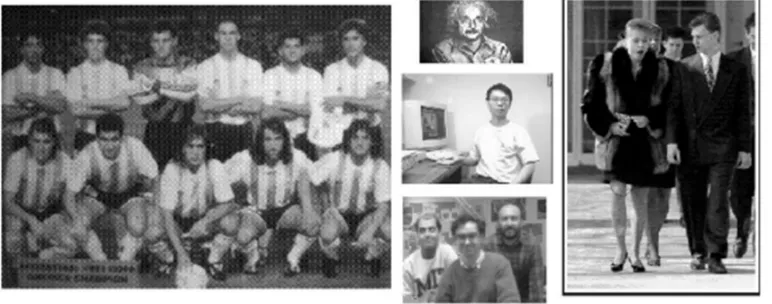
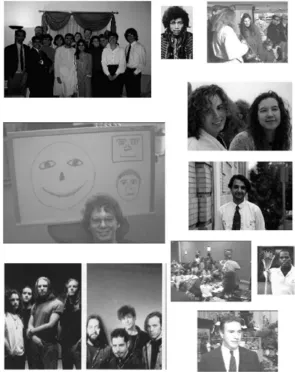
problems that systems might face in the real world and that superior performance on these benchmarks may translate to superior performance on other real-world tasks. Toward this end, researchers have compiled a wide collection of data sets from a wide variety of images. Sung and Poggio created two databases for face detection [17-18]. The first set consists of 301 frontal and near frontal mugshots of 71 different people. These images are high quality digitized images with a fair amount of lighting variation. The second set consists of 23 images with a total of149 face patterns. Most of these images have complex background with faces taking up only a small amount of the total image area. The most widely-used face detection database has been created by Rowley et al. [19-20](available at http://www.cs.cmu.edu/~har/faces.html). It consists of 20 images with a total of 507 frontal faces. This data set includes 23 images of the second data set used by Sung and Poggio [18]. Most images contain more than one face on a cluttered background and, so, this is a good test set to assess algorithms which detect upright frontal faces. Fig. 2shows some images in the data set collected by Sung and Poggio [18], and Fig. 3 shows images from the data set collected by Rowley et al. [21].Rowley et al. also compiled another database of images for detecting 2D faces with frontal pose and rotation in image plane [22]. It contains 50 images with a total of 223 faces, of which 210 are at angles of more than 10 degrees. Fig. 4 shows some rotated images in this data set. To measure the performance of detection methods on faces with profile views, Schneiderman and Kanade gathered a set of208 images where each image contains faces with facial expressions and in profile views [23]. Fig. 5 shows some images in the test set.
Figure 3 Sample images in Rowley et al.’s data set
C. Performance Evaluation
In order to obtain a fair empirical evaluation of face detection methods, it is important to use a standard and representative test set for experiments. Although many face detection methods have been developed over the past decade, only a few of them have been tested on the same data set. Table 2 summarizes the reported performance among several appearance-based face detection methods on two standard data sets described in the previous section. Although Table 2 shows the performance of these methods on the same test set, such an evaluation may not characterize how well these methods will compare in the field. There are a few factors that complicate the assessment of these appearance-based methods. First, the reported results are based on different training sets and different tuning parameters. The number and variety of training examples have a direct effect on the classification performance. However, this factor is often ignored in performance evaluation, which is an appropriate criteria if the goal is to evaluate the systems rather than the learning methods. The second factor is the training time and execution time. Although the training time is usually ignored by most systems, it may be important for real-time applications that require online training on different data sets. Third, the number of scanning windows in these methods vary because they are designed to operate in different environments (i.e., to detect faces within a size range).
Figure 4Sample images of Rowley et al.’s data set
Table 2 Test Sets for Face Detection
Figure 5 Sample images of profile faces from Schneiderman and Kanade’s data set
V.CONCLUSION
and share test sets and to report results on already available test sets. We also feel the community needs to more seriously consider systematic performance evaluation: This would allow users of the face detection algorithms to know which ones are competitive in which domains. It will also spur researchers to produce truly more effective face detection algorithms. Although significant progress has been made in the last two decades, there is still work to be done, and we believe that a robust face detection system should be effective under full variation in:
lighting conditions,
orientation, pose, and partial occlusion,
facial expression, and
Presence of glasses, facial hair, and a variety of hair styles.
Face detection is a challenging and interesting problem in and of itself. However, it can also be seen as a one of the few attempts at solving one of the grand challenges of computer vision, the recognition of object classes. The class of faces admits a great deal of shape, colour, and albedo variability due to differences in individuals, non-rigidity, facial hair, glasses, and makeup. Images are formed under variable lighting and3D pose and may have cluttered backgrounds. Hence, face detection research confronts the full range of challenges found in general purpose, object class recognition. However, the class of faces also has very apparent regularities that are exploited by many heuristic or model-based methods or are readily “learned” in data-driven methods. One expects some regularity when defining classes in general, but they may not be so apparent. Finally, though faces have tremendous within-class variability, face detection remains a two class recognition problem (face versus non face).
REFERENCES
[1] A. Pentland, “Looking at People,” IEEE Trans. Pattern Analysis and Machine Intelligence, vol. 22, no. 1, pp. 107-119, Jan. 2000.
[2] A. Pentland, “Perceptual Intelligence,” Comm. ACM, vol. 43, no. 3,pp. 35-44, 2000.
[3] A. Pentland and T. Choudhury, “Face Recognition for Smart Environments,” IEEE Computer, pp. 50-55, 2000.
[4] Y. Tian, T. Kanade, and J. Cohn. Robust lip tracking by combining shape, color and motion. In
Proc. Of ACCV’2000, 2000.
[5] A. Yuille, P. Haallinan, and D. S. Cohen. Feature extraction from faces using deformable templates. International Journal of Computer Vision,, 8(2):99–111, 1992.
[6] B. Lucas and T. Kanade. An interative image registration technique with an application in stereo vision. In The 7th International Joint Conference on Artificial Intelligence, pages 674–679, 1981.
[7] M. Kirby and L. Sirovich. Application of the klprocedure for the characterization of human faces. IEEETransc. On Pattern Analysis and Machine Intelligence, 12(1):103–108, Jan. 1990.
[8] Y. Kwon and N. Lobo. Age classification from facial images. In Proc. IEEE Conf. Computer Vision and Pattern Recognition, pages 762–767, 1924.
[10] M. Turk and A. Pentland. face recognition using Eigen faces. In Proc. IEEE Conf. Computer Vision andPattern Recognition, pages 586–591, 1991.
[11] P.J. Phillips, H. Moon, S.A. Rizvi, and P.J. Rauss, “The FERET Evaluation Methodology for Face-Recognition Algorithms,” IEEE Trans. Pattern Analysis and Machine Intelligence, vol. 22, no. 10, pp. 1090-1034, Oct. 2000
[12] M. Turk and A. Pentland, “Eigen faces for Recognition,” J. Cognitive Neuroscience, vol. 3, no. 1, pp. 71-86, 1991.
[13] F.S. Samaria, “Face Recognition Using Hidden Markov Models,” PhD thesis, Univ. of Cambridge, 1994.
[14] P. Hallinan, “A Deformable Model for Face Recognition Under Arbitrary Lighting Conditions,” PhD thesis, Harvard Univ., 1995.
[15] S. Pigeon and L. Vandendrope, “The M2VTS Multimodal Face Database,” Proc. First Int’l Conf. Audio- and Video-Based BiometricPerson Authentication, 1997.
[16] D.B. Graham and N.M. Allinson, “Characterizing Virtual Eigen signatures for General Purpose Face Recognition,” Face Recognition: From Theory to Applications, H. Wechsler, P.J. Phillips,V. Bruce, F. Fogelman-Soulie, and T.S. Huang, eds., vol. 163,pp. 446-456, 1998.
[17] A. Martinez and R. Benavente, “The AR Face Database,” Technical Report CVC 24, Purdue Univ., 1998.
[18] K.-K. Sung, “Learning and Example Selection for Object and Pattern Detection,” PhD thesis, Massachusetts Inst. of Technology,1996.
[19] K.-K. Sung and T. Poggio, “Example-Based Learning for View-Based Human Face Detection,” IEEE Trans. Pattern Analysis andMachine Intelligence, vol. 20, no. 1, pp. 39-51, Jan. 1998.
[20] H. Rowley, S. Baluja, and T. Kanade, “Neural Network-Based Face Detection,” Proc. IEEE Conf. Computer Vision and Pattern Recognition,pp. 203-208, 1996.
[21] H.A. Rowley, “Neural Network-Based Face Detection,” PhD thesis, Carnegie Mellon Univ., 1999.
[22] H. Rowley, S. Baluja, and T. Kanade, “Neural Network-Based Face Detection,” IEEE Trans. Pattern Analysis and Machine Intelligence, vol. 20, no. 1, pp. 23-38, Jan. 1998.
[23] H. Rowley, S. Baluja, and T. Kanade, “Rotation Invariant Neural Network-Based Face Detection,” Proc. IEEE Conf. Computer Vision and Pattern Recognition, pp. 38-44, 1998.
[24] H. Schneiderman and T. Kanade, “A Statistical Method for 3DObject Detection Applied to Faces and Cars,” Proc. IEEE Conf. Computer Vision and Pattern Recognition, vol. 1, pp. 746-751, 2000.
AUTHORS BIBILIOGRAPHY
A.Swaminathan is a student of Veltech Multitech Dr.Rangarajan Dr.Sakunthala
Engineering College, Chennai. He did his Bachelor of technology in Information Technology in the year 2012 and now he is doing his masters in Computer Science & Engineering. His areas of interests are Image processing, Artificial Intelligence and Networks.
N.Kumar is an assistant professor in Veltech Multitech Dr.Rangarajan Dr.Sakunthala
Engineering College Chennai. He has eight years’ experience in the field of teaching. He completed his masters in Computer Science Engineering in the year 2008 and currently he is doing his research in the field of Adhoc networks. His areas of interests are Image processing, wireless and adhoc Networks.
M.Ramesh Kumar is an assistant professor in Veltech Multitech Dr.Rangarajan