VICTORIA UNIVERSITY OF TECHNOLOGY
DAMAGE DETECTION IN STRUCTURES USING
MEASURED FREQUENCY RESPONSE FUNCTION
DATA
by
Abhijit Roy Choudhury
A thesis submitted to the Victoria University of Technology
for the degree of Doctor of Philosophy.
I would like to express my sincere gratitude to Dr. Jimin He for his untiring
supervision, advice and guidance which have greatly contributed to the
success of this project.
My thanks are also due to Professor Geoffrey Lleonart for his helpful
guidance in writing this thesis. Other members of the staff in the department
of mechanical engineering are also acknowledged for their help at different
stages of this work.
Sincere thanks are also due to all colleagues for their friendly cooperation and
fruitful discussions during the course of the present work.
The author is also thankful to Victoria University of Technology for the
financial support provided over the period in which this work was carried out.
More personally, the author owe most to his parents, wife Amba and sister
Mousumi for their constant support and encouragement, without which this
ABSTRACT
Modem engineering structures such as offshore oil platforms, transmission
towers, bridges and aircraft frames are regularly monitored and maintained in
order to avert catastrophic failure. Despite our best efforts, sporadic failures,
which may have disastrous consequences in terms of human life and
resources, still occur. It is therefore important to develop techniques which
lead to significant improvements in the reliability of the structures.
A challenging area of structural dynamics research is concerned with the
development and practical implementation of monitoring systems which can
identify and quantify damage as it occurs in a structure. The development of a
number of techniques that contribute to providing means to detect structural
damage is the goal of the work presented in this thesis.
A structural damage detection technique based on constrained minimization
theory, which can both locate and quantify damage in a structure has been
successfully developed. For locating damage only in a structure, a method
which works well in the presence of appreciable measurement noise and
coordinate incompleteness was demonstrated. In addition, a submatrix
procedure was successfully applied to directly identify damaged elements in a
structure instead of the degrees of freedom.
Each of the methods required a finite element model of the undamaged
structure. For applications where such a model was not available, a new
NOMENCLATURE
The following list gives the principal use of the symbols in this thesis.
However, a given symbol might be used to denote different quantities under
special situations. The interpretation to be given to a symbol will be clear
from the context in which it is employed.
[A 1 ] - as given in equation (3.3.8)
[A2] - as given in equation (3.3.9)
[AQ] - as explained in equation (2.2.25)
[AMIX] " as defined in equation (3.3.14)
[B] - as defined in equation (5.4.1)
{b} - as defined in equation (5.4.1)
[C] - viscous damping matrix
[D] - as explained in equation (2.2.31)
{D} - vector derived from matrix [D]
{df(Q)} - as defined in equation (2.4.3)
{d(Q)} - as defined in equation (3.2.7) in Chapter 3
d - number of frequency pairs
E - Young's Modulus
e - error function as defined in equation (2.2.9)
e l to e5 - random errors
F - number of unknown non-zero coefficients in the stiffness matrix
{F(Q)} - excitation at frequency Q
[G*] - -[A°]'^[KSQ'][A°]
gi, g2 - constraints in the Lagrange equation
[H] - structural damping matrix in Chapter 1
[H]ij - { A D } J { R ^ } / in Chapter 2
{h} - vector comprising of scaling factors
[I] - identity matrix
IYY - moment of inertia of cross sectional area about axis Y-Y
I2Z - moment of inertia of cross sectional area about axis Z-Z
[K] - stiffness matrix of the structure
[K]j - j submatrix of stiffness matrix transformed to global coordinate system
[KSQ] - [K]uD ® [K]uD
[AK] - differential stiffness matrix of the structure due to damage
Knn - coefficient of stiffness matrix at rm coefficient location in the matrix.
[kj - diagonal modal stiffness matrix
kr - r modal stiffness
L - Lagrange function
[M] - mass matrix of the strucmre
[AM] - differential mass matrix of the structure due to damage
th
[M]j - j submatrix of mass matrix transformed to global coordinate system
[mj] - diagonal modal mass matrix
m, - r^ modal mass
mm - number of measured modes
m - number of measured coordinates
N - number of degrees of freedom of the system
n^ - number of averages
[P] - contains orthonormalized eigenvectors of ([T] + [S])
[QM] - damage quantification matrix due to change in mass only
[QK] - damage quantification matrix due to change in stiffness matrix
[Q2] - damage quantification matrix due to change in dynamic stiffness
matrix
th
Q2,ij - ij element of matrix [Q2]
{R} - as defined in equation (4.2.12)
{R^}i - ith column of [AD]^[KSQJ] in Chapter 2
[S] - as explained in equation (2.2.32)
s - number of frequency points
Vll
[TR]
[U]
u
[V]
{ X }
{X}
{Y}
[Y]
[Z(^)]
Z(Q)D,ij
{ZUD(")}J
[ZSQ]
[AZ(Q)]
[a(Q)]
{aD(Q)}k
{aD(f)(Q)}k
{auD(^)}k
{Aa(Q)}k
akk(Q)
{P(^)}
{ S } K
Yxy'(^)
[<!)]
TlK
- transformation matrix
- as defined in equation (2.2.10)
- number of unmeasured coordinates
• diagonal matrix whose diagonal elements are the eigenvalues of
([T] + [S])
- as defined equation (2.2.20) in Chapter 2
- as defined equation (5.4.1) in Chapter 3
- as defined in equation (4.2.13)
- as defined in equation (4.2.14)
- dynamic stiffness matrix of the structure
- ij^ element of dynamic stiffness matrix of damaged structure at
frequency Q
- j ' \ o w o f [Z(Q)]uD
- 0.25 [ZJuD <8) [Z]uD
- differential dynamic stiffness matrix of the structure due to damage
at frequency Q
- receptance matrix at frequency Q
th
- k column of the RFRF matrix of the damaged structure at
frequency Q
- k column of the filtered RFRF matrix of the damaged structure at
frequency Q
til
- k column of the RFRF matrix of the undamaged structure at
frequency Q.
th
- k column of the differential RFRF matrix between damaged and
undamaged structure at frequency Q
- kk element of receptance matrix at frequency Q
- damage location vector
- delta vector whose k element is unity
- coherence at frequency Q
- mass normalised mode shapes
th
X,\i - Lagrange multipliers
[\\f] - eigenvector matrix
[kf\ - diagonal matrix whose diagonal elements are the eigenvalues
>uk - k eigenvalue
BQ* - defined in equation (3.2.20) in Chapter 3
Q - frequency of the system
th
COK - k natural frequency
Operators and symbols
S - summation
{ }^» [ ]^ " transpose
0 - matrix element by element operation
[ ]-l - standard inverse
[ ]+ - pseudo inverse
II II - matrix norm
[ ]i5 - represents damaged structure
[ luD " represents undamaged structure
{*"} - superscript m refers t o measured coordinate
{"} - superscript u refers to unmeasured coordinate
Abbreviations
CDLV - cumulative damage location vector
CMDQ - constrained minimization damage quantification
COMAC - coordinate modal assurance criterion
D. E - dynamic expansion
DLP - damage location plot
DLV - damage location vector
DOF -degree of freedom
IX
FEM - finite element model
FRF - frequency response function
IRS - improved reduced system
MAC - modal assurance criterion
MDOF -multiple degree of freedom
MRPT - minimum rank perturbation technique
PMAC - partial modal assurance criterion
RFRF - receptance frequency response fiinction
SDOF - single degree of freedom
SEREP - system equivalent reduction expansion process
Figure Title Page
2.1 Graph showing variation of normalized random error as a 58 function of coherence and number of averages
2.2 Graph of normalized random error and number of averages 58
2.3 Flowchart of program for computer implementation of 59 CMDQ method
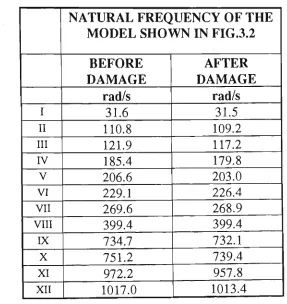
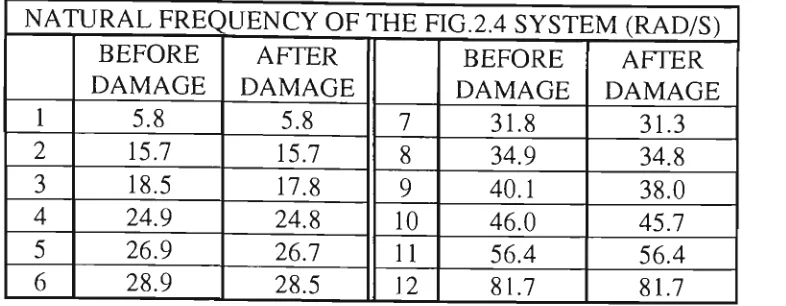
2.4 A 12 DOF mass-spring system (Model 2.1) 60
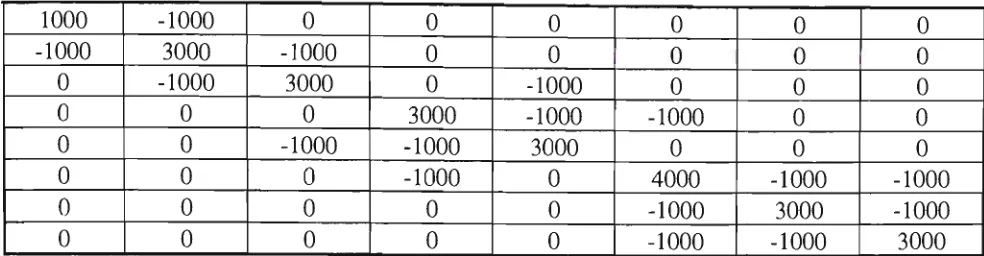
2.5 An 8 DOF mass-spring system (Model 2.2) 60
2.6 A 20 member plane truss structure (Model 2.3) 61
2.7 Actual [AK] for model 2.1 62
2.8 Calculated [AK] using CMDQ method for pure data in 62 model 2.1 (29 valid eigenvalues; 3, 12, 14 rad/s)
2.9 Calculated [AK] using CMDQ method for pure data in 62 model 2.1 (26 valid eigenvalues; 3, 12, 14 rad/s)
2.10 Calculated [AK] using CMDQ method for pure data in 62 model 2.1 (23 valid eigenvalues; 3, 12, 14 rad/s)
2.11 Calculated [AK] using CMDQ method for pure data in 63 model 2.1 (23 valid eigenvalues; 8, 10, 11 rad/s)
2.12 Calculated [AK] using CMDQ method for pure data in 63 model 2.1 (25 valid eigenvalues; 8, 10, 11, 13 rad/s)
XI
model 2.1 (29 valid eigenvalues; 8, 10, 11, 13, 15.4rad/s)
2.14 Calculated [AK] using CMDQ method for 2% noisy data in 63 model 2.1 (29 valid eigenvalues; 3, 12, 14 rad/s)
2.15 Calculated [AK] using CMDQ method for 2% noisy data in 64 model 2.1 (29 valid eigenvalues; 3, 12, 14, 13 rad/s)
2.16 Calculated [AK] using CMDQ method for 2% noisy data in 64 model 2.1 (29 valid eigenvalues; 3, 12, 14, 13, 16 rad/s)
2.17 Calculated [AK] using CMDQ method, 2% noisy data in 64 model 2.1 (29 valid eigenvalues; 3, 12, 14, 13, 16, 9 rad/s)
2.18 Calculated [AK] using CMDQ, noise filtering for 2% noisy 64 data in model 2.1 ( 3, 12, 14, 13, 16 rad/s)
2.19 Actual [AK] for model 2.2 65
2.20 Calculated [AK] using CMDQ method for pure data in 65 model 2.2 (16 valid eigenvalues; 8, 14 rad/s)
2.21 Calculated [AK] using CMDQ method for pure data in 65 model 2.2 (16 valid eigenvalues; 8, 14, 19 rad/s)
2.22 RFRF for model 2.3 before and after damage 66
2.23 Actual [AK] for model 2.3 66
2.24 Calculated [AK] using CMDQ method for pure data in 66 model 2.3 (12, 19, 25, 43 rad/s)
2.25 Calculated [AK] using CMDQ method for 2% noisy data in 67 model 2.3 ( 12, 19, 25, 43 rad/s)
2.26 Calculated [AK] using CMDQ method for 2% noisy data in 67 model 2.3 (12, 19, 25, 37, 43 rad/s)
3.1 A 5 DOF mass-spring system 110
3.2 A 12 DOF mass-spring system (Model 3.2) 110
3.3 A truss structure (Model 3.3) 111
3.4A 3-D DLP using D.E A (Case 1/ Subcase 1 in section 3.4) 112
3.4B 3-D DLP using D.E B (Case 1/ Subcase 1 in section 3.4) 112
3.4C 3-D DLP using D.E C (Case 1/ Subcase 1 in section 3.4) 112
3.4D 3-D DLP using FRF mix (Case 1/ Subcase 1 in section 3.4) 112
3.4E 3-D DLP using SEREP 1 (Case 1/ Subcase 1 in section 3.4) 113
3.4F 3-D DLP using SEREP2 (Case 1/ Subcase 1 in section 3.4) 113
3.4G 3-D DLP using SEREP3 (Case 1/ Subcase 1 in section 3.4) 113
3.4H 3-D DLP using SEREP4 (Case 1/ Subcase 1 in section 3.4) 113
3.5A 3-D DLP using D.E A (Case 1/Subcase 2 in section 3.4) 114
3.5B 3-D DLP using D.E B (Case!/Subcase 2 in section 3.4) 114
3.5C 3-D DLP using D.E C (Case 1/ Subcase 2 in section 3.4) 114
3.5D 3-D DLP using FRF mix (Case!/Subcase 2 in section 3.4) 114
3.5E 3-D DLP using SEREPl (Case 1/ Subcase 2 in section 3.4) 115
3.5F 3-D DLP using SEREP2 (Case 1/ Subcase 2 in section 3.4) 115
3.5G 3-D DLP using SEREP3 (Case 1/ Subcase 2 in section 3.4) 115
3.5H 3-D DLP using SEREP4 (Case 1/ Subcase 2 in section 3.4) 115
3.6A 3-D DLP using D.E A (Case 11/ Subcase 1 in section 3.4) 116
X l l l
3.6B 3-D DLP using D.E B (Case 11/ Subcase 1 in section 3.4) 116
3.6B/1 CDLV using D.E B (Case 11/ Subcase 1 in section 3.4) 116
3.6C 3-D DLP using D.E C (Case 11/ Subcase 1 in section 3.4) 117
3.6C/1 CDLV using D.E B (Case 11/ Subcase I in section 3.4) 117
3.6D 3-D DLP using FRF mix (Case Il/Subcase 1 in section 3.4) 117
3.6D/1 CDLV using FRF mix (Case 11/ Subcase 1 in section 3.4) 117
3.7A 3-D DLP using D.E A (Case 11/ Subcase 2 in section 3.4) 118
3.7A/1 CDLV using D.E A (Case 11/ Subcase 2 in section 3.4) 118
3.7B 3-D DLP using D.E B (Case 11/ Subcase 2 in section 3.4) 118
3.7B/1 CDLV using D.E B (Case 11/ Subcase 2 in section 3.4) 118
3.7C 3-D DLP using D.E C (Case 11/ Subcase 2 in section 3.4) 119
3.7C/1 CDLV using D.E C (Case 11/ Subcase 2 in section 3.4) 119
3.7D 3-D DLP using FRF mix (Case Il/Subcase 2 in section 3.4) 119
3.7D/1 CDLV using FRF mix (Case 11/ Subcase 2 in section 3.4) 119
3.8A 3-D DLP using D.E A (case 1/ subcase I; fig.3.3 model) 120
3.8B 3-D DLP using D.E A (case 1/ subcase II; fig.3.3 model) 120
3.8C 3-D DLP using D.E A (case 1/ subcase III; fig.3.3 model) 120
3.9A 3-D DLP using D.E A (case 2/ subcase I; fig.3.3 model) 121
3.9B 3-D DLP using D.E A (case 2/ subcase II; fig.3.3 model) 121
3.9C 3-D DLP using D.E A (case 2/ subcase III; fig.3.3 model) 121
4.2 A 10 DOF mass-spring system 143
4.3 A cantilever truss structure 144
4.4 Scaling factor due to damage in model 3.2 145
4.5 Identified scaling factor (Approach 1; 2 frequency points, 145 no noise)
4.6 Identified scaling factor (Approach 1; 4 frequency points, 146 no noise)
4.7 Identified scaling factor (Approach 2; no noise) 146
4.8 Identified scaling factor (Approach 1; 4% noise) 147
4.9 Identified scaling factor (Approach 2; 4% noise) 147
4.10 Identified scaling factor (Approach 2 and DLP; 4% noise) 148
4.11 Identified scaling factor (Approach 2, incomplete 148 measurement; 4% noise)
4.12 Identified scaling factor (Approach 2 and DLP; 149 measurement available; 4% noise)
4.13 Identified scaling factor (Approach 2 and DLP; 149 interpolated data; 4% noise)
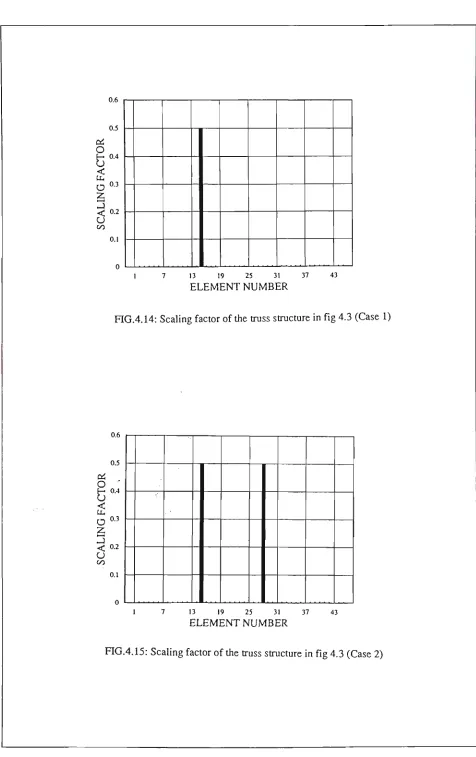
4.14 Scaling factor of the truss structure in fig. 4.3 (Case 1) 150
4.15 Scaling factor of the truss structure in fig. 4.3 (Case 2) 150
4.16 3-D DLP for case 1 damage in fig. 4.3 model 151
4.17 Identified scaling factor for the truss structure in fig.4.3 151 (Casel)
XV
4.19 Identified scaling factor for the truss structure in fig.4.3 152
(Case2)
5.1 A 3 DOF mass-spring system 179
5.2 A continous beam and its lumped mass model 179
5.3 [AK] for the 12 DOF mass-spring system in fig. 3.2 180 5.4 Calculated [AK] for the 12 DOF mass-spring system in fig. 180
3.2 (using Method I in section 5.5.1)
5.5 Calculated [AK] for the 12 DOF mass-spring system in fig. 181 3.2 (using Method II in section 5.5.2)
5.6 Identified scaling factor for fig. 3.2 system (Method III in 181 section 5.5.3; 4% noise)
5.7 Calculated [AK] for fig. 3.2 system (using Method II, 182 frequency points different from case represented in fig.5.5)
5.8 Identified scaling factor for fig. 3.2 system (Method III in 182 section 5.5.3; 4% noise, frequency different from case
represented in fig. 5.6)
5.9 Calculated [AK] for fig. 3.2 system (using Method II, 4% 183 noise, incomplete coordinates measured)
5.10 Identified scaling factor for fig. 3.2 system (Method III in 183 section 5.5.3; 4% noise, incomplete coordinates measured)
5.11 Calculated [AK] for fig. 3.2 system (using Method II, 4% 184 noise, incomplete coordinates interpolated)
5.12 Identified scaling factor for fig. 3.2 system (Method III in 184 section 5.5.3; 4% noise, incomplete coordinates
interpolated)
6.1 A beam structure 223
6.3a Location on the beam where measurements were taken 225
6.3b Location on the grid where measurements were taken 225
6.4 Schematic diagram of the measurement set-up 226
6.5 Photograph of the experimental rig 226
6.6 a n 1 i(Q) for the beam from measurement and FE model 227
6.7 Coherence of RFRF ( a n ii(Q)) for the undamaged beam 228
6.8 oty 7(Q) for the grid from measurement and FE model 229
6.9 Frequency response of different forms of attachment 229
6.10 aii,i i(^) for the beam before and after damage 230
6.11a 3-D DLP for the beam 231
6.11b CDLV for the beam 231
6.12 a7,7(^) for the grid before and after damage 232
6.13a 3-D DLP for the grid structure 233
6.13b CDLV for the grid structure 233
6.14A a i 1,11(^) for the beam (regenerated, before and after 234 damage) for case A
6.14B a i 1,11(^) for the beam (regenerated, before and after 234 damage) for case B
6.14C tt] 11 i(Q) for the beam (regenerated, before and after 235 damage) for case C
6.15A ai 11 i(Q) for the beam (regenerated, before and after 235 damage) using scaling factor . 15
damage) using scaling factor .17
XVll
6.15C ai 11 i(Q) for the beam (regenerated, before and after damage) using scaling factor .26
236
6.16A a-jjiQ) for the grid (regenerated, before and after damage for case A
6.16B ay 7(Q) for the grid (regenerated, before and after damage for case B
6.16C ay 7(Q) for the grid (regenerated, before and after damage for case C
6.16D a7 7(Q) for the grid (regenerated, before and after damage for case D
6.17A ajj(Cl) for the grid (regenerated, before and after damage using scaling factor .38
6.17B a7 7(Q) for the grid (regenerated, before and after damage using scaling factor ..24
6.17C a7 7(Q) for the grid (regenerated, before and after damage using scaling factor .37
6.17D a7 7(Q) for the grid (regenerated, before and after damage using scaling factor .34
237
237
238
238
239
239
240
240
6.18 ot7 7(Q) for the grid (undamaged and after both damages) 241
6.19a 3-D DLP for the grid for both damages 242
TITLE i
ABSTRACT ii
ACKNOWLEDGEMENTS iv
NOMENCLATURE v
LIST OF FIGURES x
TABLE OF CONTENTS xviii
1. INTRODUCTION 1
1.1 Damage location using measured receptance FRF data 1
1.2 System models 4
1.3 Review of previous work 10
1.4 Assumptions of this study 16
1.4 Scope of present work 17
2. DETERMINATION OF STRUCTURAL DAMAGE EXTENT
USING CONSTIiAINED MINIMIZATION THEORY 20
2.1 Introduction 20
2.2 Constrained minimization damage quantification (CMDQ) method 23
2.3 Discussion 34
XIX
2.3.2 Determining the number of frequency points 37
2.3.3 Simultaneous mass and stiffness changes due to damage 38
2.4 Noise filtering algorithm for proposed method 40
2.5 Results of numerical analysis 43
2.6 Summarising remarks 51
3. DAMAGE LOCATION IN A STRUCTURE USING MEASURED
FRF DATA 68
3.1 Introduction 68
3.2 Theory of damage location using FRF data 71
3.3 Compatibility of measured and analytical data 77
3.3.1 Reduction Techniques 78
3.3.2 Expansion Techniques 81
3.4 Results of numerical simulations 89
3.5 Analysis of numerical results 99
3.6 Summarising remarks 106
4. SUBMATRIX APPROACH FOR DETERMINING DAMAGE
EXTENT IN A STRUCTURE 122
4.1 Introduction 122
4.2 Theory of determining damage extent using submatrix approach 124
4.3 Discussions 131
4.5 Summarising remarks 140
5. USING SPATIAL MODEL TO DETERMINE DAMAGE
EXTENT 153
5.1 Introduction 153
5.2 Review of previous works for spatial model derivation 154
5.3 Theory to generate spatial model 157
5.4 Discussion 163
5.5 Application of the method for determining damage extent 166
5.5.1 Method I (Direct Method) 166
5.5.2 Method II (Indirect Method) 167
5.5.3 Method III (Using Submatrix Approach) 168
5.6 Results of numerical case studies 169
5.7 Summarising remarks 174
6. EXPERIMENTAL CASE STUDY 185
6.1 Introduction 185
6.2 The test structures 186
6.3 Measurement equipment 186
6.4 Calibration of the measurement equipment 188
6.5 FE modelling of undamaged structure 189
XXI
6.5.2 Cross stiffened grid structure 190
6.6 Test structure preparation for measurement 190
6.6.1 Support Condition 190
6.6.2 Type of Excitation 191
6.6.3 Attachment and location of transducer 192
6.7 Introduction of damage in the structure 193
6.8 Execution of the measurement 193
6.9 Damage location 194
6.10 Discussion of location results 197
6.11 Determination of damage severity 198
6.12 Discussion of damage severity results 207
6.13 Location of multiple damage 211
6.14 Summarising remarks 211
7. CONCLUSION AND SUGGESTIONS FOR FUTURE
RESEARCH 243
7.1 General conclusion 243
7.2 New contributions of present research 245
7.3 Suggestions for further work 246
REFERENCES 248
APPENDIX B 265
APPENDIX C 269
APPENDIX D 272
CHAPTER 1
INTRODUCTION
With the progress of materials science, new materials have been introduced
which have made it possible to build large and complicated structures with
reduced weight. However, due to the large size and complexity of such
structures and the possible catastrophic effect associated with their failure, it is
imperative to develop a technique which is able to locate, and determine the
extent, of structural damage as it develops in a structure. Advancement in recent
years in the capability of modem electronic instrumentation for signal
processing have resulted in the development of superior instruments for
monitoring the condition of machines. From experience gained in the
machinery health monitoring field, it is expected that the vibration signature of
a structure should provide adequate and useful information to detect possible
structural damage.
1.1 DAMAGE LOCATION/QUANTIFICATION USING MEASURED RECEPTANCE FRF (RFRF) DATA
As a result of the consequences associated with the failure of some present day
structures, in terms of both human life and resources, a lot of effort has been
directed towards developing a suitable technique for detecting damage in
structures. Most of the work in structural damage detection uses the general
framework of model refinement or model updatings where the analytical spatial
experimental modal model of the damaged structure (natural frequencies and
mode shapes) have been used together to determine damage location and its
extent. In these approaches it is assumed that the analytical model of the
undamaged structure truly represents the structure within certain frequency
ranges of interest.
Although the system identification technique is a promising method in
structural damage detection, use of modal parameters introduces some
disadvantages and limitations into these methods. The experimental modal
parameters of a system by themselves usually present a limited amount of data.
This is because these modal parameters are restricted only to natural frequencies
and mode shapes of the system within the measured frequency range. For most
practical applications the measured frequency range contains only a limited
number of natural frequencies. In addition, if the modal parameters available are
not severely affected by damage, then it would be difficult to detect damage by
applying existing methods using modal parameters.
To generate a true analytical model of a structure, it is required to discretize it
into a large number of degrees of freedom (DOFs). If the number of DOFs is N,
then the complete modal model of the structure should have information about
all N natural frequencies and their corresponding mode shapes. However, the
experimental modal model obtained for a structure is incomplete, as it becomes
difficult to measure over a wide frequency band if the value of N is large. In
addition, it is impractical to measure as many coordinates as an analytical
model has. A few of the earlier methods which required a complete
Chapter 1: Introduction
unsatisfactorily when working in practical situation. In addition, use of modal
parameters for detecting damage involves the extraction of them from
measured frequency response function (FRF) data by an analysis method called
experimental modal analysis, which may introduce additional computational
burden and errors.
However, if a suitable technique can be developed which makes use of the
analytical spatial model and the experimental response model (FRF data)
instead of the modal model, then it is possible to eliminate most of the
limitations and disadvantages associated with using the modal model.
Therefore, in contrast to the existing structural damage detection methods based
on system identification using the.
Spatial Model Of The Undamaged Structure + Modal Model Of The
Damaged Structure,
the method proposed in this work will use the.
Spatial Model Of The Undamaged Structure + Response Model Of The
Damaged Structure
to locate and quantify damage in the structure. These models are described in
the next section.
However, two problems which confront any structural damage detection
• effect of noise - in spite of all the technological advances in electronic
instrumentation, it is hard to envisage a condition where no noise of any type
has contaminated the measured vibration data. When using FRF data
directly, it is possible to judiciously select frequency points with a high
signal to noise ratio but it is unlikely that the noise effect will be zero.
• effect of DOF incompleteness - when developing a finite element model of a
structure, it is possible to use a large number of DOFs to discretize it in order
to better resemble the structure. However, while taking measurements of the
structure, it is not possible to measure at all the DOFs corresponding to the
finite element model (FEM) of the structure. One way to tackle this problem
of DOF incompatibility is either to expand the measured DOFs to equal to
FE model DOFs or to reduce the FE model in accordance with the measured
DOFs. However, both the expansion and reduction methods introduce
inaccuracy into the data.
These two problems will be addressed in the context of using FRF data to locate
and determine the extent of structural damage.
1.2 SYSTEM MODELS
The dynamic properties of a system, analytically or experimentally derived, can
be represented in the following model formats: spatial model, modal model and
response model. For the application of damage detection, either the
experimental modal model or the experimental response model of the damaged
Chapter 1: Introduction
Structure to detect the possible location and extent of damage. These three
models used to describe the dynamic properties of the system are defined
below.
(1) Spatial Model
When a given structure is discretized analytically, spatially distributed
properties, such as the mass, stiffness and damping, are assigned to each of the
N DOFs. These properties are presented in matrix form as given below:
[M]NXN " mass matrix whose diagonal terms define the inertia force assigned
to each DOF when they experience an acceleration and whose off-diagonal
terms contain inertia coupling information.
[K]NXN ~ stiffness matrix whose diagonal terms define the inherent restoring
forces due to relative displacement at each DOF and the off-diagonal terms
express the static coupling between DOFs.
[C]NXN or [H]NXN " viscous and structural damping matrices respectively. In
cases where the dissipative forces are negligible, they are often neglected.
If a spatial model has N co-ordinates, then it is expected to have N modes.
However, if it is reduced by one of the reduction methods to be discussed in
Chapter 3, to 'm' co-ordinates (m < N), it will contain information on 'm'
Spatial models are also referred to as "Time Models", since equations of motion
formulated by using spatial properties contain the response motions of system
as fiinctions of time.
(2^ Modal Model
Dynamic properties of a system are also often described in terms of natural
frequencies, modal damping factors and associated mode shapes. A
mathematical model comprising these data is called a modal model.
Mathematically, the mode shapes are represented as vectors in which each
element represents a deflection of one DOF relative to the other (N-1) DOFs in
the model. The mode shapes (or eigenvectors) can be grouped together in the,
so called Modal Matrix which is represented by [^]Nxm- This is a square or
rectangular matrix containing information about N co-ordinates and m modes.
The eigenvalues related to system natural frequencies can be grouped together
forming a diagonal matrix represented by [XrJmxm- Generally, both matrices are
th
complex. The k eigenvalue is given here as X^ and the corresponding mode
shape as {^jk- The diagonal matrix corresponding to system natural
frequencies and the modal matrix is presented next:
Chapter 1: Introduction
M N . . =
af+ibf
a2'+ib;
< +
'K
(1.2)
The k^ eigenvalue contains information related to the k^ natural frequency (co^)
and modal damping (ri^). The k^ mode shape {\)/}i^ is represented by a real part
and an imaginary part.
Since the mode shapes represent relative amplitudes at the DOFs, rather than
absolute deflections of the structure, the elements of each mode shape can be
scaled arbitrarily. For instance, they can be scaled in such a way that the largest
element becomes unity for graphical visualisation purposes. On other occasions,
mode shapes may be required to be uniquely defined. This can be achieved by
making use of the concept of modal mass and modal stiffness. Due to the
orthogonality theory of a multi-degree-of-freedom system, the following
relationships hold (if m < N):
Nxm
(1.3)
(1.4)
With [K] assumed as a complex stiffiiess matrix, equations (1.3) and (1.4) gives
the diagonal modal mass and modal stiffiiess matrices whose elements are
k /
interrelated as X^ = y = coJ(l-i-iT]J. The mode shapes of the system can be
1-0.5
W-Mk]" (1.5)
where [(j)] is called the mass normalized mode shape. This will result in a new
set of orthogonality equations given below as:
['t'lLjM],,J(|)],.„=[I]_ (1.6)
[ C N M » . H W . . „ = [ ^ , L „ (1.7)
These mass normalized mode shapes can be experimentally obtained from a
modal analysis process, as illustrated by Ewins [1].
(3) Response Model
A linear, time invariant dynamic system, when subjected to a certain input, will
generate a definite output. The basic system equation is:
OUTPUT = SYSTEM CHARACTERISTICS x INPUT (1.8)
It can be seen that the output response is related to the input via its dynamic
characteristics. Using the same system equation for any linear system excited by
harmonic excitation, the input/output relationship in the frequency domain at
frequency Q can be written as:
{X(Q)} = [a(Q)]{F(Q)} (1.9)
Chapter I: Introduction
where [a(Q)] and [Z(Q)] are related by the following relationship.
[Z(Q)] = [a(Q)]-^ (1.11)
[a(Q)] is called the receptance frequency response function matrix of the
system. The receptance FRF matrix [a(Q)] will become the Mobility matrix or
Inertance matrix if the response measured is velocity or acceleration. In these
matrices each element is a complex ratio (response/force) called the FRF which
covers a certain frequency range. In addition, there exists three other formats for
FRF data, these being the inverse of receptance, mobility and inertance. They
are generally known as 'dynamic stiffiiess', 'mechanical impedance' and
'apparent mass' respectively. The response model is then expressed as an FRF
matrix which may be derived either analytically or experimentally.
It is important to comprehend different practical implications if measuring
[a(Q)] or [Z(Q)]. Consider an element aij(Q)in matrix [a(Q)]. It represents the
amplitude and relative phase of a harmonic displacement at DOF 'i' due to a
harmonic force applied at DOF ' j ' (no other external forces are applied to the
system). However, Zij(Q) represents the amplitude and relative phase of a
harmonic force applied to DOF 'i' due to a unit displacement at DOF ' j ' (when
no other displacement exists in the system).
For a SDOF system it is easy to measure or calculate either a(Q) or Z(Q). For a
MDOF system, it is physically impossible to measure [Z(Q)] since it is
impossible to ensure displacement response only at one DOF while
Elements in a particular column of matrix [a(Q)] can be measured by changing
the point of response while force location is the same. According to the
reciprocity principle, matrix [a(Q)] is symmetric. Therefore, measuring one
column is equivalent to measuring one row, although the mechanism of
measurement is different.
To summarize, the Response model of a dynamic system can be described by
the FRF matrix whose elements can be either measured or analytically
calculated or sometimes, a mixture of both.
1.3 REVIEW OF PREVIOUS WORKS
Using vibration test data to locate structural damage has been attempted by
many researchers in recent years. A brief review is given here. More details are
given in later chapters where some specific techniques are studied.
Most of the prior work in structural damage detection is based on the general
framework of FEM refinement (System Identification) techniques. The need for
FEM refinement of a structure arose because of the deviation that occurred
between the modal properties predicted by the Finite Element Model and that
measured. To reduce this deviation, the technique of FEM refinement was used
where measurement data of a structure was used to tune or correct the FEM of
the structure. The tuned or correlated FEM is expected to represent the actual
structure more accurately. Unlike model refinement, where the deviation is
Chapter 1: Introduction 11
attributed to the damage in the structure. This explains the reason behind the
application of the FEM refinement algorithm to damage location problems.
The FEM refinement algorithms which may be used for structural damage
detection may be broadly divided into three categories: optimal matrix
updating, eigenstructure assignment and sensitivity analysis. Among these
categories, perhaps the most widely used is optimal matrix updating. Early
work in this area included that of Rodden [3] who used vibration test data to
determine the structural influence coefficients of a structure. The problem of
finding a matrix that satisfies a set of measurements as well as symmetry and
positive definiteness was addressed by Brock [4]. Berman and Flannely [5]
discussed the calculation of system matrices when the number of DOFs and the
number of measured modes do not coincide.
Several optimal matrix update algorithms are based on the problem formulation
set forth by Baruch and Bar Itzhack [6]. In their work, a closed form solution
was developed for the minimal Frobenius norm matrix adjustment to the
structural stiffness matrix incorporating measured natural frequencies and mode
shapes. Berman and Nagy [7] adopted a similar formulation but included
approaches to improve both the mass and stiffiiess matrices. In their work, the
refined stiffiiess (mass) takes a form in which the original physical connectivity
of the system is destroyed. In separate publications Kabe [8] and Smith and
Beattie [9] suggested algorithms which preserved the original connectivity of
The Kabe [8] algorithm utilised a percentage change in the stiffness value cost
function and preserved the coimectivity of the original structure. Assuming that
the accurately measured mode shapes of the damaged structure were available
at every finite element DOFs of the structure, Smith and Hendricks [9]
investigated the extent of structural damage. However, in this case the stiffness
matrix coefficients corresponding to undamaged members were significantly
affected, making the detection uncertain. Although the minimization of the
matrix norm of the stiffness difference before and after damage might be a
promising mathematical method, the success of such a method depends heavily
on the introduction of adequate and necessary physical constraints.
The control-based eigenstructure assignment technique determines the
pseudo-control that would be required to produce the measured modal properties with
the initial Finite Element model. The pseudo-control is then translated into
matrix adjustments applied to the initial FEM. Among the approaches described
by Inman and Minas [10], the first approach corrected the stiffness matrix using
information about the eigenparameters. The symmetry in the resultant model
was enforced by using an unconstrained numerical non-linear optimization
approach. The second approach based upon eigenvalue information used a state
space formulation to find the errors due to damage. Zimmerman [11] used a
symmetry preserving eigenstructure assignment theorem where the information
regarding eigenparameters of the damaged structure was incorporated in the
spatial model of the undamaged structure. This algorithm used the solution of a
generalized algebraic Riccati equation whose dimension was defined solely by
Chapter 1: Introduction 13
Sensitivity analysis for damage detection makes use of the derivatives of modal
parameters with respect to physical design variables. The derivatives are then
used to update the physical parameters. These algorithms result in updated
models consistent within the original finite element programme framework.
Hajela and Soeiro [12] and Soeiro [13] made direct application of non-linear
optimization to the damage detection problem. Among other works reported
that uses sensitivity analysis, Jung and Ewins [14] described the application of
an inverse eigensensitivity method for model updating using arbitrarily chosen
macro elements to a simple frame. Although the method has been shown to be
reasonably insensitive to noise, the number of eigensensitivity vectors (derived
from eigenvectors) required for the method to succeed might become
prohibitively large for complicated structures.
In addition to the methods discussed above, Liu and Yao [15] considered the
development of the probabilistic methodology for the prediction of multiple
crack distribution in a structure of beam elements. The probabilistic measure of
crack distribution could then be used for probabilistic diagnosis of crack
location and extent. Several other authors have also shown that crack locations
could be identified by using the concept of fracture mechanics along with
information about change in natural frequencies due to damage. Among them
was Gudmundson [16] who used saw cuts to simulate open cracks and the
experimental results obtained by him from vibration measurements agreed
remarkably well with the predictions from the open crack mathematical model
Chondros and Dimarogonas [17] also created actual fatigue cracks in welded
joints and established a simple relationship between the crack depth and its
flexibility using concepts of fracture mechanics. However, although it is
relatively easy to create an open crack mathematical model of a simple beam, it
may be difficult to apply it to real life structures. Among other researchers in
this area who tried to analyse the change in natural frequencies due to damage
by using fracture mechanics, a notable contribution has been made by Ju [18]
who used the concept of structural modal frequency and concluded that it would
change with the presence of fracture damages in the structure. In his approach,
Ju used fracture mechanics to define a damage characteristic and assumed that
the changes in modal frequencies were functions of damage characteristics.
A different approach to identifying system matrices was suggested by Lim [19]
which was described as a 'submatrix' approach. Instead of working with
individual coefficients in the stiffiiess matrix affected by damage, the submatrix
approach focused on individual blocks or submatrices which often coincided
with individual physical components in the structure. Heam and Testa [20]
studied the dependence of natural frequencies and modal damping coefficients
on structural deterioration and tried to establish the magnitude of change in
natural frequencies as a function of location and severity of deterioration.
Adams et al. [21] used the decrease in natural frequencies and increase in
damping to detect cracks in fibre reinforced plastics. They developed a
theoretical model to detect the damage location but the model seems to be valid
only for simple beam structures. Adams and Cawley [22] employed sensitivity
Chapter I: Introduction 15
on the finite element analysis method, but this method appears to be
computationally intensive. Yuen [23] showed in his paper that for a cantilever
beam there is a systematic change in the first mode shape with respect to
damage location. However this method seems to work only when the first mode
is sensitive to change and for simple structures like beams.
Instead of comparing the shifts of modal parameters such as natural frequencies
and mode shapes to detect structural damage, Chemg and Abdelhamid [24]
tried to introduce a new variable called the Signal Subspace Correlation (SSC)
index derived from the impulse response function. However, this parameter
contained no information about damage location. Numerical examples given
assumed that all modes are present and there was noise free measurement,
which is impossible to obtain in a practical situation. Therefore, it is not clear
how the method will behave with incomplete modes and noise present in
measurement, and in which way it is advantageous to use the SSC index instead
of commonly used parameters like natural frequency and mode shapes to detect
structural change. Chen and Garba [25] developed a three step damage location
procedure that initially used residual force vectors to locate potential damage
areas; then a least squares approach was used to determine scalars for the
appropriate element stiffness matrice and finally, damage was located in
structural members where the calculated element scalars were less than unity.
Measured modal test data along with an analytical model was used by Ricles
and Kosmatka [26] to locate damaged regions using residual force vectors and
to conduct a weighted sensitivity analysis to assess the extent of variations,
statistical method of identification based on generalised least square theory to
detect structural damage. In addition to the works referred to above, Wang and
Liou [28] tried structural damage detection by observing the change in the FRFs
of the damaged substructure. A comparison of some of the structural damage
detection methods has been given by Salawu and Williams [29].
Some of the model updating and damage detection methods discussed above
have already been applied to detect structural damage with encouraging results.
However, almost all of them have to rely on modal parameters. In addition,
adequate emphasis has not been given to address the problems of measurement
noise and DOF incompatibility. Both these factors can be determinants in the
ultimate success of these methods. This thesis aims at using measured FRF data
to detect structural damage. In this context, it addresses the question of
measurement noise and the DOF incompatibility between the analytical and
experimental data.
1.4 ASSUMPTIONS OF THIS STUDY
In the present study certain assumptions have been made regarding the
behaviour of structures on which the methods to be proposed in this work can
be applied successfully. These assumptions are made after an extensive
literature review on the existing methods for structural damage detection and
conditions based on which the methods operate:
The first assumption made is that, following structural damage, the major
Chapter 1: Introduction 17
changes in mass and damping small enough to be neglected. This is in line with
assumptions made by other researchers in the field of damage detection.
Although the theory developed is valid for changes in mass also, the numerical
and experimental case studies presented are based on stiffiiess change only.
It is also assumed that the damping in the structures is small and the structure
can be safely regarded as undamped without introducing appreciable error. For
many practical applications, this might be regarded as a reasonable assumtion as
it is often found that the dissipative forces in the structure are negligible
compared to its inertial and restoring forces. For structures, where damping is
big enough to be neglected, the methods to be proposed in this study can be
readily extended as shown in the appendix.
Finally, it was assumed that the structures were linear. This means that the
response of a structure to a combination of forces applied simultaneously is the
summation of the responses corresponding to each individual force. This is a
reasonable assumption as most of the real life structures exhibit linear
behaviour within a certain frequency and dynamic range. Therefore, the FRF
data used in this study should reflect the linear behaviour of a structure.
1.5 SCOPE OF PRESENT WORK
The research program presented in this thesis is concerned with developing a
technique for structural damage detection using measured FRF data and it is
Chapter 2 introduces a method called Constrained Minimization Damage
Quantification (CMDQ) method to identify structural damage. This method
uses receptance FRF data at different frequencies and information about
structural connectivity to determine damage extent in a structure. The constraint
minimization theory behind the CMDQ method is presented along with
numerical examples to demonstrate the effectiveness of the method. When
determining damage extent, the CMDQ method works with the whole structural
model. This increases the computational burden and results in difficulties in
dealing with noise and incomplete coordinates. To overcome these difficulties
the next part of the thesis presents a method that concentrates on locating the
damage in a structure, and then determining the damage extent by focussing
only on that part of the structure where damage has been located.
Location of damage in a structure is the subject of Chapter 3. In this chapter, a
brief review of existing damage location techniques is given. The central part of
this chapter is devoted to the introduction of a new method of locating damage
in a structure by using measured RFRF data. The performance of the method
with noise contaminated data is explored. In addition, the sensitivity of the
method to coordinate incompleteness is investigated. In this connection,
different expansion and reduction methods currently available are discussed and
the suitability of the method proposed in conjunction with different expansion
methods to locate structural damage has been examined.
In Chapter 4, the use of the submatrix approach in the field of damage detection
has been illustrated. Instead of identifying the DOFs affected due to damage,
Chapter 1: Introduction 19
FRF data along with the submatrix technique to identify the damaged element
and the severity of the damage.
For determining structural damage extent, a new technique has been proposed
in Chapter 5. For situations where the finite element model of the structure is
not available, this method can be used to derive the spatial parameters of the
structure prior to damage. Subsequent to damage, the same procedure can be
repeated to obtain the spatial parameters of the damaged structure. A simple
comparison of the spatial parameters thus derived before and after damage
provide valuable information about the location and extent of damage. In
addition, this method, when used in conjunction with the damage location
method proposed in Chapter 3, utilises the information regarding damage
location and can work only in that part of the structure where damage is located.
Numerical examples have been provided to demonstrate these two applications
of the method.
Experimental case studies are presented in Chapter 6. Central to this chapter are
the results obtained from two different structures by applying the damage
location and quantification methods proposed in earlier chapters. The results
refiect the application of the methods proposed, to real structures, in
determining the location and extent of damage in a structure using measured
FRF data.
Finally, Chapter 7 presents the general conclusions, contributions of the current
DETERMINATION OF STRUCTURAL DAMAGE EXTENT
USING CONSTRAINED MINIMIZATION THEORY
2.1 INTRODUCTION
Any real life structure under impact, operating and fatigue load is susceptible to
structural damage over its operating life. Undetected and unattended structural
damage can lead to structural deterioration ultimately resulting in failure. To
detect such damage numerous inspection and monitoring procedures have been
developed. Examples of such endeavours include x-ray, ultrasonic testing,
magnetic response, dye penetration and visual inspection. These methods are
time consuming and are local assessments. An alternative approach to damage
location and quantification is the system identification technique which utilizes
changes in the vibration signature of a structure before and after damage occurs
to determine both the location and extent of the structural damage.
Determining damage location and extent is an area which has seen considerable
research effort in recent years. He and Ewins [30] in their work proposed the
use of an error matrix method both to locate and to quantify system changes in
the field of model updating. Adelman and Haftka [31] made use of a sensitivity
method to detect damage in a structural system. Wolff and Richardson [32]
published a paper in 1989 in which they investigated the correlation between a
physical change and changes in a structure's modal parameters. Using changes
Chapter 2: Determination of structural damage extent using constrained minimization theory 21
of a bolt between a plate and a rib. Martinez, et al. [33] used system
identification techniques to detect changes in electronic packages by analysing
the changes in their modal parameters. This work may be regarded more as an
effort to make practical applications of the concept that the change in modal
parameters can be used as an effective tool to study changes in the system.
In addition to the publications mentioned above, a modal model based method
for the tasks of model updating and identification of joint models in structural
assemblies has been proposed by Nobari, et al. [34]. Lallement, et al. [35]
introduced a parametric optimization technique based on sensitivity analysis of
static deformation with regard to stiffhess parameters of a FEM. This numerical
process is based on static deformations which naturally introduces the difficulty
of constructing a sufficiently rigid support during measurement. Law and Li
[36] presented a perturbation study of a dynamic system involving an
investigation of the effect of change in the system matrices on the eigenvalues.
Assuming damage in a structural system affects stiffness only, the changes in
eigenvalues can be expanded in Taylor's series where only the first term is
considered. The method used by Law and Li claimed to improve the accuracy
of the calculated changes in eigenvalues due to large damage by including the
second term for consideration. This method seems to be more appropriate for
structural modification than for damage detection.
Dong, et al. [37] in a more recent publication attempted to examine the
sensitivity of modal parameters to both crack location and extent. They made
use of fracture theory to generate finite element model of a cracked beam. Using
parameters by altering crack size and location. This work is similar to that of
Yuen [23]. Even for simple structures like beams the technique has been found
to work only if the first mode is affected by damage.
An algorithm proposed by Zimmerman and Kaouk [38] made use of an original
finite element model and a subset of measured eigenvalues and eigenvectors to
locate damage. After locating the damage they endeavoured to determine the
extent of stiffiiess change due to damage by using a method based on minimum
rank stiffhess perturbation constraint which they named as the minimum rank
perturbation technique (MRPT) method. Assuming that there are Ng damaged
portions and each damaged portion has rank r stiffness model, this technique
would require NgXr modes of vibration to determine damage extent if the data
were noise free.
This places a severe constraint on this method since it may not be always
possible to obtain the required number of eigenvalues and eigenvectors if the
number of rank change due to damage is large or unknovm. Kaouk and
Zimmerman [39] extended the concept of MRPT presented in [38] by applying
the MRPT to each portion of the structure seperately. Although the
improvement resulted in a significant decrease in the number of modes
required, the authors did not discuss the performance of the method for
situations where the data contained noise and/or expansion errors.
Most of the methods mentioned above have their origin in system identification
techniques, where the analytical model of the undamaged structure and the
Chapter 2: Determination of structural damage extent using constrained minimization theory 23
damage location and extent in one step. However, use of modal parameters
introduced certain limitations into these methods as described in Chapter 1.
The outcomes however, can be improved by use of measured FRF data instead
of modal data. The successful use of FRF data instead of modal data was
demonstrated by Lin and Ewins [40] in the area of model updating; further,
Zimmerman et al. [41] in a more recent publication have also made a
preliminary attempt to use FRF data for structural damage detection. The fact
that the abundance of data available when using FRF data instead of modal data
can be advantageous was appreciated by all the authors mentioned above. In
addition, FRF data not only eliminates the computational burden associated
with extracting modal parameters from measured FRF data, but also
circumvents the errors introduced when extracting modal parameters from
measured FRF data with curve fitting techniques.
In this chapter a new technique named Constrained Minimization Damage
Quantification (CMDQ) method based on system identification techniques has
been presented. The method makes use of the measured receptance Frequency
Response Function (RFRF) data of the damaged structure and the spatial model
of the undamaged structure to detect damage in a structure. It employs
measured RFRF data at different frequencies and applies the concept of
constrained minimization theory to both locate and quantify damage in a
2.2 CONSTRAINED MINIMIZATION DAMAGE QUANTIFICATION (CMDQ) METHOD
Consider an N-DOF undamped system whose mass and stiffness properties are
given by NxN matrices [M]^^ and [K]UD respectively. According to vibration
theory [2], the dynamic stiffness matrix of the system at frequency Q is given
by:
[Z(Q)]uD = ([K]uD - ^ ' [ M ] U D ) (2.2.1)
It is assumed the mass and stiffness matrices of the undamaged system have
changed to [M]D and [K]^ respectively due to damage and they are related by
the following equations:
[ M ] D = [ M ] U D - [ A M ] (2.2.2)
[ K ] O = [ K ] U D - [ A K ] (2.2.3)
Since the dynamic stiffhess matrix of the undamaged structure at a frequency Q
is given by [Z(Q)]UD, on introduction of damage, the dynamic stiffiiess matrix
of the undamaged structure at the same frequency Q will be altered to [Z(Q)]j)
where
[ Z ( Q ) ] D = ( [ K ] O - Q ' [ M ] O ) (2.2.4)
Most of the damage detection methods based on system identification
Chapter 2: Determination of structural damage extent using constrained minimization theory 25
represents the structure correctly from the connectivity point of view. This
essentially means that the model of the undamaged structure truly reflects how a
particular member is connected to the remaining members of the structure.
However, if the algorithm used for generating the model of the damaged
structure develops a model which shows different connectivity between
structural members of the damaged structure, then it would become difficult to
compare the models before and after damage and isolate the area of damage. In
fact, structural damage should not usually alter the connectivity of the
undamaged structure. For this reason, one important feature of the algorithm to
be developed for determining damage extent in a structure should be to ensure
that the structural connectivity of the model before and after damage is
identical.
In order to ensure that the constraint of connectivity is preserved in the
following development, it is assumed that the dynamic stiffiiess matrices at a
particular frequency Q before and after damage are related by the following
equation:
[ Z ( Q ) ] D = [ Z ( Q ) ] U D ® [ Q Z ] (2.2.5)
where the operator ® defines the element operation Z ( Q ) D y = Z(Q)UD y Qz y ;
Here the matrix [Q^] is denoted as damage quantification coefficient matrix due
to changes in both mass and stiffness. The use of the operator ® in equation
(2.2.5) ensures that all elements of dynamic stiffness matrix with values of zero
Z(Q)uD,ij has a value of zero, Z(Q)D y will also have a value of zero. As a result,
the connectivity of the undamaged and damaged structure remains the same.
If the difference in dynamic stiffness of the structure at a frequency Q due to
damage is denoted by [AZ(Q)], then
[ A Z ( Q ) ] = [Z(Q)]uD - [Z(a)]D (2.2.6)
Combining equations (2.2.5) and (2.2.6) together yields
[AZ(Q)] = [Z(Q)]UD - [Z(n)]uD ®[Qz] (2.2.7)
or [ A Z ( Q ) ] = [Z(Q)]uD ® ([U] - [U] ® [QJ) (2.2.8)
Following the method suggested by Kabe [8], any unrealistic changes in
dynamic stiffiiess elements can be minimized by defining an error function such
that it is independent of the magnitude of dynamic stiffness elements. This is
done by defining the error frmction as the norm of matrix ([U]- [U]®[Qz])
which can be denoted as:
e = ||[U]-[U](8)[Qj| (2.2.9)
e = S Z ( ^ - U , Q . , ) ^ (2.2.10)
where Uy = 1 if Z^D,]] ^ 0 and Uy = 0 if ZuD,ij = 0
From a mathematical viewpoint, the objective is to determine a matrix [Qz]
which will result in minimum deviation between the dynamic stiffiiess matrix
Chapter 2: Determination of structural damage extent using constrained minimization theory 27
from equation (2.2.5), a known [Q^] will lead to the dynamic stiffiiess matrix
[Z(Q)]D. This mathematical operation needs to be performed under certain
physical constraints. These constraints ensure that the resultant dynamic
stiffness matrix (dynamic stiffness matrix corresponding to damaged structure)
satisfies the physical reality of the structure. If an adequate number of such
constraints can be imposed when determining [Qz], it is both mathematically
and physically feasible to expect that the dynamic stiffness matrix obtained will
represent the damaged structure. The mathematical formulation of the problem
is as follows:
Given a vector {ao(Q)}k which is the measured k column of receptance
matrix of the damaged structure, find a matrix [Qz] which minimizes the
norm given by equation (2.2.9) and also satisfies the constraints given by
equations (2.2.11) and (2.2.12) below:
([Z(Q)]uD® [Qz]){aD(^)}k- {S}k= {0} (2.2.11)
tVi
where {5}^ is a vector whose elements are zero except that the k element is
unity and
[Qz]-[Qzf=[0] (2.2.12)
From a physical viewpoint, the first constraint ensures that the calculated [Qz]
should be such that the dynamic stiffness derived is orthogonal to any column
of the receptance matrix of the damaged structure. The second constraint is
Structure is symmetric. Using the method of Lagrange Multipliers, as discussed
in appendix C, to incorporate these constraints, a Lagrange function can be
defined as:
L = e + :^gi + ^g2 (2.2.13)
where X and |LI are the Lagrange multipliers, gi and g2 are the given constraints
and L is the Lagrange function. It can be written as
n n
L = e + X ^ , ( Z Z ( Q ) ^ , Q , . , a , ^ , ) - Y + X Z ^ i , ( Q z , - Q z , , ) (2-2.14)
i=l 1=1 i=l j=l
where Y represents the second term on left hand side of equation (2.2.11).
Taking the partial derivative of L with respect to Qz^y and setting them equal to
zero yields an equation that Qz,y has to satisfy for L to be minimal:
Sy = - 2 ( U , , - Q , , , ) + X , Z ( n ) ™ , a „ j + H „ - H j , = 0 (2.2.15)
<5Qz,,
Equation (2.2.15) can be written in a matrix form yielding:
-2([U] - [Qz]) + [Z(Q)]uD® ({^}{ocD(^)}k^) + [l^] - il^f = [0] (2.2.16)
Since the physical constraints are applied at a single frequency Q, the Lagrange
multiplier has a single column corresponding to the frequency point used.
Taking the transpose of equation (2.2.16) and adding it to equation (2.2.16)
Chapter 2: Determination of structural damage extent using constrained minimization theory 29
4([U] - [Qz]) + [Z(Q)]uD® ({^}{aD(Q)}/+ {a:,(Q)h{Xf) = [0] (2.2.17)
Multiplying equation (2.2.17) by 0 . 2 5 [ Z ( Q ) ] U D and rearranging terms it yields.
[Z(a)]uD® [Qz] = [ Z ( Q ) ] U D - [ZSQ] ® {{X}{a:,iQ)]J+ {ao(Q)k {X}^)}(2.2.18)
where [ZSQ] = 0 . 2 5 [ Z ( Q ) ] U D ® [Z(Q)]UD
Replacing equations (2.2.18) into (2.2.11), the following equation is derived:
[Z(Q)]uD{aD(n)}k- [ZSQ] (8) ({;V}{aD(a)}k^+ {aD(Q)}k{^}^){aD(Q)}k
= {6}k (2.2.19)
(2.2.20)
where {X} = ([Z(Q)]uD{aD(Q)}k - (Slk)
[ZSQ] 0 ({^}{aD(Q)}'^k+ {aD(^)}k {^}^){aD(Q)}k= {X}
Now the left hand side of equation (2.2.20) can be written as:
ZzSQ,a?,,„
i=l0
0
SzSQ^.af,,,
i=l
hi
> +ZSQ,,a],jo •• ZSQj„a„^Dan^p
Z S Q n i O t n k . D ^ l k . D ZSQ„nOCnk,D X,
x^
Hence equation (2.2.20) can be written as:
([a] + [b]){^} = {X}
-1
or, {;i}==([a]+[b])-'{X} (2.2.21)
Once {X} is derived, it can be put back into equation (2.2.18) to derive the
The dynamic stiffness matrix [Z(Q)] is a function of frequency. Therefore, at a
different frequency the matrix [Qz] will also be different, resulting in a different
error function defined in equation (2.2.9). The constraint equations will also be
frequency dependant.
However, if it is assumed that due to structural damage, only stiffiiess
characteristics have been affected, while variations in mass are small enough to
be neglected, then the error function may be simplified. In such case, it can be
written as
[AK] = [ K ] U D - [ K ] D (2.2.22)
or, [AK] = [K]UD([U] - [U] ® [QK]) (2.2.23)
where matrix [QK] is denoted as the damage quantification matrix due to change
in stiffhess only. Since the stiffhess matrix does not vary with frequency, the
constraint equations may be used repeatedly for multiple frequency points.
Therefore the constraint equation becomes :
( [ K ] u D ® [ Q K ] ) [ { a D ( ^ l ) } k v . . { a D ( n n ) } k ] " [ M ] u D [ { a D ( Q l ) } k v . . , { a D ( Q n ) } k ] [ ^ n ' ]
-[{5}k...{5}k] = [0] (2-2.24)
or, ( [ K ] U D ® [QK])[AD] - [M]uD[AD][^n'] - [{§}k, ,{S}k] - [0] (2.2.25)
where [ Q / ] is a diagonal matrix. Qj (i = 1, 2, ...., n) is the frequency at which
RFRF data have been measured, and
Chapter 2: Determination of structural damage extent using constrained minimization theory 31
The second physical constraint is again the symmetry of matrix [Q^],
[QK] - [QK]'' - [0] (2.2.26)
The Lagrange function in equation (2.2.14) can then be defined as:
n s n
L = e + E S : ^ , ( Z K ^ , Q K , A O , )
-
Y + E Z ^ O ( Q K , ,-
QK,,)(2-2.27)
i=l j=l 1=1 i=l j=l
Here 's' represents the number of frequency points used. The term Y represents
the second and third terms of the left hand side of equation (2.2.25) which are
not a function of Q^ y and need not be defined. They do not contribute to the
derivative of L with respect to QK,ij.
Taking the partial derivative of L with respect to QK,y and setting them equal to
zero yields equations that Q^^ have to satisfy for L to be minimal. Repeating
the same procedure for the case of the dynamic stiffness matrix gives:
-2([U] - [QK]) + [K]uD® rniA^f) + M - [lif = [0] (2.2.28)
In contrast to equation (2.2.16), the constraint has been applied here at multiple
frequency points and hence the Lagrange multiplier is given by a matrix [k]
where each column corresponds to a particular frequency point. Adding the
transpose of equation (2.2.28) to itself yields :
Multiplying equation (2.2.29) by 0.25[K]UD and rearranging terms yields,
[K]uD® [QK] = [K]uD - 0.25 [KSQ] ® ( [ X ] [ A D ] ^ + [AD][^]^) (2.2.30)
where [KSQ] = [Kj^o ® [K]UD
Substituting equation (2.2.30) into equation (2.2.25) leads to :
[D] + {[KSQ] ® ([?.][AO]'')}[AD] + {[KSQ] (x) ([AD][;1]'")}[AD] = [0] (2.2.31)
where [D] = 4.0i[KU[Ah- [MU[AU Q„'] - [{5}k...{5}k])
Equation (2.2.31) can be used to establish [X] which when put back into
equation (2.2.30), will yield [K]^. From equation (2.2.31) the following
relationship can be derived
D} = ([T] + [S]){^} (2.2.32)
where the column vector {D} is formed by putting columns of [D] into a single
column consecutively. The same happens to column vector {X}. Matrix [T] can
be represented by the following matrix
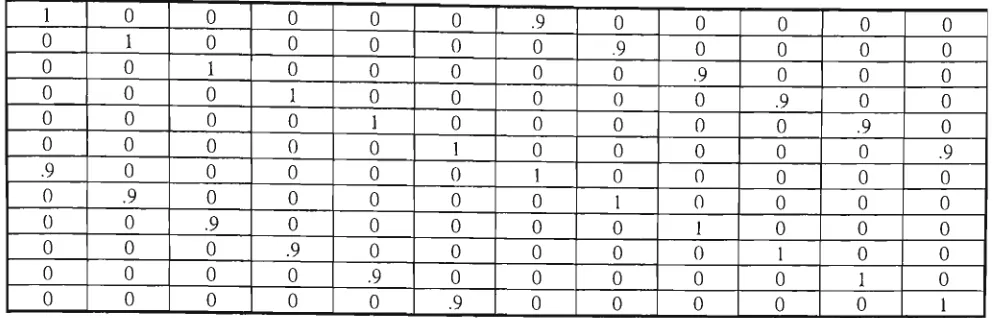
![Table 5.4: Second combination of frequency pairs used to generate [M] and [K] for the cantilever beam model shown in Fig.5.2](https://thumb-us.123doks.com/thumbv2/123dok_us/7942218.1318408/198.565.47.531.263.737/table-second-combination-frequency-pairs-generate-cantilever-model.webp)