Universally Composable Authentication and Key-exchange with
Global PKI
Ran Canetti∗ Daniel Shahaf† Margarita Vald‡ October 9, 2014
Abstract
Message authentication and key exchange are two of the most basic tasks of cryptography. Solutions based on public-key infrastructure (PKI) are prevalent. Still, the state of the art in composable security analysis of PKI-based authentication and key exchange is somewhat unsatisfactory. Specifically, existing treatments either (a) make the unrealistic assumption that the PKI is accessible only within the confines of the protocol itself, thus failing to capture real-world PKI-based authentication, or (b) impose often-unnecessary requirements—such as strong on-line non-transferability—on candidate protocols, thus ruling out natural candidates.
We give a modular and universally composable analytical framework for PKI-based message au-thentication and key exchange protocols. This framework guarantees security even when the PKI is pre-existing and globally available, without being unnecessarily restrictive. Specifically, we model PKI as a global set-up functionality within theGlobal UCsecurity model [Canettiet al., TCC 2007] and relax the ideal authentication and key exchange functionalities accordingly. We then demonstrate the security of basic signature-based authentication and key exchange protocols. Our modeling makes minimal security assumptions on the PKI in use; in particular, “knowledge of the secret key” is not needed.
Keywords: public-key infrastructure, message authentication, digital signatures, key exchange, deniabil-ity, non-transferabildeniabil-ity, universal composability
Contents
1 Introduction 2
1.1 Our results . . . 4
1.2 Related work . . . 7
2 Overview of Generalized UC Security 8 3 The Global Functionality Composition Theorem 11 4 Secure Authentication using Signatures 13 4.1 Signatures and certificates . . . 14
4.2 Using EU-CMA signatures for certification . . . 19
4.3 Defining and realizing non-deniable message authentication . . . 22
5 Non-deniable Key Exchange 24 6 Capturing Invisible Adaptive Attacks 25 References 26
List of Figures
1 A snapshot of an authentication in the system . . . 73 The bulletin-board certificate authority (CA) functionality . . . 14
4 The certification functionality . . . 15
5 The basic signature functionality [Can04] . . . 17
6 The certification with keys functionality . . . 18
7 The signing module . . . 21
8 The non-deniable authentication functionality . . . 23
9 The signature-based authentication protocol . . . 23
10 The non-deniable key exchange functionalityFcert-ke . . . 26
1
Introduction
Background. Guaranteeing authenticated communication over an unauthenticated medium is a fundamental task that is widely used in practice. The problem dates to antiquity: classical ciphers, which in their time were kept in secret, were thus guaranteeing authenticity as well, and even coins were (and are) a form of authenticated communication: the bearer of forged coins is but an active attacker on the communications link between the mint and the merchant. Defined, authentication is the task of linking the identity of an actor in a session (such as the author of a received message) to a longer-lived entity, process, oridentity, that exists beyond the scope of the session or action being verified.
In modern times the demand for authentication has redoubled: every telephone call, every email, every credit card swipe involves multiple authentications—and is becoming more and more frequent an occurrence. Furthermore, nearly every cryptographic protocol uses authentication as an assumed ground-layer component; and even anonymous, public services, which do no userauthentication, may still engage in useridentification. Overall, the increasing pervasiveness of technology and Internet connectivity makes more and more people consumers of authenticity, which increases the demand for practical cryptosystems in general and for public-key-based cryptosystems in particular.
Public-key-based authentication. Authentication may be done in many different ways, such as biometric human identification, or via some pre-shared longer-term secret (such as a pre-shard key or a password). In this work, however, we concentrate on public-key authentication, as put forth in the groundbreaking work of Diffie and Hellman [DH76]: The parties have noà priorishared secret information or other physical means for authentication. The only mechanism available for authenticating messages is a globally-accessible public records database that allows actors to record arbitrary information; each record is made publicly available and linked to the public identity of the actor who created it. We call this setting theglobal public-key
infrastructure(PKI) setting.
A simple and frequently-used message authentication protocol in this setting proceeds as follows. For Alice to send an authenticated message to Bob, Alice signs the message, her and Bob’s identities, and a session identifier all together (using her private key) and sends the message and the signature to Bob over an unauthenticated channel. Bob authenticates the message by obtaining Alice’s public key from the PKI and verifying the signature.
Another, almost equally simple authenticated key exchange protocol is the following: Alice sends to Bob her Diffie-Hellman messagega, bob responds by sending his Diffie-Hellman messagegb, together withga and a signaturesB=SigBob(ga,gb,‘Alice’). Alice responds bysA=SigAlice(ga,gb,‘Bob’). Both parties
are assumed to have each other’s verification key in advance, and verify the signatures to authenticate. (This is essentially the ISO 9798-3 key exchange standard.) For sake of illustration, we keep these two simple protocols, respectively denotedφauthandφke, as running examples throughout this paper. Practical protocols
that useφauthandφke(or close variants thereof) to establish trust in the identity of an interlocutor or in data
payloads are ubiquitous. For instance, they include the TLS standard, chip-and-pin debit cards [EMV11], end-to-end authentication of email contents [RFC 1847], and many others.
Since these protocols use signatures against a globally-available PKI, and send them in the clear over world-readable channels, anyone in the system can verify Alice’s and Bob’s signatures, even though they were intended only for each other. While we recognize this as an inherent property of signatures (namely, they providetransferableverifiability), in the context of authentication this is merely a side-effect which may or may not be desirable.
protocols turns out to be a difficult problem, mainly due to the intricate interactions among the various components of the actual protocols, the public-key infrastructure, and the systems they run in.
Modular analysis. In light of the complexity and ubiquity of authentication protocols, it would be desirable to be able to analyze them in a modular fashion: to abstract out an ideal authentication service for higher-level protocols to use, such that the security of the higher-level protocols would be independent of the details of its implementation. This approach allows consumers of authentication to dynamically replace their authentication implementations—for example, to base authentication on a different setup service or on a different hard problem—without affecting the security of the higher-level protocol. Conversely, modularity also encourages reuse of an authentication module by multiple higher-level protocols, discouraging local,ad hocimplementations.
Several efforts to model public-key based authentication within a composable security framework appear in the literature. Canetti and Krawczyk [CK01] and Shoup [Sho99] perhaps provide the first such guarantees in the context of authenticated key exchange, but their modeling of the public key infrastructure is quite rudimentary and does not allow analyzing the long-term signature and certification module separately from the rest of the protocol.
Other attempts at composable analysis were made in [CK02] and later in [Can04] within the Universally Composable (UC) security framework of [Can01]. (The second work is more directly focused at analyzing the simpleφauth.)
However, these works have the following significant drawback: They treat the public-key infrastructure— namely, the public record with the public information provided by each actor—as a construct that is local to each specific protocol instance and unavailable for use outside that protocol instance. This modeling is inadequate for representing the PKI model as envisioned by Diffie and Hellman and used in practice—where the public information isgloballyavailable. Instead, this analysis guarantees security only when each instance of the analyzed protocol uses its own independent instance of a PKI.
This is the case even if the PKI is modeled as joint to a number of instances of the authentication protocol in question, and composition is argued via Universal Composition with Joint State (JUC) [CR03]. Indeed, even there the PKI is modeled not as a global entity but rather as an entity that is local to a specific collection of instances of some specific protocol.
The works of [MTC13, KMO+14], which are set in the Abstract Cryptography setting of [MR11], have a similar modeling shortcoming: the public key infrastructure is modeled as local to the protocol instance. Furthermore, as argued below, this discrepancy is not merely aesthetic; rather, it has real security implications. Long-lived, global trusted information that is shared among all parties, protocols, and protocol instances in the system are addressed in the Global UC (GUC) framework [CDPW07]. That framework is similar to the (“basic”) UC framework, but directly models trusted entities that are globally available throughout the system regardless of any specific protocol to be analyzed. Authentication protocols with global PKI are analyzed in [DKSW09, Wal08]. However, these works consider only authentication protocols that provide additional properties on top of authenticity: only protocols that provide thenon-transferability(or,deniability) property are considered. This leaves us with the following fundamental question:
A litmus test: the transferability problem. The discrepancy between the security modeling of [CK02, Can04, CR03, MTC13, KMO+14] and real implementations of PKI infrastructure is illustrated by the following issue: while real-life PKI-based authentication is transferable, ideal authentication is not.1
In detail, ideal authentication is defined as a deniable task that leaves “no trace”; it passes a message from the sender to the receiver, but the receiver is unable to subsequently prove to a third party that the authentication had in fact happened. In contrast, some PKI-based authentication protocols (and, in particular, protocolφauth) allow the receiver to obtain atransferableand non-repudiable proof of communication (e.g., a
signature), which can be verified by anyone against the global PKI. Hence, PKI-based authentication protocols are transferable (non-deniable) whenever the PKI is globally available. Moreover, this transferability gap is independent of the security model in use. This was formalized by [DKSW09], which proves that no protocol based on a plain PKI can realize the ideal authentication functionality. Still, in [Can04, CR03, MTC13, KMO+14], protocol φauth (or variants thereof) securely realize an ideal process that guarantees
non-transferable authentication. (Note that moving to a stronger modeling of PKI, where registering parties are required to prove knowledge of a secret key associated with the registered public value, does not solve the problem. Indeed, protocolφauthremains transferable even with such sronger PKI.)
We stress that transferability, or lack thereof, is not the main concern of this work; it only serves an example of the inadequacy of the current models of composable security in capturing the security requirements of PKI-based authentication and key exchange.
What about game-based modeling? The above line of reasoning concentrates on models that provide composable security, more specifically models that define security by way of emulating an ideal process. Can we avoid the difficulties described above by putting general composability aside and instead using game-based modeling of authentication and key exchange? This is an interesting research direction. Indeed, we are not aware of any game-based modeling of authentication and key exchange that directly considers global PKI that can be used (and abused) by arbitrary other applications.
1.1 Our results
We provide a framework for analyzing security of authentication and key exchange protocols that use a globally-available PKI. Our framework adequately represents global PKIs. Specifically, we concentrate on authentication and justifying the security of transferable protocols. To exemplify our framework, we analyze protocolsφkeandφauth, which previously could not be justified in a realistic security model. In particular:
1. We model global PKI as a globally-available bulletin-board that provides minimal guarantees of binding between strings and identities, without requiring or promising any knowledge or secrecy.
2. We relax the UC authentication and key exchange functionalities of [CK02, Can04] to be non-deniable. Our functionalitiesFcert-authandFcert-keallow the adversary to obtain “global” certificates on messages
that have the session id ofFcert-authorFcert-keas a prefix. (A global certificate is one that can be verified by any entity in the system.) In particular, the adversary may obtain a global certificate on the message to be authenticated. This coupling eliminates the authentication functionality’s deniability, without affecting authenticity.
We remark that the underlying technical trick inFcert-authis reminiscent of the one in the relaxed key exchange functionality of [DKSW09]. However, there, one needs a PKI that is only partially-global
and a very specific non-deniable protocol to realize that functionality. In contrast, our goal in this work is to analyze basic protocols with a completely-global PKI.
3. We prove security of the natural public-key-based protocols φauth and φke. The protocols require
no setup beyond a bulletin-board and GUC-securely realize the authentication and key exchange functionalitiesFcert-auth andFcert-ke, respectively.
To the best of our knowledge,this is the first treatment of authentication with a realistic modeling of PKI as a global construct that can be used by arbitrary protocols.
While we concentrate on protocolφauthandφkefor simplicity and clarity, our treatment can be naturally
extended to deal with other PKI-based authentication and key exchange protocols.
Review of UC and GUC. We first briefly review the UC and GUC frameworks. Informally, UC security is defined via a challenge to distinguish between actual attacks, performed by an adversaryAon protocolπand simulated attacks, performed by a simulatorS on protocolφ. The model allows the attacks to be orchestrated by an environmentZ that has an I/O interface to the parties running the challenge protocol (π orφ) and is allowed to freely communicate with the attacker (without knowing whether it isAorS). However, the environmentZisconstrainedto execute only a single instance of the challenge protocol. In this execution model, protocolπis said toUC-emulatethe protocolφ if for any adversaryAattacking a protocolπthere exists a simulatorSattacking protocolφ such that no environment can successfully distinguish these two possible scenarios.
The GUC challenge experiment is similar to the basic UC experiment, only with an unconstrained environment. In particular, nowZ is allowed to invoke and interact with arbitrary protocols, and even multiple sessions of the challenge protocol. The protocols invoked by Z may share subroutines with challenge protocol instances. GUC emulation is defined analogously to basic UC emulation. The UC and GUC frameworks are presented more rigorously in Section 2.
Our methods. We develop a general framework for analyzing PKI-based authentication and key-exchange protocols. Our framework consists of an ideal message authentication functionality (or ideal key-exchange functionality) coupled with a long-lived certificates functionality.
For simplicity we concentrate on the authentication protocol. The treatment of the key exchange protocol is analogous. We formulate an ideal authentication functionality that does not impose unnecessary requirements (such as deniability) on the implementing protocols. The functionality, denotedFcert-auth, is
a sender-receiver functionality that on inputmfrom the sender not only deliversmto the receiver but also allows the adversary to see legitimate signatures on messages of its choice, whichFcert-authobtains from the ideal certificates functionalityGcert. (This does not affectFcert-auth’s authenticity promises sinceFcert-auth
delivers the originalmto the receiver.) This is done as follows:
The adversary determines the message to be signed and hands it toFcert-auth; then,Fcert-auth requests a signature (on behalf of the sender) on the message affixed with the session identifier. The signature obtained by the adversary is thus tied to a specificFcert-auth session and cannot be used in other sessions. Since the signature seen by the adversary is truly generated and can be successfully verified by any entity in the system, deniability (or, non-transferability) is no longer guaranteed. Nonetheless, the essence of authentication—binding an action to some long-lived entity—remains guaranteed. It is captured by coupling
the key exchange protocol, which is the opposite of our purpose here. Indeed, the goal in [DKSW09] is close to diametrically opposite to the goal of this work: Dodiset al.study deniable protocols, whereas we study real-life, non-deniable protocols.
We also show that standard EU-CMA signatures together with a globally-available PKI precisely capture the guarantees provided byGcert, and can be in its stead. That is:
1. We define a global ideal certificate functionalityGcert that is parametrized by a party identity (PID). That is, Gcert is willing to provide certificates on chosen messages to any session of that PID. The verification service is provided to any PID in the system. The authentication functionalityFcert-authwill
provide certificates generated byGcertto the adversary.
2. To realizeGcert, we define a signing moduleGΣ, parametrized by a PID, that holds the secret key (of
some signature scheme) and similarly toGcertis willing to provide signing service to any session of that PID. Similarly to [CK01], our signing module enables modeling “key knowledge” and “signing capabilities” separately. Separation of long-term key handling and signing module from session module is an essential part of security modeling of key-exchange and secure sessions: it preserves security of sessions even when other sessions using the same public-key are compromised. This was not done previously in any UC-based framework.
3. We show a GUC-secure realization of ideal certificatesGcertfrom standard EU-CMA signatures (where the secret key is kept in the signing module).
We exemplify the usability of our model by analyzingφauthandφkeand the signed key exchange protocol
of Diffie-Hellman ISO 9798-3 within it and showing it GUC-realizesFcert-authandFcert-ke, respectively. (The complete realization ofFcert-authwithin our framework is depicted in Figure 1).
To this end, we formalize new composition theorems that allow reduction between global functionalities. The first theorem (in Section 3) shows that a secure realization of functionalityGis sufficient for replacing any use ofG(as a global functionality) withG’s implementation:
Theorem 1.1 (informal statement). Letπ be a protocol with access to global functionalityG. If a
function-alityF GUC-realizesG, thenπ using globalF GUC-realizesπusing globalG.
Our second composition theorem presents the necessary conditions, required from a pair of global functionalities, such that any secure protocol GUC-realizing some task using globally one of the functionalities would remain equally secure using the other:
Theorem 1.2 (informal statement). Letπ andφbe protocols with access to global functionalityG. Ifπ
GUC-realizesφ, the functionalityF GUC-realizesGandGGUC-realizesF, thenπGUC-realizesφwith
access to global functionalityF.
Gbb
Signing module
sid1 sidi
pid1
Signing module
sid1 sidj
pid2
φauth
φauth
more
φauth’s
Figure 1: A snapshot of an authentication in the system. The signing module together withGbbis an instantiation
ofGcert. Each party participates in multiple executions ofφauth, one per session. Each session may involve a different
interlocutor (not limited topid1andpid2). The bulletin-boardGbbis shared with many other protocols executing in the
system. The parties also obtain signatures from their local signing module instances upon demand.
1.2 Related work
Due to the fundamentality of the problem, there been a vast line of works on secure authentication and its equivalent problem of key exchange. PKI-based authentication can be examined from three different angels: the composability guarantees of the model, the modeling of the PKI, and the deniability guarantees of the ideal authentication. We concentrate on composable settings, where the authentication (or key exchange) maintains its security guarantees when used as a component in building complex protocols.
UC-based models. Many works [CK02, FAK08, CG10, AF10] analyze key agreement and key exchange protocols in the UC framework. However, like [Can04], they also model the PKI as local to the protocol instance. Another line of works in UC prohibit honest participants from engaging in multiple sessions concurrently [LBdM07, BLdMT09] or assume password-based security and erasures [DF12]. Likewise, here the PKI modeling does not allow external protocols to access the PKI.
Dodiset al.[DKSW09, Wal08] study deniable authentication in a GUC setting. They prove it impossible to securely realize standard message authentication in GUC with merely a standard PKI. To overcome this impossibility result, they present a non-transferable authentication protocol based on symmetric keys. The symmetric keys are obtained from a non-standard PKI. However, their protocol has two drawbacks: Its security proof requires a strong PKI (namely, key registration with proof of knowledge of the secret key) and their protocol is somewhat less efficient thanφauth. Most importantly, that framework cannot be used to
justify the security ofφauthas a basic authentication protocol.
The Abstract Cryptography (AC) model. Maureret al.[MTC13] implement authenticated channels in the Abstract Cryptography setting of [MR11]. Their construction is composable, uses the canonical signature-based authentication protocol (φauth) and assumes a standard PKI. Still, similarly to Canetti [Can04], these
works treat the PKI as alocalfunctionality that services only a single instance of an authentication protocol. Indeed, their abstraction of an authentication channel is deniable, while their protocol is PKI-based.
Game-based models. The work of [CK01] develops a game-based framework for analyzing the key exchange problem;. Later, [BFS+13] proposed a framework with stronger composability guarantees to enable analysis of the TLS protocol. However, both frameworks allow only limited composition and model the PKI as a setup inaccessible by other protocols.
Other models. Kidron and Lindell [KL07] study impossibility results in a number of public-key models. However, none of the considered public-key models are in a global setting, and thus do not address the issue at hand. Baraket al.[BCL+05] study what notion of security is achievable in a PKI-less setting. Their work does not address the setting of global PKI.
Invisible adaptive attacks. Nielsen and Strefler [NS14] point out a weakness in definitions of security in the GUC model, calledinvisible adaptive attacksand propose a general way to fix the weakness. We demonstrate in Section 6 that our protocols satisfy even that stronger definition.
2
Overview of Generalized UC Security
To provide the proper setting for the authentication, we now review the original UC [Can01, Can00] (referred to as basic UC) and Generalized UC [CDPW07] frameworks.2 We will focus on the notion of protocol
emulation, wherein the objective of a protocolπis to imitate another protocolφ. In this work, the entities
and protocols we consider are polynomial-time bounded Interactive Turing Machines, in the sense detailed in [Can01].
The Basic UC Framework. At a very high level, the intuition behind security in the basic UC framework is that any adversary Aattacking a protocol π should learn no more information than could have been obtained via the use of a simulatorSattacking protocolφ. Furthermore, we would like this guarantee to hold even ifφwere to be used as a subroutine in arbitrary other protocols that may be running concurrently in the networked environment and after we substituteπ forφ in all the instances where it is invoked. This requirement is captured by a challenge to distinguish between actual attacks on protocolφ and simulated attacks on protocolπ. In the model, attacks are executed by an environmentZthat also controls the inputs and outputs to the parties running the challenge protocol. The environmentZ isconstrainedto execute only a single instance of the challenge protocol. In addition, the environmentZis allowed to interact freely with the attacker (without knowing whether it isAorS). At the end of the experiment, the environmentZis tasked with distinguishing between adversarial attacks perpetrated byAon the challenge protocolπ, and attack simulations conducted bySwith protocolφacting as the challenge protocol instead. If no environment can successfully distinguish these two possible scenarios, then protocolπis said toUC-emulatethe protocolφ.
Balanced environments. In order to keep the notion of protocol emulation from being unnecessarily restrictive, we consider only environments where the amount of resources given to the adversary (namely, the length of the adversary’s input) is at least some fixed polynomial fraction of the amount of resources given to all protocols in the system. From now on, we only consider environments that are balanced.
Definition 2.1 (UC-emulation). Letπ andφbe multi-party protocols. We say thatπUC-emulatesφ if for
any adversaryAthere exists an adversaryS such that for any (constrained) environmentZ, we have:
EXECπ,A,Z≈EXECφ,S,Z
Defining protocol execution this way is sufficient to capture the entire range of network activity that is observable by the challenge protocol but may be under adversarial control. Therefore, the UC framework admits a very strong composition theorem, which guarantees that arbitrary instances ofφthat may be running in the network can be safely substituted with any protocolπ that UC-emulates it. More formally,
Definition 2.2 (Subroutine-respecting protocols; [Can00]). We say that a protocol π is subroutine-respecting if the following properties hold with respect to every instance ofπ in any execution of any
protocolρthat makes subroutine calls toπ:
1. No ITI which is a subsidiary of this instance passes inputs or outputs to an ITI which is not a party or subsidiary of this instance.
2. At first activation, each ITI that is currently a subsidiary of this instance, or will ever become one,
sends a special message to the adversary, notifying it of its own code and identity, as well as the codeπ
and SID of this instance. We call this requirementsubroutine publicness.3
Theorem 2.3 (UC-Composition). Letρ,π andφ be protocols such thatρ makes subroutine calls toφ. Ifπ
UC-emulatesφand bothπ andφ are subroutine-respecting, then protocolρπ/φ UC-emulates protocolρ.
The Generalized UC Framework. As mentioned above, the environmentZin the basic UC experiment is unable to invoke protocols that share state in any way with the challenge protocol. In many scenarios, the challenge protocol produces information that is shared by other network protocol sessions. For example, protocols may share information via a global setup such as a public Common Reference String (CRS) or a standard Public Key Infrastructure (PKI) The basic UC framework discussed above does not address this kind of shared state; moreover, the UC composition theorem does not hold for non-subroutine-respecting protocols (i.e., protocols that share state information with other protocol sessions). Still, we would like to analyze such protocols in a modular way. To overcome this limitation, [CDPW07] propose the Generalized UC (GUC) framework. The GUC challenge experiment is similar to the basic UC experiment, only with an
unconstrainedenvironment. In particular, nowZis allowed to invoke and interact with arbitrary protocols,
and even multiple sessions of the challenge protocol. Some of the protocol sessions invoked by Z may even share state information with challenge protocol sessions, and indeed, those protocol sessions might provideZ with information related to the challenge protocol instances that it would have been unable to obtain otherwise. To distinguish this from the basic UC experiment, we denote the output of an unconstrained environmentZ, running with an adversaryAand a challenge protocolπ in the GUC protocol execution experiment, by GEXECπ,A,Z. GUC emulation is defined analogously to the definition of basic UC emulation
outlined above:
Definition 2.4 (GUC-emulation). Letπandφ be multi-party protocols. We say thatπGUC-emulatesφ if
for any adversaryAthere exists an adversaryS such that for any (unconstrained) environmentZ, we have:
GEXECπ,A,Z≈GEXECφ,S,Z.
The External-subroutine UC Framework. The great generality provided by the GUC framework also raises difficulties in proving security of protocols in it. Observing real scenarios, it turns out to be sufficient to model shared state information via the use of “shared functionalities”, which are simply functionalities that may interact with more than one protocol session (such as the PKI functionality). For clarity, we distinguish the notation for shared functionalities by adding a bar. We call a protocolπ that only shares state information via a single global functionality ¯Ga ¯G-subroutine respectingprotocol (Definition 2.2 is extended to allow communication with ¯G). Moreover, a ¯G-externally constrained environment is subject to the same constraints as the environment in the basic UC framework, only it is additionally allowed to invoke a single ITI that runs the code of ¯G. Thus, any state information that will be shared by the challenge protocol must be shared via calls to ¯G(i.e., challenge protocols are ¯G-subroutine respecting), and the environment is specifically allowed to access ¯G. AlthoughZis once again constrained to invoking a single instance of the challenge protocol, it is now possible forZto internally mimic the behavior of multiple sessions of the challenge protocol, or other arbitrary network protocols, by making use of calls to ¯Gwherever shared state information is required. We allow the environment direct access to shared state information. This security notion is called External-subroutine UC (EUC) security. The EUC-security notion collapses to UC-security for subroutine-respecting protocols (Definition 2.2).
Given a ¯G-subroutine respecting protocolπ, we denote the output of the environment in the EUC protocol experiment by EXECπ,G¯,D,Z. The EUC-emulation definition presented here is an extension of the emulation
definition appearing in [CDPW07]. The new definition allows a protocolπ to emulateφ using a different shared functionality thanφuses. More formally,
Definition 2.5 (EUC-emulation). Letπandφ be multi-party protocols, whereπ isF¯-subroutine respecting
andφ isG¯-subroutine respecting. We say thatπ EUC-emulatesφ if for any adversaryA there exists a
adversaryS such that for anyF¯-externally constrained environmentZ, we have:
EXECπ,F¯,D,Z≈EXECφ,G¯,S,Z.
Note that a ¯F-subroutine respectingπcommunicates with the global functionality ¯F(similarly,φwith ¯G). We remark that, in the underlying model, the substitution of ¯Gfor ¯F is done by changing the control function (so that messages addressed to ¯F are implicitly delivered to ¯Ginstead), in a similar manner to the changes effected thereto when substitutingφforπin UC or GUC.
Ideal protocols ([Can01, Can00]). LetF be an ideal functionality andsidbe its session ID. The ideal protocolIDEALF forF is defined as follows: Whenever a dummy party is activated with inputv, it writesv onto the input tape of the ideal functionalityF(sid,⊥)(recall that this message includes the extended identity of
the calling ITI). Messages delivered by the adversaries, including corruption messages, are ignored. Whenever a dummy party receives a valuevfromFon its subroutine output tape, it writes this value on the subroutine output tape of an ITI instructed byF. Specifying the output destination enables an ideal functionalityF
to communicate with another (shared) ideal functionality ¯Qvia the dummy party. Such functionalityF is called ¯Q-subroutine respecting functionality. We say that a functionalityF EUC-realizes an functionalityG
ifIDEALF EUC-emulatesIDEALG. GUC-realization is defined analogously.
Since the class of ¯G-subroutine respecting protocols captures a broad range of real-life protocols, we focus our attention on those. For this class of protocols, [CDPW07] shows that GUC-emulation is equivalent to EUC-emulation.
Theorem 2.6 ([CDPW07]). LetGbe some ideal functionality and letπandφ beG¯-subroutine respecting
Although it is not stated in [CDPW07], subroutine publicness ofφ, as described in Definition 2.2, is necessary for the equivalence to hold.
As a special case, if the challenge protocol does not share any state information (i.e., it is subroutine-respecting according to [Can01]), then Theorem 2.6 states that GUC- and UC-security are equivalent.
3
The Global Functionality Composition Theorem
Suppose a protocolρ uses another protocolφ as a subroutine. Global UC [CDPW07] shows that we can replace the use ofφ with any protocolπ that GUC-emulates it. This replacement maintains the security of the composed protocol, even if both the calling protocolρ and the subroutine protocol (φorπ) have access to the same instance of a global ideal functionality. However, it is unknown whether it is safe to replace the global functionality with something “equivalent”. Such a replacement would be useful, for example, for designing protocols using an efficient signatures scheme (with keys that can be used concurrently by any other protocols) and analyzing their security using an ideal signatures functionality.
In this section we provide a new composition theorem that handles security of global functionality replacement. Informally, the theorem states that a protocol that shares state via a global functionality ¯G
remains secure if we replace this functionality with a different (presumably weaker) global functionality ¯F, provided thatFis a secure implementation ofG. The theorem holds even if the global functionalities share state via a third global functionality. (In Section 4, this theorem is used to substitute an ideal certification functionality, which shares state via a global PKI functionality, by EU-CMA signatures.)
Theorem 3.1 (Generalized Functionality Composition). LetG,FbeQ¯-subroutine respecting
functionali-ties, for some ideal functionalityQ. Letπbe aG¯-subroutine respecting protocol. IfFEUC-realizesG, then
πF¯/G¯ GUC-emulatesπ.
Proof. We denote byπ andπ0 the protocolsπG¯ andπF¯/G¯ respectively. We first prove thatπ0EUC-emulates
π and then show that GUC-emulation follows. We make use of an equivalent formulation of emulation with respect to dummy adversaries. Thus, denoting the dummy adversary byD, we wish to construct an adversaryS such that:
EXECπ0,F¯,D,Z≈EXECπ,G¯,S,Z
for any(F¯,Q¯)-constrained environmentZ. SinceF EUC-realizesGthere is an adversarySF such that
EXECF,Q¯,D,ZF ≈EXECG,Q¯,SF,ZF (1)
for any ¯Q-constrained environmentZF. That is,SF expects to interact withGand ¯Q, and translates it to
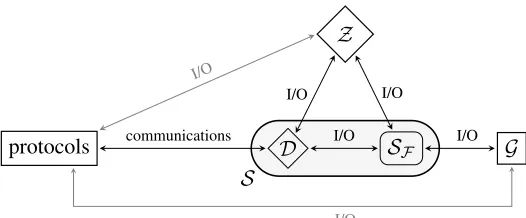
mimic the action of the corresponding execution ofFand ¯Qfrom the viewpoint of any environmentZF. We present and analyzeS. (We note that the construction ofSand the proof of its validity are reminiscent of the treatment in in [CDPW07]. Still, the context is quite different.) The construction idea is to internally run a single copySF to mimic all the calls toFand route all relevant messages through this adversary. In addition, the adversarySbehaves as follows:
1. forwarding all messages intended for ¯F sent by the environmentZ to its internal simulation ofSF, as
well as forwarding any messages fromSF back toZas appropriate.
D SF S
Z
protocols communications I/O G
I/O I/O
I/O
I/O
I/O
(a)The simulatorSinteracting with the protocolπand the global
functionalityG.
Z D
protocols
I/O
I/O communications
ˆ
Z
GorF SForD
I/O I/O
I/O
(b)The environment ˆZconstructed out ofZ. The entire system is executed inside ˆZexcept for the interaction with the global functional-ity, which is eitherForG.
Figure 2:The simulatorSand the distinguishing environment ˆZconstructed in the proof.
3. forwarding all messages ofSF to the functionality ¯Gand back, as appropriate. This is done using the
subroutine publicness property, as explained in Definition 2.2).
A graphical description ofScan be found in Figure 2(a).
In order to prove thatSsatisfies the required, we perform a standard proof by contradiction. Assume there exists an environmentZ capable of distinguishing the interaction withSandπfrom the interaction withDandπ0. We show how to construct an environment ˆZsuch that
EXECπ,G¯,S,Z =EXECG,Q¯,SF,Zˆ
and
EXECπ0,F¯,D,Z =EXECF,Q¯,D,Zˆ.
The environment ˆZwill internally runZand behave as follows: Any message fromZtoFis forwarded to the external adversary. Any output from the external adversary is forwarded back toZ. Any other message fromZis internally simulated. That is, ˆZinternally executes the dummy adversaryDand honestly simulates any uncorrupted entity in the execution (i.e., parties of π and parties of other protocols). Whenever an internally simulated honest party provides an input toF or ¯Q, the environment ˆZforwards it externally and the response is forwarded back to the internal honest party. Eventually, the environment ˆZoutputs whatever
Zoutputs. The environment ˆZ is depicted in Figure 2(b).
It follows from the construction that if the external adversary isDthenZ interacts with the dummy adversaryD, the protocolπ0and functionalityF. If the external adversary isSF thenZ interacts withD
where all of its accesses toFare replaced with accesses toGviaSF. This is exactly the execution ofZwith
the adversaryS and the protocolπwith access toG. Hence, existence of such distinguishing environmentZ contradicts Equation (1) as desired.
Note that the components ofS (i.e., the dummy adversaryDand simulatorSF) can handle multiple
instances ofπand thereforeScan simulateπ0with unconstrained environment as well. In other words,
for any unconstrained environmentZ.
Informally, secure realization allows replacing any use of an idealized task by an implementation of the task, in a localized manner (that is, without having to consider the rest of the system). In particular, if a protocolπ securely implements another protocolφ, where ¯Gexists in the system, then we intuitively expect πto continue to securely implementφ after we replace ¯Gwith some ¯Fthat securely implements ¯G. However, this intuition is misleading. Consider, for example, some functionalityFand letGbe asF but with extra capabilities granted to the adversary. The functionalityF (trivially) securely implementsG, since it is a restriction ofG. However, the simulation ofπ might be such that it uses the extra adversarial capabilities given him by ¯G. Thus, once we replace ¯Gwith ¯Fthe simulation becomes invalid, and moreover, the extra capabilities might be essential to the simulation ability. This hints that in order for the intuition to hold, it must be the case that ¯F and ¯G must have “similar” adversarial interfaces. This is formally captured as follows:
Theorem 3.2. LetG,FbeQ¯-subroutine respecting functionalities, for some ideal functionalityQ. Letπ,φ
beG¯-subroutine respecting protocols. If the following holds:
1. πGUC-emulatesφ.
2. FEUC-realizesGand vice versa.
ThenπF¯/G¯ GUC-emulatesφF¯/G¯.
Proof. The theorem fully follows from Theorem 3.1. We denote byπ and φ the protocols πG¯ and φG¯
respectively. More formally, by Theorem 3.1 and Item (2.) we obtain thatπF¯/G¯GUC-emulatesπ. Combining this with Item (1.) we obtain thatπF¯/G¯ GUC-emulatesφ. Next, using again Theorem 3.1 with Item (2.) we infer thatφGUC-emulatesφF¯/G¯ and conclude thatπF¯/G¯GUC-emulatesφF¯/G¯as desired.
Such composition enables the GUC-framework to offer full modularity in analyzing protocols.
4
Secure Authentication using Signatures
As discussed in the introduction, the standard authentication functionalityFauthis unimplementable in a GUC setting with fully global PKI since it requires non-transferability (deniability). However, thisde jure impossibility does not prevent people from using digital signatures in day-to-day communications to achieve an authentication guarantee.
In this section, we bridge the gap between practical and provably secure authentication. We show that the classic, signature-based authentication protocol implements (transferable) authentication using standard public key infrastructure (PKI). That is, we formalize the “Authentication via signatures” paradigm in a GUC setting and present a functionality which encapsulates it.
This has two benefits: it allows for analyzing in the modular setting of GUC real-life protocols that use digital signatures as a building block, and it increases the trust in the signature-based authentication protocol by proving it secure under GUC’s strong composition operation.
Global FunctionalityG¯bb
Report: Upon receiving a message(Register,v)from partyP, send(Registered,P,v)to the adversary; upon receiving ok from the adversary, and if this is the first request from P, then record the
pair(P,v). Otherwise, ignore the new message.
Retrieve: Upon receiving a message(Retrieve,Pi)from some partyPj (or the adversaryS), generate a
public delayed output(Retrieve,Pi,v)toPj, wherev=⊥if no record(Pi,v)exists.
Figure 3:The bulletin-board certificate authority (CA) functionality. Any ITI can register a single key that would be associated with its identity. Any ITI in the system can request the key of any other ITI.
4.1 Signatures and certificates
We formulate a global ideal functionality, ¯Gcert, that provides ideal binding of messages to party identities.
Then, we present a protocol that realizes ¯Gcertgiven the classicalFsigand a public bulletin-board ¯Gbb. The key difference in our setting is that ¯Gcertis accessible at any time, by any party, no matter which protocols it participates in. Another important difference from previous formulations is that the public key lives in a global bulletin-board, to capture the fact that a principal has a single keypair (“secret”) which she uses in multiple protocols. We start by presenting ¯Gbband ¯Gcert. For simplicity of exposition, we present the protocol as an ideal functionality called ¯Gcwk.
The bulletin board functionality. The global bulletin board functionality, ¯Gbb, is presented in Figure 3.
The bulletin board accepts only the first registered value, and does not allow to modify or delete it.4 The bulletin board is authenticated in a sense that it records the value along with the identity of the publisher, but does not perform any checks on the registered value; it simply publicly records the value. Nonetheless, as we will show later, the present minimal formulation suffices for authentication.
The certification functionality. The ideal certification functionality, ¯Gcert, is presented in Figure 4. The session ID names a distinguished principal, the ‘signer’. The functionality provides direct binding between a message and the identity of the signer. (In contrast,Fsig, which appears in Figure 5, binds a message only to a verification key.) Using common terminology, this corresponds to providing signatures accompanied by “certificates” that bind the verification process to the signer’s identity. The functionality generates a key for each new signer; however, the key is used only to register in the bulletin-board. That is, neither signing nor verification is done with respect to this key. Verification (and signing) requests are processed only if the signer is registered in the bulletin-board, however, they are indifferent to the registered value. Lastly, corrupted signers are allowed to dictate the verification result. We note that ¯Gcertis a ¯Gbb-subroutine respecting functionality as defined in Section 2.
We model the certificate authority in a simplistic way, by associating each ¯Gcertwith an owner PID, and
providing certificates to any session of the owner. A more sophisticated modeling could have the certificate authority provide certificates according to some policy provided by the owner. For example, policies that
Global FunctionalityG¯certpid
Parameterized by a party identitypid, global functionality ¯Gcertpid proceeds as follows:
Signature Generation: Upon receiving a value(Sign,sid,m)fromPpiddo:
(a) Verify thatsid= (pid,sid0)for somesid0. If not, then ignore the request. (b) If this is the first request then do:
(i) IfPpidis honest then generate a verification key (i.e., run the Key Generation procedure
described in Figure 5). Upon receiving(Verification Key,sid,v)from the adversary, send
(Register,pid,v)to ¯Gbb(done via an output toPpid).
(ii) Else, check thatPpidis registered in the ¯Gbb(i.e., send(Retrieve,pid)and verifying that
v6=⊥). If not, then ignore the request.
(c) Send(Sign,sid,m)to the adversary. Upon receiving(Signature,sid,m,σ)from the adver-sary, verify that no entry(m,σ,0)is recorded. If it is, then output an error message toPpid.
Else, output(Signature,sid,m,σ)toPpid, and record the entry(m,σ,1).
Signature Verification: Upon receiving a value (Verify,sid,m,σ) from some party P, where sid= (pid,sid0) for somesid0, check whether a pair(pid,v) is recorded. If not, send(Retrieve,pid) to ¯Gbb, and obtain a response (Retrieve,pid,v). Ifv=⊥then output(Verified,sid,m,0). Else,
record(pid,v)and hand (Verify,sid,m,σ)to the adversary. Upon receiving(Verified,sid,m,φ) from the adversary do:
(a) If(m,σ,b0)is recorded then set f=b0.
(b) Else, if the signer is not corrupted, and no entry(m,σ0,1)for anyσ0 is recorded, then set f=0 and record the entry(m,σ,0).
(c) Else, set f=φ, and record the entry(m,σ,φ).
Output(Verified,sid,m,f)toP.
Corruption: Upon receiving a value (Corrupt,sid) from the adversary, ifsid= (pid,sid0) mark the partyPpid as corrupt.
allow sessions of other PIDs to generate certificates would capture a more refined notion of trust (“delegated signers”).
The certification with keys functionality. The functionality is a different presentation of the protocol in [Can04]; it is used to realize the certification functionality. For an uncorrupted party it offers the capabilities of signing a message (reserved for the owner PID) and verifying a signature. It also captures the ways in which a corrupted party may deviate: as a signer, a corrupted party may refrain from registering the generated key in the bulletin-board, and as a verifier it may request verification of messages with respect to keys of its choice (instead of the key registered in the bulletin-board). The only difference between the two formulations is the inability of a corrupted signer to generate a signing key without providing a message to be signed. Nonetheless, the capabilities of the attacker with respect to the formulations are equivalent. A formal description appears in Figure 6. We note that ¯Gcwkis a ¯Gbb-subroutine respecting functionality, as defined in
Section 2.
Claim 4.1. The functionalityGcwkEUC-realizes functionalityGcertand vice versa, with respect to adaptive
corruptions.
Proof. First we observe that as long as verification requests are done with the actual verification key, the
functionalities are equivalent. To handle the other scenarios, we use the simulator’s ability to postpone signature requests of corrupted signers up to the verification moment.
We begin by showing thatGcwkGUC-realizes functionalityGcert. The simulation here is even simpler than
in [Can04] due to the existence of ¯Gbbalso in the ideal execution. We make use of an equivalent formulation of GUC-emulation with respect to dummy adversaries. Thus, denoting the dummy adversary byD, we wish to construct an adversarySsuch that:
GEXECGcwk,D,Z≈GEXECGcert,S,Z (2)
The adversaryS is specified as follows. For signature generation, if the signer is honest then behave as the dummy adversaryD. That is, any output ofGcertand ¯Gbbis forwarded toZand any input ofZis forwarded
toGcert or ¯Gbb, in an appropriate manner. It also records the generated key v. If the signer is corrupted, Sbehaves as follows: for the first sign request it verifies that the signer is registered in ¯Gbb(if not it ignores the sign request) and simulates the key generation procedure. After recording the generated keyvit simulates the signature generation process, without involvingGcert, and records the tuple(m,σ,v,1)whereσ is the signature chosen byZ(except when a record(m,σ,v,0)exists, in which case it outputs an error message). Note thatGcertdoes not receive any sign requests from a corrupted signer during the simulation of signature generation. Signing usingGcertis postponed, and executed only if a verification request is received for this
record.
For signature verification, we simulate differently depending on the integrity of the signer and the key used by the verifier. If the signer is honest and some uncorrupted party makes a verification request (or a corrupted party that is using the key registered in ¯Gbb) then do the following:
(a) behave as a dummy adversaryDin the retrieve process (if executed).
(b) Once(Verify,sid,m,σ)received, append the verification key, which is recorded in ¯Gbb, and forward
Global FunctionalityFsigpid
Parameterized by a party identitypid, functionalityFsigpid proceeds as follows:
Key Generation: Upon receiving a value (KeyGen,sid) from some partyPpid verify that this is the
first request and sid = (pid,sid0) for some sid0. If not, then ignore the request. Else, hand
(KeyGen,sid)to the adversary. Upon receiving(Verification Key,sid,v)from the adversary, output
(Verification Key,sid,v)toPpid.
Signature Generation: Upon receiving a value (Sign,sid,m)from Ppid, verify that sid= (pid,sid0)
for some sid0. If not, then ignore the request. Else, send(Sign,sid,m) to the adversary. Upon receiving(Signature,sid,m,σ)from the adversary, verify that no entry(m,σ,v,0)is recorded. If it is, then output an error message toPpid and halt. Else, output(Signature,sid,m,σ)toPpid, and
record the entry(m,σ,v,1).
Signature Verification: Upon receiving a value (Verify,sid,m,σ,v0) from party P, where sid = (pid,sid0) for somesid0 verify that a pair(pid,v)is recorded. If not, output(Verified,sid,m,0)
toP. Else, hand(Verify,sid,m,σ,v0)to the adversary. Upon receiving(Verified,sid,m,φ)from
the adversary do:
(a) Ifv0=vand the entry(m,σ,v,1)is recorded, then set f =1. (This condition guarantees completeness: If the verification key v’ is the registered one andσis a legitimately generated signature form, then the verification succeeds.)
(b) Else, ifv0=v, the signer is not corrupted, and no entry(m,σ0,v,1)for anyσ0 is recorded, then set f=0 and record the entry(m,σ,v,0). (This condition guarantees unforgeability: If v0is the registered one, the signer is not corrupted, and never signedm, then the verification fails.)
(c) Else, if there is an entry(m,σ,v0,f0)recorded, then let f =f0. (This condition guarantees consistency: All verification requests with identical parameters will result in the same answer.)
(d) Else, let f=φand record the entry(m,σ,v0,φ)
Output(Verified,sid,m,f)toP.
Corruption: Upon receiving a value(Corrupt,sid)from the adversary, ifsid= (pid,sid0)then mark the partyPpid as corrupt.
Global functionalityG¯cwkpid for realizingG¯cert
The functionality ¯Gcwkpid internally runs the code ofFsigand proceeds as follows:
Signature Generation: Upon receiving a value(Sign,sid,m)fromPpid, do:
(a) Verify thatsid= (pid,sid0)for somesid0. If not, then ignore the request. (That is, verify that it is the legitimate signer for thissid.)
(b) If this is the first request then do:
(i) IfPpidis corrupted, then verify thatPpidis registered in ¯Gbb(otherwise, then ignore the
request).
(ii) Generate a verification key, i.e., send (KeyGen,sid) to Fsig. Upon receiving
(Verification Key,sid,v), send(Register,pid,v)to ¯Gbb(done via an output toPpid).
(c) Send (Sign,sid,m) to Fsig. Upon receiving (Signature,sid,m,σ) from Fsig, output
(Signature,sid,m,σ)toPpid.
Signature Verification: Upon receiving a value(Verify,sid,m,σ), wheresid= (pid,sid0)for somesid0, check whether a pair(pid,v)is recorded. If not, send(Retrieve,pid)to ¯Gbb, and obtain a response
(Retrieve,pid,v). If v=⊥ then output (Verified,sid,m,0). Else record (pid,v). Next, send
(Verify,sid,m,σ,v)toFsig, and output the response(Verified,sid,m,f).
Corrupted Signature Verification: Upon receiving a value(Verify,sid,m,σ,v0) from the adversary, wheresid= (pid,sid0)for somesid0, send(Verify,sid,m,σ,v0)toFsig, and output the response
(Verified,sid,m,f).
Corruption: Upon receiving a value(Corrupt,sid)from the adversary, forward it toFsig.
Figure 6: The certification with keys functionality. The functionality ¯Gcwk is parametrized by a party identity and
internally executes the code of the basic signature functionalityFsig. The functionality does not allow generating a key
For corrupted signer, upon receiving a verification request from a honest verifier (or a corrupted verifier that is using the key registered in ¯Gbb) do the following:
(a) behave as a dummy adversaryDin the retrieve process (if executed).
(b) if a record(m,σ,v0,1)exists, wherev0is the key registered in ¯Gbb, forward a sign request onmtoGcert, pickσ to be the signature and delete the record.
(c) behave exactly as in the honest signer honest verifier scenario to emulate the communication withZ. That is, append the verification key, which is recorded in ¯Gbb, and forward it to to the environmentZ.
The response ofZis forwarded back toGcert.
In case a verification request is made with a key that does not match the key registered in ¯Gbb, independently of
the signer’s integrity, then simulate the verification process by givingZthe appropriate(Verify,sid,m,σ,v00) and obtaining its responseφ. Next, if the tuple(m,σ,v00,b0)is recorded, setφ=b0, else record(m,σ,v00,φ). In any case, output(Verified,sid,m,φ). It is important to note that verification requests withv006=v are simulated without involvingGcert.
Since the simulator does nor perform any cheating, the simulation is perfect. That is, the environmentZ’s view of an interaction withS andGcert is distributed identically to its view of an interaction with parties
running protocolGcwkin the ¯Gbb-hybrid model, even ifZis computationally unbounded.
Now we show the other direction: Gcert GUC-realizes functionalityGcwk. Signature generation for a honest signer is simulated by behaving as a dummy adversaryD. If the signer is corrupted, we forward the signing request toGcwkand pick the key forFsigto be the key registered in ¯Gbb. In the verification process, as before, retrieve is simulated by behaving as a dummy adversary. Upon receiving(Verify,sid,m,σ,v) fromGcwk, the simulator dropsvand forwards the modified message toZ. The response(Verified,sid,m,φ)
ofZis forwarded toGcwk. Note that the simulator ensures that the key in ¯Gbbis the same as the key registered inFsig. Therefore, all simulated verification requests are made with respect to the correct key, and hence answered exactly as in the real execution. This follows from the functionalities being identical when the verification is done with the key recorded inFsig.
4.2 Using EU-CMA signatures for certification
[Can04] shows that realizingFsigis equivalent to being EU-CMA secure (existential unforgeability against chosen message attacks; [GMR88]). However, his theorem does not apply to a setting where the keys are reused by arbitrary protocols. This section extends the connection between ideal signatures and EU-CMA security to the GUC setting. We first briefly restate the [GMR88] notion and show its equivalence to ¯Gcwk.
A signature scheme is a triple of PPT algorithmsΣ= (gen,sig,ver), wheresigmay maintain local state between activations.
Definition 4.2 ([GMR88]). A signature scheme Σ= (gen,sig,ver) is called EU-CMA if the following
properties hold for any negligible functionνand all large enough values of the security parameterκ.
Completeness: For any message m,Pr
(s,v)←gen(1κ);σ←sig(s,m); 0←ver(m,σ,v)
<ν(κ). Consistency: For any m, the probability thatgen(1κ)generates(s,v)andver(m,
σ,v)generates two different
outputs in two independent invocations is smaller thanν(κ).
Unforgeability: For any PPT forger F,
Pr[(s,v)←gen(1κ);(m,σ)←Fsig(s,·)(v); 1←ver(m,
Hash-then-sign. In practice, protocols often authenticate messages by signing a collision-resistant hash value of the message, as opposed to signing the message directly. This is done for efficiency (the hash value is constant-sized whereas the message payload may be arbitrarily large) but does not affect authenticity guarantees, so we omit it from our modeling for simplicity.
We briefly restate the reason why hashing messages before signing does not affect authenticity (the binding of messages to the verification key). LetΣ= (gen,sig,ver)be an EU-CMA signature scheme and h← Hbe a collision-resistant hash function (drawn from an ensembleH), and consider the signature scheme Σ0h= (gen0,sig0,ver0)defined bygen0=gen,sig0(s,m):=sig s,h(m), andver0(m,σ,v):=ver h(m),σ,v. ThenΣ0his complete and consistent because the range ofhis a subset of the message space ofΣ; andΣ0hcan also be shown to be unforgeable, sinceΣis unforgeable andhis deterministic and collision-resistant. Thus, Σ0his also EU-CMA.
Signing module. To capture re-usability of keys within different protocols, we describe a signing module that accepts sign requests from its owner PID. This module can be thought of as alocal service process, physically running on some local machine, providing signing service to all authorized processes on this machine. This is formally described as an ideal functionality, denoted ¯GΣpid, parametrized by a signature schemeΣ= (gen,sig,ver)and some party ID. The keys’ re-usability is modeled by having the functionality be shared among different SIDs, as long as they are owned by the same PID. That is, the functionality ¯GΣpidis a “local” subroutine of this PID and is not accessible by anyone else. Formal description appears in Figure 7.
The signing module separates the signing capability from secret key knowledge, and hence allows greater flexibility in terms of corruptions. Corrupting the module captures the scenario of complete privacy loss; corrupting a principal in a single session that uses the module captures a weaker privacy loss, allowing the adversary to sign some messages but not arbitrary messages. In particular, corrupting a session that uses the module does not provide the adversary with the secret key or with the ability to sign messages of other SIDs. The signing module could be generalized to be selective about which sign requests it honors (for example, as a function of the session id and message contents). For our purpose, it suffices to consider the basic module.
To our knowledge, this is the first modeling of authentication in a composable setting to feature SID-wise corruption; prior works used PID-wise corruptions exclusively.
The equivalence. A signature schemeΣ= (gen,sig,ver)may be translated into a per-PID protocolπΣpid that “locally” usesGpid
Σ . This protocol localizes the signing/verification process and reduces trust in the setup.
That is, it is no longer required to trust a global, accessible by many parties, signing functionality; instead, each party can trust merely his local signing module, which is running on his computer.
The protocolπΣpidproceeds as follows:
(a) When partyPreceives an input(Sign,sid,m), it verifies thatsid= (P,sid0)for somesid0. If not, it ignores the input. Next, it forwards(Sign,sid,m)toGΣpid. It obtains a verification keyvand a signatureσ on messagem. If no key is registered, then forwardvtoGbband outputs(Signature,sid,m,σ).
(b) When partyPreceives an input(Verify,sidc,m,σ), wheresidc = (pidc,sid0), it checks whether a pair
(pidc,v)is recorded. If not, send(Retrieve,pid)c toGbband obtain a response(Retrieve,pidc,v). Ifv=⊥
then output(Verified,sidc,m,0). Else record(pidc,v). Next output Verified,sidc,m,ver(m,σ,v)
.
FunctionalityG¯pid Σ
Parameterized by a security parameterκ, a key generation and sign functionsgenandsignrespectively, global functionality ¯GΣpidproceeds thusly when running with partyPpid:
Signature Generation: Upon receiving a value(Sign,sid,m)fromPpid, do:
(a) Verify thatsid= (pid,sid0)for somesid0. If not, then ignore the request. (b) If this is the first request run(s,v)←gen(1κ), record(s,v).
In any case, output(Signature,sid,m,sig(s,m),v).
Corruption-module: Upon receiving a valueCorrupt-modulefrom the adversary, outputsif recorded, otherwise ignore.
Figure 7:The signing module. The functionality ¯GpidΣ is parametrized by a party identity and some signature scheme. The functionality generates a signing and verification keypair. The signing key is kept inside ¯GΣand used to handle signing requests. The verification key is given outside, similarly to ¯Gcwk.
Claim 4.3. LetΣ= (gen,sig,ver)be a signature scheme. IfΣis EU-CMA, thenπΣpidEUC-realizesGcwkpid with respect to adaptive corruptions.
Proof. Note that hereGΣis a subroutine ofπΣand not a global functionality that exists in the simulator’s
world. LetΣ= (gen,sig,ver)be some EU-CMA signature scheme. Assume thatπΣpiddoes not realizeGcwkpid, i.e., for any ideal-process adversarySthere exists an environmentZthat can tell whether it is interacting with
Gcwkpid andSin the ideal process, or withπΣpid and the dummy adversaryDin the real-life model. We show thatΣviolates Definition 4.2. SinceZ succeeds for anyS, it also succeeds for the following “generic”S. The constructedSdirectly communicates withZ; then:
(a) Whenever S receives a message (KeyGen,sid) from Gcwkpid, it does: If sid is not of the form (pid,sid0), then S ignores this request. Otherwise, S runs(s,v)←gen(1k), recordss, and returns
(Verification Key,sid,v)toGcwkpid.
(b) WheneverS receives a message(Sign,sid,m)from Gcwkpid, if there is a recorded signing keys, then
Scomputesσ=gen(s,m), and hands(Signature,sid,m,σ)back toGcwkpid. Otherwise, it does nothing.
(c) Whenever S receives (Verify,sid,m,σ,v) from Gcwkpid, it returns (Verified,sid,m,φ) where
φ=ver(m,σ,v).
(d) WhenZrequests toCorrupt-module, thenSreveals the signing keys.
We show thatΣis not EU-CMA secure. Assume that schemeΣis both complete and consistent (otherwise the theorem is proven). We demonstrate that it is not unforgeable, by constructing a forgerF. This is done as follows.Fruns a simulated copy ofZ, and simulates forZan interaction withSin the ideal process forGcwk
(whereF plays the role of bothSandGcwkforZ). However, in the first activation, instead of runninggento
thenFoutputs that pair and halts. Else it continues the simulation. IfZasks to corrupt the module thenF halts with a failure output.
We analyze the success probability of F. LetB denote the event that, in a run of πΣ withZ with
sid= (pid,sid0), the signerSgenerates a public keyv, and some party is activated with a verification request
(Verify,sid,m,σ,v), wheregen(m,σ,v) =1, andSis uncorrupted and never signedm. SinceΣis complete
and consistent, we have that as long as event B does not occur, Z’s view of an interaction with πΣ is
statistically close to its view of an interaction withSandGcwkin the ideal process. (The views may differ in case of a completeness or consistency error, but these happen only with negligible probability.) However, we are guaranteed thatZdistinguishes with non-negligible probability between the interaction withπΣand the
interaction withSandGcwk. Thus we are guaranteed that, whenZ interacts withπΣ, eventBoccurs with
non-negligible probability. It remains to observe that, from the point of view ofZ, the interaction with the forgerFlooks the same as an interaction in the real-life model withπΣ. Thus, we are guaranteed that eventB
will occur with non-negligible probability. Notice that eventBcan occur only before the signerSis corrupted. This means that whenever eventBoccurs,F outputs a successful forgery.
4.3 Defining and realizing non-deniable message authentication
This section shows that the most basic PKI, i.e., bulletin-board, suffices for secure authentication, even if the keys are reused in other arbitrary protocols. This is similar to the last step of [Can04]’s construction, except that we use a weaker authentication functionality—one that lets the adversary obtain a signature of the ‘authentication transaction’—to capture non-deniability. (The signature serves as atransferable‘proof of
transaction’.)
We first formulate a non-deniable ideal authentication functionalityFcert-auth. The non-deniability property is obtained via the usage of ideal certificates. Then, we show that the classic signature-based authentication protocol (presented in Figure 9) GUC-securely realizes this relaxed authentication functionality. Finally, using the composition theorem and the results of Sections 4.1 and 4.2, we obtain an authentication protocol using merely existentially-unforgeable signatures and a global bulletin-board.
On capturing transferability. Since the essence of transferability is that “anyone” may become convinced of the message that was authenticated, one might attempt to capture transferability by havingFauthdisclose to any principal in the system, upon request, that an authentication took place; the identities of the originator and recipient; and the contents of the authenticated message. This modeling allows any principal in the system to become convinced in the contents of the authenticated message and the identities of its originator and recipient. However, this modeling of authentication poses unnecessary requirements on the implementing protocol, such as supporting inquiries by third parties in an authenticated manner.
The non-deniable authentication functionality. The functionalityFcert-auth, presented in Figure 8, is a non-deniable version of the authentication functionality of [Can04]. The non-deniability of the functionality is captured by allowing the adversary to request signatures on messages affixed withFcert-auth’s session id
(SID). Including the SID in the signed message binds the signature to the execution at hand, and prevents the adversary from reusing the signatures in other sessions. Later, any entity can verify this signature and be convinced that this message was indeed sent fromStoR. OurFcert-authis a ¯Gcert-subroutine-respecting
FunctionalityFcert-auth
(a) Upon receiving an input(Send,S,R,sid,m)from ITIS, output(Sent,S,R,sid,m)to the adversary, and, after a delay, provide the same output to R and halt.
(b) Upon receiving a value(Corrupt,sid)from the adversary, markSas corrupted.
(c) Upon receiving a value(Corrupt-send,sid,m0)from the adversary, ifSis marked as corrupted and an output was not yet delivered toR, then output(Sent,S,R,sid,m0)toRand halt.
(d) Upon receiving(External-info,S,R,sid,m0)from the adversary, if an output was not yet delivered
toR, then output Sign,(S,(R,sid)),(m0,sid,R)
to ¯GS
cert(on behalf ofS) and forward the response
to the adversary.
(e) Upon receiving(Corrupt-sign,sid,m0)from the adversary, ifSis marked as corrupted then output
Sign,(S,R,sid),(m0,sid,R)to ¯Gcertand forward the response to the adversary.
Figure 8: The non-deniable authentication functionality. The adversarial ability to obtain legitimate signatures on messages of its choice makes the authentication non-deniable. Signatures are obtained by instructing the dummy party Sto communicate with ¯Gcert.
Protocolφauthfor realizingFcert-auth
(a) Upon receiving an input(Send,A,B,sid,m), partyAsetssid0= (A,B,sid), setsm0= (m,sid,B), sends(Sign,sid0,m0)to ¯Gcert, obtains the response(Signature,sid0,m0,σ), and sends(sid,A,m,σ) toB.
(b) Upon receiving (sid,A,m,σ), party B sets sid0 = (A,B,sid), sets m0 = (m,sid,B), sends
(Verify,sid0,m0,σ)to ¯Gcert, and obtains a response(Verified,sid0,m0,f). If f =1 thenBoutputs
(Sent,A,B,sid,m)and halts. ElseBhalts with no output.
Figure 9:The signature-based authentication protocol.
but also the intended recipient’s identity; and it also prevents the adversary from relaying signatures between different sessions. The authentication functionality enables a corrupted sender to produce many signature on messages of its choice. This enables corrupting parties without corrupting their signing module. One could define, and realize by a similar protocol, a receiver-deniable version ofFcert-auth. However, receiver-deniable authentication enables the adversary to reroute messages to a destination of its choice.
Claim 4.4. The protocolφauthGUC-emulates functionalityFcert-authwith respect to adaptive corruptions.
Proof. The proof here is simpler than the proof of [Can04] due to having the certificate functionality in both
the ideal and real executions.
LetDbe the dummy adversary that interacts with parties runningφauthin the ¯Gcert-hybrid model. We construct
an ideal-process adversary (simulator)Ssuch that the view of any environmentZ from an interaction withD
andφauthis distributed identically to its view of an interaction withSin the ideal process forFcert-auth. The
simulatorSproceeds as follows.