Electronic Thesis and Dissertation Repository
8-18-2011 12:00 AM
Innovation Practice Transfer and Capability Development within
Innovation Practice Transfer and Capability Development within
the Multinational Enterprise
the Multinational Enterprise
Nathaniel C. Lupton
University of Western Ontario
Supervisor Paul W. Beamish
The University of Western Ontario Graduate Program in Business
A thesis submitted in partial fulfillment of the requirements for the degree in Doctor of Philosophy
© Nathaniel C. Lupton 2011
Follow this and additional works at: https://ir.lib.uwo.ca/etd
Part of the Business Administration, Management, and Operations Commons
Recommended Citation Recommended Citation
Lupton, Nathaniel C., "Innovation Practice Transfer and Capability Development within the Multinational Enterprise" (2011). Electronic Thesis and Dissertation Repository. 223.
https://ir.lib.uwo.ca/etd/223
This Dissertation/Thesis is brought to you for free and open access by Scholarship@Western. It has been accepted for inclusion in Electronic Thesis and Dissertation Repository by an authorized administrator of
CAPABILITY DEVELOPMENT WITHIN THE
MULTINATIONAL ENTERPRISE
(Spine Title: Innovation Practice Transfer in Multinational Enterprises)
(Thesis Format: Monograph)
by
Nathaniel C. Lupton
Graduate Program in Business Administration
A thesis submitted in partial fulfillment of the requirements for the degree of
Doctor of Philosophy
School of Graduate and Postdoctoral Studies The University of Western Ontario
London, Ontario, Canada
ii
CERTIFICATE OF EXAMINATION
Supervisor
Dr. Paul W. Beamish
Supervisory Committee
Dr. Christopher Williams
Examiners
Dr. Jean-Louis Schaan
Dr. Christopher Williams
Dr. Trevor Hunter
Dr. Torben Pedersen
The thesis by
Nathaniel C. Lupton
entitled:
Innovation Practice Transfer and Capability Development within the Multinational Enterprise
is accepted in partial fulfillment of the requirements for the degree of
Doctor of Philosophy
iii
grow and evolve through innovation. Hence, investment in developing these capabilities
is a significant managerial priority. The original view within international business
research holds that these capabilities are developed in the headquarters of the
multinational enterprise (MNE) and are subsequently exploited globally through foreign
affiliates. However, as MNEs become established in a multitude of foreign markets,
affiliates are now often involved in innovation activities themselves.
Establishing innovation mandates within foreign affiliates often requires the
transfer of practices from elsewhere within the MNE network. If, in accordance with the
knowledge based theory of the firm, the MNE is superior to markets in the exploitation
and diffusion of knowledge and capabilities, it must identify and diffuse superior
practices throughout the innovation network.
Case study methodology is used to examine the transfer, adaptation and diffusion
of innovation practices and the resulting development and enhancement of associated
capabilities within four MNEs. Contributions from this study include a) the role of
headquarters in creating mutual interdependencies amongst subsidiaries in order to hasten
innovation capability development and enhance knowledge flow, b) an identification of
different modes of innovation practice transfer consisting of central administration,
brokering, and organic diffusion, the structural configurations which favour them, and the
iv
Key Words
Content: International business, multinational enterprises, knowledge based theory of the
firm, institutional theory, internationalization of innovation, subsidiary
capability development, practice transfer.
v
trying to measure, thus biasing the value of the measurement from the „true‟ value. This
phenomenon is referred to as measurement error and there are often statistical and
mechanical ways to „correct‟ for it. In qualitative, interpretive research such as this, the
measurement device is the researcher, in this case me. Therefore, I provide this brief
introduction to give the reader some assistance as they interpret the contents of this
thesis.
Prior to pursuing an academic career, I worked for several large and small
multinational enterprises in the telecommunications industry, and also a small family run
business as a systems analyst. The industries represented in this research are aerospace,
in particular the design of both electronic and mechanical components for commercial
and defence aircraft, software, and telecommunications. I know very little about
aerospace, but much more about how electronics, software and telecommunications
work. In general, I did not find the technical jargon or frequent use of acronyms in the
interviews much of a challenge.
My interest in the topic of innovation within multinationals is naturally linked to
my professional history. My view of innovation has changed substantially over time, as a
result of my exposure to the term in scholarly research, interaction with managers in
present day innovative organizations, whose work is carried out much more globally than
it was during my tenure in industry, and of course the evolution of my own thinking on
vi
how it seems innovation is viewed within industry and society. Indeed, this view is likely
based on good reason, given the immense value generated according to this more
„incremental‟ form of innovation. This was reflected in my research as it seemed that the
organizations who participated were far more invested in quickly adapting technologies
for new and existing markets than in developing wholly new technologies. Hence, I am
inclined to view innovation as a rather broad term which brings in all the research and
development activities, whether related to products and services, processes, markets, or
management itself. It seems this broad approach captures the reality of what has been
published by academic scholars over the many decades of research in innovation as well.
This thesis is also about knowledge sharing, although the actual words used are
„practice transfer‟. In general, I think knowledge transfer makes something very complex
and difficult sound easy. For many of the respondents in my thesis research, knowledge
transfer was greatly facilitated by the fact that different members of the organization were
all trained in the language and methods of engineering and project management. Without
that common framework, I suspect that knowledge transfer would have been nearly
impossible. Furthermore, I have encountered substantial resistance to knowledge sharing
both in my personal and professional life. The attribution I am most inclined to make for
this resistance is that people have a natural tendency to want to hold on to what they
know, thereby protecting its value for their own personal use. Hence, even within
organizations, there may be reasons that know-how does not flow readily, beyond its tacit
vii
been mitigated through reflexive thought, and honest introspection.
I employed a qualitative methodology in formulating and conducting the research
which eventually lead to this thesis. Qualitative methodology is often described as
„iterative‟, which can mean a number of different things. To me, iterative means that,
while there are a vast array of good techniques one may, and generally will, use in the
analysis of qualitative data, the exact order is not clearly specified. As Richards (2005)
suggests, where one begins is not very critical, so long as they are faithful and
viii
influential mentor in all aspects of life and more universal matters. Without his
mentorship, I would not have had the will to finish what was started five years ago, nor
ix
and individual over the course of my doctoral studies. First is my advisor Dr. Paul
Beamish who worked most closely with me and never turned me away when I showed up
unexpectedly at his office door. Dr. Christopher Williams also provided many hours of
his time to discuss both the theory and practice of the academic world, and to provide
feedback on my work during all phases. I also sincerely thank the other members of my
thesis examination committee, Dr. Torben Pedersen, Dr. Jean-Louis Schaan, and Dr.
Trevor Hunter, who devoted substantial portions of their time to aid in my development.
I am very grateful to Dr. Mary Teagarden and Dr. Andreas Schotter who provided
valuable assistance to me in completing this thesis. I of course could not have completed
this research without the participation of the many managers, who shall remain
anonymous by necessity, who shared their valuable time in providing me with their
personal insights and experience. I thank Dr. Rishikesha Krishnan at the Indian Institute
of Management, Bangalore, and Dr. Charles Dhanaraj of Indiana University, both of
whom helped me immensely during my time in India. Likewise, I would like to express
my appreciation to Dr. Zhou Changhui at the Guanghua School of Management, Peking
University, who accommodated me in Beijing.
The support of family and friends was paramount during my doctoral studies. I
sincerely thank my immediate and extended family for providing me with emotional
support and necessary occasional distractions. I hope I can repay their kindness and
x
Finally, I thank Dr. Deborah Compeau and Linda Dittmer-Pino from the PhD
Program Office and all the staff at the Richard Ivey School of Business, including the
xi
Abstract ... iii
Personal Statement ... v
Dedication ... viii
Acknowledgements ... ix
List of Tables ... xv
List of Figures ... xvi
List of Appendices ... xvii
List of Abbreviations ... xviii
Chapter 1: Introduction ... 1
1.1 Purpose of the Research ... 1
1.2 Conceptualization of Innovation ... 5
1.3 Practice Transfer and Capability Development ... 6
1.4 Introduction to the Theoretical Background ... 8
1.5. Introduction to the Methodology ... 11
1.6. Outline of the Thesis ... 13
Chapter 2: MNE Innovation and Subsidiary Mandates ... 16
2.1 Motives for Foreign Direct Investment... 18
2.2 Subsidiary Mandate Characteristics and Evolution ... 22
2.2.1 Defining and Characterizing Subsidiary Innovation Mandates ... 22
2.2.2 Specialization ... 30
xii
3.1 Organizational Knowledge, Capabilities and Practices ... 43
3.1.1 Knowledge of the Organization ... 44
3.1.2 Organizational Capabilities ... 46
3.1.3 Organizational Practices ... 48
3.1.4 Organizational Roadmap from Routines to Value Creation ... 52
3.1.5 Innovation in Communities of Practice ... 54
3.2 The Origin and Constitution of Innovation Practices ... 55
3.3 Innovation as Legitimate Peripheral Participation ... 62
3.3 Summary ... 65
Chapter 4: Theoretical Background ... 66
4.1 Descriptive Models ... 68
4.2 National Level Influences on Practice Transfer ... 72
4.3 Organizational Level Influences on Practice Transfer ... 78
4.3.1 Institutional Differences... 81
4.3.2 Subsidiary Innovation Mandate ... 85
4.3.3 Micro-Politics and Internal Competition ... 87
4.3.4 Organizational Requirements for Innovation ... 89
4.4 Innovation Practice Characteristics and Transfer ... 90
4.5 Practice Adaptation and Capability Development ... 93
4.6 Innovation Outcomes ... 96
xiii
5.2 Case Study Epistemology ... 105
5.3 Research Design... 108
5.4 Exploratory Phase ... 109
5.5 Case Study Phase ... 114
5.5.1 Sample Selection ... 115
5.5.2 Data Collection and Analysis... 118
Chapter 6: Subsidiary Capability Development ... 124
6.1 Overview of the MNEs Included in this Research... 124
6.2 Innovation Practice Transfer and Capability Development ... 129
6.3 Summary ... 148
Chapter 7: Diffusion and Adaptation of Innovation Practices... 150
7.1 Modes of Diffusion ... 150
7.2 Innovation Practice Adoption and Adaptation ... 155
7.2.1 Regulatory Pressures ... 158
7.2.2 Normative Pressures ... 161
7.2.3 Organizational Pressures ... 164
7.2.4 Subsidiary Pressures ... 168
7.2.5 Practice Characteristics and Innovation Practice Adaptation ... 178
7.3 Summary ... 180
Chapter 8: Discussion ... 181
xiv
8.4 Subsidiary Impatience and Institutional Duality... 200
8.5 Summary ... 204
Chapter 9: Conclusion ... 205
9.1 Contributions... 205
9.2 Future Research ... 209
9.3 Limitations ... 211
9.4 Managerial Implications ... 213
9.5 Conclusion ... 216
References ... 218
Appendices ... 241
xv
mandate. ... 20
Table 2: Characteristics and examples of existing subsidiary mandate typologies. ... 24
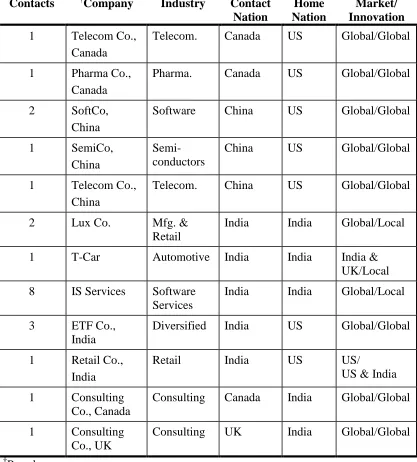
Table 3: Interviews conducted during the exploratory phase of the research... 110
Table 4: Characteristics of MNEs in the sample. ... 116
Table 5: Interviews conducted in the course of the research. ... 117
Table 6: Innovation practice transfer discussed across four MNE cases. ... 120
Table 7: MNE Innovation, control, subsidiary mandate, industry innovation cycle and innovation practice diffusion characteristics. ... 126
xvi
geographic scope. ... 27
Figure 2: Subsidiary innovation mandate characteristics and implications for innovation practice transfer. ... 38
Figure 3: Model of the knowledge composition of the MNE and value creation... 53
Figure 4: Innovation practice lifecycle model...70
Figure 5: Multilevel descriptive model of influences on innovation practice transfer...71
Figure 6: Multilevel descriptive model of influences on innovation practice transfer (revised)...92
Figure 7: Progression of research phases. ... 109
Figure 8: The role of practice transfer in subsidiary capability development. ... 183
Figure 9: Processes of diffusion of innovation practices amongst subsidiaries. ... 189
xvii
Appendix 2: Letter of Information and Consent...243
Appendix 3: Interview Protocol...245
xviii CC – Competency Creating
CE – Competency Exploiting
CME – Coordinated Market Economy
FAA – Federal Aviation Administration
FDI – Foreign Direct Investment
HQ – Headquarters
HRM – Human Resource Management
IS – Information Systems
IT – Information Technology
K – Thousand
KBT – Knowledge Based Theory (of the firm)
KM – Knowledge Management
LME – Liberal Market Economy
LPP – Legitimate Peripheral Participation
MNE – Multinational Enterprise
NSI – National System of Innovation
PMI – Project Management Institute
R&D – Research and Development
UK – United Kingdom
US – United States
Chapter 1:
Introduction
1.1 Purpose of the Research
The purpose of this thesis is to contribute to a growing body of research which
recognizes the increasing contribution of foreign subsidiaries to the competitiveness of
the MNE. In particular, I investigate and build theory to explain the phenomenon of
practice transfer and adaptation within the network of MNE subsidiaries and
headquarters, and how these activities contribute to the development of new capabilities
which allow MNE affiliates to create new value through innovation.
Innovation is widely considered a key value adding activity of the firm, the
principal basis of a competitive economy and crucial in addressing social issues (Brown
and Eisenhardt, 1995; Dosi, Gaffard and Nesta, 2008; Hamel, 2006; Jaffe and Lerner,
2004; Schumpeter, 1942; Tellis, Prabhu and Chandy, 2009; Zander, 1999). The
Schumpeterian view of competition, holding that there is no long term effective strategy
except to continue to grow and evolve through innovation has long been a central feature
of fast growing, short product lifecycle industries such as electronics,
telecommunications, pharmaceuticals and a host of others.
While innovation is a function of the MNE which is shaped by its overall strategy
and structure, it is a particularly influential component as the primary evolutionary engine
driving the development of capabilities, strategic competencies, and ultimately the
of associated requisite capabilities represents an important decision area for managers
(Cohen and Levinthal, 1990; Ethiraj, Kale, Krishnan and Singh; 2005).
Historically, innovation activity, and hence research, was rooted in the context of
industrialized societies during periods of higher economic growth, leading to a
path-dependent view of technological capability development in which a few nations became
technological centers by virtue of initial investments and the efforts of firms operating
inside their borders (Dosi, 1982; 1988; Jaffe and Lerner, 2004; Nelson and Winter, 1977;
1982; 2002). According to this view, multinational enterprises (MNEs) develop
capabilities close to home, almost exclusively countries of the western world, and exploit
these capabilities abroad in foreign subsidiaries in order to benefit from the advantages
afforded by scale and scope economies. The underlying assumption of this focus is the
traditional efficiency view that the role of foreign subsidiaries is the replication and
exploitation of technology developed in the MNE home country (Kindleberger, 1969;
Stopford and Wells, 1972; Vernon, 1966). This view has now evolved to acknowledge
the role that foreign subsidiaries play in enhancing existing capabilities in the MNE and
creating new ones (e.g. Cantwell and Mudambi, 2005; Kuemmerle 1999b).
Of the many forces shaping globalization including politics, culture, and social
institutions, technology diffuses the most readily and rapidly throughout the world
(Archibugi and Iammarino, 2002). As a result, scholars and practitioners alike largely
focused on the exploitation of MNE capabilities abroad. However, the forces associated
and knowledge workers, have now turned the attention of managers and researchers to
the creation of new capabilities via knowledge integration and coordination amongst
foreign affiliates.
Increasingly, subsidiaries are becoming contributing participants in innovation
activities including the production of new technologies, broadly construed as products,
processes, and administrative practices (Cantwell, 1995; Dunning, 1994; Florida, 1997).
This in part reflects a shift in the logic of technological competition from scale economies
to innovation (Cantwell and Fai, 1999). Hence, the mirror side of the efficiency ratio,
represented by value generation through coordination and exploitation of globally
dispersed assets, is presently deserving of more scholarly attention (Dunning, 1993;
1996; Zander, 1997). As MNEs continue to deploy their innovation activity
internationally, partially shifting the logic of geographic expansion in order to take
advantage of comparative country advantages, managers must deal with increasingly
complex integration and coordination amongst geographically diverse affiliates (Cantwell
and Janne, 1999; Papanastassiou and Pearce, 1997; Pearce, 1999; Zander 1999). Hence,
contemporary innovation research now needs to focus on the challenges inherent in
developing capabilities in the context of geographically dispersed innovation occurring in
global networks. This thesis focuses on the value generation side of the efficiency
equation through an examination of innovation capability development in foreign
subsidiaries with a mandate to produce new value through innovation, and further how
„innovation practice‟ used in this thesis refers to the variegated, institutionalized
processes involved with innovation. Examples include agile development, user-led
design, and stage gate process. Within any given MNE, there will also be many more
practices which have emerged and become institutionalized, and hence are idiosyncratic
to the organization.
In addition to coordination issues, and somewhat paradoxically, successful
innovation requires the production of something new, which in turn implies the use of
novel means. Under these conditions, the probability that subsidiaries will modify,
augment, and/or replace organizational practices of the MNE increases. Hence,
internationalization of innovation within the MNE creates a new challenge for managers
in identifying and diffusing valuable practices developed in a geographically dispersed
network of subsidiaries. This research examines the phenomenon of innovation practice
transfer, adaptation and evolution motivated by the following questions:
RQ1) What is the role of organizational practices transfer in the development of innovation capabilities in foreign subsidiaries?
RQ2) What influences lead to subsidiaries’ adaptation of innovation practices?
1.2 Conceptualization of Innovation
There is neither a consistent definition, nor operationalization of innovation in
existing literature (Adams, Bessant and Phelps, 2006). Innovation may be better
described as a body of literature, delineated into diffusion of innovation, organizational
innovativeness, and innovation processes (Wolfe, 1994), or perhaps as an „umbrella‟
construct (Suddaby, 2010) that encapsulates a variety of loosely related dimensions.
Innovation is multidimensional in nature, consisting of innovation process stages, levels
of analysis, types, and scope (Camisón-Zornoza et al, 2004). The term innovation
therefore refers to both an outcome and the inputs and processes which produced it. The
main reason for this is that innovation captures the inseparable coproduction of processes
and outcomes; inseparable because creating something entirely novel typically requires
novel means.
Consistent with the characterization of innovation as both process and outcome in
the literature, the following definition is employed for the purpose of this research:
innovation is the intentional production of novelty to fulfill a practical goal in order to
create new value for the MNE. In essence, innovation is characterized by the calling into
being of that which did not exist prior. As with the existing body of literature, this
definition refers both to the processes of innovation as well as the tangible or intangible
outcomes of those processes. This definition also indicates that in order for an outcome
from processes of innovation to be considered an innovation, it must satisfy some
differentiates innovation from invention which may result in something tangible, but
which does not necessarily involve implementation or add value (Garcia and Calantone,
2002).
1.3 Practice Transfer and Capability Development
In order to build capabilities within foreign subsidiaries, MNEs typically transfer
those practices identified with its core competencies, and which are often a source of
competitive advantage (Kostova, 1999). These practices embody organizational
knowledge and the value adding capability of the firm, as these provide a source of
competitiveness which must be exploited to realize a competitive advantage (Bartlett and
Ghoshal, 1997; Eisenhardt and Martin, 2000; Ghoshal and Bartlett, 1988; Grant, 1996;
Kogut, 1991; Nohria and Ghoshal, 1997; Zander and Kogut 1995). Organizational
practices refer to the routinized manner in which the members of a firm work collectively
to complete various activities (Kostova, 1999). Similar to organizational routines (Dosi,
Nelson and Winter, 2000; Nelson and Winter, 1982; Szulanski, 1996), practices represent
repeated patterns of regularity in the collective behaviour of organizations which evolve
in accordance with the interaction of environmental stimuli and individual agency
(Becker, 2004). Examples of organizational practices include recognized industry
standards and managerial „fads‟ (Abrahamson, 1991; Birkinshaw, Hamel and Mol, 2008),
such as total quality management and continuous improvement, but most are the product
of path dependencies emergent from the socio-structural processes of the organization
The most recognized practices, from the perspective of individual firm managers,
are those related to the particular strategic competencies of the firm. In this thesis, the
focus is on practices of the firm related to innovation. Even this class of practices can be
quite broadly construed as consisting of particular ways of developing new products and
services (e.g. technology development practices: Ethiraj et al 2005), encouraging
employee innovativeness (e.g. human resource practices: Chen and Huang, 2009;
Laursen and Foss, 2003; Starbuck, 1992), stimulating project development (e.g. finance
practices: McGrath and Nerkar, 2004), and sharing knowledge across organizational units
(e.g. knowledge management practices: Miller, Fern and Cardinal, 2007; Tsai, 2001). A
more parsimonious and generalized categorization is used in this research, consisting of
the level of tacit knowledge required to understand and internalize an innovation practice,
and the extent to which the practice is institutionalized.
Transferring practices is often deceptively challenging (Gupta and Govindarajan,
1991) because, in addition to the expected challenges inherent in learning something new,
transfer is often impeded by aspects of the practice, such as its tacit quality, as well as
aspects of the organization itself including structure and modes of coordination (Ghoshal
and Bartlett, 1988; Kedia and Bhagat, 1988; Kostova, 1999; Szulanski, 1996; Zander and
Kogut, 1995). In the international environment, additional challenges arise from the
plurality in cultures (Lemak and Arunthanes, 1997), government policies (Kostova and
Roth, 2002) and consumer preferences (Bartlett and Ghoshal, 1989; Cui and Liu, 2001;
innovation practices to a foreign subsidiary is especially challenging given the
complexity and interrelatedness of the variegated processes and sources of knowledge
involved, and heightened causal ambiguity in new value creation.
In many cases, isolated foreign subsidiaries engaged in similar but uncoordinated
functions develop different practices according to their own histories, experiences, and
the preferences and agency of the members of communities of practice from which
practices arise (Roberts, 2006; Wenger, McDermott and Snyder, 2002). Efforts by the
parent firm to integrate and coordinate the work of foreign affiliates with heterogeneous
practices can prove challenging, as was found by the German multinational Siemens, for
example. Employees of subsidiaries in Munich, Germany and Boca Raton, Florida
reported that working together was complicated by substantial differences in software
development practices which both sides refused to agree upon. Furthermore, problems
encountered when troubleshooting newly implemented systems at customer sites could be
traced back to the practice of software developers in an Indian affiliate who would
immediately focus on fixing, rather than documenting software faults in great detail, as
per their German counterparts (Thomke and Nimgade, 2001).
1.4 Introduction to the Theoretical Background
Practice generation, evolution and diffusion within the MNE are phenomena
influenced by factors at various levels of analysis including national, organizational and
the characteristics of the practice itself. In constructing the initial descriptive framework,
applying a complementary set of theoretical lenses operating at these different levels of
analysis (Hitt, Beamish, Jackson and Mathieu, 2007; Kozlowski and Klein, 2000). First
and central to this research is the knowledge based theory (KBT) of the firm which posits
that firms are superior to markets in the dissemination and exploitation of knowledge due
to the facilitating presence of social ties amongst organizational members (Grant 1996;
Hedlund, 1994; Kogut and Zander, 1992; Nonaka, 1994). Hence, the capabilities
involved in transferring, diffusing and adapting practices provide a potential source of
competitive advantage for the MNE, similar to the notion of second order, or dynamic
capabilities (Teece, 2007; Zahra, Sapienza and Davidsson, 2006; Zollo and Winter,
2002).
Institutional theory (DiMaggio and Powell, 1983; Meyer and Rowan, 1977; Scott,
1995) provides a lens on factors influencing the adoption and diffusion of organizational
practices, with a particular focus on factors influencing the legitimacy of the adopting
unit. As posited by institutional theorists, organizations face normative, regulative and
cognitive pressures to adopt organizational practices in order to achieve legitimacy,
which result in some degree of practice consistency within identifiable groups such as
industries. At the country level of analysis, distinctive national cultural and legal systems
are sources of pressures which shape management practice, resulting in variance across
borders (Gooderham, Nordhaug and Ringdal, 1999; Rosenzweig and Singh, 1991). As
MNEs by definition must coordinate assets located in multiple nations, subsidiaries often
the host country and MNE environment impede the diffusion of practices throughout the
MNE, and provide impetus for adaptation (Kostova, 1999; Kostova and Roth, 2002;
Kostova and Zaheer, 1999; Morgan and Kristensen, 2006). Practice adaptation provides
one avenue for alleviating legitimacy threats arising from institutional duality (Jensen and
Szulanski, 2004).
Finally, the practice itself is the product of an emergent effort of a collective
group of individuals with various expertise, commitment to the practice, distributed
agency, and access to organizational support (Anand, Gardner and Morris, 2007). Hence,
while adaptation of practices may be shaped by institutional pressures in the focal
subsidiary, selection and diffusion of adapted practices may be impeded by
micro-political pressures operating within loosely coordinated affiliates (Morgan and
Kristensen, 2006).
Together, KBT, institutional theory, and micro-political view within communities
of practice helped to provide a comprehensive view of the various factors constraining
and enabling practice transfer and adaptation, and the resulting development of
innovation capabilities. The primary contribution of this thesis is in linking KBT to the
communities of practice perspective on innovation, with emphasis on examining how
innovation practices within the MNE, incorporating tacit knowledge and the skills of
communities of practice as crucial inputs, are developed. Hence, this research
knowledge is created, transferred, adapted, and contributes to MNE capability
development (Adams, Bessant and Phelps, 2006; Anand et al, 2007).
The innovative value emanating from communities of practice is sufficient reason
for organizations to guide and potentially even nurture their development (Brown and
Duguid, 2001). Understanding how their emergence and usefulness are variably
influenced by their organizational, institutional and cultural environments (Roberts,
2006) and how innovation practices evolve within them is a crucial initial step in
formulating guidance for management practitioners. Likewise, understanding the
evolution of innovation practices provides momentum for the development of a
contemporary theory of innovation from the perspective of the organizations which
contribute substantially to that effort.
1.5. Introduction to the Methodology
In pursuing this research agenda, the processes of practice transfer, adaptation,
and capability development were investigated in the context of the MNE, from the
perspective of both subsidiaries and headquarters, where foreign subsidiaries are given a
mandate to produce new value through innovation. The empirical research was
conducted according to the replication logic of multiple case studies in which the primary
units of analyses are practices transferred between affiliates of an MNE. Case study
research is particularly useful in building theory on processes (Langley, 1999; Pettigrew,
Woodman and Cameron, 2001), when the researcher has little or no control over subject
where it is very difficult to discern the phenomenon of interest from the context in which
it occurs (Eisenhardt and Graebner, 2007; Yin, 2009).
Multiple case studies have proven especially valuable in studying group processes
including the building of communities of practice (e.g. Anand et al, 2007; Edmondson,
Bohmer, and Pisano, 2001). Each of the four cases in this study is a MNE which is, or is
attempting, to produce and capture new value through innovation in multiple geographic
locations. Replicating this research across the four MNEs, in accordance with the logic
of literal replication, improves the generalizability of the theory generated (Yin, 2009).
By examining multiple accounts of practice transfer in the words of those involved within
each MNE, new theory on international innovation practice transfer is built which
contributes to a growing body of research on how subsidiaries contribute enhanced and
even new capabilities to the MNE. Each case is akin to an experiment in that it is
approached with a set of intermediate questions and propositions to be tested. As the data
for each case was collected and analyzed, these initial questions lead to new questions
and new propositions to be tested.
Although qualitative research, especially that employing a hermeneutic approach,
is typically more inductive and interpretive than deductive and positivist (Miles and
Huberman, 1994), relevant literature was reviewed in order to guide the study as well as
interpret the data collected. In the initial phases, which included the construction of a
research proposal, existing theory, combined with preliminary fieldwork, was used to
analysis. During data collection and analysis, the descriptive framework provided some
initial conceptual „bins‟ to place observations in. As new insights were constructed from
analyses of the data, the descriptive framework was gradually revised into an explanatory
framework (Miles and Huberman, 1994; Richards, 2005).
1.6. Outline of the Thesis
The remainder of this thesis is structured as follows. Chapter 2 provides a brief,
high level overview of firm internationalization, which covers the motive and pattern of
firm internationalization before transitioning into a discussion on the motives for the
internationalization of innovation and as a consequence, capability development. This
chapter serves to position the study within the relevant literature on firm
internationalization and capability exploitation as well as explicating some of the
relationships between internationalization motivation, subsidiary mandate, and
innovation practice transfer.
Chapter 3 reviews literature pertaining to organizational knowledge, capabilities
and practices and their position in organizational value creation. It also provides the
communities of practice perspective on innovation, taking into consideration the
impediments to community emergence and gaining new membership, in the global
setting. While researchers of communities of practice suggest that knowledge sharing
and innovation is enhanced within these social structures, geographic dispersion of MNE
innovation networks creates impediments to their functioning, and hence issues of
Chapter 4 develops the theoretical baseline and multilevel descriptive framework
which guided the empirical research. Institutional theory and KBT are reviewed, as
relevant to practice transfer, in order to develop an initial set of factors which may
influence the transfer, adaptation and diffusion of innovation practices. This section also
contains a review of literature on practice transfer and evolution, innovation, KBT and
institutional theory in order to develop a holistic process model of the „innovation
practice lifecycle‟.
In Chapter 5, the case based methodology used in the design and data collection
for this research, and qualitative analytical approach used to analyze the data in order to
derive new theory are presented. This chapter provides details on the exploratory phase
of the research which motivated the research questions and design of the final phase.
This exploratory phase consisted of interviews with MNE managers located in Canada,
China and India. This chapter also provides an overview of the four MNEs which
comprised the case studies conducted.
In Chapters 6 and 7, the theory developed during the study is presented. Chapter
6 builds theory on the role of innovation practice transfer in developing subsidiary
capabilities. Within this chapter propositions are developed relating to the role of
innovation practice transfer in promoting the use of organizational knowledge to be
applied in the context of problem solving by MNEs. Through this process, the tacit
components of innovation practices, and hence associated capabilities, are developed by
is also presented. Chapter 7 develops propositions related to the diffusion of innovation
practices within the MNE innovation network and factors which create pressures for
practice adaptation at the national, organizational, subsidiary, and practice levels of
analysis.
Chapter 8 provides a discussion of the theoretical and practical implications of the
propositions developed. Theoretical models of the role of innovation practice transfer in
subsidiary capability development, the diffusion of innovation practices, and forces for
adaptation are provided. Finally, Chapter 9 summarizes the contributions, future research
avenues suggested, limitations, and managerial implications of this research. Following
Chapter 2:
MNE Innovation and Subsidiary Mandates
Context matters in innovation practice transfer and capability development.
Practices are not transferred, nor are capabilities developed, in the absence of existing
practices and capabilities. Innovation in the MNE is highly tacit, unstructured and
difficult to control across borders. It is also more likely to lead to adaptation of practices
as transfer occurs in subsidiaries which face competing and sometimes conflicting
pressures originating from the MNE and host country environments. In this thesis,
factors influencing the transfer process and subsequent capability development of
subsidiaries are considered at the national and organizational levels of analysis, as well as
their potential interactions with the characteristics of the practices itself. Hence, multiple
levels of analysis are considered, but it is the transfer process which is of primary
interest.
In order to gain an appreciation for how innovation practices are transferred and
evolve, it is important to appreciate the various motives for, and subsequent patterns of,
the geographic dispersion of innovation activities by the MNE. The extent and pattern of
innovation internationalization undertaken by any particular firm is, for example,
explained in part by the technological capabilities required to compete within the relevant
industry, and the congruent national competencies of its home country and nations in
Most relevant to this research, capability development is a continual learning
process of which practice transfer is an integral component. An empirical examination of
the process of practice transfer and capability building can take place at any moment in
the history of the subsidiary, and so an appreciation of the stage of development of the
subsidiary‟s mandate (e.g. Delany, 2000), and its evolutionary path (Birkinshaw and
Hood, 1998) is needed in order to understand the forces acting upon subsequent practice
transfer and capability development.
Where an innovation mandate has already been established for some time in a
subsidiary, for example, transferring practices is potentially done in the context of more
evolved communities of practice from which similar, complementary and/or conflicting
practices may have already emerged. Understanding the impact of history and other
major influences on the motives of a firm to transfer innovation practices to foreign
affiliates provides important contextual information useful in developing the initial
theoretical baseline in the following chapter.
The first section in this chapter is a review of research concerning the
internationalization of innovation activities by the MNE in order to provide context for
the current study. This first section includes and examination of the motives for foreign
direct investment (FDI), which result in the internationalization of MNE activities. From
this, the motives for internationalizing innovation activities are derived, which in turn
establishes the general conditions under which the subsidiary is or is not granted an
The next section provides an examination of the evolution of the MNE innovation
network which results in varying levels of specialization and integration of its constituent
affiliates with respect to their innovation mandate. Within this section, literature is also
reviewed pertaining to subsidiary mandate typologies in order to define innovation
mandates, and to provide a positioning for the current research, which examines
subsidiaries with a globally scoped, competency creation role within the MNE innovation
network. Next, the key dimensions of the subsidiary mandate, consisting of the level of
specialization and integration of a subsidiary‟s mandate as well as factors which may
potentially lead to changes to subsidiary mandates are discussed. Implications for
practice transfer according to the type of mandate received by the subsidiary, and when it
was received in relation to its initial establishment are provided. Subsidiaries which do
not participate in the MNE innovation network are not within the scope of this research,
and hence are not discussed.
2.1 Motives for Foreign Direct Investment
The purpose of this section is to relate the initial motives for establishing a new
subsidiary to whether or not it will possess, as part of its overall mandate, responsibility
for carrying out innovation activities which add new or enhanced capabilities and hence
value to the MNE. Modern MNEs have been characterized as geographically dispersed
innovation networks which create and integrate new knowledge in order to generate new
value (Almeida, 1996; Bartlett and Ghoshal, 1989; Birkinshaw, 1997; Cantwell, 1989;
network is initially established for one or more reasons including market, resource,
efficiency and strategic asset seeking (Dunning, 2000). A particular subsidiary may not
initially be part of the MNE innovation network, but its mandate can evolve over time as
it develops capabilities and takes on new roles (Birkinshaw and Hood, 1998; Frost,
Birkinshaw and Ensign, 2002; Garcia-Pont et al, 2009). This section provides an
examination of which initial motives for establishing a subsidiary are more likely to
result in an innovation component as part of the overall subsidiary mandate.
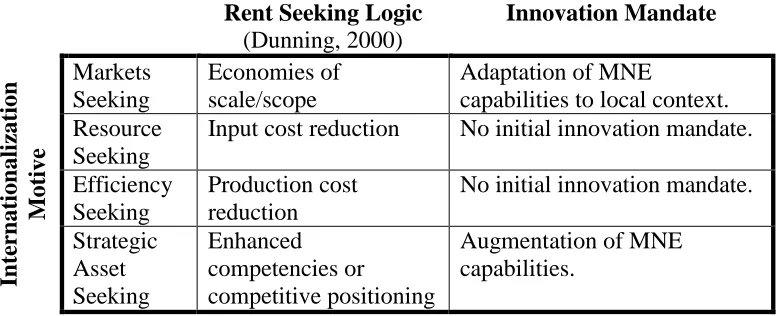
Market seeking involves setting up foreign sales and service affiliates to tap new
markets with existing products and services, but can also include varying levels of R&D
to adapt or develop new products and services for local sale (Cantwell and Mudambi,
2005; Kuemmerle, 1999b). Firms following a resource seeking motive for FDI are
interested in accessing the natural resources and labour forces of the host nation while the
efficiency seeking motive entails geographical diversification amongst functional areas of
the MNE in order to achieve division of labour and its associated specialization
advantages. Finally, MNE FDI is sometimes motivated to improve its competitive
positioning viz. its competitors by accessing complementary strategic assets through FDI
which augment existing competencies. The rent seeking logic and potential innovation
mandates of newly established foreign subsidiaries are summarized in Table 1.
Market seeking is associated primarily with demand-pull oriented innovation in
that local adaptation is often necessary to effectively serve markets. Resource seeking
with sourcing material inputs to production more efficiently. Efficiency seeking motives
primarily entail foreign investments made to benefit from labour cost differences between
the home and host country. Subsidiaries set up according to an efficiency seeking motive
may provide the MNE efficiency gains in supporting the R&D function, but do not, at
least initially, actively contribute to competency creation. Strategic asset seeking,
conversely, is associated with supply-push innovation, in that knowledge assets acquired
through FDI give the MNE opportunities to integrate and coordinate internationally
dispersed strategic assets for the purpose of globally focused innovation.
Table 1: Internationalization motives, rent seeking logic, and subsidiary innovation mandate.
Rent Seeking Logic
(Dunning, 2000) Innovation Mandate In te rn at ion ali zat ion M ot ive Markets Seeking Economies of scale/scope
Adaptation of MNE
capabilities to local context. Resource
Seeking
Input cost reduction No initial innovation mandate.
Efficiency Seeking
Production cost reduction
No initial innovation mandate.
Strategic Asset Seeking Enhanced competencies or competitive positioning
Augmentation of MNE capabilities.
In Dunning‟s original formulation of the eclectic paradigm (1977; 1988; 1993;
1998), the MNE primarily internationalized to exploit assets developed at home, and
industry positioning. Later, researchers recognized that internationalization was also
undertaken to secure increasingly strategic knowledge assets (Almeida, 1996; Cantwell,
1995; Dunning and Narula, 1995; Kogut and Chang, 1991). Hence, strategic asset
seeking is now more often associated with the motivation to acquire geographically
dispersed strategic assets, most often in the form of knowledge workers.
This preceding review establishes a general linkage between the initial motives of
the MNE for establishing a particular subsidiary and the type of innovation mandate, if
extant, that the subsidiary receives. There are three caveats to address before proceeding
to the discussion on subsidiary mandate characteristics and evolution. First is that in the
presence of any of the four motives it is not absolutely certain that an innovation mandate
will be established. MNEs can access markets without making any adaptations by setting
up marketing and/or production satellites (White and Poynter, 1984), or by making any
necessary adaptations from a subsidiary located elsewhere. As well, although less often
the case, firms may access pools of knowledge workers through FDI without granting an
innovation mandate. Such would be the case, for example, in a pharmaceutical company
managing clinical trials through a foreign subsidiary while handling drug discovery
elsewhere. Second, it is important to note that the innovation mandates proposed in
Table 1 refer only to the initial purposes for which the subsidiary was established.
Although head office assignment of mandates is perhaps the most common mode of
establishment, it is not the only one (Birkinshaw and Hood, 1998). As the MNE evolves,
value creation (Delany, 2000). Hence, innovation internationalization and associated
capability development pathways evolve contemporaneously with subsidiary mandates
(Cantwell and Piscitello, 2000). The evolution of subsidiary mandates, and their relation
to established taxonomies are presented in the next section. Finally, although the four
categories presented here are conceptually distinct from one another, MNEs may be
pursuing multiple objectives when establishing foreign subsidiaries. In any case, the
presence of a market or strategic asset seeking motive greatly increases the likelihood
that a subsidiary will receive an innovation mandate at inception, hastening the transfer of
innovation practices from the MNE.
2.2 Subsidiary Mandate Characteristics and Evolution
This section begins by defining an innovation mandate and positioning it within
existing taxonomies. Next, the integration and specialization dimensions of a subsidiary
innovation mandate are identified, and their implications for innovation practice adoption
and adaptation are proposed. Within this section, the stage of subsidiary development is
presented as an important contextual consideration which influences innovation practice
transfer.
2.2.1 Defining and Characterizing Subsidiary Innovation Mandates
A subsidiary‟s mandate is the role which is granted to it by regional or corporate
headquarters, but which can subsequently evolve as a result of either headquarters or
Over the past three decades, several typologies of subsidiary mandates have been
presented in the literature including those related to the scope of the subsidiaries
responsibilities, its role in exploiting and contributing knowledge, its integration within
the MNE vs. its host country environment, and its role in decision making within the
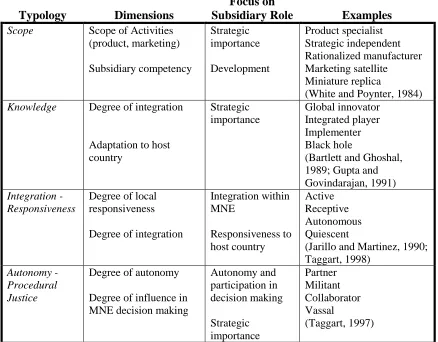
MNE (Manolopoulos, 2008). Table 2 lists these existing typologies, outlines the key
dimensions of the mandate used in categorizing subsidiaries, identifies the general focus
of the research employing these typologies and provides some examples of each. This
table is not exhaustive in its identification of the research employing subsidiary mandate
typologies, nor the mandate types recorded in the literature. Manolopoulos (2008)
provides a more detailed and integrated typology review for the interested reader.
Early research classified subsidiary mandates according to the extent of
responsibility and control over markets, products and the value-chain (White and
Poynter, 1984). World product mandates grant the subsidiary full control over the
complete range of value-adding activities for a particular product line (Rugman and
Douglas, 1986). Roth and Morrison (1992) extended the world product mandate type by
differentiating between subsidiaries which were part of, and hence dependent upon, the
overall MNE value chain, and those which have complete control over the entire value
chain for a particular product or product line. World product mandates are of interest to
researchers in evaluating the effect that the strategic importance of a subsidiary has on its
Knowledge-related typologies (e.g. Bartlett and Ghoshal, 1989; Jarillo and
Martinez, 1990; Papanastassiou and Pearce, 1999) focus on the extent to which
knowledge and competencies are utilized the subsidiary. Prior research has found that
the range of knowledge sources available to a subsidiary from within the MNE and its
host environment, as well as its ability to utilize them, has a positive impact on subsidiary
innovation (Almeida and Phene, 2004; Phene and Almeida, 2008).
Table 2: Characteristics and examples of existing subsidiary mandate typologies.
Typology Dimensions
Focus on
Subsidiary Role Examples
Scope Scope of Activities (product, marketing) Subsidiary competency Strategic importance Development Product specialist Strategic independent Rationalized manufacturer Marketing satellite Miniature replica
(White and Poynter, 1984) Knowledge Degree of integration
Adaptation to host country Strategic importance Global innovator Integrated player Implementer Black hole
(Bartlett and Ghoshal, 1989; Gupta and Govindarajan, 1991) Integration -
Responsiveness
Degree of local responsiveness
Degree of integration
Integration within MNE Responsiveness to host country Active Receptive Autonomous Quiescent
(Jarillo and Martinez, 1990; Taggart, 1998)
Autonomy - Procedural Justice
Degree of autonomy
Degree of influence in MNE decision making
A third typology, extensively employed in research, considers the extent of
subsidiary integration within the global MNE network, and its capacity to respond to
local market needs (Bartlett and Ghoshal, 1989; Doz, Bartlett and Prahalad, 1981;
Prahalad and Doz, 1987). Whereas these authors initially characterized integration and
responsiveness as involving a trade off, Jarillo and Martinez (1990) treated these
dimensions as independent. Other researchers found that subsidiaries with high levels of
embedment within the local environment also have higher strategic importance to the
MNE (e.g. Cantwell, 1995; Kuemmerle, 1999b).
The final typology of subsidiary mandates considers procedural justice, the extent
to which the process of allocating decision making rights is deemed fair by the subsidiary
(Kim and Mauborgne, 1991; 1993), and the level of subsidiary autonomy (Taggart,
1997). Subsidiaries with higher degrees of autonomy are greater contributors to the
MNE, and hence of more strategic importance, and those which have access to greater
procedural justice work in a more integrated and collaborative fashion with MNE
headquarters and other subsidiaries (Taggart, 1997).
Mandate typologies provide mutually exclusive categorizations of each subsidiary
to which they are applied. Innovation mandates do not fall within a particular typology,
but each typology provides implications according to their dimensions. Delany (2000)
divides subsidiaries according to a linear development model in which they obtain
progressively larger scope, from basic, to enhanced, and finally to advanced. However,
located furthest upstream in terms of contribution to MNE capability development.
Hence, these mandates are advanced regardless of the scope of the mandate. With
respect to geographic scope, the subsidiary may innovate for the local, regional or global
market. However, this research employs the transnational view of the MNE (Bartlett and
Ghoshal, 1989) and focuses on subsidiaries with global innovation mandates. These
mandates involve greater complexity, uncertainty, risk and learning, and hence they
present an especially important management challenge.
In general, subsidiaries are mandated to either exploit existing MNE capabilities
or to participate in the creation of new capabilities (Cantwell and Janne, 1999;
Kuemmerle, 1999b). These are not mutually exclusive categories, as subsidiaries can
engage in both capability exploitation (CE) and capability creation (CC) to varying
extents, which is sometimes a result of competing pressures for efficiency and local
adaptation (Rosenzweig and Singh, 1991; Westney, 1993). However, consistent with
other current research (e.g. Cantwell and Mudambi, 2005) the focus here is on
subsidiaries which play a significant role in MNE innovation and hence capability
creation. Where a subsidiary possesses an innovation mandate, it is expected to contribute
to MNE capability creation thus creating a source of new value. A subsidiary can have
many mandates, including manufacturing, marketing, sales and distribution, but the focus
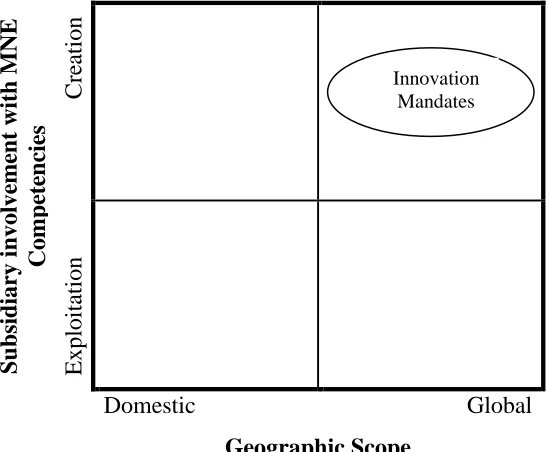
of this research is on subsidiaries with innovation mandates. Figure 1 depicts the
classification of innovation mandates considered in this research according to their global
Figure 1: Position of innovation mandates with respect to competency creation and geographic scope.
S u b si d iary i n volvem en t w ith M NE Com p ete n cies C re ati on Exploi tation
Domestic Global
Geographic Scope
While transferring practices from the MNE to the subsidiary represents capability
exploitation, a subsidiary that is given an innovation mandate needs to build upon those
competences in order to add new value. The outcomes of innovation are always highly
uncertain and cannot be achieved solely through the application of a set of practices.
Generally speaking, innovation is highly resistant to systematization (Frenkel, Maital and
Grupp, 2000), a feature which makes highly innovative organizations stronger
competitors. It is not possible to fully codify the capability required to innovate, nor can
innovation be entirely routinized, which creates an impediment to efficiently transferring
the capability throughout the MNE network.
Mandated subsidiaries develop new capabilities over time, with resources sourced
from within the MNE, in order to innovate. The adoption of practices from the MNE
headquarters is therefore a necessary but not sufficient condition for developing
innovation capabilities. Furthermore, in the process of innovation practice diffusion, it is
quite possible, even likely, that some practices will be adapted or discarded, and new
practices created. New and adapted practices might be of value to the MNE, but only if it
is able to recognize that value and diffuse the practice.
The research comprising this thesis focuses specifically on the internationalization
of competency creation (CC), a phenomenon which has interested scholars for some time,
although empirical accounts have largely focused on the determinants of international
R&D investment (inter alia Cantwell, 1995; Cantwell and Mudambi, 2005; Kuemmerle,
1999a; 1999b; Pavitt, 2001; 2002) and patent citation patterns (e.g. Frost and Zhou, 2005;
Phene and Almeida, 2008). This focus is novel because the process of CC through
innovation practice transfer is examined, as opposed to practice transfer in general, and
furthermore attempts are made to take into account the role of the subsidiary within the
overall network according to a more comprehensive set of parameters than prior
empirical examinations.
The mandate dimensions listed in Table 2, as applicable to subsidiary innovation
subsidiary competency, extent of integration within the MNE innovation network,
responsiveness to the local country, and decision making autonomy and participation.
Scope of mandate often refers to the range of value chain segments over which a
subsidiary has control (White and Poynter, 1984). As this research pertains to the role of
innovation practice transfer in the development of subsidiary capabilities, competency is
considered a dependent variable as opposed to a mandate dimension. While competency
and mandate are mutually reinforcing (Birkinshaw and Hood, 1998), it is the role that
transferring innovation practices plays in building capabilities which is the focus of this
research. Responsiveness to the host country environment can impede practice transfer,
as the subsidiary faces greater pressures to adapt to the local environment, thus increasing
the likelihood and extent to which innovation practices will be adapted. However, only
those subsidiaries with global innovation mandates are considered here and hence the
focus is on global integration. The role of subsidiary autonomy and influence over MNE
strategic decision making partially overlaps with the pressures for local adaptation. The
micro-political dynamics of headquarter and subsidiary interaction are considered in the
next chapter, in the context of organizational influences on innovation practice transfer.
In this research, scope is not considered from a value chain perspective, as
innovation can apply to any segment, but instead is considered the scope of functional
expertise to which a transferred innovation practice applies. Degree of integration within
the MNE innovation network influences the emergence of communities of practice,
dimensions of a subsidiary‟s innovation mandate are both likely to influence the ease of
transfer, and degree of adaptation of innovation practices.
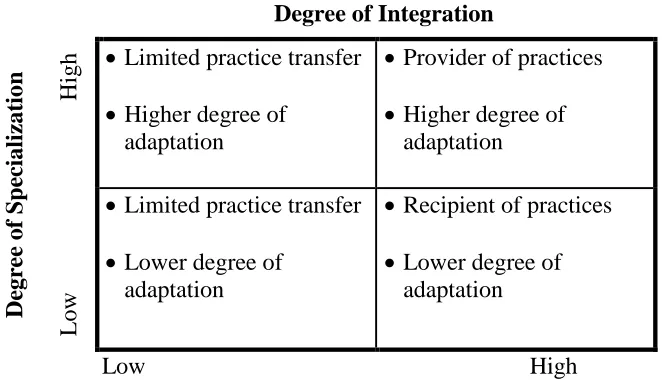
The next sections examine the influence of subsidiary innovation mandate
integration and specialization on innovation practice transfer in more depth. First, the
degree of specialization according to functional expertise is considered. Following this,
the level of integration of a focal subsidiary, which is defined as the extent to which it
interacts with the overall MNE innovation network, is discussed. Following this the
specialization and integration components of subsidiary mandate are related to potential
implications for innovation practice transfer.
2.2.2 Specialization
The relationship between MNE internationalization and innovation capability
development has evolved from a state in which the two processes were relatively
disconnected to a state in which they are mutually reinforcing, as MNEs increasingly
access local innovation expertise where they reside (Cantwell and Piscitello, 2000). The
product cycle model (Vernon, 1966) provided some of the earliest thinking on patterns of
internationalizing innovation activities. This model assumes that demand conditions are
the primary drivers of innovation, that home markets are both the primary source of this
demand, and the preferred location for developing new technologies due to the
availability of the required resources, most notably a skilled workforce (Vernon, 1979).
Following this logic, MNEs innovate close to home and then exploit the resulting
scale and scope. This in turn produces path dependencies in both technological
development and national comparative advantages in innovation. Furthermore, it implies
that practices flow in one direction, from the MNE home location, to the foreign
subsidiary, and that no capability enhancement would be obtained.
Under the assumptions that innovation is resource intensive and path dependent
(Dosi, 1982; 1988; Jaffe and Lerner, 2004; Nelson and Winter, 1977; 1982; Porter, 1980),
and that knowledge spillovers play an important role in technological path development,
geographically bounded agglomeration is the expected result (Almeida and Kogut, 1997;
Cantwell, 1991; Feldman, 1993; Jaffe, Trajtenberg and Henderson, 1993). As a result of
this agglomeration, nations experience the „Matthew effect‟, that is, those rich in
resources and capabilities as a result of initial technology development will accrue more,
while those which lack adequate resources will have their stock reduced (Merton, 1968;
1988). Hence, only successful innovators in the present would be able to innovate in the
future.
A counterpoint to the product lifecycle logic, is the emergence of location-bound
expertise either due to the development of a comparative national advantage in specific
industries or functions related to innovation (e.g. Cantwell and Janne, 1999; Cantwell and
Mudambi, 2005; Cantwell and Piscitello, 2000) or the evolution of subsidiary capabilities
which enables downstream movement along the value chain (Birkinshaw and Hood,