Green Mining: toward a less energetic impact of
cryptocurrencies
Philippe Jacquet
Nokia Bell LabsNozay, France
Email: [email protected]
Bernard Mans
Macquarie UniversitySydney, Australia Email: [email protected]
Abstract—While cryptocurrencies continue to gain popularity, their energy cost is increasingly becoming unsustainable. In this paper, we present an innovative scheme which eliminates the burden of the proof of work which is the main cause of the energy waste in cryptocurrencies such as Bitcoin. The scheme is based on a green leader election scheme which guarantees a bounded average number of simultaneous mining whatever the size of the population in competition.
I. INTRODUCTION
Popular cryptocurrencies have now been effectively in use for nearly ten years (e.g. Bitcoin [9]). In addition to the increasing appetite for its key financial aspects (e.g., fast, transparent, secure and private), their potential to facilitate, verify, or enforce the negotiation or performance of various transactions provide an important innovative service that will have an ongoing impact in all aspects of our life.
Actual cryptocurrencies are completely decentralized proto-cols. They are based on the blockchain concept where trans-actions are regrouped by blocks and committed in a common distributed directory connected in peer to peer organization. The transactions and the blocks are chained via a chain of hash function which is too expensive to forge and falsify. The blockchain allows that each block and each transaction can be checked back by anyone as if there would be in a gigantic distributed accounting book. The block has also the function of tracing and controling the inflation of the Bitcoin volume and facial value. This is done by giving a reward to the block miner (the action of proposing a block) which is accepted by distributed consensus when the block is “committed” (e.g., in Bitcoin, followed by six newer blocks). A block which is not committed disappears.
One drawback of popular cryptocurrencies such as Bitcoin is the moderation of block mining rate. Since mining reward is a fundamental tool in the control of volume of values, there is a fierce competition in block mining. Some individuals may be tempted to mine multiple blocks in order to augment their revenue or bend the system in their favor (e.g., by double spending).
In order to avoid that too many simultaneous blocks are mined and proposed for commitment, Bitcoin requires a “proof of work” by forcing the block miner to execute a large number of CPU cycles via iterated hash computation before submitting his/her block. The idea of computational puzzle as proof of
work is not new, it appears first in the seminal work of Dwork and Noar [5] and was later suggested to avoid Sybil attack by Aspnes et al. [1]. The proof of work provides scarcity and uniqueness that help reduce the individual block mining rate.
However the “Proof of Work” presently costs
100,000,000,000 CPU cycles (around 10 minutes on a current PC) and if one million miners contends at the same time, then the energy cost of mining one Bitcoin exceeds the value of the Bitcoin itself. Furthermore this cost is expected to quadratically grow or at least linearly grow with the number of contending miners leading to a protocol whose energy cost can absolutely not be sustainable in the near future.
In order to avoid these catastrophic consequences, a plethora of alternatives have been suggested, from variants of proofs of stake (e.g., [3], [13]) to various proofs of “something” (e.g., proof of Exercise [12]). Other attempts to tackle the huge waste generated by the Proof of Work as implemented in Bitcoin have been aiming at turning them into work that is actually useful (e.g., solving practical problems have been investigated in [2]) but not really in reducing the amount of work. The main issue is that it is still paramount to reach agreement and prevent double spending while providing a way to mint the currency.
In this paper, we mainly focus on the unsustainable energy cost and propose a cryptocurrency protocol moderated through a "green" mining protocol in such a way that it will remove the high energy cost of the proof of work while keeping the blockchain mining input rate between reasonable limits. Those limits can be arbitrarily tuneda priori, while the proof of work CPU parameter must be constantly updated.
Our scheme is inspired by a “green” leader election [8]. At its core our model implements a Leader Election that (in addition to public verifiability) provides liveness and fairness: the unique chain grows and the probability of electing each party is independent to its relative computational power. Our model is “permissionless”: there is no explicit membership protocol, anyone can join the system. Our model also offers the safety property (block are eventually committed and cannot be removed).
II. THEGREENCOIN MINING PROTOCOL A. Parameters and format
Our Green Coin protocol is based on the following param-eters:
• an integerk;
• a vector of increasing probabilities of length k + 1: P0, P1, . . . , Pk, withPk= 1;
• an upper bound N on the maximum admissible number of contending block, it can be set as large as possible. Typical values for these parameters would be k = 8, N = 232 are examples. The green coin leader protocol consists in
authorizing the mining of an average number of orderN1/k out ofn≤N contending blocks.
As with Bitcoin, each block of the Green Coin protocol will carry some values obtained by hash function. We denotehthe length of the hash value fields in the block. A typical value is h= 256(32 bytes).
Contrary to Bitcoin where there is only one kind of block, Green Coin relies on two kinds of blocks:
• theregularblock containing transactions;
• theemptyblock which does not contain any transactions.
The regular block format is similar with Bitcoin block format but with the difference that it does not contain anounce
field but instead acallfield. The call field is similar to a hash value field. The following table gives an abstract format listing the most significant fields:
1 hash of previous block
2 date
3 list of transactions ... ...
4 call value 5 hash of the block
The empty block looks similar but the transaction list is replaced by a nounce field of same size as a hash value field.
1 hash of previous block 2 date
3 nounce value 4 call value 5 hash of the block
B. Mining protocol
Initially, to simplify our presentation, we will assume that empty slots are mined by a central entity and on a restricted depositary. We will discuss later how the protocol can be made distributed or how to face forgery.
A block can be mined only if its hash value is smaller than the call value of the previous block. The call field of a regular block has always the same value which is2h+1P
0.
If no regular block is mined, after a certain lapse of time the central entity mines an empty block. The empty block hash value should not necessarily be smaller than the call value of the previous block, but any regular block should. The call value of the empty block should have value2h+1P1. The use
of the nounce field will be described later.
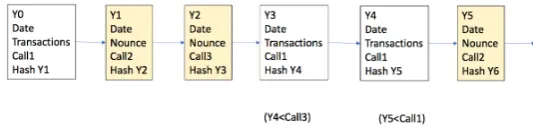
Fig. 1: A sequence of blocks, empty blocks are grayed.
As long as no new regular block is mined, the cen-tral entity mines empty block with successive call values
2h+1P
2, . . . ,2h+1Pk. After k mined empty blocks the call values sequence restarts.
As there is no nounce field in the regular block there is no proof of work computation required. The block are authorized via the call values which have the effect of regulating the mining rate. Since the non authorized blocks do not need to be submitted there is also a regulation of the traffic generated by the block mining.
If a call fails,i.e.no regular block is mined, then a new call will be made via a new empty block. Since Pk = 1, the last call value is the max-value2h+1 (in fact2h+1−1, otherwise
it would exceed the field length), which means that every block is eligible (as long as it contains the hash value of the last empty block). Therefore any competition of block mining will result in at least one block mined. Figure 1 displays an example of block sequences in the blockchain. The chain is enforced by the hash valuesY0, Y1, . . .. The value of a regular
block hash should always be smaller than the call value of the previous block, regardless it is empty or regular. Empty blocks do not need to follow this rule.
C. Distributed empty block mining
The main issue around the mining of empty block is that other user could be tempted to mine empty blocks. Having several parallel empty blocks is not a problem per se since, without nounce, they will be identical. But a user may like to accelerate the protocol in order to get to the call value
2h+1−1 which allows to mines blocks without restriction.
Notice that in this case all regular blocks in competition would be simultaneously eligible and letting them go and mine at the same time would not give a competitive advantage to those who caused this. It should be noted that the empty block itself, as carrying an empty list of transactions, provides no monetary advantage to those who mine it.
Anyhow an excessive flow of blocks to be mined may cause a congestion problem which is exactly the proof of work concept that we want to solve. Of course the most suitable way to fight this syndrome is to give the authority to a single entity the right of mining empty blocks and store them on a single fully secure depository.
work which will delay the time last between two empty block mining. That way a secondary forged empty block miner will be still delayed by the proof of work. This is a safe solution when we consider that the acceleration of empty block mining is the most dangerous threat of the present scheme.
III. PERFORMANCE ANALYSIS
A. The classic leader election via collision
The goal of leader election (e.g., [7], [11]) is to select one among n > 0 players, by proceeding through a number of rounds. Note that using rounds is natural here as it is also commonly accepted that the Blockchain model incorporates some degree of synchrony assumptions, otherwise if network delay can be unbounded then the adversary can boost its power just by making the non-faulty parties incur much higher delays [4].
The rounds of our leader election are made via coin toss-ing. We assume that all competitors has a coin whose head probability is p and tail probability q = 1−p. We want to proceed to a leader election among n ≥ 1 competitors. At the beginning all thencompetitors transmit. If it results into a collision then each competitor tosses the coin, only those who get a head contend for the second round, we call them the survivors. If the second round results in a collision, then a second coin tossing occurs and a subset of survivors contend, and the protocol continues until none survive. In this case we take as result the last non empty set of survivors.
There is an additional procedure in order to reduce the survivor population in order to get a single leader. In general it is a collision algorithm but it is not useful here because we allow a subset of survivors as long as this subset is of reasonable size.
In fact the average size of the last non empty survivor set can be computed precisely using analytic combinatorics to be plog(1q /p) with some fluctuations of small amplitude. We notice that this value is finite and independent of the initial number contenders. This average size can also be tuned to be small or large by tuning the parameter p. It can be done by compromising with the average number of rounds which tends tolog1/pnwhenn→ ∞. If we wanted to imitate this process with the call values in the empty block one should consider a sequence (P0, P1, . . .) such that P` = p` represents an exponential descending staircase. However this will not work as expected since after the first call one would have already n mined blocks. Still we can be inspired by this protocol in order to design the ascending exponential staircase. This is indeed made possible because we can safely assume that there is a large yet fixed limit N to the number of simultaneous contenders.
In this case we suppose thatP0=N1 and thatP`= N1p−` for `≤k. In order to havePk= 1 one must havep=N11/k.
If N = 232 and k = 8 we will have p = 161 and the call sequence will be:
call value rank value 0 (initial) 2224−1
1 2228−1
2 2232−1
3 2236−1
4 2240−1
5 2244−1
6 2248−1
7 2232−1
8 2256−1
We denoteMnthe average number of regular mined block when n blocks are in competition after a regular block. An important but classic assumption in this paper is that succes-sive calls of a hashing function are independent. Of course
stricto sensu this is not true since hash value determinations are deterministic computations, but traditionally the better successive hash values imitates independent random variables, the better is a hash function. In fact this argument is the foundation of the resilience of blockchain made of successive hash computation against attack.
Let M`
n denote the number of blocks mined after the `th empty block under the condition that all the previous empty blocks resulted into no regular block mined. We have
Mn=M0nand sincePk= 1:Mkn=n. Since the fact that the successive calls to hash values are assumed independent, the number of blocks called by the`th empty block is a binomial random variable B(n, P`)of probability P`. For` < k when the binomial variable is B(n, P`) = 0 which occurs with probability (1−P`)n, no block is mined after the `th block andM`
n=M`−n 1. Thus for all integersm,m >0: P(M`n =m) =
n
m
P`m(1−P `)n−m
+(1−P`)nP(M`n+1=m) (1) and
P(M`n= 0) =δ(n). (2)
where δ(n) = 1 if n= 0 and zero otherwise. Let M` n(u) = E[uM`
n].
Lemma 1:We have for ` < k
Mn`(u) = (1 +P`(u−1)) n
+(1−P`)nMn`+1(u)
andMk
n(u) =un.
Proof: This is a direct application of equation (1)
Lemma 2:We have the identity
E[Mn] =nP0+
`=k
X
`=1
nP`
Y
j<`
(1−Pj)n (3)
Proof: This is a direct application of previous lemma by using E[uM`
n] = ∂
∂uM ` n(1)
Remark: the optimal value is k = O(logN) but lower values are also interesting.
Proof:From equation 3 we get the inequalities
E[Mn] ≤ nP0+
k
X
`=1
nP`(1−P`−1)n (4)
≤ nP0+
X
1≤`≤k
nP`exp (−P`−1n). (5)
The quantity P
1≤`≤knP`exp(−P`−1n) is equal to
P
1≤`≤k Nnp
`exp(−p`−1n/N). This quantity is smaller
thanf(n/N)withf(x) =p1P
`∈Zg(p
`x)withg(x) =xe−x.
The function f(ex) is periodic of period logp and therefore is bounded. Since p = N−1/k we get E[M
n] = O(N1/k) sincen/N≤1 becausen≤N.
Theorem 2:We have the more precise estimate
E[Mn]≤ n N +AN
1/k. (6) with A = log(11/p)P
k∈Z|Γ (1 + 2ikπ/logp)|, p denoting N−1/k and whereΓ(.)is the Euler "Gamma" function.
Proof:We can give an accurate estimate of the maximum value of function f(x). The function f(ex) is periodic of periodlogpand therefore has a Fourier decomposition:
f(ex) =X
k∈
gke2ikπx/logp (7) wheregk is the Fourier coefficient.
We have
gk = Z 0
logp
f(ex)e2ikπ/logpdx (8)
= 1
log(1/p) Z ∞
0
g(x)2ikπ/logp−1dx (9)
= 1
log(1/p)Γ (1 + 2ikπ/logp) (10)
and then use the upper bound|f(ex)| ≤P
k∈Z|gk|.
In passing we get the mean value of f(ex) to be equal to g0=log(11/p).
Figure 2 shows the quantity E[Mn] versus n for various parameters. Notice that the sequence of bumps reflects the periodic fluctuations as function of logn analyzed in the upper bound. Figure 3 shows the same quantities obtained by simulation, each point being simulated 1,000 times.
We can give a close expression of the distribution ofMn.
Lemma 3:For all complex numberu:
E[uMn] = (1 +P
0(u−1))
n
−(1−P0)n
+ X
0<`<k
Y
j<`
(1−Pj)n
×((1 +P0(u−1))
n
−(1−P0)n)
+unY j<k
(1−Pj)n.
Proof:By application of lemma 1.
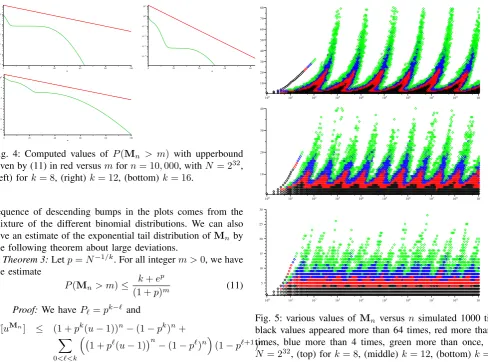
Figure 4 displays the various shape of the sequencesP(Mn> m) versus integer m for various parameters. Notice that the
Fig. 2: The quantityE[Mn]and the upper bound given by (6) in red versusnforN = 232, (top) fork= 8, (middle)k= 12,
(bottom) k= 16.
Fig. 4: Computed values of P(Mn > m) with upperbound given by (11) in red versusmforn= 10,000, withN = 232, (left) fork= 8, (right) k= 12, (bottom)k= 16.
sequence of descending bumps in the plots comes from the mixture of the different binomial distributions. We can also give an estimate of the exponential tail distribution ofMn by the following theorem about large deviations.
Theorem 3:Letp=N−1/k. For all integerm >0, we have the estimate
P(Mn> m)≤
k+ep
(1 +p)m (11)
Proof:We have P`=pk−` and
E[uMn] ≤ (1 +pk(u−1))n−(1−pk)n+ X
0<`<k
1 +p`(u−1)n
−(1−p`)n(1−p`+1)n +un(1−p)n
Let u = 1 + p we have 1 + (u−1)p` = 1 +p`+1 and
therefore (1 + (u−1)p`)(1 −p`+1) = 1−p2(`+1) ≤ 1.
Thus E[uMn] ≤ (1 +pk+1)n +k. Since (1 +pk+1)n ≤ exp(npk+1) = exp(pn/N). Since n < N we have
exp(np/N) ≤ exp(N−1/k). We conclude the proof with the observation that for all integers m: umP(M
n > m) ≤ E[uMn]
Figure 5 displays the histograms of 1,000 simulations ofMn versusnfor N = 232 andk= 8,12,16.
ACKNOWLEDGMENT
We are indebted to Daniel Augot for earlier discussions on Blockchain systems.
REFERENCES
[1] James Aspnes, Collin Jackson, and Arvind Krishnamurthy, Expos-ing computationally-challenged Byzantine impostors, Technical Report YALEU/DCS/TR-1332, Yale University Department of Computer Sci-ence, July 2005.
[2] Marshall Ball, Alon Rosen, Manuel Sabin, and Prashant Nalini Vasude-van.Proofs of useful work, 2017.
Fig. 5: various values of Mn versus nsimulated 1000 times black values appeared more than 64 times, red more than 16 times, blue more than 4 times, green more than once, with N = 232, (top) for k= 8, (middle) k= 12, (bottom)k= 16.
[3] Iddo Bentov, Charles Lee, Alex Mizrahi, and Meni Rosenfeld, Proof of activity: Extending bitcoin’s proof of work via proof of stake, ACM SIGMETRICS Performance Evaluation Review, 42(3):34–37, 2014. [4] Christian Decker and Roger Wattenhofer,Information Propagation in the
Bitcoin Network, P2P, 13th IEEE International Conference on Peer-to-Peer Computing, Trento, Italy, September 2013.
[5] Cynthia Dwork and Moni Naor, Pricing via processing or combatting junkmail, CRYPTO, 12th Annual International Cryptology Conference on Advances in Cryptology, pp. 139–147, London, UK, 1993. [6] Juan Garay and Leonardos Kiayias, The bitcoin backbone protocol:
Analysis and applications, EUROCRYPT, pp. 281–310, 2015.
[7] P.J. Grabner and H. Prodinger,Sorting algorithms for broadcast commu-nications: Mathematical analysis, Theoretical computer science, 289(1), pp. 51-67, 2002.
[8] Philippe Jacquet, Dimitris Milioris and Paul Mühlethaler,A Novel En-ergy Efficient Broadcast Leader Election, Mascot, 21st International Symposium on Modelling, Analysis and Simulation of Computer and Telecommunication Systems, San Francisco, August, 2013, pp. 495–504. [9] S. Nakamoto, Bitcoin: a peer-to-peer electronic cash system, 2008,
Available: http://www.bitcoin.org
[10] Rafael Pass, Lior Seeman, and Abhi Shelat,Analysis of the blockchain protocol in asynchronous networks, EUROCRYPT, LNCS 10211, pp. 643– 673, 2017.
[11] Helmut Prodinger and Guy Louchard,The Asymmetric Leader Election Algorithm with swedish stopping: A probabilistic analysis, Discrete Mathematics & Theoretical Computer Science 14(2), pp. 91-128, 2012. [12] Ali Shoker,Sustainable blockchain through proof of exercise, NCA, 16th
IEEE International Symposium on Network Computing and Applications, Cambridge, 2017, pp. 393-401.
![Fig. 2: The quantity E[Mn] and the upper bound given by (6)in red versus n for N = 232, (top) for k = 8, (middle) k = 12,(bottom) k = 16.](https://thumb-us.123doks.com/thumbv2/123dok_us/7985478.1324906/4.595.306.473.90.333/fig-quantity-mn-upper-bound-given-versus-middle.webp)