Available Online atwww.ijcsmc.com
International Journal of Computer Science and Mobile Computing
A Monthly Journal of Computer Science and Information Technology
ISSN 2320–088X
IJCSMC, Vol. 3, Issue. 6, June 2014, pg.933 – 941
RESEARCH ARTICLE
Performance Evaluation of WIMAX Network
with WIMAX PHY using different QoS
Suman Rani
1, Lokeshwar
2, Kuldeep Vats
3 1M.Tech Scholar, Department of ECE, RN College of Engineering & Management, Rohtak, Haryana, India
2
Assistant Professor, Department of ECE, RN College of Engineering & Management, Rohtak, Haryana, India
3
B.E. Honors, M.Tech (CSE), Department of Computer Science Engineering, Sonepat, Haryana, India
_________________________________________________________________________
ABSTRACT- The worldwide interoperability for microwave access (WiMAX) is one of the newest technologies developed for broadband wireless network which offers high data rates, long coverage area and several types of quality of services to the users. In this paper, a basic simulation and performance analysis of WiMAX network in three different scenarios, using different quality of services like WIMAX Physical Uplink and Downlink BLER, throughput, Network load, WIMAX Physical Pathloss and total Tx power is carried out using OPNET modeler which is a powerful tool used for simulation of wireless networks.
KEYWORDS – WiMAX, WiMAX physical IEEE 802.16, OPNET, QoS, BLER
_____________________________________________________________________________________
I. INTRODUCTION
and users. The Forum develops interoperability specifications for equipment using IEEE 802.16 standards. IEEE standards have many options and allow a wide range of parameters. While this generality is good, it also makes it difficult for equipment from two vendors to interoperate unless they both choose the same set of optional features and similar values of various parameters. WiMAX Forum members limit the standard options to a set of profiles that can be implemented in products. The products are then tested for interoperability in WiMAX forum certification laboratories. WiMAX Forum certification ensures that the equipment purchased from two different vendors will interoperate. All networking and telecommunications technologies have similar interoperability organizations. For example, WiFi Alliance for IEEE 802.11 wireless local area network (LAN) standards.
WiMAX is the new revolution in wireless world which is growing faster than ever. It is the latest fourth generation wireless technology which has given an edge over all previous generations technologies. In this paper our focus is to simulate and evaluate the performance of WiMAX in terms of different quality of services which include WiMAX PHY uplink and downlink BLER, network load and the throughput.
Fig 1. Bandwidth and coverage of wireless technologies [2]
II. WIMAX OVERVIEW
In this Section, a brief overview of WiMAX technology is given. WiMAX which is abbreviated as “Worldwide Interoperability for Microwave Access” is currently one of the hottest technologies in wireless which provides broadband connectivity by connecting to the Internet Service Provider even when you are roaming outside home. The Institute of Electrical and Electronics Engineers (IEEE) 802 committee has published a set of standards that define WiMAX. IEEE standard Board in 1999 introduced and worked on Broadband Wireless Access Standards which aimed for global deployment of broadband Wireless Metropolitan Area Networks. The family of 802.16 is known as Wireless MAN which is also known as “WIMAX” or wireless broadband [3]. IEEE 802.16-2004 is known as „fixed WiMAX‟ and IEEE 802.16-2005 or 802.16e is known as „mobile WiMAX‟.
III.Related Researches
traffic that fluctuates beyond its nominal rate, having the possibility to give back some of its reserved bandwidth; ertPS has the advantage to permit the transmission of BE traffic [4].
Terminal mobility with Quality of Service (QoS) can be provided through efficient and seamless handoffs and handoff management procedures in 4G wireless access networks. S. Bhosale, R.D. Daruwala (2013) analyzed the handoff management procedures within a WiMAX access networks and to evaluate its impact on different QoS metrics such as Packet Loss, Throughput and End-to-End Delay [5].
Vinit Grewal and A K Sharma (2010) analyzed various QoS provisions for different application traffics. The effect of Adaptive Modulation Coding (AMC) mechanism on the QoS performance of WiMAX network was also determined. The results obtained showed that these provisions and mechanisms enhance the QoS performance of the network in terms of throughput, packet loss and delay [6].
IV.Simulation Scenarios
4.1 Simulation Software
The software used in this study is OPNET Modeler. OPNET is a network and application management software designed and distributed by OPNET Technologies Inc. OPNET provides technologies, protocols, communication devices for academic research, assessment and improvement [7][8].
4.2 Simulation Model
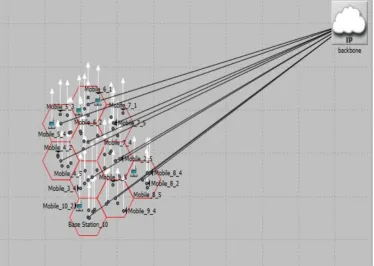
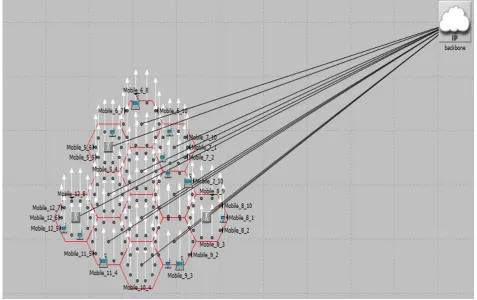
In our proposed model, we have simulated WiMAX network on two different network models that vary in number of their base stations and total no. of nodes [9]. A large geographic location has been divided into various cells of hexagonal shape. WiMax performance measurements for the following two simulations were performed:
1. Scenario_1: In first scenario model, performance of WiMAX network on Small network model is observed with ten BS each having 5 nodes as shown in figure 2.
2. Scenario_2: In second scenario model, performance of WiMAX network on Large network model is observed which consists of 12 BS each having 10 nodes as shown in figure 3.
Fig 3. Scenario2 (Network with 12 BS having 120 clients)
V. Parameters setup
The various parameters used during simulation are presented in table 1 below.
Table 1. WiMAX Parameters
Parameters Value
Average
Simulation speed
152,672 event/sec
Memory used
(MB)
50,120
No. of cells 10,12
Simulation Time 1000 sec
Update Interval 50,0000event
Multipath channel model
ITU vehicular A
Altitude (m) 0.10
PHY profile type OFDM
Scan Request
retransmission (milli sec.)
50
Request retries 16
VI.Simulation Results
6.1 BLER
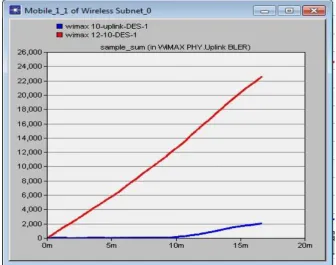
BLER stands for block error ratio. A Block Error Ratio is defined as the ratio of the number of erroneous blocks received to the total number of blocks sent [10]. The WiMAX PHY uplink and downlink BLER comparison of two scenarios are shown in figure 4 and 5 respectively.
Fig 5. WiMAX PHY downlink BLER.
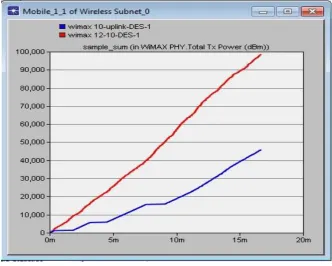
6.2 Total Tx power: Transmission power gives the total power transmitted from a base station to all of the
subscriber stations. As shown in fig 6, total transmission powers for small and large network are 46000dBm and 98000dBm respectively.
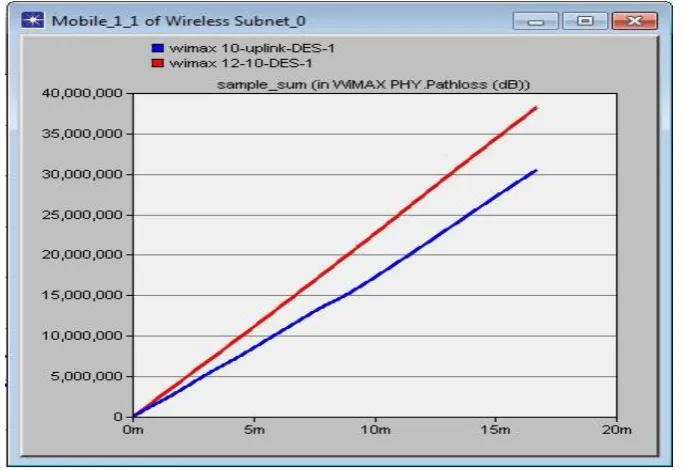
6.3 PHY path loss: The path loss gives the difference (in dB) between the transmitted power and the received power. It represents signal level attenuation caused by free space propagation, reflection, diffraction and scattering. After simulation of 1000 sec. WiMAX PHY path loss values in two models with 802.16 are show in figure 7.
Fig 7. WiMAX PHY path loss(dB).
6.4 Throughput
Throughput is defined as the ratio of the total data reached to a receiver from the sender [11][12]. The time receiver takes to receive the last message is known as throughput. Throughput is expressed as bytes or bits per sec (byte/sec or bit/sec). Throughput can be represented mathematically as in equation (ii);
Fig 8. WiMAX throughput (bits/sec).
6.5 Load
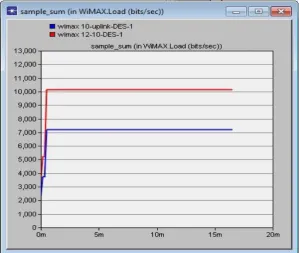
Network load represents the total load in bit/sec submitted to wireless LAN layers by all higher layers in all WLAN nodes of the network. When there is more traffic coming on the network, and it is difficult for the network to handle all this traffic then it is called the network load.
After simulation of 1000 sec., network load values in two models with 802.16 are shown in figure 9.
VII. Conclusion
The simulation study of this work has been done for two WiMAX scenarios, consisting of different no. of mobile workstations, analyzing the behavior of WiMAX network for each scenario with respect to WIMAX Physical Uplink and Downlink BLER, Path loss, Total Tx power, throughput and network load and the results performed on OPNET modeler using sample sum filter shows that both WiMAX PHY uplink and downlink BLERs are highest for the network having Maximum no. of users and lowest for that having Minimum no. of users. The throughput, WIMAX PHY Path loss and total tx power of WiMAX network is maximum in large networks and is minimum in small networks. The network load is also highest for large networks and lowest for small networks. Thus the motive of this study was to check the performance of WiMAX network over these two scenarios with different no. of connected nodes.
References
[1] Williamjeet Singh and Jyotsna Sengupta, ”PERFORMANCE EVALUATION OF A CELL SITE
IN CELLULAR NETWORKS USING WIMAX TECHNOLOGY”, GESJ: Computer Science and Telecommunications 2011|No.2(31), ISSN 1512-1232
[2] W. Hrudey and Lj. Trajkovic, “Streaming video content over IEEE 802.16/WiMAX broadband
access,” OPNETWORK 2008, Washington, DC, Aug. 2008.
[3] Dr. Mayyada Hammoshi,” WiMAX Simulation Model to Investigate Performance Factors”,
Journal of Convergence Information Technology, Volume 6, Number 1. January 2011.
[4] Iwan Adhicandra, “Measuring Data and VoIP Traffic in WiMAX Networks”, JOURNAL OF
TELECOMMUNICATIONS , VOLUME 2, ISSUE 1, APRIL 2010.
[5] Sahana Bhosale ,R.D. Daruwala, ”Performance Evaluation of QoS Parameters during WiMAX to
WiMAX Handoff using NS2 and QualNet”, International Journal of Computer Applications (0975 – 8887) Volume 64– No.9, February 2013.
[6] Vinit Grewal, Ajay K Sharma,” On Performance Evaluation of Different QoS Mechanisms and AMC scheme for an IEEE 802.16 based WiMAX Network”, International Journal of Computer Applications (0975 – 8887) Volume 6– No.7, September 2010
[7] Bapuji, V. and Sharma, S.S.V.N. (2011) “Quality of service for mobile Ad-Hoc wireless networks”, International Journal on Computer Science and Engineering, vol. 3, 4, pp. 1573-1577.
[8] OPNET Modeler 14.5 Documentation.
[9] Kalpana Chaudhari, Upena D Dalal, Rakesh Jha,” Mobile Governance based on WiMAX Connectivity for Rural Development in India”, I. J. Computer Network and Information Security, 2012, 4, 49-55,May 2012 in MECS (http://www.mecs-press.org/)
[10]Block error rate. [Online]. Available: http://en.wikipedia.org/wiki/Block_Error_Rate
[11] Latif, S.B.A. and Rashid, M.A. (2004) F.Alam, „„Profiling Delay and Throughput Characteristics of Interactive Multimedia Traffic over WLANs using OPNET‟‟, School of Engineering Institute of Technology & Engineering, Massey University, Auckland, New Zealand.
![Fig 1. Bandwidth and coverage of wireless technologies [2]](https://thumb-us.123doks.com/thumbv2/123dok_us/1984092.1262261/2.595.82.519.256.468/fig-bandwidth-coverage-wireless-technologies.webp)