ISSN: 2502-4752, DOI: 10.11591/ijeecs.v11.i1.pp113-120 113
Chaotic Local Search Based Algorithm for Optimal DGPV
Allocation
Sharifah Azma Syed Mustaffa1, Ismail Musirin2, Mohd. Murtadha Othman3, Mohamad Khairuzzaman Mohamad Zamani 4, Akhtar Kalam5
1 College of Engineering, Universiti Tenaga Nasional, Malaysia 2,3,4 Faculty of Engineering, Universiti Teknologi MARA, Shah Alam, Malaysia
5 College of Engineering & Science, Victoria University, Australia
Article Info ABSTRACT
Article history:
Received Jan 5, 2018 Revised Mar 15, 2018 Accepted Mar 30, 2018
The advent of advanced technology has led to the increase of electricity demand in most countries in the world. This phenomenon has made the power system network operate close to the stability limit. Therefore, the power utilities are looking forward to the solution to increase the loadability of the existing infrastructure. Integration of renewable energy into the grid such as Distributed Generation Photovoltaic (DGPV) can be one of the possible solutions. In this paper, Chaotic Mutation Immune Evolutionary Programming (CMIEP) algorithm is used as the optimization method while the chaotic mapping was employed in the local search for optimal location and sizing of DGPV. The chaotic local search has the capability of finding the best solution by increasing the possibility of exploring the global minima. The proposed technique was applied to the IEEE 30 Bus RTS with variation of load. The simulation results are compared with Evolutionary Programming (EP) and it is found that CMIEP performed better in most of the cases.
Keywords:
Chaotic local search DGPV optimal location FVSI
Power losses
Copyright © 2018 Institute of Advanced Engineering and Science. All rights reserved.
Corresponding Author:
Sharifah Azma Syed Mustaffa, College of Engineering,
Universiti Tenaga Nasional, Malaysia. Email: [email protected]
1. INTRODUCTION
The world electrical power demand has increased about 22.9% from the year 2005 to the year 2016 due to rapid growth in industrial and commercial activities [1]. Due to this situation, several options have been considered to meet the future energy demand for the existing power system. One of the options is the integration of renewable energy such as the solar energy into the existing grid. Distributed Generation Photovoltaic (DGPV) is the preferable source commonly implemented in power system. The role of DGPV is mainly to provide the active power and no reactive power generated to the system. This solution not only able to meet the increasing power demand but also can further improve the power losses and the system stability [2]. Effect of DGPV on the distribution [3],[4] and transmission systems [5] have been an interesting subject for many researchers. Most of the research efforts are conducted for location and sizing of DGPV to satisfy the technical benefits such as loss minimization, voltage stability enhancement and maximum loadability increment. Among these, some of the researchers focused only to minimize the power losses as the objective function [6]-[8]. In other studies, the optimal location and sizing of DG were studied to focus only on the voltage stability improvement as the objective function [9],[10].
most analytical methods for DG allocation is discussed in [13]. For the same purpose, evolutionary algorithm (EA) techniques have also been applied for single or multi DGs location and sizing for various objectives. EA techniques are preferable due to its computational times compared to analytical techniques. EA techniques start with random initialization of the population followed by the evolvement of the population across several generations. In each generation, fit individuals are selected to become parent individuals. Then these individuals undergo the mutation process to produce offspring individuals.
In evolutionary algorithm, there are two important criteria which need to be considered in order to enhance the performance of the algorithm namely the exploration and the exploitation phase [14],[15]. Exploration space refers to the ability of the algorithm to search for a solution in the whole region of search space. Meanwhile, exploration specifies the convergence towards the best optimal solution in the exploration space. There are many techniques used to improve these phases for example gradient descent, random walk and local search. However, currently, many researchers have considered using chaos theory as one of the approaches to improve the performance of evolutionary algorithm [16]-[18]. From the previous studies, many metaheuristic algorithms have been integrated with a chaotic map in order to improve the performance. In [18], the chaotic local search is utilized in Differential Evolution (DE) and has been tested on 13 classical test functions. The result showed significant improvement in exploitation phase as compared to the traditional DE. Peng Lu et al [19] also concluded that chaotic behaviour is able to enhance the performance of differential bee colony optimization to solve the economic dispatch problem. The results of these studies provide the proof of how successful chaos theory is in improving the evolutionary algorithm. In this study, the chaotic mapping is used to enhance the performance of Chaotic Mutation Immune Evolutionary Algorithm (CMIEP) as the local search technique for optimal DGPV allocation. Comparative studies were performed with respect to Evolutionary Programming (EP). Results had indicated that CMIEP with chaotic local search outperformed EP in terms of accuracy of FVSI and transmission losses.
2. PROBLEM FORMULATION
In this study, two single objective functions are considered and optimized separately while satisfying system equality and inequality constraints.
2.1. Objective functions
The objective of the optimal location and sizing of DGPV is to minimize two objective functions namely the active power loss and the voltage stability index separately.
2.2. Minimization of Voltage Stability Index
A line based voltage stability index, FVSI developed by I. Musirin et al. [20] is used to measure the closeness of the system to voltage collapse. The FVSI formulation was derived from a voltage quadratic equation on a two-bus system and defined by the following equation:
21 2
4 j
i
Z Q f X
V X
1 1
F X min f X
(1)
Z is line impedance X is line reactance
Qj is reactive power at the receiving end Vi is voltage at the sending end
X
f1 is the first objective function
2.3. Minimization Active Power Loss
The total real power loss, Ploss in the transmission lines can be expressed as in equation (2):
2 loss ,i
f X P for i nr
F X min f X
2.4. Constraints
The objective functions are subjected to the following constraints:
1) The generating capacity
N
i
P
P
P
max i , DG min i ,DG
DGi,
(3)
where
P
min i ,DG and
P
maxDG,i are the minimum and the maximum output of DGPV respectively and i is the totalbus number. The bus voltage constraint is defined as follows:
N
i
vmax vi
vmin
(4)where Vmin and Vmax are the lower and the upper bound of bus voltage limit respectively and Vi is the voltage
magnitude at bus i for all the N bus. The power balance constraint is shown in equation (5):
N
i
P
)
P
P
P
G,i D,i DG,i loss(
(5)
where
P
G,i,P
D,i,P
DG,iandP
loss are the active power of bus generator, active load and active power losses respectively. i is the total bus number.3. CMIEP FOR DGPV PLACEMENT
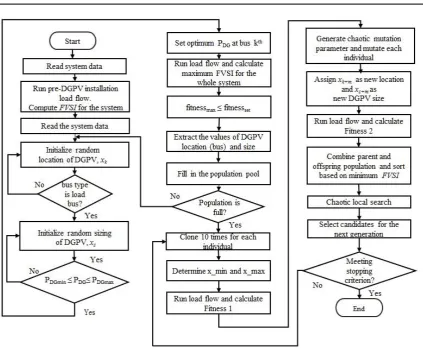
For a transmission network, load flow analysis is carried out and FVSI or loss value is computed for each line using Equation (1) and Equation (2) respectively. The CMIEP algorithm is used for finding the optimum size of DGPV at an optimum location based on a minimum total power loss, with constraints given in Equation (3) to (5). In this study, the 30 Bus IEEE RTS is used as the test system. The complete flow chart for DGPV allocation and sizing is represented in Figure 1.
3.1. Chaotic Local Search
To improve the search capability and for achieving global optima solution of DGPV location and sizing, chaotic dynamics is incorporated into CMIEP. A chaotic function known as Piecewise Linear is employed and the equation is defined as in Equation (6) [21],[22]:
10
0 5
0 5
1
0 5
0 5 1
1
1
1
t t
i t
t
t t
t t
c
p
c
, p
c
p
.
p
c
p, .
c
p c
.
p
c
. ,
p
c
p
c
p,
(6) tFigure 1. Flowchart for DGPV Allocation Using CMIEP
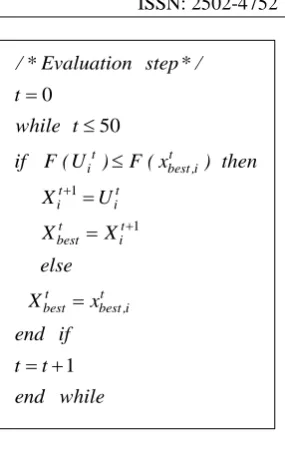
Step 1: Setting the iteration, t=0, global best decisions,
x
best,i
t
i
1
,
2
...,
V
,fitness value from the optimizationF
xbestt ,i ,initial value of search space for each of the variable, rx as in Equation (7):
1 22
x
UB LB
r t x , ,..i
(7)
and chaotic variables, cx
t rand
1,x where UB and LB are the upper and lower boundary of searching space for decision variables x. and V is the total decision variables to be solve respectively.Step 2: Determine the chaotic variablescx
t1 for the next iteration using the chaotic equation in equation (6) according tocx
t .Step 3: Determine the decision variable
U
it by converting the chaotic variablesc
x
t
1
using the following equation :
1
1
0 5
t
i i i x x
U
x t
x t
c
t
. * r t
(8)
Step 4: Calculate the new fitness
t iU F .
Figure 2. Evaluation Algorithm
Step 6: Update the search radius for each decision variables, xias in Equation (9):
1
0 1x x
r t r t * rand ,
(9)
Step 7: If maximum iteration is reached, display the output of chaotic local search. Otherwise, go back to Step 2.
4. SIMULATION RESULTS
The chaotic variable is initialized by the rand function whose advantage is already addressed in the previous section. IEEE 30 bus RTS is used as the test system to verify the feasibility and robustness of the proposed CMIEP with chaotic local search. Two DGPV installations are used in this study to find optimal location and size of DGPV. There are three cases considered in this paper to monitor the capability of the optimization technique. The simulation result obtained using CMIEP is then compared with the result obtained by EP to prove the effectiveness of the proposed algorithm.
4.1. Base Case
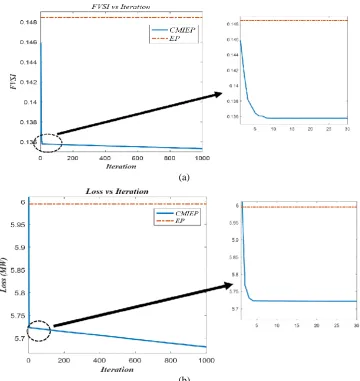
The best results obtained by the implementation of the two objectives separately in base case condition is shown in Table 1. The results of post-installation of DGPV have been compared with the results from pre-DGPV installation. The FVSI of post-installation using CMIEP has been reduced to 32 % from the pre-installation FVSI. Meanwhile, by using EP the FVSI has been reduced to 25% of the pre-installation value. The loss shows the reduction of about 67% from the pre-installation value by using CMIEP and about 65% by using EP. Therefore, it can be seen that the proposed algorithm is capable of finding better solutions for each objective as compared to EP. The convergence characteristic for this case is presented in Figure 3. Results indicated that CMIEP has better fitness and convergence rate compared to EP.
Table 1. Comparison of Objective Functions for 2 DGPV Installation
Objective Function Pre-installation Post-Installation
CMIEP EP
FVSI 0.2037 0.1381 0.1519
Loss (MW) 17.58 5.68 5.99
1
1 0
50
1
t t
i best ,i
t t
i i
t t
best i
t t
best best ,i
/ * Evaluation step* / t
while t
if F (U ) F ( x ) then
X U
X X
else
X x
end if t t end while
(a)
(b)
Figure 3. (a) FVSI and (b) Loss Convergence Characteristics of CMIEP and EP with Two Units DGPV
4.2. FVSI Minimization
Results for FVSI minimization using CMIEP when load bus 29 is subjected to load variation is tabulated in Table 2. The increment of loading condition showed a significant increase on the maximum FVSI of the system. However, after the DGPV installation, FVSI has been reduced to28%, 6% and 9% for load variation of 10, 20 and 30 MVAR respectively. The location and sizing of DGPV to achieve the improvement of FVSI can be referred to the same table.
Table 2. FVSI Minimization when Load Variation was Subjected to Bus 29
Loading
Condition Pre-Installation
Post-Installation using CMIEP
DGPV DGPV % FVSI
Reduction
Qd29(MVAR) FVSI Location Size (MW) FVSI
10 0.2111 17 29 42.89 42.90 0.1503 28.78
20 0.3573 30 24 13.18 56.29 0.3359 5.99
reduction from the pre-installation loss. The optimal location and sizing optimized by CMIEP technique are buses 21 and 7 with 59.68 MW and 61.66 MW respectively. From the table, it is clearly showed that bus 12 and bus 7 are the optimal location for all the loading condition.
Table 3. Transmission Loss Minimization when Load Variation was Subjected to Bus 29
Loading Condition Pre-Installation Loss DGPV Post-Installation using CMIEP DGPV Loss % Loss reduction
Qd29 (MVAR) (MW) Location Size (MW) (MW)
10 18.12 21 7 59.68 64.01 6.00 66.87
20 19.39 21 7 56.37 61.66 7.19 62.91
30 22.44 21 7 60.65 50.56 10.10 55.00
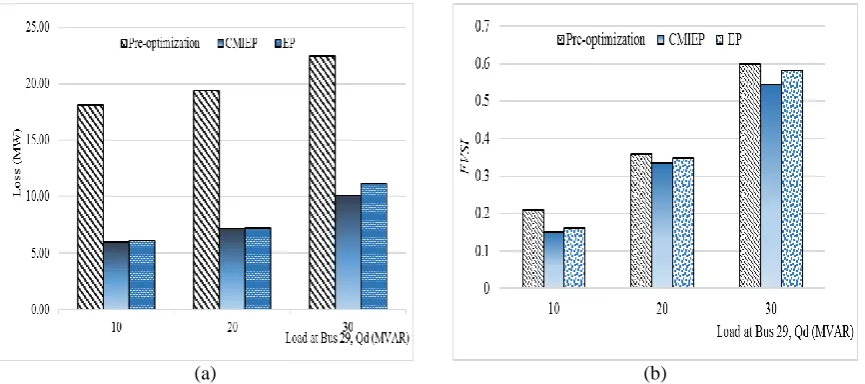
The results of minimization of FVSI and minimization of losses for CMIEP and EP are compared with the pre-installation value and shown in Figure 4. In Figure 4(a), both CMIEP and EP are comparable at load variation of 10 MVAR and 20 MVAR. However, at load variation of 30 MVAR, CMIEP outperformed EP with 4% difference of post-installation loss reduction. In Figure 4(b), it is clear to mention that CMIEP outperformed EP in all cases to determine the optimal location and size of DGPV for FVSI reduction.
(a) (b)
Figure 4: (a) Loss (b) FVSI with Load Variation Subjected to Bus 29
5. CONCLUSION
This study proposed a modified version of a pre-developed Chaotic Mutation Immune Evolutionary Programming (CMIEP). Chaotic local search has been added into the original CMIEP algorithm. The inclusion of chaotic local search managed to achieve a better optimal solution for location and sizing of DGPV in the transmission system. In the proposed placement scheme, the transmission loss and FVSI value are treated as the fitness equations and optimized separately. From the study, the optimal value of DGPV units for different loading levels are changed as load changes. The results also revealed that the utilization of DGPV into the transmission system reduces the total of active power losses and effectively improve the voltage stability of the system. A comparative study, also showed that the proposed CMIEP algorithm outperformed EP exhibited by a better reduction in FVSI values and lower loss values, for all cases. In the future, CMIEP can be used to perform multi-objective functions taking FVSI and losses as the objective functions.
ACKNOWLEDGEMENT
REFERENCES
[1] British Petroleum, “BP Statistical Review of World Energy,” 2017.
[2] P. Mehta, et al., “Optimal selection of distributed generating units and its placement for voltage stability
enhancement and energy loss minimization,” Ain Shams Engineering. Journal, 2015.
[3] S. G. Naik, et al., “Optimal allocation of combined DG and capacitor for real power loss minimization in
distribution networks,” International Journal Electrical Power Energy System, vol. 53, pp. 967-973, 2013.
[4] J. O. Petinrin and M. Shaabanb, “Impact of renewable generation on voltage control in distribution systems,”
Renewable Sustainable Energy Review, vol. 65, pp. 770-783, 2016.
[5] Z. A. Kamaruzzaman and A. Mohamed, “Dynamic voltage stability; power distribution system; grid-connected PV system,” Journal Electrical System, vol. 2, pp. 239-248, 2016.
[6] J. E. C. Becerra and H. E. H. Riaño, “Location and Size of Distributed Generation to Reduce Power Losses using a Bat-inspired Algorithm,” VII Simposio Internacional sobre Calidad de la Energía Eléctrica SICEL, 2103.
[7] S. Shaddiq, et al., “Optimal Capacity and Placement of Distributed Generation Using Metaheuristic Optimization Algorithm to Reduce Power Losses in Bantul Distribution System, Yogyakarta,” 8th International Conference on Information Technology and Electrical Engineering, vol. 7, pp. 2-6, 2016.
[8] L. I. Dulău, et al., “Optimal location of a Distributed Generator for power losses improvement,” Procedia Technology, vol. 22, pp. 734-739, 2015.
[9] P. Mehta, et al., “Optimal selection of distributed generating units and its placement for voltage stability
enhancement and energy loss minimization,” Ain Shams Engineering Journal, Ain Shams University, 2015. [10] J. J. Jamian, et al., “Optimum multi DG units placement and sizing based on voltage stability index and PSO,”
Proceeding University Power Engineering Confonference, 2012.
[11] S. Sharma and A. R. Abhyankar, “Loss Allocation for Weakly Meshed Distribution System Using Analytical Formulation of Shapley Value,” IEEE Transaction on Power System, vol/issue: 32(2), pp. 1369-1377, 2017. [12] P. Kumawat, et al., “An analytical approach for optimal allocation of DG unit in distribution system,” IEEE 7th
Power India International Conference (PIICON), 2016.
[13] A. Ehsan and Q. Yang, “Optimal integration and planning of renewable distributed generation in the power distribution networks: A review of analytical techniques,” Applied Energy, vol. 210, pp. 44-59, 2017.
[14] G. G. Wang, et al., “Chaotic Krill Herd algorithm,” Information Sciences, vol. 274, pp. 17-34, 2014.
[15] D. Jia, et al., “An effective memetic differential evolution algorithm based on chaotic local search,” Information Sciences, vol/issue: 181(15), pp. 3175-3187, 2011.
[16] G. Kaur and S. Arora, “Chaotic Whale Optimization Algorithm,” Journal of Computational Design and Engineering, 2018.
[17] V. P. Sakthivel and S. V Vijayasundaram, “Chaotic Particle Swarm Optimization for Congestion Management in an Electricity Market,” International Journal of Scientific and Research Publications, vol/issue: 4(6), pp.1-6, 2014. [18] M. K. M. Zamani, et al., “Chaos embedded symbiotic organisms search technique for optimal FACTS device
allocation for voltage profile and security improvement,” Indonesian Journal Electrical Engineering and Computer Science (IJEECS), vol. 8, pp. 146-153, 2017.
[19] Z. Guo, et al., “An enhanced differential evolution with elite chaotic local search,” Computer Intelligence Neuroscience, 2016.
[20] P. Lu, et al., “Chaotic differential bee colony optimization algorithm for dynamic economic dispatch problem with
valve-point effects,” International Journal Electrical Power Energy System, vol. 62, pp. 130-143, 2014.
[21] I. Musirin and T. Rahman, “Novel fast voltage stability index (FVSI) for voltage stability analysis in power transmission system,” Student Conference on Research and Development Proceeding, pp. 265-268, 2002.