lETTERS
TO
THE
EDITOR
This
section
is
open to comments by any member of fhe Society.Opinions
expresseddo
notnecessarily
represent thoseof
fheJournal
and
the Sociefy.SHOULD THE A.S.R.M. REMAIN SILENT?
It is gratifying to see your announce- ment that the Journal of Range Man- agement is to be opened to letters to the Editor. Hereby I raise some questions of interest to members of the Society.
Mismanaged range lands are one basic reason for some maladjustments that afflict American agriculture today. The dust bowl winds of the “dirty 30’s” helped to dramatize that fact. This spring brings a repeat performance. Our surplus wheat, so troublesome in recent years, is another result of unwise use policies on range lands. As an operator I well know that many progressive range operators now do a very good job of range management and ask for more research guidance, but too many still do not.
Range management, like some other aspects of resource conservation, is now in a disturbing state of confusion. Secre- tary Benson has made a generalized statement favoring accelerated research. He also advocates greater local and state participation in better manage-
ment of our natural resources but just how this is to be financed and accom- plished is not yet entirely clear. The Secretary has made far-reaching organi- zation changes in the Soil Conservation Service and elsewhere in the Depart- ment. Four long-established Forest and Range Experiment Stations have been combined into two super-stations and further consolidations across regional limits are feared. Certain range research functions have been transferred to another centralized agency with less field experience and organization to handle them with top effectiveness.
A columnist recently reported that 9 out of 12 men from the top command in the Department of i4griculture have quit after policy rows or .for other reasons not always fully understood. Do these rows and important but sudden reorganization moves made without full public airing indicate that the USD,4 is now coming under autocratic rule? Has Departmental approval of pending legislation of questionable effects on good conservation been a factor in the
CHANGING YOUR ADDRESS?
existing confusion? Do these changes and uncertainties ahead explain why the morale of lesser departmental workers is now at a new low ebb?
,4 few years ago when the U. S. Department of Agriculture and several Western states started a good though belated effort to give range research and management the recognition and sup- port that they deserved, the American Society of Range Management was organized to foster and promote that program. This Society can hardly re- main unconcerned with the developing changes just mentioned briefly that so directly affect the field in which its operating and professional members are involved.
It would seem that the responsible voice of our Society should command some consideration when important range policy matters are being decided. Just what and how we should do it is a big question now. It deserves careful thought.-Leon C. Hurtt, Range and Ranch Consultant, 541 Evans Ave., Missoula, Montana. (Received March 20,
1954)
If your plans for the next few months include a change of address, please give us
Journal of
RANGE
MANAGEMENT
Editorial
A Continuing Appraisal of Range
Management
P
REVIOTJS
nal have assessed the progress editorials in the Jour- made by the Society in its short spa” of years. These have been ap- praisals of past accomplishments and suggestions for future progress. The Journal, being the medium for expression from those who have a primary interest in range manage- ment, is also the proper place for a” evaluation from time to time of progress in the composite discipline we call range management.No complete appraisal GIL” he made at any one period of time. Range management is dynamic and is becoming increasingly larger in scope. The writer in the pages of the Journal once attempted t,o de- fine range management and was rhallenged by many readers, all of whom had varying definitions. This is just a” indicatio” that range management is a broad body of knowledge hound together by a common goal-management of mild lands for profit or greater use by society whatever that use may be. When knowledge assembled from studies of soils, plants, animals and climate is correlated vith the cco- nomic and physical environment superimposed by man’s activities we arrive at range management. We we, however, prome t,o forget that man’s activities are heroming in- creasingly important in their effect on the managrm~nt, aspwt of range ma"ageme"t
The body of knowledge which we call range ma”agcmn”t was set upon its course about 50 years ago. Certainly there must have bee” a
need for specific study and applica- tion of these studies to manngement of range or wild lands. A look at, the record will disclose many important research findings which have re- sulted in improvement of soil and forage conditions by management. Of equal importance, perhaps, has been the development of under- st,anding bctveen t,he land user, the ranrher, the Federal and state governments, the wildlife rnthu- s&t,, and the public generally. These relntimlships do not exist, in perfect harmony but the founda- tion has been laid. For this the Amerioa” Socint,y of Range Man- agement ran assume wxne degwe of responsibility.
Management of the range is the end product of research and rule of thumb techniques. To coordinate effort leading to “management”, we must know, at least approximately so, what the management goal should be. Additionally, the cow elusion may be rearhpd t,hat any management goal presently envis- aged is hut, a” intermediate step to a changing USA or demand for the land.
Of recent years the range man- ager has give” increased attentio” t,o the att,itude of society regarding the use and management of un- cultivatrd latlds. In the lnnt snal,Y- sis tho objectives of our sorirty will dirtnt,e the goal for the manngc- mart of range lands. ‘I‘hcx msu:~grr who snalyars the operation of PK. nomic ~IVX~~S has t,ake” the initial step toward the establish- ment of a manageme”t goal. FOI
private lands the immediate goal will he a” economic return. For public lands t,he return may bc a measurable eronomic return or n r&urn of tangible hen&t t,o the public. These are primary goals which must be preceded by prior goals. Good range management must precede the goal of great& use or return from the land.
We <:a” look bwk a fen. years whm domestic stock used at will most of the w&r” lands. Thrw seemed no need for a considrratio” of any other use-the Nation dn- manded meat, hides, and ~vool. Production of livestock was the goal of range management at t,hat time. Sincr then range management has bwome of age and does not consist, solely of managing lands fm dome& livrst,ork production. Pro- during liv&ock from native forage certainly is a most important aspect, but it has been supplanted in many areas by other demands made on the lands.
148
forage for livestock production. This will be so regardless of whether the land is in public or private ownership. Nevertheless some range lands will be managed for other than livestock production. In this instance these lands will probably be in some form of public owner- ship. This is not so because public ownership is the only desirable type of ownership but because the mul- tiple use demanded of the land is best served by a combined holding.
Examples can be cited where state agencies are purchasing pri- vately owned lands to provide more range for big game herds. This is not just a whim of responsible public officials. They are acting in response to an economic demand of the people for greater access to hunting and recreation, and for which the return may be greater than for other uses. This is a prob- lem of the management aspect of range management. Or is it range management?
This writer is not attempting to make a case for any particular type of land ownership. The point to be made is that we have approached the time when applied effort in the field of range management can logically be separated into two or more distinct activities. The al- liance will be close but the inter- mediate goals may vary. Initially we might separate range manage- ment into range science and land management. Range science would include and provide the basic physical information necessary to adequate management of wild lands. This field is too comprehen-
EDITORIAL
sive to detail at this time. Land management should be the activity that correlates the basic informa- tion and adapts it to management goals. Land management should also set the management goals from studies of the economic, and social requirements of society for the land. It matters little whether the manager supervises lands in public or in private ownership. The pri- mary economic use of the land will dictate the management goal. In addition, the physical aspects of the land will affect the economic use to a large extent although not wholly so.
The gap between basic research and practical application to achieve a management goal for land is much narrower today than a decade ago. Nevertheless management tech- niques and management planning have not progressed at the pace set by basic research. Now more than ever before there exists a need for individuals trained to manage wild lands using the available scientific and economic facts.
Range management, as taught in the colleges and universities, places emphasis on the biological and associated animal sciences. This training is basic, but for those in- dividuals interested in management in the sense used here, further training in the social sciences is necessary. Management of land to produce an economic return or to serve a specific goal of society is the final result of the applied manage- ment technique. Formal training in this aspect of range management has been neglected.
The Journal of Range Manage- ment should reflect the interests of the members individually and col- lectively. A study of past issues of the Journal indicates a dearth of articles on the “management” aspects of range management. Per- haps the land administrators and managers have not had the in- centive to formal presentation of their knowledge. Must we lose a large body of knowledge which if disseminated would be indicative of the practical application made of basic research?
This short appraisal of range management is not presented as a critique of past progress or accom- plishments. The many contribu- tions made by research and the outstanding articles published in the Journal are proof of progress made in accumulating basic infor- mation. However, there appears to be a neglected area of activity in range management. This area of activity can be termed management science as contrasted to range science.
I believe the Society and the colleges and universities should give greater thought to development of the management aspect of range management. It is a field of activity that is not as precise as basic bio- logical research. But it is in this activity that the fruits of range science can be realized and the best use of land can be planned and reached-H. R. Hochmuth, Bureau of Land Management, U. S. De- partment of the Interior, Washing- ton, D. C.
CALL FOR PAPERS FOR 1955 ANNUAL MEETING
Members who wish to present papers at the annual meeting in San Jose, California, January 25-28, 1955, are invited to offer them now.
Improved
Pasture for Spring and Sum-
mer, Range for Fall and Winter
ARTHUR D. MILES
Rancher, Livingsto?
I
NCREASED forage production onthe range, and improved pas- ture have enabled us to wean heavier calves and lambs, run more head of livestock and reduce the costs of operation. Improved pasture has in- creased carrying capacity and weight gains ; winter ranging has
reduced the cost of wintering. Our steep and broken range lies above 5000 feet in South Central Montana. Much of the twenty to thirty inches of precipitation falls as snow. During storm periods, snow will accumulate to a depth of two or three feet on the level, but the strong winds and warm chinooks provide open grazing dur- ing most of the winter. The grass association resembles the Pacific bunch grass type of bluebunch wheatgrass (Agropyron spicatum)
and Idaho fescue (Festuca idahoen-
sis) .
Most of the increase in livestock production has resulted either di- rectly or indirectly from improved pasture. The carrying capacity of improved pasture is twice as great as good native range. Better August gains are made on improved pas- ture. The elimination of spring use and the deferred summer use af- forded by improved pasture, have increased range forage production.
Crested wheatgrass pastures, sown on the lower south slope benches after two crops of barley, were the first to be established. The original purpose of the crested wheatgrass pastures was to reduce the losses from tall larkspur (Del-
phinium spp.). During the first
three years of running cattle, 15 head out of a herd of 50 died of larkspur. Since crested wheatgrass has kept the cattle off the range
Montana
during the larkspur season (May and June), we have had no larkspur losses the past seven years, even though we’ve increased the herd to 200 head.
Calving is started in February, instead of March in order to escape the difficulty of engorged teats that result when calving on crested wheatgrass. The calves born in February and March are able to take the full flow of milk when they are turned to crested wheatgrass the first of May.
New and practical management suggestions from a young Mon- tana rancher based on experi- ence. An article full of useful information and stimulating sug-
gestions for the rancher and
technician alike.
sativa) on favorable moisture sites
of the range, and on crop land no longer needed for hay production. The deep-rooted alfalfa and orchard grass furnish succulent pasturage during the dry Augustj, drawing on winter-accumulated moisture. Or- chard grass-alfalfa pastures pro- duce 5 animal unit months per acre, of grazing a year, and crested wheatgrass 3 animal months.
Winter Ranging
The range no longer needed for summer grazing is used to carry the cattle and sheep through the dor- mant season of production, fall and winter. The sheep used to go on full hay ration the middle of De- cember. We now keep them on the range until the first of April. The cattle range out through February. Supplements are fed after the first of January, and the cattle and sheep winter well on the range.
We ran out of grass the first few years of winter grazing. We had grass left, but it was scattered throughout the inaccessible parts of the range. Since a grazing plan has been adopted to reserve the closer, snow-free sites for winter use, we have had an abundance of winter grass.
Nursing cows on improved pas- ture become fat. Because of their good condition, the calves are kept on them longer in the fall. Cows in good condition winter easily on the range and less supplement is required.
Not only does improved pasture increase carrying capacity, but greater gains are possible. Yearlings summered on improved pasture weigh 900 lb. compared to those summered on Idaho fescue grass- land weighing 750 lb. Considering the investment in cattle, the cost of wintering and the ease of looking after cattle on pasture, it is a ques- tion if it’ pays to turn out on range in summer.
For summer grazing we are estab- lishing orchard grass (Dactylis
glomerata) and alfalfa (Medicago
149
Cattle winter better on areas with little brush. They tend to congregate in the brush and con- sume little feed during stormy weather. On brush-free areas, they find protection in the swales and are always on good feed.
Relatively little difference has been found between north and south slopes in maintaining the stock. The amount of area the snow will blow off determines the amount of grass available.
The animals a.re fed supplements on areas of the range that have an abundance of grass as a means of obtaining distribution (Fig. 1,
1.). Four-wheel-drive trucks with
lii0 ARTHUR D. MILES
courage the animnls to ronsumc more grass.
The cat,tle range out farther from mater in winter than they do iu summer. Our water is spring fed and stays “pen during the day. (Fig. 1, rt.) The sheep do well rith- out water when there is snow, even when supplemented with hay.
Good quality alfalfa hay is used as a supplement, supplying digest- ible protein for one-third less cost than pelleted concentrates. Much less range grass is consumed when alfalfa is fpd as a supplement. Sheep do w?ll in the early winter (January) with % pound of oats or barley. The ability of sheep to select the portions of forage plants with higher protein and their ap- petite for the high-protein browse plants allow them to balance their diet better than cattle. The<attle satisfactorily utiliac coarse grass that sheep leave, when fed a protpin supp1emcnt.
Sheep are considered he&r rus- tlers than cattle because they paw away the sn”\v and their rr-001 af- fords them protection from the iry winds. Cattle will rustlr if turned into areas of tall grass after hravy snows. It is necessary to accustom
the snimals to the method of hsn- dling desired. Animals that are used to heing fed all winter need to he trained to rustle.
Wintering on t,he rangr is less expensive than feeding straight, hay, even though some additiomal ex- pense is incurred hauling the hay to the range. We fred one half as much hay by wintering on the range.
In severe winters such as 191% 1919 !ve str&h our hay supply by feeding our reserve of oats and barley. Oats and barley will replace 2 pounds of hey per pound fed, and make a better rcseerve than large amounts of hay carried from our year to the next.
Range Type Cow
Rettcr distrihut,ion over the range can be obtained rith corns that have the ability and desire to range out. Heavy cows with large feet find it difficult to move “vcr our steep and rocky range. Cows that range out ut,ilize distant areas. Greater forage production vith in- creased carrying capacity results from t,he cvcn grazing of range type cows.
Cows are judged for east of
wintering and size of calf they pro- dure. Corns that rannot, maintain t,heir condition in minter are culled. We are breeding toward a cow that has a capacity and appetite to conSunK large amounts of coitwe grass in summer and bulky matured grass, coitrse hays and straw in minter, and has a long lactation period that corresponds to our seasou of green grass.
Wild and nervous rows, although they range out, generally stay t,hin and produce light ureight calves. Wr prefer cows that take their calves rith them to graze, as opposed to those that hide their calves nrrd run hack to them frequeutly during the day.
We select bulls from cows that produce growthy calves under our conditions. Replacement heifers are selected after they hare raised t,wo or three calves. Poor milkers and poor keepers are cullrd.
Sagebrush
SUMMER PASTIJRE, WINTER RANGE 151
cnttb? tend to tramp out m&rush. He!
is
six
weeks later than on the ad- jacent snom-free areas (Fig. 2 ten.). The stock will not touch the um palstahlc mature grasses until the snolr.-accumulatiorl areas arc grazed hare.Our method of dealing rith sage- brush is twofold: (I) the level sites of snow a~aunulation are ploxed and soxvn to summer grass, and (2) the season of grazing is changrzd on other areas from spring and summer to fall aud winter (Fig. 2, rl.). In the fall, the grasses arc all at the same stage of maturity. ln the winter, t,he heavy snow cover pro- hibits the grazing of the snow-ac- cumulation areas.
We brlicvc the cheapest method of controlling sagebrush is to main- tain forage competition. Improved pasture or properly grazed range maintains a competitive corer that sagebrush and other weeds are not able to invade. Since the natural mortality of sagebrush is high, and, wince it is easily killed by burning or spraying, the problem is one of r&hlishing and maintaining ade- cluate competitive cover.
Range Fertility
Nitrate fcrtilizat,ion, as supplied hy mnnurcs and legume residues, has shown marked msponse on our range. It sppcars that nit,rstes alonp rould dnuhlr forage produr- tion. Frrtility may be as important
as intensity of grazing in maintain- ing a. good grass cover. We look to better utilization of auimsl mauuws aud mow legumes as low rest methods of supplying nitrates and phosphates.
Much of t,hr pow manure is wasted in arcas of deciduous brush. ;L R solution to the prohlcm, we hn\.e: (1) fenced thP cattle out of the brush in some areas, and (2) rcmovcd cousiderable brush along with the development of improved pastures.
Cattle do as well in brushless pastures, srck the high ground when the flies arc had and do not form the habit, of ramping in the brush. Fall and winter graaiug affords bcttcr manure distribution sinw the <:o\vs camp on wowfwe flats.
1V’r harr introdurcd sweet rlo\w (.lflMolU.s ufficiannllls) into mauy of the range areas. Sweet, clover has perpetuated itself on some parts of the range for over 20 years. Al- lowing for production of wed and managing for seedling cstshlish- ment are fwtors in maint,aining sweet elovcr. Sweet clover main- tains itself best under light, spring and heavy winter use.
Considerable possibilities are seen in other legumes. Montana common alfalfa (Medicago saliva) has Bern established in hcnvily-disk& sag?- brush. Alfalfa reseeds itself under spring and winter grazing ou thr
rauge. Alsike clowr (Tr~folizcm h~hridzcm) maintains a fair stand on owe-cultivated north slopes t,hat have been uudcr sheep grazing for 25 years. Some of the nat,ive lrgumps, such as lupines (Lupims
spp.), grow in dense stands, hut their ability to fix nit,rates is uot known.
At, the present time little response has hew ohtained from applica- tions of phosphato to range areas that have pardial stands of legumes. It is thought that phosphates may help to maintain the balance of legumes and grasses.
As the fertility elements of thr original organic mat,ter arc ut,ilieed in plant growth, just as happens uudrr cultivation, the supply of accumulated phosphates aud n- trates is deplrtcd. In order to in- crease orgauio matter, it seems that a. supply of phosphates as wrll as &rates would he nrccssary.
Deep rooted plants may supply phosphate with less rest than pur- chased fertilizer. Sweet 14orw has beeu show1 to be valuable in t,his rrspert. Its roots penetrate deeply
(ten feet) into the soil and ahsorh potash aud phosphsk that is ~1. available to the roots of other plank
Summary
152
nated larkspur losses and increased carrying capacity. Crested wheat grass is utilized for spring pasture, the deep-rooted orchard grass and alfalfa for summer forage. The cat- tle and sheep winter on the range no longer needed for summer grazing.
LEO B. MERRILL
They consume one half as much Sagebrush is being controlled by
hay wintered on the range as when the development of improved pas-
wintered on hay alone. ture and by maintaining the range
A cow that will range out is recog- in good condition. Phosphates and
nized as desirable. Cows are being nitrates are recognized as constitu- ents of organic matter, and it is
bred that will raise sizable calves believed that they can be supplied
and winter on available feeds. cheaply by deep-rooted legumes.
A Variation of Deferred Rotation Graz-
ing for Use under Southwest Range
Conditions
LEO B. MERRILL
Range Specialist, Texas Agricultural Experiment Station, Sonora, Texas
D
URING the past several years
there has been considerable discussion regarding the relative merits of deferred rotation grazing. Much of the material presented is unfavorable to this system of use. In any system of grazing, how- ever, there are many factors to be taken into consideration. As was aptly stated, (Sampson 1951) “It becomes clear that regional and local conditions have much to do with the results achieved.”
The majority of rotation grazing studies have been conducted on two or three-pasture systems and most of these systems concentrate live- stock on one pasture while the re- mainder are resting. It would seem that as rainfall diminishes such a system becomes more and more hazardous since, during the period of concentrated grazing, a pasture might be damaged to the extent that it could not recover during the ensuing rest period.
The three-pasture rotation sys-
tem, with grazing concentrated on one pasture, was used in the studies of Dickson, et al. (1948), Frandsen
(1950), Rogler (1951) and McIlvain and Lagrone (1953). In all of these
studies except that of Frandsen there appeared to be little advan- tage, if not a definite disadvantage, in deferred rotation grazing as far as livestock gains were concerned. However, most of these studies indicated that vegetation improved
under rotation. The example of
deferred rotation given by Frandsen has no period of time in which
livestock were concentrated for
more than 46 days on a pasture
producing green vegetation. This
concentration was always followed by a period in which vegetation was allowed to make at least 92
days’ growth. This system of
grazing apparently gave favorable results.
Procedure
A deferred rotation system was established at the Ranch Experi- ment Station on the Edwards Pla- teau of Texas in a comparison with continuous grazing at three rates of stocking. This study has been carried on for a period of four years, from July 1, 1949 to June 30, 1953, using a combination of three classes
of livestock-cattle, sheep and
goats. Under the yearlong grazing
system, three rates of stocking were employed, namely, heavy at 48 animal units per section, moderate at 32 animal units per section and light at 16 animal units per section. Under the deferred rotation system, four 60-acre pastures were set up as a rotation unit in which a com- bination of cattle, sheep and goats was used at a moderate rate of stocking, or 32 animal units per section.
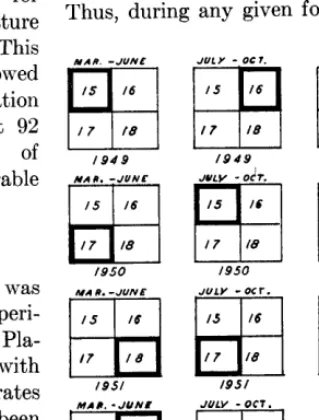
In the rotation system (Fig. 1) each pasture is grazed 12 months, then rested 4 months. In Figure 1 the pasture which is rested during any period is enclosed by heavy black lines. The rest period comes at a different season in each suc- ceeding 16-months grazing cycle. Thus, during any given four years’
MAR. -JUNE
I949 MA a. -JUNC
I950 MA R. -JUNE
IS I6
q
l? I81951
MAA. -JUNE
JULY - OCT.
I5 I6
w
I? I8 1949
JULY -Oh.
I950 JULY -0cr.
I951
JULY -OCT.
1952
NOV. - rce.
NOV. -Cd-I.
NOV. - FEb.
lQS/-lg.52
NW. - FCI).
FIGURE 1. Grazing system on rotation
152
nated larkspur losses and increased carrying capacity. Crested wheat grass is utilized for spring pasture, the deep-rooted orchard grass and alfalfa for summer forage. The cat- tle and sheep winter on the range no longer needed for summer grazing.
LEO B. MERRILL
They consume one half as much Sagebrush is being controlled by
hay wintered on the range as when the development of improved pas-
wintered on hay alone. ture and by maintaining the range
A cow that will range out is recog- in good condition. Phosphates and
nized as desirable. Cows are being nitrates are recognized as constitu- ents of organic matter, and it is
bred that will raise sizable calves believed that they can be supplied
and winter on available feeds. cheaply by deep-rooted legumes.
A Variation of Deferred Rotation Graz-
ing for Use under Southwest Range
Conditions
LEO B. MERRILL
Range Specialist, Texas Agricultural Experiment Station, Sonora, Texas
D
URING the past several years
there has been considerable discussion regarding the relative merits of deferred rotation grazing. Much of the material presented is unfavorable to this system of use. In any system of grazing, how- ever, there are many factors to be taken into consideration. As was aptly stated, (Sampson 1951) “It becomes clear that regional and local conditions have much to do with the results achieved.”
The majority of rotation grazing studies have been conducted on two or three-pasture systems and most of these systems concentrate live- stock on one pasture while the re- mainder are resting. It would seem that as rainfall diminishes such a system becomes more and more hazardous since, during the period of concentrated grazing, a pasture might be damaged to the extent that it could not recover during the ensuing rest period.
The three-pasture rotation sys-
tem, with grazing concentrated on one pasture, was used in the studies of Dickson, et al. (1948), Frandsen
(1950), Rogler (1951) and McIlvain and Lagrone (1953). In all of these
studies except that of Frandsen there appeared to be little advan- tage, if not a definite disadvantage, in deferred rotation grazing as far as livestock gains were concerned. However, most of these studies indicated that vegetation improved
under rotation. The example of
deferred rotation given by Frandsen has no period of time in which
livestock were concentrated for
more than 46 days on a pasture
producing green vegetation. This
concentration was always followed by a period in which vegetation was allowed to make at least 92
days’ growth. This system of
grazing apparently gave favorable results.
Procedure
A deferred rotation system was established at the Ranch Experi- ment Station on the Edwards Pla- teau of Texas in a comparison with continuous grazing at three rates of stocking. This study has been carried on for a period of four years, from July 1, 1949 to June 30, 1953, using a combination of three classes
of livestock-cattle, sheep and
goats. Under the yearlong grazing
system, three rates of stocking were employed, namely, heavy at 48 animal units per section, moderate at 32 animal units per section and light at 16 animal units per section. Under the deferred rotation system, four 60-acre pastures were set up as a rotation unit in which a com- bination of cattle, sheep and goats was used at a moderate rate of stocking, or 32 animal units per section.
In the rotation system (Fig. 1) each pasture is grazed 12 months, then rested 4 months. In Figure 1 the pasture which is rested during any period is enclosed by heavy black lines. The rest period comes at a different season in each suc- ceeding 16-months grazing cycle. Thus, during any given four years’
MAR. -JUNE
I949 MA a. -JUNC
I950 MA R. -JUNE
IS I6
q
l? I8 1951MAA. -JUNE
JULY - OCT.
I5 I6
w
I? I8 1949
JULY -Oh.
I950 JULY -0cr.
I951
JULY -OCT.
1952
NOV. - rce.
NOV. -Cd-I.
NOV. - FEb.
lQS/-lg.52
NW. - FCI).
FIGURE 1. Grazing system on rotation
DEFERRED
grazing, each pasture is deferred once during each of the 4-month seasonal periods. This allows some plants to set seed and gain vigor. Under this system only one group of livestock is moved every four months. The stocking rate on each of the three stocked pastures during any given 4-month period is 43 animal units per section. When the acreage of the deferred pasture is included for computing stocking rates in the four pasture rotations, the rate is 32 animal units per sec- tion overall.
Rainfall
During the first year of the study, 1949-50, the rainfall was 26.97 inches, which was above the aver- age of 24 inches for the station. The three years following were characterized by a severe drought. The yearly rainfall for the three years, 1950-53, was 14.61 inches, 6.96 inches and 4.91 inches respec- tively.
Results
Reaction of Livestock to Deferred Rotation as Compared to
Yearlong Grazing
In the first year of this study, 1949-1950, rotation grazing showed little evidence of being superior to yearlong grazing. At a stocking rate of 32 animal units per section for both systems, steers made a gain of 285 pounds per head under rotation grazing and 283 pounds per head under the yearlong sys- tem. On the other hand, sheep made slightly less gain under rota- tion than under yearlong grazing, or 35.0 and 37.2 pounds per head, respectively.
In the three years following 1949-1950, the trend has been for livestock weights to increase in the rotation pastures above those under yearlong stocking, except for 195% 1953 in which steers in the rotation pastures gained only 143 pounds per head while those in the year- long-grazed pastures gained 175 pounds per head. The weight gains
ROTATION GRAZING IN THE SOUTHWEST 153
20
18
I
q
L /GW
/6
q
MODERATC
/d
ia NEA VY
v ,
12
l0
t9
6
4
2
0
/949*1350 Is509lS$/ 1951~1952 /952-1BSS ALL
FIGURE 2. Per-acre gains for sheep under continuous and deferred rotation
grazing.
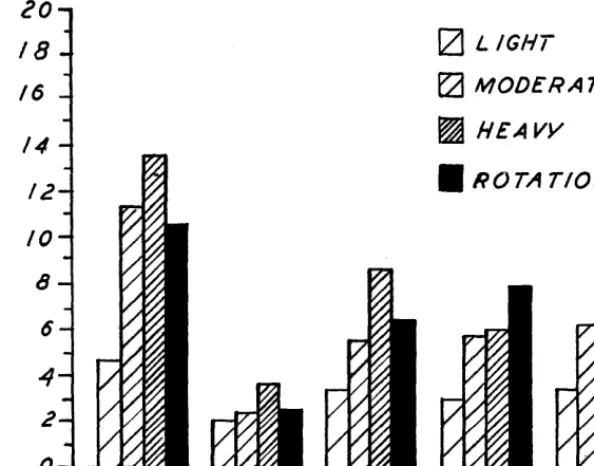
of sheep in the rotation system have steadily increased as compared with those under yearlong grazing. Per-acre gains of sheep under year- long and rotation grazing are shown in Figure 2. During the first year of the study, 1949-50, the highest, gains of 13.5 pounds per acre were ob- tained from pastures grazed year- long with 48 animal units per section, followed in order by gains of 11.2 pounds per acre from year- long stocking at 32 animal units per section, 10.2 pounds from rota- tion grazing at 32 animal units per section and 4.3 pounds from year- long stocking at 16 animal units per section.
In 1952-53, sheep on the moder- ately stocked rotation pastures made the highest gains of 7.9 pounds per acre, followed by the heavily stocked, yearlong-grazed pastures with a gain of 5.8 pounds per acre, and the moderately stocked yearlong-grazed pastures with 5.6 pounds per acre. During the ent,ire four-year period, the highest, annual gain of 7.8 pounds per acre was made on the heavily stocked pastures grazed yearlong. The second highest weight gain of 6.8 pounds per acre was made on
the moderately stocked rotation pastures, followed in order by the moderately and lightly stocked yearlong-grazed areas with gains of 6.1 and 3.1 pounds per acre, re- spectively. In succeeding years, however, the advantage in gain per acre held by the pastures heavily grazed yearlong steadily diminished, while the deferred rotation pas- tures made consistent gains.
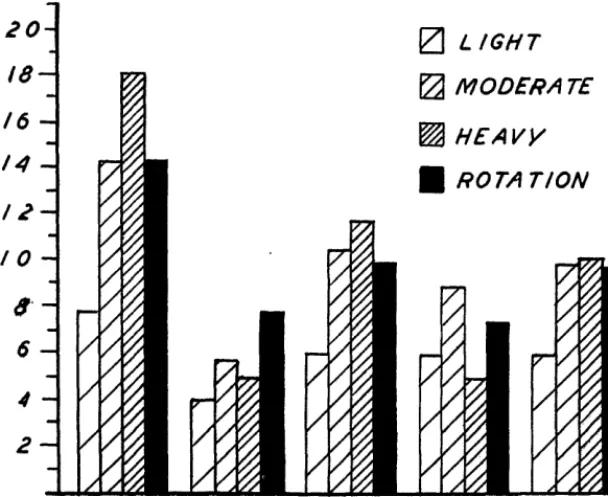
Figure 3 shows the per-acre gains obtained from steers under the various systems of grazing. The re- sults are similar to those obtained from sheep, except that the steer gains of 7.7 pounds per acre under rotation grazing exceeded those from all other systems of use during the second year. Yearlong grazing at the moderate stocking rate showed t’he second highest gains of 5.7 pounds per acre, followed by heavy grazing with 4.9 pounds and light grazing with 3.8 pounds per
154 LEO B. MERRILL
#?o
/8
16
14
12
10
I
el LIGHT a
MODERA Tf
a
HEAVY
m ROTA T/ON
&’
6
4
2
/949-t9so 1950~/9st 19W19Sh /951*/953 ALL
FIGURE 3. Per-acre gains for steers grazing.
were obtained from the moderately stocked rotation pastures and the yearlong moderately and heavily stocked pastures, respectively.
In May 1953 a severe tornado
passed through the rotation pas- tures and destroyed practically all of the grass on approximately one- third of the area. Decline in steer weights on these pastures during 1952-53 is attributed to this cause. The storm did not strike the moder- ately stocked, yearlong-grazed pas- tures and thus the vegetation was not disturbed as on the rotation areas.
Vegetational Response Plots were established on all pastures for determinations of vege- tational trends under the various systems of grazing. The initial survey indicated that all pastures had a similar cover of grass. The composition of this cover during the first year of the study was as
follows :
Curly mesquite 77 percent grass
Hairy triodia 13 percent and red grama
Needle grasses 6 percent
under continuous and deferred rotation
Desirable bunch grasses (side-
4 percent
oats grama, hairy grama, silver bluestem, little bluestem, fall witchgrass, Texas winter- grass and others)
The vegetational composition had changed very little on most pas- tures by the fall of 1952. However, the greatest improvement was made on the moderately stocked rotation pastures and on the lightly stocked pastures grazed yearlong. The bunch grasses, lightly utilized, were seeding and the seedling grasses were establishing themselves in the areas. In the moderately stocked pastures grazed yearlong, the bunch grasses were grazed more closely, and, although the mature plants were seeding, few grass seedlings were becoming estab- lished. There was no evident re- seeding on the pastures heavily grazed yearlong.
A survey of grass survival made recently following three years of severe drouth showed a marked
difference in the amount of grass which survived under the several systems of grazing. Curly mesquite grass, which in normal years com- prised 77 percent of all grass cover, suffered death losses under yearlong grazing of 91, 89 and 55 percent, respectively on heavily, moderately and lightly grazed pastures. The moderately grazed rotation pas- tures showed a 78 % loss in grass cover. However, this was true only on the areas not damaged by the tornado.
Summary
The rotation system used is simple in application, since it is necessary to move only one group of livestock every four months. Under this system each pasture is grazed 12 months and rested 4 months. The rest period comes at a different time of the year in each rotation cycle.
No definite advantage in live- stock gains has been found on deferred rotation pastures as com- pared with those grazed yearlong at the same stocking rate. However, the vegetation on the rotation pas- tures is obviously improving more than that on the yearlong grazed areas. There is, therefore, a steady trend toward improved range con- ditions as well as increased financial returns on these pastures.
LITERATURE CITED
DICKSON, R. E., C. E. FISHER AND P. T. MARION. 1948. Grazing experiments on native grassland at Spur 1942- 1947. Texas Agri. Exp. Sta. Prog. Rpt. 1123. 8 pp.
FRANDSEN, W. R. 1950. Management of reseeded ranges. Jour. Range Mangt. 3: 125-129.
MCILVAIN, E. H. AND W. F. LAGRONE. 1953. Seventeen-year summary of range improvement studies at the U. S. Southern Great Plains Field Station. U. S. So. Gr. Plains Field Sta., Woodward, Okla. 24 pp. ROGLER, GEORGE A. 1951. A twenty-five
year comparison of continuous and rotation grazing in the Northern Great Plains. Jour. Range Mangt. 4: 35-41.
Grassland Management in New Zealand’
KLING L. ANDERSON”
Professor of Agronomy, Kansas State College, Manhattan,
Kansas
G
RASS production in New Zea-land is basic, not only to agriculture but also to the entire national economy. On a land area (66 million acres) slightly smaller than that of Colorado, but with only a little more than 42 million acres occupied, New Zealand sup- ports a sheep population (33 million head) greater than that of the United States plus about 5 million cattle and smaller numbers of hogs, horses and goats. This entire live- stock population is a product of the pastures. Even the pigs are grazed and supplemented with skim milk and whey from the dairy industry. Of the 2 million acres under cul- tivation, more than one-third is in “plantations” of introduced tim- ber trees, chiefly Monterey pine
(Pinus radiata), and nearly one-
third is in temporary pasture crops, leaving only about one-half million acres for cash field crops.
In New Zealand, “grassland agri- culture” is not simply a term desig- nating some far-distant goal toward which to strive. Theirs is, in fact, a grassland agriculture in the highest sense, an agriculture in which the operation of all but a few specialized farms (fruit, truck, tobacco, etc.) is based on grass production and utilization. Grassland agriculture has in some cases been carried too far. The economy of the nation and the welfare of the farmers them- selves would be benefited by wider use of cultivated food crops in rotation with the grasses. It is now
1 Contribution no. 500, Department of Agronomy, Kansas Agricultural Experi- ment Station, Manhattan.
2 On leave, April through December 1952, for study under a Fulbright grant at Massey College of Agriculture, Palmers- ton North, New Zealand.
necessary to import substantial quantities of such staples as wheat despite the fact that the average wheat yield is more than 40 bushels per acre and yields of twice that amount are not uncommon. New Zealand farmers exhibit a reluc- tance to plow up grass that is com- parable to the resistance encoun- tered in America to the seeding of cultivated lands to perennial pas- ture.
Situated almost exactly halfway around the globe from Great Brit- ain, its principal market, New
A perspective of the grazing problems and management prac- tices in the hill country pastures
of New Zealand-a country in
which grass production is basic to the entire national economy. A view of grassland agriculture under intensive management.
Zealand has had to stress low pro- duction costs to compete with much nearer sources of meat and dairy products. High pasture production and efficient utilization of the for- age have made this possible. No grain is fed to livestock, but peren- nial pastures are supplemented with temporary grazing crops in addition to hay and silage made from the pastures themselves during the flush of spring and early summer growth.
Efficient utilization of pasture forage by stock is stressed. Nothing is gained by producing a big forage crop unless it is turned into animal products. The entire agriculture is geared to that idea. Pastures ac- count directly for 95 percent of
155
New Zealand’s exports and for more than 60 percent of its total production.
The New Zealander’s attitude toward pasture, which may at first be a little difficult for an outsider to understand, was summed up by Dr. E. Bruce Levy, former head, Grassland Divisions of the New Zealand Department of Scientific and Industrial Research, at a meet- ing of the New Zealand Grassland Association in November 1952, when he said, “I don’t like to see any crop harvested if it can be grazed off by stock.” That state- ment carries several important implications that show why New Zealand is a leader in grassland farming :
1. That sheep and cattle can make better and more efficient use of green, growing vegetation than of harvested crops.
2. That at least as much feed can be produced with pasture as with harvested crops.
3. That grazing is the basis for build-up and maintenance of soil fertility, while the removal of crops has the opposite effect.
4. That it is far less costly to let the stock harvest the crop than to cut and haul it, store it, and per- haps even process it before feeding it and hauling manure back to the land.
156 KLING L. ANDERSON
plus additional quantities of milk, hides, other animal products and cash crops.
The high producing capacity of New Zealand pastures is due largely to a climate favorable to both plants and animals. Lying far enough from the equator to escape the heat of the tropics, its climate is further tempered by the sea so that low temperatures, too, are avoided. Most of the country receives ample moist- ure, although the area lying east of the Southern Alps in South Island is relatively deficient in rainfall. Elsewhere the precipitation in the occupied portions is mostly between 30 and 80 inches annually and is rather well distributed over the year.
New Zealand perennial pastures may be grouped into two broad categories: (1) the improved pas- tures grown on flat to undulating “farm” land and (2) the hill coun- try pastures. The former may, in turn, be divided into permanent and temporary improved pastures. The hill country pastures include the natural tussock grasslands and those sown on land formerly for- ested.
Improved Pastures
Perennial, improved pastures are made up of plantings of the “Eng- lish grasses” and legumes, the cool season species, chief of which are perennial ryegrass (Lolium perenne)
and white clover (Trifo1iu.m repens).
Other important ones are cocksfoot (D~tzJis glomerata), short-rotation rye-grass (Lolium perenne x L.
multiflorum), crested dogstail (Cy-
noswus cristatus), timothy (Phleum
pratense) , prairie grass (Bromus
catharticus), and red clover (Tri-
folium prutense). These improved
pastures are highly productive and are used chiefly for dairy and fat lamb production and to fatten beef animals. Their management is in- tensive and not a range enterprise. Therefore, it will not be considered in detail in this discussion.
Hill Country Pastures The hill country pastures of New Zealand fall into two cate- gories : (1) those sown on land originally in native cover and (2) native tussock grasslands. The sown pastures, according to Levy (1951), occupy some 18 million acres of which 12 million have replaced forest, 4 million have replaced tussock, and 2 million have re- placed fern or scrub. These acreages include the intensively managed, improved pastures on the flat to gently-sloping land. There is no sharp distinction based on intensity of management, the improvement being carried as far up the slopes and into the “back country” as is economically feasible.
The Sown Pastures
Hill country pasture that has replaced forest or scrub and fern lies mostly in North Island where the native vegetation was pre- dominantly rain forest except for a limited amount of tussock grassland occupying the elevated, central volcanic plateau. These sown grass- lands have been developed largely over the past 80 years and there still remain some 3 million acres of standing forest and 2 million acres of scrub awaiting development. Also awaiting development are at least 2 million acres once sown to grass but since allowed to revert to secondary growth. Data are not available on the extent to which tussock grassland can be converted to sown pasture but the acreage is considerable.
Converting the forest to grass- land was based on fire. Between the years 1880 and 1910 very large areas of hill country forest were cut and burned (Cameron, 1952). The for- ests were felled during the winter and burned in the spring when the entire mass was dry enough to give a hot fire, one which would make a “white burn.” The grass seed was sown directly into the fresh ash as soon as possible, but if the burn
was not made until early summer, a sowing of white turnips might first be made. The grass would then be sown among the turnips as they were being grazed off in the autumn.
Heavy seeding rates were (and still are) the rule, 30 to 40 or more pounds of seed being applied per acre. The major species have been perennial ryegrass and white clover, but many others also have been added to mixtures, including cocks- foot, crested dogstail, Kentucky bluegrass (Pou prutensis) , browntop
(Agrostis tenuis), danthonia (Dun-
thoniu pilosu), and, more recently,
the newer short-rotation rye-grass. In the warmer northern parts paspalum (Puspulum dilututum) is widely used, while white and red clover are used throughout. Lotus
(Lotus uliginosus) frequently is
added to mixtures in wet areas, and subterranean clover (Trifolium sub-
terruneum) in drier ones.
Burned areas might not be sown to a uniform mixture. Often the relative amount of browntop was increased in the drier sites and per- haps some Chewing’s fescue (Fes-
tutu rubru var. commututu) added,
whereas these two and danthonia might be left out altogether on more favorable sites, with timothy and alsike clover (Trifolium hybridum)
used in their place. The annual suckling clover (Trifolium dubium)
and certain Medicago species are sometimes sown, but the burclovers are not favored as the burs tend to contaminate the wool.
NEW ZEALAND GRASSLAND 157
beast to lo-15 sheep was generally
regarded as sufficient” (Levy, 1951). The botanical composition of the pastures on these once forested areas varies according to the soil fertility and grazing use. Where it has been
maintained by fertilization and
proper livestock management, the sward is made up mostly of peren-
nial ryegrass, cocksfoot, crested
dogstail and white clover. From three to six ewes per acre can be carried throughout the year if some phosphate is applied as topdressing.
Less carefully maintained pas-
tures and those on less fertile areas may contain small amounts of the above species, but they also will have much browntop, danthonia,
Yorkshire fog (Holcus lanatus),
sweet vernal (Anthoxanthum odora-
turn), lotus, suckling clover and
weeds. They can carry only one to three ewes per acre plus perhaps one steer or cow for each eight to fifteen sheep. The poorer and drier sites are likely to be dominated by danthonia along with sweet vernal,
hairgrass (Vulpia spp.), ratstail
(Sporobolus capensis) , New Zealand
ricegrass (Microlaena stipoides) and
annual clovers.
Levy and Suckling (1949) pointed out that the majority of the de- forested hills in the North Island
are potentially almost as highly
productive as the lower, flat and
undulating country, capable of
grazing four to six ewes and fat lambs per acre. To achieve this productive state requires the fer- tilizer ingredients from the excreta of at least three to four sheep per acre. Such fertility must come orig- inally from clovers and phosphates. Under proper grazing management it is made available to the grasses throughout the season after passing through the digestive tracts of the animals.
This being a forest climate, nat- ural succession is first to fern and
scrub and ultimately to forest.
Stocking with sheep alone will not prevent the development of scrub
and, in spite of much time and effort spent in brush eradication, some 2 million acres already have reverted
to this secondary growth. The
cattle are, in effect, the “imple- ments” for consolidation of the soil and “crushing out” the scrub and fern growth. They also prepare the pasture for the ewes and lambs by “cleaning up” roughage during the autumn and winter so that the new fresh spring growth will be free of old tops and succulent enough for best utilization by sheep. Cattle, then, are not kept in the hill coun- try primarily for the profits they bring when marketed, but to “do a job of work,” to “keep the pastures in order.” Often they are kept until three or four years of age before being taken to the “easy country” to be fattened on grass for market. Usually they do not bring direct profits, as do the sheep, and farmers may attempt to do without them in order to run a few more sheep. This leads to deterioration.
The most successful grazing man- agement in the hill country consists of rotational grazing with rather
heavy concentrations of animals
for relatively short periods. “Spell- ing” (deferment) to create shade at the ground surface encourages the better grasses and discourages the fern and scrub seedlings. It is not uncommon to “spell” an area for an entire growing season and then to graze it off rather closely with cattle in the winter. Another fairly common practice is to graze the sheep year-long and rotate the cattle grazing as required to “keep the pastures in order,” or to graze the cattle on a yearlong basis and
rotate the sheep grazing. “Set
stocking” (yearlong or season-long grazing) is less likely to succeed
than rotational grazing, but is
widely practiced.
The hill country of North Island is capable of great expansion in livestock production through the development of its pastures and the intensification of its grazing. New
and better power equipment is
extending tillage onto slopes for- merly considered far too steep to work. Large disks and plows are now available to turn under brush 10 or 15 feet high. In this land of ample moisture, liming, fertilizing and reseeding will double or even quadruple the carrying capacity as the soil fertility is “built up” by legumes and grazing management. Extensive development schemes to
accomplish this on government
lands are now under way.
Farther up the slopes and in the back country, much is being done through grazing management alone However, soil fertility remains a serious problem for without phos- phates the legumes will not thrive and thus grass growth falls off, allowing fern and scrub to encroach. To meet this need for legumes and improved soil fertility, much hill land has been topdressed by hand and some by means of blowers that distribute fertilizer by wind blast over considerable distances (Ham- blyn, 1949 and Cameron, 1952). Neither method has given entirely satisfactory distribution and both are costly. More recently a system of aerial topdressing and aerial overseeding has been developed. Today many thousands of tons of superphosphate are applied to hill lands by light planes that land on air strips the farmer himself de- velops, often on some narrow but relatively flat ridgetop where the fertilizer can be hauled by truck
or wagon (Lynch, 1950, 1951).
Legume seed, too, is being applied in this manner, and a great ex- tension of this practice can be ex-
pected. Extensive application by
means of large aircraft operating from a few main centers is being contemplated.
158 KLING L. AXDERSON
tiou of greater numbers of animals. They will also permit the raising of dairy replacement stock away from the intensive dairy farms of the “easy country” which many rorkers believe should be reserved for milking cows and for fat lamb production, the replacements all coming from the hill pastures.
Native Grasslands
The tussock or bunch-forming grasses dominate nearly 14 million acres, mostly on the relatively dry, eastern slopes of the Southern Alps. These are mostly ~IWWII lands, grazed on an extensve ranching basis, but they, too, have in part been converted to sown pasture. There also exists a smaller area of tussock grassland in the volcanic region near the middle of North Island which is not a climax grass- land but a subsere, dating from the period of volcanic activity that ceased there some 2300 years ago. The dominant species are medium to large grasses that occur as fairly widely spaced tussocks with various
forbs and shrubs growing under and among them.
The tussock grasses are maiuly species of Fcstuca, Danthonia, Pm
and Agropgron. They vary in palatability, some being quite harsh and coarse, but the early set,tlers soon discovered t,hat nev, fresh growth following fire was taken readily by stork. Also, the fires reduced the size and vigor of shrubs and other coarse plants, allowing the native forbs and cert,ain introduced grasses and legumes to spread. As a result, burning has greatly altered the character of the native grass- land, weakening the tussocks, open- ing up the turf, and allowing great increases in soil erosion.
The tussock grasslands, according to Barker (1!&3), consisted of two general types: (1) a tall tussock grassland on the higher slopes dominated by large, coarse tussock grasses, and (2) & low tussock grass- land dominated by smaller and less coarse species and occupying a rela- tively lower altitudinal zone. Inter- mixed with t,he tussork grasslands,
occupying the shady, north-facing slopes and the lower gullies, is an evergreen forest dominated in places by species of Nothafagus and in others by species of Podocarpus.
Land in the high country is not privately owned but is held by t,he state, the sheep stations being leased on a long-term basis. The lease holders appear to be in com- plete control and are uot required to practice conservative grazing or any other form of range improve- ment, but are required to obtain a permit hefore burning. This is an extremely difficult rule to adminis- ter, ho\ve\w.
The tussock grasslands ollce ex- tended dovn the slopes and across the co&al plain to the Pacific. The coastal plain has been de- veloped largely for arable farming and improved farm pastures, but the lower eastern slopes and valleys of the Southern Alps, knoxrn as the “high rountry”, are still tussock grassland. They are used primarily for extensive grazing of sheep, grazing use extending up the slopes to an elevation of 5000 to 6000 feet or a little more. Very little vegeta- tion occurs beyond that elevation and none at all much above 7500 or 8000 feet. Timber line is at 3500 to 4000 feet and above that a nar- row a”ne of snowgrass, 8. large, coaxse Danthonia tussock.
The “high country” is used mainly to graze Merino sheep, kept almost solely for their wool. Weather conditions are rather severe and death losses quite high. The lamb- ing percputage is relatively lor, so the natural increase usually is not much more than sufficient to maintain the wool flock of ewes and w&hers. On the lovw slopes, where the environment is less severe, the sheep are mostly cross- breds, the Romney of the lowlands being crossed on the “cast-for-age” ewes.
NEW ZEALASD GRASSLAND 159
acres per sheep heing required in the high country. The lower slopes and valleys are utilized for winter grazing because SCOWS do not lie on them for long periods. After shearing in the spring, the sheep are put in the higher paddocks, the wethers going to the highest and steepest, ones and the ewes with lambs to t,hose less difficult to graze. Shearing in the high rountry is mostly with “the blades” hecause mechanical shearers tend to remove t,he wool too closely, leaving the sheep more susceptible to early spring cold spells. The wethers generally are shorn earlier than the ewes and are turned into the higher paddocks.
Much of this high country is steep. Erosion, characterized by shingle slides, becomes severe IThere the grazing is not carefully regu- lated. Heavy movement of shingle into the fast-flowing streams pre- sents a serious problem in the ral- leys below. It is believed by many conservationists that certain of the most erosive areas should be closed to grazing for watershed protection.
The tussock grasslands on the higher and drier sites do not prom- ise economic response to fertilizers and overseeding. Levy and Suckling (1949) have emphasized that if depleted montanc tussock is to be regenerated, them must be st,rict control of fire and rabbits and live- stock must, be exrluded for several seasons. Since most of this grass- land is on crown lauds, the gorern- ment could enforce such measures, but only at t,he expense of greztly reducing, temporarily at least, the livestock population of the high country. Such enforcement rould bring strong opposition, but ie probably the only practical solu- tion.
While improvement of the high country consists mainly of regulated stocking and the control of burning to prevent further depletion of the tussock grasses, research is showing
A-.
z.
Ikp,. SC-i. and Ind. Il’cs.)that the gentler slopes aud valleys can he seeded to improved legumes and grasses and that responses to lime and fertilizers are good. De- rclopment by plowing and the cs- tablishment of improved pastures is being carried out in awas with as little as 20 inches of precipitation annually. The species sown are the ones used in North Island with tall oatgrass (Arrhmatherum da- tius) being added in drier sites. Other introduced grasses, such as various speries of Agropyron and
Bromus and a number of the native
species, are being tested. Just as in Yorth Island, overseeding and topdressing are being rarried farther and farther into the hills.
Irrigation is beginning to play a role in the improvement program, small valleys being put, to improved past,ures or supplemental feed crops and watered by flooding or by over- head irrigation. Even rather steep pastures are being developed for “wild flooding”, the mater being spilled over the low banks of small field ditches lwated at intervals along thr slopes.
A unique method of hill land im- provement consists of building up the fertility and establishing leg- umes on the steep lands hy means of livestock. Heavily fertilized pad- docks in the valleys are “closed up”
to allov the legumes to mature seed. Cattle are then pastured briefly on these and driven to the nearby slopes rhere their excre- ment deposits both plant nutrients and legume seed. Marked improve- ment may be noted after one or two seasons of such treatment. This method is, of course, not limited to the twsock grasslands.