VOLUME 5
November 1952
Number 6
In this Issue
Editorial-The Range Rules ... ..Kenneth B. Platt
395
Chemical Control of Big Sagebrush in Wyoming
A.C. Hull, Jr. et al.
398
Colorado's Range-Livestock Championship
Wilbert B. Harvey
403
Storing Rainfall at the Grass Roots ... Ben Osborn
408
Longevity of Ripped Furrows in Southern Arizona Desert
Grassland.... ... Albert L. Brown and A.C. Everson 415
Book Reviews:
The Nature and Properties of Soils (Lyon et al.)
John L. Retzer
420
Understanding Heredity-An Introduction to Genetics
(Goldschnidt)
R.M. Durham and J.J. Norris
420
Current Literature... ... Robert R. Humphrey
422
News and Notes . ... ... ... ... 426
With the Sections... ... ... ... 430
Society Business ... ... ... ... 436
Index to Volume 5, 1952 .. ... ... ... 441
Published Quarterly by
FOR WEED AND BRUSH CONTROL
Uolker Quality Chemicals
2,4-D WEED KNJmERS l l l
. . . Esters and -Amine salts.
Selected weed killers proved effective against annual and perennial weeds, many types of thistle and cress
-and nettle.
2,4,5-T BRUSH KILLERS.. .
. . . isopropyl and Butyl esters.
Low volatile, high kill esters of 2, 4, 5-T recom- mended and approved for mesquite and other brush control on range and grassland, along railroads,
pipelines and other right-of-ways.
To meet increasing demands, Kolker-one of the nation’s major producers of weed and brush control chemicals-has expanded production facilities at its Newark plant. Expert technical assistance supplied. Call on Kolker-and be sure of delivery at the right time, at the right price.
DIAMOND ALKALI COMPANY
Other products of Kolkcr Chemical Work.r, Dia- mond Alkali’s subsidiary, specializing in organic hemicals for agriculture and industry, include:
DDT. . . . . . . . . . . . . . . .Tcchnical BHC . .Tcchnical Grade (36% and ycf& gamma) LINDANE. . . . . . . . .gg’% gamma Isomer
W--D . . . Weed Killers 2,4,5-T. . . . . . Brush Killers K-~or...Miticidc
Order from
KOLKER CHEMICAL WORKS, INC.
80 LISTER AVENUE, NEWARK 5, NEW JERSEY
SIXTH
ANNUAL MEETING
Albuquerque, New Mexico
January 20, 21, 22, and 23, 1953 American Society of Range Management
Headquarters for the meeting will
be in the Hilton Hotel, where the an-
nual banquet will be held on Wednes-
day evening, January 21.
Information concerning hotel and
motel rates will be furnished by the
Executive Secretary. Each member is
to make his own reservations.
Entertainment plans include the
ladies, with tentative plans for trips to
historical points in the vicinity.
The Board of Directors will meet
on January 19.
PERSONALIZED STATIONARY
for mem-bers of the American Society of Range Man- agement. Attractive cut of “The Trail Boss” on letterheads and envelopes,
Introductory Offer, post paid
200 Sheets, 6” X 7" and 150 envelopes $2.00 300 sheets, 6” X 7” and 150 envelopes 2.75 200 sheets, 8-l/2” X 11” and 150 envelopes 2.50 300 sheets, 8-l/2” X 11” and 150 envelopes 3.50
Please print your name and address plainly.
Mail to Cascade Print
Orchards Washington
NATIVE RANGE
GRASS SEEDS
Blue Grama-Side Oats Grama--Blue Stem
-Buffalo-Crested Wheat-Love Grasses-
Sand Drop, etc.
We purchase-Harvest-and Sell.
PEPPARD SEED CO.
1131 West 8th StreetKANSAS CITY 7, MO.
PRACTICAL
GRASSLAND MANAGEMENT By B. W. ALLRED
Regional Range Conservationist, U. S. Soil Conservation Service, Fort Worth, Texas
Most Practical Grass Book Publish&
Written for students and ranchmen, this book has 15 well-illustrated, readable chapters on growth, care, and management of the country’s most valuable crop- grass.
FEATURES.. . latest facts about economic and conser- vation values of important range plants . . . guide for seeding 64 native and domestic grssaes . . . gkBS8~ of
range terms.. . check list of nearly 1000 important range plants, with common and scientific names.
The first printing was sold out within six months. Im- mediately adopted as text by the Veterans’ Vocational Training program, many colleges and schools in west and southwest.
COMMENTS.. . “Of all the trained men in range man- agement, I know of no one individual better qualified through professional training and applied experience to write a book on the subject of Practical Grassland Management.. .” VERNON A. (YOUNO, Head, Dept. of Range and Forestry. A & M College of Tsms.
$5.00 PP. Second Printing
Publisher:
SHEEP AND GOAT RAISER
San Angelo, Texas
RANCH k Management Service * Consulting & Appraisals * Reseeding Contractors * Investment Agents
Throughout the Western States & Canada Call or Wire: R. B. (Dick) Peck, WESTERN RANCHING SERVICES
1. MESQUITE
For best results, spray from the air with low-volatile Du Pont 2,4,5-T Ester Brush Killer when foliage is growing and when soil moisture and temperature are high. Use 1% to 1 x pints in 1 gallon light diesel oil plus 3 gallons of water per acre. In- crease dosage for heavy growth.
4.LOTE or BLUE BRUSH
A thorough, drenching spray on the foliage ia highly effective, using 1 gallon Du Pont 2,4,5-T Ester Brush Killer in 96 gallons diesel oil or kerosene. For beet results, spray from the ground when the plants are growing fast, and when the soil moisture is high.7.SCRUB OAK
For thick growth, spray the green oak leaves in the late summer or fall with Du Pont “Ammate” Weed Killer, 1 pound per gallon of wa- ter. For scattered trees growing in clumps, cut the trees and spray the fresh stumps with 4 pounds of “Ammate” per gallon of water.
2. SAND SAGE
Spray by air with 2 x pints Du Pont 2,4-D Ester Weed Killer in 3 or 4 gallons of water plus 1 gallon diesel fuel or kerosene per acre. For best results, apply in May or early in June when the soil moisture is high and plants are growing rapidly.
5. HUISACHE
Spray from the ground in the grow- ing season for best control. Spray the bottom 2 or 3 feet of trunks from the ground up with 1 gallon Du Pont 2,4,5-T Ester Brush Killer in 48 gallons of kerosene. For best results, be sure to wet the entire circumference of the stems.
3. PRICKLY PEAR
Spray from the ground in summl with 1 gallon Du Pont 2,4,5-T E ter Weed Killer in 20 gallons ken sene or diesel oil and 20 gallons twater, wetting all the foliage tho oughly. Tests show that this sari treatment also controls Tasajil and Cholla cacti.
6. MCCARTNEY'S ROSE
Spray from the ground in the grov ing season with 1 to 1% quar Du Pont Ester Brush Killer or 3 I 4 quarts Du Pont 2,4-D Ester Wee Killer in 2 gallons of light diesel c and 100 gallons of water. Use higl pressure spray to penetrate th thick clumps of brush so as to wt all foliage.For help in control of mixed stands of brush, see your local agricultural expl ment station, and write to Du Pont for full information. Du Pont has cooperc in extensive tests in the range areas. Address Du Pont, Grasselli Chemicals De 5031 ‘Du Pont Bldg., Wilmington, Del., or 513 Esperson Bldg., Houston 2, Te
Better Things for Better living
DU PONT CHEMICALS FOR THE FARM INCLUI Fungicides: PARZATE* (Liquid and Dry), FERMATE*, 2 LATE*, Copper-A (Fixed Copper), SULFORON* and S FORON*-X Wettable Sulfurs... Insecticides: DEENATE* C MARLATE* Methoxychlor, LEXONE* Benzene Hexac ride, KRENITE* Dinitro Spray, EPN 300 Insecticide, Calc Arsenate. Lead Arsenate . . . Weed and Brush Kil, AMMATP, 2,4-D, TCA and 2,4,5-T. . . Also: Du Pont Co Dusts, Du Pont Spreader-Sticker, PARMONE* Fruit D
Inhibitor, and many others. *REG. U. S. PAT. 0
. . . through Chemistry On all chemical8 alwat~s follow dwections for application. W
warning or caution statements on u.ae of the prodmt are pi
When there’s a need in Grassland Agriculture. . .
THERE'S
AN ANSWER
AT
NORTHRUP
KING
For overgrazed
range lands...
For depleted
meadow
lands..
For irrigated
pastures..
.N K produces
dependable
seed!
Seed of proven quality
and purity for every
grassland situation are
available through your
nearest Northrup King
Branch office:
BOISE, IDAHO . SALT LAKE CITY, UTAH
ALBANY, OREGON
lBERKELEY, CALIFORNIA
PHOENIX, ARIZONA . DALLAS, TEXAS
ORTHRUP
KING & CO.
Journal
of
Volume 6, Number 6, . November, 1953
RANGE
MANAGEMENT
Editorial
The Range Rules
M
ANY a romantic story has been spun about the me” who ruled the Western range in its heyday. Well paid pens still thrill new readers-and a lot of us old ones, toewith tales of the days vhen men were tall in the saddle and unspoiled grass swept the stirmps as they rode! Empires of grass were marked out, fought over, and r&d by me” who left their mark in the history of the West and whose legends live on in many a famous brand.These earlier, territorial conflicts settled, the men who build and hold range em- pires today are those who have recog- nized the natural limitations of their ranges and have adapted their uses accordingly. Or, we might say, it is the Lange that rules, and he who would prosper must fit himself to its require- ments.
This is not a new thought. It has been expounded with increasing frequency over the last generation. It is fully ac- cepted in thoughtful range circles today. The” why mention it?
The idea is worth our attention here because, notwithstanding the general recognition just mentioned, there re- mains a widespread unawareness of one of its most important implications. If, indeed, the range rules, then there lies ahead of the range brotherhood a major task as yet only touched here and there- the task of fitting livestock, and refitting
livestock operations, to the range. The too frequently held idea that this task is essentially completed will not bear close scrutiny.
There is a current emphasis upon fitting range to the existing livestock. Vast sums are being spent on reseeding, introducing forage plants more resistant to destrwtion by usual grazing usage, developing water at most effective in- tervals, etc. This effort by no means should be abated. But its limits should be recognized and courses of action es- tablished to provide for the blank spots which it does not and cannot reach.
Throughout the arid sections of the United States range area today, and extending into Mexico and Canada, are
396 EDITORIAL
millions of acres adjacent to available waters being overgrazed in the effort to secure maximum area utilization from each water. Adjoining them are other millions of acres underused because they lie beyond the normal travel radius of the livestock concerned. This maladjustment has been and is being systematically reduced by the range restoration and development practices mentioned above. But only so many waters can be developed no matter how intensive the effort. Only a minor fraction of the arid range acreage is susceptible to effective reseeding by methods now known. After all has been done that may be done by these means, there will remain a major balance of the total problem area yet untouched. And even successfully restored areas must be expected again to decline unless the causes which produced the original de- cline are removed.
Major shifts in livestock production over the last thirty years have intensified the problem. Range horses of an earlier generation made good use of various areas little used today. Similarly, the larger sheep populations of past years utilized major grazing resources only partially reached by the cattle which have replaced them.
What is the answer to this problem? Hainly it is not fully contained in the livestock breed improvement work now going on, well conceived and executed though this work is. For by and large this work is directed toward developing animals fitted to the more general needs of efficient production. To produce more pounds of meat or wool from the same feed does not solve the problem of more complete and balanced utilization of the available range resource.
This is a problem of many parts. Experienced stockmen, especially those whose memories include the operation of wether sheep or mature steers in con-
trast to the ewe-and-lamb, cow-and-calf operations which dominate so much of the range today, will quickly recognize, the advantages in range utilization which these earlier modes of range operation provided. Many outlying reaches of range lying fallow today were well used by the wethers and steers of former years. Again, the longer legs that have been so purposefully bred off our range animals in recent decades were not with- out virtue in carrying those animals more readily to the less easily accessible areas of the range.
But let us waste no nostalgic tears on these changes. They were practical changes, dictated by the needs of the time. The point is, we face a new need for practical change. Today’s needs may require some retracing of the way we have come. If so, so be it. Or they may lead in other directions. Perhaps today’s need for cattle that will travel farther, and more readily, from water than our present dominant range strains can be met within the limits of existing breeds. Certainly this need should be met without undue sacrifice of the progress in carcass desirability and efficiency of gains achieved by animal breeders to date. But in any case the practical need should, indeed must, rule.
And while the breeder busies himself with this part of the problem, let the range economist apply the tools of his trade to the mass of range plant data now available. Let him come up with some usable determinations on the rela- tive economy of various grazing opera- tions on various ranges, based on the sustained-yield productivity of those ranges under the various alternative uses, including realistic consideration of the costs of rebuilding damaged ranges.
EDITORIAL 397
what he can sell. Available labor skills may tip the scales one way or the other. Governmental price and production poli- cies may be important.
The basic point, however, remains : There is a limit to how far these other factors can be accommodated without serious loss in range utilization and/or serious impairment of the producing capacity of ranges.
The challenge to the range fraternity is three-fold: To determine the above
1. An insatiable hunger for clear understanding.
2. An incessant curiosity about things not understood.
3. The gift for patient, close observation.
4. An unfettered imagination.
5. Initiative and an impelling urge to exercise it.
6. Devotion to orderly procedures.
7 Objective‘interest in results.
8. Integrity in the interpretation of results.
9. Clarity in reporting results.
10. Basic Training conducive to proficiency. 11. Tolerance of conflicting viewpoints. 12. Willingness to cooperate with others.
limit; to produce range animals with grazing habits suited as closely as possible to range needs; to produce practical guides for choosing between various classes of livestock and operating plans, in keeping with a long term range economy.
There is work here for all.-Kenneth B. P&t, Land Management Specialist, T.C.A<., Cairo, Egypt; formerly U. S. Bureau of Land Management, Washing- ton, D. C.
A CHECK LIST FOR RESEARCHERS
.
Chemical Control of Big Sagebrush in Wyoming
A. C. HULL, JR. AND N. A. KISSINGER, JR.; AND W. T. VAUGHNRange Conservationists, Rocky Mountain Forest and Range Experiment Station. Fort Collins, Coloradol; and Range Conservationist, Bureau of Land Management, U. S. Department
I of the Interior, Lander, Wyoming
C
OOPERATIVE studies in chemicalcontrol of big sagebrush (Artemisia tridentata) in west central Wyoming were started in 1949 by the Forest Service and the Bureau of Land Manage- ment. The purpose of this work was to test methods of reducing sagebrush com- petition to allow an increase in produc- tion of palatable native forage plants. It is believed that the results obtained will be useful in numerous areas where big sagebrush is neither an important source of browse for game nor is producing desirable forage for domestic livestock.
The experimental area, near Lander, is typical of much of the sagebrush-grass- land in Wyoming between the elevations of 5,500 and 7,500 feet. .The general aspect is dominated by sagebrush with an all-age stand which averages 25 to 30 plants per 100 square feet (Fig. 1A). Other shrubby species include occasional plants of small rabbitbrush (Chrysotham- nus sp.) and spineless horsebrush (Tetra- dymia canescens var. inermis). There is a fair to good herbaceous understory of thickspike wheatgrass (Agropyron dasy- stachyum) and streambank wheatgrass (A. riparium) with lesser amounts of bluebunch wheatgrass (A. spicatum), Cusick bluegrass (Poa cusiclcii), Sandberg bluegrass (P. secunda), and needle-and- thread (Stipa comata). Forbs are infre- quent and produce little palatable forage. 1 Maintained by the Forest Service, U. S. Department of Agriculture, in cooperation with Colorado A & M College at Fort Collins, Colorado, and with Research Center Head- quarters at Laramie, Wyoming, in cooperation with the University of Wyoming.
They include milkvetch (Astragahs sp.), lupine (Lupinus sp.), phlox (Phlox sp.), and clover (Trifolium sp.).
METHODS
A total of 57 different herbicide and carrier mixtures were sprayed on big sagebrush in 1949; and 59 in 1950. The work was continued in 1951. Tractor- mounted spraying equipment was used to apply the chemicals on l-acre ground- sprayed plots on two dates in 1949, and three dates in 1950. Airplane application was made on six 6.6-acre plots on two dates in 1949 and on eight 5-acre plots on one date in 1950. A total of 228 acres of ground-sprayed plots and 135 acres of aerial-sprayed plots have been treated with chemicals.
One year after treatment, sprayed plots were sampled by pace transect to obtain the percent kill of individual sagebrush plants. Only those plants which had no living foliage were con- sidered when the effects of chemical treatments were evaluated.
Observations were made on the reac- tions of other vegetation to herbicides. Early in 1951 exclosures were constructed on several plots sprayed in 1949 to obtain herbage-production data. The experi- mental area outside the exclosures was grazed by cattle during each summer.
propylene glycol butyl ether esters. Tests were made with 2,4-D, 2,4,5-T, and mixtures of the two at rates of 0.5 to 3 pounds acid equivalent per acre in
cm BIG S*GEBRUSH 399
Flying Service flew the aerial plots. This art,icle is not an endorsement of com- merrial firms or products nor is any discrimination intended.
right.
1949, and 0.5 to 2 pounds per acre in
1950. Other chemicals Vested in 1949 were pentachlorophenol and arsenir tri- oxide, and in 1950 t&s were mndc with 2,4,5-T ethyl amine, m&ic hydrazide, and dinitro wed killers. Carriers unxe water at 3. to 50.gallon-per-acre rates, diesel oil at 1. to 5.gallon rates, and a 4-to-l-gallon rater-oil emulsion. Diesel oil alone as a check was tried on all dat,es.
Chemicals for these tats were furnished by the Sherwin-Williams Company, Du- Pont de Nemours Company, Dow Chemi- cal Company, and others. The Big Horn
RESULTS
This paper summarizes the principal findings of the firat tvo years’ st,udy. The 1949 work was reported earlier in more detail by Hull and Vaughn (1951). The treatments madr in 1950 and their results were reported by Kissinger et al (1952).
1949
.
400 A. C. HULL, JR. ET AL.
CHEMICAL
2,4-D ester weedkillel (3.34 lbs. isopropyl es. ter per gallon)
2,4,5-T ester brushkiller (2.66 lbs. isopropyl and 0.67 lb. amyl ester per gallon)
POUNDS ACID PER
ACRE
one-half of their seasonal growth, aver- again an important factor affecting aged 50 percent higher kill than June 15 sagebrush kill. Highest kills were from treatments when twig growth was near treatments made during the period June completion. 5 to 10 (Table 1). 2,4,5-T appeared to Chemicals-The 2,4-D butyl ester gave be effective earlier in the season and for a higher sagebrush kills than did mixtures longer period than 2,4-D.
of 2,4-D and 2,4,5-T, or other chemicals. Sagebrush twig growth has been a As little as 1.5 pounds acid equivalent poor index of the best time to spray in of 2,4-D on May 25 killed an average this area owing to yearly variations in of 73 percent of the plants. date and rate of development. The growth
TABLE 1
Sagebrush plants dead on July 65,1951, from treatments made on three dates in 1950
DATE OF SPRAYING
GALLONS CARRIER PER ACRE
May 15
June 5-10
June 25
May 15 June 5-10
June 25
2 13 37 12 17 40 10 42 50 59 27 53 51 3 4 6 25 45 35 58 16 34 39 43 49 65 90 51
Percent kill
3 29 19 25 41 41 8 42 45 50 59 52 71 49 - 31 - 16 12 32 - 12 - - - 66 - - 5 37 48 65 69 60 8 55 66 71 68 88 94 62 26 26 49 26 37 74 20 27 56 62 52 81 85 76
Carriers-Generally, higher sagebrush kills were obtained using diesel oil as the carrier than the same volumes of water, although water at all rates gave good results on May 25.
Vegetation-Sagebrush plants reacted much the same to treatment regardless of age. Other vegetation was little affected except phlox which was almost completely killed. Small rabbitbrush, horsebrush, and lupine were damaged but grew again in 1950.
1950
Date of treatment-Stage of plant de- velopment at time of treatment was
stage of associated vegetation appears to be a more reliable indicator. Highest sagebrush kills were obtained in 1949 and 1950 from treatments made just prior to and during the early bloom stage of the native bluegrasses.
CHEMICAL CONTROL OF BIG SAGEBRUSH 401
of spraying date and type and rate of carrier were constant. Both 2,4,5-T and mixtures of 2,4,5-T and 2,4-D gave higher kills than did 2,4-D alone. Isopropyl ester formulations were more effective than propylene glycol butyl ether or butoxy ethanol esters.
TABLE 2
Percent of sagebrush plants killed by dij’erent commercial ester formulations of 2,4-D
and 2,4,5-T*
CHEMICAL
2,4-D
Isopropyl ester. . . Propylene glycol butyl
ether ester. . . Butoxy ethanol ester. 2,4,5-T
Isopropyl and amyl es- ter...
Propylene glycol butyl ether ester.. . . .
2,4-D
and 2,4,6-T mix-tures
Propylene glycol butyl ether ester (1:l)i. . Butoxy ethanol ester
(2: 1). . . .
POUNDS ACID EQUIVALENT PER ACRE
t i
1
I
2
Percent kill
26 37 74
- 20 41
- 4 6
52 81 85
- 47 77
- 64 89
- 16 18 _ * In 5 gallons of diesel oil per acre during the period June 5 to 10, 1950.
t Ratio of 2,4-D to 2,4,5-T in the mixtures.
The ethyl amine of 2,4,5-T was less effective during the optimum period than the esters of 2,4-D. Maleic hydrazide and the dinitro weed killers had little herbicidal effect on big sagebrush in these studies.
Cost-The studies provide a comparison of chemical costs but have not been carried long enough to show the degree of kill which will provide the maximum return on the spraying investment. For example, 2 pounds acid equivalent per acre of 2,4-D isopropyl ester wa,s re- quired to kill 74 percent of the plants.
At current jobber prices this would mean about $3.00 per acre for chemical. A slightly higher kill, 81 to 88 percent,
(Table 1) was obtained in these studies using 1 pound of 2,4,5-T isopropyl ester. Here again cost of chemical would be approximately $3.00 per acre. The 2,4-D and 2,4,5-T mixture at $2.50 per pound may prove to be the least costly for any desired sagebrush kill. One pound of low-volatile ester of this mixture gave a 64-percent kill. Since isopropyl esters of 2,4-D and 2,4,5-T gave higher kills than the corresponding low-volatile esters, a mixture of 2,4-D and 2,4,5-T in the isopropyl ester form may also be superior.
TABLE 3
Average air-dry herbage production of perennial grasses in 1951 on sagebrush plots sprayed
in 1949
SPECIES
Total grass. Thickspike and
streambank wheat.grasses. Bunchgrasses
(all) . . . . . . -
AVERAGE SAGEBRUSH KILLS
tJj&d / 58% 1 ‘56% 1 78% / 97% --~
222
189
33
Pounds per acre
490 553 559
318 420 449
172 133 110 645
493
152
Costs of application will depend on volume, size of project, and availability of equipment. In this area, aerial applica- tion costs varied from $3.00 to $5.00 per acre and tractor application from $2.00 to $3.00 per acre. Tractor application is slow and would be limited to small projects.
402 A. C. HULL, JR. ET AL.
In no instance did results with 3 gallons bluebunch wheatgrass, and needle-and- of water per acre compare favorably with thread were the principal bunchgrasses. 3 gallons of oil. The increased grass production was due
The higher kills obtained with 3 gallons to the spread and increase in vigor of of oil as compared with 5 gallons of oil the original plants rather than to es- per acre are not explainable on the basis tablishment of new plants from seed. of available data. Neither are the un- Cattle seemed to prefer the sprayed usually high kills for the 0.5- and l- plots and at midseason in 1951 grass pound rates of 2,4-D in 3-gallon treat- utilization on the 1949 sprayed areas ments on June 5 to 10. was nearly twice as heavy as on adjacent
Methods of spraying-During both unsprayed areas. We believe this con- years, airplane and ground spraying centration resulted from the increased appeared equal in effectiveness. Cost supply of available forage.
will therefore be a major factor in deter-
mining which method to use on any area*. SUMMARY
Other vegetation-Many rabbitbrush plants were killed back to the root crown, but in the following year grew new shoots and showed no evidence of permanent damage. The data indicate that small rabbitbrush is somewhat more susceptible to 2,4-D than to 2,4,5-T. Rabbitbrush also appeared to reach the stage of maxi- mum susceptibility later in the season than did big sagebrush. Horsebrush was not injured by any of the treatments. Phlox was damaged and often completely killed by both 2,4-D and 2,4,5-T in openings where it was not protected by the sagebrush foliage.
Grass Production-Grass production may be increased two to three times in 2 years by chemical control of big sage- brush where there is a fair grass under- story present before treatment (Table
Studies near Lander, Wyoming, reveal that 75 percent and higher kills of big sagebrush can be obtained with as little as 1 pound per acre of 2,4,5-T ester or 2 pounds per acre of 2,4-D ester. These herbicides were most effective in this area when applied in 3 to 5 gallons of diesel oil carrier about the time the native bluegrasses started blooming. Treatments which gave good control of big sagebrush did not result in severe damage to other shrubby species or herbaceous vegetation.
Airplane and ground-spraying equip- ment gave similar results for comparable treatments.
Native grass production was increased approximately two to three times by killing 60 to 97 percent of the sagebrush.
LITERATURE CITED
3). These increases are to some degree
proportional to the percent of sagebrush HULL, A. C. JR., AND W. T. VAUGHN. 1951. plants killed (Fig. 1B to 1D). Controlling other chemicals. big sagebrush with 2,4-D and Jour. Range Manage-
Thicksnike and streambank wheat- ment 4: 158-164. -
Colorado’s Range-Livestock
Championship
WILBERT B. HARVEYFormerly Assistant Editor, Western Farm Life, Denver, Colorado
S
TOCKMEN in Colorado and else- where throughout the West have a story to tell-one of increasingly intelli- gent efforts to manage grazing for the most efficient use of native grass ranges, of improving these ranges by reseeding, weed and erosion control and water diversion, of protecting them from over- grazing and soil damage. The Range- Livestock Championship, now in its second year, is designed to tell that story. Stockmen have been acutely conscious of the unfavorable impression of their activities held by many. Too often those who do not understand the importance of the cattle and sheep industries to the economy of the nation picture western stockmen as “cattle. barons,” greedily reaching for every dollar possible, eagerly denuding the range to make current profits to the permanent damage of both private and public lands.Early in 1950 two Colorado extension service workers, Charles L. Terrell, Extension Conservationist, and Ford C. Daugherty, Extension Animal Husband- man, were discussing this problem and the efforts of stockmen to present a true story of their operations as they returned from a meeting in southern Colorado. As a result of that conversation, they talked to others about the need of a range and livestock recognition program for Colorado.
At about the same time, Jim White, Editor of Western Farm Life magazine, and Don Peach, Agricultural Director of radio station KOA, also discussed the need for such a competition. After nine months of planning by a committee
representing a dozen private and public agencies interested in furthering the Colorado range livestock industry, the Range-Livestock Championship was an- nounced in January, 1951.
Some 80 contestants for the title of Top Hand were nominated throughout the state by 30 or more local stockmen’s associations. Enthusiastic cooperation of the Colorado Cattlemen’s Association and Colorado Wool Growers’ Association and their local affiliates, representatives of Colorado A & M College, the Soil Conservation Service and many other public-spirited individuals made the RLC program a success the first year.
For 1951, the RLC program spotlighted the range and livestock operations of eight ranchers, many of whom had never been so recognized before. These were Frank Fehling of Nathrop, Harvey Harris of Sterling, Calvin Hixson of Ordway, Chester Mayer of Eagle, Wade Peterson of La Jara, Jim Price of Byers, G. N. Winder of Craig, and Wallace Wineinger of Ordway.
Fehling, widely known and respected stockman, received the title of Top Hand of the RLC for 1951, and he and Mrs. Fehling were guests of the sponsoring Western Farm Life and KOA at Denver’s National Western Stock Show.
Top Hand Fehling supplements his own holdings with 7,040 of Taylor grazing land in Park county, and in the neigh- borhood of 13,760 acres of land in the Pike and San Isabel National Forests. What he was doing to stop erosion on his own land with heavy earth-moving equip- ment to divert runoff water by terracing
404 WILBERT B. HARVEY and filling gullies caught the eye of
government engineers faced with similar problems on the public domain.
The success of the contest was largely due to the efforts of the 12 men who worked with Jim White, Editor of Western Farm Life, and Don Peach, Mile High Farmer at KOA. They devised the rules of the contest, developed the score card, and outlined the working plan for judging on county, district, and state levels.
The group included Dave Rice, Sec- retary of the Colorado Cattlemen’s Association; Brett Gray, Secretary of the Colorado Wool Growers’ Association ; Kenneth W. Chalmers, Colorado State Conservationist for the Soil Conservation Service; Charles L. Terrell, Extension Conservationist, and Ford Daugherty, Livestock Specialist, both of the Colorado A & M College extension service; Paul Swisher, Commissioner, Colorado state Department of Agriculture; Don Daily, Secretary of the National Association of Soil Conservation Districts; John T. Caine III, representing the National Western Stock Show and the Denver Union Stock Yards; W. G. McGinnies, Director of the Rocky Mountain Forest and Range Experiment Station; H. J. Burback, Regional Conservationist of the United States Bureau of Land Management ; Edward Cliff, then Re- gional Forester of the United States Forest Service; and Frank Temple of Hayden, Colorado, representing the Colo- rado Association of Soil Conservation Districts.
By April 1 local stockmen’s associations made the nominations for Top Hand with the help of extension agents, soil con- servation technicians, forest rangers, and district graziers.
By August 1 three-man judging teams consisting, usually, of an extension agent, a soil conservationist, and a rancher had picked 31 county Top Hands. Men from
one county judged contestants in another county. District or regional judging was completed on a similar basis by the first of September, limiting the field to eight contestants for the title of Top Hand in Colorado.
The three specialists selected as finalist- judges were chosen with great care by
the steering committee. They were D. A.
Savage, Superintendent, United States Southern Great Plains Field Station at Woodward, Oklahoma; Tony Fellhauer, Extension Livestock Specialist, Univer- sity of Wyoming; and Ivan Watson, Extension Animal Husbandman, New Mexico A & M College.
The writer accompanied the finalist judges on their trek around the state and was impressed with their studied delibera- tion as they independently weighed and evaluated each operation. The enthusiasm of the contestants, all of whom were substantial ranchers, was a surprise to the judges. Invariably they were as eager as 4-H club ,members to show their handiwork and to pick up suggestions for improving their projects.
The success of the Range-Livestock Championship program, after it had run its course for a year, has been evaluated by a number of range and livestock specialists. Their views reflect the opinion that the arrangement and content of the score card account in a good measure for the favorable reception of the project.
COLORADO’S RANGE CHAMPIONSHIP 405
it a usable tool to aid in impartial, ob- ranches according to the accompanying jective evaluation. It had to be inclusive score card are purposely rather general enough in subject matter to cover a wide to give all judges wide latitude in con- variety of conditions encountered due sidering the various natural differences to varying terrain, size and type of opera- in ranches.”
tions, elevation, and normal rainfall. A high proportion of the entrants use Here are excerpts from the judging both deeded and public land in their tips : operations. As a guide to judging their
RANGE-LIVESTOCK CHAMPIONSHIP SCORE SHEET
Address
VEGETATION: Pt. N.F. 8.L.Y. L.U. Forage condition ... ... .... ... Ikpree of we and utiliration.. ... ... ... Improvement ... . ... ... ... Total.. ...
SOIL:
Accumulation of litter.. .. ... ... ... ... Soil stabilization ... ...
Soil improvement ... . . ... I ... I ... I ... 1 ...
Total.. ... Ll\‘ESTOCK: Livestock production ... I Quality and grade of animals ... Balanced feed program.. ... . . . . . . . . . . .._.... _. MA ,NACEMENT ASD LEADERSHIP: Feed reserves . . . Health and parasite control . . . Management : Ranch headquarters . . . Ranch buildings and corrals . . . Fences . . . , . . . W&or supply . . . , . . . .Management . . . * . . . h&l-ship . . . 500 375 375 -- 1250 250 250 250 i50
...
...
1
...
...
---
...
.
.
. . . 9 . . . * . . .I
100I . . .
... 100 ...... 200 ...
... 200 ...
... 300
7 ... ... 100 ...
Total.. ... i&ij ... Grand Total.. ... 5000 ...
FIGURE 1. Score card for selection of Top Hands, Colorado Range-Livestock Championship,
sponsored by the Western Farm Life magazine and radio station K 0 A, Denver.
“The success of a contestant cannot be based solely on the manner in which he operates and cares for his grass,. his soil, his livestock, or the physical plant alone. It includes all these, plus the over- all management of the entire ranch and the leadership of the stockman himself.
“Items to be considered in judging
contribution to the improvement of government land, the following was suggested :
406 WILBERT B. HARVEY
be scored separately. After land of each ownership being used by the stockman has been rated, the total score will be based on the proportionate time each is used by the rancher. Multiple scoring will be done for vegetation and soils sections only.
“For example : Suppose a stockman uses private land 6 months of the year, national forest for 3 months and a bureau of land management allotment for 3 months. His score on private land would be multiplied by six; the national forest score by three, and the BLM score by three. These three scores would be added, and the sum would be divided by 12 (for the full 12 months of use) to obtain the final score.”
The score card likewise has a definite educative value. Remember, it is sent to each nominated applicant for the title of Top Hand. Last year there were 83 nominees. They and their neighbors studied the descriptive data as to how the point evaluation is related to good range practices.
In addition the score card went to presidents of more than 100 livestock associations, and to all extension, Soil Conservation Service and Forest Service workers in the state, and was distributed at many livestock and conservation meetings. This material was also made the subject of radio broadcasts and articles in Western Farm Life magazine.
The subject of vegetation is treated in these words :
“Forage condition (500 points) : Forage condition describes the general health and vitality of the vegetation and is considered in terms of the present con- dition in relation to potential forage- production capacity. It is measured in terms of the kinds of grasses and weeds present and their abundance, density, and vigor. A range in excellent condition will have a maximum cover of valuable
forage plants and a minimum of noxious, worthless, and poisonous plants.
“Degree of use and utilization (375 points): Degree of use describes the amount of forage used in comparison with the amount needed by the forage plants to maintain their productiveness and vigor. Stubble remaining at the end of the grazing season is the basis for judging. Attention will be given to uniformity of utilization over the unit. For best utilization, the goal is neither too light, resulting in inefficiency of forage use, nor too heavy, resulting in loss of pro- ductivity.
“Improvement (375 points) : Forage improvement on land used for grazing livestock is brought about by natural or artificial means, such as: Improved grazing practices ; reseeding ; eradication of noxious, worthless, and poisonous plants ; renovation ; irrigation ; soil con- servation. A definite plan of use should include proper use of seasonal pastures, timely use, rotation grazing, resting pastures periodically during the growing season, and provision for obtaining good livestock distribution.”
To guide judges in rating the work of each entry on soil stabilization and improvement, the following suggestions were made :
COLORADO’S RANGE CHAMPIONSHIP 407
liabilities. Such eroded areas can be corrected by: Diversions taking off water, drainage-ways, gully plugs, bank sloping and seeding, contour furrows, reseeding, etc.
“Soil improvement (250 points): Soil improvement describes the betterment of the productive capacity of soils. It is brought about by such as : Use of com- mercial fertilizer, use of barnyard manure, planting adapted legumes, plowing under green-manure crops and organic matter, drainage and correction of alkali spots.”
Similar detailed instructions were given on rating of livestock, and management and leadership.
Judges who used the card last year were questioned as to suggestions for improving its usefulness. They pro- nounced it to be so satisfactory that few changes have been made for 1952.
Conducted :“show me” tours of the
district Top Hand operations, arranged by the local stockmen’s associations, are being well attended. A recent one was composed of nearly 50 cars full of visiting ranchers. Such enthusiastic interest in the program bespeaks its lasting value.
John T. Caine III predicted as much when he said :
“These awards will bring wide publicity to the men who have taken intelligent care of their ranges and ranches and who have followed the best practices in the improvement of their livestock. The Top Hands will be known as outstanding managers, and their places will be demon- stration ranches where students of the industry can study and find real down-to- earth information. This worthwhile proj- ect of selecting the Top Hand in Colorado will ultimately result in improvements which should effect the economic stability of the state.”
THE IWBLICATION OF RESEARCH-5
Schopenhauer divided writers into three groups. The first and largest group wrote without thinking; the second thought and wrote at the same time; and the third group, a very small one, thought before they even began to write.
There can not be clear writing without clear thinking, and when one learns to write clearly, he will in the process learn to think clearly. Indeed it may be doubted whether thought and its expression can be separated. Vagueness or turbidity of language usually indicates similar qualities in the thinking. The attempt to express a matter clearly in writing thus helps in the process of clear thinking.
Storing Rainfall at the Grass Roots
BEN OSBORN
Soil Conservationist, U. S. Soil Conservation Service, San Angelo, Texas
T
HE conservation and use of rainfall is a major concern of ranchmen throughout the West. On most native ranges, moisture is the principal growth factor limiting forage production, upon which the whole range economy is based. Water stored where it falls on grasslands, and held in the grass roots zone of the soil, is put to work producing feed for livestock. That which escapes as surface runoff creates problems of soil erosion, downstream flooding, and siltation.That range vegetation itself can con- tribute to the intake and storage of rain- fall has been documented in reports of a number of watershed investigations in the West and by numerous experiment station studies. Range cover evaluations conducted by the Operations and Re- search branches of the Soil Conservation Service in the Western Gulf Region add further insight into the relation of water conservation to range conditions and grazing management.
In a two-year field survey a mobile raindrop applicator was used (Osborn, 1951) to test the effectiveness of range cover in protecting the soil from the damaging effects of raindrop impact-i.e., splash erosion and related phenomena. Information on the influence of surface cover and soil conditions upon water intake during rains was also obtained. This paper reports results pertaining to the water-intake phase of the study.
EQUIPMENT
AND METHODSThe evaluations included 216 examples of different cover conditions on 14 range sites representing major soil units in central and western Texas and Oklahoma.
On each site, a series of 8 to 24 plots was selected to represent cover conditions from the best to the worst, including examples of each range condition class and degree of current use.
The raindrop applicator (Fig. 1) ap- plied controlled amounts of water as falling drops of uniform size and velocity of impact on each plot. The soil detached and the water lost were measured. These results indicated the relative effective- ness of the cover in protecting the soil and preventing runoff.
Plots were 12 by 18 inches in size (Fig. 2). Water was applied at a standard rate-2 inches in 20 minutes, or 6 inches per hour. Such a rain in Texas may be expected once in 35 years at Fort Worth, once in 50 years at San Angelo, and once in 100 years at Pecos (Yarnell, 1935). In each case, the combined amount of water collected from the plot as splash and runoff was considered as water lost. This was expressed as a percentage of the amount applied.
SOME TYPICAL RESULTS
Wide variations in the proportions of the applied water lost and held during the standardized tests on different plots of the same site showed that changes in the amounts of cover and condition of the soil in response to range use or abuse profoundly affect the disposition of rain- fall.
Comparisons of selected plots from the same site which had maximum and minimum water losses reveal the degree to ’ which the infiltration and water storage capacities of a soil may vary with changing range conditions.
Results from contmst,ing renditions of On A Hvavl~ Tight Sod cover on the Trans.Pecos cln,y loam flats
site, a deep, fine-textured, slowly pa-me the Edwards Platww following a flood- Tests on deep heavy upland range of able soil, illustrate this point. With a producing storm at San Angelo, Texas, dense cover of tohosa grass (Nilaria demonstrated the pot,ential capacity of mutica) unused during the current, season this sit?, when in optimum condition, to
(Fig. 3L), this soil absorbed 97 percent of the applied water. The same soil, in poor range condition, with only a few annual weeds for cover (Fig. 3R) lost 90 percent of the water as runoff.
Similar results were obtained on nearly every range site tested. Except on two very shallow soils, on every site where good or excellent range condition8 were found, one to several plots absorbed 90 percent or more of the applied water. In some cases, fair condition plots with an abundance of cover did just as well. On the other hand, the least favorable plot on each site lost more than 60 per- cent, and in several cakes 90 percent, of the water applied in the standard test.
absorb hard rains without producing runoff.
STORING RAINFALL 411
On a Deep Sand
An equally striking example of different water intake under different cover con- ditions was found on a deep sandy soil representing the other extreme in texture and natural permeability.
On the Rolling Red Plains deep sand, plot 196, in excellent condition and with 11,386 pounds per acre of little bluestem
(Andropogon scoparius) cover, lost only 8 percent of the water applied. Across a pasture fence, not a hundred yards away, a bare ground plot in a poor condition area lost 79 percent of the applied water.
Here again, differences in soil conditions were reflected in organic matter content and volume-weight of the surface soil. Plot 196 contained 1.43 percent organic matter, and had a volume-weight of 1.33, while the bare plot had .99 percent or- ganic matter and a volume-weight of 1.58. It is apparent that the force of the drops beating on a coarse sand seals and compacts the surface to prevent the
as entry of water just fine-textured soil.
effectively as on a
SUMMARY OF RESULTS
The foregoing examples are typical of findings on most of the range sites tested. They show how different cover and soil conditions on the same soil can influence water intake during rains.
The importance of the intake capacity of a site during the first few minutes of a rain should not be under-estimated. Most of the rains in the range areas are of less than 2 inches. Many of them are of high intensities, and most of them fall on dry soil. The ability of the land to absorb this water and use it to produce forage is as important to the ranchman as the control of runoff during major storms. These tests gave convincing testimony to the importance of cover in holding and utilizing these small but vital rains in the range country.
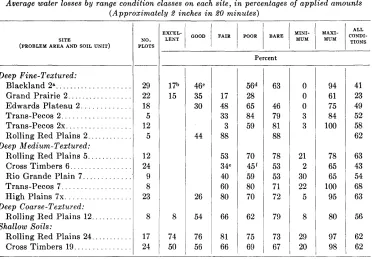
When water losses were averaged by range site and condition, it was found that on each site, average losses generally increased materially with each lower range condition class (Table 1). Almost without exception, highest water losses were from poor condition or bare ground plots.
There were consistently greater differ- ences between average results from differ- ent range conditions on the same site than between averages of all conditions on different sites.
An extremely wide range of water losses occurred on all sites, usually ranging from nearly nothing on the plots of best condition, to nearly all the water applied on one or more poor condition or bare ground plots. The only exceptions to this were the two very shallow sites, where water losses were high from all range conditions.
Thus it appears that initial water losses during rains are affected more by the condition of the range than by the permanent characteristics of the site, except where impervious layers near the surface limit storage and disposal capac- ities to less than the amount of rainfall. Since range condition is classified by the ecological stage of development or deteri- oration of the vegetation, as indicated by composition of the present cover in comparison to the climax (Dyksterhuis, 1949)) the condition classes naturally summarize both cover and soil conditions. Water intake and runoff consequently are likely to be more closely related to general range condition than to any one feature of cover or soil.
Individual Factors
412 BEN OSBORN
In general, the amount of water ab- conditions and the accidents of recent sorbed on the plots was proportional to use and treatment.
the amounts of surface cover on each When percent of water loss from all site, but results of individual tests were plots was plotted against the effectiveness extremely variable in relation to this of the cover in intercepting raindrop factor. On some sites, no well-defined impact, it was found that high water relationship between water loss and losses occurred whenever the cover was amount of cover was apparent. When of low effectiveness, and soil splash water losses from all sites and conditions correspondingly active. In general, water
TABLE 1
Average water losses by range condition classes on each site, in percentages of applied amounts (Approximately 2 inches in SO minutes)
SITE
(PROBLEM AREA Am SOILUNIT)
NO.
PLOTS
Deep Fine-Textured:
Blackland 2&. . . . . . . Grand Prairie 2.. . . . . . . . Edwards Plateau 2. . . . Trans-Pecos 2.. . . . . . . Trans-Pecos 2x.. . . . Rolling Red Plains 2.. .
Deep Medium-Textured:
29 22 18 5 12 5 17b 15 46’ 35 30 44
Rolling Red Plains 5. . . . Cross Timbers 6. . . . . Rio Grande Plain 7.. . . . Trans-Pecos 7.. . . High Plains 7x. .
Deep Coarse-Textured:
12 24 9 8
23 26
Rolling Red Plains 12.. .
Shallow Soils:
8 8 54
Rolling Red Plains 24.. . . 17 74 76 Cross Timbers 19. . . . 24 50 56
Percent - 17 48 33 3 88 56d 28 65 84 59 46 79 81 88
0 94
0 61
0 75
3 84 3 100
41 23 49 52 58 62
53 70 78 21 78 63 34” 45’ 53 2 65 43 40 59 53 30 65 54 60 80 71 22 100 68
80 70 72 5 95 63
66
81 66
62 79 8 80 56
75 73 29 97 62 69 67 20 98 62
63
a Numbers refer to soil mapping units in conservation surveys, b Native meadow, c Reestab- lished meadow, d Farm pastures, e Wooded pastures, * Old field pastures.
were plotted against weight of cover on the plots, a poorly defined trend within very broad limits of variation was evident.
Amount of cover on range land is related in general to range condition, the average amount declining with each lower range condition class. However, the actual amount of forage and litter on the ground at any particular time and place is greatly affected by seasonal
losses exceeded 50 percent of the applied amount whenever the cover was less than 50 percent effective in controlling splash. However, control of the splash did not necessarily prevent loss of water. High water losses as well as low ones occurred when the cover was 95 to 100 percent effective in controlling splash.
STORING RAINFALL 413
‘range land. These must, no doubt, be sought in the soil itself.
Soil Conditions
Within the same site, amounts of water loss were clearly related to soil conditions, such as organic matter content, volume- weight, and observable structure, which are associated in a general way with the stage of ecological development or deteri- oration of the cover.
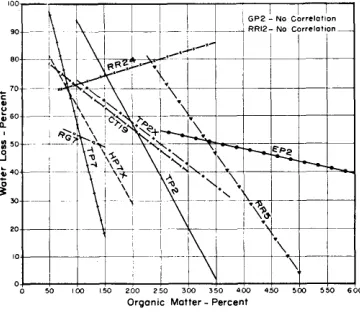
FIGURE 4. Water loss from various sites in relation to organic matter content of surface 2 inches of soil.
A considerable range in organic matter content of the surface 2 inches of soils of the same site in different cover condi- tions was found. On most sites the aver- age organic matter content declined with each lower range condition class. Water losses tended to increase sharply as organic matter content of the soil de- creased (Fig. 4).
Comparative weights of the surface 2 inches of soil were obtained from undis- turbed core samples taken from near each plot. The volume-weight of the soil was expressed as the ratio between oven-dry weight of soil and weight of an equal volume of water. Considerable range in volume-weights was found in
every site, and water losses increased sharply as the density of the soil increased (Fig. 5). Average volume-weights by condition classes generally increased with each lower class.
Surface crusts were often found on bare soils or those with sparse cover. High water losses were generally as- sociated with these conditions. The degree of crusting was not measured, but was clearly shown in photographs of plots.
Volume - ‘0. I. s.11, “I sm. Weight
FIGURE 5. Water loss from various sites in relation to volume-weight of surface 2 inches of soil.
Observable structure, insect burrows, and other evidences of animal life in the soil frequently provided logical explana- tions for water held or lost on the same site, but these factors were not measured. They must be reckoned, however, among soil conditions that influence infiltration and runoff.
CONCLUSIONS
The potential capacity of range lands to absorb and store most ordinary rains is indicated by results of standardized tests on small field plots with a mobile raindrop applicator.
Longevity of Ripped Furrows in Southern Arizona
Desert Grassland
ALBERT L.BROWN AND A.C.EVERSON
Assistant Range Ecologist and Research Assistant, Department of Botany and Range Ecology, College of Agriculture, University of Arizona, Tucson
V
ARIOUS mechanical treatments have been applied to rangeland to conserve moisture, prevent erosion, and increase forage production. These treat- ments have included construction of rock and brush percolators, terracing, pitting with an eccentric disc, and con- tour furrowing with a lister or other shallow-draft plow.Ripping with a subsoiling chisel is one variation of contour furrowing that has been extensively used. Two (occasionally one or three) subsoiling chisels are spaced five feet apart on a wheeled implement carrier drawn by a heavy crawler-type tractor. This treatment produces a furrow as deep, and a ridge as high, as an average lister furrow. The subsoiling chisel has the additional advantage of loosening the soil to a depth of 18 to 24 inches which provides a deep reservoir for water col- lected by the furrows.
Because of the heavy draft of the ripper and the resultant large power requirement the treatment is expensive. Commercially ripped furrows in southern Arizona cost from $6 to $15 per acre, where the entire area is treated. In spite of this expense, results on some ranges have been so satisfactory that the method is being used widely.
A major factor in determining the economic feasibility of such a treatment is the longevity of the furrows, i.e., the length of time the furrows are effective in producing more forage than the sur- rounding, non-ripped range. Several studies (Whitfield and Fly, 1939; Dick- son, et al., 1940; Barnes and Nelson,
1945; Caird and McCorkle, 1946), have indicated the value of furrows for ex- pediting recovery of rangeland. Caird and McCorkle place the longevity of listed furrows at seven years. No study on the longevity of ripped furrows has been reported.
The writers had opportunity to observe the condition of ripped furrows on a southern Arizona ranch ten years after treatment. Since the furrows still ap- peared to be effective, a study of grass yield was made to determine the effects of these furrows after such a prolonged period.
SITE CONDITIONS
The study area is at an elevation of 4,950 feet on the Babocomari Ranch, four miles southeast of Elgin, Santa Cruz County, Arizona. The area is representative of some of the highest- potential desert grassland range in Arizona.
Average annual precipitation is about 16 inches, received mostly in July and August. The June mean maximum tem- perature is 90”F., and the December mean minimum 25°F. Snowfall averages about six inches annually.
The soil, a sandy clay loam, is deep valley fill which contains an abundance of fist-sized boulders. The topography is rolling, or with flat table-lands dissected by deep, steep-sided drainages.
The vegetation is grassland (Fig. l), with a mixture of blue and hairy gramas
(Bouteloua gracilis, B. hirsuta) predomi- nating. Wolftail (Lycurus phleoides), pov-
416 LCIXCEVITY OF RlPPED FURROnY
ALBERT L. BROWN AND A. C. EVERSON 417
(sic), a land grant to Ignacio and Eulalia Elias, December 25, 1832. It has been grazed almost continually since that time. Mr. Frank C. Brophy has owned the ranch since 1934, at which time it was in a severely depleted condition. In 1939 the Soil Conservation Service en- tered into a cooperative agreement with Mr. Brophy, established a management plan for the ranch, and applied a number of mechanical range treatments. Several areas of contour-furrows were included in these treatments. Mr. Brophy has contour-furrowed some portions of the range almost every year since the 1940 ripping. The furrows were in pairs spaced five feet apart at approximately 30-foot horizontal intervals. In the fall of 1950 the authors obtained grass yields from one of the originally treated areas.
METHODS
The effect of the contour-furrows on forage production was determined by comparing the air-dry yield of grass on and between the pairs of furrbws. Sample plots 9.6 square feet in size (4.8’ X 2.0’) were mechanically located through- out the study area. The metal frame was placed either on the furrow or far enough away to be free from the furrow influence. Ripping influenced the area actually furrowed, and for about two feet on either side. Thus, two chisels at five- foot spacing would influence a maximum area of about nine feet. This is in ac- cord with the findings of Caird and McCorkle (1946), Barnes and Nelson (1945), and Whitfield, et al. (1939), who concluded that solid listing resulted in heavier forage yields than wider spacings. The total weight of all the grass within the plot was estimated. This weight was
then broken down into estimated per-
centages by species. The grasses were clipped at a one-inch stubble height, the individual species weighed, and the
estimated percentages corrected. The procedure of estimating and weighing was continued until the estimates were consistently within ten percent of the actual percentage weights. After this, the percent composition by weight of the plots was estimated and the species combined in clipping. The samples were retained throughout the study for dry- weight determinations. Fifty plots were clipped on the furrows and fifty between the furrows.
TABLE 1
Forage production on lo-year-old ripped furrows and on adjacent untreated range
SPECIES
Cane beardgrass. Poverty three-awn.. . Blue and hairy
gramas*... Wolftail. . . Sideoats grama. . . . Spruce-top grama.. . Black grama... Other perennials?. . Total perennials. .
Annual grasses Total grasses. .
-
POUNDS PER ACRE
On
138 198
9 80
On Off ~-
9.8 1.6 14.1 14.2
526 319 37.51 56.7 285 78 20.3 13.9 154 1 10.9 0.2 30 41 2.0 7.2 25 8 1.8 1.5 28 17 2.0 3.1 1384 554 98.5 98.4
21 9 1405 563 1
1.5 1.4 00.0/100.0
Off
-
PERCE KTAGE OF TOTAL
WEIGHT
* Blue and hairy gramas were combined to facilitate estimates in the field.
t Slender grama, small grama, curly mes- quitegrass, vine mesquitegrass, plains bristle- grass, Arizona cottongrass and fluffgrass.
RESULTS