Procedia Computer Science 00 (2009) 000–000
Science
www.elsevier.com/locate/procediaInternational Conference on Computational Science, ICCS 2010
Knowledge extraction from multiple criteria linear programming
classification approach
Yuejin Zhang
a,b,Peng Zhang
c, Lingling Zhang
b, Yong Shi
a,d,*
aResearch Center on Fictitious Economy and Data Sciences, Chinese Academy of Sciences, 100190, Beijing, ChinabSchool of Management, Graduate University of Chinese Academy of Sciences, 100190, Beijing, China cInstitute of Computing Technology, Chinese Academy of Sciences, Beijing, 100190, China dCollege of Information Science and Technology, University of Nebraska ant Omaha, NE68182, Omaha, USA
Abstract
As an effective model for classification, Multiple Criteria Linear Programming (MCLP) has been widely used in business intelligence. However, a possible limitation of MCLP is that it generates unexplainable black-box models which can only tell us results without reasons. To overcome this shortage, in this paper, we present a knowledge mining strategy which mines explainable decision rules from black-box MCLP models. Firstly, we use the rough set theory to distinguish the definable set
where samples are perfectly classified, from the rough set where misclassified samples may exist. Then, to get explainable knowledge, we present a clustering-based decision rule extraction approach to extract knowledge from the definable set, and a rough set-based rule extraction approach to the rough set. Finally, empirical studies on real world VIP Email data sets demonstrate that our method can effectively extract explicit rules from MCLP model with only a little lost in performance.
Keywords: MCLP, rule extraction, clustering, rough set;
1. Introduction
Classification is a useful method in data mining [1-5]. Recently, many mathematical programming based algorithms are used to do classification, such as the fuzzy set, neural networks, and linear programming. Among them, linear programming has been initiated in classification since twenty years ago [6]. After that, linear programming methods gradually evolve to the Multiple Criteria Linear Programming (MCLP) approach by Shi et al. [7] to classify real world credit card data set. Compared to the traditional mathematical tools, the MCLP approach is much more flexible by allowing decision makers to play an active part in the analysis [8]. And it has been extensively used in a series of business applications such as credit scoring, customer classification, medical fraud detection.
Although MCLP is able to achieve good classification accuracies, it has a very notable shortcoming that it
* Corresponding author. Tel./fax: +86-10-82680697.
E-mail address: [email protected] (Y. Shi), [email protected] (Y. Zhang), [email protected] (P. Zhang), [email protected] (L. Zhang)
c
⃝2012 Published by Elsevier Ltd.
Procedia Computer Science 1 (2012) 2441–2448
www.elsevier.com/locate/procedia
1877-0509 c⃝2012 Published by Elsevier Ltd. doi:10.1016/j.procs.2010.04.275
Open access under CC BY-NC-ND license.
generates unexplainable models. For example, in credit scoring, MCLP models can tell us whether a customer is a high-risk one, and those who have a low credit score will be rejected to get any loan. Nevertheless, to customers who are rejected, MCLP models can’t tell us why they are assigned low credit scores. In addition, there often exists overlapping between classes in actual classification applications, so any linear function can not entirely separate the classes from each other. MCLP approach gives an optimal classified boundary by a compromise solution approach, and the accuracy rate of classification. But it did not tell us with what attribute values the samples may be classified into a wrong class.
To solve this limitation, in this paper, we present a knowledge mining strategy which mining explainable knowledge from black-box MCLP models. Firstly, the concept of rough set is employed to distinguish the definable setwhere samples are perfectly classified, from the rough set in which samples may be misclassified. Then, for the definable set, we propose a rule extraction approach based on clustering; and for the rough set, we propose the rough set-based rule extraction approach. By using the rule extraction approaches, we can open up the black-box to extract usable, readable if-then rules. These rules can be easily understood by humans.
The rest of this paper is organized as follow. In the next section, we survey some related works. In the third section, we discuss a clustering based rule extraction method. After that, we discuss another rough set based decision rule extraction method in section four. To demonstrate our method’s performance, we do some empirical studies in section five. Finally, we conclude this paper in section six.
2. Related Work
Multiple Criteria Linear Programming (MCLP) Model: A general problem of data classification by using multiple criteria linear programming can be described as following: given a set of r variables or attributes in databaseA (A1,",An r n)u , let ( 1, , )
r
i i ir
A a "a R be the sample observations of data for the variables, where i 1nandnis the sample size. If a given problem can be predefined as sdifferent classes, C1 Cs, then the boundary between the jth and j1th classes can be bjj 1sí1. Then we define the coefficients for an appropriate subset of the variables, denoted by ( ,1 )T r
r
X x "x R and scalars bj such that the separation of these classes can be described as follows:A Xi db1, Ai C1,bk1dA Xi dbk, Ai C kk, 2,"s1, and A Xi tbs1, Ai Cs, whereA Xi tbs1, Ai Cs, means that data case Aibelongs to class Cj.
For the purpose of simplification, we discuss about the binary classification. Let Ai (ai1,",air), i=1,…, m, be the sample observations of data for the variables, boundary b is to separate the two classes C1, and C2, and the separation can be described as:A Xi db, Ai C1, and A Xi tb, Ai C2.
The quality of separation can be measured by minimizing the total overlapping of data and maximizing the distances of every data to its class boundary simultaneously [6]. Consequently, we have the following conclusions.
LetDi be the overlapping degree with respect of data case Ai within C1 and C2, and we want to minimize the sum of Di, then the primal linear programming can be written as:
i i Minimize
¦
D (1) Subject to A Xi d b Di, AiC1 i i A Xt b D , AiC2Let Ei be the distances from Ai within C1 and C2 to its adjusted boundaries, and we want to minimize the sum ofEi, then the primal linear programming can be denoted as:
i i
Maximize
¦
E (2) Subject to A Xi t b Ei, AiC1A Xi d b Ei, AiC2
i i Minimize
¦
D & i i Maximize¦
E (3) Subject to A Xi b DiEiˈAiC1 A Xi b DiEiˈAiC2Where Ai are given, X and b are unrestricted, and D Ei, it0, i 1,",m.
Rough sets-based rule extraction method: Rough set theory is a useful mathematical analysis tool for dealing with fuzzy and uncertain information and discovering knowledge and rules hidden behind data [9]. Knowledge or attribute reduction and rule extraction are the major applications of rough set theory.
Let S=˄U, A, V, f˅be an information system (attribute-value system), where U is a non-empty set of finite objects, called the universe, and A is a non-empty, finite set of attributes, A CD, CD ˈwhere C is conditional attributes , and D are decision attributes. With any
P
A
there is an associated equivalence relationIND(P): 2
( ) {( , ) | , ( ) ( )}
IND P x y U a P a x a y . The relation IND(P) is called a P-indiscernibility relation. The partition of U is a family of all equivalence classes of IND(P) and is denoted by U/IND(P)(or U/P).
Let XUbe a target set that we wish to represent using attribute subset P.X is called a rough set, if it cannot be expressed exactly by using the equivalence classes induced by attribute subset P; otherwise X is called a definable set.
The rough set approach generates the classification rules through attribute reduction of the decision table. For the information system S=(U, A, V, f), attribute a is reducible, for СaęA , if the following equation is tenable:
( ) ( { })
ind A ind A a .
Let |U|=n·S be an n×n discernibility matrix, for any element ( , )D x y is the discernibility of all the attributes of the object x and y, where ( , )D x y {aA f x a| ( , )zf y a( , )}. For attributeaA, there is a Boolean variable “a”. IfD( , )x y { ,a a1 2,",ak}z , then the Boolean function
( , ) ( , ) x y U U x y D u '
¦
=a1a2"ak˗otherwise, if ( , )x yD , then Ƹ=1 [9]. And for BA, if BD( , )x y z , then B is called a reduct of A. The set of attributes which is common to all reducts is called the core:core A( ) {aA| ( , )D x y { },a where x y, U}the core is the set of attributes which is possessed by every legitimate reduct, and therefore consists of attributes which cannot be removed from the information system without causing collapse of the equivalence-class structure.
Let Xi be the equivalence class of U/C, Yi be the equivalence class of U/D, the description of Xi is denoted asdes X( i), which is the specific value of each conditional attribute for Xi. Similarly, the description of Yi is denoted asdes Y( )i , which is the specific value of each conditional attribute for Yi. The decision rule is defined as follows:rij:des X( i)odes Y( )j ,YjXiz , Where (P X Yi, j) |YjXi| / |Xi|is the certainty factor of rule rij,
0P(X Yi, j)d1.
3. Rule Extraction based on Clustering for MCLP Classification
For the purpose of simplification, considering the binary classification we discussed above. Ai (ai1,",air), i=1,Ă, m, is the sample observations of data for the variables, two classes C1 and C2 are given, so Aibelongs to C1, otherwise it belongs to C2. Based on MCLP model, we get the hyper-plane to separate the two classes from each other. The hyper-plane of r-dimensional space or classification function is as follows:
AX b (4) Where X ( ,x x1 2,",xn) is weight vector, b is a scalar. Thus, for , 1
r i A R i n " . If A Xi b, then AiC1; if i A X!b, then AiC2.
In the last few years, there have been many methods proposed to extract rules from black-box models, such as neural networks and SVM, to generate explainable rules. These approaches can be categorized into two groups:
decompositional method and pedagogical method [10]. The decompositional method is closely intertwined with the internal structure of models. For example, Nunez et al. [11] proposed a clustering based rule extraction of SVM models by creating rule-defining regions based on prototype and support vectors. The extracted rules are represented by equation rules and interval rules. Fung et al. [12] proposed a non-overlapping rule by constructing hyper cubes with axis-parallel surfaces. On the other hand, the pedagogical rule extraction method directly extracts rules by using other machine learning algorithms. For example, after building a black-box model, we can use some other rule-extraction algorithms such as C4.5 to extract rules out of the model [13, 14].
For MCLP classification approach, we present a clustering-based knowledge mining method for extracting decision rules. Firstly, a MCLP model is built and all the samples are classified into their own classes. Then in each class, a clustering method, k-means will be carried out to catch the prototype vectors, which are the centers of the clusters. After that, for comprehensibility, we generate hyper cubes with edges parallel to the axis and one vertex on the classification boundary. For the accuracy of the rules, the hyper cubes cannot cross the boundary and the edges of each other. Moreover, if not all the samples are covered in the hyper cubes, the clustering method will be carried again with the number of cluster changed until all the instances in the sample are covered by the generated hyper cubes. At last, each hyper cube can be translated to a decision rule. The procedure can be describes in Algorithm1
Algorithm 1 Rule extraction algorithm based on clustering
Input: The data setAi (ai1,",air), MCLP model m, original boundary b
Output:Classification Rules {w}
Processing flow:
Step 1 Classify all the samples in Ausing model m; Step 2 Define Covered set C=), Uncovered se U=A; Step 3 While (U !=)) Do
Step 3.1 for each group Gi,
Calculate the clustering center Pik = Kmeans(Gi), k=+1; end for
Step 3.2 calculate the Distance d = Distance(m, Gi); Step 3.3 Draw a new hypercube H=DrawHC(d, Gi); Step 3.4 for all the instancesaiU,
if covered by H, then U = U\ai , C = CĤai; end if
end for end While
Step 4 Translate each hypercube H into Classification Rules W; Step 5 Return Rule set {w}
4. Rough Set-based rule extraction from MCLP classification approach
The rule extraction approach discussed above based on the assumption that the samples are approximately linearly separable, while neglects the misclassified samples. However, in many real world classification applications, there often exists overlapping between classes. That is to say, any linear function can not entirely separate the classes from each other. MCLP approach gives an optimal classified boundary by a compromise solution approach, and the accuracy rate of classification. But it did not tell us with what attribute values the samples may be classified into a wrong class.
For the uncertainty region with misclassified samples, we employed Rough Set theory, which is good at expressing and dealing with uncertain knowledge.
For the binary MCLP classification above, the r-dimension space is separated by the hyper-planeA Xi b. The samples Ai (ai1,",air) are classified into class C1 or C2.
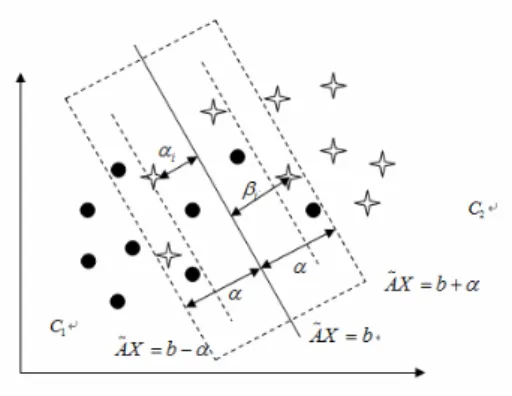
Fig. 1. A binary MCLP classification
In the overlapping region, there are some misclassified samples, as shown in Figure 1. According to rough set theory, the r-dimension space r
R can be separated into four subspaces, denoted bySj(j 1, 2, 3, 4), which can be expressed as follows: 1 { | , 1} r i i i S AR A Xd b D AC , 2 { | , 2} r i i i S AR A Xt b D A C , 3 { | , 2 } r i i i S AR bDdA Xdb AC z , 4 { | , 1 } r i i i S AR bdA Xd b D AC z .
Consequently, S1S2is the set of samples which are classified into the right class, and it is a definable set on the MCLP classification model; S3S4 is the overlapping region, and it is the rough set.
Theoretically,Dis the max overlapping of two-group (classes) boundary for all cases Ai, that is to say, it is the farthest distance from the misclassified vector to the classification super-plane. Actually, the outlier samples will make the D meaningless. Thus, a proper Dcan be set according to the mode of all the Di, or it can be obtained according to an appointed threshold of classification accuracy.
For the classification super-planeAX b , and the classification accuracy acc, let P* be the threshold of classification accuracy. If acc< P*, we get the adjusted super-planes AX b D, and AX b D , where the
classification accuracy * 1 2 accS S tP . For 1 { | } r i i S AR A Xd b D and 2 { | } r i i S AR A Xt b D , the classification accuracy is calculated as follows:
1 1 1 | { | , } | | { | } | r i i i r i i A R A X b A C accS S A R A X b D D d d (5) 2 2 2 | { | , } | | { | } | r i i i r i i A R A X b A C accS S A R A X b D D t t (6) 1 1 2 2 1 2 1 2 | | | | | | | | accS S accS S accS S S S u u (7)
Then, the rough set-based rule extraction from MCLP classification approach can be described in algorithm 2 in detail.
Algorithm 2 Rough Set-based Rule Extraction Algorithm
Input: The data setAi (ai1,",air), MCLP model m, original boundary b, classification accuracy threshold P *
Output:Classification Rules {w}, certainty factor Pij
Step 1 Classify all the samples in Ausing model m; Step 2 for 1 { r| } i i S AR A Xd b D , and 2 { r| } i i S AR A Xt b D , use Algorithm 1 to extract rules,
end for;
Step 3 for 3 4 { | }
r
i i
S S AR bDdA Xd b D , get the decision table S=˄U, A, V, f˅; get the adjusted decision table S’=˄U, A, V, f˅; end for
Step 4 Calculate the discernibility matrix |U|=n·S, Step 4.1 for any element ( , ) |D x y U|,
( , )D x y {aA f x a| ( , )z f y a( , )}; end for Step 4.2 ifD( , )x y { ,a a1 2,",ak}z , ( , ) ( , ) x y U U x y D u '
¦
=a1a2"ak; end if ifD( , )x y , Ƹ=1; end ifStep 5 Get the reduct B, core(A); Step 6 Get Rules {w};
: ( ) ( ) { }
ij i j
r des X odes Y w ,Pij |YjXi| / |Xi|.
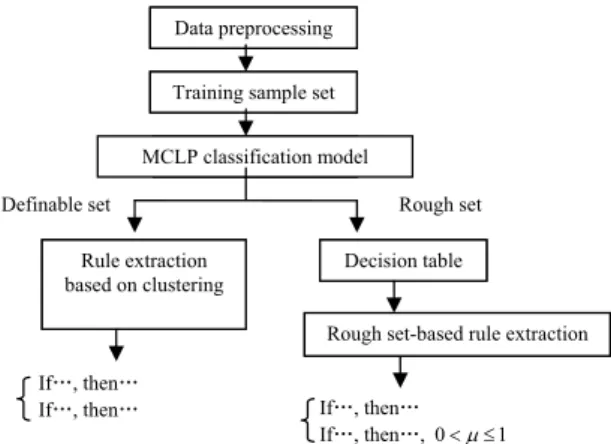
To sum up, after we get the MCLP classification model, for the definable set S1S2, we employ the rule extraction approach based on clustering; and for the rough set, we use the rough set-based rule extraction approach. The MCLP knowledge mining model can be shown as figure 2.
Fig. 2. MCLP knowledge mining model
5. Experiment Results
We use the VIP Email data set as the benchmark data set for comparison. For the sake of space, we omit the description of the VIP Email data set here. For more information, please check our former work [15]. As we
Training sample set Data preprocessing
MCLP classification model
Rule extraction based on clustering
Decision table
Definable set Rough set
IfĂ, thenĂ
IfĂ, thenĂ IfĂ, thenĂ
IfĂ, thenĂ,0Pd1 Rough set-based rule extraction
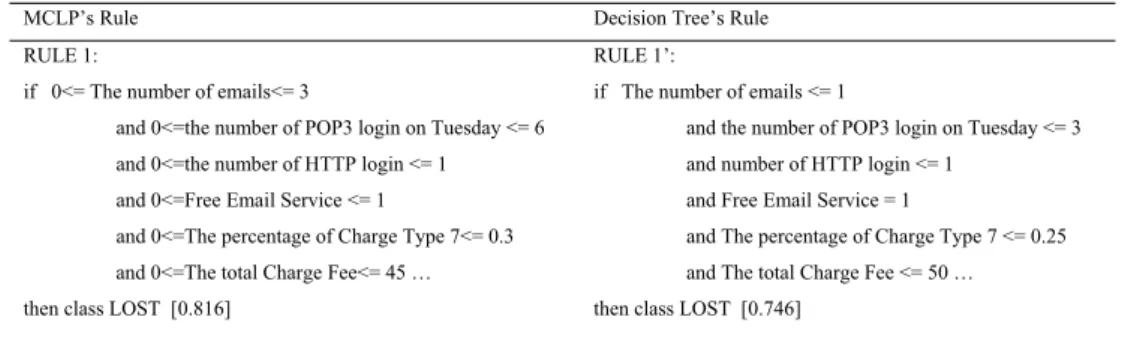
discussed above, decision tree is a widely used method to extract rules from the training sample. So in the following experiments, we compare our method with decision tree (which is implemented by the WEKA J48 package). Table 1 lists the comparison results between our method and the decision tree. By using our rule extraction method, we get more than 20 hyper cubes, due to the limitation of the space, we only list two most representative rules (i.e., Rule 1 for class “LOST” and Rule 6 for class “CURRENT”) in the left side of Table 2. Then we find the corresponding rules from decision tree (i.e., Rule 1’ for class “LOST” and Rule 6’ for class “CURRENT”), and list them in the right side of Table 2. From the results, we can observe that, our rule extraction method can acquire much accurate rules than the decision tree method. For example, when comparing Rule 1 with Rule 1’, we can get the conclusion that Rule 1 is supported by 81.6% examples in the “LOST” class; on the contrast, rules from decision tree only gets 74.6% supportive examples.
Table 1. Comparisons between our method and Decision Tree’s Rule
MCLP’s Rule Decision Tree’s Rule
RULE 1:
if 0<= The number of emails<= 3
and 0<=the number of POP3 login on Tuesday <= 6 and 0<=the number of HTTP login <= 1 and 0<=Free Email Service <= 1
and 0<=The percentage of Charge Type 7<= 0.3 and 0<=The total Charge Fee<= 45 … then class LOST [0.816]
RULE 1’:
if The number of emails <= 1
and the number of POP3 login on Tuesday <= 3 and number of HTTP login <= 1
and Free Email Service = 1
and The percentage of Charge Type 7 <= 0.25 and The total Charge Fee <= 50 … then class LOST [0.746]
6. Conclusions
The main goal of data mining in business intelligence is to extract a set of hidden patterns describing the customers’ behaviors. As an effective approach for classification, MCLP generates simple and flexible classification models. Nevertheless, a major shortcoming of the MCLP is that it generates black-box models which are unexplainable. To this limitation, in this paper we discussed a ‘second’ mining strategy to extract explainable knowledge from the MCLP model. By using the rule extraction approaches, we can open up the black-box to acquire usable, readable if-then rules which are easily understood by human beings. Experimental results on the real world VIP Email dataset demonstrate that our method is effective in extracting accurate rules from MCLP model.
Acknowledgements
This research has been partially supported by a grant from National Natural Science Foundation of China (#70921061, #70501030, #70621001, #90718042, #60674109, #70871111), Beijing Natural Science Foundation (#9073020), and President Fund of GUCAS (Grant No.085102HN00).
References
1. N. Ren, M. Zargham, and S. Rahimi, A Decision Tree-Based Classification Approach to Rule Extraction for Security Analysis, International Journal of Information Technology and Decision Making, (2006) Volume: 5, Issue: 1, pp. 227-240
2. B. Boutsinas, S. Athanasiadis, On Merging Classification Rules, International Journal of Information Technology and Decision Making, (2008) Volume: 7, Issue: 3, pp. 431-450
3. J. He, X.T. Liu, Y. Shi, W.X. Xu,, and N. Yan, Classifications Of Credit Cardholder Behavior By Using Fuzzy Linear Programming, International Journal of Information Technology and Decision Making, (2004) Volume: 3, Issue: 4, pp. 633-650
4. Y. Shi, Y. Peng, G. Kou, and Z.X. Chen, Classifying Credit Card Accounts for Business Intelligence and Decision Making: A Multiple-Criteria Quadratic Programming Approach, International Journal of Information Technology and Decision Making, (2005) Volume: 4, Issue: 4, pp. 581-599
5. C.H. Lin, and Y.H. Liu, Multiple Trait Selection and Classification of Genotype — A Data Mining Approach, International Journal of Information Technology and Decision Making, Volume: 2, Issue: 3(2003) pp. 445-457
6. N. Freed, and F. Glover, Simple but powerful goal programming models for discriminant problems. European Journal of Operational Research, (1981)7, 44̢60.
7. Y. Shi and P.L. Yu, Goal setting and compromise solutions. In: B. Karpak and S. Zionts (Eds.), Multiple Criteria Decision Making and Risk Analysis Using Microcomputers, (1989) pp. 165–204. Springer-Verlag, Berlin.
8. Y. Shi, Y. Peng, X. Xu and X. Tang, Data mining via multiple criteria linear programming: Applications in credit card portfolio management. International Journal of Information Technology and Decision Making, (2002), Volume: 1, Issue: 1, 145–166.
9. Z. Pawlak,.Rough sets. International Journal of Computation and Information Sciences, (1982)11, 341–356.
10. D. Martens, B. Baesens, T. V. Gestelc, and J. Vanthienena, Comprehensible credit scoring models using rule extraction from support vector machines, European Journal of Operational Research, Volume 183, Issue 3, 16 December (2007), Pages 1466-1476
11. H. Nunez, C. Angulo, and A. Catala. Rule based learning systems from SVMs. In: European Symposium on Artificial Neural Networks Proceedings, (2002), pp.107-112.
12. G. Fung, S. Sandilya, R.Bharat Rao, Rule extraction from linear support vector machines, In: Proceeding of KDD’05. pp. 32-40. 13. J.Y. He, et al, Rule Extraction from SVM for Protein Structure Prediction, Studies in Computational Intelligence (SCI) (2008)80, 227– 252
14. S.N. Pang, N. Kasabov, Encoding and decoding the knowledge of association rules over SVM classification trees, knowledge Information System, (2009)19: 79-105.
15. P. Zhang and J.R. Dai, Multiple Criteria Linear Programming for VIP E-Mail Behavior Analysis (2007). Proc. of IEEE ICDM 2007 Workshops, pages: 289-296.