Western University Western University
Scholarship@Western
Scholarship@Western
Electronic Thesis and Dissertation Repository
11-21-2011 12:00 AM
Trust-Based Service Selection
Trust-Based Service Selection
Zainab Aljazzaf
The University of Western Ontario
Supervisor Mark Perry
The University of Western Ontario Joint Supervisor Miriam Capretz
The University of Western Ontario Graduate Program in Computer Science
A thesis submitted in partial fulfillment of the requirements for the degree in Doctor of Philosophy
© Zainab Aljazzaf 2011
Follow this and additional works at: https://ir.lib.uwo.ca/etd
Part of the OS and Networks Commons
Recommended Citation Recommended Citation
Aljazzaf, Zainab, "Trust-Based Service Selection" (2011). Electronic Thesis and Dissertation Repository. 314.
https://ir.lib.uwo.ca/etd/314
Trust-Based Service Selection
by
Zainab Mohammed Aljazzaf
Graduate Program in Computer Science
A thesis submitted in partial fulfillment of the requirements for the degree of
Doctor of Philosophy
The School of Graduate and Postdoctoral Studies The University of Western Ontario
London, Ontario, Canada December, 2011
c
THE UNIVERSITY OF WESTERN ONTARIO
SCHOOL OF GRADUATE AND POSTDOCTORAL STUDIES
CERTIFICATE OF EXAMINATION
Supervisors Examiners
Dr. Mark Perry Dr. Qusay H. Mahmoud
Dr. Miriam Capretz Dr. Abdallah Shami
Dr. Michael A. Bauer
Dr. Michael Katchabaw
The thesis by
Zainab Mohammed Aljazzaf
entitled
TRUST-BASEDSERVICE SELECTION
is accepted in partial fulfillment of the requirements for the degree of
Doctor of Philosophy
Abstract
Service Oriented Architecture (SOA) is an architectural style that builds enterprise solutions based on services. In SOA, the lack of trust between different parties affects the adoption of such architecture. Trust is as significant a factor for successful online interactions as it is in real life communities, and consequently, it is an important factor that is used as a criterion for service selection. In the context of online services and SOA, the literature review shows that trust is not mature and does not reflect trust as it is in the online world in terms of trust definition and the consideration of the essentials trust aspects that reflects the nature of trust.
This thesis proposes a trust-based service selection solution, which requires establishing trust for services and supporting service selection based on trust. This work considers building trust for service providers besides rating services, an area that is neglected in the services trust literature. This work follows progressive steps to arrive at a solution. First, this work develops a trust definition and identifies trust principles, which cover different aspects of trust. Next, SOA is extended to build a trust-based SOA that supports trust-based service selection. In particular, a new component, the trust mediator, which is responsible for trust establishment is added to the architecture. Accordingly, a trust mediator framework is built according to the trust definition and principles to identify its main components. Subsequently, this work identifies the trust information, or metrics, for services and service providers. Accordingly, trust models are built to evaluate trust rates for the applicable metrics, services, and service providers.
Keywords
Acknowledgements
All Praise and Thanks to my Lord, ALLAH ..
I would like to thank Kuwait University for the financial support throughout my study as well as the University of Western Ontario for the provision of facilities for completing my research.
I would like to express my sincere gratitude to my supervisors, Prof. Mark Perry and Dr. Miriam Capretz, for their great support during my studies. Their guidance, assistance, encour-agement, and friendship have been instrumental in my fulfilment of this work.
I give great thanks to my husband, Abbas Khajah, his mother, Khair Al-Nisa Khajah, my children, Albatool, Athraa, Ahmed, and Hamza, my parents, Mohammed and Masooma, and my family for their great patience, understanding, prayer, and support. They have played an integral part in making this work complete and successful.
Finally, I greatly appreciate my colleagues, and give special thanks to David Allison, Raphael Mafita Bahati, Chern Har Yew, Diego Garcia, Vinson Wang, and Rizwan Tejpar, as well as the employees in the university, especially Maaike Froelich from the Student Development Centre and the staff in the Writing Support Centre and Teaching Support Centre.
“Whoever
Trusts
in Allah, will find Him sufficient.
Verily, Allah will accomplish his purpose.”
Abbreviations
BPEL Business Process Execution Language CA Certificate Authority
OASIS Organization for the Advancement of Structured Information Standards OSTM Objective Service Trust Metric
P2P Peer to Peer network PTM Provider Trust Metric QoBiz Quality of Business QoE Quality of Experience QoS Quality of Service
SLA Service Level Agreement SOA Service Oriented Architecture SOAP Simple Object Access Protocol SOC Service Oriented Computing SSTM Subjective Service Trust Metric ST Security Token
STM Service Trust Metric STS Security Token Service
TOST M Trust rate of Objective Service Trust Metric Tpr Trust rate of service provider
TP T M Trust rate of Provider Trust Metric Ts Trust rate of service
TSST M Trust rate of Subjective Service Trust Metric TST M Trust rate of Service Trust Metric
TT M Trust rate of Trust Metric
TM Trust Metric
ToTEF Total Trust Evaluator Framework
UDDI Universal Description, Discovery, and Integration W3C World Wide Web Consortium
WS Web Service
Table of Contents
Certificate of Examination ii
Abstract iii
Keywords iv
Acknowledgements vii
Abbreviations vii
List of Tables xiii
List of Figures xiv
1 Introduction 1
1.1 Motivation . . . 3 1.2 Dissertation Outline . . . 9
2 Background 11
2.1 Services . . . 11 2.2 Service Oriented Architecture . . . 14
2.4 Trust Aspects . . . 18
2.5 Reputation Computation Methods . . . 23
2.6 Commercial and Live Reputation Systems . . . 24
2.7 Trust and Security . . . 26
2.8 WS-Trust . . . 28
2.9 Summary . . . 30
3 Related Work 31 3.1 Trust Definition in the Literature . . . 31
3.2 Trust Information . . . 34
3.3 Trusting Service Providers . . . 38
3.4 SOA Extension . . . 39
3.5 Community-Based System . . . 41
3.6 Trust Models . . . 41
3.7 Trust Bootstrapping . . . 44
3.8 Summary . . . 46
4 Trust-Based SOA and Trust Framework 47 4.1 The Proposed Trust Definition and Trust Principles . . . 47
4.1.1 The Trust Definition . . . 48
4.1.2 The Trust Principles . . . 50
4.2 Trust-Based SOA . . . 53
4.3 ToTEF: Total Trust Evaluator Framework . . . 55
4.3.1 Pre-Processing Phase . . . 56
4.3.3 Post-Processing Phase . . . 59
4.4 Summary . . . 61
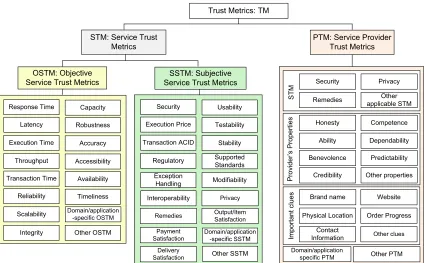
5 Trust Metrics 62 5.1 The Proposed Trust Metrics (TM) . . . 64
5.1.1 Service Trust Metrics (STM) . . . 64
5.1.1.1 Objective Service Trust Metrics (OSTM) . . . 64
5.1.1.2 Subjective Service Trust Metrics (SSTM) . . . 65
5.1.2 Provider Trust Metrics (PTM) . . . 67
5.2 TM Publication Approaches . . . 69
5.3 Summary . . . 72
6 Trust Models for Trust Metrics 73 6.1 Trust Rating Scales . . . 75
6.2 OSTM Trust Models . . . 76
6.3 SSTM Trust Models . . . 80
6.4 PTM Trust Models . . . 81
6.5 Summary . . . 85
7 Trust Models for Services and Service Providers 86 7.1 Service Trust Model . . . 89
7.2 Service Provider Trust Model . . . 93
7.3 Trust Matching Model . . . 94
8 Implementation and Experiment 97
8.1 Trust-Based SOA Prototype . . . 97
8.2 Prototype Implementation . . . 99
8.2.1 Prototype Design . . . 99
8.2.2 Prototype GUIs . . . 102
8.3 Experiments . . . 104
8.3.1 A Case Study: Electronic-Market . . . 105
8.3.2 Experimental Methodology . . . 105
8.3.3 Experimental Results . . . 112
8.4 Evaluation . . . 115
8.4.1 Scenario 1: Service Selection Based on Requestor Trust Preferences and Providers Rates . . . 116
8.4.2 Scenario 2: Trust PreferenceTs versus GeneralTs . . . 117
8.5 Summary . . . 117
9 Conclusion and Future Work 119 9.1 Contributions and Discussion . . . 120
9.1.1 Trust Solution and Trust Principles . . . 120
9.1.2 Trust Solution and Trust Challenges . . . 123
9.2 Future Work . . . 126
Appendix A 138
Appendix B 139
Bibliography 143
List of Tables
3.1 QoS Parameters and Descriptions. . . 37
5.1 Trust Metrics and their Published Values. . . 71
6.1 Trust Ratings of the TM (TT M) and the Evaluation Approaches. . . 74
7.1 Trust Rating: Simple vs. Exponential Averaging (Behaving Well). . . 88
8.1 Experimental Methodology. . . 107
8.2 Services and Service Providers Used in the Experiment. . . 108
8.3 Portion of the Service Table Presents Services Published by Provider 2. . . 112
8.4 Service Provider TM and Trust Ratings. . . 114
8.5 Scenario 1: Selecting a ‘Calculator’ Service Based on Requestor’s Trust Pref-erences. . . 117
List of Figures
1.1 Trust Relationship. . . 2
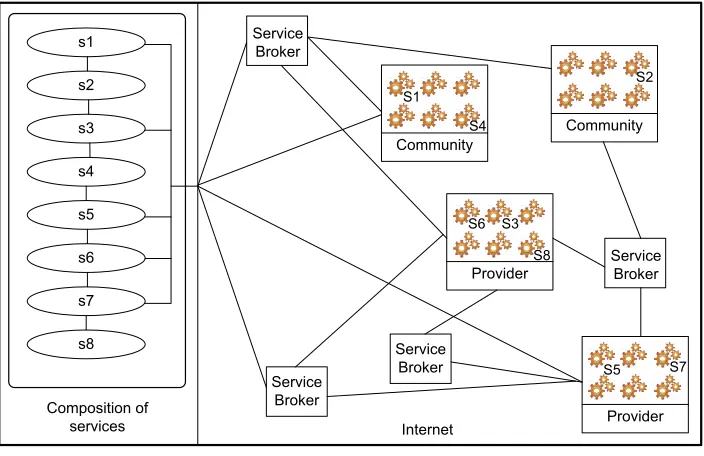
1.2 Trust Relationship between a Service Requestor and a Service/Service Provider. 4 1.3 SOA Environment. . . 6
2.1 Web Services Technology Stack [74]. . . 13
2.2 Service Oriented Architecture. . . 15
2.3 Approaches for Trust-Based Service Selection [21]. . . 17
2.4 Reputation System Architecture [39]. . . 18
2.5 Trust Network. . . 19
2.6 WS-Security Standards BuilT on SOAP [1]. . . 27
2.7 WS-Trust Model [43]. . . 29
3.1 SOA Extensions to Support QoS/Ranking/Trust. . . 40
4.1 Trust-Based SOA. . . 54
4.2 ToTEF: Total Trust Evaluator Framework. . . 56
4.3 Trust Establishment Process for Trust Metrics, Services, and Service Providers. 61 5.1 QoS Properties for Services. . . 63
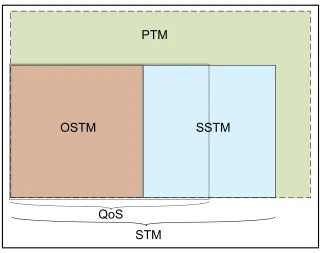
5.3 The Overlap between the Trust Metrics. . . 66
5.4 The Selected Service and Service Provider Trust Metrics. . . 70
6.1 OSTM Trust Models: The Steps and an Approach to Rating OSTM. . . 76
6.2 Low OSTM Possible Range of Values, diff Values, and Trust Rates. . . 78
6.3 High OSTM Possible Range of Values, diff Values, and Trust Rates. . . 79
6.4 SSTM Trust Models: The Steps and Approaches to Rating SSTM. . . 80
6.5 PTM Trust Models: The Steps and Approaches to Rating PTM. . . 82
7.1 Trust Rating: Simple vs. Exponential Averaging (Behaving Well). . . 88
7.2 Trust Bootstrapping and Rating Services: Activity Diagram. . . 90
7.3 Trust Bootstrapping and Rating Services: Sequence Diagrams. . . 92
7.4 Trust Bootstrapping and Rating Service Providers. . . 95
8.1 Trust-Based SOA Prototype. . . 98
8.2 A Snapshot of the List of the Created Web Service Providers (EJB): Providers’ Web Services, and Services’ WSDLs. . . 100
8.3 Rating Registry: Trust Database. . . 101
8.4 SoapUI Project Snapshot. . . 102
8.5 A Snapshot of the Provider Trust GUI. . . 103
8.6 A Snapshot of the Requestor Trust GUI. . . 104
8.7 Trust-Based SOA, E-market Case Study. . . 106
8.8 A Snapshot of a Provider Publishing a Service. . . 110
8.9 Trust Rates of Services Provided by the Service Providers. . . 113
8.10 Trust Rates of the Service Providers. . . 115
8.12 General vs. Trust Preference Rate of the Sort Numbers Service. . . 118
Chapter 1
Introduction
“It is impossible to go through life without trust.” Graham Greene
In human communities, there is uncertainty about the behaviour of strangers. Since people who do not trust others avoid interacting with them, trust plays a significant role in facilitating interactions in such uncertain environments. Trust is a property of relationships rather than individuals [96], and accordingly, it is usually specified as a relationship between a trustor and a trustee. Atrustoris a subject that trusts a target entity known as atrustee[88]. In this case, an entity can include a person, store, bank, service, or product, and it can be identified by its properties, such as name, identification, picture, signature, store location, and stated policies [22, 80]. An entity’s decision to interact with others represents an act of trust. In this case, the trustor relies on and places its trust in the trustee to accomplish the task as agreed upon [44]. Figure 1.1 depicts the trust relationship between the trustor and the trustee.
Trustor
Trustee
Trusts
Figure 1.1: Trust Relationship.
perform trust management. Entities, such as sellers, buyers, items, and services in such systems are rated on the basis of their past interactions, which creates future expectations for the entities.
In the real or offline world, trust can be built based on obvious evidence, such as names and physical presences. However, trust establishment on the Internet contains additional issues. In such an online environment, entities are separated by physical distance and are likely to be complete strangers. Some entities on the Internet use real names and have physical location. However, this is not always the case, as entities are generally not physically identified, and there are many anonymous entities. Additionally, as in the offline world, the Internet is a diverse system of different domains, and each domain has different requirements. Hence, a domain’s requirements need to be considered when establishing trust for entities joining that domain. For example, one domain may require an entity that can be trusted based on security criteria and another domain may require privacy specifications. Therefore, a trust solution needs to consider the diverse requirements of online organisations.
In order to realize the potential of SOC, Service Oriented Architecture (SOA) should be developed to overcome many enterprise challenges, including designing complex distributed services, managing business processes, ensuring transaction Quality of Service (QoS), comply-ing with agreements, and leveragcomply-ing different computcomply-ing devices such as personal computers and cell phones [75].
Services around the Web are diverse with different properties. For example, one service may include response time, throughput, and privacy as its main properties and another service may consider reliability and security as its major properties. However, the identification of the devel-opment of trust information and trust for such diverse entities is more challenging. In addition, some services and service providers are malevolent in providing poor services or intention-ally offering services that are not consistent with their promises [38]. Thus, it is necessary to determine the trustworthiness of services and the selection of a trustworthy service.
To build a service oriented application, the application developer, or service requestor, can select services from different providers on the Internet. Since there are many services with similar functionalities, service requestors need to differentiate between them. The only differ-entiating factor between similar services may be their non-functional properties, which can be considered as criteria for service selection. As a non-functional property, trust has been used as a criterion for service selection [21, 95, 37, 41]. Accordingly, Figure 1.2 shows the trust relationship between a service requestor and a service or service provider. A service requestor, or trustor, may select a service from a service provider, the trustees, based on their trustworthi-ness. Thus, trust can help requestors in their service selection decision, and it is a less expensive approach for service selection than monitoring or Service Level Agreements (SLA) [94].
The rest of this chapter is organized as follows: Section 1.1 discusses the thesis motivation and Section 1.2 presents the dissertation outline.
1.1
Motivation
Requestor Service/ Service provider
Trusts
Figure 1.2: Trust Relationship between a Service Requestor and a Service/Service Provider.
and SOA is still relatively new and not mature [94, 39, 91]. Hence, there is a need for a solid solution to establish trust for services and select services based on trust criterion. The trust literature for online services and SOA does not reflect trust as it is in the online world in terms of defining trust and considering the essential trust aspects. In addition, there are different trust challenges that need to be addressed. The rest of this section identifies the gaps in the literature that motivate this work.
What does trust mean? Trust is a complex subjective term. Defining trust has been thor-oughly studied in the offline and online worlds [61, 42, 32, 17, 12]. There are dozens of trust definitions, mostly distinct while others overlap, and mostly related to a specific domain require-ment such as security. However, defining trust in the services area is still new. The majority of studies of trust in Web Services and SOA do not define trust. Some studies refer to others definitions, do not define trust, or attempt to define trust based on a number of limited existing definitions. Moreover, some studies that address trust, define it as QoS, conduct QoS rating and scoring, or use a reputation approach. However, trust, QoS, and reputation are different terms. Reputation is “what is generally said or believed about a person’s or thing’s character or stand-ing” [39]. There is a need to view trust in a more generic way and build a mature‘standardized definition of trust’, which suits different domains and would allow researchers to compare their work and make progress in the field.
require-ments for establishing a comprehensive and concrete solution for trust. Daignault et al. [18] defined several trust principles. However, the list is not complete or mature and it needs to be extended to add other important aspects and requirements.
What information should be used to build trust? Trust is based on information [18, 94]. In the offline world, traditional forms of communication allow people to assess a wider range of cues related to trustworthiness than is currently possible through online communication. In fact, the Internet provides little evidence for the solidity of the entity behind it. As a result, it is challenging to find sufficient online substitutes for the traditional trust cues that are obvious in the physical world and to identify new information elements that are appropriate for deriving measures of trust [39].
The development of trust for an entity is based on the information provided by that entity. For example, a service can present its reliability as trust information and requestors will estab-lish trust for the service based on its reliability. In the literature, there is no clear identification of trust information, or Trust Metrics, which should be considered for building trust for services and providers.
In SOA, a transaction may span a range of domains and organizations. In particular, ser-vices and service providers may encompass many domains with different properties and require-ments, and services may have different functional and non-functional properties. Furthermore, a service requestor has many requirements and each requestor seeks for different functional and non-functional properties. Thus, the identification of trust metrics for such environment is a challenge. Some studies attempt to overcome this problem by defining a notion of community [52, 10] or addressing trust in specific domains [21, 44, 100]. Accordingly to the literature, a community is a container or a domain that groups related Web Services with specific areas of interest, such as auto makers or car dealers [52]. Communities may not be suitable in an SOA environment, which forces enterprises to move from private to public networks. Hence, a new approach is required for such environment that is not community-based.
Service Broker
Community
Provider s1
s2
s3
s4
s5
s7 s6
s8
Composition of services
Service Broker
Service Broker
Service Broker
Provider Community
Internet
S1
S2
S3 S4
S5 S6
S7 S8
Figure 1.3: SOA Environment.
or service brokers, and thus from diverse domains. A requestor or an application should be able to select services in this diverse environment based on its trust preferences. In addition, services should suit this diverse domain and support different services’ trust metrics, to satisfy the requirements of different domains and trust preferences.
Since there is a need to build a trust solution that is‘not community-based’in order to suit a diverse environment such as SOA, a domain may need to support a range of trust metrics, which requires the identification of‘a unified trust metrics’for an open environment.
Is it effective to consider building trust for service providers?The rating of service providers is neglected in the services trust literature [94]. However, ratings of a service and its provider are related and interdependent. If a service provider offers highly rated services, its rating will also be high. Thus, the trustworthiness of a service provider can enhance the requestor’s trust in its services [94], and a requestor can select a service from the most trustworthy providers [58].
It is important to consider and establish‘trust for service providers’and to select a service based on the trustworthiness of the service and its provider. The rating of providers encourages them to behave honestly, increases the business opportunities of trustworthy providers, encour-ages competition between providers, influences the economic growth of the providers, increases the usage of the Internet technologies such as e-markets, and evolves online commerce.
How to collect trust metrics and evaluate trust rates? In order to rate services and service providers, ‘trust models’ need to be built. Services and service providers are rated based on their trust metrics. Therefore, trust models to rate trust metrics need to be built and different trust metrics require different trust models.
How to extend SOA to support trust? It is essential to extend SOA to support trust and build
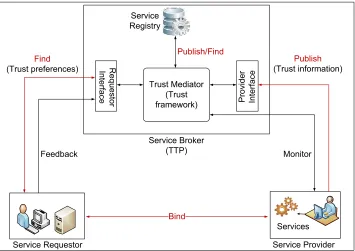
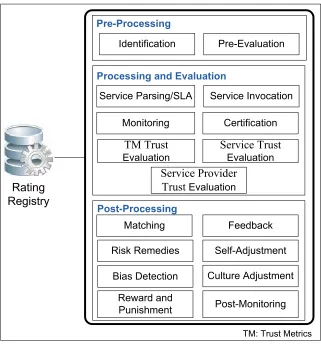
‘a trust-based SOA’, which supports the selection of services based on their trustworthiness. A trust mediator that is responsible to conduct the trust process, must be added to the trust-based SOA. Hence, it is important to build the trust mediator framework and identify its main components, which are founded on the trust definition and trust principles. The result is ‘a unified trust framework’ that contains the important components for building a concrete trust solution. Specifically, trust framework components perform different tasks that require different techniques.
Can the trust solution address different trust challenges? There are different trust chal-lenges that need to be considered when building a trust solution:
crucial stage in any trust relationship,trust bootstrappingis the first step in trust building process. Thus, a trust solution needs to address the bootstrapping challenge.
• Whitewash/Zero-cost identity or Changing identity: In order to receive better ratings, an entity will change its identity if there has been a significant loss of reputation [39, 18, 80, 81, 26]. Whitewashers are entities that leave and rejoin the system with a new identity in an attempt to eradicate the poor reputation they have gathered under their previous identity [85]. Hence, a trust solution should address whitewashing challenge.
• Cold Start: A cold start describes a situation in which there is a lack of initial ratings. Specifically, it occurs when a new entity registers in the system and has no rating record [84]. A trust solution that addresses trust bootstrapping should also address the cold start challenge.
This thesis contributes to the literature by addressing the previous questions. In particular, it aims to provide a roadmap that builds a concrete solution of trust for services and service providers and a trust-based system for service selection. Specifically, it establishes trust for services and service providers and supports service selection based on trust. First, it will build a
trust definition, identifytrust principles, considerrating service providers, extend SOA and build atrust-based SOAto support trust-based service selection by adding a new component, the trust mediator, and additional link interactions. Subsequently, this work will build thetrust mediator framework based on the trust definition and trust principles to identify its main components, identify thetrust metricsfor services and service providers, buildtrust models
1.2
Dissertation Outline
The rest of the dissertation is organized as follows:
• Chapter 2 presents the background on services, SOA, and trust. Section 2.1 presents the background on services, and Section 2.2 covers Service Oriented Architecture. Subse-quently, Section 2.3 provides trust-based service selection approaches, and Section 2.4 discusses trust aspects. Reputation computation engines are examined in Section 2.5, and commercial and live reputation systems are discussed in Section 2.6. Section 2.7 dis-cusses trust and security, and WS-Trust is presented in Section 2.8. Finally, Section 2.9 summarizes the chapter.
• Chapter 3 surveys the related work about trust. The chapter covers the trust definition in Section 3.1, trust information in Section 3.2, and trusting service providers in Section 3.3. Section 3.4 provides SOA extension, and Section 3.5 demonstrate community-based systems. Trust models are examined in Section 3.6, and trust bootstrapping is discussed in Section 3.7. Finally, Section 3.8 summarizes the chapter.
• Chapter 4 presents the proposed trust definition, trust principles, as well as the trust ar-chitecture and framework. Section 4.1 presents the trust definition and principles, while Section 4.2 introduces the trust-based SOA. Section 4.3 presents ToTEF, the trust media-tor framework, and Section 4.4 summarizes the chapter.
• Chapter 5 discusses the trust metrics; specifically, Section 5.1 presents the trust metrics, and Section 5.2 discusses the trust metrics publication approaches. Section 5.3 summa-rizes the chapter.
• Chapter 7 examines the trust models for services and service providers. Section 7.1 pro-vides the service trust model, and Section 7.2 presents the service provider trust model. The trust matching model is discussed in Section 7.3, and Section 7.4 summarizes the chapter.
• Chapter 8 presents empirical studies that include the implementation, experiment, and evaluation of the trust bootstrapping solution. Section 8.1 examines the trust-based SOA prototype, and Section 8.2 presents the implementation of the prototype. The experiment is presented in Section 8.3. Section 8.4 presents the evaluation. Section 8.5 summarizes the chapter.
Chapter 2
Background
“Trust yourself. You know more than you think you do.” Benjamin Spock
This chapter presents the background on services, SOA, and trust. Section 2.1 presents the background on services, and Section 2.2 covers Service Oriented Architecture. Subsequently, Section 2.3 provides trust-based service selection approaches, and Section 2.4 discusses trust aspects. Reputation computation engines are examined in Section 2.5, and commercial and live reputation systems are discussed in Section 2.6. Section 2.7 discusses trust and security, and WS-Trust is presented in Section 2.8. Finally, Section 2.9 summarizes the chapter.
2.1
Services
Services have many properties, as they are loosely-coupled, self-contained, platform-independent, dynamically discoverable, invokable, and composable [75]. Coupling refers to the extent of dependency between a consumer and a service. Hence, loosely coupled services have few de-pendencies, while tightly coupled services have more dependencies. A more tightly coupled system indicates that changes to one service will affect other services, and thus, the service is less flexible [82]. A self-contained service is one that maintains its own state independent of the application utilizing it. Furthermore, services are platform-independent, where requestors can invoke them using any hardware or software [75].
Services can be implemented using Web Service technology. Web Services are an emerging technology that enables applications running from different machines over the Web to integrate and exchange data regardless of their platform, hardware, operating system, and languages [74]. Moreover, Web Services are based on common standards, such as Extensible Markup Language (XML), and existing technologies, such as Hypertext Transfer Protocol (HTTP).
A Web Service is defined by the World Wide Web Consortium (W3C) as “a software ap-plication identified by a URI, whose interface and binding are capable of being defined, de-scribed and discovered by XML artefacts and supports direct interactions with other software applications using XML based messages via Internet-based protocols” [27]. Similarly, IBM defines a Web Service as “self-contained, self-described, dynamically discovered applications with Internet-based interfaces” [99]. Accordingly, a Web Service is a new breed of Web appli-cations, which is modular and can be published, located, and invoked across the Web. Once a Web Service is deployed, other applications can discover and invoke it. Web Services are loosely coupled, platform-neutral, reusable, and distributed software components [99]. Papa-zoglou [74] defines a Web Service as “a platform-independent, loosely coupled, self-contained, programmable Web-enabled application that can be described, published, discovered, coordi-nated, and configured using XML artefacts (open standards) for the purpose of developing dis-tributed interoperable applications”.
Transactions
WS-Security Coordination
Context WS-Reliability
Quality of service
UDDI
WSDL
SOAP
XML
HTTP, JMS, SMTP Orchestration – BPEL4WS
Choreography – CDL4WS Business processes
Discovery
Description
Transport Message
M
an
ag
em
en
t
Figure 2.1: Web Services Technology Stack [74].
among different parties [99]. Additionally, there are many other Web Services standards, as shown in Figure 2.1 [74].
SOAP is an XML-based standard messaging protocol, using HTTP as a means of transport and circumventing the firewalls. WSDL is the service representation language used to describe the interface of and access to Web Services. This description includes the operations and pa-rameters, location, and invocation protocol of the Web Services.
UDDI is a cross-industry directory standard for describing, publishing, and discovering of Web Services. This standard stores the Web Service interfaces described by WSDL, catego-rizes Web Service information, and allows searching the directory for Web Services. There are other alternatives to UDDI, such as electronic business XML (ebXML) and Directory Services Markup Language (DSML). Furthermore, Business Process Execution Language (BPEL) is an orchestration language for building a composition of Web Services [74].
(W3C) [48] describes the QoS requirements for Web Services as “the quality aspect of a Web Service”. Since QoS is an important factor in SOC paradigms, many approaches have been proposed to examine QoS compliance by monitoring or collecting quality ratings from the users. QoS has been used as a non-functional property for selecting services and for establishing trust for services [76, 58, 21, 95, 37, 41, 57, 46, 49, 58].
2.2
Service Oriented Architecture
Software architecture is “a description of a software system in terms of its major components, their relationships, and the information that passes among them” [82]. Traditional software architecture is focused on building software applications. However, SOA is focused on the construction of cross-organizational enterprise applications that are based on the interactions between consumers or business processes with needs and services or service providers with aptitude [82].
The Organization for the Advancement of Structured Information Standards (OASIS) de-fines SOA as “a paradigm for organizing and utilizing distributed capabilities that may be under the control of different ownership domains” [56]. More specifically, SOA is “a framework for integrating business processes and supporting IT infrastructure as secure, standardized com-ponents - sevices - that can be reused and combined to address changing business priorities” [11], and it is “an architectural style for building enterprise solutions based on services” [82], which may be implemented within a single organization. However, most large organizations build an enterprise application of composable services, which are disseminated across the In-ternet. Therefore, SOA is responsible for creating the environment necessary to build and use composable services across the enterprise [82].
Service Requestor
Services
Service Provider Find
Bind
Pu blish
Service Registry
Service Broker
Figure 2.2: Service Oriented Architecture.
because of their important features, especially their interoperability and self description inter-faces, as well as the fact that they base their development on existing ubiquitous infrastructures, such as HTTP and XML [75].
Four aspects are necessary for the successful development and deployment of a distributed SOA. Withservice enablement, each application is exposed as a service, whileservice orches-trationorchestrates services in specified processes. Furthermore,deploymenttransmits services and processes from testing to the production environment andmanagementensures that services are monitored and that the service invocation and selection is adjusted to meet the application goals.
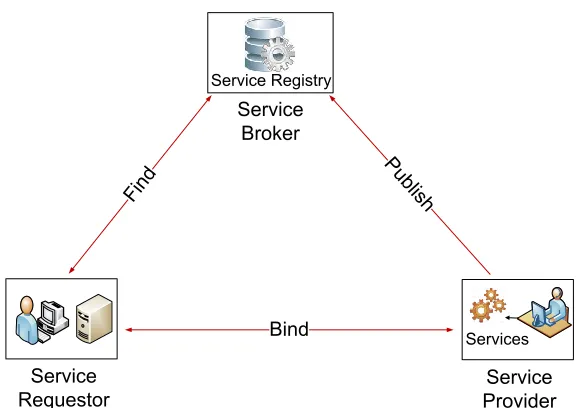
Moreover, there are three operations within SOA [74]: in the publish operation, service providers publish their services into the registry. This operation consists of two functions: describing the services in the WSDL file and registering the services by storing the service description in a categorized service registry for requestor access. Withfind operation, requestors search and find services from the service registry. It consists of two functions: discovering services and selecting the desired service from the result. Finally, inbind operation, requestors invoke services at run time using the technical information provided in the WSDL file to bind to the services. The invocation may occur directly between the requestors and services or it may occur through the service broker.
2.3
Trust-Based Service Selection Approaches
Figure 2.3 [21] presents the trust-based service selection approaches. In thedirect experience
approach, requestors build trust for services after utilizing them. However, since there is a need to trust services before executing them, theTrusted Third Party (TTP)approach enables consumers to consult a trusted third party for determining the trustworthiness of services. This approach relies on the underlying assumption that consumers trust the TTP they decided to consult. Specifically, there are two TTP approaches: social and matchmaking. In thesocial TTP
Direct Experience
Trusted Third
Party Hybrid
Trust Negotiation
Social (Indirect
Experience) Matchmaking SocioCognitive
Direct Experience and Reputation Trust and
Reputation
Referrals Recommendation
Reputation
Trust-Based Approaches for Online Service Selection
Figure 2.3: Approaches for Trust-Based Service Selection [21].
[38, 103] involves the combination of different approaches, aiming to improve the weaknesses of some approaches by combining with other approaches. The automated trust negotiation
approach [21] builds a mutual trust between service requestors and service providers. In this approach, trust is assessed in two directions: a requestor trusts a service and the service trusts the requestor. The trust negotiation approach depends on the disclosure of digital credentials between the two parties.
In order to predict the trustworthiness of entities, Massa and Avesani [55] distinguish be-tween two trust ratings: local and global ratings. Global ratings provide a unique trust ranking independently of the entity who performed the evaluation and define how the community as a whole trusts entities. In this system, an entity has a unique rating that is viewed by all other entities. In contrast, local ratings depend on the user performing the evaluation, and hence, it provides personalized ratings.
Figure 2.4: Reputation System Architecture [39].
user trustworthiness does not exist. Therefore, each user can build different trust rates for dif-ferent entities.
In reputation systems, requestors provide their feedback about services they have consumed. Figure 2.4 [39] presents a reputation system architecture that provides global ratings. In this system, entities evaluate each other and provide their feedback (ratings) to the reputation center, which acts as a TTP. The TTP gathers the feedback and computes the trust ratings for the entities. Subsequently, it stores the ratings and provides them globally. When an entity needs to interact with another entity, it consults the TTP about the entity’s trustworthiness. For example, Entity A, which wants to interact with Entity D for the first time, consults the TTP. The TTP then will return the global rating or reputation of D to A. Thus, A trusts D based on the opinions of other entities. Figure 2.5 presents an example of personalized local ratings [55]. In this figure, Entity B has two ratings from the perspective of Entities, A and D. A has rated B as 0.9, and D has rated B as 0.3.
2.4
Trust Aspects
Figure 2.5: Trust Network.
Trust development phases
Trust is a dynamic concept that can be divided into three development phases [42]: trust build-ing, trust stabilizing , and trust dissolution.
1. Trust building: In the trust building phase, trust is formed and initial trust formation is important. For example, an entity may build trust based on cognition rather than personal interactions. In cognition-based trust, the trustor relies on first impressions, such as ven-dor size, privacy, security, and convenience use of Web site. In this first development stage, online trust can also be based on rational calculation of possible costs and benefits, which is known as calculus-based trust.
2. Trust stabilizing : Trust stabilizing is where trust already exists. Since trust evolves over time, it is based on the interactions and observations between parties. In this phase, trust is based on the trustors’ knowledge of trustees from past interactions, which is known as knowledge or experience-based trust. In identification-based trust, which represents a highest level of trust, trust is formed by joined values, tasks, and goals by creating a collective identity, such as a common team name.
Properties of trust relationship
There are a number of trust relationship properties [94, 33]. First of all, trustcan be transitive; for example, if Alice trusts Bob, and Bob trusts Sam, then Alice can trust Sam. Furthermore, trust is not symmetric; for instance, even if Alice trusts Sam, this does not necessarily mean that Sam trusts Alice. Trust iscontext-specific; for example, someone may trust a person based on a specific context, such as in his/her role as a doctor, but not in another context, as a chef. Similarly, trust isnot absolute, as a trustor trusts a trustee with respect to its ability to perform a specific action within a specific context; and it ismulti-faceted, since differentiated trusts need to be developed for different aspects or properties of an entity. For example, a service may have different QoS properties, such as response time and scalability, and trust should be built for each QoS property. Hence, the overall trust depends on the combination of trusts for each property. Trust isdynamic; as it may decrease, increase, become less important or irrelevant, or decay with time. Trust relations can be one, between a trustor and a trustee, one-to-many, between a trustor and a group of entities, many-to-one, such as between the members of a department and the manager, and many-to-many, such as the mutual trust between members of a group [33].
Principles of trust online
Daignault et al. [18] identified ten principles surrounding trust online:
1. Trust depends on identity: The history or past experience of interactions are built and mapped to an identity. Identities allow a party’s rating from the past to be associated with the party in the future [39]. While in the offline world, identities can be established by visual recognition or identification, in the online world, an identity may be established by using authentication and token [43].
3. Trust is the function of perception of risk: Trust and risk are related, since “risk is the core of trust in that trust is the degree to which a trustor holds a positive attitude toward the trustee’s goodwill and reliability in a risky exchange situation” [18]. However, trust is not only about experiences with others, but it is also about the expectation of a trustee’s behaviour in risky circumstances and the extent of their commitment to the rules.
4. Trust deepens over time and with increased reciprocity: “Trust is earned by meeting pectations” [18]. For example, as a consumer makes more transactions and has more ex-periences with the market, which has acted upon their obligation, their confidence grows with time and they will have high market expectations in the future. Even when the market initially pays a high cost for acquiring customers, the market will receive the customer’s trust in subsequent years.
5. Trust is a matter of degree: Trust varies among individuals, organizations, and situations. For example, a customer may trust an organization more or less than its products. Thus, customers have to specify the degree level of trust information for different entities.
6. Culture affects trust: The Web is an open system that spans different countries, regula-tions, and cultures, which impact the trust-building process. For example, people from different cultures may respond differently to risk. Furthermore, the importance of trust information varies, as individuals in different cultures trust entities differently.
7. Third-party ratings are important in developing trust: An expert opinion from an au-thorized trusted third party, or TTP, is important. TTPs help users to obtain ratings of different entities without the user having direct experience with that entity.
8. Second-party opinions are important in developing trust: Trust feedback from some par-ties, such as friends can enhance trust between two entities.
10. Formal and social controls are important in developing trust: Formal controls employ rules to specify behaviours and penalties. On the other hand, social controls use organi-zational and cultural rules to encourage the desired behaviour.
Trust classes
Different classes of trust can be distinguished in the literature relating to Internet services [39, 33]. Provision trust is where users trust entities and seek protection from malicious entities. Furthermore, resource access trust describes trust as a principle for accessing resources, and
delegation trust is where agents delegate or act on behalf of users. Identity trust describes the belief that an entity’s identity is as claimed, and context trust describes trust in the presence of a system that has the ability to support transactions and perform remedies. Finally, the
certification of trustee is based on a third party’s certification of an entity’s trustworthiness, where trust is founded on a criteria relating to a set of certificates, such as the Pretty Good Privacy (PGP) [6], VeriSign [5], and others [31] that are presented by the trustee to the trustor. For example, trustors may trust VeriSign to certify programs that can run on their machine.
Categories of trust semantics
Semantic characteristics of trust ratings are important for participants to interpret those mea-sures [39]. Trust semantics can be described in terms of the“specificity-generality” dimension and the “subjectivity-objectivity” dimension. Aspecificmeasure is based on one characteristic, while a general measure represents the average of all characteristics. Furthermore, a subjec-tivemeasure is based on judgement, while anobjectivemeasure is determined by assessing the entity against formal criteria, such as calculation. In total, there are four categories of trust semantics:
2. Subjective and general: Based on the average of all characteristics of an entity. For example, users of eBay’s reputation system rate their transactions and products providing an aggregate ratings.
3. Objective and specific: Based on the objective measure of a specific characteristic. For example, a product is tested according to energy consumption or noise and a company is tested according to earnings or profits.
4. Objective and general: Based on a set of characteristics and the derivation of an overall score. For example, the rating of a product is the average of all the product characteristic rates.
2.5
Reputation Computation Methods
It is necessary to assign a level of trust or trust rating for an entity, especially since some entities are trusted more than others. Trust values can be discrete or continuous [33]. Grandison and Sloman [33] mentioned that “it is not clear whether this level should be discrete or continu-ous. If discrete values are used, then a qualitative label such as high, medium or low may be sufficient. Some systems support arithmetic operations on trust recommendations so numeric quantification is more appropriate”.
There are many trust and reputation computation methods for deriving scores. This section describes various principles for computing trust and reputation measures [39].
2. Bayesian systems [66, 67]: The system computes scores by statistical updates of beta probability density functions (PDF). More specifically, it takes a binary input positive or negative, and computes reputation based on the previous ratings and new ratings. The result is represented as (∝, β), the amount of positive and negative, respectively, and the probability value of beta PDF. This method is complex and difficult for the average person to understand [39].
3. Discrete trust models [53]: Humans are often able to rate more successfully in discrete verbal measures than in continuous measures. For example, an entity’s trustworthiness can be in the high, medium, or low range.
4. Fuzzy models [53, 87]: Trust and reputation systems can be represented as fuzzy con-cepts; measuring the degree to which the entity can be trustworthy [39].
5. Flow models: In this model, systems evaluate entities’ rates by iterative looping or long chains. For example, in Google’s pageRank [73], any hyperlink to a Web page increases its pageRank, and any hyperlink from a Web page decreases its pageRank.
A good reputation computation or scoring system should be understandable, as users should understand what each score implies. The scores could be as simple as the sum of the rating, or they can involve more complicated functions, applying optimization techniques and using a neural network. However, complex rating systems will be difficult for the user to understand the implications of the score. [20]
2.6
Commercial and Live Reputation Systems
This section describes some popular applications of online reputation systems. All of the sys-tems are centralized syssys-tems, and most of them use simple summation or average rating com-putation methods, while some systems use flow models [39, 80].
system: positive, neutral, and negative, or 1, 0, and -1, respectively. To avoid repetitions in rating entities, eBay allows rating only after the transaction is completed. The observed ratings on eBay are mostly positive, accounting for 99% of ratings [39]. Also, eBay uses global trust ratings [55].
• Expert sites: There are a number of experts on different expert sites, including AllExperts, Advogato, and AskMe who answer questions in their area of expertise. Individuals who ask questions rate the experts based on the quality of the replies, which include metrics such as timeliness, politeness, knowledgeability, and clarity. For example, in the Allex-pert reputation system, an individual rates the exAllex-perts and provides ratings in the interval [1,10], and most experts receive a rating close to 10. On each site, the final score is the average of all received ratings.
• Product review sites: Reviewers provide information to assist consumers in making better purchase decisions. These reputation systems rate products and reviewers. For instance, Epinions is a review site established in 1999. It rates products, shops, reviews and re-viewers, each with different metrics ranging from 1 to 5. In Epinions’ Web of Trust, members can choose to trust or block other members. Epinions has a sophisticated repu-tation system because of its incentive mechanism based on revenue, where reviewers can earn money by helping customers to make or avoid certain purchase decisions. Also, there is a hierarchy of reviewers, which are Advisor, Top Reviewer, and Category Lead, where Category Leads will normally generate more revenue than Advisors and Top Reviewers.
• Amazon: An online store that allows members to rate products, such as books, and com-panies from 1 to 5. The total rating of a product or company is the average of its total ratings. Both members and non-members can vote on reviews, and Amazon rates the reviewers as top 1000, top 500, top 100, top 50, top 10, or #1 reviewer, which is the best reviewer. Amazon does not provide revenue incentives; however, other external sources, such as book publishers, pay people to review their goods.
the page rank represents how many other pages are linked to it. The reputation of any page increases or decreases depending on the number of links referring to it or its referral to other pages. A single link to a page represents a positive rating of that page [39], so that pages are popular based on the number of links they are referenced. A page that is referenced from a popular page is given a lot of weight [20].
The main weakness of such systems is their vulnerability and unreliability. Anybody can sign up to become a member and vote on different products or reviewers. Some examples of dishonest ratings occur when members write many positive reviews to provide a high score or negatively rate products or reviewers to provide low ratings. Therefore, reputation systems should be vigilant and respond to any abuses that emerge from the system.
2.7
Trust and Security
In general, security mechanisms provide protection against malicious parties. However, such mechanisms are unable to protect against providers that act deceitfully, in which trust and repu-tation can provide protection against such threats. Accordingly, security can be subdivided into
hard security and soft security [21]. Hard security involves traditional security mechanisms, such as encryption, authentication, authorization, confidentiality, and integrity [24], while soft security involves social control mechanisms, of which trust and reputation systems are exam-ples [21]. Certification authorities (CA) and identity management systems assure the identity of an entity and provide ‘identity trust’ [39]. CAs are described as trust provider or identity trust systems [39]. However, users are also interested in provision trust, knowing the reliability of authenticated parties, and the quality of services they provide. Only trust and reputation sys-tems are useful tools for deriving provision trust [39]. Therefore, soft security mechanisms are required to derive trust.
WS-Policy
WS-Security
SOAP foundation
WS-Trust WS-Privacy
WS-Secure
Conversation WS-Federation WS-Authorization
Figure 2.6: WS-Security Standards BuilT on SOAP [1].
built on XML Signature, XML Encryption and other security standards. The other standards, such as WS-Policy, WS-Trust, and WS-Privacy rely on WS-Security.
Although Web Services security technologies, such as secure socket layer, WS-Security, WS-Trust, and cryptography, increase the security in the Web Services environment, they cannot determine entities with hidden motives or other trust issues, such as detecting unfair ratings, determining the level of trustworthiness of entities, rewarding positive behaviour, punishing malicious behaviour, and reputation bias [38, 86].
security ‘levels of trust’, which include two security requirements: features and assurances. The features requirement safeguards protected information and includes access control, authentica-tion, user identificaauthentica-tion, and auditing. Alternatively, the assurance requirement determines the quality of a trusted system and includes architecture, verification, testing, and documentation requirements.
2.8
WS-Trust
WS-Trust [43] is an OASIS standard, that represents an extension built on to the WS-Security standard. Specifically, WS-Trust uses WS-Security mechanisms for providing secure messaging and adding extensions for security token exchange within different trust domains. Although different parties can secure the exchange of messages using credentials, they need to trust the asserted credentials. WS-Trust provides a framework for requesting, issuing, renewing, and validating security tokens as well as brokering trust relationships.
The WS-Trust specification document includes a list of the following terminologies:
• Claim: Statements made about clients, services, or other resources, such as name, identity, key, group, and privilege.
• Security Token (ST): Represents a collection of claims.
• Trust Engine: A conceptual component of a Web Service that evaluates the security re-lated feature of the message.
• Security Token Service (STS): A service that issues security tokens.
• Direct Trust: When the service accepts all or some of the claims in the token sent by the requestor.
Figure 2.7: WS-Trust Model [43].
Service should accept the claims in the ST to establish trust connection with the requestor. If the message comes without proof of claims, the message will be ignored or rejected by the Web Service. STS is a Web Service, and a requestor may also be a Web Service. Thus, STSs and requestors may require STs and express policies.
token. A requestor needs, simply, to obtain the trust ratings of different entities and to select among these entities.
2.9
Summary
Chapter 3
Related Work
“You may be deceived if you trust too much, but you will live in torment if you don’t trust enough.” Frank Crane
There is a number of review papers and studies on trust and reputation systems [33, 39] and trust-based Web Services selection [94, 21]. Researchers study different approaches for building reputation, rating entities, and receiving feedback in different trust systems, such as the reputation and recommendation systems in centralized and decentralized architectures. This chapter will present literature related to this thesis. Specifically, Section 3.1 will present trust definition, and Section 3.2 will provide trust information. Section 3.3 discussing trust for service providers, and Section 3.4 examines SOA extension. A community-based system is presented in Section 3.5, and trust models are examined in Section 3.6. Finally, Section 3.7 discusses trust bootstrapping and Section 3.8 summarizes the chapter.
3.1
Trust Definition in the Literature
trust definitions in the offline and online worlds. Our approach in defining trust is to explore the trust literature for extracting the important components of a trust definition.
Trust Definitions in the Offline World
The English dictionary defines trust asreliability, reliance on integrity, confident expectations, obligations or responsibilities imposed on someone/something in whom confidence or author-ity is placed, a fiduciary relationship, being left in guardianship of another, belief, reliance, dependence, certainty, faith, no fear of consequences, commitment, and hope [2, 3]. Further-more,companionship,friendship,love, agreement, relaxation, andcomfortare some emotions associated with trust [19].
According to David [19], “trust is both an emotional and logical act. Emotionally, it is where you expose your vulnerabilities to people, but believe they will not take advantage of your openness. Logically, it is where you have assessed the probabilities of gain and loss, calculating expected utility based on hard performance data, and concluded that the person in question will behave in a predictable manner” [19]. People trust others because they have experienced their trustworthiness and because they have faith in human nature [19]. Honesty is truthfulness, and an honest entity does not lie or cheat [2].
Trust Definitions in the Online World
attitude of confident expectation in an online situation of risk that one’s vulnerabilities will not be exploited”. The authors include some key concepts in their definition, which are risk,
vulnerability, expectation, confidence, andexploitation. Alternatively, Chang et al. [15] define trust as “the belief that the Trusting Agent has in the Trusted Agent’s willingness and capability to deliver a quality of service in a given context and in a given Timeslot”. This definition implies thecontext-specificproperty of trust.
Buttyan and Hubaux maintain that “trust is about the ability to predict the behaviour of an-other party” [13]. Grandison and Sloman [33] define trust as “the firm belief in the competence of an entity to act dependably, securely, and reliably within the specified context”. In contrast, these authors define distrust as “the lack of firm belief in the competence of an entity to act dependably, securely and reliably within a specified context”. These definitions imply that trust is a composition of multiple attributes, such as reliability, honesty, dependability, security, time-liness, and competence, all of which must be considered in different environments where trust will be established.
There are two common definitions of trust in the literature: reliability trust and decision trust. Reliability trust [29] involves a context where A relies on and expects B to perform a given action on which A’s welfare depends. This definition includes the concepts ofdependency
andreliability. On the other hand, decision trust [62] is “the extent to which one party is willing to depend on something or somebody in a given situation with a feeling of relative security, even though negative consequences are possible”. This definition implies thecontext-specific
property of trust and includes the concepts ofdependency, reliability, utility,risk attitude,law enforcement,insurance and other remedies.
as information to establish trust, trust is not a QoS. Maximilian and Singh [58] distinguish be-tween trust and QoS and maintain that the selection of Web Services is based on non-functional attributes, such as QoS and trust.
Often, trust is used synonymously with terms such as cooperation, faith, competence, re-liance and credibility. However, cooperation is either a cause or a manifestation of trust, and trust includes reason, which is the opposite offaith. Moreover, trust goes beyond the belief in thecompetenceof the trusted party. Trust in information means that the information iscredible
or believable [17]. Also, it is possible to rely on a person without trusting him/her [17, 12]. Mayer et al. [61] add confidence and predictability as terms that are considered synonymous with trust. However, with trust, risk is assumed, but withconfidenceit is not.
3.2
Trust Information
In the literature, there is no clear identification of trust information for services. Zhengping et al. [103] define domain-specific trust information. Their work monitors the behaviour of Web Services for bugs during operation, which will decrease the degree of trust placed in the Web Services. The authors identified some properties of services to establish their trust, such as services’ functions and the run-time environment. Furthermore, they suggested properties for recommenders that recommends services, such as popularity and authenticity of the description. The system analyst defines the domain characteristics.
Kim and Doh [46] propose the selection of an optimal path for composing a number of Web Services based on QoS information and trust type. The trust type is the computed trust level based on aggregated ratings from the service consumer, thus indicating on estimation of the service provider’s reliability. The authors assume that trust type is associated with each service, where the assignment of trust types is performed by the clients themselves or by a trust authority. Thus, trust information is not specified and trust is based on an assumed trust type.
of trust is a key QoS aspect of Web Service selection. The author uses security features of services to establish trust that satisfy the provider’s trust security requirements. Ying-Feng and Pei-Ji [95] specify trust or reputation as a QoS of Web Services. Similarly, Kalepu et al. [41] identify a new QoS attribute,verity, as an important contributor to the quality-driven selection and composition of Web Services, and they consider verity as a measure of trustworthiness for Web Services. Specifically, verity refers to the degree of variance in the compliance levels of the services and assesses the reputation of the provider based on local and global ratings. These authors identify verity for Web Services and for Web Service providers. Trust, however, has a different meaning than QoS.
Maximilien and Singh [57] model reputation as a vector of QoS attributes such as perfor-mance and reliability. Jin-Dian et al. [38] measure the possibilities of malicious behaviour and satisfaction values that measure how satisfied a user feels about a given interaction. Both measures are real numbers in the interval [0,1], where a high rate reflects a high interaction quality. Trust evaluation can include different QoS requirements, such as process time and ac-cess speed. Vu et al. [90] rank services according to their prospective level of satisfying users’ QoS requirements. However, the development of trust should consider other properties besides QoS.
Some researchers attempt to distinguish between trust and QoS and consider or use QoS as trust information [58, 94]. Wang and Vassileva [94] state the importance of defining information required for a trust and reputation mechanism. Specifically, they stated the use of QoS to build trust where trust and reputation are built for each quality property of a service and where the overall trust and reputation depend on the combination of trust and reputation for each property. Maximilian and Singh [58] distinguish between trust and QoS, and present the selection of Web Services on the basis of non-functional attributes, such as QoS and trust.
Quality of Service
There are many research efforts to define and categorize QoS as well as attempts to express, quantify, and model QoSs [48, 46, 78, 98, 83]. In [48, 41, 94, 78, 70, 65, 30, 77, 63, 34], in-cluding generic and business QoS requirements for services. Garcia and de Toledo [30] define a set of major Web Service QoS attributes. Menasce [63] examines QoS issues in Web Ser-vices, and Yu et al. [98] provide a list of QoS parameters and explain how to evaluate each. Although security is not a quantifiable QoS, these authors present a formula to test the security of Web Services based on the number of attack detections. Based on the most common QoS re-quirements in the literature, Rahman and Meziane [77] present five essential QoS rere-quirements: readiness, transaction, reliability, speed, and security.
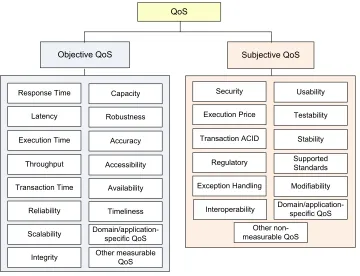
To identify a generic QoS, the QoS of services from the literature [48, 77, 78, 98, 46, 30, 70, 74, 24, 34, 63, 46, 20] are aggregated, including latency or network latency, execution time, response time, transaction time, reliability, scalability, capacity, robustness, exception handling, accuracy, integrity, accessibility, availability, interoperability, execution price, regulatory, time-liness, security, and transaction, which refers to ACID property: Atomicity, Consistency, Iso-lation, and Durability. Security includes: authentication, authorization, confidentiality, non-repudiation, accountability, traceability and auditability, data encryption, access control, and prevention of the Denial-of-Service attack (DoS). Table 3.1 presents the description of some QoS parameters that are used in this work.
Table 3.1: QoS Parameters and Descriptions.
QoS parameters Descriptions References
Latency or Net-work Latency
“The time the SOAP message needs to reach its destination”.
[83]
Execution Time The time taken by the service to execute and process its sequence of activities.
[48]
Response Time The time required to process and complete a service request; the response time includes the execution time and the latency.
[48, 77, 30, 70, 63, 78, 98, 46] Throughput The number of requests a service can process
per unit of time.
[48, 30, 70, 63, 78] Security Offers mechanisms of authentication,
autho-rization, confidentiality, non-repudiation, ac-countability, traceability, and auditability.
[48, 78, 34, 74, 20]
Hoyle [34] identifies other quality characteristics for services, such as courtesy, comfort, competence, credibility, dependability, efficiency, effectiveness, flexibility, honesty, prompt-ness, and responsiveness. Specifically, the author argues that people are either competent or incompetent without any varying degrees of competency. Individuals are competent if they have the ability to produce the desired results when required and demonstrate performance that meets all required standards. Competence, which can be assessed under close supervision, is “the ability to demonstrate the skills, behaviours, attributes, and qualifications to the level re-quired for the job” and “a quality of individuals, groups, and organizations” [34]. “A competent entity is capable of performing the functions expected of it or services it is meant to provide correctly and within reasonable time scale” [88].
competence is one of many cognitive cues for trust, and similarly, Mayer et al. [61] present competence and honesty as trust factors for trustees. “An honest entity is truthful and does not deceive or commit fraud” [88].
Some research work [51, 40, 64] evaluate honesty of raters through long-term interaction. Specifically, Malik and Bouguettaya [51] evaluate the credibility of raters in a reputation-based framework based on the evaluation of their honestly over time. This framework aims to protect the reputation system from malicious raters and to fairly assess the providers’ reputations.
Larson [47] identifies serviceability and user satisfaction as performance measurements for service delivery, and Moorsel [65] discusses quantitative metrics and develops a framework for evaluating Internet services. This author defines three metrics that should be emerged to evaluate Business to Consumer (B2C), Business to Business (B2B), and service providers. The metrics include QoS, Quality of Experience (QoE), and Quality of Business (QoBiz). While QoE quantifies the user experience, QoBiz measures the business return.
3.3
Trusting Service Providers
In Web Services and SOA, the idea of building trust and reputation for service providers is neglected [94]. Jin-Dian et al. [38] present the idea of assigning provider trust rates to Web Services. Specifically, they mention that assigning trust rates for providers is an interesting research problem. Consequently, they suggest a registry to use past experiences with the Web Service’s provider for initializing the rate of the new Web Services as equal to its provider’s rate.
Maximilien and Singh [58] mention that if a service provider has been determined as trust-worthy, then requestors will select a service from a provider that has the the highest trust level. The authors state that determining trust levels for providers is non-trivial, especially in an open environment. In particular, Maximilien and Singh [57] assess the trustworthiness of a Web Service provider by measuring its reputation on the basis of rates given by users.
service provider trust information, which occurs in the Internet literature. The Internet literature has identified quality requirements for providers to enhance their trustworthiness and help users in their decision to use providers’ services [42, 61]. Based on a trustee’s attributes, Kautonen and Karjaluoto [42] have distinguished between two dimensions of online trust: a hard dimen-sion and a soft dimendimen-sion. The hard dimendimen-sion contains a functionality-based nature, such as competence, ability, and predictability. Alternatively, the soft dimension includes characteris-tics, such as honesty, integrity, and credibility. Based on these dimensions, providers can pro-vide important clues for trustors to assess their trustworthiness. For example, some merchants provide contact information, retail location, online contact on their Web site. In addition, the trustee can provide quality information on important issues such as order progress and delivery charges as well as policies on privacy, returns, and remedies. Mayer et al. [61] present a review of the proposed factors that lead to trust, such as availability, competence, consistency, integrity, loyalty, benevolence, honesty, group goals, openness, caring, goodwill, and promise. In partic-ular, they examine three characteristics of a trustee that appear frequently: ability, benevolence, and integrity.
3.4
SOA Extension
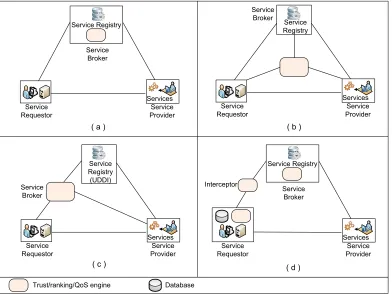
This section will discuss the literature on extending the basic architecture of SOA based on QoS and trust. There are variations on the way in which SOA is extended to support trust. In addi-tion, the three roles of SOA, requestor, service provider, and registry, and the new components addressing ranking or trust, such as service evaluation center and rating registry, are connected in different ways.
![Figure 2.1: Web Services Technology Stack [74].](https://thumb-us.123doks.com/thumbv2/123dok_us/7755213.1271851/28.612.154.441.103.311/figure-web-services-technology-stack.webp)