Available Online atwww.ijcsmc.com
International Journal of Computer Science and Mobile Computing
A Monthly Journal of Computer Science and Information Technology
ISSN 2320–088X
IMPACT FACTOR: 6.017
IJCSMC, Vol. 6, Issue. 4, April 2017, pg.142 – 150
Effective and Secure Method of
Color Image Steganography
Omar M. Albarbarawi
Albalqa Applied University, Faculty of Engineering Technology, Jordan-Amman
Abstract: An efficient and secure method of hiding secret message-extracting embedded message into/from a color image will be proposed. The proposed method will be tested, implemented and analyzed. Different secrete messages with different length will be selected and embedded into color images with different sizes. Efficient, quality, and security issues will be done to prove the advantages of the proposed method.
Keywords: Efficiency, quality, security, MSE, PSNR.
1-
Introduction
RGB color image is a three dimensional matrix [1], [2]; the first dimension is for the red components, the second for the green components, while the third is for the blue component.RGB color image usually has a huge size, so it is convenient to use this image to hold a secrete message, and this process is called image steganography [3], [4], [5].
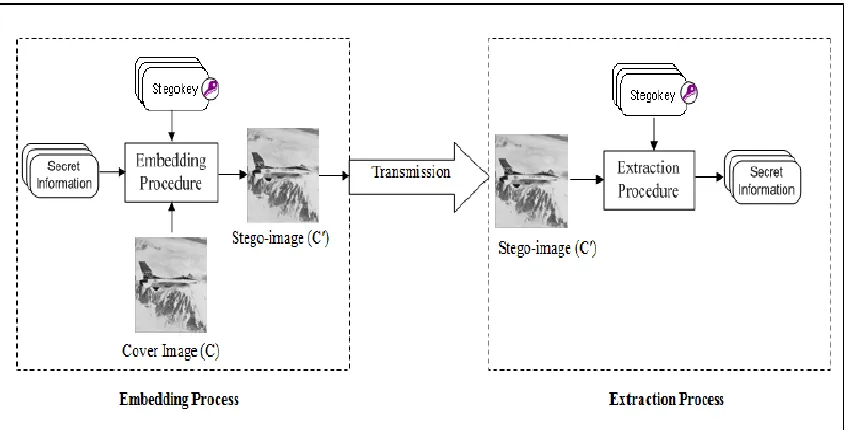
The process of image steganography as shown in figure 1 can be implemented in 2 phases [6], [7], [8]:
Phase 1:
Embedding the secret message based on the private key used to insert the message in the covering image.
Phase 2:
Extracting secret message from the holding image based on the private key.
For comparative analysis of steganography techniques some parameters are used such as MSE, PSNR, embedding time needed to hide a massage in color image, and extracting time needed to extract the message from the covering color image.
PSNR- Peak signal to noise ratio is calculated usually in logarithmic (dB) (equation 1)scale is a metric use to measure the quality of any image reconstructed, restored or corrupted image with respect to its reference or ground truth image. It is a full reference image quality measure defined as the maximum value of maximum signal power with respect to MSE (Mean square error) assumed as noise power. Similarly MSE can be calculated (equation 2) as the square difference between reference image and reconstructed image. Thus a higher value of PSNR indicates that the image is of higher quality and vice-versa. A 20 dB or higher PSNR indicates that the image is of good quality [3], [9].
The PSNR value approaches infinity as the MSE approaches zero; this shows that a higher PSNR value provides a higher image quality. At the other end of the scale, a small value of the PSNR implies high numerical differences between images.
All LSB methods of hiding message in color image are simple but they are not highly secure and they need an extra work to add an encryption tool to increase the security of hidden information, thus the proposed method can be used to hide short messages within a color image taking in consideration achieving best performance by providing a high secure of message hiding and extracting within a minimum time of processing.
2-
The Proposed Method
Many methods [9],[10],[11] were proposed for secrete message hiding, mostly they are based on least significant bit (LSB) method , all these methods of hiding message in color image are simple but they are not highly secure and they need an extra work to add an encryption tool to increase the security of hidden information, thus the proposed method can be used to hide short messages within a color image taking in consideration achieving best performance by providing a high secure of message hiding and extracting within a minimum time of processing.
The proposed method here came to increase the security level, minimize the embedding and extracting time keeping the level of holding image quality closed to that one obtained by any other method.
The proposed method can be implemented applying the following steps:
Phase 1: Embedding secrete message:
This phase can be implemented by executing the following sequence of operations: 1. Get the covering color image.
2. Get the size of each of the three color components (n1: number of rows; n2: number of columns). 3. Get the secrete message.
4. Get the length of the secrete message (n4). 5. Divide the message into three sub-messages.
6. Generate 3 random private keys: Red, green and blue keys, each key will contain the position in color component where to hide a character from the sub-message.
These keys can be implemented applying the following formulas: Kxred=floor (rand (1, ceil (n4/3))*n1); Kyred=floor (rand (1, ceil (n4/3))*n2); Kxgreen=floor (rand (1, ceil (n4/3))*n1);
Kygreen=floor (rand (1, ceil (n4/3))*n2); Kxblue=floor (rand (1, ceil (n4/3))*n1); Kyblue=floor (rand (1, ceil (n4/3))*n2); 7. Save the keys.
Phase 2: Extracting secrete message
This phase can be implemented applying the following sequence of operations: 1. Get the holding color image.
2. Separate the image into three components. 3. Get the private key.
4. Use the private keys to extract the sub-messages from each component. 5. Construct the secret messages from the three sub-messages.
3-
Experimental Results and Analysis
3-1 Quality Analysis
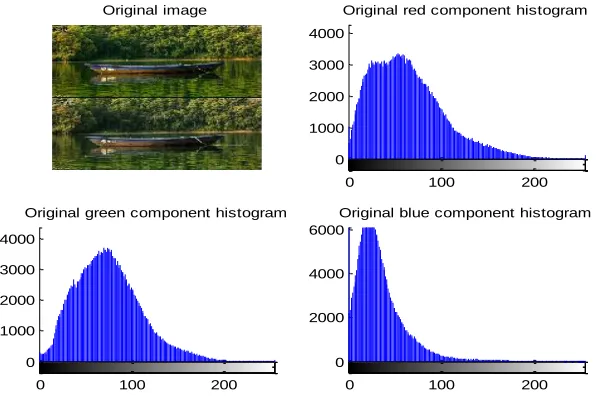
The proposed method was implemented several times using various length messages and various size color images and the experimental results showed that it is very difficult to distinguish the difference between them using the human eye this is show in figures 2 to 5:
Covering image before embedding message
0 100 200 0
1000 2000 3000
Red histogram
0 100 200 0
1000 2000 3000
Green histogram
0 100 200 0
1000 2000 3000
Blue histogram
Figure 2: Original image (png with size 384x512x3)
Covering image after embedding message
0 100 200 0
1000 2000 3000
Red histogram
0 100 200 0
1000 2000 3000
Green histogram
0 100 200 0
1000 2000 3000
Blue histogram
Original image
0 100 200 0
1000 2000 3000 4000
Original red component histogram
0 100 200 0
1000 2000 3000 4000
Original green component histogram
0 100 200 0
2000 4000 6000
Original blue component histogram
Figure 4: Original image (jpg with size 516x600x3)
Holding image
0 100 200
0 1000 2000 3000 4000
Holding red component histogram
0 100 200
0 1000 2000 3000 4000
Holding green component histogram
0 100 200
0 2000 4000 6000
Holding blue component histogram
Figure 5: Holding image (message length=42)
Table 1: Calculated parameters using Png image with size=384x512x3
Message length Embedding time(second)
Extraction time(second)
MSE PSNR
10 0.000001 0.000001 0.0445 141.9392
20 0.000001 0.000001 0.1968 127.0797
30 0.000001 0.000001 0.2043 126.7078
40 0.000001 0.000001 0.2817 123.4927
50 0.000001 0.000001 0.4798 118.1682
60 0.000001 0.000001 0.5273 117.2244
70 0.000001 0.000001 0.5633 116.5651
80 0.000001 0.000001 0.6338 115.3851
90 0.000001 0.000001 0.6842 114.6209
100 0.000001 0.000001 0.8576 112.3610
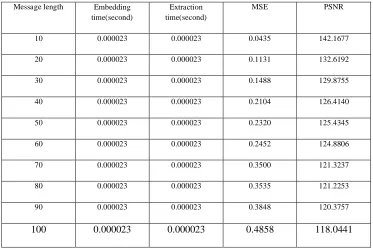
Table 2: Calculated parameters using jpg image with size=516x600x3
Message length Embedding time(second)
Extraction time(second)
MSE PSNR
10 0.000023 0.000023 0.0435 142.1677
20 0.000023 0.000023 0.1131 132.6192
30 0.000023 0.000023 0.1488 129.8755
40 0.000023 0.000023 0.2104 126.4140
50 0.000023 0.000023 0.2320 125.4345
60 0.000023 0.000023 0.2452 124.8806
70 0.000023 0.000023 0.3500 121.3237
80 0.000023 0.000023 0.3535 121.2253
90 0.000023 0.000023 0.3848 120.3757
100 0.000023 0.000023 0.4858 118.0441
10 20 30 40 50 60 70 80 90 100 110
115 120 125 130 135 140 145
PSNR
Message length
P
S
N
R
Figure 6: Relationship between PSNR and message length
10 20 30 40 50 60 70 80 90 100
0 0.1 0.2 0.3 0.4 0.5 0.6 0.7 0.8 0.9
MSE
Message length
M
S
E
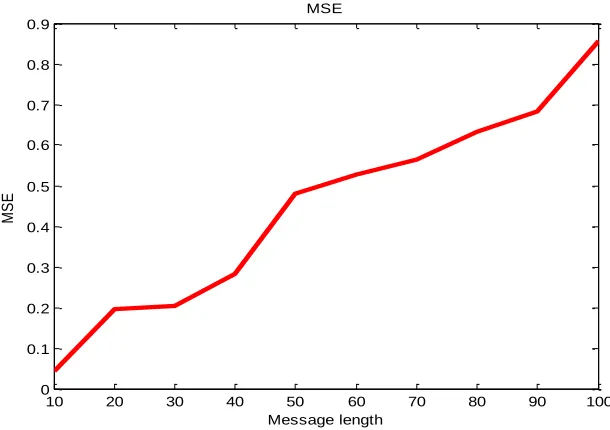
Figure 7: Relationship between MSE and message length
3-2 Security Analysis
Table 3: Private Key of message hiding
Color image component
First character Second character Third character Fourth character
Red positions (151, 259) (115, 379) (282, 357) (445, 201)
Green positions (367, 264) (170, 161) (214, 340) (98, 74)
Blue positions (448, 509) (318, 589) (59, 372) (313, 332)
3-3 Performance Analysis
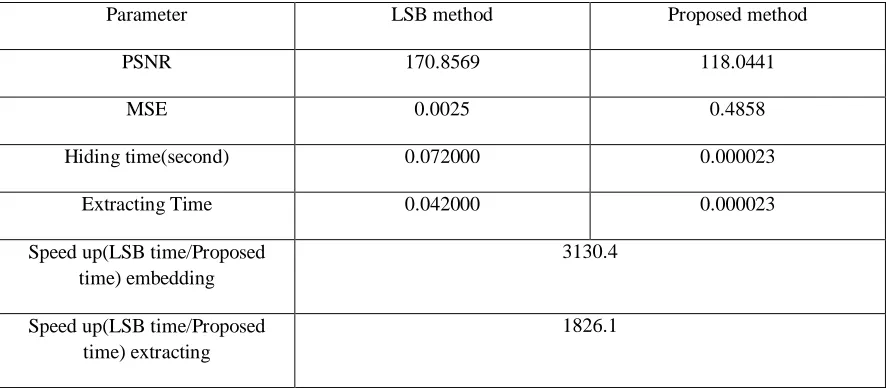
Table 1 and 2 show the times needed to hide and to extract secrete message these times are very small comparing with LSB method of data hiding, table 4 shows a comparisons between the proposed method results and LSB method results:
Table 4: Results comparisons
Parameter LSB method Proposed method
PSNR 170.8569 118.0441
MSE 0.0025 0.4858
Hiding time(second) 0.072000 0.000023
Extracting Time 0.042000 0.000023
Speed up(LSB time/Proposed time) embedding
3130.4
Speed up(LSB time/Proposed time) extracting
1826.1
Conclusions
References
[1]. Jihad Nadir, Ziad Alqadi and Ashraf Abu Ein, Classification of Matrix Multiplication Methods Used to Encrypt-decrypt Color Image, International Journal of Computer and Information Technology (ISSN: 2279 – 0764) Volume 05 – Issue 05, September 2016.
[2]. Majed O. Al-Dwairi, Ziad A. Alqadi, Amjad A. AbuJazar and Rushdi Abu Zneit, Optimized True-Color Image Processing, World Applied Sciences Journal 8 (10): 1175-1182, 2010 ISSN 1818-4952. [3]. Prof. Ziad A.A. Alqadi, Prof. Mohammed K. Abu Zalata, Ghazi M. Qaryouti, Comparative Analysis of Color Image Steganography, IJCSMC, Vol. 5, Issue. 11, November 2016, pg.37 – 43.
[4]. Bruice Schneier, Applied Cryptography Protocols, Algorithm and Source Code in C. Second edition. Wiley India edition 2007.
[5]. Yuan-Hui Yu , Chin-Chen Chang, Iuon-Chang Lin, A new steganographic method for color and grayscale image hiding Computer Vision and Image Understanding 107 (2007) 183–194
[6]. W. Bender, D. Gruhl, N. Morimoto, and A. Lu, “Techniques for data hiding”, IBM Systems , vol. 35,
Issues 3&4 1996 Journal, pp. 313-336.
[7]. Souvik Bhattacharyya and Gautam Sanyal. An image based Steganography model for promoting global
cyber security. In, 2009 Proceedings of International Conference on Systemic, Cybernetics and Informatics,
Hyderabad, India.
[8]. Shikha and Vidhu Kiran Dutt, Steganography: The Art of Hiding Text in Image using Matlab, International Journal of Advanced Research in Computer Science and Software Engineering, Volume 4, Issue 9, September 2014
[9]. Mekha Jose, Hiding Image in Image Using LSB Insertion Method with Improved Security and Quality, International Journal of Science and Research (IJSR) ISSN (Online): 2319-7064.
[10]. Reena M Patel,D J Shah , “Concealogram : Digital image in image using LSB insertion method”, International journal of electronics and communication engineering & technology(IJECET), 2013.