Available Online at www.ijcsmc.com
International Journal of Computer Science and Mobile Computing
A Monthly Journal of Computer Science and Information Technology
ISSN 2320–088X
IMPACT FACTOR: 6.017
IJCSMC, Vol. 6, Issue. 5, May 2017, pg.405 – 417
PREDICTION OF MU STUDENT’S
PERFORMANCE USING DATA
MINING TECHNIQUE
HEMANT SHARMA
1, SHIV KUMAR
21
M.Tech Scholar, Computer Science & Engineering, Mewar University, Gangrar, Chittorgargh-312901, India [email protected]
2
Computer Science & Engineering, Mewar University, Gangrar, Chittorgargh-312901, India [email protected]
Abstract— The role of technology in education industry is increasing day by day specially after reaching the
growth rate of the IT industry to the saturation point. That is why, even AICTE has closed the affiliation of
engineering colleges in number of states. So, education industry can change their plan to survive in this
environment by using data mining techniques to identify the outstanding students as well as to pay the extra
attention to the poor performer students to improve their performance. As a Mewarian, this is our first duty to
develop such type of system which can predict the performance of the MU students by learning their past
results in terms of 10th marks, 12th marks, previous semester marks, current semester PCA marks and
attendance record using data mining classification techniques of Naïve Bayes classification and J48
classification techniques.
Keywords—Mu, Data mining, Prediction, Naive ayes, J48, Performance, Classification
I. INTRODUCTION
The biggest challenges in front of the education industry is to provide the job to each student of the colleges or
university in any how situation to survive when students are not skilled and industry requires multi talented
students those can work without training. The branded engineering colleges can survive in this scenario by
selecting creamy layer students who can pay fee for the any type of training by using third party. But, Mewar
University like university or colleges are unable to provide such type of services because they depend on the
students of this country, the goal and objective is excellence one while the services are also very high class but
not as par the requirement of the students. That is why performance or growth of the university decreasing day
by day. As par last two years trends in admission of Faculty of Engineering & Technology School, this
department will be closed in 2k18 until unless university will take precaution measures to survive because this
school is the heart of the university or Chittorgarh in the field of education.
This type of problem can be solved by using latest technology like data mining. Data mining is like mining
industry, only difference is that mining industry extracting ores from raw
material while data mining
techniques extracting useful data or information from the raw data. Data mining solves problem by analysing
large amount of available data by providing useful pattern and rules using some classification method in
following steps as shown in figure1:
Figure1: Data mining steps
As university has large amount of data of their students since its existence. But the problem is not the storing
data but the extracting the meaningful data from the available data. The problem of bad performance in the
examination can be solved by deploying data mining tools to trace the record of the students and future
assistance for their improvement. Our main aim is to identify different factors that affect the performance of the
students by implementing data mining techniques. There are several data mining techniques. Some of them are: Primary techniques
Secondary techniques
A primary technique includes the following techniques: Classification techniques
Clustering techniques
A secondary technique includes the following techniques:
Sequential Patterns techniques
Regression techniques
Deviation Detection techniques
We have used classification techniques in the proposed system that is why we are discussing only this technique. In classification techniques two sets of data are used:
Training set data
Test set data
Training set is a collection of given records, where each record has number of attributes. Attributes is the name of column id data is in tabular format. While each attribute is known as the class. It is used to build the model. Test set is also a collection of given records but it is used to validate the model. Generally number of records in training set and test are in the ratio. There are several classification techniques, some of them are:
Decision Tree based Methods
Rule-based Methods
Memory based reasoning
Neural Networks
Genetic Algorithms
Naïve Bayes and Bayesian Belief Networks
Support Vector Machines
II. LITERATURE REVIEW
R.sumitha,et.al., [2016] [1], “Prediction of students outcome using Data mining Techniques” has discussed about the classification panel enables the user to apply classification and regression algorithms to the resulting dataset, to estimate the accuracy of the resulting predictive model, and also to visualize SMO, J48, REP TREE.
Abeer Badr El Din Ahmed,et.al., [2014] [2], “Data mining: A prediction for students‟ performance using classification method “has discussed the decision tree method on student’s database to predict the student’s performance on the basis of student’s database. This study helps the student’s to improve their performance and to identify student’s those needed special attention to reduce failing rate and taking appropriate action at right time.
Dorina kabakchieva,et.al., [2013] [3] ,”Predicting students‟ performance by using data mining methods for classification has discussed to find out the class variable using the explanatory variable .it is possible to predicate.
Marie Bienkowski,et.al., [2012] [4], “Enhancing teaching and learning through Educational data mining and learning analytics” has discussed that higher Education institutions are applying learning analytics to improve the services. this is useful in majoring and improving grades.
Puja Thakur,et.al., [2015] [5], “Performance analysis and prediction in educational Data mining : A research Travelogue “ has discussed about the challenging higher education facing today in making students knowledgeable and skill .
M.Ramaswami, et. al. [2010][7], “ A chaid based performance prediction model in educational data mining has discussed the prediction model of students by using seven class predictor variable.
Arockian,et.al., [2011] [8], “Deriving association between urban and rural students programming skills” has discussed about FP tree and K-means clustering technique for finding similarity between urban and rural students programming skills. FP tree mining is applied to sieve the patterns from the dataset. K-means clustering is used to determine the programming skills of the students.
Komal S.Sahedani,et.al., [2013] [9], “A review: Mining educational data to forecast failure of engineering students has discussed that community colleges and universities can build model that predict high degree of accuracy by using clustering technique. By acting on these predictive models, educational institutions can effectively address issues reses from transfers and retention..
III. PROBLEMSTATEMENT
Predicting students‟ performance becomes more challenging due to the large volume of data in educational databases. This is due to main two reason. First, the study of existing prediction methods is still insufficient to identify the most suitable methods for predicting the performance of students in the University. Second is due to the lack of investigations on the factors affecting student’s achievements in particular courses. Therefore, a necessary literature reviews on predicting student performance by using data technique is
IV. OBJECTIVE
The main object of this research is as following: Study of Data mining techniques
Prediction of Mewar University result using Naïve Bayes & J48 algorithm Implementation of these algorithms on Weka tool following parameter:
10th (TP ) and +2(TP+2) Attendance(AP)
Teacher assessment(TA) Pre Final(PM)
Chart, presentation, assignment(PCA) Comparative analysis of the result
V. PROPOSEDSYSTEM
NAÏVE BAYES ALGORITHM:
The Naïve Bayes algorithm is a simple probabilistic classifier which is used on Bayes theorem with
independence assumptions. It is one of the most basic classification techniques with various application spam
detection, personal email sorting, document categorization and sentiment detection. Despite the Naïve design
and over simplified assumptions this Naïve Bayes algorithm performs well in many complex real-world
problems.
Figure3 Flow chart of Naive Bayes
J48 Algorithm
Figure 4 Flowchart of J48 algorithms:
VI. RESULT AND ANALYSIS
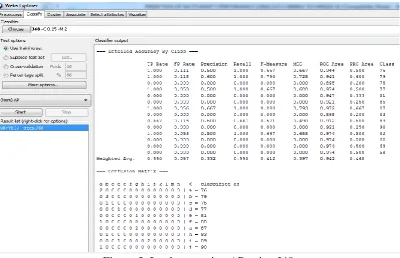
Implementation of AP Using J48:
Implemantation Tree View of Decision Tree Based on AP using J48
Figure 6: Tree View implementation of AP using J48
Figure 6: Tree view Implementation AP using J48
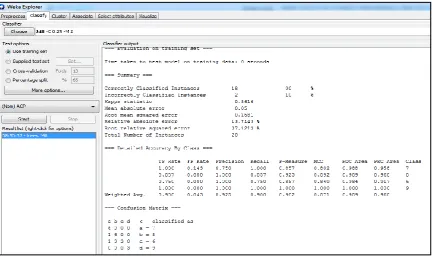
Implementation of ACP Using J48:
Implemantation Tree View of Decision Tree Based on ACP using J48
Figure 8: Tree View Implementation ACP Using J48
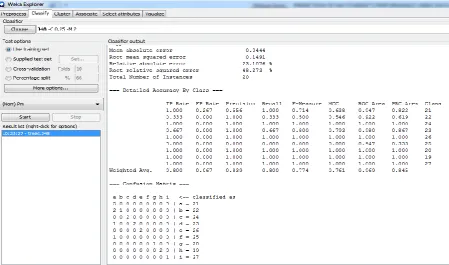
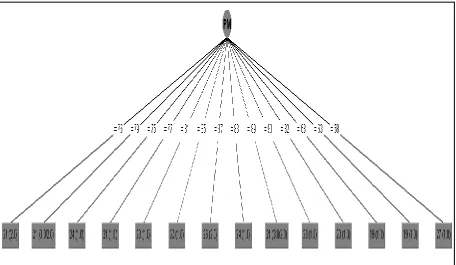
Implementation of PM using J48
Implemantation Tree View of Decision Tree Based on PM using J48
Figure10: Tree View Implementation PM using J48
Implementation of AP using Naïve Bayes Algorithm
Implementation of ACP using Naïve Bayes Algorithm
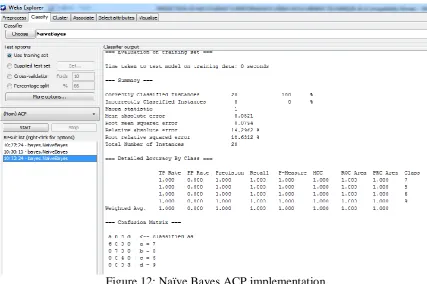
Figure 12: Naïve Bayes ACP implementation
Implementation of PM using Naïve Bayes Algorithm
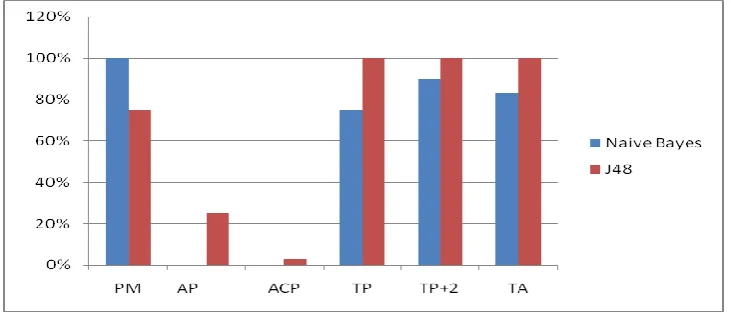
Result Analysis of 20 Instances on the basis of confusion matrix
Method
Naive Bayes
J48
PM
100%
75%
AP
00%
25 %
ACP
0.0004
0.0296
TP
75%
100%
TP+2
90%
100%
TA
83.2341
100%
Total Number of Instances
20
20
Table 1: Result analysis of 20 Instances
Figure 14: Graph representation of 20 instance result
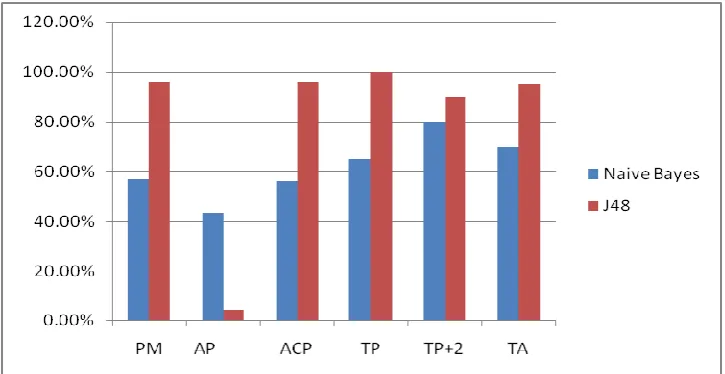
Result Analysis of 153 Instances on the basis of confusion matrix
Method
Naive Bayes
J48
PM
56.8627 %
96.0784 %
AP
43.1373 %
3.9216 %
ACP
0.563
0.9603
TP
65%
100%
TP+2
80%
90%
TA
70%
95
Figure 15: Graph representation of 153 instance result
VII. CONCLUSIONS
As number of records increases the accuracy of result cases very slowly for all the attributes
in Naïve Bayes as per experiment result. While in case of J48 algorithm accuracy rate also
decreases for only one attribute that is prefinal marks (PM). For other two attributes accuracy
increases. There are huge difference between J48 and naïve Bayes results. In percentage this
is 40% for 153 records. For small numbers of records naïve bayes classification algorithm is
best because it show more accuracy as per experimental results. For large number of records
J48 algorithm is better than naïve bayes algorithm because it shows more accuracy per
instances.
VIII. FUTURE SCOPE
In future, accuracy rate can be calculated on actual data for different – different organizations
by modifying or changing attributes. Anyone can apply different – different methods to know
the best method suited for education domain.
ACKNOWLEDGEMENT
Foremost, I would like to express my sincere gratitude to my advisor Shiv Kumar for the
continuous support of my study, for his patience, motivation, enthusiasm, and immense
knowledge. Besides my advisor, I would like to thank the rest of my Friends and well-wisher.
R
EFERENCES
[1] Students Programming Skills”, International Journal on Computer Science and Engineering Vol. 02, No. 03, pp 687-690.
[2] Zaïane, O. (2001),” Web usage mining for a better web-based learning environment”, Proceedings Of Conference L.Arockiam, S.Charles,Arulkumar et.al(2010), “Deriving Association between Urban and Rural on Advanced Technology For Education, 60-64.
[3] Zaïane, O. (2002), “Building a recommender agent for e-learning systems”. Proceedings of the International Conference on Computers in Education,55–59.
[4] Baker, R.S., Corbett, A.T., Koedinger, K.R. (2004), “Detecting Student Misuse of Intelligent Tutoring Systems”. Proceedings of the 7th International Conference on Intelligent Tutoring Systems, 531-540. [5] Tang, T., McCalla, G. (2005),” Smart recommendation for an evolving e-learning system: architecture and
experiment”, International Journal on E-Learning, vol. 4, issue1, 105–129.
[7] M.Ramaswami and R.Bhaskaran(2010), “A CHAID Based Performance Prediction Model in Educational Data Mining”, International Journal of Computer Science Issues Vol. 7, Issue 1, pp 10-18. [8] Dringus, L.P., Ellis, T. (2005),” Using data mining as a strategy for assessing asynchronous discussion
forums”, Computer and Education Journal, 45, 141–160.
[9] M.Ramaswami and R.Bhaskaran(2010), “A CHAID Based Performance Prediction Model in Educational Data Mining”, International Journal of Computer Science Issues Vol. 7, Issue 1, pp 10-18.