Attacks on RFID Protocols
Ton van Deursen
[email protected]Saˇsa Radomirovi´c
[email protected]August 6, 2009
Version 1.1Abstract
This document consists of a description of attack methodologies and a collection of detailed attacks upon RFID protocols. It is meant to serve as a quick and easy reference and it will be updated as new attacks are found. Currently the only attacks on protocols shown in full detail are the authors’ original attacks with references to similar attacks on other protocols.
The main security properties considered are authentication, untrace-ability, and desynchronization resistance.
Keywords: RFID, identification protocols, attacks.
Parts of this document have appeared in [DR08a,DR08b,DR09].
Contents
Preliminaries 4
Terminology. . . 4
Notation. . . 4
Conventions . . . 6
Security Properties . . . 6
Intruder Model . . . 7
Attacking RFID Protocols 7 Algebraic Replay Attacks . . . 8
Attribute Acquisition Attacks . . . 10
Cryptanalytic Attacks . . . 13
1 [CH07] 15 1.1 Description . . . 15
1.2 Claimed Attacks . . . 15
1.2.1 Tag authentication . . . 15
2 [DM07] 17
2.1 Description . . . 17
2.2 Claimed Attacks . . . 18
2.2.1 Authentication and Untraceability . . . 18
2.3 Related Protocols. . . 19
3 [HMNB07a] 20 3.1 Description . . . 20
3.2 Claimed Attacks . . . 20
3.2.1 Tag authentication . . . 20
3.2.2 Untraceability . . . 20
3.2.3 Desynchronization resistance . . . 21
3.3 Related Protocols. . . 22
4 [KCL07] 24 4.1 Description . . . 24
4.2 Claimed Attacks . . . 24
4.2.1 Untraceability . . . 24
5 [KCLL06] 26 5.1 Description . . . 26
5.2 Claimed Attacks . . . 26
5.2.1 Reader authentication . . . 26
5.3 Related Protocols. . . 27
6 [KN05] 28 6.1 Description . . . 28
6.2 Claimed Attacks . . . 29
6.2.1 Tag authentication . . . 29
6.2.2 Reader authentication . . . 29
6.2.3 Untraceability . . . 29
6.2.4 Desynchronization resistance . . . 29
6.3 Related protocols . . . 30
7 [LAK06] 31 7.1 Description . . . 31
7.2 Claimed Attacks . . . 31
7.2.1 Tag Authentication. . . 31
7.3 Related Protocols. . . 32
8 [LBV07] 33 8.1 Description . . . 33
8.2 Claimed Attacks . . . 33
8.2.1 Untraceability . . . 33
9 [LBV08] 35
9.1 Description . . . 35
9.2 Claimed Attacks . . . 35
9.2.1 Untraceability . . . 35
9.3 Related Protocols. . . 36
10 [LD07] 37 10.1 Description . . . 37
10.2 Claimed Attacks . . . 37
10.2.1 Untraceability . . . 37
10.3 Reader Authentication . . . 38
10.4 Related Protocols. . . 39
11 [OTYT06] 40 11.1 Description . . . 40
11.2 Claimed Attacks . . . 40
11.2.1 Reader authentication . . . 40
11.2.2 Desynchronization resistance . . . 40
11.2.3 Untraceability . . . 41
11.3 Related Protocols. . . 41
12 [LY07a, LY07c, LY07b,HM04] 42 12.1 Description . . . 42
12.2 Claimed Attacks . . . 42
12.2.1 Tag authentication . . . 42
12.3 Related Protocols. . . 42
13 [SLK06] 43 13.1 Description . . . 43
13.2 Claimed Attacks . . . 43
13.2.1 Tag authentication . . . 43
13.2.2 Desynchronization resistance . . . 43
13.2.3 Untraceability . . . 44
13.3 Related Protocols. . . 44
14 [SM08] 45 14.1 Description . . . 45
14.2 Claimed Attacks . . . 46
14.2.1 Tag authentication . . . 46
14.2.2 Reader authentication . . . 46
14.2.3 Desynchronization resistance . . . 47
14.2.4 Untraceability . . . 47
15 [YPL+05] 49
15.1 Description . . . 49
15.2 Claimed Attacks . . . 49
15.2.1 Untraceability . . . 49
15.2.2 Desynchronization resistance . . . 49
15.3 Related Protocols. . . 50
Change Log 57
Preliminaries
Terminology
In this document,reader refers to the actual RFID reader as well as a potential database or server communicating with the reader, since in all protocols con-sidered this communication takes place over a secure channel. Anagent can be a tag or a reader, while a role refers to the protocol steps a tag or reader is expected to carry out. Arun is the execution of a role by an agent. Anonce is a random number or a random string.
For convenience and intuition, we will refer to certain attacks on protocols as quality-time attacks. These are attacks in which the adversary interacts with a tag in absence of an honest or trusted RFID reader. The attacks can be carried out on tags that happen to be in the vicinity of an adversary for a short period of time or on tags the attacker is able to isolate from their environment for an extended period of time.
When we refer to the untraceability property of a protocol, we mean the tag’s untraceability.
Notation
The exclusive or (xor) operator is a commutative, associative operator, denoted by⊕. The xor operator has the property that equal terms cancel each other out, i.e. (a⊕b)⊕a=b for anyaandb.
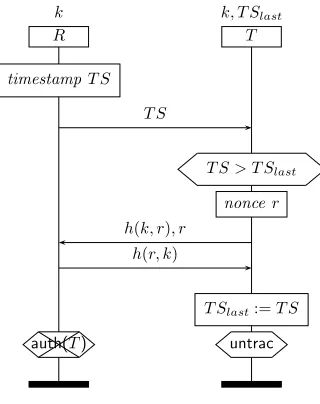
We use message sequence charts, such as in Figure 1, for the description of protocols as well as attacks on protocols1.We add textual explanations only when the message sequence chart is ambiguous or insufficient in some form.
Every message sequence chart shows the role names, framed, near the top of the chart. Above the role names, the terms known to the role are shown. Actions, such as nonce generation, computation, verification of terms, and as-signments are shown in boxes. Messages to be sent and expected to be received are specified above arrows connecting the roles. It is assumed that an agent continues the execution of its run only if it receives a message conforming to its role. Other conditions that need to be satisfied are shown in diamond boxes. Such conditions will include security claims made by the protocol’s authors,
such as untraceability or authentication claims, which will appear typically at the bottom of the chart. There are two types of condition boxes that represent security claims. The first type is a crossed-out diamond box, representing a security claim we invalidate. Such an invalidated claim will be accompanied by an explicit attack on the security claim. The second type is a normal diamond box, representing a security claim we have not invalidated nor proven.
For example, in Figure1, the role names areRandT, both know the secret termk, onlyT knows T Slast. The picture represents the following execution
flow. R generates the timestamp T S before sending the first message. After reception of the first message, T verifies the condition T S > T Slast before
continuing its run. T generates a noncer and sends the second message toR. The reader hashes the keykand the second part of the message (r)and verifies that the hash is equal to the first part of the message(h(k, r)). If not, the reader stops its execution, else it continues by hashingr andk and sending the third message toT. The tag verifies that the received value matchesh(r, k) and if so it setsT Slast toT S. The protocol has been claimed to satisfyuntraceability of
the tag role andauthentication of the tag role towards the reader role but the latter claim can be shown to be false.
k R
k, T Slast T
timestampT S
T S
T S > T Slast
noncer h(k, r), r
h(r, k)
T Slast:=T S
auth(T) untrac
Figure 1: Example protocol
Table 1: Notation
Symbol Meaning
A, B, R, T agent names
h cryptographic hash function
, concatenation
⊕ exclusive or operator
ID,k, k0, k1, . . . shared secret between reader and tag
r, r0, r1, r2. . . random numbers
reader or tag update stored variables, the variables whose values are being up-dated are shown with a prime after the update.
Convention
To simplify references, we name the presented protocols with the citation key which consists of the first letters of the last names of the protocol’s authors and the year of publication appended. Thus for instance, the Diffie-Hellman key exchange protocol would be named [DH76].
Security Properties
In terms of Lowe’s authentication hierarchy [Low97], we consider recent alive-nessto be the most appropriate authentication requirement for RFID protocols. Recent aliveness captures the fact that the tag needs to have generated a mes-sage as a consequence of a reader’s query. More formally, a protocol guarantees to an agentain role Athat any corresponding agent bin role B has been re-cently alive, iff wheneveracompletes a run, there has been an event ofbduring that run. What recent aliveness does not capture, is the requirement that the tag needs to be in the vicinity of the reader at the time of the communication. We do not consider this issue in the present paper.
We consider the notion of untraceability as defined in [DMR08] which cap-tures the intuitive notion that a tag is untraceable if an adversary cannot tell whether he has seen the same tag twice or two different tags.
The third security property we investigate is desynchronization resistance as defined in [DMRV09]. It ensures that the system in which the protocol runs will never evolve into a state where there is nobody who can successfully execute the protocol with a tag. In this paper, we restrict ourselves to the three aforementioned properties.
Intruder Model
We perform our security analyses in the Dolev–Yao intruder model [DY83]. In this model, the adversary may eavesdrop on any message exchanged between tag and reader, modify or block any message sent from tag to reader or vice versa, and may inject his own messages making them look like they were sent by tag or reader. We additionally assume that the adversary can observe whether an agent successfully completed its run. This is in line with adversary mod-els designed for RFID protocol analysis, such as Avoine [Avo05], Jumod-els and Weis [JW07], Vaudenay [Vau07], Damg˚ard and Pedersen [DP08], and Paise and Vaudenay [PV08].
Attacking RFID Protocols
From the general description of the adversary’s capabilities we derive three types of attack strategies for the adversary which are meant to enhance the intuition for the attacks and simplify their description.
The simplest strategy is to eavesdrop on messages transmitted between tag and reader. The adversary may then deduce information and combine messages to later impersonate or trace a tag.
The second strategy is to spend some “quality time” with a tag. In these attacks, to which we refer asquality-timeattacks, the adversary interacts with a tag in absence of an honest or trusted RFID reader. The point of such an attack is to send carefully designed challenges to the tag in order to obtain information which can later be used to impersonate a reader or the tag, trace the tag, or attack any other security requirement of a protocol.
Quality-time attacks are facilitated by the mobile and wireless nature of RFID tags. The attacks can be carried out on tags that happen to be in the vicinity of an adversary for a short period of time or on tags the attacker is able to isolate from their environment for an extended period of time. In case tags and readers share secret keys, a quality time attack might be mounted on the reader as well.
The third strategy involves modifying messages transmitted between a reader and a tag. This attack works best when the adversary has simultaneous access to a legitimate reader and a tag which is not in the reader’s vicinity. The adversary may modify transmitted messages and then observe the evolution of the communication session.
For each of the three strategies, the feasibility of an attack depends on many factors. In general, it is obvious that the fewer interactions an adversary needs to engage in, eavesdrop on, or modify, the more feasible the attack becomes.
identities.
Algebraic Replay Attacks
A common way to authenticate RFID tags is by means of the following challenge-response mechanism. The RFID reader challenges the tag with a nonce r1 to
which the tag replies with a term derived from the noncer1, some informations
identifying the tag, and potentially a noncer2generated by the tag. If present,
the noncer2serves as the tag’s challenge to the reader in mutual authentication
protocols or as a “blinding term” to achieve tag untraceability. We can thus represent the tag’s reply to the reader’s challenge as the termr2, g(r1, r2, s) with
the understanding thatr2 may be constant or empty. The reader verifies the
authenticity by applying the inverse of the functiongto the term and checking whether the response contains r1 and a valid s. If g is a one-way function
then the reader verifies the authenticity of the tag by computing the function g(r1, r2, s) and comparing it to the received value. The reader can compute
this function, since it generated the valuer1 itself, the valuer2 is supplied by
the tag, and the reader has a database with values of s for every tag it may authenticate.
We now argue that the following two properties are necessary in order for the challenge-response mechanism to guarantee recent aliveness of the tag.
Freshness For fixedr2 and sthe range of the function r1 →g(r1, r2, s) must
be large. More precisely, givenr2, s, the adversary’s advantage in
guess-ing g(r1, r2, s) correctly for an unknown, randomly chosen r1 must be
negligible.
ARR Let Os(x) be an oracle which upon input x randomly chooses y and
returnsy and g(x, y, s). Ifs is unknown, then given access to a polyno-mial number of queriesOs(x1), . . . , Os(xl) to the oracle, it is infeasible to
computeg(r1, r2, s) for a givenr16∈ {x1, . . . , xl} and anyr2.
If the freshness property is satisfied, then as stated, the probability of the adversary guessingg(r1, r2, s) is negligible. Thus with overwhelming probability,
a responser2, g(r1, r2, s), to the reader’s challenger1must have been generated
after the challenge was sent. This property is obviously necessary for recent aliveness and in particular excludes classic replay attacks.
The ARR (algebraic replay resistance) property guarantees that there is no efficient algorithm to compute a response r2, g(r1, r2, s) to the challenge
r1 even after having observed previous challenge-response pairs. Clearly, an
It is obvious that for a functiong(r1, r2, s) to have the ARR property, it must
preserve the secrecy ofs. Indeed, cryptographic hash functions are frequently used for the type of challenge-response mechanism considered here. Since the collision resistance property of cryptographic hash functions does not seem nec-essary for the challenge-response mechanism, the question arises whether all one-way functions satisfy the ARR property and the answer is negative. It is certainly false for all homomorphic one-way functions. Consider, for instance, the Rabin function, defined byx→ x2 mod N for certain composite integers
N. If (r1, r2, s)→g(r1, r2, s) = (r1r2s)2 modN is a Rabin function, then given
only one challenge-response pair,r1, g(r1, r2, s) it is easy to compute responses
for any challenger′
1, sinceg(r1′, r2, s) =g(r1, r2, s)·(r1′/r1)2.
Furthermore, even non-homomorphic one-way functions will in general not have the ARR property if theirargument has algebraic properties. As demon-strated in the examples below, there are several protocols that fail to achieve recent aliveness for this very reason. In these protocols the challenge-response construction can typically be represented asg(r1, r2, s) =f(r1◦r2, s), wheref
is a (non-homomorphic) cryptographic hash function and◦denotes an operator with the following algebraic property. Given a, b, and c, it is easy to find d witha◦b=c◦d. This construction clearly does not have the ARR property, regardless of the properties off. The algebraic replay attack on such a protocol works as follows. An adversary observing one execution of the protocol learns r1, r2, andf(r1◦r2, s). When challenged withr′1, the adversary findsr2′ such
that r1 ◦r2 = r1′ ◦r2′ and replies with r′2, f(r1◦r2, s). The attack succeeds
becausef(r1◦r2, s) =f(r1′ ◦r′2, s).
Examples of operators ◦ for which this type of attack succeeds are xor, modular addition, and any associative operator for which it is easy to compute left inverses.
Examples
The protocols by Chien and Huang [CH07], Kim et al. [KCLL06], Lee et al. [LAK06], and Song and Mitchell [SM08], shown in sections 1, 5, 7, 14, respectively, are vulnerable to this type of attack. This is due to the fact that they employ a hash-like function or a cryptographic hash function composed with xorwhich fits into the challenge-response construction with the functionf(r1◦r2, s) shown
above.
Attacks which we classify as algebraic replay attacks have also been described by Peris-Lopez et al. [PLHCETR07,§4.2] and Bringer et al. [BCI08]:
1. Chien and Chen [CC07] implement the challenge-response mechanism by composing the cyclic redundancy check (CRC) function with xor. To a challenge r1, the tag responds with r2, CRC(EP C, r1, r2)⊕k, where
To attack the protocol, the adversary observes one protocol execution. When challenged withr′
1 the adversary computes thexor of the observed
responseCRC(EP C, r1, r2)⊕kwith
CRC(0EP C, r1,0r2)⊕CRC(0EP C, r1′,0r2).
The terms0EP C and 0r2 are 0-bit strings of length equal to the length
of EP C and r2, respectively. Because CRC is a homomorphism, the
computation will result in a correct response CRC(EP C, r′
1, r2) to the
challenger′
1.
2. The protocol proposed by Lee et al. [LBV08], described in detail in Sec-tion9, is vulnerable to an algebraic replay attack in which the adversary needs to observe three protocol executions or perform a quality-time attack consisting of three queries. The algebraic replay attack can then be exe-cuted by solving a small system of equations yielding a constant particular to the tag. While this constant does not reveal the tag’s secret informa-tion, it can still be used to compute the correct response to a reader’s challenge. This attack has been first described by Bringer et al. [BCI08].
Attribute Acquisition Attacks
A simple, necessary condition for tag untraceability is that an adversary, which has observed a particular tag once, must not be able to recognize the tag as being the same tag in the future. To make this more precise, we call a term, which the adversary can derive from one or more runs of a tag and which identifies the tag to the adversary, aunique attribute of the tag. The necessary condition for a tag to be untraceable then is that the adversary must not be able to derive a unique attribute for the tag. Should the adversary be able to compute a unique attribute, then we refer to the adversary’s steps to arrive at such a term as the attribute acquisition attack.
A simple unique attribute can be found in protocols where the tag’s answer to a challengec is merely a function f(c, k) of the challenge and a secret (or collection of secrets)k and does not involve any nonce created by the tag. In this case, c is under the adversary’s control, k is unique to the tag, and the adversary learnsf(c, k) after one round of communication with the tag. Thus for constantc chosen by the adversary,f(c, k) is a unique attribute of the tag whose secret isk.
be valid after the update. References to such protocols are given in the examples section below.
To find unique attributes in general, consider a given RFID protocol in a formal trace model such as the one proposed by Cremers and Mauw [CM05], extended by Van Deursen et al. [DMRV09], or the strand spaces model of Thayer F`abrega et al. [THG98]. Then the unique attribute for the tag role can be obtained, if it exists, by computing the intersection of the adversary’s knowledge with the set of terms which can be constructed from constants that are unique to the tag and terms that are under the adversary’s control. Such a term can be found effectively, provided that the intersection is non-empty.
To find a term in the intersection for the special class of challenge-response protocols in which the tag includes a fresh nonce r in its reply f(c, k, r) to a challengec, the adversary needs to find challengesc1, . . . , cl and an efficiently
computable functiong(x1, . . . , xl), such that
g(f(c1, k, r1), . . . , f(cl, k, rl)) = ˜g(c1, . . . , cl, k)
does not depend on the tag’s nonces r1, . . . , rl. In this case ˜g(c1, . . . , cl, k) is
the unique attribute. The attribute acquisition problem displayed in this form is more amenable to solutions by algebraic methods, as the following examples show.
Examples
1. A simple attribute acquisition attack exists on the protocol proposed by Kim et al. [KCL07], shown in Section4. In this protocol, the tag’s response can be represented byf(c, k, r) =k1⊕r, h(c, k2)⊕r, wherek=k1, k2 is
the tag’s secret,cthe reader’s challenge and rthe tag’s nonce. To find a unique attribute, the attacker challenges the tag with a constantc1 and
computes the unique attribute by taking thexor of the two terms in the response: k1⊕r⊕h(c1, k2)⊕r=k1⊕h(c1, k2) = ˜g(c1, k).
with message rthe tag is challenged with c1⊕r. After the next update
with messager′, the tag is challenged withc1⊕r⊕r′ and so forth. The
tag’s response to these challenges is each timeh(k⊕c1).
3. A more challenging example is the authentication protocol proposed by Lee et al. [LBV08] and shown in Section 9. The protocol is based on a fixed, system-wide elliptic curve over a finite field. The pointsP,Y =yP, x1P, x2P on the elliptic curve are publicly known, the scalar y is only
known to the reader, and the scalarsx1, x2 are unique to each tag and
only known to the tag. The elliptic curve is assumed to have been chosen such that the computational Diffie-Hellman problem is hard, that is, given only the pointsxP,yP, andP on the elliptic curve, it is hard to compute xyP.
In the protocol, the reader challenges the tag with a random numberr26= 0
to which the tag responds with two pointsT1=r1P,T2= (r1+x1)Y on
the elliptic curve and a scalar v = r1x1+r2x2. Using this information,
the reader can infer the tag’s identity.
Thus, this protocol, too, is a challenge-response protocol with challenger2
and a response that can be written asf(r2, k, r1) =r1P,(r1+x1)yP, r1x1+
r2x2, where k = x1, x2. The points P and yP are constant. To find a
unique attribute, the adversary needs to find challenge termsc1, . . . , cland
functions g,g˜ such that g(f(c1, k, r1), . . . , f(cl, k, r1(l))) = ˜g(c1, . . . , cl, k),
where ˜g does not depend on the tag’s random numbersr1, . . . , r(1l).
If we writef(c, k, r1) =T1, T2, vas in the protocol specification, and recall
that primes indicate terms transmitted in the second run, then
g(f(c, k, r1), f(c, k, r1′)) =
T1−T1′
v−v′ =x −1 1 P
depends only on the first part of the secretk=x1, x2. Thus ˜g(k) =x−11P
is a unique attribute.
From the definition of the functiong, it is now easy to obtain the attribute acquisition attack. By carrying out a quality-time attack, the adversary challenges the tag twice with the same valuec. The information received from the tag in the two runs can be used to compute the term x−1
1 P as
follows. Observe thatv−v′= (r1−r′
1)x1 andT1−T1′ = (r1−r1′)P, thus,
multiplying T1−T1′ with the inverse of v−v′ modulo the order of the
elliptic curve, the attacker obtainsx−1 1 P.
Note that after executing this quality-time attack, it suffices for the adver-sary to challenge any given tag only once with the previously used value cto determine whether the presented tag is equal to the tag identified by x−1
1 P.
r2v′−r2′v= (r2r′1−r′2r1)x1
r2T1′−r2′T1= (r2r1′ −r′2r1)P
The attacker may then combine these two equations to obtainx−1 1 P and
proceed as described above.
Cryptanalytic Attacks
The authentication and untraceability properties of RFID protocols often rely on the secrecy of shared keys. In some cases, revealing parts of a secret key may already be enough to trace the tag. If sufficiently many bits of a key can be revealed, brute-forcing the remaining bits may become feasible. Formal methods approaches typically do not consider attacks in which an adversary may learn just a few bits of a key, since keys are modeled as atomic terms.
If we assume that operators with algebraic properties are applied to terms sent back and forth between a reader and a tag, then a natural point of attack is to set up equations involving the terms on whose secrecy a protocol depends. Such equations may be obtained by observing several protocol runs, but also by selectively modifying parts of messages. In other words, one may attempt to apply any cryptanalytic method known to mankind. While this is hardly an original strategy, it turns out to be quite successful in the domain of RFID pro-tocols. One reason for this is the popularity of simple operators with algebraic properties. The other reason is due to the simple structure of typical RFID pro-tocols. The reader challenges the tag with a noncerto which the tag responds with a message involving that nonce and a secretk. This leads to a function r 7→ f(k, r) which can be compared to a cipher m 7→ C(k, m) or keyed hash functionx7→h(k, x). The tag’s response can further be analyzed by forwarding a modified version of it to the reader and checking the reader’s response. For RFID protocols with three or more messages, a tag-generated nonce, may fre-quently be considered as a known plaintext. Finally, stateful RFID protocols, i.e. RFID protocols in which the tag upon successful completion of the protocol updates its secret ID or cryptographic key, can be analyzed by taking advantage of algebraic relations between previous and future ID’s or keys.
Examples
The protocol [KN05], shown in Section6, is vulnerable to cryptanalytic attacks. There are also several examples of cryptanalytic attacks in the literature:
• In the HB+ protocol of Juels and Weis [JW05], tags use the binary inner
• Van Deursen et al. [DMR08] use information obtained through eavesdrop-ping on executions of the Di Pietro and Molva protocol [DM07] to expose two thirds of the bits of a tag’s secret key. In the protocol execution, bits of the tag’s secret key are combined with random nonces using xor and logical and and or operators and then sent from the tag to the reader. The attack is carried out by solving a system of linear equations derived from the observed messages which yields two thirds of the secret key’s bits. This is enough to break untraceability. It furthermore permits a brute force attack on the remaining bits in order to break authentication. A simpler, but less efficient attack is shown in Section2.
• In the protocols of Peris-Lopez et al. [PLCETR06c,PLCETR06a,PLCETR06b], logicalandandor operators are used in addition toxorand modular arith-metic leading to information leaks exploited by Alomair et al. [ALP07] and Li and Wang [LW07].
1
[
CH07
]
1.1
Description
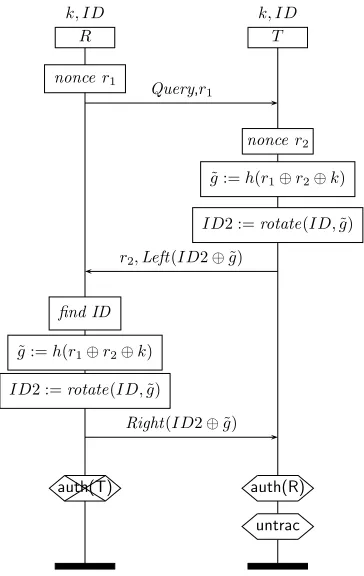
The readerRand tagT share secretskandID. The reader starts by sending a random bit stringr1. The tag generates a random stringr2 and hashes thexor
ofr1,r2, and the secretk. This hash andIDare used as input for a function in
which theID is rotated by a value depending on the hash. The tag computes the xor of the rotated ID and the hash, before sending the left half of the resulting bits andr2 to the reader. The reader performs the same operations
on every pair ofID and k until it finds the corresponding tag. It then sends the right half of the corresponding bits to the tag.
k, ID R
k, ID T
noncer1
Query,r1
noncer2
˜
g:=h(r1⊕r2⊕k)
ID2 :=rotate(ID,˜g)
r2,Left(ID2⊕˜g)
find ID
˜
g:=h(r1⊕r2⊕k) ID2 :=rotate(ID,˜g)
Right(ID2⊕g)˜
auth(T) auth(R)
untrac
Figure 2: The protocol
1.2
Claimed Attacks
1.2.1 Tag authentication
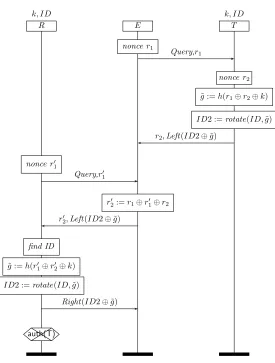
challenge a tag with anyr1to obtain a valid combination ofr1, r2,Left(ID2⊕˜g).
This information suffices for the adversary to be able to respond to any future challenger′
1 received from a reader. When challenged, the adversary setsr2′ =
r′
1⊕r1⊕r2and sends r2′,Left(ID2⊕g˜).
1.3
Related Protocols
We have found the same attack on the protocols [LAK06,KCLL06,SM08].
k, ID
R E
k, ID T
noncer1
Query,r1
noncer2
˜
g:=h(r1⊕r2⊕k)
ID2 :=rotate(ID,˜g)
r2,Left(ID2⊕g)˜
noncer′ 1
Query,r′ 1
r′
2:=r1⊕r1′⊕r2 r′
2,Left(ID2⊕˜g)
find ID
˜ g:=h(r′
1⊕r′2⊕k) ID2 :=rotate(ID,˜g)
Right(ID2⊕g)˜
auth(T)
2
[
DM07
]
2.1
Description
This is an authentication protocol which not only aims to keep tags untraceable, but also to limit the damage a compromised reader can cause.
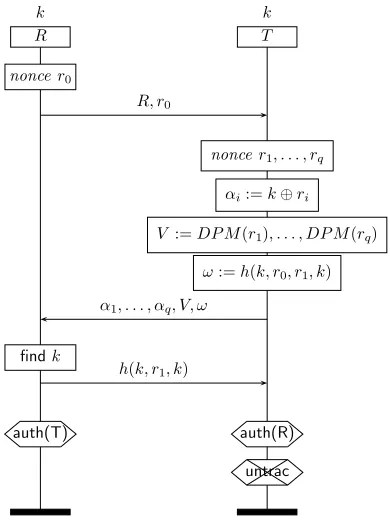
In the protocol, depicted in Figure 4, the function DP M(x) is defined as the parity of majority functions of consecutive bit-triplets ofx. The size of its output is therefore one bit. The protocol begins with the reader sending its name and a noncer0 to the tag. The tag replies with the message α1, . . . , αq, V, ω,
where αi = k⊕ri for randomly chosen ri (a bit-string of length ℓ, ℓ = 117
suggested by authors), thei-th bit ofV (a bit string of lengthq) isDP M(ri), and
ω=h(k, r0, r1, k). The reader has a database of all tags’ keys it is authorized
to identify. The reader can find a particular tag’s key k with the help of the vectors αi and values DPM(ri) by going through all the keys in its database
and iteratively excluding the impossible ones, namely those for whichDP M(k⊕ αi)6=DPM(ri). It is expected that eachαireduces the number of possible keys
by approximately one half. At last, the reader usesω to uniquely identify the correct key and authenticate the tag. The last message of the protocol allows the tag to authenticate the reader.
k R
k T
noncer0
R, r0
noncer1, . . . , rq
αi:=k⊕ri
V :=DP M(r1), . . . , DP M(rq)
ω:=h(k, r0, r1, k)
α1, . . . , αq, V, ω
findk
h(k, r1, k)
auth(T) auth(R)
untrac
2.2
Claimed Attacks
2.2.1 Authentication and Untraceability
In the following we show that over several rund, the protocol leaks 2ℓ
3 bits ofk.
This allows an attacker to brute-force the remaining bits ofk for the suggested parameterℓ= 117.
Let x= x1x2· · ·xℓ be a bit string of length ℓ, for some positive integer ℓ
divisible by three. Then DP M(x) = M(x1, x2, x3)⊕ · · · ⊕M(xℓ−2, xℓ−1, xℓ),
whereM(a, b, c) is the majority function on three bits. Let ¯xi denote the
com-plement of the bitxi. It is easy to see thatM(¯x1, x2, x3) =M(x1, x2, x3) if and
only ifx2 =x3. Analogous equations hold for the complements ofx2 and x3.
It follows that
DP M(¯x1, x2, x3, . . .) =DP M(x1, x2, x3, . . .)⇔x2=x3, (1)
again with analogous equations for any other bit ofx.
The adversary can take advantage of the property (1) as follows. Suppose the adversary intercepts the tag’s message, flips the first bit ofα2=r2⊕k to
obtain ˜α2 and forwards the modified message to the reader. If the second and
third bit ofr2 are equal, thenDP M(k⊕α˜2) =DP M(k⊕α2) =DP M(r2). In
this case, the reader will still be able to find the correct keyk and answer the tag with the third message of the protocol. However, if the second and third bit ofr2are not equal, thenDP M(k⊕α˜2)6=DP M(r2) and the reader will remove
the keykfrom the list of possible keys. No other key will pass the verification withω, thus the reader will not answer with the third message. The adversary can therefore distinguish the two cases.
It follows that by selectively flipping bits ofα2an adversary may, after several
protocol executions, determine for each consecutive bit triplet of k which bits are equal to each other. In other words, the adversary may determine the bits ofkup to complements of consecutive bit-triplets.
This information can be used to reduce the complexity of computing all bits of k to a brute force search of a space whose size is the cubic root of the full key space. For the parameters of the system suggested by Di Pietro and Molva, this brute force search becomes feasible (239keys). The knowledge of the secret
keyk then allows the attacker to also impersonate the tag to the reader, thus breaking the authentication claim of the protocol. By sufficiently increasing the key length, however, this attack becomes infeasible.
To break untraceability, the brute force search is not necessary. The prob-ability that two keys are equal up to complements of consecutive bit-triplets is vanishingly small [DMR08]. Increasing the key length does not prevent this attack.
2.3
Related Protocols
The presented attack is similar to the active attack on the HB+protocol [JW05]
3
[
HMNB07a
]
3.1
Description
The protocol starts with the reader querying the tag with a nonce r1. The
response of the tag depends on the value of a state variable S. In case the previous run ended successfully the value of S is 0 and the tag will respond withh(ID). In case it did not end successfully the value ofS is 1 and the tag will respond withh(ID, r2, r1). In either case, the tag will set its S to 1. The
reader will authenticate the tag if the response is equal toHID, h(ID, r2, r1)
or h(P ID, r2, r1) for any stored value of HID, ID or P ID. The reader will
then update the information for the particular tag according to Table 2. The reader then sendsh(P ID, r2) to the tag, after which the tag replaces itsIDby
h(P ID, r1) and setsS to 0. The protocol is depicted in Figure 5.
Table 2: Reader’s verification and update procedure
Tag response Reader action
h(ID), r2 ID′ :=h(ID, r1);HID′:=h(ID);P ID′ :=ID;
h(ID, r2, r1), r2 ID′ :=h(ID, r1);HID′:=h(ID);P ID′ :=ID;
h(P ID, r2, r1), r2 ID′ :=h(P ID, r1);HID′:=h(ID);P ID′:=P ID;
other reject tag
3.2
Claimed Attacks
3.2.1 Tag authentication
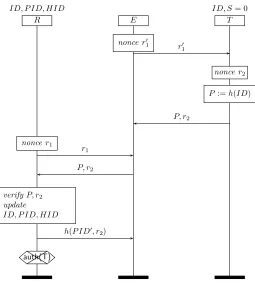
Note that if no messages are blocked or lost, the tag always responds with h(ID) allowing for an efficient lookup by the reader. An attacker can thus impersonate any tag which is in state 0 by sending a query to it and replaying the tag’s response before the tag has been queried by an authorized reader. The attack is depicted in Figure6.
3.2.2 Untraceability
The tag’s response depends on the value of S, i.e. the state the tag is in. If S = 0 the tag responds with h(ID), r2 and otherwise the tag responds with
h(ID, r1, r2). Because the attacker does not know ID, he can not conclude
from the response in which state the tag is. However, the attacker may use the fact that if the tag is in state 0, changingr2 does not result in a rejection of
the response by the reader. If the tag is in state 1, changingr2 would lead to a
3.2.3 Desynchronization resistance
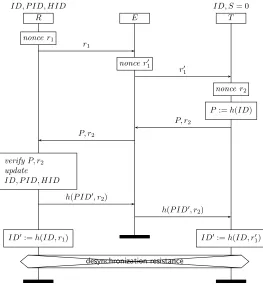
Any tag that is in state S = 0 can be desynchronized from a reader by a man-in-the-middle attack. In a communication between the reader and a tag, the adversary intercepts and modifies the reader’s challenge r1 to any value
r′
1 6=r1. The adversary then sends the modified value to the tag and forwards
all other messages between reader and tag without modification. Since in the caseS = 0 the reader does not verify that the tag received the correct value r1, the adversary’s modification goes by unnoticed. Thus, at the end of the
protocol execution, reader and tag updateID to different values. The reader storesh(ID, r1), while the tag storesh(ID, r′1). Therefore, the reader and tag
will be in adesynchronized state and future authentication of the tag becomes impossible. The attack is depicted in Figure7.
ID, P ID, HID R
ID, S T
noncer1
r1
noncer2
if S= 0thenP:=h(ID) elseP:=h(ID, r2, r1)
S′:= 1 P, r2
verifyP, r2
updateID, P ID, HID
h(P ID′, r 2)
if h(P ID′, r
2) =h(ID, r2) then
ID′:=h(ID, r
1),S′:= 0
auth(T) auth(R)
untrac
desynchronization resistance
3.3
Related Protocols
The protocols in [LY07c, LY07a, LY07b, HM04] are challenge-response-based protocols with a similar authentication flaw.
A similar untraceability flaw in [HM04] was found by [Avo05]. There a quality time attack is used to increase a tag’s internal counter to an abnormal level in order to recognize the tag later.
ID, P ID, HID
R E
ID, S= 0 T
noncer′
1 r′
1
noncer2
P :=h(ID)
P, r2
noncer1
r1
P, r2
verifyP, r2 update ID, P ID, HID
h(P ID′, r 2)
auth(T)
ID, P ID, HID
R E
ID, S= 0 T
noncer1
r1
noncer′ 1
r′ 1
noncer2
P:=h(ID) P, r2
P, r2
verifyP, r2 update ID, P ID, HID
h(P ID′, r 2)
h(P ID′, r 2)
ID′:=h(ID, r
1) ID′:=h(ID, r1′)
desynchronization resistance
4
[
KCL07
]
4.1
Description
The protocol is depicted in Figure8.
k, ID R
k, ID T
noncer1 r1
noncer2
ID⊕r2, h(r1, k)⊕r2
auth(T)
untrac
Figure 8: The KCL07 protocol
4.2
Claimed Attacks
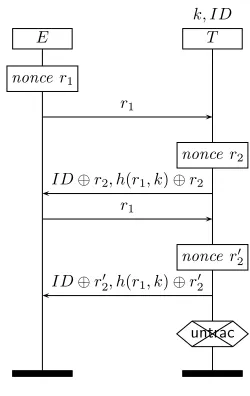
4.2.1 Untraceability
E
k, ID T
noncer1
r1
noncer2 ID⊕r2, h(r1, k)⊕r2
r1
noncer′ 2 ID⊕r′
2, h(r1, k)⊕r′2
untrac
Figure 9: The attack on untraceability
same nonce. He can then calculate the xor of the two parts ID ⊕r2 and
h(r1, k)⊕r2of the responses, the adversary then twice obtainsID⊕h(r1, k), if
5
[
KCLL06
]
5.1
Description
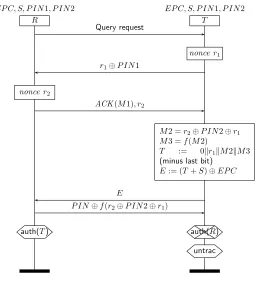
The protocol is depicted in Figure10. In the original specification, the protocol control bits (P C) and a CRC are transmitted in the fourth message. These are irrelevant to any of the considered security properties and are therefore left out. After being powered up, the tag generates a noncer1 and sends thexor of
the nonce and itsP IN1 to the reader. The reader acknowledges the message and generates a nonce r2. Both the acknowledgement and the nonce are sent
to the tag. The tag calculates the next message as is displayed in Figure10. The reader applies a one-way functionf to thexor of the two nonces and the P IN2. The result isxored with theP IN and sent to the tag.
EP C, S, P IN1, P IN2
R
EP C, S, P IN1, P IN2
T Query request
noncer1
r1⊕P IN1
noncer2
ACK(M1), r2
M2 =r2⊕P IN2⊕r1 M3 =f(M2)
T := 0kr1kM2kM3 (minus last bit)
E:= (T+S)⊕EP C
E
P IN⊕f(r2⊕P IN2⊕r1)
auth(R) auth(T)
untrac
Figure 10: The protocol
5.2
Claimed Attacks
5.2.1 Reader authentication
The adversary can impersonate a legitimate reader by sending a noncer′
2 that
order to be able to replay P IN ⊕f(r2⊕P IN2⊕r1) in another session, the
following condition must be satisfied: r1⊕r2 =r1′ ⊕r′2. This can be done by
settingr′
2 tor1⊕r2⊕r′1. The attack is depicted in Figure11.
5.3
Related Protocols
We have found a similar attack on the protocols [CH07,LAK06,SM08].
E
EP C, S, P IN1, P IN2
T
obtain P IN⊕
f(r2⊕P IN2⊕r1)
Query request
nonce r1 r′
1⊕P IN1
ACK(M1),(r1⊕P IN1)⊕(r1′⊕P IN1)⊕r2
M2 =P IN2⊕r′ 1⊕r2 M3 =f(M2)
T := 0kr′
1kM2kM3 (minus last bit)
E:= (T+S)⊕EP C
P C, E, CRC16
P IN⊕f(r2⊕P IN2⊕r1)
auth(R)
6
[
KN05
]
6.1
Description
In this protocol, the tag generates a random valuer0from a small domain and
a random valuer1 of lengthn. The tag sends the two hashesh(ID, r0),h(r1, k)
andID⊕r1 to the reader. Using h(ID, r0), the reader findsIDby trying out
all combinations of values forIDstored in its database and of all possible values forr0. This is possible for the reader becauser0is chosen from a small domain
and the number of IDs stored in its database is very small compared to the number of possibleIDs. UsingIDthe reader retrieveskfrom its database, and usingID⊕r1 andID, the reader findsr1 and may then verify the correctness
of the value ofh(r1, k). The reader then generates a random valuer2 of length
nand sendsID⊕r2 andh(r1, r2) to the tag. The tag verifies these and sends
r1+r2 mod 2n back to the reader. Both tag and reader update the ID by
xor-ing it withr1⊕r2.
The protocol is depicted in Figure12. Note that r0 is chosen from a small
domain, and can therefore be brute-forced fromh(ID, r0) ifIDis known.
k, ID R
k, ID T Query
noncer0
noncer1
h(ID, r0), h(r1, k), ID⊕r1
nonce r2
h(r1, r2), ID⊕r2 r1+r2mod2n
k′:=r1+r2mod2n k′:=r1+r2mod2n
ID′:=ID⊕r 1⊕r2 ID′:=ID⊕r
1⊕r2
auth(R) auth(T)
untrac
desynchronization resistant
6.2
Claimed Attacks
6.2.1 Tag authenticationAn eavesdropping adversary is able to find bits of theIDby combiningh(ID, r0),
ID⊕r1,ID⊕r2, andr1+r2mod 2nobserved in the last three messages of the
protocol.
Since hash functions are assumed to be perfect, we consider the termsID⊕ r1,ID⊕r2, andr1+r2 mod 2n, setting up a system of equations involving the
variables ID, r1, r2, and the values observed during runs of the protocol. A
moment’s thought shows that we may combine the first two equations to obtain r1⊕r2.
For convenience, we setV =r1+r2mod 2nandW =r1⊕r2. LetV[i] be the
i-th bit ofV, and similarly forW,r1, andr2. Furthermore, letV[1] be the least
significant bit ofV. By comparing addition modulo 2n withxorit is easy to see
thatV[i+ 1]6=W[i+ 1] only if there is a carry bit in the computation ofV[i]. If this is the case, thenr1[i]6=r2[i]⇔W[i] = 1 andr1[i] =r2[i] = 1⇔W[i] = 0.
Since the latter case determines r1[i] and r2[i] uniquely, it follows that it
can be used to find the i-th bit of ID. More bits from ID can be obtained by noticing that a carry bit inV[i] followed by no carry bit inV[i+ 1] implies r1[i+ 1] =r2[i+ 1] = 0.
Since r1 and r2 are chosen at random, on average, every communication
session leaks roughly n−1
4 bits ofID. Revealing all bits ofID, once sufficiently
many bits are known, can be achieved with a brute-force search over possible values forIDandr0 and comparing their hash toh(ID, r0). Revealing all bits
ofID is made a little more complicated by the fact that reader and tag update ID at the end of every protocol execution by setting it to ID⊕r1⊕r2. The
adversary may therefore need to keep track of two or three consecutive protocol executions between the tag and reader before performing the exhaustive search in order to completely reveal the tag’sID. Knowing theID, the adversary can impersonate both tag and reader and furthermore trace the tag.
6.2.2 Reader authentication
Revealing the tag’sIDas in Section6.2.1breaks reader authentication as well.
6.2.3 Untraceability
Revealing the tag’sID as in Section6.2.1breaks untraceability as well.
6.2.4 Desynchronization resistance
6.3
Related protocols
7
[
LAK06
]
7.1
Description
The reader and tag share a secretkwhich is used for mutual authentication. To prevent desynchronization due to message loss, the old values ofk is stored in k′. The reader initiates the protocol by challenging the tag with a noncer
0. The
tag generates a noncer1and computes the response as in Figure13. The reader
uses the response to find the correspondingkin its database. The reader xors the response with the reader nonce and the key and sends the cryptographic hash of the result to the tag.
k, k0 R
k T
noncer0
r0
noncer1
r1, h(r0⊕r1⊕k) h(h(r0⊕r1⊕k)⊕k⊕r0)
k′ 0:=k k′ := h(k)
k′:=h(k)
auth(T) auth(R)
untrac
desynchronization resistant
Figure 13: The protocol
7.2
Claimed Attacks
7.2.1 Tag Authentication
The adversary challenges the tag with a random valuer0, obtaining a response
r1, h(r0⊕r1⊕k). When queried by a trusted reader with challenge r′0, the
adversary uses the response generated by the tag.
The attack is depicted in Figure14. The adversary may replayh(r0⊕r1⊕k)
if he ensures thatr0⊕r1=r′0⊕r1′. To satisfy this condition the adversary sets
r′
7.3
Related Protocols
We have found a similar attack on the protocols [CH07,KCLL06,SM08].
k, k0
R E
k T
noncer0
r0
noncer1
r1, h(r0⊕r1⊕k)
noncer′ 0
r′ 0
r′
1:=r0⊕r0′⊕r1 r′
1, h(r0⊕r1⊕k) h(h(r0⊕r1⊕k)⊕k⊕r′
0)
k′ 0:=k k′ := h(k)
auth(T)
8
[
LBV07
]
8.1
Description
The protocol, shown in Figure 15 aims to efficiently authenticate a tag to a reader while keeping the tag untraceable. The protocol is based on a fixed, system-wide elliptic curve over a finite field. P, yP, x1P, x2P are publicly
known points on the elliptic curve, the scalaryis only known to the reader, and the scalarsx1,x2are unique to each tag and only known to the tag. The elliptic
curve is assumed to have been chosen such that it is difficult to compute,x1, x2, y
from x1P, x2P, yP. The reader challenges the tag with a random number r1,
the tag responds with two points T1 = r2P, T2 = (r2+x1)Y on the elliptic
curve and a scalar v =r1(x2+r2) +x1. The reader infers the tag’s identity
and authenticates it from the points and the scalar as follows. Since the reader knowsyit can computey−1T
2−T1=x1P to obtain the identity of the tag and
then compute (vP −x1P)r1−1−T1=x2P to authenticate the tag.
y, P, x1P, x2P R
x1, x2, P, Y =yP T
noncer1
r1
noncer2
T1:=r2P
T2:= (r2+x1)Y
v:=r1(x2+r2) +x1
T1, T2, v
findx1P=y−1T2−T1
(vP−x1P)r−1
1 −T1=x2P
auth(T) untrac
Figure 15: The protocol.
8.2
Claimed Attacks
8.2.1 Untraceability
• If the tag is challenged with r1 = 1, the information obtained from the
tag’s response,T1=r2P,T2= (x1+ 1)yP,v= (x2+r2) +x1, can be used
to compute a constant, unique value for the tagvP −T1= (x1+x2)P.
• If a tag is challenged twice, once with a random value r1 and once with
r′
1 =r1+ 1, then the information received from the tag in the two runs
can be used to compute the constant term−x2P as follows. Recall that
primes indicate terms transmitted in the second run. Observe that
v−v′ =r
1(x2+r2)−(r1+ 1)(x2+r′2) =−x2−r′2+r1(r2−r′2),
thus we can compute
−x2P = (v−v′)P+T1′−r1(T1−T1′)
since the terms on the right-hand side are known.
8.3
Related Protocols
9
[
LBV08
]
9.1
Description
The protocol, shown in Figure 16 aims to efficiently authenticate a tag to a reader while keeping the tag untraceable. The protocol is based on a fixed, system-wide elliptic curve over a finite field. P,Y =yP,x1P,x2P are publicly
known points on the elliptic curve, the scalaryis only known to the reader, the scalarsx1, x2 are unique to each tag and only known to the tag. The elliptic
curve is assumed to have been chosen such that it is difficult to compute,x1, x2, y
fromx1P, x2P, yP.
y, P, x1P, x2P R
x1, x2, P, Y =yP T
noncer2
r2
r26= 0 noncer1
T1:=r1P
T2:= (r1+x1)Y
v:=r1x1+r2x2
T1, T2, v
findx1P =y−1T2−T1
(vP−x1T1)r2−1=x2P
auth(T) untrac
Figure 16: The protocol
9.2
Claimed Attacks
9.2.1 Untraceability
An attacker carries out two sessions with the tag sending the same noncer2 in
both sessions. The attacker then computes (using primes for the second session) v−v′= (r
1−r′1)x1 andT1−T1′ = (r1−r′1)P. Thus computing the inverse of
v−v′ modulo the order of the elliptic curve, the attacker obtainsx−1
1 P which
9.3
Related Protocols
10
[
LD07
]
10.1
Description
The [LD07] protocol was designed for use in supply chains. Each supply chain consists of a chain of partners, each of which is represented by a reader. Reader Ri and tagT share a secretk0. Additionally, readerRi knows secrets ki and
ki+1. At the end of a successful protocol execution, the tag updates the shared
secret.
k0, ki, ki+1 Ri
α=k0⊕ki T
noncer
r h(r⊕α)
a:=ki⊕ki+1 b:=h(a⊕k0⊕ki)
a, b
ifb=h(a⊕α), thenα′:=α⊕a
auth(T) auth(R)
untrac
Figure 17: The protocol
10.2
Claimed Attacks
10.2.1 Untraceability
The protocol does not satisfy untraceability for the tag role, which is acknowl-edge by the protocol’s authors and hence not claimed. This is because between any two updates ofα, an adversary that twice sends the same challenge r to the same tag, will twice receive the same response. The authors do claim a weak form of untraceability, namely untraceability after updates. This claim is not satisfied either. The attack is shown in Figure18and runs as follows. By observing the authentication session the adversary learnsr, h(r⊕α), a, and b. The adversary can now query the tag with r′ = r⊕a, to which the tag will
respond withh(r′⊕α′). This response is equal to the previously observed one:
10.3
Reader Authentication
Reader authentication can be broken by settinga=r and b=h(r⊕α). The tag accepts a and b, because b = h(a⊕α) = h(r⊕α). The attack is shown in Figure19. This attack also results in desynchronization of the database and the tag.
k0, ki, ki+1 Ri
α=k0⊕ki
T E
noncer
r h(r⊕α)
a:=ki⊕ki+1 b:=h(a⊕k0⊕ki)
a, b
α′:=α⊕a r⊕a h(r⊕α)
untrac
Figure 18: Attack on untraceability
E
α=k0⊕ki T
noncer
r h(r⊕α)
r, h(r⊕α)
α′:=α⊕r auth(R)
10.4
Related Protocols
11
[
OTYT06
]
11.1
Description
The protocol is depicted in Figure20.
k R
k T
noncer1
r1 h(k⊕r1)
noncek1
k⊕k1
k′:=k
1 k′:=k1
auth(R) auth(T)
untrac
desynchronization resistance
Figure 20: The protocol
11.2
Claimed Attacks
11.2.1 Reader authentication
Since the tag does not know the new keyk1, the tag is not able to verify whether
the third message is indeedk⊕k1. Since no check can be performed by the tag,
the adversary may send a random messagerto the tag which will cause the tag to replacekbyk⊕r.
11.2.2 Desynchronization resistance
• The attack on reader authentication desynchronizes the secret key k, shared between the tag and the reader, rendering future authentication impossible. Note that the attacker is the only one who can re-synchronize the secret information between reader and tag since he is the only one who knowsk⊕r.
• Blocking the last message from reader to tag leads the reader to updatek while the tag does not carry out the update, leaving tag and reader in a desynchronized state.
11.2.3 Untraceability
An attacker observing a protocol run obtains a triple (r, h(k⊕r), k⊕k1). He
may now challenge a tag withr⊕k⊕k1giving him the same response he already
observed, provided that the tag is the same as the one which was eavesdropped on before. The attack is depicted in Figure21.
k
R E
k T
nonce r1
r1
r1 h(k⊕r1) h(k⊕r1)
k⊕k1
k⊕k1
k′:=k1 k′:=k1
r1⊕k⊕k1 h(k⊕r1)
untrac
Figure 21: Attack on untraceability
11.3
Related Protocols
12
[
LY07a
,
LY07c
,
LY07b
,
HM04
]
12.1
Description
The protocols have a challenge-response structure as depicted in Figure22. The reader challenges the tag, the tag computes a function over one or more terms in its knowledge and sends the result to the reader. However, the challenge is not used by the tag as an input to the function.
k R
k T c
f(k)
. . .
auth(T)
Figure 22: General protocol structure.
12.2
Claimed Attacks
12.2.1 Tag authentication
Because the tag’s response does not depend on the reader’s challenge, an adver-sary may query a tag and later replay the response to a reader when challenged. Therefore, none of these protocols satisfy the recent aliveness claim with respect to the tag role. The general structure of the attack is depicted in Figure23.
k
R E
k T c
f(k)
c′ f(k)
. . .
auth(T)
Figure 23: Attack on tag authentication
12.3
Related Protocols
13
[
SLK06
]
13.1
Description
The protocol assumes that the reader and tag share the secretsk,ID, andP IN. WhileID andP IN are unique to each tag,kis equal for all tags the reader is allowed to authenticate. The tag further stores the timestampT Slast of the last
successful mutual authentication initialized to 0 at the factory. The protocol is depicted in Figure24.
k, ID, P IN R
k, ID, P IN, T Slast T
timestampT S
h(k, T S), T S
T S > T Slast
h(ID)
h(ID, P IN)
ID′:=h(ID, P IN, T S) ID′:=h(ID, P IN, T S)
T S′
last:=T S
auth(T) untrac
auth(R)
desynchronization resistant
Figure 24: The protocol
13.2
Claimed Attacks
13.2.1 Tag authentication
To attack the protocol, it suffices to note that the challenge of the reader and the response of the tag are not related. See Section12for the attack.
13.2.2 Desynchronization resistance
13.2.3 Untraceability
The fact that a reader and tag do not agree on the valueID, i.e. are desyn-chronized, is observable, since in such a case the reader terminates the protocol early. Thus the adversary can trace such tags. Furthermore, when a tag becomes desynchronized, it will not be able to updateID andT Slast anymore, thus its
response to any valid challengeh(k, T S), T SwithT S > T Slastwill remain
con-stant allowing an adversary to distinguish between recently desynchronized tags and earlier desynchronized tags.
13.3
Related Protocols
The same authentication problem exists in the protocols [LY07c,LY07a,LY07b, HMNB07a].
14
[
SM08
]
14.1
Description
The protocol is depicted in Figure25. Bit rotations are denoted by≫ and≪ wherea≫b meansashifted cyclically to the right byb bits. The function ft
that is used to computeM2is a keyed hash function, wheret is the key.
The reader and tag share a secrettwhich is used for mutual authentication. The reader also stores the hash oft inu. To prevent desynchronization due to message loss, the old values oftanduare stored int′andu′. The reader initiates
the protocol by generating a random valuer1 of length ℓ and challenging the
tag withr1. The tag generates a noncer2 and computes the responseM1, M2
as in Figure 25. The reader usesM1 and M2 to find the tag in its database.
The reader computesM3 and sends it to the tag, after which both reader and
tag update their secrets.
u, t, u0, t0 R
t T
noncer1
r1
noncer2 M1:=t⊕r2 M2 := ft(r1⊕
r2) M1, M2
M3:=u⊕(r2≫ℓ/2) M3
u′ 0:=u t′
0:=t
u′:= (u≪ℓ/4)⊕(t≫ ℓ/4)⊕r1⊕r2 t′:=h(u′)
u′:=M3⊕(r2≫ℓ/2) ifh(u′) =tthen t′ := h(u′ ≪ ℓ/4)⊕
(t≫ℓ/4)⊕r1⊕r2)
auth(T) auth(R)
untrac
desynchronization resistant
14.2
Claimed Attacks
14.2.1 Tag authenticationThe attack on tag authentication is depicted in Figure 26. The attacker uses the fact that he may replayM2forM2′ if he ensures that r1⊕r2=r1′ ⊕r′2. To
satisfy this condition he setsM′
1to M1⊕r1⊕r′1.
u, t, u0, t0
R E
t T
noncer1
r1
noncer2 M1:=t⊕r2 M2 := ft(r1⊕
r2) M1, M2
noncer′ 1
r′ 1
M′
1=M1⊕r1⊕r1′ M′
2=M2 M′
1, M2′
M′
3:=u⊕(r2⊕r1⊕r′1≫ℓ/2) M′
3
u′ 0:=u t′
0:=t
u′:= (u≪ℓ/4)⊕(t≫ ℓ/4)⊕r1⊕r2 t′:=h(u′)
auth(T)
Figure 26: Attack on tag authentication
14.2.2 Reader authentication
14.2.3 Desynchronization resistance
The attack depicted in Figure27desynchronizes the reader from the tag.
14.2.4 Untraceability
After the reader and tag are desynchronized using the attack depicted in Fig-ure27, the adversary can recognize it since it is no longer accepted by a valid reader.
u, t, u0, t0
R E
t T
noncer1
r1
r1
noncer2 M1:=t⊕r2 M2:=ft(r1⊕r2) M1, M2
M1, M2
M3:=u⊕(r2⊕ ≫ℓ/2) M3
noncer′ 1
r′ 1
noncer′ 2 M1:=t⊕r′2 M2:=ft(r′
1⊕r′2) M′
1, M2′
M′
3:=M3⊕(M1⊕M1′)≫ℓ/2 M′
3
u′
0:=u;t′0:=t u′:= (u≪ℓ/4)⊕(t≫ ℓ/4)⊕r1⊕r2 t′:=h(u′)
u′:=M′
3⊕(r2≫ℓ/2) ifh(u′) =tthen t′ := h(u′ ≪ ℓ/4)⊕
(t≫ℓ/4)⊕r′ 1⊕r2′) auth(R)
untrac
desynchronization resistant
14.3
Related Protocols
15
[
YPL
+05
]
15.1
Description
The reader and tag share secretsk, k1, k2. The reader initiates the protocol by
challenging the tag with a noncer1. The tag responds withh(k1⊕r1⊕k). The
reader then replies with h(k2) and both tag and reader update secretsk1 and
k2. Figure28depicts the protocol.
k, k1, k2 R
k, k1, k2 T
noncer1 r1 h(k1⊕r1⊕k)
h(k2)
k′
1 := k1⊕ h(k2) k′
2 := k2⊕ h(k1⊕r1⊕k)
k′
1 := k1⊕ h(k2) k′
2 := k2⊕ h(k1⊕r1⊕k)
untrac
desynchronization resistant
auth(R) auth(T)
Figure 28: The protocol
15.2
Claimed Attacks
15.2.1 Untraceability
An attacker observing a communication session of the protocol obtains the mes-sagesr1, h(k1⊕r1⊕k), h(k2). Reader and tag then update their secrets. The
attacker can recognize the tag by challenging it with r1⊕h(k2) to which the
previously observed tag will respond withh(k1⊕r1⊕k). Figure29depicts the
attack.
15.2.2 Desynchronization resistance
k, k1, k2
R E
k, k1, k2 T
noncer1
r1
r1 h(k1⊕r1⊕k) h(k1⊕r1⊕k)
h(k2)
h(k2)
k′ 1:=h(k2) k′
2 := k2⊕ h(k1⊕r1⊕k)
k′ 1:=h(k2) k′
2 := k2⊕ h(k1⊕r1⊕k)
r1⊕h(k2) h(k1⊕r1⊕k)
untrac
Figure 29: Attack on the untraceability
15.3
Related Protocols
References
[ALP07] Basel Alomair, Loukas Lazos, and Radha Poovendran. Passive attacks on a class of authentication protocols for RFID. In ICISC, pages 102–115, 2007. 6.3
[Avo05] Gildas Avoine. Adversary model for radio frequency identi-fication. Technical Report LASEC-REPORT-2005-001, Swiss Federal Institute of Technology (EPFL), Security and Cryptog-raphy Laboratory (LASEC), Lausanne, Switzerland, September 2005. 3.3,13.3
[BCI08] Julien Bringer, Herv´e Chabanne, and Thomas Icart. Crypt-analysis of EC-RAC, a RFID identification protocol. InCANS, pages 149–161, 2008.
[CC07] Hung-Yu Chien and Che-Hao Chen. Mutual authentication pro-tocol for RFID conforming to EPC class 1 generation 2 stan-dards. Computer Standars & Interfaces, Elsevier Science Pub-lishers, 29(2):254–259, February 2007. 6.3
[CH07] Hung-Yu Chien and Chen-Wei Huang. A lightweight RFID pro-tocol using substring. InEmbedded and Ubiquitous Computing (EUC), pages 422–431, 2007. 1,5.3,7.3,10.4,14.3
[CLL05] Eun Young Choi, Su Mi Lee, and Dong Hoon Lee. Efficient RFID authentication protocol for ubiquitous computing envi-ronment. In Tomoya Enokido, Lu Yan, Bin Xiao, Daeyoung Kim, Yuanshun Dai, and Laurence Yang, editors,International Workshop on Security in Ubiquitous Computing Systems – se-cubiq 2005, volume 3823 ofLecture Notes in Computer Science, pages 945–954, Nagasaki, Japan, December 2005. Springer-Verlag. 6.3
[CM05] C.J.F. Cremers and S. Mauw. Operational semantics of security protocols. In S. Leue and T.J. Syst¨a, editors,Scenarios: Mod-els, Algorithms and Tools (Dagstuhl 03371 post-seminar pro-ceedings, September 7–12, 2003), volume 3466 ofLNCS, pages 66–89, 2005.
[DFJ07] Benessa Defend, Kevin Fu, and Ari Juels. Cryptanalysis of two lightweight RFID authentication schemes. In PerCom Work-shops, pages 211–216, 2007. 6.3
[DM07] Roberto Di Pietro and Refik Molva. Information confinement, privacy, and security in RFID systems. In ESORICS, pages 187–202, 2007. 2
[DMR08] Ton van Deursen, Sjouke Mauw, and Saˇsa Radomirovi´c. Un-traceability of RFID protocols. InInformation Security Theory and Practices. Smart Devices, Convergence and Next Genera-tion Networks, volume 5019 ofLecture Notes in Computer Sci-ence, pages 1–15, Seville, Spain, 2008. Springer.
[DMRV09] Ton van Deursen, Sjouke Mauw, Saˇsa Radomirovi´c, and Pim Vullers. Secure ownership and ownership transfer in RFID sys-tems. InProc. 14th European Symposium On Research In Com-puter Security (ESORICS’09), Lecture Notes in ComCom-puter Sci-ence. Springer, 2009. To appear.
[DP08] Ivan Damg˚ard and Michael Østergaard Pedersen. RFID secu-rity: Tradeoffs between security and efficiency. In CT-RSA, pages 318–332, 2008.
[DR08a] Ton van Deursen and Saˇsa Radomirovi´c. Security of an RFID protocol for supply chains. InProceedings of the 1st Workshop on Advances in RFID, AIR’08 (to appear). IEEE Computer Society, October 2008.
[DR08b] Ton van Deursen and Saˇsa Radomirovi´c. Security of RFID pro-tocols – A case study. In Proceedings of the 4th International Workshop on Security and Trust Management, STM 2008 (to appear), ENTCS. Elsevier, June 2008.
[DR09] Ton van Deursen and Saˇsa Radomirovi´c. Algebraic attacks on RFID protocols. InInformation Security Theory and Practices. Smart Devices, Pervasive Systems, and Ubiquitous Networks (to appear), Lecture Notes in Computer Science, Brussels, Belgium, 2009. Springer.
[DY83] D. Dolev and A.C. Yao. On the security of public key protocols. IEEE Transactions on Information Theory, IT-29(2):198–208, March 1983.
[GRS05] Henri Gilbert, Matthew Robshaw, and Herv´e Sibert. An active attack against HB+ – a provably secure lightweight
authentica-tion protocol. Manuscript, July 2005. 2.3
[HM04] Dirk Henrici and Paul M¨uller. Hash-based enhancement of lo-cation privacy for radio-frequency identifilo-cation devices using varying identifiers. InPerCom Workshops, pages 149–153, 2004.
[HMNB07a] JaeCheol Ha, Sang-Jae Moon, Juan Manuel Gonz´alez Nieto, and Colin Boyd. Low-cost and strong-security RFID authenti-cation protocol. InEmbedded and Ubiquitous Computing (EUC) Workshops, pages 795–807, 2007. 3,12.3,13.3
[HMNB07b] JaeCheol Ha, Sang-Jae Moon, Juan Manuel Gonz´alez Nieto, and Colin Boyd. Security analysis and enhancement of one-way hash based low-cost authentication protocol (OHLCAP). InPAKDD Workshops, pages 574–583, 2007. 6.3
[JW05] Ari Juels and Stephen Weis. Authenticating pervasive devices with human protocols. In Victor Shoup, editor, Advances in Cryptology – CRYPTO’05, volume 3126 of Lecture Notes in Computer Science, pages 293–308, Santa Barbara, California, USA, August 2005. IACR, Springer-Verlag. 2.3
[JW07] Ari Juels and Stephen Weis. Defining strong privacy for RFID. InInternational Conference on Pervasive Computing and Com-munications – PerCom 2007, pages 342–347, New York, USA, March 2007. IEEE, IEEE Computer Society Press.
[KCL07] Il Jung Kim, Eun Young Choi, and Dong Hoon Lee. Secure mobile RFID system against privacy and security problems. In SecPerU 2007, 2007. 4,10.4,11.3,15.3
[KCLL06] Kyoung Hyun Kim, Eun Young Choi, Su-Mi Lee, and Dong Hoon Lee. Secure EPCglobal class-1 gen-2 RFID sys-tem against security and privacy problems. In On The Move (OTM) Workshops (1), pages 362–371, 2006. 1.3, 5, 7.3,14.3,
15.3
[KN05] Jeonil Kang and Daehun Nyang. RFID authentication protocol with strong resistance against traceability and denial of service attacks. In Refik Molva, Gene Tsudik, and Dirk Westhoff, ed-itors, European Workshop on Security and Privacy in Ad hoc and Sensor Networks – ESAS’05, volume 3813 ofLecture Notes in Computer Science, pages 164–175, Visegrad, Hungary, July 2005. Springer-Verlag. 6,15.3
[LAK06] RFID mutual authentication scheme based on synchronized se-cret information. InSymposium on Cryptography and Informa-tion Security, Hiroshima, Japan, January 2006.1.3,5.3,7,14.3,
15.3
[LBV08] Yong Ki Lee, Lejla Batina, and Ingrid Verbauwhede. EC-RAC (ECDLP based randomized access control): Provably secure RFID authentication protocol. InProceedings of the 2008 IEEE International Conference on RFID, pages 97–104, 2008. 8.3,9
[LCUL06] Yong-Zhen Li, Young-Bok Cho, Nam-Kyoung Um, and Sang Ho Lee. Security and privacy on authentication protocol for low-cost RFID. InComputational Intellegence and Security (CIS), pages 788–794, 2006. 10.4
[LD07] Yingjiu Li and Xuhua Ding. Protecting RFID communications in supply chains. InASIACCS, pages 234–241, 2007. 10,10.1
[Low97] Gavin Lowe. A hierarchy of authentication specifications. In CSFW, pages 31–44, 1997.
[LW07] Tieyan Li and Guilin Wang. Security analysis of two ultra-lightweight RFID authentication protocols. InIFIP SEC 2007, Sandton, Gauteng, South Africa, May 2007. IFIP. 6.3
[LY07a] N. W. Lo and Kuo-Hui Yeh. An efficient mutual authentication scheme for EPCglobal class-1 generation-2 RFID system. In Embedded and Ubiquitous Computing (EUC) Workshops, pages 43–56, 2007. 3.3,12,13.3
[LY07b] N. W. Lo and Kuo-Hui Yeh. Hash-based mutual authentica-tion protocol for mobile RFID systems with robust reader-side privacy protection, to appear. 2007. 3.3,12,13.3
[LY07c] N. W. Lo and Kuo-Hui Yeh. Novel RFID authentication schemes for security enhancement and system efficiency. In Se-cure Data Management, pages 203–212, 2007. 3.3,12,13.3
[OTYT06] Kyosuke Osaka, Tsuyoshi Takagi, Kenichi Yamazaki, and Os-amu Takahashi. An efficient and secure RFID security method with ownership transfer. InComputational Intellegence and Se-curity (CIS), pages 778–787, 2006. 10.4,11,15.3
[PLCETR06a] Pedro Peris-Lopez, Julio C´esar Hern´andez Castro, Juan M. Est´evez-Tapiador, and Arturo Ribagorda. EMAP: An efficient mutual-authentication protocol for low-cost RFID tags. InOn The Move (OTM) Workshops (1), pages 352–361, 2006. 6.3