Impact of Intel’s New Instruction Sets on Software
Implementation of
GF
(2)[
x
] Multiplication
Chen Su
School of Software, Tsinghua University
Beijing 100084, PR China
[email protected]
Haining Fan
School of Software, Tsinghua University
Beijing 100084, PR China
[email protected]
Abstract
PCLMULQDQ, a new instruction that supports
GF
(2)[
x
] multiplication, was introduced
by Intel in 2010. This instruction brings dramatic change to software implementation of
multiplication in
GF
(2
m) fields. In this paper, we present improved Karatsuba formulae for
multiplying two small binary polynomials, compare di
ff
erent strategies for
PCLMULQDQ-based multiplication in the five
GF
(2
m) fields recommended by NIST and conclude the best
design approaches to software implementation of
GF
(2)[
x
] multiplication.
Keywords:
GF
(2)[
x
] multiplication, Karatsuba Algorithm, SSE, AVX, PCLMULQDQ
1
Introduction
Multiplication in characteristic-two fields
GF
(2
m) is a key operation in implementation of many
cryptographic applications [1]. Multiplication in
GF
(2
m) can be divided into two steps:
mul-tiplying two binary polynomials and reducing their product to the final result. Traditionally, it
is complicated to implement binary polynomial multiplication on x86 processors. The
straight-forward method is using exclusive OR (XOR) and shift operations (also called shift-and-add
method), which is quite a time consuming approach. Another technique is using table-lookup
methods to precompute products of two small polynomials. Limited by word size and memory
of computers, this approach cannot be e
ffi
ciently generalized to polynomials of larger degrees.
Therefore, accelerating
GF
(2)[
x
] multiplication can significantly contribute to achieving high
speed secure computing and communication.
In 2010, Intel introduced a new instruction called PCLMULQDQ in their 32nm processor
families. The PCLMULQDQ instruction computes the product of two 64-bit operands
carry-lessly, that is, multiplication of binary polynomials of degree at most 63, producing a polynomial
of degree at most 126. According to Agner Fog’s manual [2], the instruction can be executed
in 8
∼
14 clock cycles, which is significantly faster than traditional methods. If we use the
instruction as the basic operation in multi-precision polynomial multiplication, we may compute
the product of two polynomials in larger size in high speed. In 2011, Intel introduced Advanced
Vector Extensions (AVX) instruction set, providing 256-bit wide SIMD registers and new
non-destructive instruction syntax, which may bring further speedup.
In a whitepaper from Intel [3], Gueron and Kounavis presented their results of
perfor-mance comparison between di
ff
erent implementations of AES-GCM, including the one
us-ing PCLMULQDQ and AES instructions. The result showed that new instructions o
ff
ered
significant acceleration, but their work did not provide exclusive tests for performance of
PCLMULQDQ. More recently, Jonathan Taverne et al. discussed the impact of the instruction
on some field arithmetic and elliptic curve scalar multiplication in [4], while a comprehensive
analysis for PCLMULQDQ’s impact on practical
GF
(2)[
x
] multiplication was still missing.
In this work, we discuss strategies for using Intel’s new instructions on multiplication of
binary polynomials, mainly focusing on polynomials in the five
GF
(2
m) fields recommended
in the FIPS 186-3 standard by National Institute of Standards and Technology (NIST), where
m
=
163, 233, 283, 409 and 571 respectively. We present our improvement to the well-known
Karatsuba algorithm. Programming optimization techniques are also discussed systematically.
We then compare di
ff
erent implementations of multiplication and give the conclusions on best
methods for software implementation.
2
Methods for binary polynomial multiplication
Besides the straightforward method, the two most common methods to improve binary
polyno-mial multiplication are L´opez and Dahab’s comb method [5] and Karatsuba algorithm (KA) [6].
The comd method is an improvement to the shift-and-add method, and was considered to be
the fastest for fields of practical interest [7]. However, the method cannot take advantage of the
PCLMULQDQ instruction, so we will focus on Karatsuba algorithm in this work.
For two binary polynomials
a
(
x
)
=
a
1(
x
)
x
l+
a
0(
x
) and
b
(
x
)
=
b
1(
x
)
x
l+
b
0(
x
) of degrees
m
=
2
l
, the two-term (basic) Karatsuba formula computes their product as follows:
a
(
x
)
·
b
(
x
)
=
a
1b
1x
2l+
[(
a
1+
a
0)(
b
1+
b
0)
+
a
1b
1+
a
0b
0]
x
l+
a
0b
0.
(1)
This edition is adapted from the original one in [6], since the addition and subtraction are
the same in fields of characteristic two. The formula can be applied recursively until reaching
some threshold, where a straightforward method (such as shift-and-add or table-lookup) can
then be used [7]. The splits usually take place on word boundaries and the threshold is set to
word length. In our experiments, we use PCLMULQDQ as the straightforward method, and set
the threshold to 64.
Some improved Karatsuba formulae for small non-power-of-2 lengths have been proposed
in [8], [9] and [10]. These formulae can be used for fields of practical interest, for example,
the five
GF
(2
m) fields recommended by NIST. When using 64-bit word size, polynomials in
these fields can be represented by 3, 4, 5, 7 and 9 words respectively. Based on these Karatsuba
formulae, we present the following techniques for further improvement.
2.1
Non-recursive Karatsuba multiplication
Traditionally the four-term KA is done by calling two-term KA recursively twice. We expand
the recursion and get the following explicit formula:
a
(
x
)
·
b
(
x
)
=
(
a
3x
3+
a
2x
2+
a
1x
+
a
0)(
b
3x
3+
b
2x
2+
b
1x
+
b
0)
=
(
a
3x
+
a
2)(
b
3x
+
b
2)
x
4+
{
[(
a
1+
a
3)
x
+
(
a
0+
a
2)][(
b
1+
b
3)
x
+
(
b
0+
b
2)]
+
(
a
3x
+
a
2)(
b
3x
+
b
2)
+
(
a
1x
+
a
0)(
b
1x
+
b
0)
}
x
2+
(
a
1x
+
a
0)(
b
1x
+
b
0)
=
m
3x
6+
(
m
2+
m
3+
m
5)
x
5+
(
m
1+
m
2+
m
3+
m
7)
x
4+
(
m
0+
m
1+
m
2+
m
3+
m
4+
m
5+
m
6+
m
7+
m
8)
x
3+
(
m
2+
m
1+
m
0+
m
6)
x
2+
(
m
1+
m
0+
m
4)
x
+
m
0,
(2)
where
m
0=
a
0b
0,
m
1=
a
1b
1,
m
2=
a
2b
2,
m
3=
a
3b
3,
m
4=
(
a
1+
a
0)(
b
1+
b
0),
m
5=
(
a
3+
a
2)(
b
3+
b
2),
m
6=
(
a
2+
a
0)(
b
2+
b
0),
m
7=
(
a
1+
a
3)(
b
1+
b
3) and
m
8=
(
a
2+
a
0+
a
1+
a
3)(
b
2+
b
0+
b
1+
b
3).
To simplify the formula, we use cubic quadranomials as multiplicands. A general formula can
be obtained by replacing
x
with
x
l.
The formula has the same number of multiplications as the recursive edition, but the
over-head of recursion is eliminated. Although it needs 56 word additions for multiplication of two
4-word polynomials (more than 40 of the recursive edition), its addition complexity can be
further reduced using common subexpression elimination (see Section 2.3).
2.2
Modified formulae
While the two-term KA formula (1) needs 8 word additions for multiplication of two 2-word
polynomials, the following trick can reduce the number of additions to 7 [11, 12]:
a
(
x
)
·
b
(
x
)
=
(
a
1b
1x
l+
a
0b
0)(
x
l+
1)
+
(
a
1+
a
0)(
b
1+
b
0)
x
l.
(3)
We generalize it for the three-term formula presented in [13]:
a
(
x
)
·
b
(
x
)
=
(
a
2b
2x
2l+
a
1b
1x
l+
a
0b
0)(
x
2l+
x
l+
1)
+
(
a
1+
a
0)(
b
1+
b
0)
x
l+
(
a
2+
a
0)(
b
2+
b
0)
x
2l+
(
a
1+
a
2)(
b
1+
b
2)
x
3l.
(4)
The formula needs 20 word additions for multiplication of two 3-word polynomials, fewer than
24 in the original one.
Similarly, we also generalize this technique to the four-term formula (2) and five-term
for-mula in [10] to reduce the number of additions:
a
(
x
)
·
b
(
x
)
=
(
m
3x
3+
m
2x
2+
m
1x
+
m
0)(
x
3+
x
2+
x
+
1)
+
m
8x
3+
(
m
5x
2+
m
4)(
x
3+
x
)
+
(
m
7x
+
m
6)(
x
3+
x
2)
=
(
m
3x
3+
m
2x
2+
m
1x
+
m
0)(
x
+
1)(
x
2+
1)
+
m
8x
3+
(
m
5x
2+
m
4)(
x
3+
x
)
+
(
m
7x
+
m
6)(
x
3+
x
2)
,
(5)
where the
m
1, . . . ,
m
13are the same as defined in (2), and
a
(
x
)
·
b
(
x
)
=
(
m
5x
3+
m
1)(
x
+
1)(
x
4+
x
2+
1)
+
m
12(
x
3+
x
5)
+
(
m
4x
2+
m
3x
+
m
2)(
x
+
1)(
x
3+
1)
+
(
m
11x
+
m
10)(
x
3+
x
4)
+
(
m
9x
3+
m
8x
2+
m
7x
+
m
6)(
x
4+
x
)
+
m
13(
x
3+
x
4+
x
5)
,
(6)
where the
m
1, . . . ,
m
13are the same as defined in [10]. The two formulae above need 42 and 85
additions respectively, also fewer than 56 and 102 in the original formulae.
2.3
Common subexpression elimination
Another technique to reduce the number of additions is common subexpression elimination
(CSE). However, finding best strategy for eliminating common subexpressions is a hard
prob-lem, so we only tried to make such elimination based on observation and optimized code by
hand.
The implementation of modified formulae discussed above usually takes more temporary
space to store intermediate results. An alternative approach is to split products of parts into two
halves and perform CSE on additions of the halves. Roche gave an example for two-term KA
in [14]. We now generalize it for three-term formula: let
m
0=
a
0b
0,
m
1=
a
1b
1,
m
2=
a
2b
2,
m
3=
(
a
1+
a
0)(
b
1+
b
0),
m
4=
(
a
2+
a
0)(
b
2+
b
0),
m
5=
(
a
1+
a
2)(
b
1+
b
2),
m
khand
m
kldenote
high and low halves of
m
k(
k
=
0
, . . . ,
5), then we get
a
(
x
)
·
b
(
x
)
=
m
2x
4l+
(
m
2+
m
1+
m
5)
x
3l+
(
m
0+
m
1+
m
2+
m
4)
x
2l+
(
m
0+
m
1+
m
3)
x
l+
m
0=
m
2hx
5l+
(
m
2l+
m
1h+
m
2h+
m
5h)
x
4l+
(
m
0h+
m
1h+
m
2h+
m
2l+
m
4h+
m
1l+
m
5l)
x
3l+
(
m
0l+
m
1l+
m
0h+
m
2l+
m
4l+
m
1h+
m
3h)
x
2l+
(
m
0l+
m
1l+
m
0h+
m
3l)
x
l+
m
0l.(7)
The common subexpressions in (7) are emphasized. After eliminating them, the formula
also costs only 20 additions. Similarly, the number of additions in (2) can be reduced to 38
using this approach.
This method actually changes the granularity of additions form 2
l
to
l
. Smaller granularity
leads to more common subexpressions, thus more additions can be eliminated. For the
pur-pose of comparison, if we perform CSE on the original two-term KA formula, nothing can be
eliminated; for the original three-term formula, only 2 additions can be eliminated, with 22 left.
However, the di
ffi
culty of finding common subexpressions also increases, and the code becomes
more complex. Besides, granularity also a
ff
ects instructions used for additions (see Section 3.1).
3
Implementation issues and experimental results
Based on the original and improved Karatsuba formulae mentioned above, we have di
ff
er-ent dividing strategies for computing products of two polynomials in the NIST fields using
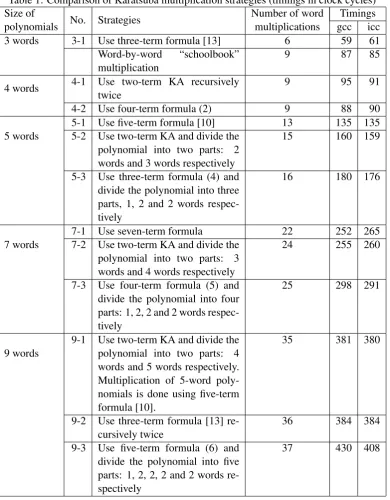
PCLMULQDQ. The strategies are listed in Table 1. The seven-term formula was generated
us-ing moduli polynomials from [10]. We implemented multiplication in the five NIST fields usus-ing
C programming language.
1Although we focus on polynomial multiplication in this paper, in order to compare our
results with [4], we also adapted and implemented the algorithms for fast reduction in the five
NIST fields from [7] for 64-bit word size. The algorithms were also optimized using the double
precision shift instruction, SHLD.
3.1
Programming optimization techniques
Optimization techniques in programming include utilization of Intel SSE and AVX instructions.
The PXOR instruction in SSE2 instruction set provides 128-bit exclusive OR operation while
requiring the same number of clock cycles as 64-bit general purpose instruction XOR,
accel-erating additions. Using 64-bit word size, the PCLMULQDQ instruction produces a 128-bit
product. We used PXOR to perform additions on the products. Although AVX do not provide
a 256-bit integer SIMD instruction for exclusive OR operation, two float-point instructions,
VXORPD and VXORPS, can both o
ff
er the same functionality. Either of them has the same
latency as PXOR, but with larger reciprocal throughput (1 cycle rather than 1
/
3). We also used
VXORPD instead of PXOR in some parts of the code to reduce the number of instructions.
As discussed in Section 2.3, the granularity of additions can be changed. When the
granular-ity is a multiple of 128 bits, additions can be implemented using only 128-bit PXOR instruction.
However, 64-bit XOR instruction must be used when the granularity is an odd multiple of words,
increasing the total number of addition instructions. As a result, the implementation of four-term
formula (2) actually contains fewer addition instructions than the recursive edition. For the same
reason, the formulae with halved granularity were not used in some strategies, including 3-1,
4-2, 5-1 and 7-1 in Table 1.
Polynomial multiplication may benefit from another feature of AVX: non-destructive
in-struction syntax. Traditional Intel x86 inin-structions have destructive syntax, i.e., one of the source
operands is used as the destination operand, with its original value destructed. As a result,
com-pilers often have to insert some extra copy operations to save the original value in other registers,
thus the number of registers needed increases. AVX introduce the non-destructive instruction
syntax for (and only for) SIMD instructions, which adds one more operand as destination. This
instruction syntax can reduce amount of unnecessary copy instructions.
We also analyzed two famous open source libraries which were carefully optimized for
multiplication of small binary polynomials: NTL [15] and gf2x [16], and utilized some useful
1
The source code can be found at the end of this paper.
Table 1: Comparison of Karatsuba multiplication strategies (timings in clock cycles)
Size of
No.
Strategies
Number of word
Timings
polynomials
multiplications
gcc
icc
3 words
3-1
Use three-term formula [13]
6
59
61
Word-by-word
“schoolbook”
multiplication
9
87
85
4 words
4-1
Use two-term KA recursively
twice
9
95
91
4-2
Use four-term formula (2)
9
88
90
5 words
5-1
Use five-term formula [10]
13
135
135
5-2
Use two-term KA and divide the
polynomial into two parts:
2
words and 3 words respectively
15
160
159
5-3
Use three-term formula (4) and
divide the polynomial into three
parts, 1, 2 and 2 words
respec-tively
16
180
176
7 words
7-1
Use seven-term formula
22
252
265
7-2
Use two-term KA and divide the
polynomial into two parts:
3
words and 4 words respectively
24
255
260
7-3
Use four-term formula (5) and
divide the polynomial into four
parts: 1, 2, 2 and 2 words
respec-tively
25
298
291
9 words
9-1
Use two-term KA and divide the
polynomial into two parts:
4
words and 5 words respectively.
Multiplication of 5-word
poly-nomials is done using five-term
formula [10].
35
381
380
9-2
Use three-term formula [13]
re-cursively twice
36
384
384
9-3
Use five-term formula (6) and
divide the polynomial into five
parts: 1, 2, 2, 2 and 2 words
re-spectively
37
430
408
techniques found in these libraries for our implementation, such as interleaved storage of the
two polynomials and aligning the product of two words to 128-bit before performing additions.
3.2
Results and comparisons
We ran the code to get running times of our implementations. The compilers used were GNU
C Compiler 4.6.0 (gcc) and Intel C
++
Compiler 12.0.4 (icc). Compiler intrinsics were used
instead of assembly language for accessing special instructions. Compiler optimization level
was O3, and word size was 64-bit. The target machine was an Intel Sandy Bridge Core i5
2300 (2.80 GHz) that supports PCLMULQDQ and AVX, running Linux with a 2.6.38 kernel.
To obtain more accurate results, the system was run in single-user text mode, with Speedstep
Technology and Turbo Boost Technology of the CPU disabled.
Table 1 presents timings of di
ff
erent implementations. Our experiments show that optimized
implementations using
n
-term formulae for polynomials of
n
words o
ff
er best performance,
s-ince they cost fewest PCLMULQDQ instructions while the increase of additions is acceptable.
For three-word polynomials we also tested an optimized edition of the “schoolbook” method,
and it is much slower than Karatsuba algorithm. The implementation using four-term formula
(2) is slightly better than the recursive edition. Although compilers would perform inlining for
the latter and actually generate non-recursive code, the four-term formula can benefit more from
SIMD instructions and compiler optimization. Three strategies (5-3, 7-3 and 9-3) were
imple-mented using 256-bit AVX instructions in order to reduce the number of addition instructions,
but their performance is still worst due to large amount of multiplications.
Table 2: Comparison between our results and gf2x 1.0 (timings in clock cycles)
Fields
GF
(2
163)
GF
(2
233)
GF
(2
283)
GF
(2
409)
GF
(2
571)
Our
gcc
59
88
135
252
381
fastest
icc
61
90
135
265
380
gf2x [16]
gcc
70
99
159
298
449
The gf2x library (version 1.0) includes routines tailored for multiplying polynomials of sizes
1
∼
9 words, which are also based on PCLMULQDQ instructions and Karatsuba formulae. The
library can only be compiled using gcc. We ran the routines for multiplying 3, 4, 5, 7 and 9-word
polynomials, which are suited for multiplication in the five NIST fields, and list timings of the
fastest ones for each field in Table 2. Our codes take 11%
∼
16% less time than the library.
Table 3: Comparison of field multiplication between our results and [4] (timings in clock cycles)
Platforms
Compilers
GF
(2
233)
GF
(2
409)
Our fastest
Westmere
gcc
126
322
icc
126
304
Sandy Bridge
gcc
115
288
icc
116
300
[4]
Westmere
gcc
128
345
icc
128
348
Sandy Bridge
gcc
100
270
icc
100
273
Table 3 compares best results of field multiplication (polynomial multiplication with
reduc-tion) in
GF
(2
233) and
GF
(2
409) that we implemented with results in [4]. Since the latter were
obtained on both a Westmere processor and a Sandy Bridge processor, we also list timings of
our code run on an Intel Core i5 650 in the table. It is worth noting that Taverne et al. claimed
implementations based on multiple-term Karatsuba formulae had lower performance than
ap-plying the two-term Karatsuba formula recursively in [4], but that is contrary to our results.
Since no source code or detail of implementation is given in their work, we cannot make further
analysis.
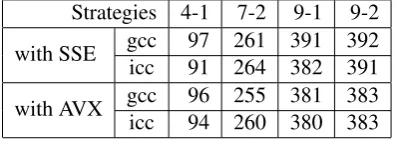
Table 4 shows the running time of codes implementing the same algorithms, but using
dif-ferent instruction sets (with 128-bit SSE instructions and with 256-bit AVX instructions). The
256-bit VXORPD instruction does not bring significant speedup, which we believe is caused by
relatively large reciprocal throughput of the instruction.
Table 5 shows the running time of codes implementing the same algorithms, both using
128-bit SSE instructions, but compiled with -mavx and -msse4.2 options respectively. The former
Table 4: Timings of codes using di
ff
erent instruction sets (in clock cycles)
Strategies
4-1
7-2
9-1
9-2
with SSE
gcc
97
261
391
392
icc
91
264
382
391
with AVX
gcc
96
255
381
383
icc
94
260
380
383
Table 5: Timings of codes using destructive syntax and non-destructive syntax (in clock cycles)
Strategies
3-1
4-2
5-1
7-1
9-1
Non-destructive
gcc
59
88
135
252
381
syntax
icc
61
90
135
260
380
Destructive
gcc
61
96
141
253
390
syntax
icc
63
98
136
267
404
uses non-destructive syntax and must be run on CPU supporting AVX, while the latter uses
destructive syntax and can be run on CPU of previous generation. Codes with non-destructive
syntax are slightly faster, since only SIMD instructions can benefit from it.
4
Conclusions
The utilization of PCLMULQDQ, with some other SIMD instructions, changes the way to
im-plement
GF
(2)[
x
] multiplication in software, making Karatsuba algorithms the best choice for
the NIST fields. In this paper, we give non-recursive four-term Karatsuba formula and improved
three, four and five-term Karatsuba formulae. We discuss di
ff
erent strategies for
implementa-tion and optimizaimplementa-tion of polynomial multiplicaimplementa-tion in the five NIST fields using Intel’s new
instructions and compare running time of codes using the strategies. Experimental results show
that our improved multiple-term Karatsuba formulae have better performance, and the fastest
implementations are better than previous works in [4] and gf2x library. The results also show
that current AVX instructions bring slight speedup to
GF
(2)[
x
] multiplication.
Acknowledgments
The authors would like to thank the reviewers for their valuable comments and suggestions that
helped to improve the presentation of this paper. The work was supported by NSFC under grant
number 60970147 and 973 project No.2010CB328004.
References
[1] R. P. Brent, P. Gaudry, E. Thom´e, P. Zimmermann, Faster multiplication in
GF
(2)[
x
], in:
ANTS-VIII 2008, Vol. 5011 of LNCS, Springer-Verlag, 2008.
[2] A. Fog, Instruction tables: Lists of instruction latencies, throughputs and micro-operation
breakdowns for Intel, AMD and VIA CPUs (2012).
URL
http://www.agner.org/optimize/instruction_tables.pdf
[3] S. Gueron, M. Kounavis, Intel
Rcarry-less multiplication instruction and its usage for
com-puting the GCM mode (2010).
[4] J. Taverne, A. Faz-Hern´andez, D. F. Aranha, F. Rodr´ıguez-Henr´ıquez, D. Hankerson,
J. L´opez, Speeding scalar multiplication over binary elliptic curves using the new
carry-less multiplication instruction, Journal of Cryptographic Engineering 1 (2011) 187–199.
[5] J. L´opez, R. Dahab, High-speed software multiplication in
F
2m, in: INDOCRYPT 2000,
Vol. 1977 of LNCS, Springer-Verlag, 2000.
[6] A. Karatsuba, Y. Ofman, Multiplication of multidigit numbers on automata, Soviet Physics
Doklady 7 (1963) 595.
[7] D. Hankerson, A. Menezes, S. Vanslone, Guide to Elliptic Curve Cryptography,
Springer-Verlag, New York, 2004.
[8] P. L. Montgomery, Five, Six, and Seven-Term Karatsuba-Like Formulae, IEEE
Transac-tions on Computers 54 (2005) 362–369.
[9] H. Fan, M. A. Hasan, Comments on “Five, Six, and Seven-Term Karatsuba-Like
Formu-lae”, IEEE Transactions on Computers 56 (2007) 716–717.
[10] M. Cenk, F. ¨
Ozbudak, Improved Polynomial Multiplication Formulas over
F
2Using
Chi-nese Remainder Theorem, IEEE Transactions on Computers 58 (2009) 572–576.
[11] R. T. Moenck, Practical fast polynomial multiplication, in: the third ACM symposium on
Symbolic and algebraic computation, 1976, pp. 136–148.
[12] D. J. Bernstein, Fast multiplication (2000).
URL
http://cr.yp.to/talks.html#2000.08.14
[13] A. Weimerskirch, D. Stebila, S. C. Shantz, Generic GF(2
m) arithmetic in software and its
application to ECC, in: ACISP 2003, Vol. 2727 of LNCS, Springer-Verlag, 2003.
[14] D. S. Roche, Space- and time-e
ffi
cient polynomial multiplication, in: the 2009
internation-al symposium on Symbolic and internation-algebraic computation, ACM, 2009, pp. 295–302.
[15] V. Shoup, NTL: A library for doing number theory,
http://www.shoup.net/ntl/
(2009).
[16] E. Thom´e, P. Zimmermmann, P. Gaudry, R. Brent, gf2x is a library for multiplying
poly-nomials over the binary field,
https://gforge.inria.fr/projects/gf2x/
(2011).
/*////////////////////////////////////////////////////////////////////////// //
// This is the source code of GF(2)[x] multiplication algorithms // in paper "Impact of Intel's New Instruction Sets on Software // Implementation of GF(2)[x] Multiplication" by C. Su and H. Fan. // The code is licensed under the GNU General Public License: // http://www.gnu.org/licenses/gpl-3.0.txt
//
// Author: Chen Su //
// Platform: Intel Sandy Bridge processors, Linux kernel 2.6.30 or later, 64-bit only // Usage: 1. Save the code as a source file (eg. mul.cpp);
// 2. Use GNU C Compiler (4.5 or later) or Intel C++ Compiler // (11.1 or later) to compile the source:
// g++ -O3 -mpclmul -mavx -static -o mul mul.cpp
// icpc -O3 -ip -inline-level=2 -xAVX -mavx -static -o mul mul.cpp // 3. Run the executable generated.
// You can change some macros and statements to conduct different tests. See the // comments in the code for further information.
///////////////////////////////////////////////////////////////////////////*/
//Macros for compiler intrinsics included (for GCC) #define __SSE3__ 1
#define __SSSE3__ 1 #define __SSE4_1__ 1 #define __PCLMUL__ 1 #define __AVX__ 1
#define _USE_AVX_ 1 //If defined, use 256-bit AVX instructions /*
* To run the code on Westmere processors, comment the two macros above out * and replace "avx" with "sse4.2" in compiler parameters
*/
#include <x86intrin.h> #include <wmmintrin.h> #include <immintrin.h> #include <stdlib.h> #include <stdio.h> #include <string.h> #include <time.h>
//If defined, align on 32 bytes //#define _ALIGN_32_ 1
const int WordLength = sizeof(unsigned long)*8; #define MAX(a,b) (((a)>(b))?(a):(b))
#define MIN(a,b) (((a)<(b))?(a):(b)) #define WINDOW 4
#define pow2(n) ((unsigned long)1 << (n))
//Different copy methods #define MEM_COPY_SET 1 #ifdef PLAIN_COPY_SET
#define _copy(a, b, n) for(int zqa=0; zqa<(n); zqa++) *((a)+zqa) = *((b)+zqa);; #elif defined MEM_COPY_SET
#define _copy(a, b, n) memcpy(a, b, (n)*sizeof(unsigned long)) #else
#define _copy(a, b, n) __movsq(a, b, n) #endif
#ifndef __INTEL_COMPILER #define _PXOR2 1 #endif
#ifdef _PXOR2
#define xor2(a, b, c, n) for(int zqa=0; zqa<(n)-1; zqa+=2) _mm_storeu_si128((__m128i *)((a)+zqa),\ _mm_xor_si128(_mm_loadu_si128((__m128i *)((b)+zqa)), _mm_loadu_si128((__m128i *)((c)+zqa))));\ if((n) & 1) *((a)+(n)-1) = *((b)+(n)-1) ^ *((c)+(n)-1);
#else
#define xor2(a, b, c, n) for(int zqa=0; zqa<(n); ++zqa) *((a)+zqa) = *((b)+zqa) ^ *((c)+zqa);; #endif
//The two intrinsics below are not supported by icc #ifdef __INTEL_COMPILER
inline __m128i _mm_set_epi64x(long long q1, long long q0) {
return _mm_xor_si128(_mm_cvtsi64_si128(q0), _mm_slli_si128(_mm_cvtsi64_si128(q1), 8)); }
inline __m128i _mm_set1_epi64x(long long q) {
} #endif
inline void ui64_m128i(__m128i &v, const unsigned long *i) {
v = _mm_loadu_si128((__m128i *)i); }
inline void m128i_ui64(unsigned long *i, const __m128i &v) {
_mm_storeu_si128((__m128i *)i, v); }
inline void xor_128(__m128i &v, const unsigned long *i) {
__m128i v1 = _mm_loadu_si128((const __m128i *)i); v = _mm_xor_si128(v, v1);
}
inline void xor_128(unsigned long *i, const __m128i &v) {
__m128i v1 = _mm_loadu_si128((__m128i *)i); v1 = _mm_xor_si128(v1, _mm_loadu_si128(&v)); _mm_storeu_si128((__m128i *)i, v1);
/**i ^= _mm_cvtsi128_si64(v); *(i+1) ^= _mm_extract_epi64(v, 1);*/ }
#ifdef __AVX__
inline void xor_256(unsigned long *i, const __m256d &v) {
__m256d v1 = _mm256_loadu_pd((double *)i); v1 = _mm256_xor_pd(v1, v);
_mm256_storeu_pd((double *)i, v1); }
#endif
//Multi-precision shift by SHRD
#define shiftright128(c,a,b,n) __asm__("movq %1, %0; shrd %3, %2, %0;" : "=D"(c) : "r"(a), "r"(b), "J"(n))
// 1-word multiplication
inline void ins_mul1_64(__m128i &a, const unsigned long &b, const unsigned long &c) {
__m128i v1, v2;
v1 = _mm_cvtsi64_si128(b); v2 = _mm_cvtsi64_si128(c);
a = _mm_clmulepi64_si128(v1, v2, 0); }
// 2-word multiplication
#define _SHIFT 1 //Different ways for computing (a0 + a1)(b0 + b1), see below inline void ins_mul2_64(unsigned long *a, const unsigned long *b, const unsigned long *c) {
register __m128i v1, v2; __m128i t1, t2, t3, t4;
ui64_m128i(v1, b); ui64_m128i(v2, c);
t1 = _mm_clmulepi64_si128(v1, v2, 0); t2 = _mm_clmulepi64_si128(v1, v2, 0x11); #ifdef _XOR64
t3 = _mm_cvtsi64_si128(b[0] ^ b[1]); t4 = _mm_cvtsi64_si128(c[0] ^ c[1]); v1 = _mm_clmulepi64_si128(t3, t4, 0); #elif defined _XTR
t3 = _mm_cvtsi64_si128(_mm_cvtsi128_si64(v1) ^ _mm_extract_epi64(v1, 1)); t4 = _mm_cvtsi64_si128(_mm_cvtsi128_si64(v2) ^ _mm_extract_epi64(v2, 1)); v1 = _mm_clmulepi64_si128(t3, t4, 0);
#elif defined _SHIFT
t3 = _mm_xor_si128(v1, _mm_srli_si128(v1, 8)); t4 = _mm_xor_si128(v2, _mm_srli_si128(v2, 8)); v1 = _mm_clmulepi64_si128(t3, t4, 0);
#elif defined _SHUF
t4 = _mm_castpd_si128(_mm_shuffle_pd(_mm_castsi128_pd(v1), _mm_castsi128_pd(v2), 1)); t3 = _mm_xor_si128(v1, t4);
t4 = _mm_xor_si128(v2, t4);
v1 = _mm_clmulepi64_si128(t3, t4, 16); #elif defined _UPK
t3 = _mm_unpackhi_epi64(v1, v2);
t4 = _mm_xor_si128(t3, _mm_unpacklo_epi64(v1, v2)); v1 = _mm_clmulepi64_si128(t4, t4, 1);
#endif
t1 = _mm_xor_si128(t1, _mm_slli_si128(v2, 8)); t2 = _mm_xor_si128(t2, _mm_srli_si128(v2, 8)); m128i_ui64(a, t1);
m128i_ui64(a + 2, t2); }
#define xor_2(x,y,z) _mm_storeu_si128((__m128i *)(x), _mm_xor_si128(_mm_loadu_si128((__m128i *)(y)), \ _mm_loadu_si128((__m128i *)(z))))
#define xor4(a,b) _mm_store_si128(a, _mm_xor_si128(_mm_load_si128(a), _mm_load_si128(b))); \ _mm_store_si128((a+1), _mm_xor_si128(_mm_load_si128(a+1), _mm_load_si128(b+1)));
#ifdef __AVX__
#define xor4_avx(x,y,z) _mm256_storeu_pd((double *)(x), \
_mm256_xor_pd(_mm256_loadu_pd((double *)(y)), _mm256_loadu_pd((double *)(z)))) #if defined _ALIGN_32_
#define xor4a_avx(x,y,z) _mm256_store_pd((double *)(x), \
_mm256_xor_pd(_mm256_load_pd((double *)(y)), _mm256_load_pd((double *)(z)))) #else
#define xor4a_avx xor4_avx #endif
inline __m256d ins_mul_128(const __m256d &b, const __m256d &c, const int imm8) {
register __m128i v1, v2; unsigned long a[4]; __m128i t1, t2, t3, t4;
v1 = _mm256_castsi256_si128(_mm256_castpd_si256(b)); v2 = _mm256_extractf128_si256(_mm256_castpd_si256(c), 1); t1 = _mm_clmulepi64_si128(v1, v2, 0);
t2 = _mm_clmulepi64_si128(v1, v2, 0x11); t3 = _mm_xor_si128(v1, _mm_srli_si128(v1, 8)); t4 = _mm_xor_si128(v2, _mm_srli_si128(v2, 8)); m128i_ui64(a, t1);
m128i_ui64(a + 2, t2); ui64_m128i(v1, a + 1);
m128i_ui64(a + 1, _mm_xor_si128(v1, _mm_xor_si128(_mm_xor_si128(_mm_clmulepi64_si128(t3, t4, 0), t2), t1))); return _mm256_load_pd((double *)a);
} #endif
// 3-word multiplication
inline void ins_mul3_64(unsigned long *a, const unsigned long *b, const unsigned long *c) {
__m128i v1, v2; __m128i t1, t2, t3; __m128i t4, t5, t6, t7, t8;
t3 = _mm_set_epi64x(c[2], b[2]);
t7 = _mm_clmulepi64_si128(t3, t3, 1); //a2b2 t4 = _mm_loadu_si128((__m128i *)b);
t5 = _mm_loadu_si128((__m128i *)c);
t8 = _mm_clmulepi64_si128(t4, t5, 0); //a0b0 t6 = _mm_clmulepi64_si128(t4, t5, 0x11); //a1b1 v1 = _mm_unpacklo_epi64(t4, t5);
v2 = _mm_unpackhi_epi64(t4, t5);
t4 = _mm_xor_si128(v1, v2);
t1 = _mm_clmulepi64_si128(t4, t4, 1); t5 = _mm_xor_si128(t3, v2);
t2 = _mm_clmulepi64_si128(t5, t5, 1); v1 = _mm_xor_si128(v1, t3);
t3 = _mm_clmulepi64_si128(v1, v1, 1);
v1 = _mm_xor_si128(t6, t8); t1 = _mm_xor_si128(t1, v1);
t2 = _mm_xor_si128(t2, _mm_xor_si128(t6, t7)); t3 = _mm_xor_si128(t3, _mm_xor_si128(v1, t7)); t8 = _mm_xor_si128(t8, _mm_slli_si128(t1, 8)); t7 = _mm_xor_si128(t7, _mm_srli_si128(t2, 8)); t3 = _mm_xor_si128(t3, _mm_alignr_epi8(t2, t1, 8)); m128i_ui64(a, t8);
m128i_ui64(a+4, t7); m128i_ui64(a+2, t3); }
//3-word multiplication (naive)
void naive163(unsigned long *c, const unsigned long *a, const unsigned long *b) {
ab0 = _mm_set_epi64x(b[0], a[0]); ab1 = _mm_set_epi64x(b[1], a[1]); ab2 = _mm_set_epi64x(b[2], a[2]); __m128i p, q, r;
p = _mm_clmulepi64_si128(ab0, ab0, 1); _mm_storeu_si128((__m128i *)c, p);
q = _mm_xor_si128(_mm_clmulepi64_si128(ab1, ab1, 1), _mm_clmulepi64_si128(ab0, ab2, 1)); r = _mm_xor_si128(q, _mm_clmulepi64_si128(ab0, ab2, 16));
_mm_storeu_si128((__m128i *)(c+2), r); q = _mm_clmulepi64_si128(ab2, ab2, 1); _mm_storeu_si128((__m128i *)(c+4), q);
xor_128(c+1, _mm_xor_si128(_mm_clmulepi64_si128(ab0, ab1, 1), _mm_clmulepi64_si128(ab0, ab1, 16))); xor_128(c+3, _mm_xor_si128(_mm_clmulepi64_si128(ab2, ab1, 1), _mm_clmulepi64_si128(ab2, ab1, 16))); }
// 4-word multiplication (recursive)
void ins_mul4_64(unsigned long *a, const unsigned long *b, const unsigned long *c) {
unsigned long t1[2], t2[2], t[4]; ins_mul2_64(a, b, c);
ins_mul2_64(a + 4, b + 2, c + 2);
m128i_ui64(t1, _mm_xor_si128(_mm_loadu_si128((__m128i *)b), _mm_loadu_si128((__m128i *)(b+2)))); m128i_ui64(t2, _mm_xor_si128(_mm_loadu_si128((__m128i *)c), _mm_loadu_si128((__m128i *)(c+2)))); ins_mul2_64(t, t1, t2);
__m128i *p = (__m128i *)a, *q = (__m128i *)t; xor4(q, p);
p = (__m128i *)(a+4); xor4(q, p);
p = (__m128i *)(a+2); xor4(p, q);
}
// 4-word multiplication (non-recursive)
void mul4_64_0(unsigned long *a, const unsigned long *b, const unsigned long *c) {
register __m128i v1, v2, t1, t2; __m128i m[9], bc0, bc1, bc2, bc3;
ui64_m128i(v1, b); ui64_m128i(v2, c);
bc0 = _mm_unpacklo_epi64(v1, v2); bc1 = _mm_unpackhi_epi64(v1, v2); ui64_m128i(t1, b+2);
ui64_m128i(t2, c+2);
bc2 = _mm_unpacklo_epi64(t1, t2); bc3 = _mm_unpackhi_epi64(t1, t2); /*
bc[0] = _mm_set_epi64x(c[0], b[0]); bc[1] = _mm_set_epi64x(c[1], b[1]); bc[2] = _mm_set_epi64x(c[2], b[2]); bc[3] = _mm_set_epi64x(c[3], b[3]); */
m[0] = _mm_clmulepi64_si128(bc0, bc0, 1); m[1] = _mm_clmulepi64_si128(bc1, bc1, 1); m[2] = _mm_clmulepi64_si128(bc2, bc2, 1); m[3] = _mm_clmulepi64_si128(bc3, bc3, 1); t1 = _mm_xor_si128(bc0, bc1);
t2 = _mm_xor_si128(bc2, bc3);
m[4] = _mm_clmulepi64_si128(t1, t1, 1); m[5] = _mm_clmulepi64_si128(t2, t2, 1); t1 = _mm_xor_si128(bc0, bc2);
t2 = _mm_xor_si128(bc1, bc3);
m[6] = _mm_clmulepi64_si128(t1, t1, 1); m[7] = _mm_clmulepi64_si128(t2, t2, 1); v1 = _mm_xor_si128(t1, t2);
m[8] = _mm_clmulepi64_si128(v1, v1, 1);
t1 = _mm_xor_si128(m[0], m[1]); t2 = _mm_xor_si128(m[2], m[6]); v1 = _mm_xor_si128(t1, m[4]);
bc0 = _mm_xor_si128(m[0], _mm_slli_si128(v1, 8)); bc1 = _mm_xor_si128(t1, t2);
m128i_ui64(a, bc0);
t1 = _mm_xor_si128(m[2], m[3]); t2 = _mm_xor_si128(m[1], m[7]); v2 = _mm_xor_si128(t1, m[5]); bc2 = _mm_xor_si128(t1, t2);
bc3 = _mm_xor_si128(m[3], _mm_srli_si128(v2, 8)); m128i_ui64(a+6, bc3);
t2 = _mm_xor_si128(_mm_xor_si128(v1, v2), _mm_xor_si128(t1, m[8])); m128i_ui64(a+2, _mm_xor_si128(bc1, _mm_alignr_epi8(t2, v1, 8))); m128i_ui64(a+4, _mm_xor_si128(bc2, _mm_alignr_epi8(v2, t2, 8))); }
// 4-word multiplication (recursive improved)
void mul4_64_1(unsigned long *a, const unsigned long *b, const unsigned long *c) {
unsigned long t1[2], t2[2], t[4]; ins_mul2_64(a, b, c);
ins_mul2_64(a + 4, b + 2, c + 2);
m128i_ui64(t1, _mm_xor_si128(_mm_loadu_si128((__m128i *)b), _mm_loadu_si128((__m128i *)(b+2)))); m128i_ui64(t2, _mm_xor_si128(_mm_loadu_si128((__m128i *)c), _mm_loadu_si128((__m128i *)(c+2)))); ins_mul2_64(t, t1, t2);
__m128i *p = (__m128i *)(a+2), *q = (__m128i *)(a+4);
__m128i v = _mm_xor_si128(_mm_loadu_si128(p), _mm_loadu_si128(q));
__m128i t3, t4; ui64_m128i(t3, a); ui64_m128i(t4, a+6); t3 = _mm_xor_si128(t3, v); t4 = _mm_xor_si128(t4, v); ui64_m128i(v, t);
m128i_ui64(a+2, _mm_xor_si128(t3, v)); ui64_m128i(v, t+2);
m128i_ui64(a+4, _mm_xor_si128(t4, v)); }
// 4-word multiplication (recursive using 256-bit avx) #ifdef __AVX__
void mul4_64_avx(unsigned long *a, const unsigned long *b, const unsigned long *c) {
unsigned long t1[2], t2[2];
#if defined _ALIGN_32_ && defined __INTEL_COMPILER __declspec(align(32))
#endif
unsigned long t[4]; ins_mul2_64(a, b, c);
ins_mul2_64(a + 4, b + 2, c + 2);
m128i_ui64(t1, _mm_xor_si128(_mm_loadu_si128((__m128i *)b), _mm_loadu_si128((__m128i *)(b+2)))); m128i_ui64(t2, _mm_xor_si128(_mm_loadu_si128((__m128i *)c), _mm_loadu_si128((__m128i *)(c+2)))); ins_mul2_64(t, t1, t2);
double *p = (double *)a, *q = (double *)t;
_mm256_store_pd(q, _mm256_xor_pd(_mm256_load_pd(q), _mm256_load_pd(p))); p = (double *)(a+4);
_mm256_store_pd(q, _mm256_xor_pd(_mm256_load_pd(q), _mm256_load_pd(p))); p = (double *)(a+2);
_mm256_storeu_pd(p, _mm256_xor_pd(_mm256_loadu_pd(p), _mm256_load_pd(q))); }
#endif
// 5-word multiplication (strategy 5-1)
void ins_mul5_64(unsigned long *a, const unsigned long *b, const unsigned long *c) {
register __m128i v1, v2, t1, t2; __m128i m[14], bc[5];
bc[0] = _mm_set_epi64x(c[0], b[0]); bc[1] = _mm_set_epi64x(c[1], b[1]); bc[2] = _mm_set_epi64x(c[2], b[2]); bc[3] = _mm_set_epi64x(c[3], b[3]); bc[4] = _mm_set_epi64x(c[4], b[4]);
ui64_m128i(v1, b); ui64_m128i(v2, c);
m[1] = _mm_clmulepi64_si128(v1, v2, 0); m[2] = _mm_clmulepi64_si128(v1, v2, 0x11); ui64_m128i(v1, b+2);
ui64_m128i(v2, c+2);
m[3] = _mm_clmulepi64_si128(v1, v2, 0); m[4] = _mm_clmulepi64_si128(v1, v2, 0x11); m[5] = _mm_clmulepi64_si128(bc[4], bc[4], 1); v1 = _mm_xor_si128(bc[0], bc[1]);
m[10]= _mm_clmulepi64_si128(v2, v2, 1); t1 = _mm_xor_si128(t1, bc[1]);
m[11] = _mm_clmulepi64_si128(t1, t1, 1); v1 = _mm_xor_si128(v1, t2);
m[12] = _mm_clmulepi64_si128(v1, v1, 1); v1 = _mm_xor_si128(v1, bc[2]);
m[13] = _mm_clmulepi64_si128(v1, v1, 1);
_mm_store_si128((__m128i *)a, m[1]);
_mm_store_si128((__m128i *)(a+8), m[5]); m[0] = _mm_xor_si128(m[1], m[2]);
m128i_ui64(a+2, _mm_xor_si128(m[0], _mm_xor_si128(m[7], m[3]))); v1 = _mm_xor_si128(m[0], m[6]);
m[0] = _mm_xor_si128(m[4], m[5]);
m128i_ui64(a+6, _mm_xor_si128(m[0], _mm_xor_si128(m[8], m[3]))); v2 = _mm_xor_si128(m[0], m[9]);
register __m128i t;
t = _mm_xor_si128(m[13], v1); t = _mm_xor_si128(t, v2); t = _mm_xor_si128(t, m[10]); t = _mm_xor_si128(t, m[11]);
_mm_store_si128((__m128i *)(a+4), t);
t = _mm_xor_si128(m[13], m[12]);
m[0] = _mm_xor_si128(_mm_load_si128((__m128i *)(a+2)), t); t = _mm_xor_si128(_mm_load_si128((__m128i *)(a+6)), t); m[0] = _mm_xor_si128(m[0], m[5]);
m[0] = _mm_xor_si128(m[0], m[11]); t = _mm_xor_si128(t, m[1]); t = _mm_xor_si128(t, m[10]); xor_128(a+5, m[0]);
xor_128(a+3, t); xor_128(a+1, v1); xor_128(a+7, v2); }
// 5-word multiplication (strategy 5-2)
void mul5_64_1(unsigned long *c, const unsigned long *a, const unsigned long *b) {
unsigned long t1[3], t2[3], t3[6]; ins_mul3_64(c, a, b);
ins_mul2_64(c + 6, a+3, b+3);
_mm_storeu_si128((__m128i *)t1, _mm_xor_si128(_mm_loadu_si128((__m128i *)a), _mm_loadu_si128((__m128i *)(a+3)))); t1[2] = a[2];
_mm_storeu_si128((__m128i *)t2, _mm_xor_si128(_mm_loadu_si128((__m128i *)b), _mm_loadu_si128((__m128i *)(b+3)))); t2[2] = b[2];
ins_mul3_64(t3, t1, t2); xor2(t3, t3, c, 6); xor2(t3, t3, c + 6, 4); xor2(c + 3, c + 3, t3, 6); }
// 5-word multiplication (strategy 5-2, modified)
void mul5_64_2(unsigned long *c, const unsigned long *a, const unsigned long *b) {
unsigned long t1[3], t2[3], t3[6]; ins_mul3_64(c, a, b);
ins_mul2_64(c + 6, a+3, b+3);
_mm_storeu_si128((__m128i *)t1, _mm_xor_si128(_mm_loadu_si128((__m128i *)a), _mm_loadu_si128((__m128i *)(a+3)))); t1[2] = a[2];
_mm_storeu_si128((__m128i *)t2, _mm_xor_si128(_mm_loadu_si128((__m128i *)b), _mm_loadu_si128((__m128i *)(b+3)))); t2[2] = b[2];
ins_mul3_64(t3, t1, t2);
unsigned long t4[7]; _copy(t4, c, 6);
xor2(t4 + 3, t4 + 3, c + 6, 3); t4[6] = c[9];
xor2(c + 3, t4, t3, 6);
memset(c, 0, 3 * sizeof(unsigned long)); xor2(c, c, t4, 7);
}
// 5-word multiplication (strategy 5-3) #ifdef __AVX__
void mul5_128_avx(unsigned long *c, const unsigned long *a, const unsigned long *b) {
#if defined _ALIGN_32_ && defined __INTEL_COMPILER __declspec(align(32))
#endif
unsigned long t1[4], t2[4], t3[4]; ins_mul2_64(c + 4, a + 2, b + 2); ins_mul1_64(t, a[4], b[4]); m128i_ui64(c + 8, t); xor_2(c, a, a+2); xor_2(c+2, b, b+2); ins_mul2_64(t1, c, c+2);
_mm_store_si128((__m128i *)c, _mm_xor_si128(_mm_loadu_si128((__m128i *)(b+2)), _mm_cvtsi64_si128(b[4]))); _mm_store_si128((__m128i *)(c+2), _mm_xor_si128(_mm_loadu_si128((__m128i *)(a+2)), _mm_cvtsi64_si128(a[4]))); ins_mul2_64(t2, c, c+2);
_mm_store_si128((__m128i *)c, _mm_xor_si128(_mm_loadu_si128((__m128i *)(b)), _mm_cvtsi64_si128(b[4]))); _mm_store_si128((__m128i *)(c+2), _mm_xor_si128(_mm_loadu_si128((__m128i *)(a)), _mm_cvtsi64_si128(a[4]))); ins_mul2_64(t3, c, c+2);
ins_mul2_64(c, b, a);
xor4a_avx(t1, t1, c); xor4a_avx(t1, t1, c+4); xor_2(t2, t2, c+8); xor4a_avx(t2, t2, c+4); xor4a_avx(t3, t3, c); xor_2(t3, t3, c+8); xor4a_avx(c+4, c+4, t3); xor4_avx(c+2, c+2, t1); xor4_avx(c+6, c+6, t2); }
#endif
// 7-word multiplication (strategy 7-1)
void mul7_64_0(unsigned long *a, const unsigned long *b, const unsigned long *c) {
__m128i m[22], bc[7]; __m128i v1, v2;
__m128i t1, t2, t3, t4, t5, t6, t7, t8;
bc[0] = _mm_set_epi64x(c[0], b[0]); bc[1] = _mm_set_epi64x(c[1], b[1]); bc[2] = _mm_set_epi64x(c[2], b[2]); bc[3] = _mm_set_epi64x(c[3], b[3]); bc[4] = _mm_set_epi64x(c[4], b[4]); bc[5] = _mm_set_epi64x(c[5], b[5]); bc[6] = _mm_set_epi64x(c[6], b[6]);
ui64_m128i(v1, b); ui64_m128i(v2, c);
m[1] = _mm_clmulepi64_si128(v1, v2, 0); //p0 m[2] = _mm_clmulepi64_si128(v1, v2, 0x11); //p1
t1 = _mm_xor_si128(v1, _mm_xor_si128(_mm_slli_si128(v1, 8), _mm_cvtsi64_si128(b[2]))); t2 = _mm_xor_si128(v2, _mm_xor_si128(_mm_slli_si128(v2, 8), _mm_cvtsi64_si128(c[2]))); m[4] = _mm_clmulepi64_si128(t1, t2, 0); //p02
m[3] = _mm_clmulepi64_si128(t1, t2, 0x11); //p01 ui64_m128i(v1, b+4);
ui64_m128i(v2, c+4);
m[5] = _mm_clmulepi64_si128(v1, v2, 0); //p4 m[6] = _mm_clmulepi64_si128(v1, v2, 0x11); //p5 t3 = _mm_xor_si128(v1, _mm_set1_epi64x(b[6])); t4 = _mm_xor_si128(v2, _mm_set1_epi64x(c[6])); m[7] = _mm_clmulepi64_si128(t3, t4, 0); //p46 m[8] = _mm_clmulepi64_si128(t3, t4, 0x11); //p56 v1 = _mm_xor_si128(t1, t3);
v2 = _mm_xor_si128(t2, t4);
m[9] = _mm_clmulepi64_si128(v1, v2, 0); //p0246 t5 = _mm_xor_si128(_mm_xor_si128(bc[1], bc[3]), bc[5]); m[16] = _mm_clmulepi64_si128(t5, t5, 1); //p135 t6 = _mm_xor_si128(t5, bc[4]);
m[17] = _mm_clmulepi64_si128(t6, t6, 1); //p1345
m[18] = _mm_clmulepi64_si128(_mm_xor_si128(v1, t5), _mm_xor_si128(v2, _mm_srli_si128(t5, 8)), 0); //p0123456 v1 = _mm_xor_si128(_mm_srli_si128(t1, 8), t3);
v2 = _mm_xor_si128(_mm_srli_si128(t2, 8), t4);
t7 = _mm_xor_si128(_mm_insert_epi64(v1, 0, 1), _mm_slli_si128(v2, 8)); m[15] = _mm_clmulepi64_si128(t7, t7, 1); //p0146
t8 = _mm_xor_si128(t7, bc[3]);
m[10] = _mm_clmulepi64_si128(t8, t8, 1); //p01346 t7 = _mm_xor_si128(bc[3], bc[0]);
t7 = _mm_xor_si128(t7, _mm_srli_si128(t3, 8)); t7 = _mm_xor_si128(t7, _mm_insert_epi64(t4, 0, 0)); m[11] = _mm_clmulepi64_si128(t7, t7, 1); //p0356 t7 = _mm_xor_si128(t7, bc[2]);
m[14] = _mm_clmulepi64_si128(bc[6], bc[6], 1); //p6 t5 = _mm_xor_si128(_mm_xor_si128(bc[2], bc[4]), bc[5]); t6 = _mm_xor_si128(t5, bc[1]);
m[19] = _mm_clmulepi64_si128(t6, t6, 1); //p1245 t7 = _mm_xor_si128(t5, bc[6]);
m[20] = _mm_clmulepi64_si128(t7, t7, 1); //p2456 t5 = _mm_xor_si128(bc[2], bc[3]);
t6 = _mm_xor_si128(t5, _mm_xor_si128(bc[0], bc[4])); m[21] = _mm_clmulepi64_si128(t6, t6, 1); //p0234 t7 = _mm_xor_si128(t5, _mm_xor_si128(bc[1], bc[6])); m[0] = _mm_clmulepi64_si128(t7, t7, 1); //p1236
_mm_store_si128((__m128i *)a, m[1]); _mm_store_si128((__m128i *)(a+12), m[14]); t1 = _mm_xor_si128(m[1], m[2]);
t2 = _mm_xor_si128(m[4], m[13]); t8 = _mm_xor_si128(t1, t2);
_mm_store_si128((__m128i *)(a+2), t8); _mm_store_si128((__m128i *)(a+4), t8); t8 = _mm_xor_si128(t1, m[3]);
xor_128(a+1, t8);
t7 = _mm_xor_si128(t2, m[3]);
_mm_store_si128((__m128i *)(a+6), t7); _mm_store_si128((__m128i *)(a+8), t7);
t5 = _mm_xor_si128(m[6], m[14]); t6 = _mm_xor_si128(m[5], m[7]); t4 = _mm_xor_si128(t5, t6);
_mm_store_si128((__m128i *)(a+10), t4); xor_128(a+11, _mm_xor_si128(t5, m[8])); t3 = _mm_xor_si128(m[8], m[14]); t1 = _mm_xor_si128(m[15], m[17]);
t5 = _mm_xor_si128(m[16], m[9]); v1 = _mm_xor_si128(m[8], m[6]);
xor_128(a+7, _mm_xor_si128(_mm_xor_si128(t7, t5), _mm_xor_si128(_mm_xor_si128(t6, t3), _mm_xor_si128(m[20], t1))));
t1 = _mm_xor_si128(m[12], t1);
v2 = _mm_xor_si128(m[0], _mm_xor_si128(m[19], m[21]));
xor_128(a+5, _mm_xor_si128(_mm_xor_si128(t1, v2), _mm_xor_si128(_mm_xor_si128(t6, t3), _mm_xor_si128(m[2], m[3]))));
xor_128(a+6, _mm_xor_si128(_mm_xor_si128(v1, v2), _mm_xor_si128(m[10], m[20]))); t3 = _mm_xor_si128(m[10], _mm_xor_si128(m[18], m[21]));
xor_128(a+8, _mm_xor_si128(_mm_xor_si128(_mm_xor_si128(m[1], m[6]), t6), _mm_xor_si128(m[0], _mm_xor_si128(t1, t3))));
xor_128(a+4, _mm_xor_si128(_mm_xor_si128(t1, t5), _mm_xor_si128(_mm_xor_si128(m[18], m[20]), _mm_xor_si128(v1, m[19]))));
xor_128(a+9, _mm_xor_si128(_mm_xor_si128(_mm_xor_si128(m[11], m[17]), _mm_xor_si128(m[2], m[19])), _mm_xor_si128(_mm_xor_si128(t4, t2), _mm_xor_si128(t3, t5))));
v1 = _mm_xor_si128(_mm_xor_si128(m[11], m[17]), m[20]); v2 = _mm_xor_si128(_mm_xor_si128(m[0], m[10]), m[12]);
xor_128(a+3, _mm_xor_si128(_mm_xor_si128(t6, m[8]), _mm_xor_si128(_mm_xor_si128(t5, t8), _mm_xor_si128(v1, v2))));
}
// 7-word multiplication (strategy 7-2)
void mul7_64_1(unsigned long *c, const unsigned long *a, const unsigned long *b) {
unsigned long t1[4], t2[4], t3[8]; /*ins_mul4_64*/mul4_64_0(c, a, b); ins_mul3_64(c+8, a+4, b+4);
m128i_ui64(t1, _mm_xor_si128(_mm_loadu_si128((__m128i *)a), _mm_loadu_si128((__m128i *)(a+4)))); m128i_ui64(t1+2, _mm_xor_si128(_mm_loadu_si128((__m128i *)(a+2)), _mm_cvtsi64_si128(*(a+6)))); m128i_ui64(t2, _mm_xor_si128(_mm_loadu_si128((__m128i *)b), _mm_loadu_si128((__m128i *)(b+4)))); m128i_ui64(t2+2, _mm_xor_si128(_mm_loadu_si128((__m128i *)(b+2)), _mm_cvtsi64_si128(*(b+6)))); /*ins_mul4_64*/mul4_64_0(t3, t1, t2);
#ifndef _USE_AVX_ xor2(t3, t3, c, 8); xor2(t3, t3, c + 8, 6); xor2(c + 4, c + 4, t3, 8); #else
_mm256_store_pd((double *)t3, _mm256_xor_pd(*(__m256d *)t3, _mm256_loadu_pd((double *)c)));
_mm256_store_pd((double *)(t3+4), _mm256_xor_pd(*(__m256d *)(t3+4), _mm256_loadu_pd((double *)(c+4)))); _mm256_store_pd((double *)t3, _mm256_xor_pd(*(__m256d *)t3, _mm256_loadu_pd((double *)(c+8)))); _mm_store_si128((__m128i *)(t3+4), _mm_xor_si128(_mm_loadu_si128((__m128i *)(t3+4)),
_mm_loadu_si128((__m128i *)(c+12))));
_mm256_storeu_pd((double *)(c+4), _mm256_xor_pd(_mm256_loadu_pd((double *)(c+4)), *(__m256d *)(t3))); _mm256_storeu_pd((double *)(c+8), _mm256_xor_pd(_mm256_loadu_pd((double *)(c+8)), *(__m256d *)(t3+4))); #endif
}
void mul7_64_2(unsigned long *a, const unsigned long *b, const unsigned long *c) {
unsigned long t1[4], t2[4], t3[4], t[4];
ins_mul2_64(a + 4, b+2, c + 2); ins_mul2_64(a + 8, b + 4, c + 4);
m128i_ui64(a, _mm_xor_si128(_mm_loadu_si128((__m128i *)b), _mm_loadu_si128((__m128i *)(b+2)))); m128i_ui64(a+2, _mm_xor_si128(_mm_loadu_si128((__m128i *)c), _mm_loadu_si128((__m128i *)(c+2)))); ins_mul2_64(t1, a, a+2);
m128i_ui64(a, _mm_xor_si128(_mm_loadu_si128((__m128i *)(b+2)), _mm_loadu_si128((__m128i *)(b+4)))); m128i_ui64(a+2, _mm_xor_si128(_mm_loadu_si128((__m128i *)(c+2)), _mm_loadu_si128((__m128i *)(c+4)))); ins_mul2_64(t2, a, a+2);
m128i_ui64(a, _mm_xor_si128(_mm_loadu_si128((__m128i *)(b+4)), _mm_loadu_si128((__m128i *)(b)))); m128i_ui64(a+2, _mm_xor_si128(_mm_loadu_si128((__m128i *)(c+4)), _mm_loadu_si128((__m128i *)(c)))); ins_mul2_64(t3, a, a+2);
ins_mul2_64(a, b, c);
xor_2(t+2, a+8, a+6); xor_2(t+2, t+2, a+10); xor_2(t, a, a+2); xor_2(t, t, a+4); xor_2(t3, t3, a+6); xor_2(t3, t3, a+8); xor_2(t3+2, t3+2, a+2); xor_2(t3+2, t3+2, a+4);
m128i_ui64((a+2), _mm_load_si128((__m128i *)t)); m128i_ui64((a+4), _mm_load_si128((__m128i *)t)); m128i_ui64((a+6), _mm_load_si128((__m128i *)(t+2))); m128i_ui64((a+8), _mm_load_si128((__m128i *)(t+2))); xor4((__m128i *)(a+4), (__m128i *)t3);
xor4((__m128i *)(a+2), (__m128i *)t1); xor4((__m128i *)(a+6), (__m128i *)t2);
__m128i v1, v2, bc6, bb, cc; ins_mul1_64(v1, b[6], c[6]); m128i_ui64(a+12, v1);
bc6 = _mm_set_epi64x(c[6], b[6]); ui64_m128i(bb, b);
ui64_m128i(cc, c);
v1 = _mm_clmulepi64_si128(bb, bc6, 0x10); v2 = _mm_clmulepi64_si128(cc, bc6, 0);
m128i_ui64((a+6), _mm_xor_si128(_mm_loadu_si128((__m128i *)(a+6)), _mm_xor_si128(v1, v2)));
v1 = _mm_clmulepi64_si128(bb, bc6, 0x11); v2 = _mm_clmulepi64_si128(cc, bc6, 1);
m128i_ui64((a+7), _mm_xor_si128(_mm_loadu_si128((__m128i *)(a+7)), _mm_xor_si128(v1, v2))); ui64_m128i(bb, b+2);
ui64_m128i(cc, c+2);
v1 = _mm_clmulepi64_si128(bb, bc6, 0x10); v2 = _mm_clmulepi64_si128(cc, bc6, 0);
m128i_ui64((a+8), _mm_xor_si128(_mm_loadu_si128((__m128i *)(a+8)), _mm_xor_si128(v1, v2)));
v1 = _mm_clmulepi64_si128(bb, bc6, 0x11); v2 = _mm_clmulepi64_si128(cc, bc6, 1);
m128i_ui64((a+9), _mm_xor_si128(_mm_loadu_si128((__m128i *)(a+9)), _mm_xor_si128(v1, v2))); ui64_m128i(bb, b+4);
ui64_m128i(cc, c+4);
v1 = _mm_clmulepi64_si128(bb, bc6, 0x10); v2 = _mm_clmulepi64_si128(cc, bc6, 0);
m128i_ui64((a+10), _mm_xor_si128(_mm_loadu_si128((__m128i *)(a+10)), _mm_xor_si128(v1, v2)));
v1 = _mm_clmulepi64_si128(bb, bc6, 0x11); v2 = _mm_clmulepi64_si128(cc, bc6, 1);
m128i_ui64((a+11), _mm_xor_si128(_mm_loadu_si128((__m128i *)(a+11)), _mm_xor_si128(v1, v2)));
}
// 7-word multiplication (strategy 7-3, using 256-bit avx) #ifdef __AVX__
void mul7_128_avx(unsigned long *a, const unsigned long *b, const unsigned long *c) {
__m256d v1, v2, t1, t2; __m256d m[9], bc[4];
bc[0] = _mm256_castsi256_pd(_mm256_insertf128_si256(_mm256_castsi128_si256( _mm_loadu_si128((__m128i *)b)), _mm_loadu_si128((__m128i *)c), 1)); bc[1] = _mm256_castsi256_pd(_mm256_insertf128_si256(_mm256_castsi128_si256(
bc[2] = _mm256_castsi256_pd(_mm256_insertf128_si256(_mm256_castsi128_si256( _mm_loadu_si128((__m128i *)(b+4))), _mm_loadu_si128((__m128i *)(c+4)), 1)); bc[3] = _mm256_castsi256_pd(_mm256_insertf128_si256(_mm256_castsi128_si256(
_mm_cvtsi64_si128(b[6])), _mm_cvtsi64_si128(c[6]), 1));
t1 = _mm256_xor_pd(bc[0], bc[1]); t2 = _mm256_xor_pd(bc[2], bc[3]);
ins_mul2_64((unsigned long *)m, (unsigned long *)bc, (unsigned long *)bc + 2);
ins_mul2_64((unsigned long *)(m+1), (unsigned long *)(bc+1), (unsigned long *)(bc+1) + 2); ins_mul2_64((unsigned long *)(m+2), (unsigned long *)(bc+2), (unsigned long *)(bc+2) + 2); ins_mul2_64((unsigned long *)(m+3), (unsigned long *)(bc+3), (unsigned long *)(bc+3) + 2); ins_mul2_64((unsigned long *)(m+4), (unsigned long *)(&t1), (unsigned long *)(&t1) + 2); ins_mul2_64((unsigned long *)(m+5), (unsigned long *)(&t2), (unsigned long *)(&t2) + 2);
t1 = _mm256_xor_pd(bc[0], bc[2]); t2 = _mm256_xor_pd(bc[1], bc[3]); v1 = _mm256_xor_pd(t1, t2);
ins_mul2_64((unsigned long *)(m+6), (unsigned long *)(&t1), (unsigned long *)(&t1) + 2); ins_mul2_64((unsigned long *)(m+7), (unsigned long *)(&t2), (unsigned long *)(&t2) + 2); ins_mul2_64((unsigned long *)(m+8), (unsigned long *)(&v1), (unsigned long *)(&v1) + 2);
_mm_store_si128((__m128i *)a, _mm256_castsi256_si128(_mm256_castpd_si256(m[0])));
_mm_store_si128((__m128i *)a + 1, _mm_xor_si128(_mm256_extractf128_si256(_mm256_castpd_si256(m[0]), 1), _mm256_castsi256_si128(_mm256_castpd_si256(m[1]))));
_mm_store_si128((__m128i *)a + 2, _mm_xor_si128(_mm256_extractf128_si256(_mm256_castpd_si256(m[1]), 1), _mm256_castsi256_si128(_mm256_castpd_si256(m[2]))));
_mm_store_si128((__m128i *)a + 3, _mm_xor_si128(_mm256_extractf128_si256(_mm256_castpd_si256(m[2]), 1), _mm256_castsi256_si128(_mm256_castpd_si256(m[3]))));
_mm_store_si128((__m128i *)a + 4, _mm256_extractf128_si256(_mm256_castpd_si256(m[3]), 1)); __m128i v = _mm_xor_si128(_mm_load_si128((__m128i *)a + 3), _mm_load_si128((__m128i *)a + 4)); _mm_store_si128((__m128i *)a + 6, v);
_mm_store_si128((__m128i *)a + 5, _mm_xor_si128(_mm_load_si128((__m128i *)a + 2), v)); __m128i t = _mm_xor_si128(_mm_load_si128((__m128i *)a + 1), _mm_load_si128((__m128i *)a + 2)); _mm_store_si128((__m128i *)a + 4, _mm_xor_si128(t, v));
xor_128(a + 6, _mm_xor_si128(_mm_load_si128((__m128i *)a), t));
_mm_store_si128((__m128i *)a + 2, _mm_xor_si128(t, _mm_load_si128((__m128i *)a))); xor_128(a + 2, _mm_load_si128((__m128i *)a));
t = _mm_xor_si128(_mm256_extractf128_si256(_mm256_castpd_si256(m[6]), 1), _mm256_castsi256_si128(_mm256_castpd_si256(m[7])));
v = _mm256_extractf128_si256(_mm256_castpd_si256(m[7]), 1);
v1 = _mm256_castsi256_pd(_mm256_insertf128_si256(_mm256_castsi128_si256(_mm_xor_si128(t, _mm256_castsi256_si128(_mm256_castpd_si256(m[6])))), _mm_xor_si128(t, v), 1));
v2 = _mm256_xor_pd(_mm256_xor_pd(v1, m[8]), _mm256_xor_pd(m[4], m[5])); t1 = _mm256_xor_pd(m[5], _mm256_castsi256_pd(_mm256_castsi128_si256(v))); t2 = _mm256_xor_pd(m[4], _mm256_permute2f128_pd(m[6], _mm256_setzero_pd(), 2)); _mm256_storeu_pd((double *)a+2, _mm256_xor_pd(_mm256_loadu_pd((double *)a+2), t2)); _mm256_storeu_pd((double *)a+6, _mm256_xor_pd(_mm256_loadu_pd((double *)a+6), v2)); _mm256_storeu_pd((double *)a+10, _mm256_xor_pd(_mm256_loadu_pd((double *)a+10), t1));
/* Original code (using original 4-term formula) _mm256_storeu_pd((double *)a, m[0]);
_mm_storeu_pd((double *)a+12, _mm256_extractf128_pd(m[3], 0)); t1 = _mm256_xor_pd(m[0], m[1]);
t2 = _mm256_xor_pd(m[2], m[6]);
_mm256_storeu_pd((double *)a+4, _mm256_xor_pd(t1, t2)); v1 = _mm256_xor_pd(t1, m[4]);
_mm256_storeu_pd((double *)a+2, _mm256_xor_pd(_mm256_loadu_pd((double *)a+2), v1)); t1 = _mm256_xor_pd(m[2], m[3]);
t2 = _mm256_xor_pd(m[1], m[7]);
_mm256_storeu_pd((double *)a+8, _mm256_xor_pd(t1, t2)); v2 = _mm256_xor_pd(t1, m[5]);
_mm256_storeu_pd((double *)a+10, _mm256_xor_pd(_mm256_loadu_pd((double *)a+10), v2)); t1 = _mm256_xor_pd(m[6], m[7]);
_mm256_storeu_pd((double *)a+6, _mm256_xor_pd(_mm256_loadu_pd((double *)a+6), _mm256_xor_pd(_mm256_xor_pd(v1, v2), _mm256_xor_pd(t1, m[8]))));
*/} #endif
// 9-word multiplication (strategy 9-1)
void mul9_64_1(unsigned long *c, const unsigned long *a, const unsigned long *b) {
unsigned long t1[5], t2[5];
/*__declspec(align(32))*/ unsigned long t3[10]; ins_mul5_64(c, a, b);
mul4_64_0(c+10, a+5, b+5); #ifndef _USE_AVX_
_mm_storeu_si128((__m128i *)t1, _mm_xor_si128(_mm_loadu_si128((__m128i *)a), _mm_loadu_si128((__m128i *)(a+5))));
_mm_storeu_si128((__m128i *)(t1+2), _mm_xor_si128(_mm_loadu_si128((__m128i *)(a+2)), _mm_loadu_si128((__m128i *)(a+7))));
_mm_storeu_si128((__m128i *)(t2+2), _mm_xor_si128(_mm_loadu_si128((__m128i *)(b+2)), _mm_loadu_si128((__m128i *)(b+7))));
#else
_mm256_store_pd((double *)t1, _mm256_xor_pd(_mm256_loadu_pd((double *)a), _mm256_loadu_pd((double *)(a+5)))); _mm256_storeu_pd((double *)t2, _mm256_xor_pd(_mm256_loadu_pd((double *)b), _mm256_loadu_pd((double *)(b+5)))); #endif
t1[4] = a[4]; t2[4] = b[4];
ins_mul5_64(t3, t1, t2);
#define pxor_assign(x, y) _mm_storeu_si128((__m128i *)(x), _mm_xor_si128(_mm_loadu_si128((__m128i *)(x)), \ _mm_loadu_si128((__m128i *)(y))))
#ifndef _USE_AVX_
pxor_assign(t3+8, c+8);
_mm_storeu_si128((__m128i *)(t3), _mm_xor_si128(_mm_loadu_si128((__m128i *)(t3)), _mm_xor_si128(_mm_loadu_si128((__m128i *)(c)), _mm_loadu_si128((__m128i *)(c+10))))); _mm_storeu_si128((__m128i *)(t3+2), _mm_xor_si128(_mm_loadu_si128((__m128i *)(t3+2)),
_mm_xor_si128(_mm_loadu_si128((__m128i *)(c+2)), _mm_loadu_si128((__m128i *)(c+12))))); _mm_storeu_si128((__m128i *)(t3+4), _mm_xor_si128(_mm_loadu_si128((__m128i *)(t3+4)),
_mm_xor_si128(_mm_loadu_si128((__m128i *)(c+4)), _mm_loadu_si128((__m128i *)(c+14))))); _mm_storeu_si128((__m128i *)(t3+6), _mm_xor_si128(_mm_loadu_si128((__m128i *)(t3+6)),
_mm_xor_si128(_mm_loadu_si128((__m128i *)(c+6)), _mm_loadu_si128((__m128i *)(c+16))))); pxor_assign(c+5, t3);
pxor_assign(c+7, t3+2); pxor_assign(c+9, t3+4); pxor_assign(c+11, t3+6); pxor_assign(c+13, t3+8); #else
__m256d d1 = _mm256_loadu_pd((double *)(t3));
d1 = _mm256_xor_pd(d1, _mm256_loadu_pd((double *)(c))); d1 = _mm256_xor_pd(d1, _mm256_loadu_pd((double *)(c+10)));
__m256d d2 = _mm256_loadu_pd((double *)(t3+4));
d2 = _mm256_xor_pd(d2, _mm256_loadu_pd((double *)(c+4))); d2 = _mm256_xor_pd(d2, _mm256_loadu_pd((double *)(c+14)));
_mm_storeu_si128((__m128i *)(c+13), _mm_xor_si128(_mm_loadu_si128((__m128i *)(c+13)),
_mm_xor_si128(_mm_loadu_si128((__m128i *)(t3+8)), _mm_loadu_si128((__m128i *)(c+8)))));
_mm256_storeu_pd((double *)(c+5), _mm256_xor_pd(_mm256_loadu_pd((double *)(c+5)), d1)); _mm256_storeu_pd((double *)(c+9), _mm256_xor_pd(_mm256_loadu_pd((double *)(c+9)), d2)); #endif
}
#define xor3(a, b, c) _mm_storeu_si128((__m128i *)(a), _mm_xor_si128(_mm_loadu_si128((__m128i *)(b)), \ _mm_loadu_si128((__m128i *)(c)))); *(a+2) = *(b+2) ^ *(c+2);
// 9-word multiplication (strategy 9-2)
void mul9_64_2(unsigned long *a, const unsigned long *b, const unsigned long *c) {
unsigned long t1[6], t2[6], t3[6], t[6];
ins_mul3_64(a + 6, b+3, c + 3); ins_mul3_64(a + 12, b + 6, c + 6); xor3(a, b, b+3);
xor3(a+3, c, c+3); ins_mul3_64(t1, a, a+3); xor3(a, b+3, b+6); xor3(a+3, c+3, c+6); ins_mul3_64(t2, a, a+3); xor3(a, b, b+6); xor3(a+3, c, c+6); ins_mul3_64(t3, a, a+3); ins_mul3_64(a, b, c);
/* Original code (using original 3-term formula) xor3(t+3, a + 12, a+9);
xor3(t+3, t+3, a+15); xor3(t, a, a+3); xor3(t, t, a+6); xor3(t3, t3, a+9); xor3(t3, t3, a+12); xor3(t3+3, t3+3, a+3); xor3(t3, t3, a+6); _copy(a+3, t, 3); _copy(a+6, t, 3); _copy(a+9, t+3, 3); _copy(a+12, t+3, 3); */
#ifndef _USE_AVX_ __m128i v1, v2, v3;
_mm_storeu_si128((__m128i *)(t1), _mm_xor_si128(_mm_loadu_si128((__m128i *)(t1)), _mm_xor_si128(v1, v2))); _mm_storeu_si128((__m128i *)(t2), _mm_xor_si128(_mm_loadu_si128((__m128i *)(t2)), _mm_xor_si128(v3, v2))); _mm_storeu_si128((__m128i *)(t3), _mm_xor_si128(_mm_loadu_si128((__m128i *)(t3)), _mm_xor_si128(v1, v3))); v1 = _mm_loadu_si128((__m128i *)(a+2));
v2 = _mm_loadu_si128((__m128i *)(a+8)); v3 = _mm_loadu_si128((__m128i *)(a+14));
_mm_storeu_si128((__m128i *)(t1+2), _mm_xor_si128(_mm_loadu_si128((__m128i *)(t1+2)), _mm_xor_si128(v1, v2))); _mm_storeu_si128((__m128i *)(t2+2), _mm_xor_si128(_mm_loadu_si128((__m128i *)(t2+2)), _mm_xor_si128(v3, v2))); _mm_storeu_si128((__m128i *)(t3+2), _mm_xor_si128(_mm_loadu_si128((__m128i *)(t3+2)), _mm_xor_si128(v1, v3))); v1 = _mm_loadu_si128((__m128i *)(a+4));
v2 = _mm_loadu_si128((__m128i *)(a+10)); v3 = _mm_loadu_si128((__m128i *)(a+14));
_mm_storeu_si128((__m128i *)(t1+4), _mm_xor_si128(_mm_loadu_si128((__m128i *)(t1+4)), _mm_xor_si128(v1, v2))); _mm_storeu_si128((__m128i *)(t2+4), _mm_xor_si128(_mm_loadu_si128((__m128i *)(t2+4)), _mm_xor_si128(v3, v2))); _mm_storeu_si128((__m128i *)(t3+4), _mm_xor_si128(_mm_loadu_si128((__m128i *)(t3+4)), _mm_xor_si128(v1, v3)));
xor2(a+6, a+6, t3, 6); xor2(a+3, a+3, t1, 6); xor2(a+9, a+9, t2, 6); #else
__m256d d1 = _mm256_loadu_pd((double *)(t1));
d1 = _mm256_xor_pd(d1, _mm256_loadu_pd((double *)(a))); d1 = _mm256_xor_pd(d1, _mm256_loadu_pd((double *)(a+6)));
_mm_storeu_si128((__m128i *)(t1+4), _mm_xor_si128(_mm_loadu_si128((__m128i *)(t1+4)),
_mm_xor_si128(_mm_loadu_si128((__m128i *)(a+4)), _mm_loadu_si128((__m128i *)(a+10)))));
__m256d d2 = _mm256_loadu_pd((double *)(t2));
d2 = _mm256_xor_pd(d2, _mm256_loadu_pd((double *)(a+12))); d2 = _mm256_xor_pd(d2, _mm256_loadu_pd((double *)(a+6)));
_mm_storeu_si128((__m128i *)(t2+4), _mm_xor_si128(_mm_loadu_si128((__m128i *)(t2+4)),
_mm_xor_si128(_mm_loadu_si128((__m128i *)(a+16)), _mm_loadu_si128((__m128i *)(a+10)))));
__m256d d3 = _mm256_loadu_pd((double *)(t3));
d3 = _mm256_xor_pd(d3, _mm256_loadu_pd((double *)(a))); d3 = _mm256_xor_pd(d3, _mm256_loadu_pd((double *)(a+12)));
_mm_storeu_si128((__m128i *)(t3+4), _mm_xor_si128(_mm_loadu_si128((__m128i *)(t3+4)),
_mm_xor_si128(_mm_loadu_si128((__m128i *)(a+4)), _mm_loadu_si128((__m128i *)(a+16)))));
_mm256_storeu_pd((double *)(a+6), _mm256_xor_pd(_mm256_loadu_pd((double *)(a+6)), d3)); xor_2(a+10, a+10, t3+4);
_mm256_storeu_pd((double *)(a+3), _mm256_xor_pd(_mm256_loadu_pd((double *)(a+3)), d1)); xor_2(a+7, a+7, t1+4);
_mm256_storeu_pd((double *)(a+9), _mm256_xor_pd(_mm256_loadu_pd((double *)(a+9)), d2)); xor_2(a+13, a+13, t2+4);
#endif }
// 9-word multiplication (strategy 9-3)
#define mul2_128(x,y) ins_mul2_64((unsigned long *)(x), (unsigned long *)(y), (unsigned long *)(y) + 2) #define set_128(y,x) _mm256_castsi256_pd(_mm256_insertf128_si256(_mm256_castsi128_si256(\
_mm_loadu_si128((__m128i *)(x))), _mm_loadu_si128((__m128i *)(y)), 1)) #ifdef __AVX__
void mul9_128_avx(unsigned long *a, const unsigned long *b, const unsigned long *c) {
__m256d v1, v2, t1, t2; __m256d m[14], bc[5];
bc[0] = set_128(c, b); bc[1] = set_128(c+2, b+2); bc[2] = set_128(c+4, b+4); bc[3] = set_128(c+6, b+6);
bc[4] = _mm256_castsi256_pd(_mm256_insertf128_si256(_mm256_castsi128_si256(_mm_cvtsi64_si128(b[8])), _mm_cvtsi64_si128(c[8]), 1));
mul2_128(m+1, bc+0); mul2_128(m+2, bc+1); mul2_128(m+3, bc+2); mul2_128(m+4, bc+3); mul2_128(m+5, bc+4);
v1 = _mm256_xor_pd(bc[0], bc[1]); mul2_128(m+6, &v1);
v2 = _mm256_xor_pd(bc[0], bc[2]); mul2_128(m+7, &v2);
t1 = _mm256_xor_pd(bc[4], bc[2]); mul2_128(m+8, &t1);
t2 = _mm256_xor_pd(bc[3], bc[4]); mul2_128(m+9, &t2);
v2 = _mm256_xor_pd(v2, bc[3]); mul2_128(m+10, &v2);
t1 = _mm256_xor_pd(t1, bc[1]); mul2_128(m+11, &t1);
![Table 3: Comparison of field multiplication between our results and [4] (timings in clock cycles)](https://thumb-us.123doks.com/thumbv2/123dok_us/1876215.1244304/6.595.149.445.430.557/table-comparison-eld-multiplication-results-timings-clock-cycles.webp)