A New Security Model for Authenticated Key Agreement
Augustin P.Sarr1, PhilippeElbaz–Vincent2, and Jean–ClaudeBajard3
1
Netheos R&D<[email protected]>
1,2Institut Fourier – CNRS, Université Grenoble 1<[email protected]> 3LIP6 – CNRS, Université Paris 6<[email protected]>
Abstract
The Canetti–Krawczyk (CK) and extended Canetti–Krawczyk (eCK) security mo-dels, are widely used to provide security arguments for key agreement protocols. We discuss security shades in the (e)CK models, and some practical attacks unconsi-dered in (e)CK–security arguments. We propose a strong security model which en-compasses the eCK one. We also propose a new protocol, called Strengthened MQV (SMQV), which in addition to provide the same efficiency as the (H)MQV protocols, is particularly suited for distributed implementations wherein a tamper–proof device is used to store long–lived keys, while session keys are used on an untrusted host machine. The SMQV protocol meets our security definition under the Gap Diffie– Hellman assumption and the Random Oracle model.
Keywords: authenticated key agreement, practical vulnerability, strengthened eCK model, SMQV.
1
Introduction
Much of recent research on key agreement deals with provably secure key exchange. Since this approach was pioneered by Bellare and Rogaway [1], different models were proposed [3,
5, 31, 7, 14, 17]. Among these models, the Canetti–Krawczyk (CK) [7] and extended Canetti–Krawczyk (eCK) [17] models (which are incomparable [10, 34]) are considered as “advanced” approaches to capture security of key agreement protocols; and security arguments for recent protocols are usually provided in the (e)CK models.
Broadly, a security model specifies, among other things, what constitutes a security failure, and what adversarial behaviors are being protected against. The aim is that a protocol shown secure, in the model, confines to the minimum the effects of the considered adversarial behaviors. In the CK and eCK models, session specific information leakages are respectively captured using reveal queries onsession statesandephemeral keys, which stores session specific information; the adversary is supposed to interact with parties, and to try to distinguish a session key from a randomly chosen value. A protocol is secure if an adversary controlling communications between parties, cannot distinguish a session key from a random value, unless it makes queries which overtly reveal the session key.
From [30], we have a hybrid security definition, which considers leakages on interme-diate results; however the model cannot be shown to encompass the CK or eCK models. In addition, the security definition from [30] considers intermediate results and ephemeral key leakages in separate settings. In this paper, we propose a strong security definition, the strengthened eCK (seCK) model, which encompasses the eCK model, and considers leakages on intermediate results in computing session keys. We also propose a new proto-col called Strengthened MQV (SMQV). The SMQV protoproto-col provides the same efficiency as the (H)MQV protocols [18,14]. In addition, because of its resilience to intermediate re-sults leakages, SMQV is particularly suited for implementations using a tamper–resistant device, to store the static keys, together with a host machine on which sessions keys are used. In such SMQV implementations, the non–idle time computational effort of the device can be securely reduced to few non–costly operations.
This paper is organized as follows. In section 2 we discuss security shades in the (e)CK models. The protocolP [24] is described as an example of protocol that is formally CK–secure, but practically insecure, unless session identifiers are added with further res-trictions. We also discuss the vulnerability of the NAXOS type protocols to ephemeral Diffie–Hellman (DH) exponent leakages. In section 3 we present the strengthened eCK (seCK) model. In section 4, we describe the SMQV protocol, which meets the seCK security definition, and its building blocks. We conclude in section5.
The following notations are used in this paper: G denotes a multiplicatively written cyclic group of prime orderq generated by G, |q| is the bit length of q; G∗ is the set of
non–identity elements in G. For X ∈ G, the lowercase x denotes the discrete logarithm of X in base G. The identity of a party with public key A is denoted ˆA ( ˆA is supposed to contain A). If ˆA 6= ˆB, we suppose that no substring of ˆA equals ˆB. H is a λ–bit hash function, whereλis the length of session keys, and ¯H is al–bit hash function, where l = (⌊log2q⌋+ 1)/2. The symbol ∈R stands for “chosen uniformly at random in.” The
Computational Diffie–Hellman (CDH) assumption is supposed to hold inG; namely, given U =Gu and V =Gv with U, V ∈RG∗, computing CDH(U, V) =Guv is infeasible.
2
Practical Limitations in the (e)CK Models
In this section, we discuss security shades in the (e)CK models, and the related unconsi-dered attacks. (Please, refer to [10,34] for outlines and comparisons of the CK and eCK models, or [7,17] for details.)
Practical Inadequacy of the CK Matching Sessions Definition. In the CK model, two sessions with activation parameters ( ˆPi,Pˆj, s, role) and ( ˆPj,Pˆs, s′, role′) are said to be
matching if they have the same identifiers (s=s′). The requirement about the identifiers (id) used at a party is that “the session id’s of no two KE sessions in which the party participates are identical” [7]. Session identifiers may, for instance, be nonces generated by session initiators and provided to the peers through the first message in the protocol. In this case, when each party stores the previously used identifiers and verifies at session activation that the session identifier was not used before, the requirement that a party never uses the same identifier twice is achieved.
Unfortunately, when a party, say ˆB, has no mean to be aware of the sessions initiated at the other parties, and intended to it, apart from receiving the initiator’s message, the CK model insufficiently captures impersonations attacks. Consider, for instance, Protocol 1
(whereinH andH2 are digest functions); it is from [24], and is CK–secure under the Gap
Protocol 1 The protocolP
I) At session activation with parameters ( ˆA,B, s), ˆˆ A does the following: (a) Create a session with identifier ( ˆA,B, s,ˆ I).
(b) Choose x∈R[1, q−1].
(c) ComputeX=Gx andt
A=H2(Ba,I, s,A,ˆ B, Xˆ ).
(d) Send ( ˆB,A, s, X, tˆ A) to ˆB.
II) At receipt of ( ˆB,A, s, X, tˆ A), ˆB does the following:
(a) Verify thatX ∈ G∗.
(b) Create a session with identifier ( ˆB,A, s,ˆ R). (c) Computeσ=Ab and verify that t
A=H2(σ,I, s,A,ˆ B, Xˆ ).
(d) Choose y∈R[1, q−1].
(e) ComputeY =Gy,t
B=H2(σ,R, s,B,ˆ A, Yˆ ), andK =H(Xy, X, Y).
(f) Destroy y andσ, and send ( ˆA,B, s,ˆ I, Y, tB) to ˆA.
(g) Complete ( ˆB,A, s,ˆ R) by acceptingK as the session key. III) At receipt of ( ˆA,B, s,ˆ I, Y, tB), ˆA does the following:
(a) Verify the existence of an active session with identifier ( ˆA,B, s,ˆ I). (b) Verify thatY ∈ G∗.
(c) Verify thattB =H2(Ba,R, s,B,ˆ A, Yˆ ).
(d) Compute K=H(Yx, X, Y).
(e) Destroyx, and complete ( ˆA,B, s,ˆ I), by accepting K as the session key.
state is defined to be the ephemeral DH exponent1, while the protocol P is (formally)
CK–secure, its practical security is unsatisfactory, unless session identifiers are added with further restrictions. If session identifiers are nonces generated by initiators, the protocolP practically fails in authentication. As an illustration, consider Attack 1, wherein the attacker impersonates ˆA, exploiting a knowledge of an ephemeral DH exponent used at ˆA.
Attack 1 Impersonation Attack againstP using ephemeral DH exponent leakage
I) At the activation of a session ( ˆA,B, s,ˆ I), the attackerA does the following: (a) Intercept ˆA’s message to ˆB ( ˆB,A, s, X, tˆ A).
(b) Perform a sessionSesssionStateReveal query on ( ˆA,B, s,ˆ I) (to obtain x). (c) Send ( ˆA,B, s,ˆ I,¯1,0|q|) to ˆA, where ¯1 is the identity element in G and 0|q| is the
string consisting of |q|zero bits (as ¯16∈ G∗, ˆA aborts the session ( ˆA,B, s,ˆ I)). II) WhenA decides later to impersonate ˆAto ˆB, it does the following:
(a) Send ( ˆB,A, s, X, tˆ A) to ˆB.
(b) Intercept ˆB’s message to ˆA ( ˆA,B, s,ˆ I, Y, tB).
(c) ComputeK=H(Yx, X, Y).
(d) UseK to communicate with ˆB on behalf of ˆA.
The attacker makes ˆB run a session and derive a key with the belief that its peer is ˆA; in addition, the attacker is able to compute the session key that ˆB derives; in practice, this makes the protocol fail in authentication.
The capture of impersonation attacks based on ephemeral DH leakages is insufficient in the CK–model, unless the matching sessions definition is added with further restrictions.
1[24] does not specify the information contained in a session state. But, since the adversary controls communications between parties, we do not see another non–superfluous definition of a session state, with which ProtocolP can be shown CK–secure; as the protocol is insecure if the session state is defined to beσ=Ab
The reason is that (in a formal analysis) the attacker A cannot use the session at ˆB (in which it impersonates ˆA) as a test session, since the matching session is exposed, while there is no guarantee that (in practice) ˆB would not run and complete such a session. If matching sessions are defined using matching conversations, it becomes clear that Protocol P is formally and practically insecure. Indeed, in this case, a leakage of an ephemeral DH exponent in a session allows an attacker to impersonateindefinitely the session owner to its peer in the exposed session.
On the NAXOS Transformation. In the eCK model [17], all computations performed to derive a session key have to deterministically depend on the ephemeral key, static key, and communication received from the peer.
The design and security arguments of many eCK secure protocols, among which CMQV [33], NAXOS(+, –C) [17, 20, 24], and NETS [19], use the NAXOS transforma-tion [17], which consists in defining the ephemeral DH exponent as the digest of a randomly chosen value and the static private key (of the session owner), and (unnaturally) destroy-ing it after each use. The ephemeral key is then defined to be the random value. However, from a practical perspective, it seems difficult to see how the NAXOS transformation pre-vents leakages on the ephemeral DH exponents. And, in any environment, which does not guarantee that leakages on DH exponents cannot occur, the NAXOS type protocols security is at best unspecified.
Consider, for instance, Protocol2, it is from an earlier version2 of [10]. If the ephemeral keys are defined to be rA and rB (as in the NAXOS security arguments [17]) and the
signature scheme is secure against chosen message attacks, Protocol2can be shown eCK– secure.
Protocol 2 Signed Diffie–Hellman using NAXOS transformation
I) The initiator ˆAdoes the following:
(a) ChooserA∈R[1, q−1], computeX=GH1(rA,a), and destroyH1(rA, a).
(b) Compute σA= SigAˆ( ˆB, X).
(c) Send ( ˆB, X, σA) to ˆB.
II) ˆB does the following: (a) Verify thatX ∈ G∗.
(b) Verify thatσAis valid with respect to ˆA’s public key and the message ( ˆB, X).
(c) ChooserB∈R[1, q−1], computeY =GH1(rB,b), and destroyH1(rB, b).
(d) Compute σB= SigBˆ(Y,A, Xˆ ).
(e) Send (Y,A, X, σˆ B) to ˆA.
(f) Compute K=H2(XH1(rB,b)).
III) ˆA does the following: (a) Verify thatY ∈ G∗.
(b) Verify thatσB is valid with respect to ˆB’s public key and the message (Y,A, X).ˆ
(c) ComputeK=H2(YH1(rA,a)).
IV) The shared session key isK.
The protocol is however insecure if the ephemeral keys are defined to contain the
2
ephemeral DH exponents. As an adversary which (partially3) learnsH1(rA, a) in a session
initiated at ˆA with peer ˆB, can indefinitely impersonate ˆA to ˆB. For this purpose, the attacker replays to ˆB A’s message in the session in whichˆ H1(rA, a) leakage happened
(namely ( ˆB, X, σA)), and computes the session key that ˆB derives, using H1(rA, a) and
the ephemeral public keyY from ˆB.
3
Stronger Security
In this section, we describe the strengthened eCK model, which considers leakages on intermediate results (the values a party may need to compute between messages or before a session key), encompasses the eCK model [17], and provides stronger reveal queries to the attacker.
A common setting wherein key agreement protocols are often implemented is that of a server used together with a (computationally limited) tamper–resistant device, which stores the long–lived secrets. In such a setting, safely reducing the non–idle time com-putational effort of the device, is usually crucial for implementation efficiency. To reduce the device’s non–idle time computational effort, ephemeral keys can be computed on the device in idle–time, or on the host machine when the implemented protocol is ephemeral DH exponent leakage resilient.
In many DH protocols, (C, FH, H)MQV–C [18, 33, 29, 14, 15] and NAXOS(+,–C) [20, 24,17], for instance, the computation of the intermediate results is more costly than that of the ephemeral public key. For these protocols, implementations efficiency is sig-nificantly enhanced when the ephemeral keys are computed on the device, while the in-termediate results, which require expensive on–line computations and session keys are computed on the host machine. Unfortunately the security of the (e)CK–secure protocols, when leakages on the intermediate results are considered is at best unspecified. A security definition which captures attacks based on intermediate result leakages is clearly desirable. The model we propose captures such attacks, together with the attacks captured in the (e)CK models.
Session. We suppose n 6 L(|q|) (for some polynomial L) parties ˆPi=1,···,n supposed
to be probabilistic polynomial time machines and a certification authority (CA) trusted by all parties. The CA is only required to verify that public keys are valid ones (i.e., public keys are only tested for membership inG∗; no proof of possession of corresponding private keys is required). Each party has a certificate binding its identity to its public key. A session is an instance of the considered protocol, run at a party. A session at
ˆ
A (with peer ˆB) can be created with parameter ( ˆA,Bˆ) or ( ˆB,A, m), whereˆ m is an incoming message, supposed from ˆB; ˆAis the initiator if the creation parameter is ( ˆA,B),ˆ otherwise a responder. At session activation, a session state is created to contain the information specific to the session. Each session is identified with a tuple ( ˆPi,Pˆj,out,in, ς),
wherein ˆPi is the session holder, ˆPj is the intended peer, out and in are respectively the
concatenation of the messages ˆPi sends to ˆPj, or believes to be from ˆPj, andς is ˆPi’s role
in the session (initiator or responder). Two sessions with identifiers ( ˆPi,Pˆj,out,in, ς) and
( ˆP′
j,Pˆi′,out′,in′ς′) are said to be matching if ˆPi = ˆPi′, ˆPj′ = ˆPj′,ς 6=ς′, and at completion
in=out′ and out=in′.
3If an adversary partially learns
H1(rA, a), it recovers the remaining part, using Shanks’ baby step
giant step algorithm [32] or Pollard’s rho algorithm [32], if the bits it learns are the most significant ones, or tools from [11] if the leakage is on middle–part bits; recoveringH1(rA, a) from partial leakage requires
For the two–pass DH protocols, each session is denoted with an identifier ( ˆA,B, X, ⋆, ς),ˆ where ˆA is the session holder, ˆB is the peer, X is the outgoing message, ς indicates the role of ˆAin the session (initiator (I) or responder (R)), and⋆ is the incoming messageY if it exists, otherwise a special symbol meaning that an incoming message is not received yet; in that case, when ˆA receives the public key Y, the session identifier is updated to ( ˆA,B, X, Y, ςˆ ). Two sessions with identifiers ( ˆA,B, X, Y,ˆ I) and ( ˆB,A, Y, X,ˆ R) are said to be matching. Notice that the session matching ( ˆB,A, Y, X,ˆ R) can be any session ( ˆA,B, X, ⋆,ˆ I); as X, Y ∈R G∗, a session cannot have (except with negligible probability)
more than one matching session.
Adversary and Security. The adversaryA, is a probabilistic polynomial time machine; outgoing messages are submitted to A for delivery (A decides about messages delivery). A is also supposed to control session activations at each party via the Send(Pˆi,Pˆj) and Send(Pˆj,Pˆi, Y)queries, which make ˆPi initiate a session with peer ˆPj, or respond to the
(supposed) session ( ˆPj,Pˆi, Y, ⋆,I). We suppose that the considered protocol is
imple-mented at a party following one of the approaches hereunder. We suppose also that at each party an untrusted host machine is used together with a tamper–resistant device. Basing our model on these implementation approaches does not make it specific; rather, this reduces the gap that often exists between formal models and practical security. Such modeling techniques, which take into account hardware devices and communication flows between components, were previously used in [6].
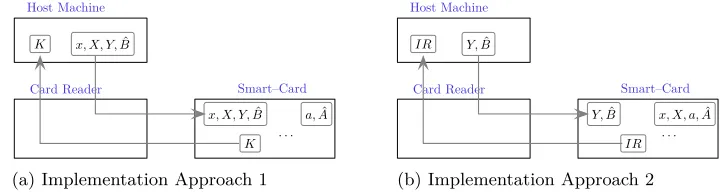
Approach 1. In this approach, the static keys are stored on the device (a smart–card, for instance) the ephemeral keys are computed on the host machine, passed to the smart–card together with the incoming public keys; the device computes the session key, and provides it to the host machine (application) for use. The information flow between the device and the host machine is depicted in Figure (1a). This implemen-tation approach is safe for eCK–secure protocols when ephemeral keys are defined to be ephemeral DH exponents, as a leakage on an ephemeral DH exponent does not compromise the session in which it is used. In addition, when an attacker learns a session key, it gains no useful information about the other session keys.
Host Machine
Card Reader Smart–Card
x, X, Y,Bˆ
x, X, Y,Bˆ a,Aˆ · · · K K
(a) Implementation Approach 1
Host Machine
Card Reader Smart–Card
Y,Bˆ
Y,Bˆ x, X, a,Aˆ · · · IR IR
(b) Implementation Approach 2
Figure 1: Implementation Approaches
except those stored in the party’s tamper–proof device; this should not compromise any unexposed session.
We define two sets of queries, modeling leakages that may occur on either implementation approaches. We consider leakages on ephemeral and static private keys, and also on any intermediate (secret) value which evaluation requires a secret information. As the adversary can compute any information which evaluation requires only public information, considering leakages on such data is superfluous.
In Set 1, which models leakages in the first implementation approach, the following queries are allowed.
• EphemeralKeyReveal(session): this query models leakages on ephemeral DH exponents. • CorruptSC(party): this query models an attacker which (bypasses the eventual tamper
protection mechanisms on the device, and) gains read access to the device’s private memory; it provides the attacker with the device owner’s static private key.
• SessionKeyReveal(session): when the attacker issues this query on an already com-pleted session, it is provided with the session key.
• EstablishParty(party): with this query, the adversary registers a static key on behalf of a party; as the adversary controls communications, from there the party is supposed totally controlled by A. A party against which this query is not issued is said to be
honest.
In Set 2, which models leakages on the second implementation approach, the following queries are allowed; the definitions remain unchanged for the queries belonging also to Set 1.
• For any node in the intermediate results, which computation requires a secret value, a reveal query is defined to allow leakage on the information computed in this node. These queries models leakages that may occur on intermediate results in computing session keys.
• SessionKeyReveal(session). • EstablishParty(party). • CorruptSC(party).
Before defining the seCK security, we define the session freshness notion. Test queries can only be performed on fresh sessions.
Definition 1 (Session Freshness). Let Π be a protocol, and ˆA and ˆB two honest parties, sidthe identifier of a completed session at ˆA with peer ˆB, andsid′ the matching session’s
identifier. The sessionsidis said to be locally exposed if one of the following holds. • Aissues a SessionKeyReveal query onsid.
• The implementation at ˆAfollows the first approach andAissues an EphemeralKeyRe-veal query on sidand aCorruptSC query on ˆA.
• The implementation at ˆA follows the second approach and A issues an intermediate result query on sid.
The sessionsidis said to beexposed if (a) it is locally exposed, or (b) its matching session sid′ exists and is locally exposed, or (c)sid′does not exist andAissues aCorruptSCquery
on the supposed peer ˆB. An unexposed session is said to be fresh.
Our session freshness conditions match exactly the intuition of the sessions one may hope to protect. In particular, it lowers (more than in the eCK model) the necessary adversary restrictions for any reasonable security definition. Notice that only the queries corresponding to the implementation approach followed by a party can be issued on it.
The protocol Π is said to be seCK–secure, if no polynomially bounded adversary can distinguish a fresh session key from a random value, chosen under the distribution of session keys, with probability significantly greater than 1/2.
Forward Secrecy. As shown in [14], no implicitely authenticated two–pass key ex-change protocol can achieve forward secrecy4. Indeed, our security definition captures
weak forward secrecy, which (loosely speaking) is: any session established without an ac-tive involvement of the attacker remains secure, even when the implicated parties static keys are disclosed. The seCK security definition can be completed with the session key expiration notion [7] to capture forward secrecy. Although the protocol we propose can be added with a third message, and yield a protocol which (provably) provides forward secrecy, in the continuation, we work with the security definition without forward secrecy, and focus on two–pass DH protocols.
Relations between the seCK and eCK models. In the eCK model, an adversary
may compromise the ephemeral key, static key, or the session key at a party, independently of the way the protocol is implemented. The seCK model considers an adversary which may (have a malware running at a party’s host machine and) learn all information at the party, except those stored in a tamper–resistant device. The seCK approach seems more prevalent in practice, and reduces the gap that often exists between formal arguments and practical implementations security.
The eCK and seCK session identifiers and matching sessions definitions are the same. When the adversary issues theCorruptSC query at a party, it is provided with the party’s
static key; the CorruptSC query is the same as the eCK StaticKeyReveal query. For a
session between two parties, say ˆA and ˆB, following the first implementation approach, the seCK session freshnessdefinition reduces to the eCK freshness. By assuming that all parties follow the first implementation approach, the seCK–security definition reduces to the eCK one; the seCK model encompasses the eCK one.
Proposition 1. Any seCK–secure protocol is also an eCK–secure one.
The seCK model also separates clearly from the eCK model. The eCK model does not consider leakages on intermediate results; and this makes many of the eCK secure protocols insecure in the seCK model. For instance, in the CMQV protocol (shown eCK– secure), an attacker which learns an ephemeral secret exponent in a session, can indefinitely impersonate the session owner; the same holds for the (H)MQV(–C) protocols [29, 30]. It is not difficult to see that NAXOS cannot meet the seCK security definition. The protocols 1 and 2 from [12, pp. 6, 12] (shown eCK–secure) fail in authentication when leakages one the intermediate results are considered. Indeed an attacker, which learns the ephemeral secret exponentss1 =x+a1 ands2 =x+a2 in a session at ˆA (see the steps 2
and 3 of the protocols 1 and 2 [12]), can indefinitely impersonate ˆA toany party. Notice that the attacker cannot compute ˆA’s static key from s1 and s2, while it is not difficult
to see that leakages ons1 (or s2) and the ephemeral key, in the same session imply ˆA’s
static key disclosure.
The seCK model is practically stronger than the CK model [7]. Key Compromise Im-personation resilience, for instance, is captured in the seCK model while not in CK model. As shown in [9], and illustrated in section 2 with Protocol P, the CK model is enhanced when matching sessions are defined using matching conversations. In addition, the seCK
reveal query definitions go beyond the usual CK session state definition (ephemeral DH exponents). Compared to the CKHMQV model5 [14], the reveal query definitions are
en-hanced in the seCK model to capture attacks based on intermediate result leakages. In the HMQV security arguments [14, subsection 7.4], the session state is defined to contain the ephemeral DH exponent6; the HMQV protocol does not meet the seCK–security [29,30].
4
The Strengthened MQV Protocol
In this section, we present thestrengthenedMQV protocol, and its building blocks, to show that the seCK security definition is useful, and not limiting; as seCK–secure protocols can be built with usual building blocks. We start with the following variants of the FXCR and FDCR signature schemes [29]. The security of the FXCR–1 and FDCR–1 schemes can be shown with arguments similar to that of the FXCR and FDCR schemes [29,30].
Definition 3 (FXCR–1 Signature). Let ˆB be a party with public key B ∈ G∗, and ˆA a verifier; ˆB’s signature on a message m and challenge X provided by ˆA (x ∈R [1, q−1]
is chosen and kept secret by ˆA) is SigBˆ(m, X) = (Y, XsB), where Y =Gy,y ∈R[1, q−1]
is chosen by ˆB, and sB=ye+b, wheree= ¯H(Y, X, m). And, ˆAaccepts the pair (Y, σB)
as a valid signature ifY ∈ G∗ and (YeB)x
=σB.
Proposition 2(FXCR–1 Security). Under the CDH assumption inG and the RO model, there is no adaptive probabilistic polynomial time attacker, which given a public key B, a challenge X0 (B, X0 ∈R G∗), together with hashing and signing oracles, outputs with non–negligible success probability a triple(m0, Y0, σ0) such that:
(1) (Y0, σ0)is a valid signature with respect to the public keyB, and the message–challenge pair (m0, X0); and
(2) (Y0, σ0) was not obtained from the signing oracle with a query on (m0, X0).
Definition 4(FDCR–1 Scheme). Let ˆAand ˆBbe two parties with public keysA, B ∈ G∗,
and m1, m2 two messages. The dual signature of ˆA and ˆB on the messages m1, m2 is
DSigA,ˆBˆ(m1, m2, X, Y) = (XdA)ye+b = (YeB)xd+a, where X = Gx and Y = Gy are
chosen respectively by ˆA and ˆB,d= ¯H(X, Y, m1, m2), ande= ¯H(Y, X, m1, m2).
Proposition 3 (FDCR–1 Security). Let A=Ga, B, X0 ∈R G∗ (A 6=B). Under the RO model, and the CDH assumption inG, givena, A, B, X0, a messagem10, a hashing oracle,
together with a signing oracle (simulating Bˆ’s role), no adaptive probabilistic polynomial time attacker can output, with non–negligible success probability a triple(m20, Y0, σ0) such
that:
(1) DSigA,ˆBˆ(m10, m20, X0, Y0) =σ0; and
(2) (Y0, σ0) was not obtained from the signing oracle with a query on some (m′1, X′) such thatX0 =X′ and(m′1, m′2) = (m10, m20), wherem
′
2is a message returned at signature query on (m′1, X′); (m10, m20) denotes the concatenation of m10 andm20.
The strengthened MQV protocol follows from the FDCR–1 scheme; a run of SMQV is as in Protocol3. The execution aborts if any verification fails.
5CK
HMQVis the variant of the CK model in which the HMQV security arguments are provided; however, it seems that the aim of [14] was not to propose a new model, as it refers to [7] for details [14, p. 9], and considers its session identifiers and matching sessions definition (which make the CK and CKHMQVmodels incomparable) as consistent with the CK model [14, p. 10]. See [10] for a comparison between the CKHMQV and (e)CK models.
Protocol 3 The Strengthened MQV Protocol
I) The initiator ˆAdoes the following:
(a) Choosex∈R[1, q−1] and compute X=Gx.
(b) Send ( ˆA,B, X) to the peer ˆˆ B.
II) At receipt of ( ˆA,B, Xˆ ), ˆB does the following: (a) Verify thatX ∈ G∗.
(b) Choose y∈R[1, q−1] and computeY =Gy.
(c) Send ( ˆB,A, Yˆ ) to ˆA.
(d) Compute d= ¯H(X, Y,A,ˆ B) andˆ e= ¯H(Y, X,A,ˆ B).ˆ (e) ComputesB =ye+b mod q and σ = (XdA)
sB
. (f) Compute K=H(σ,A,ˆ B, X, Yˆ ).
III) At receipt of ( ˆB,A, Yˆ ), ˆA does the following: (a) Verify thatY ∈ G∗.
(b) Compute d= ¯H(X, Y,A,ˆ B) andˆ e= ¯H(Y, X,A,ˆ B).ˆ (c) ComputesA=xd+a mod q, andσ = (YeB)sA.
(d) Compute K=H(σ,A,ˆ B, X, Yˆ ). IV) The shared session key isK.
Remark 1. It may appear that the the SMQV and FHMQV protocols are the same, but this is not the case. Indeed, when implementing the FHMQV or SMQV protocol, it may be desirable to reduce the sensitivity of implementation to side channel attacks [13]. In the second implementation approach, this seems to be more convenient in SMQV than in FHMQV. In fact, in the FHMQV protocol, the static private keys are always multiplied with publicly known digest values, and then potentially sensitive to well–targeted side channel attacks. In the SMQV protocol, the static private keys are only used in an addition, with the second operand (involving the ephemeral private key) used once, and unknown to the attacker. This makes side channel attacks aiming to reveal the static private keys significantly more difficult against SMQV than against FHMQV.
In SMQV, the shared secret σ is the FDCR–1 signature of ˆA and ˆB, on challenges X, Y and messages ˆA,Bˆ(the representation of ˆAand ˆB’s identities). The parties identities and ephemeral keys are used in the final digest computation to make the key replication resilience security attribute immediate (and also to avoid unknown key share attacks). A run of SMQV requires 2.5 times a single exponentiation (2.17 times a single exponentiation when the multiple exponentiation technique [22, Algorithm 14.88] is used); this efficiency equals that of the remarkable (H, FH)MQV protocols. SMQV provides all the security attributes of the (C, H)MQV protocols, added with ephemeral secret exponent leakage resilience.
Moreover, suppose an implementation of SMQV or (C, H)MQV using an untrusted7 host machine together with a device; and suppose that the session keys are used by some applications running on the host machine, and that the ephemeral keys are computed on the device in idle–time. This idle–time pre–computation seems common in practice [28] (and possible in both the (C, H)MQV and SMQV protocols). But, as (C, H)MQV is not ephemeral secret exponent leakage resilient [29, 30], the ephemeral secret exponents (sA = x +da or sB = y +eb) cannot be used on the untrusted host machine. The
exponentiationσ = (Y Be)sA = (XAd)sB has to be performed on the device in non idle– time. In contrast, for SMQV, σ = (YeB)sA = (XdA)sB can be computed on the host
machine, after the ephemeral secret exponent is computed on the device. Because the session key is used on the host machine, and a leakage of only the ephemeral secret exponent, in a SMQV session, does not compromise any other session; there is no need to protect the ephemeral secret exponent more than the session key. In SMQV, the non–idle time computational effort of the device reduces to few non–costly operations (one integer addition, one integer multiplication, and one digest computation), while for (C, H)MQV at least one exponentiation has to be performed on the device in non idle–time.
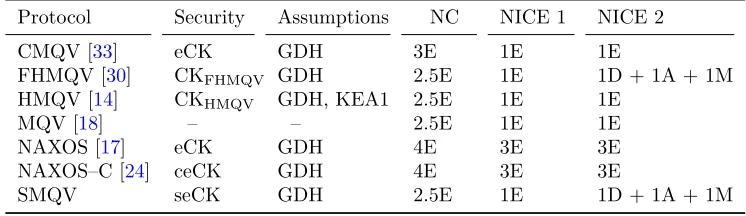
Table 1: Security and Efficiency Comparison between SMQV and other DH protocols.
Protocol Security Assumptions NC NICE 1 NICE 2
CMQV [33] eCK GDH 3E 1E 1E
FHMQV [30] CKFHMQV GDH 2.5E 1E 1D + 1A + 1M
HMQV [14] CKHMQV GDH, KEA1 2.5E 1E 1E
MQV [18] – – 2.5E 1E 1E
NAXOS [17] eCK GDH 4E 3E 3E
NAXOS–C [24] ceCK GDH 4E 3E 3E
SMQV seCK GDH 2.5E 1E 1D + 1A + 1M
Table 1 summarizes the comparisons between SMQV and some other DH protocols. All the security reductions are performed using the Random Oracle model [2]; incom-ing ephemeral keys are validated8. KEA1 stands for “Knowledge of Exponent Assump-tion” [4], CDH and GDH stand respectively for “Computational DH” and “Gap DH” as-sumptions [26]. The ‘A’, ‘D’, ‘E’, and‘M’ stand respectively forinteger addition, digest computation, exponentiation, and integer multiplication. The NC column indicates the
naive count efficiency (i.e., without optimizations from [22, Algorithm 14.88] and [25]); NICE 1 and NICE 2 indicate thenon–idle time computational effort of the device in the two approaches (when ephemeral keys are computed in idle–time).
The MQV protocol has no security reduction9. The FHMQV security arguments are provided in a model which considers intermediate results and ephemeral key leakages in two separate settings; the model implicitly assumes that all parties follow the same im-plementation approach, and cannot be shown to encompass the CK or eCK models. In contrast, the seCK model considers also the security of sessions between parties following different implementation approaches, and its matching sessions definition makes it encom-pass the eCK model. The CMQV and NAXOS protocols are shown eCK–secure, they both use the NAXOS transformation.
The NAXOS–C security arguments are provided in a variant of the eCK model, called
combined eCK model (ceCK) [24], geared to the post–specified peer model. In the post10 model, the identity of a peer may be unknown at session activation (it is learned during the protocol execution). It is worthwhile to mention that, the separation between the pre and post models security seems unclear. The protocol P claimed secure in the pre model, and not executable in the post model (unless “modified in a fundamental way”) [24, section 3.1], is insecure in the pre model, if the considered security model is strong enough.
8Ephemeral key validation is voluntarily omitted in the HMQV design [14], but the HMQV protocol is known to be insecure if ephemeral keys are not validated [23].
9We are aware of [16], which shows that under the RO model and the CDH assumption, the MQV variant whereindandeare computed as ¯H(X) and ¯H(Y), is secure in a model of their own design. But, for this MQV variant, an attacker which findsx0∈[1, q−1] such that ¯H(Gx0) = 0, can impersonateany party toany other party. Finding such anx0 requiresO(2l) digest computations.
The HMQV protocol is executable in the post model, but claimed insecure (in the post– model). In fact, the proposed attack [24, section 3.2] cannot be performed in practice; not because it requires an important on–line computational effort (260 operations, when the order ofG is a 160–bit prime), but since the step (2.c) of the attack cannot be performed without changing the ˆM found at the step (2.b). In practice, ˆM (is a certificate, and) is defined to contain M (which is provided to the certification authority at certificate issuance), and whenM is changed, so is ˆM (notice also that changingM requires another certificate issuance); and then, after the step (2.c) of the attack, the claimed equality between ¯H(X,Mˆ) and ¯H(X,B) does not hold. For the Σˆ 0 protocol, secure in the post
model, while insecure in the pre one [24, section 3.3], the model in which it is shown secure in the post model [8] is not strong enough. It is not difficult to see, for instance, that the Σ0 protocol is both eCK and ceCK insecure.
The SMQV protocol provides more security attributes than the NAXOS(+, –C), (C, H)MVQ protocols, in addition to allow particularly efficient implementations, in environ-ments wherein a tamper proof device is used to store private keys.
Proposition 4. Under the GDH assumption in G and the RO model, the SMQV protocol is seCK–secure.
5
Concluding Remarks
We discussed security shades in the (e)CK moddels. We illustrated the limitations of the CK matching sessions definition; and the insecurity of the NAXOS type protocols when leakages on ephemeral DH exponents are considered. We proposed a new security model, the strengthened eCK model, which encompasses the eCK one, and practically captures the security attributes considered in the CK model. We proposed the Strengthened MQV protocol, which in addition to provide the same efficiency as the (H)MQV protocols, is particularly suited for distributed implementation environments using an untrusted host machine and a tamper–resistant device; in such an environment, the non–idle time computational effort of the device, in a SMQV implementation, reduces to few non–costly operations.
In a forthcoming stage, we will be interested in the enhancement of existing protocols to meet the seCK security definition, and the extension of the strengthened eCK model to consider a wider class of attacks.
References
[1] Bellare M., Rogaway P.: Entity Authentication and Key Distribution. In Proc. of Crypto 93, Lecture Notes in Computer Science, vol. 773, pp. 232–249, Springer–Verlag, 1993. [2] Bellare M., Rogaway P.: Random Oracles are Practical: a Paradigm for Designing Ef-ficient Protocols. In Proc. of the first ACM Conference on Computer and Communications Security, pp. 62–73, ACM, 1993.
[3] Bellare M., Rogaway P.: Provably Secure Session Key Distribution— The Three Party Case. In Proc. of the twenty–seventh annual ACM symposium on Theory of computing, pp. 57– 66, ACM, 1995.
[4] Bellare M., Palacio A.: The Knowledge–of–Exponent Assumptions and 3–round Zero– Knowledge Protocols. In Proc. of Crypto 04, Lecture Notes in Computer Science, vol. 3152, 273–289, Springer–Verlag, 2004.
[6] Bresson E., Chevassut O., Pointcheval D.: Dynamic Group Diffie–Hellman Key Ex-change under Standard Assumptions. In Proc. of Eurocrypt 02, Lecture Notes in Computer Science, vol. 2332, pp. 321–336, Springer–Verlag, 2002.
[7] Canetti R., Krawczyk H.: Analysis of Key–Exchange Protocols and Their Use for Building Secure Channels. In Proc. of Eurocrypt 01, Lecture Notes in Computer Science, vol. 2045, pp. 453–474, Springer–Verlag, 2001.
[8] Canetti R., Krawczyk H.: Security Analysis of IKE’s Signature–based Key–Exchange Protocol. In Proc of Crypto 02, Lecture Notes in Computer Science, vol. 2442, pp. 143–161. Springer–Verlag, 2002.
[9] Choo K.–K. R., Boyd C., Hitchcock Y.: Examining Indistinguishability–Based Proof Models for Key Establishment Protocols. In Proc. of Asiacrypt 05, Lecture Notes in Computer Science, vol 3788, pp. 585-604, Springer–Verlag, 2005.
[10] Cremers C.: Formally and Practically Relating the CK, CK–HMQV, and eCK Security Models for Authenticated Key Exchange. Cryptology ePrint Archive, Report 2009/253, 2009.
[11] Gopalakrishnan K., Thériault N., Yao C. Z.: Solving Discrete Logarithms from Partial Knowledge of the Key. In Proc. of Indocrypt 07, Lecture Notes in Computer Science, vol. 4859, pp. 224–237, Springer–Verlag, 2007.
[12] Kim M., Fujioka A., Ustaoglu B.: Strongly Secure Authenticated Key Exchange without NAXOS’ Approach. In Proc. of the fourth International Workshop on Security, IWSEC 09, Lecture Notes in Computer Science, vol. 5824, pp. 174–191, Springer–Verlag, 2009.
[13] Kocher P.: Timing attacks on implementations of Diffe–Hellman, RSA, DSS, and other systems. Advances in Cryptology – Crypto 96, Lecture Notes in Computer Science, vol. 1109, pp. 104–113, Springer–Verlag, 1996.
[14] Krawczyk H.: HMQV: A Hight Performance Secure Diffie–Hellman Protocol. Cryptology ePrint Archive, Report 2005/176, 2005.
[15] Krawczyk H.: HMQV: A Hight Performance Secure Diffie–Hellman Protocol. In Proc. of Crypto 05, Lecture Notes in Computer Science, vol 3621, pp. 546-566, Springer–Verlag, 2005.
[16] Kunz-Jacques S., Pointcheval D.: About the Security of MTI/C0 and MQV. In proc. of the international conference Security and Cryptography for Networks, SCN 2006, Lecture Notes in Computer Science vol. 4116, pp. 156–172, Springer–Verlag, 2006.
[17] LaMacchia B., Lauter K., Mityagin A.: Stronger Security of Authenticated Key Ex-change. Lecture Notes in Computer Science, vol. 4784, pp. 1–16, Springer–Verlag, 2007.
[18] Law L., Menezes A., Qu M., Solinas J., Vanstone S.: An Efficient protocol for
au-thenticated key agreement,Designs, Codes and Cryptography, vol. 28(2), pp. 119–134, Kluwer
Academic Publishers, 2003.
[19] J. Lee, C. S. Park.An Efficient Authenticated Key Exchange Protocol with a Tight Security
Reduction.Cryptology ePrint Archive, Report 2008/345, 2008.
[20] Lee J., Park J. H.: Authenticated Key Exchange Secure under the Computational Diffe– Hellman Assumption. Cryptology ePrint Archive, Report 2008/344, 2008.
[21] Maurer U. M., Wolf S.: Diffie–Hellman Oracles. In Proc. of Crypto 96, Lecture Notes in Computer Science, vol. 1109, pp. 268–282, Springer–Verlag, 1996.
[22] Menezes A., van Oorschot P., Vanstone S.: Handbook of Applied Cryptography. CRC Press, 1996.
[23] Menezes A., Ustaoglu B.: On the Importance of Public–Key Validation in the MQV and HMQV Key Agreement Protocols. In Proc. of Indocrypt 06, Lecture Notes in Computer Science, vol. 4329, pp. 133-147, Springer–Verlag, 2006.
[24] Menezes A., Ustaoglu B.: Comparing the Pre– and Post–specified Peer Models for Key Agreement. International Journal of Applied Cryptography, vol. 1(3) pp. 236–250, 2009.
[26] Okamoto T., Pointcheval D.: The Gap–Problems: A New Class of Problems for the Security of Cryptographic Schemes. In Proc. of Crypto 96, Lecture Notes in Computer Science, vol. 1992, pp. 104–118, Springer–Verlag, 2001.
[27] Pointcheval D., Stern J.: Security Arguments for Digital Signatures and Blind Signa-tures. Journal of Cryptology, vol. 13, pp. 361–396, Springer New York, 2000.
[28] Schnorr C. P.: Efficient Signature Generation by Smart Cards. Journal of Cryptology, vol. 4(3), pp. 161–174, Springer New York, 1991.
[29] Sarr A. P., Elbaz–Vincent Ph., Bajard J. C.: A Secure and Efficient Authenticated Diffie–Hellman Protocol. To appear in Proc. of EuroPKI’09, 2009.
[30] Sarr A. P., Elbaz–Vincent Ph., Bajard J. C.: A Secure and Efficient Authenticated Diffie–Hellman Protocol (extended version). Cryptology ePrint Archive, Report 2009/408, 2009.
[31] Shoup V.: On Formal Models for Secure Key Exchange. Cryptology ePrint Archive, 1999/012, 1999.
[32] Teske E.: Square–root Algorithms for the Discrete Logarithm Problem (A survey). Public Key Cryptography and Computational Number Theory, pp. 283–301, Walter de Gruyter, 2001
[33] Ustaoglu B.: Obtaining a secure and efficient key agreement protocol from (H)MQV and NAXOS. Designs, Codes and Cryptography, vol. 46(3), pp. 329–342, Kluwer Academic Pub-lishers, 2008.
[34] Ustaoglu B.: Comparing SessionStateReveal and EphemeralKeyReveal for Diffe–Hellman protocols. In Proc. of Provable Security 2009, Lecture Notes in Computer Science, vol. 5848, pp. 183–197, Springer–Verlag, 2009.
A
Security Analysis of the SMQV Protocol
In accordance with our security model, the following session activation queries are allowed. • Send(A,ˆ Bˆ), which makes ˆA perform the step I) of Protocol 3, and create a session
with identifier ( ˆA,B, X, ⋆,ˆ I).
• Send(A,ˆ B, Xˆ ),which makes ˆB perform the stepII) of Protocol3, and create a session with identifier ( ˆB,A, Y, X,ˆ R).
• Send( ˆA,B, X, Yˆ ), which makes ˆA update the session identifier ( ˆA,B, X, ⋆,ˆ I) (if any) to ( ˆA,B, X, Y,ˆ I) and perform the stepIII) of SMQV.
The queries in Set 1 are the following: EphemeralKeyReveal, CorruptSC, SessionKeyRe-veal, and EstablishParty. In Set 2, the allowed queries are: (i) CorruptSC, to obtain the
static private key of a party; (ii)SessionKeyReveal, to obtain a session key; (iii) SecretEx-ponentReveal, to obtain a secret exponents=xd+aorye+b; (iv)SessionSignatureReveal, to obtain a session signatureσ; (v)EstablishParty(party)to register a static public key on behalf of a party.
Recall that an algorithm is said to be a Decisional Diffie–Hellman Oracle (DDHO) if on input G, X = Gx, Y = Gy, and Z ∈
R G, it outputs 1 if and only if Z = Gxy. And
the Gap DH (GDH) assumption [26] is said to hold in G∗ if given a DDHO, there is no
polynomially bounded algorithm, which solves the CDH problem inG, with non–negligible success probability.
A.1 Proof of Proposition 4.
random value chosen under the distribution of session keys. Distinguishing a fresh session key from a random value can be performed only in one of the following ways.
Guessing attack: Aguesses correctly the test session key.
Key replication attack: A succeeds in making two non–matching sessions yield the same session key, it then issues a session key reveal query on one of the sessions, and uses the other as test session.
Forging attack: A computes the session signature σ, and issues a digest query to get the session key.
Under the RO model, guessing and key replications attacks cannot succeed, except with negligible probability. Key replication attacks cannot succeed, as ifX 6=X′, orY 6=Y′, or
ˆ
A6= ˆA′, or ˆB 6= ˆB′, and no substring of ˆAequals ˆB (and conversely) the probability that H(σ,A,ˆ B, X, Yˆ ) equals H(σ′,Aˆ′,Bˆ′, X′, Y′) is negligible. We thus suppose that A
suc-ceeds with non–negligible probability in forging attack. LetEbe the event “Asucceeds in forging the signature of some fresh session (that we designate bysid0 = ( ˆA,B, Xˆ 0, Y0, ς)).”
The event E divides in E.1: “A succeeds in forging the signature of a fresh with match-ing session,” and E.2: “A succeeds in forging the signature of a fresh without matching session.” It suffices to show that neither E.1 nor E.2 can happen with non–negligible11 probability.
Analysis of E.1
Suppose that E.1 occurs with non–negligible probability; at least one of the following events occurs with non–negligible probability.
E.1.1: “E.1∧ both ˆA and ˆB follow the first implementation approach”;
E.1.2: “E.1∧ both ˆA and ˆB follow the second implementation approach”;
E.1.3: “E.1∧ Aˆand ˆB follow different implementation approaches.”
We have to show that none of E.1.1, E.1.2 and E.1.3 can occur, except with negligible probability.
Analysis of E.1.1. Since the test session is required to be fresh, the strongest queries
thatAcan perform on ˆA, ˆB, the test session, and its matching session are (i) CorruptSC
queries on both ˆA and ˆB; (ii) EphemeralKeyReveal queries on both sid0 and sid′0; (iii) a CorruptSC query on ˆA and an EphemeralKeyReveal query on sid′
0; (iv) an Epheme-ralKeyReveal query on sid0 and a CorruptSC query on ˆB. It thus suffices to show that
none of the following events can happen with non–negligible probability since from any polynomial time machine, which succeeds in E.1.1 and performs weaker queries, one can build a polynomial time machine which succeeds with the same probability, and performs one the strongest allowed queries.
E.1.1.1: “E.1.1 ∧ A issues CorruptSC queries on both ˆA and ˆB”;
E.1.1.2: “E.1.1 ∧ A issues EphemeralKeyReveal queries on bothsid0 andsid′0”;
E.1.1.3: “E.1.1 ∧ A issues a CorruptSC query on ˆA and an EphemeralKeyReveal query on sid′0”;
E.1.1.4: “E.1.1∧ Aissues anEphemeralKeyReveal query onsid0 and aCorruptSC query
on ˆB.”
Event E.1.1.1. Suppose that E.1.1.1 occurs with non–negligible probability, using A we
build a polynomial time CDH solver S, which succeeds with non–negligible probability.
11A functionFwith parameter
The solver interacts withAas follows.
(1) S simulates A’s environment, with n parties ˆP1, . . . ,Pˆn, and assigns to each ˆPk a
random static key pair (pk, Pk = Gpk), together with an implementation approach
indication. We only suppose that the number of parties following the first implemen-tation approach is n1 >2. S starts with two empty digest records H1 and H2. Since A is polynomial (in |q|), we suppose that each party is activated at most m times (m, n 6 L(|q|) for some polynomial L). S chooses i, j ∈R {k | Pˆk follows the first
implementation approach}, andt∈R[1, m] (with these choices, S is guessing the test
session). We refer to ˆPi as ˆA and ˆPj as ˆB.
(2) At ¯H digest query on some ̺ = (X, Y,Pˆl,Pˆm), S answers as follows: if there exists
some dsuch that (̺, d) already belongs to H1, S returns d; else, S provides A with d∈R{0,1}l, and appends (̺, d) to H1.
(3) At H digest query on some ψ = (σ,Pˆl,Pˆm, X, Y), S responds as follows: if (ψ, κ)
already belongs toH2, for some κ,S returnsκ; else, S choosesκ∈R{0,1}λ, provides
Awithκ, and appends (ψ, κ) to H2.
(4) At Send( ˆPl,Pˆm) query, S chooses x ∈R [1, q−1], creates a session with identifier
( ˆPl,Pˆm, X, ⋆,I), and provides Awith the message ( ˆPl,Pˆm, X).
(5) At Send( ˆPm,Pˆl, Y) query, S chooses x ∈R [1, q−1], creates a session with identifier
( ˆPl,Pˆm, X, Y,R), providesAwith the message ( ˆPl,Pˆm, X), and completes the session
( ˆPl,Pˆm, X, Y,R) (S also updatesH1 and H2 in this step).
(6) AtSend( ˆPl,Pˆm, X, Y) query,Supdates the identifier ( ˆPl,Pˆm, X, ⋆,I) (if any) tosid=
( ˆPl,Pˆm, X, Y,I). If the sid′ session exists and is already completed, S sets the sid
session key to that of sid′. Else, if a digest query was previously issued on some ψ= (σ,Pˆl,Pˆm, X, Y), and ifσ is thesidsession signature (S can compute the session
signature), S sets the session key to H(ψ). Else, S chooses κ ∈R {0,1}λ, sets the
session key toκ, and updatesH2.
(7) If A issues a CorruptSC, an EphemeralKeyReveal, a SessionKeyReveal, or an Estab-lishParty query at a party following the first implementation approach, S answers faithfully.
(8) IfAissues aCorruptSC, aSessionKeyReveal, aSecretExponentReveal, a SessionSigna-tureReveal, or anEstablishPartyquery at a party following the second implementation approach,S answers faithfully.
(9) At the activation of the t–th session at ˆA, if the peer is not ˆB, S aborts; else, S providesA with ( ˆA,B, Xˆ 0) (recall that S takes as input X0 and Y0 ∈RG∗).
(10) At the activation of the session matching the t–th session at ˆA, S provides A with ( ˆB,A, Yˆ 0).
(11) In any of the following situations,S aborts.
• A halts with a test session different from thet–th session at ˆA.
• Aissues aSessionKeyReveal or anEphemeralKeyReveal query on thet–th session at ˆA or its matching session.
• A issues anEstablishParty query on ˆA or ˆB.
(12) IfA provides a guessσ0 of the test session signature,S outputs
σ0(X0d0A)−bY0−ae0
(d0e0)−1
=(Xd0
0 A)y0e0Y0−ae0
(d0e0)−1
=(Ye0
0 )x0d0+aY0−ae0
(d0e0)−1
The simulated environment is perfect except with negligible probability; and ifA is poly-nomial, so isS. WhenAactivates the test session and its matching session, the ephemeral keysX0andY0 it is provided with are chosen uniformly at random inG∗; their distribution
is the same as that of the real X and Y. The probability of guessing correctly the test session is (n2
1m) −1
; and if S guesses correctly the test session andE.1.1.1 occurs, S does not abort. ThusS succeeds with probability (n2
1m) −1
Pr(E.1.1.1) which is non–negligible, unless Pr(E.1.1.1) is negligible. This shows that under the CDH assumption and RO model,E.1.1.1cannot occur, except with negligible probability.
Event E.1.1.2. If E.1.1.2occurs with non–negligible probability, using A, we build a
poly-nomial time CDH solver, which succeeds with non–negligible probability. For this purpose, we modify the simulation in the analysis of E.1.1.1 as follows.
• S takes as inputA, B ∈RG∗.
• Aˆand ˆB’s public keys are set toAandB; the corresponding private keys are unknown. (S also keeps a list of the completed session identifiers together with the session keys). • At Send( ˆPm,Pˆl, Y) query, with ˆPl= ˆA or ˆB,S responds as follows.
– S chooses x ∈R [1, q−1], computes X = Gx, creates a session with identifier
sid′ = ( ˆPl,Pˆm, X, Y,R), and providesA with the message ( ˆPl,Pˆm, X).
– S chooses κ ∈R{0,1}λ,d, e ∈R{0,1}l and sets ¯H(X, Y,Pˆm,Pˆl) =d, ¯H(Y, X,Pˆm,
ˆ
Pl) =e, and thesid′ session key toκ.
• At Send( ˆPl,Pˆm, X, Y) query, with ˆPl= ˆA or ˆB,S does the following.
– S updates the session identifier ( ˆPl,Pˆm, X, ⋆,I) (if any) tosid= ( ˆPl,Pˆm, X, Y,I).
– And, (i) if a value is already assigned to thesid′ session key,S sets the sidsession key to that of sid′. (ii) Else, if a digest query was previously issued on some ψ = (σ,Pˆl,Pˆm, X, Y), and if σ = CDH(XdPl, YePm) (in this case, d and e are
already defined, and the verification is performed using the DDHO), S sets the sid session key to H(ψ). (iii) Else, S chooses κ ∈R {0,1}λ, and sets the sid
session key toκ; if no value was previously assigned toh1 = ¯H(X, Y,Pˆl,Pˆm) (resp.
h2= ¯H(Y, X,Pˆl,Pˆm)), S chooses d∈R{0,1}l and setsh1=d(resp.h2=d). • At A’s digest query on ψ = (σ,Pˆl,Pˆm, X, Y), with ˆPl = ˆA or ˆB, or ˆPm = ˆA or ˆB,
S responds as follows.
– If there is some κ such that (ψ, κ) already belongs toH2,S returns κ.
– Else, (i) if there is an already completed session with identifiersid= ( ˆPl,Pˆm, X, Y,I)
orsid′, and ifσ =CDH(XdP
l, YePm), thenS returns the completed session’s key.
(ii) Else,S choosesκ∈R{0,1}λ, setsH(ψ) =κ, and providesAwithκ; if no value
was previously assigned to h1 = ¯H(X, Y,Pˆl,Pˆm) (resp. h2 = ¯H(Y, X,Pˆl,Pˆm)),
S choosesd∈R{0,1}l and sets h1=d(resp. h2=d).
• When Aactivates the t–th session at ˆA, if the peer is not ˆB,S aborts; elseS chooses x0 ∈R[1, q−1], and providesA with the message ( ˆA,B, Xˆ 0 =Gx0).
• WhenAactivates the session matching thet–th session at ˆA,Schoosesy0,∈R[1, q−1],
and providesA with ( ˆB,A, Yˆ 0 =Gy0).
• If A issues an EphemeralKeyReveal query on the t–th session at ˆA or its matching session,S answers faithfully.
• S aborts in any of the following situations:
– A halts with a test session different from thet–th session at ˆA;
– Aissues aSessionKeyReveal query on thet–th session at ˆAor its matching session;
– A issues aCorruptSC or an EstablishParty query on ˆAor ˆB;
• IfAhalts with a guessσ0fo the test session signature,Soutputs a guess ofCDH(A, B)
Under the RO model, the simulation remains perfect, except with negligible probabil-ity. And, ifE.1.1.2occurs with non–negligible probability,Asucceeds with non–negligible probability under this simulation. If A succeeds andS guesses correctly the test session (this happens with probability (n2
1m)−1Pr(E.1.1.2)), S outputs CDH(A, B). Under the
GDH assumption and the RO model,E.1.1.2 cannot occur, unless with negligible proba-bility.
Events E.1.1.3and E.1.1.4. The roles of ˆAand ˆB inE.1.1.3andE.1.1.4are symmetrical;
it then suffices to discussE.1.1.3. If E.1.1.3 occurs with non–negligible probability, using A, we build a polynomial time CDH solver which succeeds with non–negligible probability. We modify the simulation in the analysis if E.1.1.1as follows.
• S takes as inputX0, B∈RG∗.
• B’s public key is set toˆ B (the corresponding private key is unknown), and ˆA’s key pair is (a=pi, Ga), pi∈R[1, q−1].
• AtSend( ˆPm,B, Xˆ ) query,S responds as follows. (i)Schoosesy∈R[1, q−1], computes
Y =Gy, creates a session with identifier sid′ = ( ˆB,Pˆm, Y, X,R), and providesA with
the message ( ˆB,Pˆm, Y). (ii) S chooses κ ∈R {0,1}λ, d, e ∈R {0,1}l, sets the sid′
session key toκ, ¯H(X, Y,Pˆm,B) =ˆ d, and ¯H(Y, X,Pˆm,Bˆ) =e.
• At Send( ˆB,Pˆm, Y, X) query:
– S updates the session identifier ( ˆB,Pˆm, Y, ⋆,I) (if any) to sid= ( ˆB,Pˆm, Y, X,I).
– And, (i) if a value is already assigned to thesid′ session key,S sets the sidsession
key to that of sid′. (ii) Else, if a digest query was previously issued on some ψ = (σ,B,ˆ Pˆm, Y, X) (in this case, dand eare defined) and ifσ =CDH(XdPm, YeB),
S sets thesid session key toH(ψ). (iii) Else,S choosesκ∈R{0,1}λ and sets the
sid session key to κ; if no value was previously assigned to h1 = ¯H(Y, X,B,ˆ Pˆm)
(resp.h2= ¯H(X, Y,B,ˆ Pˆm)),S choosesd∈R{0,1}l and setsh1=d(resp.h2 =d). • AtA’s digest query on someψ= (σ,Pˆl,Pˆm, X, Y), with ˆPl= ˆBor ˆPm= ˆB,Sresponds
as follows. (i) If the same query was previously issued, S returns the previously returned value. (ii) Else, if there is an already completed session with identifiersid= ( ˆPl,Pˆm, X, Y,I) or sid′, and if σ = CDH(XdPl, YePm), S returns the completed
session’s key. (iii) Else, S chooses κ ∈R {0,1}λ, sets H(ψ) = κ, and provides A
with κ. If no value was previously assigned to h1 = ¯H(X, Y,Pˆl,Pˆm) (resp. h2 =
¯
H(Y, X,Pˆl,Pˆm)), S chooses d∈R{0,1}λ and sets h1=d(resp. h2 =d).
• When A activates the t–th session at ˆA, if the peer is not ˆB, S aborts; otherwise, S providesA with ( ˆA,B, Xˆ 0) (recall the solver takes as inputX0 and B).
• WhenAactivates the session matching thet–th session at ˆA,Schoosesy0 ∈R[1, q−1],
and providesA with ( ˆB,A, Yˆ 0).
• If A issues an EphemeralKeyReveal query on the session matching the t–th session at ˆA,S answers faithfully.
• In any of the following situations, S aborts.
– A halts with a test session different from thet–th session at ˆA.
– A issues aCorruptSC query on ˆB or an EstablishParty query on ˆAor ˆB.
– A issues anEphemeralKeyReveal query on thet–th session at ˆA.
• IfAhalts with a guessσ0,Sproduces
σ0(X0d0A) −y0e0
B−ae −1 0
as a guess forCDH(X0, B).
suc-ceeds with non–negligible probability inE.1.1.3,S outputs with non–negligible probability CDH(X0, B), contradicting the GDH assumption.
None of the events E.1.1.1, E.1.1.2, E.1.1.3 or E.1.1.4 can occur with non–negligible probability;E.1.1cannot occur, unless with negligible probability.
Analysis of E.1.2. Suppose thatE.1.2occurs with non–negligible probability, we derive
from A a polynomial time CDH solver which succeeds with non–negligible probability. The strongest queries thatS can issue on ˆA, ˆB, the test session and its matching session are CorruptSC queries on both ˆA and ˆB. (Recall that both ˆA and ˆB follow the second
approach). We modify the simulation in the analysis of E.1.1.1as follows. • S takesX0, Y0 ∈RG∗ as input.
• A’s environment, is simulated in the same way as in the analysis of E.1.1.1, except that i and j are chosen in {k |Pˆk follows the second implementation approach} (we
suppose here thatn−n1 >2, and still refer to ˆPi as ˆA and ˆPj as ˆB).
• S aborts in the following situations.
– A issues anEstablishParty query on ˆA or ˆB.
– A halts with a test session different from thet–th session at ˆA.
– A issues aSessionKeyReveal, aSecretExponentReveal, or aSessionSignatureReveal
query on the test session or its matching session.
The simulation remains prefect, and ifA is polynomial, so isS. In addition, S guesses correctly the test session with probability ((n−n1)2m)−1; and ifAsucceeds andSguesses
correctly the test session, it outputsCDH(X0, Y0) (fromA’s forgerya, b, d0ande0). S
suc-ceeds with probability ((n−n1)2m)−1Pr(E.1.2) which is non–negligible, unless Pr(E.1.2)
is negligible. Under the GDH assumption and the RO model, E.1.2 cannot occur with non–negligible probability.
Analysis of E.1.3. InE.1.3 ( ˆA and ˆB follow different implementation approaches),
ei-ther ˆA or ˆB follows the first implementation approach; we suppose that ˆA follows the first implementation approach. (As the test session’s matching session exists, from any polynomial time machine which succeeds in E.1.3 when ˆA follows the first approach, one can derive a polynomial time machine which succeeds with the same probability when ˆA follows the second approach.) The strongest queries that A can perform on ˆA, ˆB, the test session, and its matching session are (i) CorruptSC queries on both ˆA and ˆB, (ii) an EphemeralKeyReveal query on the test session and a CorruptSC query on ˆB. And, since
from any polynomial time machine which succeeds in E.1.3, and issues weaker queries, one can build a polynomial time machine which succeeds with the same probability and performs one of the above strongest queries, it suffices to consider the following events.
E.1.3.1: “E.1.3 ∧ A issuesCorruptSC queries on both ˆA and ˆB”;
E.1.3.2:“E.1.3∧ Aissues anEphemeralKeyRevealquery on the test session and aCorruptSC
query on ˆB.”
To show thatE.1.3.1cannot occur with non–negligible probability, we use the simulation in the analysis of E.1.1.1, modified as follows.
• The environment remains the same except that i ∈R {k | Pˆk follows the first
imple-mentation approach}, andj∈R{k|Pˆk follows the second implementation approach}.
• S aborts in any of the following situations.
– A halts with a test session different from thet–th session at ˆA.