Sandeep Katta
Department of Computer Science, Oklahoma State University Stillwater, OK 74078
ABSTRACT: Visual Cryptography is a secret sharing scheme that uses the human visual system
to perform computations. This paper presents a recursive hiding scheme for 3 out of 5 secret sharing. The idea used is to hide smaller secrets in the shares of a larger secret without an expansion in the size of the latter.
KEYWORDS: visual cryptography, secret sharing, recursive hiding of secrets, information
efficiency, 3 out of 5 secret sharing.
1. INTRODUCTION
Secret sharing was invented independently by G.R. Blakley and Adi Shamir [2, 12]. It was generalized to visual cryptography by Moni Naor and Adi Shamir [1]. The basic model for visual sharing of the k out of n secret image is such that;
Any n participants can compute the original message if any k (or more) of them are stacked together.
No group of k-1 (or fewer) participants cannot compute the original message.
Images are split into two or more shares such that when a predetermined number of shares are aligned and stacked together, then the secret image is revealed [1, 3] without any computation.
Recursive hiding of secrets is proposed in [4, 5, 16-18]. The idea involved is recursive hiding of smaller secrets in shares of larger secrets with secret sizes increasing at every step. While the scheme presented in [4] is a non-threshold scheme, schemes in [5, 16-19] are threshold schemes. In [16], a tree data structure is used for recursive encoding of text such that the internal nodes of the tree also carry information in addition to leaves of the tree. Repeated application of Shamir‟s scheme is used in [17] to share k-1 secrets in n shares. However, the general threshold recursive schemes in [16-19] are not visual cryptography schemes. The scheme in [5], although a recursive visual cryptography scheme, is restricted to 2-out-of-n scheme. In this article, we take a step further and present a 3-out-of-5 recursive scheme for visual secret sharing.
2
2. BASIC MODEL
In visual secret sharing, the message bit consists of a collection of black and white pixels and each pixel is handled separately.
Each pixel in the original image appears in “n” modified versions, one for each transparency and they are called shares.
Each share is a collection of “m” black and white subpixels.
The resulting picture can be thought as a [n × m] Boolean matrix S = [Sij]
Sij = 1 if the 𝑗𝑡ℎ subpixel in the 𝑖𝑡ℎ share is black.
Sij = 0 if the 𝑗𝑡ℎ subpixel in the 𝑖𝑡ℎ share is white.
Preliminary Notation
n → Group Size
k → Threshold
m → Pixel Expansion
α → Relative Contrast
C0 → Collection of n × m Boolean matrices for shares of White pixel
C1 → Collection of n × m Boolean matrices for shares of Black pixel
V → OR‟ed k rows
H(V) → Hamming weight of V
d → number in [1,m]
r → Size of collections C0and C1
Definition 1. A solution to the k out of n visual secret sharing scheme consists of two collections
of n x m Boolean matrices C0and C1. To share a white pixel, one of the matrices in C0 is
randomly chosen and to share a black pixel, one of the matrices in C1 is randomly chosen. The
chosen matrix defines the color of the m subpixels in each one of the n transparencies. The solution is considered valid if the following three conditions are met [1].
Contrast
For S in C0 (WHITE): H(V) ≤ d – αm For S in C1 (BLACK): H(V) ≥ d
Security
3
Properties of “3” out of “n” scheme, (n ≥ 3)
Pixel Expansion, m = 2n – 2.
Relative Contrast, α = 1 2𝑛− 2.
Let B be the black n × (n-2) matrix which contains only 1‟s.
Let I be the Identity n × n matrix which contains 1‟s on the diagonal and 0‟s elsewhere.
BI is an n × (2n-2) concatenated matrix.
C(BI) is the complement of BI.
C0 contains matrices obtained permuting columns of C(BI).
C1 contains matrices obtained permuting columns of BI.
Any single share contains an arbitrary collection of (n-1) black & (n-1) white subpixels.
Any pair of shares has (n-2) common black & two Individual black subpixels.
Any stacked triplet of shares from C0 has n black subpixels. Any stacked triplet of shares C1 has (n+1) black subpixels.
Based upon the following properties we can design the matrix for “3” (k) out of “5” (n) scheme.
B = n × (n-2) → 5 × (5-2) = 5 × 3
1 1 1
1 1 1
1 1 1
1 1 1
1 1 1
5 × 3 I = n × n = 5 × 5
1 0 0 0 0
0 1 0 0 0
0 0 1 0 0
0 0 0 1 0
0 0 0 0 1
5 × 5
Two collections of n × m Boolean matrices C0and C1.
m = 2n – 2 → 2(5) – 2 = 8
5 × 8 Boolean matrices.
0 0 0 0 1 1 1 1 → Share1
0 0 0 1 0 1 1 1 → Share2
C(BI) = 0 0 0 1 1 0 1 1 → Share3
0 0 0 1 1 1 0 1 → Share4
0 0 0 1 1 1 1 0 → Share5
4 Hamming weight of C(BI) i.e. is White H(V) = 5
1 1 1 1 0 0 0 0 → Share1
1 1 1 0 1 0 0 0 → Share2
BI = 1 1 1 0 0 1 0 0 → Share3
1 1 1 0 0 0 1 0 → Share4
1 1 1 0 0 0 0 1 → Share5
5 × 8 [1] [2] [3] [4] [5] [6] [7] [8]
Hamming weight of BIi.e. is Black H(V) = 8
C0 = {all the matrices obtained by permuting the columns of C(BI)}
C1 = {all the matrices obtained by permuting the columns of BI}
If the columns are not permuted then there is a possibility to reveal the secret information in any single share and therefore the process fails.
For example here are few different permutations.
{[1] [8] [2] [7] [3] [6] [4] [5]}
{[2] [4] [6] [8] [1] [3] [5] [7]}
{[3] [2] [1] [8] [7] [6] [4] [5]}
{[5] [8] [1] [6] [2] [3] [7] [4]}
Shares of a white Pixel
5
Shares of a Black Pixel
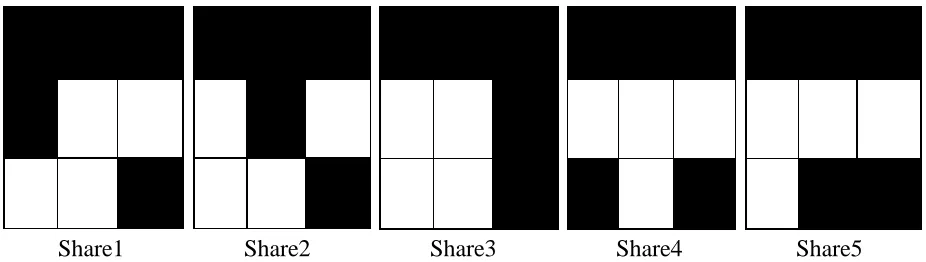
Share1 Share2 Share3 Share4 Share5
Figure 1. Partitions for black and white pixels
Superimposition of white and black pixels is shown below.
Any single share contains 4 black and 4 white pixels, so to make it a complete square array without distorting their aspect ratio, we need to add one more pixel. It should be either black or white.
White Pixel → [0]
Black Pixel → [1]
Figure 2. First Secret Image
Figure 2 is an example that shows how to transform the original pixels according to the shares we have designed; by this way we can maintain the aspect ratio of the image. These are the matrices for white and black pixels while we go for simulation.
000 111
White Pixel → [0] → 000 Black Pixel → [1] → 111
6
3. RECURSIVE INFORMATION HIDING IN 3 OUT OF 5 SCHEME
Recursive information hiding is a technique where certain additional secret information can be hidden in one of the shares of the original secret image [4]. Here the secret information which we are going to hide is taken according to their sizes i.e. small images to larger. The first small secret image is divided into five different shares using visual cryptography. These shares are placed in the next level to create the shares of larger secret information. We are distributing the shares at each consecutive level so that no one has access to all the shares of the smaller images, unless until at least three participants come together to reveal the secret information, resulting in 3 out of 5 scheme.
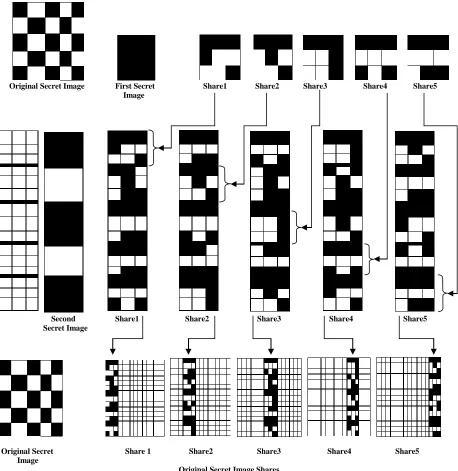
Figure 3, is an example to help readers to understand the concept visually. The original secret image under consideration is of size 5 × 5 and the first secret image is of size 1 × 1. There are totally five shares obtained for the first secret image based on the basic idea of visual cryptography. The second secret image is of size 5 × 1. To obtain the second secret image we are going to use the shares of first secret image and they are placed in different levels (level 1-5) one after the other in five different shares. Now the shares of second secret image are designed by seeing the shares of first secret image and the original second secret image.
From Figure 3, we can see share 2 of the first secret image is placed on share 2 of the second secret image (level 2), and this share is a part of complete black pixel. The original second secret image has a complete white pixel under level 2, so we need to design all the shares of level 2 of second secret image by comparing both the shares of first secret image and the original second secret image to get a partial white pixel when we combine all the 5 shares or at least 3 shares in our case. This process is recursively repeated for all the shares. By doing this we can obtain the information of original second secret image by combining any 3 shares. This is the process for recursive information hiding of images. From Figure 1 we can see that the partitions of white pixel are stacked upon each other three fifth of the pixel is white and hence appears light gray to human eye. However, the subpixels of the black pixel are not complete black when 3 shares are stacked together but it is completely black when all the 5 shares are stacked.
7
Original Secret Image First Secret Share1 Share2 Share3 Share4 Share5 Image
Second Share1 Share2 Share3 Share4 Share5 Secret Image
Original Secret Share 1 Share2 Share3 Share4 Share5 Image
Original Secret Image Shares
Figure 3. Representation of Recursive Information Hiding of secret images in the shares of
larger original image using a 3 out of 5 threshold scheme.
8
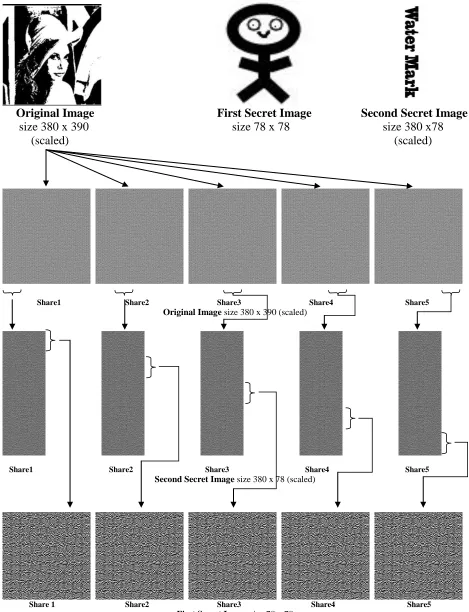
Original Image First Secret Image Second Secret Image
size 380 x 390 size 78 x 78 size 380 x78
(scaled) (scaled)
Share1 Share2 Share3 Share4 Share5
Original Image size 380 x 390 (scaled)
Share1 Share2 Share3 Share4 Share5
Second Secret Image size 380 x 78 (scaled)
Share 1 Share2 Share3 Share4 Share5
First Secret Image size78 x 78
9
After simulation these are few images than can reveal the secret information by combining any 3 shares out of 5 shares.
Share 1, 2 & 3 Share 1, 2 & 4 Share 1, 2 & 5 Share 1, 3 & 4 Share 1, 3 & 5
Regenerated Original Image size 380 x 390 (scaled here)
Shares 1, 4 & 5 Shares 2, 3 &4 Shares 2, 3 & 5 Shares 3, 4 & 5 Shares 4, 5 & 1
Regenerated Second Secret Image size 380 x 78 (scaled here)
Shares 4, 5 & 2 Shares 1, 4 & 5 Shares 1, 2 & 4 Shares 2, 3 & 4 Shares 1, 3 & 5
Regenerated First Secret Image size78 x 78
10
4. A GENERAL “k” out of “k” SCHEME
For all k there exists a general construction of k out of k visual secret sharing scheme, the pixel expansion must use at least 2𝑘−1 pixels, and the relative contrast should be 1
2𝑘−1. There is a need
to construct two collections of 𝑘 × 2𝑘−1 Boolean matrices i.e. 𝑆0 and 𝑆1.
𝑆0 Handles the white pixels.
𝑆1 Handles the black pixels.
All 2𝑘−1 columns have an even number of 1‟s in 𝑆0 and odd number of 1‟s in 𝑆1 and no two k rows are same in both 𝑆0 & 𝑆1. 𝐶0 and 𝐶1 contains all permutations of columns in 𝑆0 & 𝑆1.
Properties of “k” out of “k” scheme
Pixel Expansion, 𝑚 = 2𝑘−1 ( m should be as small as possible)
Relative Contrast, 𝛼 = 1
2𝑘 −1 ( 𝛼 should be as large as possible)
r, the size of the collections. 𝐶0 and 𝐶1 (they need not be the same size, but in all of our constructions they are). Here 𝑟 = 2𝑘−1!
logr is number of random bits needed to generate share.
By Naor and Shamir, any k out of k scheme as 𝛼 ≤ 1
2𝑘−1 and 𝑚 ≥ 2
𝑘−1
Based upon the following properties we can design the matrix for k = 3 and k =4
k = 3, therefore m = 4, α = ¼ and r = 24
0 0 1 1 0 0 1 1
𝑆0 = 0 1 0 1 𝑆1 = 0 1 0 1
0 1 1 0 1 0 0 1
3 × 4 3 × 4
k = 4, therefore m = 8, α = 1
8 and r = 40320
W = {1, 2, 3, 4}
Even cardinality subsets {{}, {3, 4}, {2, 4}, {2, 3}, {1, 4}, {1, 3}, {1, 2}, {1, 2, 3, 4}}
11
0 0 0 0 1 1 1 1 → Share1
𝑆0 = 0 0 1 1 0 0 1 1 → Share2
0 1 0 1 0 1 0 1 → Share3
0 1 1 0 1 0 0 1 → Share4
4 × 8 Hamming weight of 𝑆0 i.e. is White H(V) = 7
0 0 0 0 1 1 1 1 → Share1
𝑆1 = 0 0 1 1 0 0 1 1 → Share2
0 1 0 1 0 1 0 1 → Share3
1 0 0 1 0 1 1 0 → Share4
4 × 8 Hamming weight of 𝑆1 i.e. is Black H(V) = 8
We need two collections of 4 × 8 Boolean matrices 𝐶0 and 𝐶1, contains all permutations of columns in 𝑆0 and 𝑆1, by these two matrices we can design the shares of black and white pixels. Similarly as above, we can apply recursive scheme for any k out of k scheme.
5. A GENERAL “k” out of “n” SCHEME
A general k out of n scheme is designed from k out of k scheme. Let C be k out of k visual secret sharing scheme with parameters m, r, α. The scheme C consists of two collections of k × m Boolean matrices and 𝐶0 = 𝑇10, 𝑇20, . . . . 𝑇𝑟0 and 𝐶1 = 𝑇11, 𝑇21, . . . . 𝑇𝑟1. H is a collection of l functions ∀ℎ ∈ 𝐻, ℎ ∶ 1 … . 𝑛 → {1 … . 𝑘}. Let B be the subset of 1 … . 𝑛 of size k and 𝛽𝑞 is probability that randomly chosen function ℎ ∈ 𝐻 yields q different values on B, 1 ≤ 𝑞 ≤ 𝑘.
We construct from C and H a k out of n scheme 𝐶| with parameters 𝑚| = m . l, 𝛼| ≥ 𝛽𝑘α, 𝑟| = 𝑟𝑙
The ground set is V = U × H
Each 1 ≤ 𝑡 ≤ 𝑟𝑙 is indexed by a vector (𝑡1, 𝑡2, … . 𝑡𝑙) where each 1 ≤ 𝑡 ≤ 𝑟.
The matrix 𝑆𝑡𝑏 for t = (𝑡1, 𝑡2, … . 𝑡𝑙) where b ∈ {0, 1} is defined as
𝑆𝑡𝑏 𝑖, 𝑗, ℎ = 𝑇
𝑡𝑗𝑏[ℎ 𝑖 , 𝑗]
Contrast
Contrast should be ≥ 𝛽𝑘𝛼
k rows is 𝑆𝑡𝑏, mapped to q < k different values by h
Hamming weight of OR of q rows is f(q)
Difference is 𝛼𝑚 white and black pixels occurs when h is one and happens at 𝛽𝑘
WHITE: 𝐻 𝑣 ≤ 𝑙(𝛽𝑘 𝑑 − 𝛼𝑚 + 𝑘−1𝑞=1𝛽𝑞. 𝑓(𝑞))
12
Security
Security properties of the “k out of k” scheme imply the security of “k out of n” scheme because we are using (k,k) scheme to create (k,n) scheme. The expected hamming weight of OR of q rows, q < k is 𝑙 𝑘−1𝑞=1𝛽𝑞. 𝑓(𝑞) irrespective of WHITE or BLACK pixel.
6. CONCLUSION
Recursive information hiding in visual cryptography can be applied to many applications in real and cyber world. The advantage is that the final decryption process is done by human visual system instead of complex computations. In this article we have presented a 3 out of 5 recursive hiding scheme that can be extended to a k out of n scheme.
REFERENCES
1. Naor, M. and Shamir, A. 1995. Visual Cryptography. Advances in Cryptography-Eurocrypt, 950: 1-12.
2. Shamir, A. 1979. How to Share a Secret. Communications of the ACM. 22: 612-613.
3. Horng, G., Chen, T. and Tsai, D. 2006. Cheating in Visual Cryptography. Design, Codes and Cryptography 38: 219-236.
4. Gnanaguruparan, M. and Kak, S. 2002. Recursive Hiding of Secrets in Visual Cryptography. Cryptologia 26: 68-76.
5. Parakh, A. and Kak, S. 2008. A Recursive Threshold Visual Cryptography Scheme. Cryptology ePrint Archive, Report 2008/535.
6. Ching-Nung, Y. and Tse-Shih, C. 2004. Aspect Ratio Invariant Visual Secret Sharing Schemes with Minimum Pixel Expansion. Pattern Recognition Letters 26: 193-206.
7. Stinson, D. 1995. Cryptography Theory and Practice. CRC Press.
13
9. Verheul, E.R. and Van Tilborg, H.C.A. 1997. Construction and Properties of k out of n Visual Secret Sharing Schemes. Designs, Codes and Cryptography, 2: 179-196.
10.Droste, S. 1996. New Results on Visual Cryptography. Advances in Cryptology-CRYPTO `96, Lecture Notes in Computer Science, 1109: 401-415.
11.Prisco, R. and Santis, A. 2006. Cheating Immune Threshold Visual Secret Sharing. LNCS 4116: 216-228.
12.Blakely, G. R. 1979. Safeguarding Cryptographic Keys. Proceedings of the National Computer Conference, American Federation of Information Processing Societies Proceedings. 48: 313-317.
13.Kak, S. 1982. On Asymmetric Secret Sharing. LSU ECE Technical Report. May.
14.Alon, N. and Spencer, J. 1992. The Probabilistic Method, Wiley-Interscience, 2nd edition.
15.MacWilliams, F. J. and Sloane, N. J. A. 1977. The Theory of Error Correcting Codes, North Holland, Amsterdam.
16.Parakh, A. and Kak, S. 2010. A Tree Based Recursive Information Hiding Scheme. To appear in proceedings of IEEE ICC 2010 – Communication and Information System Security Symposium („ICC‟10 CISS‟), May 23-27, Cape Town, South Africa.
17.Parakh, A. and Kak, S. 2009. Recursive Secret Sharing for Distributed Storage and Information Hiding, Advanced Networks and Telecommunication Systems (ANTS), IEEE 3rd International Symposium on, pages 1-3, 14-16.
18.Parakh, A. and Kak, S. 2009. Space Efficient Secret Sharing: A recursive approach. Cryptology ePrint Archive, Report 2009/365.