© 2015, IJCSMC All Rights Reserved 324 Available Online at www.ijcsmc.com
International Journal of Computer Science and Mobile Computing
A Monthly Journal of Computer Science and Information Technology
ISSN 2320–088X
IJCSMC, Vol. 4, Issue. 9, September 2015, pg.324 – 331
RESEARCH ARTICLE
Analysis of Priority Scheduling Algorithm on the
Basis of FCFS & SJF for Similar Priority Jobs
Ms. Rukhsar Khan
1, Mr. Gaurav Kakhani
2¹M. Tech. Scholar, Department of Computer Science & Engineering, Mewar University, India
²Asst. Professor, Department of Computer Science & Engineering, Mewar University, India
1
[email protected]; 2 [email protected]
Abstract— Scheduling is one of the most important activity of the process manager which take decision to choose which of the process in the ready queue will be assigned to the CPU. There are different types of scheduling algorithms available for taking decision. One of them is Priority Scheduling Algorithm, which is based on the priority assigned to each process. In priority scheduling the Processes are executed on the basis of priority, the process having highest priority is executed first. In case of similar priority FCFS is used. In this paper, the priority scheduling algorithm is used in such a way that, in case of similar priority SJF algorithm is used instead of FCFS and average waiting time and average turnaround time is calculated. The comparative analysis is performed on the SJF based priority scheduling and FCFS based priority scheduling to compare the average waiting time and average turnaround time.
Keywords— SJF, FCFS, Scheduling, Priority Scheduling, Similar Priority jobs
I. INTRODUCTION
For the system of single processor, when multiple process comes, then one process can be execute at a time and other process remain in waiting state until the CPU becomes ideal or can be schedule again. To expand the CPU usage, the goal of multiprogramming is to have some procedure running at all times. CPU scheduling manages the issue of choosing which of the procedures in the ready queue is to be assigned the CPU. Operating System usually performs scheduling of processes which is major task of a system [1].
© 2015, IJCSMC All Rights Reserved 325
In priority Scheduling algorithm, a priority is assigned to each process, and priority is allowed to run. Each process have their different priorities, according to the priority the processes are executed. Higher priority process will executed first and then the lower priority and so on. Generally, we use the lowest integer as highest priority. If the two or more process has equal priorities then they executed in FCFS manner such that the process which enters first will executed first. The decision of priority can be internally or externally. Internal priority uses some factors these are available to calculate the priority of a process. External priorities are set by criteria outside the operating system. [3].
II. LITERATURE SURVEY
The general need of CPU usage builds the interest to enhance the CPU time. An overview has been made to analyze the different scheduling algorithm and to enhance them.
E.O. Oyetunji and A. E. Oluleye, “Performance Assessment of Some CPU Scheduling Algorithms”, 2009 [4],
attempted to compare different scheduling algorithms on the basis of waiting time and turnaround time. This paper gives a brief overview to the problem of scheduling jobs/processes on the central processing unit (CPU) of the computer system.
Jyotirmay Patel1 and A.K. Solanki, “CPU Scheduling: A Comparative Study”, 2011 [5], discuss about scheduling
policies of Central processing unit (CPU) for computer System. A number of problems were solved to find the appropriate among them. Therefore, based on performance, the shortest job first (SJF) algorithm is suggested for the CPU scheduling problems to decrease either the average waiting time or average turnaround time. Also, the first come first serve (FCFS) algorithm is suggested for the CPU scheduling problems to reduce either the average CPU utilization or average throughput.
Mehdi Neshat, Mehdi Sargolzaei, Adel Najaran, Ali Adeli, “The New Method Of Adaptive CPU Scheduling Using
Fonseca And Fleming’s Genetic Algorithm”, 2012 [6], proposed a new CPU scheduling . This algorithm based on the three parameters of CPU burst time, I/O service time, and priority of processes. The proposed FFGA multi objective optimization algorithm is used. It selects and runs the desired processes through adaptation. In this algorithm, the priority of processes increases with time. The proposed algorithm is analyzed with the other methods showed that the average waiting time and average response time are reduced.
Taqwa Flayyih Hasan, “CPU Scheduling Visualization”, 2014 [7], evaluated different number of algorithm to
analyze the average waiting time and average turnaround time. The result shows that, in FCFS recommended for the CPU scheduling problems of minimizing either the average CPU utilization or average throughput. In RR algorithm, selection of time quantum is the major problem. In round robin scheduling algorithm average waiting time is often quite long.
III. EXISTING FCFS BASED PRIORITY SCHEDULING ALGORITHM
© 2015, IJCSMC All Rights Reserved 326
Existing Algorithm:
Step 1: Assign the process to ready queue.
Step 2: Assign the process to the CPU according to the priority, higher priority process will get the CPU first than
lower priority process.
Step 3: If two processes have similar priority then FCFS is used to break the tie.
Step 4: Repeat the step 1 to 3 until ready queue is empty.
Step 5: Calculate Waiting time and Turnaround time of individual Process.
Step 6: Calculate Average waiting time and Average Turnaround time.
IV. PROBLEM STATEMENT
One of the most important problems in operating systems designing is CPU Scheduling and challenge in this field is to build a program to achieve proper scheduling. In case of priority scheduling algorithm when similar priority jobs arrive than FCFS is used and the average waiting and turnaround time relatively higher. The process that arrives first is executed first, no matter how long it takes the CPU. So in this case if long burst time processes execute earlier then other process will remain in waiting queue for a long time. This type of arrangement of processes in the ready queue results in the higher average waiting and turnaround time.
V. OBJECTIVE The objective of this paper is:
To Analysis of SJF priority based and FCFS priority based scheduling algorithm. To reduce the Average waiting time and Average Turnaround time of CPU.
VI. PROPOSED SJF BASED PRIORITY SCHEDULING ALGORITHM
In proposed algorithm, SJF based Priority Scheduling Algorithm is used. In which each process that have similar priority is executed on the basis of burst time, i.e. the process which have least burst time will execute first. The SJF based priority algorithm results in reduced average waiting time and turnaround time.
Proposed Algorithm:
Step 1: Assign the process to ready queue.
Step 2: Assign the process to the CPU according to the priority, higher priority process will get the CPU first than
lower priority process.
Step 3: If two processes have similar priority then SJF is used to break the tie.
Step 4: Repeat the step 1 to 3 until ready queue is empty.
Step 5: Calculate Waiting time and Turnaround time of individual Process.
Step 6: Calculate Average waiting time and Average Turnaround time.
VII. IMPLEMENTATION
The proposed algorithm has been implemented on Windows XP Operating System by using Turbo C++ editor. Different cases are used to implement the algorithm. The cases have number of processes along with the burst time and priority.
To calculate the waiting time and turnaround time we use the following formula [9]: Turnaround Time= Process completion time - Arrival time.
© 2015, IJCSMC All Rights Reserved 327
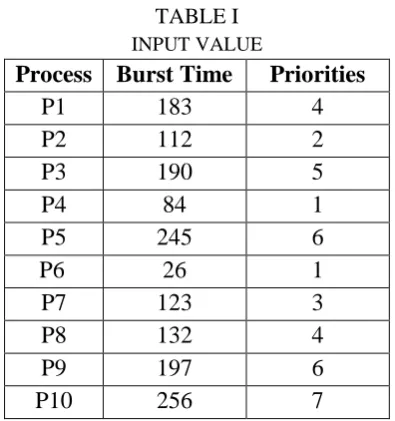
Case 1: For 10 processes.
TABLE I
INPUT VALUE
Process Burst Time
Priorities
P1
183
4
P2
112
2
P3
190
5
P4
84
1
P5
245
6
P6
26
1
P7
123
3
P8
132
4
P9
197
6
P10
256
7
A. Expected outcome on the basis of existing FCFS based priority scheduling algorithm.
P4
P6
P2
P7
P1
P8
P3
P5
P9
P10
0 84 110 222 345 528 660 850 1095 1292 1548
Figure 1: Expected Gantt chart for the above processes (For Similar Priorities)
B. Expected outcome on the basis of proposed SJF based priority scheduling algorithm.
P4
P6
P2
P7
P1
P8
P3
P5
P9
P10
0 26 110 222 345 477 660 850 1047 1292 1548
Figure 2: Expected Gantt chart for the above processes (For Similar Priorities)
VIII. RESULT AND ANALYSIS
© 2015, IJCSMC All Rights Reserved 328 A. Result
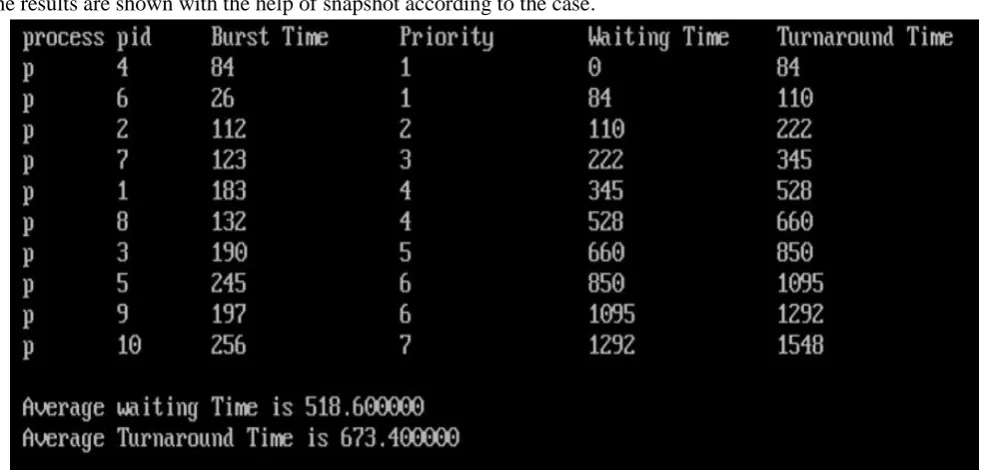
The results are shown with the help of snapshot according to the case.
Figure 3 Case 1 FCFS based priority scheduling for 10 processes.
© 2015, IJCSMC All Rights Reserved 329
TABLE II
COMPARISION OF WAITING TIME AND TURNAROUND TIME FOR 10 PROCESSES
Process
Waiting Time (ms)
Turnaround Time (ms)
FCFS based
Priority
Scheduling
Algorithm
SJF based
Priority
Scheduling
Algorithm
FCFS based
Priority
Scheduling
Algorithm
SJF based
Priority
Scheduling
Algorithm
P1
345
477
528
660
P2
110
110
222
222
P3
660
660
850
850
P4
0
26
84
110
P5
850
1047
1095
1292
P6
84
0
110
26
P7
222
222
345
345
P8
528
345
660
477
P9
1095
850
1292
1047
P10
1292
1292
1548
1548
Average
518.60
502.90
673.40
657.70
B. Analysis
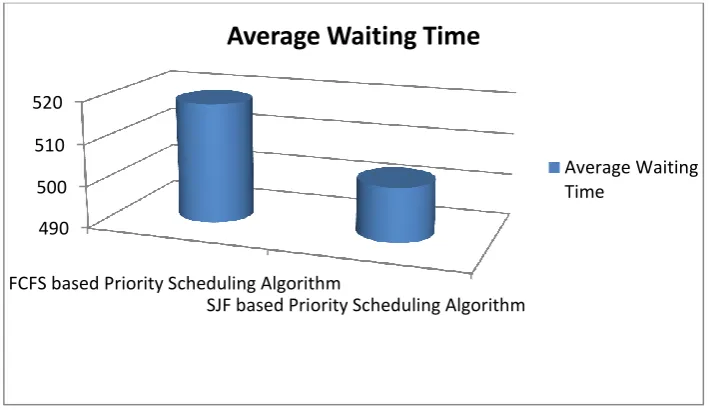
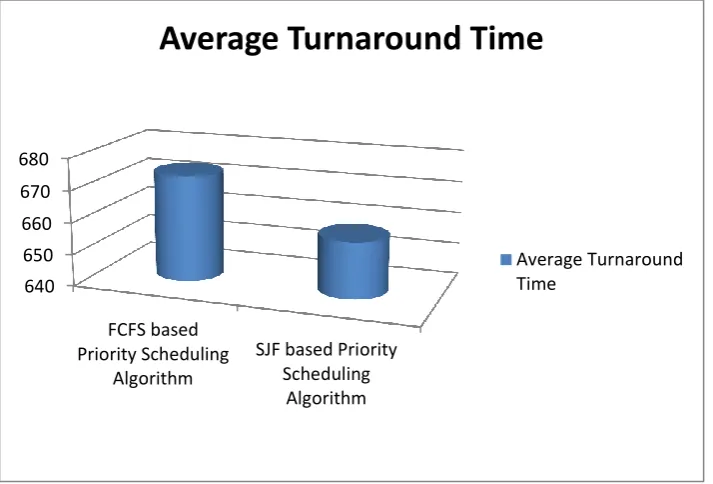
On the basis of the above outcome for FCFS and SJF based priority scheduling algorithm, the average waiting and average turnaround time is calculated which is shown in graph.
Comparison of average waiting time and turnaround time for 10 processes.
Figure 5: Average Waiting Time of FCFS based Vs SJF based Priority Scheduling Algorithm.
490 500 510 520
FCFS based Priority Scheduling Algorithm
SJF based Priority Scheduling Algorithm
Average Waiting Time
© 2015, IJCSMC All Rights Reserved 330
Figure 6: Average Turnaround Time of FCFS based Vs SJF based Priority Scheduling Algorithm
CONCLUSION
There are many scheduling algorithms having their own benefits and drawbacks. Scheduling can also be done on the basis of priority. Each process assigned a priority and the process which has highest priority will execute first. In case of similar priority generally FCFS is used to select the next process. If SJF based priority scheduling algorithm is used when two or more process having similar priority, instead of FCFS, then the average waiting time and average turnaround time is reduced. We proposed SJF based priority scheduling algorithm in which, the process that having lowest burst time will execute first. The existing FCFS based priority scheduling algorithm and proposed SJF based priority scheduling algorithm is analyzed and the result shows that the average waiting time and average turnaround time is reduced.
ACKNOWLEDGEMENT
I would like to express my cordial thanks to my supervisor Mr. Gaurav Kakhani, Department of Computer Science & Engineering, Mewar University, Gangrar for his valuable advices and suggestion so that I could complete my work comfortable.
REFERENCES
[1]
Neetu Goel, Dr. R. B. Garg, “A Comparative Study of CPU Scheduling Algorithms”, International Journal of Graphics & Image Processing, Vol 2, issue 4, November 2012.[2]
Sukumar Babu Bandarupalli, Neelima Priyanka Nutulapati, Prof. Dr. P.Suresh Varma, “A Novel CPUScheduling Algorithm–Preemptive & Non-Preemptive”, International Journal of Modern Engineering
Research (IJMER), Vol.2, Issue.6, pp-4484-4490 ISSN: 2249-6645, Nov-Dec. 2012.
[3]
Pushpraj Singh, Vinod Singh, Anjani Pandey, “Analysis and Comparison of CPU Scheduling Algorithms”,International Journal of Emerging Technology and Advanced Engineering, Volume 4, Issue 1, ISSN 2250-2459, ISO 9001:2008, January 2014.
640 650 660 670 680
FCFS based Priority Scheduling
Algorithm
SJF based Priority Scheduling
Algorithm
Average Turnaround Time
© 2015, IJCSMC All Rights Reserved 331
[4]
E.O. Oyetunji and A. E. Oluleye, “Performance Assessment of Some CPU Scheduling Algorithms”, Res. J. Inform. Technol., 1(1): 22-26, 2009, ISSN: 2041-3114, Aug 2009.[5]
Jyotirmay Patel and A.K.Solanki, “CPU Scheduling: A Comparative Study”, Proceedings of the 5thNational Conference, INDIACom, ISSN 0973-7529, ISBN 978-93-80544-00-7, 2011.
[6]
Taqwa Flayyih Hasan, “CPU scheduling Visualization”, Diyala Journal of Engineering Sciences, Vol. 07, No. 01, pp. 16-29, ISSN 1999-8716, March 2014.[7]
Mehdi Neshat, Mehdi Sargolzaei, Adel Najaran, Ali Adeli, “The New Method Of Adaptive CPU SchedulingUsing Fonseca And Fleming’s Genetic Algorithm”, Journal of Theoretical and Applied Information
Technology, Vol. 37 No.1, ISSN: 1992-8645, 15th March 2012.
[8]
Abraham Silberschatz, Peter Baer Galvin, Greg Gagne, “Operating System Concepts”, 7th Edition, John Wiley & Sons, ISBN: 978-81-265-2051-0, 2005.[9]
William Stallings, “Operating System Internals And Design Principles”, 7th Edition, Prentice Hall, ISBN 10: 0-13-230998-X, ISBN 13: 978-0-13-230998-1, 2009.[10]
Ashok Kumar, Dr. Harish Rohil, Suraj Arya, “Analysis of CPU Scheduling Policies through Simulation”, International Journal of Advanced Research in Computer Science and Software Engineering, Volume 3, Issue 5, ISSN: 2277 128X, May 2013.[11]
Siddharth Tyagi, Sudheer Choudhary, Akshant Poonia,“ Enhanced Priority Scheduling Algorithm tominimize Process Starvation”, International Journal of Emerging Technology and Advanced Engineering,
ISSN 2250-2459, Volume 2, Issue 10, October 2012.