ISSN 2348 – 7968
Transparent user authentication for secure system
Everence K JohnP 1
P
, Joel Micheal AlexP 2
P
, Sincy JohnP 3
P
1
P
IVth year BTech Student, Department of Computer Science And Engineering, MBCCET , Peermade, Kerala, India
P
2
P
IVth year BTech Student, Department of Computer Science And Engineering, MBCCET , Peermade, Kerala, India
joelmichalex @gmail.com
P
3
P
Assistant Professor, Department of Computer Science And Engineering, MBCCET , Peermade, Kerala, India
s
[email protected]32T
Abstract
Continuous and transparent user authentication are essential for a secure system. Nowadays we can see that secure authentication is very much essential. No security checks are performed during the working sessions, which are ended by an explicit logout or perish after an idle activity period of the user. Security performed in the web based and network based systems are very much considerable. We can see that cyber-attacks are very much increase in the recent times. Due to this reasons, by the introduction of biometrics solution provide a secure platform for the use authentication and verification, where username and password are replaced by biometric data. However, parallel to the spreading usage of biometric systems, the incentive in their misuse is also growing, especially considering their possible application in the financial and banking sectors.In this sophisticated situation we can’t say that biometrics security provides a comprehensive security. In fact biometric user authentication is basically formed as the one time verification providing user identification session at the login phase when one or more biometric characters may be required .Whether we verified the users identity, the system resources are available for him for a fixed period of time till explicit logout from the user. This approach assumes that a single verification (at the beginning of the session) is sufficient, and that the identity of the user is constant during the whole session. At this time, we undertake a technique which is that if a user has already logged into a security-critical service, and then the user leaves the PC unattended in the work area for a while.at this time the system will remain to an automatic time out session or logout phase. So any others can’t attend to real
users service in the system at his absence. So Emerging biometric solutions allow substituting username and password
with biometric data during session establishment, but in such
an approach still a single verification is believed sufficient, and
the identity of a user is considered absolute during the entire
session.
32T
Keywords:32T authentication,one time verification, session timeouts, cyber security ,biometrics solution
1.Introduction
Today we can see that security is one of the
important aspect in any web service and network
substantiation. .Secure user authentication is key in most
of recent ICT systems. User authentication systems
square measure historically supported pairs of username
and word and verify the identity of the user solely at
login part. No checks square measure performed
throughout operating sessions, that square measure
terminated by an exact logout or expire when associate
degree idle activity amount of the user.
Such observations cause conflict that one
authentication purpose and one biometrics information
cannot guarantee a spare degree of security. In fact,
equally to ancient authentication processes that have
faith in username and word, biometric user
authentication is often developed as a 1 time
ISSN 2348 – 7968
authentication providing user verification solely
throughout login part once one or a lot of biometric traits
could also be needed. If the identity of the user is
verified or confirmed the system options and resources
square measure allotted to a selected amount of your
time that is allotted by the system or the user or till
express logout from the user. This methodology shoulder
that this approach is spare for the session which the
identity of the user is constant throughout the session
wherever the user performed the action .Such as, we
have a tendency to think about this easy scenario a user
has already logged into a security-critical service, so the
user leaves the laptop unattended within the work space
for a short time. This drawback is even trickier within the
context of mobile devices, usually employed in public
and crowded environments, wherever the device itself
are often lost or forcibly taken whereas the user session
is active, permitting impostors to impersonate the user
and access strictly personal information. In these
eventualities, the services wherever the users square
measure genuine are often victimized simply.
Here we have a tendency to square measure
introducing a replacement methodology for user
verification and session management that's applied
within the Context Aware Security by stratified structure
Architectures (CASHMA) system for secure identity
verification on the web. CASHMA is in a position to
work firmly with any quite internet service, together with
services with high security demands as on-line banking
services, and it's supposed to be used from totally
different consumer devices, e.g., smartphones, Desktop
PCs or perhaps biometric kiosks placed at the doorway
of secure areas. Counting on the preferences and needs
of the owner of the online service, the CASHMA
authentication service will complement a standard
authentication service, or will replace it.
2. Existing System
Here we make a case study of base papers and
method of verifications which we are referenced
.
Zebra: zero-effort bilateral recurring
authentication [6], is the method to avoid unapproved
access clients verify themselves before utilizing the
terminal (e.g., by signing in with username and secret
word) and deauthenticate (i.e., log out) after their
utilization. This essential deauthentication step, in any
case, is ignored by most validation plans. Regular plans,
for example, watchword based or unique finger
impression based validation give one-time verification
and depend on the clients to log out. Shockingly, clients
regularly don't log out, they either neglect to log out or
deliberately don't log out to abstain from signing in once
more. In spite of the fact that deauthentication is critical
for a wide range of gadgets, our center in this work is to
address the DE validation. To address this issue here
propose Zero-Effort Bilateral Recurring Authentication
(ZEBRA). In ZEBRA, a client wears an arm jewelry
(with an implicit accelerometer, gyrator, and radio) on
her dominant wrist. At the point when the client connects
with a work station, the wrist trinket records the wrist
development, forms it, and sends it to the terminal. The
terminal contrasts the wrist development and the inputs it
gets from the client (by means of console and mouse),
and affirms the proceeded with vicinity of the client just
in the event that they relate. This methodology is to
constantly confirm a client taking into account her
connections with a terminal by checking her hand
developments and contrasting them with her inputs with
the terminal utilizing info gadgets (ie., the console and
ISSN 2348 – 7968
mouse). Similarly as with behavioral biometrics in view
of keystroke and mouse motion, our methodology
depends on the client's connections –but there is a critical
refinement. Behavioral biometrics depend on how the
client does a specific communication (e.g., how the client
sorts or how the client moves a mouse) and thus require
client particular preparing and regularly require long
stretches of perception to confirm the client. Our
methodology depends on what connections the client
does when utilizing a terminal and henceforth does not
require client particular preparing or long stretches of
perception to verify the client.
Zero-Effort Bilateral Recurring Authentication,
or ZEBRA, screens a client's hand developments by
means of a wrist trinket worn on their wrist that they use
to control the mouse. This arm ornament is enrolled to
the client, similar to any validation token, so its vicinity
ought to infer the vicinity of the related client. ZEBRA
goes past negligible vicinity, be that as it may.
Subsequent to signing in (utilizing extra certifications)
the client cooperates with the terminal and the wrist
trinket records the client's hand developments utilizing
worked as a part of accelerometer and gyrator sensors
and transmits their information to the terminal over a
short-extend radio (e.g., Bluetooth). The terminal then
contrasts the client's hand developments and the inputs it
watches and affirms the vicinity of the client on the off
chance that they connect. For instance, when the client
taps the mouse and afterward begins writing (with both
hands) his hand used to control the mouse (arm jewelery
hand) moves from the mouse to the console; when the
client scrolls utilizing the mouse scroll-wheel his hand is
moderately stationary. It is these sorts of hand
movements that the terminal expects for inputs that it
gets from the client.
The technique which is taken as the reference is
oPASS [7] strategy that is referenced from OPASS: A
User Authentication Protocol Resistant to Password
Stealing and Password Reuse Attacks [7]. In oPass, it
propose a client validation convention which influences a
client's mobile phone and short message administration
(SMS) to avert secret key taking and watchword reuse
assaults. As we would see it, it is hard to upset secret key
reuse assaults from any plan where the clients need to
remember something. The objective of oPass is to keep
clients from writing their remembered passwords into
booths. By embracing one-time passwords, watchword
data is no more vital. A one-time secret word is
terminated when the client finishes the present session.
Unique in relation to utilizing Internet channels, oPass
influences SMS and client's mobile phones to stay away
from secret word taking attacks.it is accepted that SMS is
a suitable and secure medium to transmit vital data
between PDAs and sites. In light of SMS, a client
personality is verified by sites without inputting any
passwords to untrusted stands. Client secret word is just
used to confine access on the client's PDA. In oPass,
every client just remembers a long haul secret key for
access her cellphone. The long haul secret key is utilized
to shield the data on the cellphone from a criminal.
ISSN 2348 – 7968
Fig 2.1 Architecture of oPass system
Fig.2.1 describes the architecture (and
environment) of the oPass framework. For clients to
perform secure login on an untrusted PC (booth), oPass
comprises of a trusted PDA, a program on the stand, and
a web server that clients wish to get to. The client works
her phone and the untrusted PC specifically to finish
secure logins to the web server. The correspondence
between the PDA and the web server is through the SMS
channel.
In a manner we can see that for a secure usage
of the system we must have to follow various strategies.
Generalized digital certificate for user for user
authentication and key establishment for secure
communications [2] is a method described. In this paper,
the idea of summed up computerized endorsement
(GDC) that can be utilized to give client verification and
key understanding. A GDC [2] contains client's open
data, for example, the data of client's advanced driver's
permit, the data of a computerized conception
authentication, and so on. And a computerized mark of
people in general data marked by a trusted endorsement
power (CA). Be that as it may, the GDC does not contain
any client's open key. Since the client does not have any
private and open key. Air, key administration in utilizing
GDC [2] is much less complex than utilizing open key
advanced declaration. The computerized mark of the
GDC is utilized as a mystery token of every client that
will never be uncovered to any verifier. Rather, the
proprietor demonstrates to the verifier that he has the
responding so as to learn of the mark to the verifier's test.
Taking into account this idea, we propose both discrete
logarithm (DL) - based and whole number figuring (IF) -
based conventions that can accomplish client
confirmation and mystery key foundation.
A computerized authentication is the mix of an
announcement and an advanced mark of the
announcement. The surely understood advanced
testament is the "X.509 open key computerized
declaration" [1]. The announcement for the most part
contains the client's open key and in addition some other
data. The endorser of the advanced mark is typically a
trusted authentication power (CA). The X.509 open key
computerized declaration has been generally utilized as a
part of open key framework (PKI) to give verification on
the client's open key contained in the testament. The
client is verified on the off chance that he can
demonstrate that he has the information of the private
key comparing to people in general key determined in
the X.509 open key computerized authentication. Be that
as it may, general society key advanced endorsement
itself can't be utilized to confirm a client since an open
key computerized authentication contains just open data
and can be effectively recorded and played back once it
has been uncovered to a verifier. In this paper, propose
an inventive methodology which empowers a client to be
validated and a mutual mystery session key be set up
with his correspondence accomplice utilizing any broad
type of computerized declarations, for example, an
advanced driver's permit, a computerized conception
endorsement or an advanced ID, and so forth. We call
this sort of advanced declaration as a summed up
computerized authentication (GDC). A GDC contains
client's open data and a computerized mark of this open
data marked by a trusted CA. In any case, in GDC,
general society data does not contain any client's open
key. Since client does not have any private and open key
combine, this kind of advanced authentication is much
less demanding to oversee than the X.509 open key
computerized testaments. The computerized mark of the
GDC is utilized as a mystery token of every client. The
ISSN 2348 – 7968
proprietor of a GDC never uncovers mark of GDC to a
verifier in plaintext. Rather, the proprietor processes a
reaction to the verifier's test to demonstrate that he has
the learning of the advanced mark. Accordingly, owning
a GDC can give client validation in an advanced world.
Furthermore, a mystery session key can be built up
between the verifier and the testament proprietor amid
this communication. User authentication through
mouse dynamics [8] is another method for case study. In
this paper Behavior-based client validation with directing
gadgets, for example, mice or touchpads, has been
picking up consideration. As a rising behavioral
biometric, mouse flow intends to address the validation
issue by confirming PC clients on the premise of their
mouse working styles. This paper shows a basic and
effective client confirmation approach taking into
account an altered mouse-operation assignment. For
every specimen of the dynamics, both conventional
comprehensive components and recently characterized
procedural elements are removed for precise and
fine-grained portrayal of a client's novel mouse conduct.
Separation estimation and Eigen space-change systems
are connected to get highlight segments for productively
speaking to the first mouse highlight space. At that point
a one-class learning calculation is utilized out yonder
based component Eigen space for the confirmation
assignment. The methodology is assessed on a dataset of
5550 mouse-operation tests from 37 subjects. Broad test
results are incorporated to exhibit the viability of the
proposed approach, which accomplishes a
false-acknowledgment rate of 8.74%, and a false-dismissal
rate of 7.69% with a comparing confirmation time of
11.8 seconds. Two extra investigations are given to
contrast the present methodology and different
methodologies in the writing. Our dataset is openly
accessible to encourage future examination.
The journey for a dependable and helpful
security system to confirm a PC client has existed
subsequent to the deficiency of customary secret key
component was acknowledged, first by the security
group, and afterward progressively by the general
population .As information are moved from conventional
restricted figuring situations to the new Cloud
Computing worldview (e.g., Box.net and Dropbox), the
requirement for better validation has turned out to be all
the more squeezing. As of late, a few extensive scale
secret word spillages presented clients to an
extraordinary danger of exposure and misuse of their
data. These episodes genuinely shook open trust in the
security of the present data base; the insufficiency of
secret key based verification systems is turning into a
noteworthy sympathy toward the whole data society. Of
different potential answers for this issue, an especially
encouraging method is mouse dynamics [8] .Mouse flow
measures and evaluates a client's mouse-conduct
attributes for use as a biometric.
EAP method [9] is another approach which
taken for the case study. Complete EAP Method is a
User Efficient and Forward Secure Authentication
Protocol for IEEE 802.11 Wireless LANs [9]. It is
important to verify clients who endeavor to get to assets
in Wireless Local Area Networks (WLANs). Extensible
Authentication Protocol (EAP) is a validation structure
generally utilized as a part of WLANs. Validation
components based on EAP are called EAP techniques.
The prerequisites for EAP strategies in WLAN
confirmation have been characterized in RFC 4017. To
accomplish client proficiency and hearty security,
lightweight calculation and forward mystery, avoided in
RFC 4017, are craved in WLAN confirmation. In any
case, all EAP techniques and validation conventions
intended for WLANs so far don't fulfill the greater part
ISSN 2348 – 7968
of the above properties. This original copy will exhibit a
complete EAP technique that uses put away mysteries
and passwords to confirm clients with the goal that it can
1) completely meet the prerequisites of RFC 4017, 2)
accommodate lightweight calculation, and 3) take into
account forward mystery. Likewise, we additionally
show the security of our proposed EAP technique with
formal confirmations.
Confirmation is the procedure of checking
clients' characters when they need to get to assets from
systems. Normally, a client gives his validation elements
to a server, and after that the server confirms them. On
the off chance that the elements are right, the client is
approved to pick up the entrance right to the assets gave
by the server, and the server creates a session-key
material that is imparted to the client. Likewise, it is
additionally vital for Wireless Local Area Networks
(WLANs) to validate clients and fabricate secure
channels with them. IEEE 802.11, the most generally
utilized standard, contains definitions for the operations
of WLANs. The first plan in the standard gives just some
fundamental validation systems, for example, preshared
key foundation and secret key check actualized between
a client and a server, called Wired Equivalent Privacy
(WEP). WEP is not secure in light of the fact that an
assailant can get unapproved access through blocked
messages .The security of IEEE 802.11 was last revised
to incorporate Wi-Fi Protected Access (WPA) and
WPA2 [33]. IEEE 802.1x characterizes the message
epitome of Extensible Authentication Protocol (EAP).
Extensible Authentication Protocol (EAP), characterized
in RFC 3748 is an adaptable confirmation structure that
has been as often as possible used in WLANs. For IEEE
802.11, WPA and WPA2 have used EAP as their
validation systems, for example, EAP-TLS, EAP-TTLS,
and EAP-SIM. A system director can properly pick a
craved confirmation instrument, called an EAP
technique.
3. Proposed System
Proposed program ongoing confirmation
strategy is grounded on transparent acquisition of
fingerprint information and on adaptive timeout control
on the foundation of the believe in posed in the customer
and in the different subsystems used for confirmation.so
potential misuses are detected by consistently confirming
the presence of the proper customer. It is integrated in a
distributed architecture to realize a protected and usable
confirmation support, and it supports security-critical
web solutions accessible over the Online. User
confirmation into a consistent process rather than a
one-time occurrence Our proposed product is mainly based
on the fingerprint confirmation which allows credentials
to be obtained transparently, i.e., without explicitly
notifying the customer or requiring his/her interaction,
which is essential to guarantee better support usability
.for fingerprint confirmation we use face identification,
voice identification, thump impression etc. Additionally
we use a one-time password (OTP) for confirmation in
period timeouts. Our new strategy for customer
confirmation and period control that is applied in the
perspective aware protection by hierarchical multilevel
architectures (CASHMA) [3] program for protected
fingerprint confirmation on the Online. CASHMA is able
to operate securely with any type of web support, such as
solutions with high protection demands as internet
banking solutions, and it is intended to be used from
different customer gadgets, e.g., mobile phones, Pc PCs
or even fingerprint kiosks placed at the entrance of
protected areas. Depending on the preferences and
specifications of the owner of the web support, the
CASHMA confirmation support can complement a
ISSN 2348 – 7968
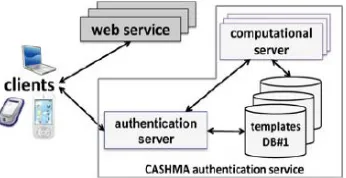
CASHMA perspective, each subsystem comprises all the
hardware/software elements necessary to obtain and
verify the credibility of one fingerprint trait, such as
receptors, comparison algorithms and all the facilities for
information transmission and control.
The CASHMA[3] confirmation support
includes: i) an confirmation server, which interacts with
the customers, ii) a set of high-performing computational
servers that perform comparisons of fingerprint
information for confirmation of the registered customers,
and iii) databases of layouts that contain the fingerprint
layouts of the registered customers (these are needed for
customer authentication/verification). The web solutions
are the various solutions that use the CASHMA
confirmation support and demand the confirmation of
registered customers to the CASHMA confirmation
server. These types of solutions are potentially any type
of Websites or program with specifications on customer
credibility. Customers we mean the users’ gadgets
(laptop and desktop PCs, mobile phones, tablet, etc.) that
find the fingerprint information (the raw data)
corresponding to the various fingerprint traits from the
customers, and transmit those information to the
CASHMA confirmation server as part of the
confirmation procedure towards the target web support.
A customer contains i) receptors to find the raw
information, and ii) the CASHMA program which
delivers the fingerprint information to the confirmation
server.
Fig 3.1: Architectural view of CASHMA system
It is required that the user and the web service
are enrolled to the CASHMA authentication service.
When the client entered into a web service which he
need .Then client contact the CASHMA authentication
server and get an authentication certificate. Using the
CASHMA application, the smartphone sends its unique
identifier and biometric data to the authentication server
for verification. The authentication server verifies the
user identity, and grants the access if: i) it is enrolled in
the CASHMA authentication service, ii) it has rights to
access the prescribed service and, iii) the acquired
biometric data match those stored in the templates
database associated to the provided identifier. In case of
successful user verification, the CASHMA
authentication server releases an authentication
certificate to the client, proving its identity to third
parties, and includes a timeout that sets the maximum
duration of the user session. The client presents this
certificate to the web service, which verifies it and grants
access to the client. The CASHMA application operates
to continuously maintain the session open: it
transparently acquires biometric data from the user, and
sends them to the CASHMA authentication server to get
a new certificate. Such certificate, which includes a new
timeout, is forwarded to the web service to further extend
the user session.
The technique behind the execution of the
system is that the client or user is continuously and
transparently acquires and transmits proof of the user
identity to maintain to a web service. The main task of
the proposed system is to create and then maintain the
user session by adjusting the session timeout on the basis
of the trust that the identity of the user in the system is
genuine.
ISSN 2348 – 7968
4. Conclusions
By this paper we exploited the novel possibility
introduced by biometrics to define a protocol for
continuous authentication that improves security and
usability of user session. The convention processes
versatile timeouts on the premise of the trust postured in
the client action and in the quality and sort of biometric
information gained straightforwardly through checking
in foundation the client's activities. In this situation we
utilize ceaseless verification approach for Internet
administrations. In this model the framework benefits
ceaselessly check the client distinguishing proof and
accept whether the substantial client is working with the
framework or not. Session administration in appropriated
Internet administrations is customarily in view of
username and secret key, express logouts and
instruments of client session termination utilizing great
timeouts. Developing biometric arrangements permit
substituting username and secret word with biometric
information amid session foundation, yet in such a
methodology still a solitary check is regarded adequate,
and the character of a client is viewed as unchanging
amid the whole session. Moreover, the length of the
session timeout might effect on the ease of use of the
administration and resulting customer fulfilment. A safe
convention is characterized for unending confirmation
through ceaseless client check. The convention decides
versatile timeouts in view of the quality, recurrence and
kind of biometric information straightforwardly gained
from the client.
References
[1]. Xixixixix Zzzng, “Existing the research field
the research field,” IEEE Trans. Information Forensics and Security., vol. 16, no. 11, pp. 51-58, Mar. 2015
[2]. 31TL. Harn31T; 31TJ. Ren31T ,” 31TGeneralized Digital
Certificate for User Authentication and Key
Establishment for Secure Communications31T
“ 31TIEEE Transactions on Wireless
Communications31T Year: 2011,
[3]. CASHMA-Context Aware Security by
Hierarchical Multilevel Architectures, MIUR FIRB, 2005.
[4]. BioID “Biometric Authentication as a Service (BaaS),” BioID Press Release,
https://www.bioid.com, Mar. 2011.
[5] T. Sim, S. Zhang, R. Janakiraman, and S. Kumar, “Continuous Verification Using Multimodal Biometrics,” IEEE Trans. Pattern Analysis and Machine Intelligence, vol. 29, no. 4, pp. 687-700, Apr. 2007.
[6] 39TS. Mare39T40T; 40T39TA. M. Markham39T40T; 40T31TC. Cornelius31T40T; 40T31TR.
Peterson31T40T; 40T31TD. Kotz31T ,” 28TZEBRA28T31T: 28T31TZero28T31T
-28T31T
Effort28T31T 28T31TBilateral28T31T 28T31TRecurring28T31T 28T31TAuthentication28T
“31TSecurity and Privacy (SP), 2014 IEEE
Symposium on31T39TYear: 201439T
[7] H. M. Sun; Y. H. Chen; Y. H. Lin,” OPASS: A User Authentication Protocol Resistant to Password Stealing and Password Reuse Attacks “ Pages: 651 - 663Year: 2012, Volume: 7, Issue: 2
[8] 39TC. Shen39T40T; 40T39TZ. Cai39T40T; X. Guan40T31T 31T40T; 40T31TY. Du31T40T; 40T31TR. A. Maxion31T ,
“31T28T31TUser28T31T28T31TAuthentication28T31T28T31TThrough28T31T28T31TMouse28T31T Dynamics31T
“39TYear: 201339T40T, 39T40TVolume: 839T40T,
40T
[9] 40T31TC. I. Fan31T; 31TY. H. Lin31T; 31TR. H. Hsu31T , "31TComplete EAP
Method: User Efficient and Forward Secure Authentication Protocol for IEEE 802.11 Wireless LANs31T” 31TIEEE Transactions on Parallel
and Distributed Systems31T Year: 2013, Volume: 24