R E S E A R C H
Open Access
Modelling of routing and spectrum handoff in
CR-MANETs
Samad Nejatian
1,2*, Sharifah Kamilah Syed-Yusof
1, Nurul Muazzah Abdul Latiff
1and Wajahat Maqbool
1Abstract
There is an extensive research interest in cognitive radio mobile ad hoc networks (CR-MANETs) to improve the spectrum efficiency by developing innovative design techniques through various layers of the protocol stacks. This paper presents the optimisation of CR-MANETs by exploiting the efficient usage of the available wireless spectrum through a framework for spectrum-aware handoff. In this paper, the concept of integrated handoff management in CR-MANETs is considered. An analytical model for a spectrum handoff scheme is introduced based on spectrum mobility in which secondary users (SUs) will move to another unused spectrum band, giving priority to a Primary User (PU), while satisfying its communication quality of service (QoS). The main contribution is using the Markov chain to model the evolution of the network (node position, node speed, channel quality, etc.) and to propose the combined spectrum handoff and routing. The performance of the network is analyzed based on the Markov chain. The
comparison results from both analytical modelling and simulation clearly show an improvement in the performance of the SU network in terms of the route maintenance probability and the SU throughput. It is also proved that not only the PU activity affects the performance of the handoff management scheme but also the channel transmission range and the node mobility have a significant effect on the performance of the management scheme.
Keywords:Cognitive radio; Mobile Ad hoc networks; Spectrum handoff; Spectrum mobility
1 Introduction
Recently, there have been major changes in wireless tech-nologies that demand more spectrum bands for allocation to emerging wireless applications. The Federal Communication Commission (FCC) has shown low spectrum efficiency usage in current wireless networks. Low and poor spectrum efficiency is due to the underutilized spectrum usage because of the fixed spectrum allocation [1]. The most influential technology that promises to improve spectrum efficiency is cognitive radio (CR) [2]. CR users can capture and use the unused spectrum bands called spectrum holes [3].
The spectrum holes may shift over time and over space [4,5]. In the CR system, the shifting of the spectrum holes is defined as spectrum mobility, which is cohesive with spectrum handoff. Spectrum handoff refers to the transfer of the ongoing data transmission of a CR user to another available spectrum band [6,7]. During the spectrum hand-off, a CR user will move to another unused spectrum band,
giving priority to a Primary User (PU), while satisfying its communication quality of service (QoS) [8,9]. Spectrum handoff is extremely challenging in CR networks, especially in cognitive radio mobile ad hoc networks (CR-MANETs), because of frequent topology variations, limited power and channel transmission range and bandwidth constraints in addition to a lack of a central controlling entity. In hetero-geneous CR networks, a channel may be available over vast mutually exclusive spectrum bands, which present remark-able heterogeneity in terms of channel transmission range and channel error rate.
The challenges in maintaining a common link arise when the secondary user (SU) nodes move. The first chal-lenge is differentiating the SU's mobility and spectrum mobility. Channel quality degradation happens because of the SU's mobility and channel heterogeneity in terms of transmission range. Therefore, there are different route failure types that necessitate different route recovery strat-egies. The second challenge related to integrated handoff management is finding the best new route and a channel to maintain the route while reducing the switching time and the number of handoffs. In multi-hop CRNs, routing * Correspondence:[email protected]
1UTM-MIMOS Center of Excellence, Faculty of Electrical Engineering,
Universiti Teknologi Malaysia (UTM), Johor Bahru 81310, Malaysia
2Department of Electrical Engineering, Faculty of Engineering, Yasouj Branch,
Islamic Azad University, Yasouj, Kohgiloyeh & Bovirahmad Province, Iran
is a crucial issue which affects the performance of the whole network [10]. When considering the influence of node mobility on the channel availability, the effect of channel heterogeneity becomes more significant. In a CR system, node mobility and channel heterogeneity lead to frequent spectrum handoffs [11].
Previous work on spectrum handoff in CR networks only considers the PU's activity. In this paper, we consider the integrated handoff management scheme for CR-MANETs. The work considers the CR spectrum handoff problem and jointly addresses the local flow handoff issue. To propose the integrated handoff management scheme, the availability of spectrum holes in CR-MANETs is consid-ered. The influence of different parameters and events on channel availability is considered in the analytical scheme to obtain a unified model for channel availability in CR-MANETs. The Markov chains are used to model the inte-grated handoff process in CR-MANETs. The effect of the integrated handoff management on the improvement of the handoff blocking probability is also demonstrated.
The rest of this paper is organized as follows: Section 2 describes the related works for spectrum handoff man-agement. In Section 3, we propose a model for integrated spectrum handoff management and routing scheme. In Section 4, we propose a unified modelling and charac-terization of the channel availability in CR-MANETs. Section 5 shows the analytical model of the integrated spectrum handoff management. In Section 6, the results and discussion are elaborated. Finally, Section 7 concludes the paper and presents future work.
2 Related works
There are a few studies related to spectrum handoff in CR-MANETs. Giupponi and Perez-Neira [12] proposed a fuzzy-based spectrum handoff decision-making approach employing two fuzzy logic controllers. Each SU estimates the distances between itself and all the active PUs in the surrounding area using the first fuzzy logic controller. The other fuzzy logic controller determines whether the SU needs to perform a spectrum handoff. In some cases, the SU can avoid performing a spectrum handoff by appropri-ate adjustment of its transmission power. Feng et al. devel-oped a spectrum handoff technique from a single-link concept to a multi-link spectrum handoff scheme [13]. The proposed algorithm attempts to minimize the total link cost by taking into account the end-to-end network connect-ivity constraint. Another major contribution of this paper was that the rerouting mechanism was per-formed before a spectrum handoff event to increase the system throughput. Song and Xie [14,15] proposed a proactive spectrum handoff configuration based on statis-tics of observed channel utilization. The network co-ordination and rendezvous issues were solved in this spectrum handoff scheme without using a common
control channel. The collision among SUs was pre-vented through a distributed channel determination scheme. Damljanovic explained the proper solutions and spectrum mobility necessities in cognitive radio networks [16]. Duan and Li proposed a spectrum hand-off strategy in which the optimal spectrum band was chosen based on a multiplex criterion considering the estimated transmission time, the PU presence probabil-ity and the spectrum availabilprobabil-ity time [17]. A coopera-tive spectrum sensing scheme was used to predict the spectrum idleness. A geo-location method was used to perform a spectrum handoff in the space domain. The
simulation results indicated that the proposed
effects of various events on the availability of spectrum holes in CR-MANETs [26]. In [27], Nejatian et al. introduced a new algorithm for integrated handoff management in which the handoff is performed considering the effects of all the parameters introduced in [25]. The study reveals that the channel heterogeneity and SU's mobility must be considered as important factors, which affect the performance of the handoff management in the CR-MANETs.
As mentioned before, maintaining the optimal routes in CR-MANETs is extremely difficult because of the rando-mness of the PU's activity, the SU's mobility and the chan-nel quality degradation. Although [27,28] introduced and investigated the integrated handoff management in CR-MANETs as a new algorithm, analytical modelling of this concept can be also efficient. Hence, a framework is intro-duced to analytically model the integrated handoff man-agement in CR-MANETs. The results of both analytical modelling and proposed algorithm are compared to show the effectiveness of the proposed solution.
3 Spectrum hole availability in CR-MANETs 3.1 System description
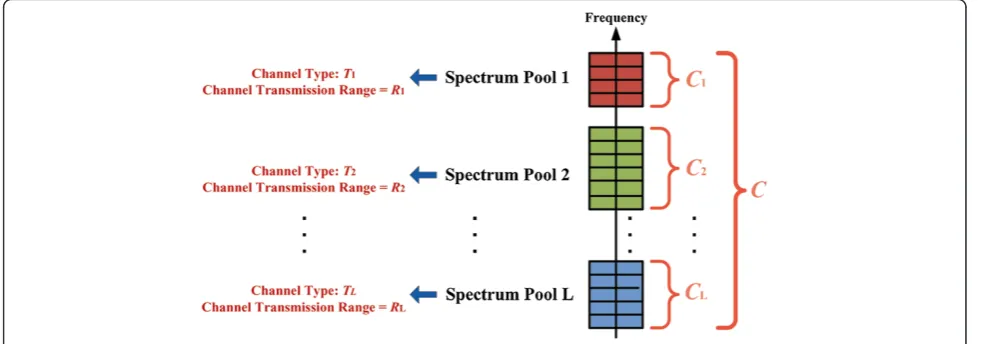
Suppose there areLdifferent channel types in a heteroge-neous PU network. The maximum number of channels that can be accessed by the SU at a time is C. The C
channels can be defined by the set ofT, which belong to the PU network. These channels are classified intoLtypes according to their different transmission ranges that the cardinality of │T│=L (see Figure 1). Channels with diffe-rent transmission ranges belong to a diffediffe-rent set of spectrum pools. The set of each type can be shown byTl
in whichlϵS,S= {1, 2,…,L},│Tl│=Cl,T= {T1,…,TL} and C=C1+…+CL. Depending on the PU activities, any SU can access up toCchannels at any position. The number of detected channels of typelby a special node is cl, and the total number of detected channels at a node isc = c1+ c2+…+cL. The transmission range of channels of typeTl
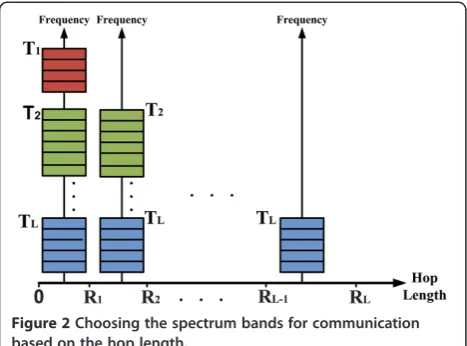
is Rl. Given the channel transmission range classification, we can model the channel heterogeneity. Assume a pair of SU transmitter-receivers, which transmit and receive, re-spectively, using channel of type Tl for communication, with a distance between them of less than Rl. When the SUs move and their distance exceeds Rl, the transmitting node must change and choose another channel. In this case, the required channel must have a transmission range longer thanRl (Figure 2). There are also Ltypes of PU; each of them can work only on a channel of typel. Once a PU of typelbecomes active and there is no empty channel of type
l, in the case which a SU has occupied a channel of typel, the SU must vacate the channel and submit it to the PU.
3.2 Characterization of channel availability and spectrum mobility in CR-MANETs
First, only the effect of the PU activity is considered on the channel availability in CR-MANETs. Table 1 shows the dif-ferent parameters and their definitions used in this paper.
Consider an established route from the source node S to the destination node D. We define the parameterpas the probability of single channel availability at a node by con-sidering the PU activity, andPcatis the probability of single channel availability per hop between two nodes. Because the channel availability on all nodes is independent of each other, we can consider different hops separately to estimate the probability of channel availability through the established route. Thus,Pcatis as follows:
Pcat¼p2 ð1Þ
Consequently,
Pcat¼1−p2 ð2Þ
The effects of the spectrum heterogeneity and mobility of the SU on the probability of channel availability is consid-ered. In a heterogeneous network, each channel experiences various levels of packet error rate (PER) and different
channel transmission ranges. In the initial condition when the nodes are assumed to be fixed, different channels will have different transmission ranges. A channel with a lower frequency range needs lower transmission power. Thus, in a heterogeneous network with different channel trans-mission ranges, the distance between the SUs affects the probability of channel availability.
We define Pcat;cl as the probability of unavailability of a single channel of type l among cl channels between two nodes as follows:
Pcat;cl¼ðPcatÞ cl
¼1−p2cl
ð3Þ
Based on (3), the probability that there is at least one single channel of type Tl among cl channels between two nodes is
Pcat;cl ¼1−Pcat;cl ¼1− 1−p
2
cl ð
4Þ
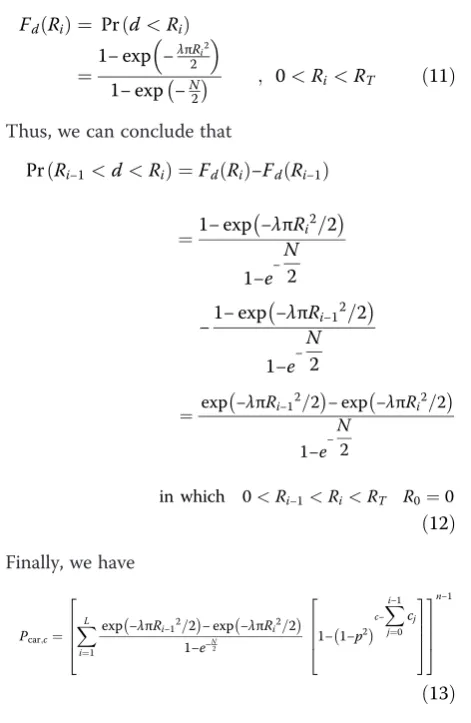
The probability of channel availability within a hop depends on the distance between nodes,d. The P(Ri) is defined as the probability that the length of the hop between two adjacent nodes in the route is less than Ri and longer than Ri − 1. The distances between adjacent nodes in a route are independent random variables. There-fore considering (4) and the law of the total probability, it can be concluded that:
Pcat;c¼P Rð Þ1 1−ð1−p2Þc
Consequently, based on (4) and (5), and the existence ofn−1 hops through a route, we have
Pcar;c¼ Pcat;c
n−1
ð6Þ
Consequently, based on (5) and (6), we have
Pcar;c¼
Let the node transmission power be fixed to RT. In fact, the transmitting range with a similar transmitting power on wireless spectrum bands with different frequencies is un-equal. We assume thatR1<…<Rl<RT. The probability of
P(Ri) is dependent on the number of hops and also the limit of the transmission range. To demonstrate the effects of channels with different transmission ranges on the system, we model the spatial distribution of mobile nodes as a Poisson variable with a densityλ. Thus [29],
Pr There areð knodes in a region with disc areaSÞ
¼λSk expð−λSÞ
k! ; k¼0;1;2;3;…
ð8Þ
Without the loss of generality, this can be considered as a snapshot of the mobile radio network, by which we can calculate P(Ri). The number of neighbouring nodes in a disc area with radiusRTis equal to
N¼λπRT2 ð9Þ
Figure 2Choosing the spectrum bands for communication based on the hop length.
Table 1 The different parameters used and their definitions
Symbol Definition
RT Transmission range
C Total number of available channels
c Number of detected channels at each node
l Channel type
L Total number of channel types
cl Number of possible channels of each type at each node
N Number of nodes in a route
NN Total number of the nodes in the network
AN Network area
P Probability of a particular channel availability at each node
λ Poisson density of nodes' spatial distribution in the network
The probability that there is no neighbour node in the forward direction in the disc with radius RT is also expressed as exp −N
2
Assume that the random variableddenotes the distance between a pair of transmitter and receiver nodes and the
fd(Ri) represents its probability density function (pdf). The probability distribution function ofdis as follows:
Fdð Þ ¼Ri Prðd<RiÞ
Thus, we can conclude that
PrðRi−1<d<RiÞ ¼Fdð Þ−Ri FdðRi−1Þ
Based on the channel availability modelling, the uni-fied spectrum handoff scheme must be proposed to in-clude different mobility events in CR-MANETs, such as spectrum and user mobility, channel quality degradation and topologic variation.
4 Routing and integrated spectrum handoff management in CR-MANETs
4.1 Proposed integrated framework
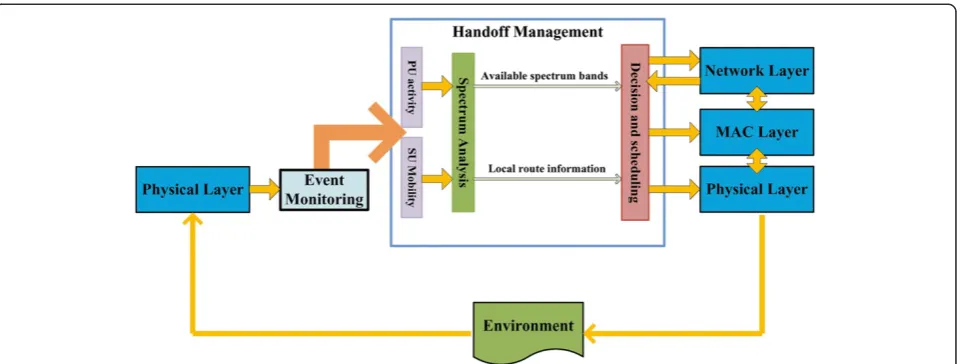
Figure 3 shows the framework for integrated spectrum handoff management and routing in CR-MANETs. The proposed framework considers the spectrum-aware handoff management based on interactions between
routing (layer 3) and the physical layer (layer 1). The proposed scheme is equipped with an algorithm to identify appropriate spectrum bands based on the channel qualities, the spectrum and the node mobility. The spectrum analysis identifies information about the situations and the mobility of the SUs. Thus, the existence of a precise and cooperative environment and a location-aware mechanism is necessary.
In the next subsections, the analytical modelling of the routing and integrated handoff management in CR-MANETs is performed considering the spectrum mobility and channel availability characterized in the previous section.
4.2 Analytical modelling of routing
A wireless network ofmnodes is modelled as a directed graph G(V,E) [30]. As Figure 4 shows, consider a path (SD) from source node S to destination node D consisting of a sequence ofnnodes and consequentlyn−1 undirected hops. The states active (A) and unactive (U) are defined for the different hops and the nodes of the rout considering their condition. A node in the route is in the state A at time
twhen there is at least one available channel on this node. A node is in the state U when there is no available channel on this node. A link in the route is in the state A when its end point nodes are within transmission range of each other independently of the states in which they are; otherwise, the link is said to be in the state U. A hop is said to be active when its two end point nodes are in the A state while they are within transmission range of each other (the link is in the A state) and they are in active state. A route exists when all its hops are in state A. Supposesv= {n1= S,n2,…,ni,…,nn=D} be the sequence ofnnodes andse={e1,e2,…,ei,…,en−1} be the sequence of n−1 links composing path (SD) withn−1 hops.
Consider linkeiwith theniand ni+ 1as its end nodes, the probability of being in active state of ith hop (hi) at timetis as follows:
PAðhi;tÞ ¼ PAðni;tÞ PAðniþ1;tÞ PAðei;tÞ ð14Þ
wherePA(ni,t) is the probability that nodeniis in state A at time t and PA(ei,t) is the probability that nodes ni and ni+ 1 are within transmission range of each other at timet.The probability of existence of the route from a source node S to a destination node D at time t is as follows:
that theU(SD)be the set of all possible routes from source node S to destination node D. The uSD,opt which is the optimum route from source node S to destination node D with the greatest existence probability is then given by
uSD;opt :Arg max
uSD∈UðSDÞ
PEðuSDÞ ð16Þ
Consequently
uSD;opt :Arg max
u∈UðSDÞ lnPEðuSDÞ ð17Þ
And it can be concluded that
uSD;opt : Arg max
uSD∈UðSDÞ
ln Y
ni∈uSD
PAðni;tÞ Y ei∈uSD
PAðei;tÞ
!!
ð18Þ
Considering the unified Equation 13, it can be con-cluded that
uSD;opt : Arg max
uSD∈UðSDÞ
ln Pcar;cðuSDÞ
ð19Þ
4.3 Analytical modelling of integrated handoff
In this part, we exploit Markov chains to model the spectrum handoff mechanism in CR-MANETs based on the channel availability modelling above. We also consider the spectrum heterogeneity in terms of PER. Once the channel quality declines or PER increases, the probability of success-ful packet transmission rate is decreased. The SU detects this deterioration throughput QoS and decides to change the channel to achieve a better throughput performance. ConsideringPEi as the PER of channel of typeiand Equa-tion 13, the probability of successful packet routing in a route or betweennnodes is deduced as
Figure 4A path(SD)from source nodeSto destination nodeD.
The probability of successful packet transmission in a hop or between two nodes is also found as
pspt;c¼pspr;c nj ¼2 ð21Þ
The parameterPEi shows the rate of failed packets sent because of the variable channel conditions caused by factors such as fading and shadowing. The probability of unsuccessful packet transmission in a hop or between two nodes is also found:
puspt;c¼1−pspt;c ð22Þ
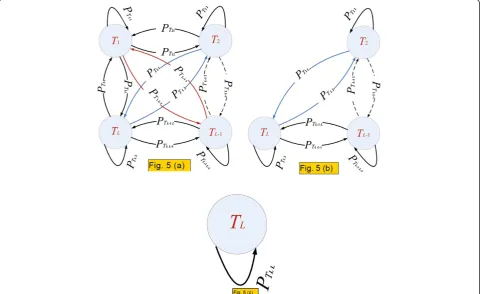
To calculate the probability distribution of spectrum handoff and also model the spectrum handoff initiation in CR-MANETs, we define the position case Dl − 1l as the case in whichRl−1<d<Rl, wheredis the length of the hop. Hereafter, for the sake of indexing convenience, we refer to the position case Dl − 1 l as Dl throughout the paper. Figure 5 shows the different Markov chains for spectrum handoff modelling based on the length of the hops. P, which is the Markov matrix, is written as follows:
The Markov chains have different numbers of states based on the different position cases Dl. As shown in Figure 2 previously, when the length of the
hop is less than R1, or when the spectrum handoff
occurs in the position case D1, the two nodes
in-volved in the current hop can select one of the
available channels of any L types. In the position
case D1, the Markov chain is as shown in Figure 5a.
In the case D2, the nodes involved in spectrum
handoff can select one channel among available
channels from type k, in which k≠1, as shown in
Figure 5b. When the distance between the involved nodes in the spectrum handoff is according to pos-ition case DL, the nodes can only select one channel among available channels of type L, as shown in
Figure 5c. The other situations can be determined based on the claims above.
Suppose that two nodes are communicating in a chan-nel of type k. There are two different conditions where nodes continue their communication in the current spectrum pool. These two conditions, in the position case ofDl, are as follows:
– The packet transmission is successful in the current
channel of typek.
– The packet transmission is not successful in
the current channel of type kbut only
successful on another channel of spectrum pool k.
Thus, the probability that the involved nodes in this hop do not switch their channel type, PTkk, is calculated as follows:
PTkk;Dl ¼pspt;ck þ YL
j¼1;j≠k
puspt;cj ð23Þ
There are also two conditions where two nodes, which are communicating on a channel of type e, switch their channel type to another channel of typeksuch that kϵ
{1,2,…, L}, k≠e. These two conditions, in the position caseDl, are as follows:
– Unsuccessful packet transmission in a channel of
typee, but only successful transmission in channel
of typek.
– Unsuccessful packet transmission in a channel of
typee,but successful transmission in channel type
sets:
Mi⊆T;j j ¼Mi Li<L ð24Þ
The row vector πPDl, which is composed of π P
Dlð ÞTi , demonstrates the steady state probability for PDl consider-ing different hop lengths. The value of πP
Dlð ÞTi is calcu-lated using the following equations:
πP
DlPDl ¼π P
Dl ; XL
i¼1
πP
Dlð Þ ¼Ti 1 ð26Þ
Ultimately, the steady state probabilities for various hop lengths for channel typeiare calculated as below:
πP T
i ð Þ ¼XL
l¼1
PrðRl−1<d<RlÞπPDlð ÞTi ð27Þ
where Pr(Rl−1<d<Rl)is calculated using (12).
4.4 Integrated mobility and spectrum handoff management
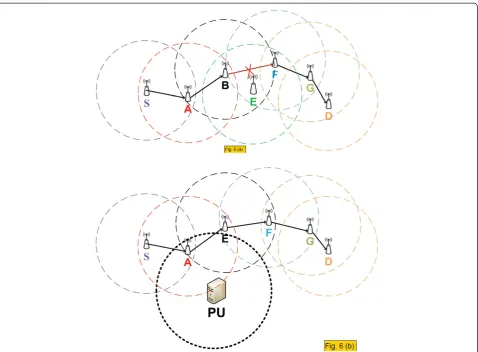
To propose the integrated spectrum handoff management, we introduce the different scenarios which cause spectrum handoff initiation through an established route in a CR-MANET. Suppose that, based on Figure 6, a route from a source node S to the destination node D has been estab-lished. There are three different scenarios that initiate the spectrum handoff in this route, which are as follows:
4.4.1 SU mobility
As shown in Figure 6a, route failure occurs when either node B or node F moves such that no channel can support their transmission. Before the route failure occurs, local flow handoff is performed. A local flow handoff can be from node B to node E and finally joining node F. In this scenario, the unified routing and spectrum handoff
PTek;Dl¼ puspt;ce pspt;ck YL
j¼1;j≠e;k
puspt;cj
!!
" #
þ puspt;ce X
Mi⊆T
Y
j¼1;2;…;i;Tj∈Mi;j≠e
psup;cj Y
j¼1;2;…;i;Tj∉Mi;j≠e
puspt;cj
Mi j j 2
6 6 4
3 7 7 5 ð25Þ
Figure 5Markov chains for spectrum handoff modelling based on the distance between SUs or the length of the hops. (a)In case D01,
management system tries to solve the problem by finding a node within the neighbouring area of the damaged links.
To perform local routing, a certain amount of overlap-ping of the transmission range between node B, node F and the node that will take responsibility for routing the packets
is necessary. To consider two nodes as two hop counts, the maximum overlapping between these two nodes is shown in Figure 7. The maximum overlapping area is 1.23RT2. In a topology where nodes are uniformly distributed over the network area, the following condition guarantees the presence of at leastɳnodes in the overlapping area [19]:
Nn≥ ηAN 1:23RT2
ð28Þ
To guarantee the overlapping of the transmission range of two nodes, the following requirement must be satisfied:
Nn>
AN
RT2
ð29Þ
This equation is in accordance with (28).
4.4.2 PU activity dominates
Figure 6b shows the second scenario when the activity of the PU in the neighbourhood of node E may cause the links A to E or E to F to fail. This route failure occurs once
Figure 6Different scenarios causing spectrum handoff initiation through an established route in CR-MANETs. (a)SU mobility and spectrum heterogeneity and(b)PU activity.
the PU starts its transmission or when node E enters the coverage area of the PU.
4.4.3 Spectrum heterogeneity and different channel transmission range
The mobility of the CR user can also lead to spectrum handoff due to spectrum heterogeneity and various channel transmission ranges. Assume that two mobile nodes, with a distance less thanRl, are communicating in an active route, while they are using a channel of typelfor their data trans-mission. When their distance exceeds the Rl, they must change their communication channel and find a channel with a transmission range longer thanRl.
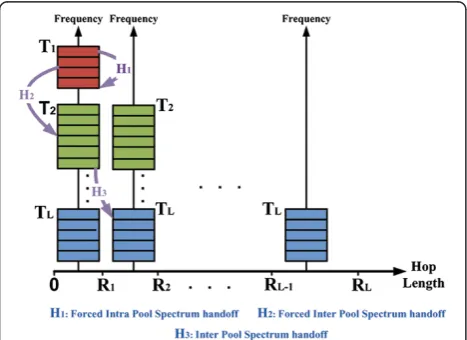
Therefore, as Figure 8 shows, the different handoff procedures are defined as:
Forced intra-pool spectrum handoff:The operation frequency of the SU is changed to another spectrum band in the same spectrum pool. This type of handoff happens because of the appearance of the PU.
Forced inter-pool spectrum handoff: The operation frequency of the SU is changed to another spectrum band in a different spectrum pool because of the appearance of the PU.
Inter-pool spectrum handoff: The CR user changes its spectrum bands from one spectrum pool to another different spectrum pool. This type of spectrum handoff occurs because of the mobility and channel quality degradation of the SU.
Local flow handoff: due to the SU mobility, there is no channel that can support the data transmission.
The spectrum handoff procedure happens when the current channel does not successfully send data. However, the spectrum handoff does not occur when the transmission
on any of all of the available channels fails. Therefore, the probability of spectrum handoff is equal to
PSH¼ that all available channels have unsuccessful packet transmission. In such a case, the troubled nodes do not perform spectrum handoff; they perform local flow handoff. Therefore, the probability of local flow handoff can be expressed as follows:
The probability of successful spectrum handoff depends on the probability of successful packet transmission in a hop pspt,c. However, to perform local flow handoff, Equations 28 and 29 must be satisfied. We define the link maintenance probability (PLM) as the probability that the link is successfully maintained in a hop or between troubled nodes, which is dependent on the probability of channel availability between two nodes. Thus, the link maintenance probability, considering only spectrum handoff, can be written as follows:
PLM;SH ¼PSHPspt;c ð32Þ
When the link maintenance is not successful, despite the spectrum handoff, local rerouting is performed. In this case, the probability of link maintenance is as follows:
PLM;LH¼
Finally, the probability of link maintenance, considering the unified routing and spectrum handoff management, can be stated as follows:
PLM;USH¼PLM;SHþPLM;LH ð34Þ
5 Data rate of the secondary user
For any secondary user that operates in a spectrum band, its maximal data rate can be represented by [31]
Dr¼Wcl log2 1þ the power of the additive white Gaussian noise (AWGN),
PTis the transmission power for SU andGis the channel gain. Given the solutions of the steady state probabilities, we know that πp(Ti) is the stationary probability that
the system is in stateTi, and thus, it can be thought of as the expected long-run fraction of the time that the Markov chain spends in the stateTi[32]:
πp T i ð Þ ¼ lim
τ→∞
1 τ
Z τ
0
PrfT tð Þ ¼Tigdt ð36Þ
where T(t) is the state of the Markov chain at time t. ConsideringDRas the long-run expected average through-put for the SU, it can be defined as follows:
DR¼ lim
τ→∞
1 τE
Z τ
o
DrðT tð ÞÞdt
ð37Þ
whereDr(T(t)) is the throughput of the SU achieved in stateT(t). Based on (35), (36) and (37), it can be con-cluded that
DR¼τlim→∞ 1 τE
Z τ
o
DrðT tð ÞÞdt
ð38Þ
Therefore, by using the Markov chain, the dynamic utilization of the empty licensed bands for SUs without conflicting with the PU can be captured. Calculation of the spectrum utilization of the SUs from a statistical point of view and of their stationary behaviour is also possible.
6 Results and discussion 6.1 Analytical results
In the first part, analytical results are illustrated to support the analysis.
Channel availability and spectrum mobility consideration
In this section, we show the effect of different parame-ters on the Pcar,c. In all of the following figures, we
suppose that there are only two types of channels with a transmission range of R1= 75 m and R2= 125 m and a
maximum node transmission range of RT= 150 m. We
also assume that the activity of the PU on different channels is identical.
Figures 9 and 10 show the effect of type of the chan-nels on the Pcar,c. In these figures, p= 1/2, R1= 75 m, R2= 125 m,RT= 150 m,c= 10 andN= 8. Figure 10 depicts the effect of the homogeneous channel transmission range on the probability of channel availability. The re-sult implies that thePcar,c is dependent on the channel transmission range.
•Link maintenance probability
Spectrum heterogeneity and SU mobility have a sig-nificant effect on the handoff blocking probability in the integrated handoff management scheme. We define the probability of unsuccessful link maintenance as the probability of spectrum handoff blocking (Phb). Figure 11 compares the probability of unsuccessful rerouting (Pusrr), the handoff blocking probability deploying only spectrum handoff (Phb,SH) and the handoff blocking probability deploying integrated handoff management (Phb,USH), considering various number of SU nodes in the net-work. In the following figures, L= 2,p= .5, R1= 75 m, R2= 125 m,RT= 150,c= 10,c1= 5,c2= 5 and the number of hops is equal to 14. Based on this figure, the inte-grated handoff management scheme outperforms the scheme deploying only spectrum handoff in terms of link maintenance probability. The probability of link maintenance in the integrated handoff scheme is also significantly higher than the probability of successful rerouting. As the number of SUs in the network increases, the probability of handoff blocking decreases because the
probability of finding the proper nodes, which work as the relay, to perform local rerouting increases.
Based on [33], with an area network of AN = 1,000 m2
and RT= 150 m, the number of expected hop counts
in the network is equal to five. Figure 12 compares the proposed parameters in Figure 11 with an expected hop count in the network equal to five. Comparing Figures 11 and 12, we conclude that the probability of handoff blocking decreases when the number of hops
decreases. This study shows that the proposed
integrated spectrum handoff management and routing
scheme achieves more actual data transmission
opportunities.
SU's data rate
Figure 13 compares the effects of channel heterogeneity and PU activity on the SU data rate. Based on this figure, the higher transmission range leads to a higher data rate because the number of handoffs will be reduced. Therefore, the effect of channel heterogeneity in terms of transmission range and path loss must be considered on the perform-ance of the integrated handoff management.
6.2 Simulation results
In this subsection, performance comparisons of three different schemes are conducted using Network Simulator 2 (ns-2) [34]. To study the handoff blocking probability, three different handoff management schemes are con-sidered. These three different versions of the handoff management scheme are defined as the SH scheme,
Figure 10The effect of the channel transmission range onPcar,c.
the reactive unified spectrum handoff (USH) scheme and the proactive unified spectrum handoff (PUSH) scheme. The first scheme only deploys the spectrum handoff, while the remaining two schemes deploy the unified spectrum handoff in which the local flow handoff will be added to the management system. One of these two schemes, USH, does not consider the handoff thresh-old; whereas PUSH considers the handoff threshold for the preemptive handoff region.
There is a total number of available channels C =10, classified into two different typesC1= 5 and C2= 5. The transmission ranges of different channel types are set to
R1= 75 m and R2= 125 m. The mobile SUs are distrib-uted in a network with a 2,000 m × 2,000 m area, and their speed is set to 3 m/s. The transmission range of the static PUs is set to 200 m, and the activity of PUs is
modelled as a two-stage on/off procedure with an expo-nential distribution.
Here, two different handoff thresholds are defined. The signal power of hello packets is used to approximate the distance between the transmitter and the receiver. Suppose thatPsndis the hello packet signal power at the transmitting antenna and Pr is the receiving power at distance r. Based on [35], the signal power received through free space decreases with distance such that:
Pr¼ Psnd
rn ð39Þ
where n is a number typically between 2 and 4 (e.g.
equal to 2 near the transmitter until a certain point at
whichn becomes 4) [35]. Because the two preemptive
regions are near the maximum transmission range, we
Figure 12Comparison of different handoff management schemes and routing performance with an expected hop count of five.
model the drop in the signal power to 1/r4throughout these regions:
Pr¼ Psnd
r4 ð40Þ
Based on (34), the signal power threshold for preemptive channel handoff (PSTPCH) can be expressed as follows:
PSTPCH;l¼
Psnd Rl−Wch;l
4
¼ Psnd
Rl− vrelativetw;l
4 ð41Þ
where the Wch,l is the warning distance for nodes
communicating on a channel of type l, vrelative is the
relative speed of nodes, andtw,lis the warning interval. The minimum power received by the receiver, which is the power at the channel transmission range,PCTR,l, is expressed as follows:
PCTR;l¼
Psnd Rl4
ð42Þ
The spectrum handoff threshold (SHTH) can be de-scribed as:
SHTH;l¼PSTPCH;l PCTR;l
¼ Rl4
Rl− vrelativetw;l
4 ð43Þ
Figure 14Comparison of the performance of different handoff management schemes in terms of handoff blocking probability.
Similarly, the handoff threshold for the preemptive local flow handoff region (LHTH) can be expressed as:
LHTH¼PSLFTH PNTR
¼ RT4
RT−Wlink
ð Þ4 ð44Þ
wherePSLFTHis the signal power threshold for
preemp-tive flow handoff and PNTR indicates the minimum
power received by the receiver at the node transmission range,RT. Thetw,l, which is the interval from the warn-ing till the communication link break off, needs to be greater than or equal to the necessary time for perform-ing the handoff.
Link maintenance, handoff blocking, handoff delay and spectrum handoff performance
In this part, the SU's route maintenance probability or handoff blocking probability is investigated. The handoff threshold time is set to 6 s, and both the PU's and the SU's arrival rates are set to be 0.25. The reactive AODV [36] routing protocol is used for route formation over CR-MANET.
Figure 14 verifies the effect of local flow handoff on the route maintenance probability. It is expressed that the proposed unified handoff approach efficiently im-proves the route maintenance probability. In this approach, the data flow is transferred to the nearby users to keep the communication while the first scheme only uses the spectrum handoff to keep the route. The probability of un-successful route maintenance is defined as the probability of spectrum handoff blocking (Phb). Figure 14 indicates that the spectrum handoff blocking probability in the PUSH
Figure 16Comparison of performance of different management schemes of SU's throughput vs. number of PU channels.
scheme (Phb,PUSH) is significantly lower than the prob-ability of the spectrum handoff blocking in the scheme deploying only spectrum handoff (Phb,SH). This is due to deploying the local flow handoff in PUSH. On the other hand, thePhb,PUSHis lower than the probability of handoff blocking in the scheme deploying reactive unified spectrum handoff (Phb,USH). This is because PUSH performs the handoff proactively. Hence, deploying the proactive local flow handoff can be more efficient than the other schemes.
Figure 15 shows the SU throughput with various num-bers of SUs. In this part, the arrival rate of SU packets is equal to 200 packets per second. The PU's packet has an arrival rate equal to 10 packets per second. It is signifi-cant that the throughput of SU transmissions decreases when the number of SUs increases. This is because more SUs result in fewer opportunities to capture the channel
for each SU. In this figure, on the other hand, the PUSH scheme outperforms the other two schemes in terms of SU throughput.
Figure 16 shows the SU throughput under various numbers of PU channels. In this part, the arrival rate of SU and PU packets are the same as in Figure 15. The number of PU channels varies and is divided into identical numbers of channels belonging to two different types detectable by any SU at any location. The number of SUs in the network is fixed at 50. As the number of PU channels increases, the SUs' throughput increases because more channels can be captured by the SUs for data transmissions. In this figure, the PUSH scheme outperforms the two other schemes in terms of SU throughput.
Figures 17 and 18 show the simulation results of the average spectrum handoff delay under different network
Figure 18Average spectrum handoff delay under different arrival rates of PUs.
conditions. From these figures, it can be stated that by using the integrated handoff management scheme, the average spectrum handoff delay is reduced significantly.
Figure 19 compares the handoff blocking probability in analytical model considering various arrival rates of the PUs in the network. This figure also compares three different handoff management schemes to study the hand-off blocking probability based on the simulation results. Based on this figure, in the analytical model, the unified handoff management scheme outperforms the scheme deploying only spectrum handoff in terms of link main-tenance probability, which is also verified by the simula-tion results. The simulasimula-tion results indicate that the spectrum handoff blocking probability in the PUSH scheme (Phb,PUSH) is significantly lower than the probability of the spectrum handoff blocking in the scheme deploying only spectrum handoff (Phb, SH). This is due to deploy-ing the local flow handoff (LFH) in PUSH. On the other hand, thePhb,PUSHis lower than the probability of handoff blocking in the scheme deploying USH (Phb,USH). This is because the PUSH performs the handoff proactively. Hence, deploying the proactive LFH can be more efficient than the other schemes.
7 Conclusions
Spectrum handoff management is still an open issue in CR networks. It is particularly challenging in CR-MANETs. In CR-MANETs, the available spectrum bands vary over time and space, while they are distributed nonadjacently over a broad frequency range. However, in CR-MANETs, the fluctuation of PU activity and the SU mobility make the issue of maintaining optimal routes more complex. In this work, we present an integrated spectrum handoff manage-ment and routing scheme that considers spectrum mobility in the time and space domains and considers the net-work topology variations. We propose a netnet-work architec-ture that considers the heterogeneous spectrum availability and its variation over time and space and distributed nodes. Then, the probability of channel availability in this dy-namic radio environment is calculated. Based on this unified architecture, an integrated routing and spectrum handoff management scheme is proposed. The proposed scheme considers the CR-MANETs spectrum handoff problem and incorporates the routing issue. Both the analytical and simulation results verify the improve-ment in the network performance using the introduced management scheme.
Competing interests
The authors declare that they have no competing interests.
Authors’information
SN is a researcher of the Universiti Teknologi Malaysia under the Post Doctoral Fellowship Scheme for the Project:‘SELF ORGANIZING INTELLIGENT-BASED COGNITIVE RADIO LEARNING SYSTEM FOR INTELLIGENT P-PUSH’.
Acknowledgements
This work was supported in part by the Ministry of Science, Technology and Innovation (MOSTI) Malaysia, and the Research Management Center (RMC), University Technology Malaysia under GUP research grant no. R. J130000.7923.4S063.
Received: 25 March 2014 Accepted: 26 August 2014 Published: 7 September 2014
References
1. V Chakravarthy, L Xue, W Zhiqiang, A Michael, F Garber, R Kannan, A Vasilakos, Novel overlay/underlay cognitive radio waveforms using SD-SMSE framework to enhance spectrum efficiency- part i: theoretical framework and analysis in AWGN channel. IEEE Trans. Commun.57(12), 3794–3804 (2009)
2. J Mitola, GQ Maguire, Cognitive radio: making software radios more personal. Pers. Commun. IEEE6(4), 13–18 (1999)
3. A Attar, H Tang, A Vasilakos, F Yu, V Leung, A Survey of security challenges in cognitive radio networks: solutions and future research directions. Proc. IEEE100(12), 3172–3186 (2012)
4. AW Min, KG Shin, Impact of mobility on spectrum sensing in cognitive radio networks, inProceedings of the 2009 ACM Workshop on Cognitive Radio Networks CoRoNet(Beijing, China, 2009), p. 13
5. WY Lee, Spectrum management in cognitive radio wireless networks, in Thesis, (PHD) Georgia Institute of Technology, 2009
6. IF Akyildiz, WY Lee, KR Chowdhury, CRAHNs: cognitive radio ad hoc networks. Ad Hoc Netw.7, 810–836 (2009)
7. X Huang, D Lu, P Li, Y Fang, Coolest path: spectrum mobility aware routing metrics in Cognitive Ad Hoc Networks, inDistributed Computing Systems (ICDCS), 31st International Conference on(Minneapolis, 2011), pp. 182–191 8. B Sang-Seon, I Balashingham, A Vasilakos, L Heung-No, Computation of an
equilibrium in spectrum markets for cognitive radio networks. IEEE Trans. Comput.63(2), 304–316 (2014)
9. B Sang-Seon, B Ilangko, V Vasilakos, A market-clearing model for spectrum trade in cognitive radio networks, inProceedings of the Twelfth ACM International Symposium on Mobile Ad Hoc Networking and Computing (MobiHoc’11)(ACM, New York, 2011)
10. M Youssef, M Ibrahim, M Abdelatif, C Lin, A Vasilakos, Routing metrics of cognitive radio networks: a survey. Commun. Surv. Tut. IEEE16(1), 92–109 (2014) 11. W Maqbool, SK Syed-Yusof, NM Abdul-Latiff, S Nejatian, Characterization of end-to-end path selection for cognitive radio wireless mesh networks. Life Sci. J.11(8), 827–834 (2014)
12. L Giupponi, AI Perez-Neira, Fuzzy-based spectrum handoff in cognitive radio networks, in3rd International Conference on Cognitive Radio Oriented Wireless Networks and Communications CrownCom(Singapore, 2008), pp. 1–6 13. W Feng, J Cao, C Zhang, C Liu, Joint optimization of spectrum handoff
scheduling and routing in multi-hop multi-radio cognitive networks, in 29th IEEE International Conference on Distributed Computing Systems (Montreal, 2009), pp. 85–92
14. Y Song, J Xie, ProSpect: a proactive spectrum handoff framework for cognitive radio ad hoc networks without common control channel. IEEE Trans. Mobile Comp.11(7), 1127–1139 (2012)
15. Y Song, J Xie, Performance analysis of spectrum handoff for cognitive radio ad hoc networks without common control channel under homogeneous primary traffic, inINFOCOM, 2011 Proceedings IEEE(Shanghai, 2011), pp. 3011–3019
16. Z Damljanovic, Mobility Management Strategies in Heterogeneous Cognitive Radio Networks. J. Netw. Syst. Manage18(1), 4–22 (2010) 17. J Duan, Y LI, An optimal spectrum handoff scheme for cognitive radio
mobile ad hoc networks. Digit Object Identifier11, 11–16 (2011) 18. K Wu, J Harms, Performance study of proactive flow handoff for mobile ad
hoc networks. Wirel. Netw12, 119–135 (2006)
19. P Abhilash, S Perur, S Iyer, Router handoff: an approach for preemptive route repair in mobile ad hoc networks. Lect. Notes Comp. Sci.2552, 347–357 (2002)
20. J Tigang, W Honggang, A Vasilakos, QoE-driven channel allocation schemes for multimedia transmission of priority-based secondary users over cognitive radio networks. IEEE J. Selected Areas Commun.30(7), 1215–1224 (2012) 21. A Chehata, An on-demand routing protocol for multi-hop multi-radio
22. AS Cacciapuoti, M Caleffi, L Paura, Reactive routing for mobile cognitive radio ad hoc networks. Ad Hoc Netw.10(5), 803–815 (2012)
23. A Cianfrani, V Eramo, M Listanti, M Polverini, A Vasilakos, An OSPF-integrated routing strategy for QoS-aware energy saving in IP backbone networks. IEEE Trans. Netw. Serv. Manage9(3), 254–267 (2012)
24. S Nejatian, SK Syed-Yusof, NM Abdul Lattif, V Asadpour, Proactive integrated handoff management in CR-MANETs: a conceptual model, inIEEE Symposium on Wireless Technology and Applications (ISWTA)(Bandung, 2012), pp. 33–38 25. S Nejatian, JA Abolarinwa, SK Syed-Yusof, NM Abdul Lattif, V Asadpour,
Characterization of spectrum mobility and channel availability in CR-MANETs, inProc. of the International Conference on Advances in Mobile Networks and Communication - MNC 2012(Kuala Lumpur, 2012), pp. 12–16
26. S Nejatian, SK Syed-Yusof, NM Abdul Lattif, N Fisal, V Asadpour, Handoff management in cognitive radio networks: Concepts, protocols, metrics and challenges. Int. Rev. Comput. Softw. (I.RE.CO.S.)7(6), 2993–3006 (2012) 27. S Nejatian, SK Syed-Yusof, NM Abdul Lattif, V Asadpour, H Hosseini,
Proactive integrated handoff management in cognitive radio mobile ad hoc networks. EURASIP J. Wireless Commun. Netw.224, (2013). doi:10.1186/1687–1499–2013224
28. S Nejatian, SK Syed-Yusof, NM Abdul-Latiff, V Asadpour, IEEE conference on Personal Indoor and Mobile Radio Communications (PIMRC), (IEEE 24th International Symposium on, 2013). ISSN 2166–9570, 28872892 29. T-C Hou, VO-K Li, Transmission range control in multihop packet radio
networks. IEEE Trans. Commun.32(1), 38–44 (1986)
30. L Peng, G Song, Y Shui, A Vasilakos, CodePipe: an opportunistic feeding and routing protocol for reliable multicast with pipelined network coding, in INFOCOM, 2012 Proceedings IEEE(Orlando, 2012), pp. 100–108 31. TM Cover, JA Thomas,Elements of Information Theory(Wiley-Interscience,
NewYork, 1990)
32. VG Kulkarni,Modeling and Analysis of Stochastic Systems(CRC, Boca Raton, 1995) 33. J Li, C Blake, DSJ De Couto, HI Lee, R Morris, Capacity of ad hoc wireless
networks. Network01, 61–69 (2001)
34. The NS Manual (formerly ns Notes and documentation)(Vint Project, Berkeley, CA, USA, 2010)
35. T Goff, NB Abu-Ghazleh, DS Phatak, R Kahvecioglu, Preemptive routing in ad hoc networks. J. Parallel Distributed Comput.63(2), 123–140 (2003) 36. CE Perkins, EM Belding-Royer, Ad hoc on demand distance vector (AODV),
inProc. Of IEEE WMCSA(New Orleans, 1999), pp. 90–100
doi:10.1186/1687-1499-2014-144
Cite this article as:Nejatianet al.:Modelling of routing and spectrum
handoff in CR-MANETs.EURASIP Journal on Wireless Communications and
Networking20142014:144.
Submit your manuscript to a
journal and benefi t from:
7Convenient online submission
7Rigorous peer review
7Immediate publication on acceptance
7Open access: articles freely available online
7High visibility within the fi eld
7Retaining the copyright to your article