R E S E A R C H
Open Access
Simultaneous wireless energy transfer
and spectrum sharing with primary data
relaying in cognitive radio networks
Zhiyuan Yu
1,2, Chao Zhai
1and Ju Liu
1,2*Abstract
Spectrum sharing and energy harvesting (EH) are promising techniques to enhance the spectrum and energy efficiency of wireless networks. In this paper, we propose a spectrum sharing scheme based on the cooperative energy and data transfer in both the time and space domains. When the primary base station (PB) transfers energy to the primary user (PU), the secondary user (SU) can transmit its own data simultaneously, and the interference of secondary data transmission becomes beneficial to improve the EH efficiency of the PU. Furthermore, the SU can assist the primary data relaying using the Alamouti coding technique to improve the link robustness through introducing the space diversity. With the energy and data cooperation from the SU, the primary data can be more quickly and reliably delivered, and hence more opportunities can be achieved for the spectrum sharing. Considering the dependence of the energy and data transfer, the throughput of both systems is investigated. The time allocation between EH and data transmission can be numerically determined by maximizing the throughput of secondary system under the throughput constraint of primary system. Performance results are presented to validate our theoretical analysis and provide some guidelines for the network configuration.
Keywords: Spectrum sharing, Wireless energy transfer, Cooperative relaying, Alamouti coding, Cognitive radio
1 Introduction
The radio frequency (RF) energy harvesting (EH) is a promising technique that enables the smart power-limited devices to harvest energy from the electromagnetic radi-ation [1]. Researchers have shown that the maximal har-vested energy is about 7.0 and 1.0μW at the free space distance of 40 m over 2.4 and 900 MHz, respectively [2]. In this way, the harmful interference becomes a source of energy, which can improve the energy efficiency and thus significantly prolong the network lifetime [3, 4]. The rapid advancement of the EH materials and devices makes the network coupling with EH devices a reality [5], e.g., the Powerharvester Receivers designed by the Powercast can harvest the RF energy to charge the remote battery-free devices [6]. A highly-efficient rectenna was designed in [7] to improve the output power of the direct current as well *Correspondence: [email protected]
1School of Information Science and Engineering, Shandong University, 27 Shanda Nanlu, 250100 Jinan, China
2National Mobile Communications Research Laboratory, Southeast University, 2 Sipailou, 210096 Nanjing, China
as the power sensitivity, which can be used for the EH in the wireless sensor network.
1.1 Related work
Spectrum sharing has been intensively studied to deal with the increasing requirements of wireless data trans-missions over the limited but under-utilized bandwidth. In this context, the unlicensed users also known as the secondary users (SUs) are allowed to access the licensed spectrum of the high-priority primary users (PUs), but under the constraint that the transmission requirements of PUs should be strictly protected.
To improve the spectrum efficiency, many spectrum sharing schemes have been proposed [8–12]. In the space domain, the SU can use a fraction of its power to relay the primary data, while the remaining power is used for its own data transmission [8]. Huang et al. studied the capac-ity tradeoff between cellular and mobile ad hoc networks for the underlay and overlay spectrum sharing schemes [9]. In the multiuser scenario, a SU can be selected to
assist the primary data transmission to tolerate the inter-ference caused by the secondary data transmission from another selected SU [10]. In the frequency domain, the SU can help relay the primary data to exchange for some disjoint bandwidth for its own data transmission [11]. To combat the low efficiency of half-duplex cooperative pro-tocols, Zhai et al. proposed the spectrum sharing based on the two-path successive relaying [12], where two SUs can alternatively and successively relay the primary data and transmit their own data using the superposition coding technique, while the successive interference cancelation (SIC) techniques is adopted by the receivers to decode the desired information.
The RF signal can carry not only information but also energy, so there exists an energy-rate tradeoff for the simultaneous wireless information and power transfer (SWIPT) [13, 14]. Huang et al. deployed the orthogo-nal frequency division multiplexing (OFDM) and trans-mit beamforming for the SWIPT in a broadband system [15]. For the large-scale network, Krikidis studied the cooperative relay protocol to show the tradeoff between the outage performance and the wireless energy trans-fer (WET) [3]. For the stochastic networks, the coop-erative energy transfer and data relaying protocol was proposed by properly modeling the locations of users as Poisson point process [16]. Rubio et al. analyzed the tradeoff between the sum-rate and the energy constraints in the multiuser multiple-input multiple-output (MIMO) system [17]. The harvest-then-transmit protocol was pro-posed in [18], where the terminals should first harvest the ambient RF energy, and then transmit data using the harvested energy. Reference [19] implemented the power beacons in the cellular network to transfer the microwave power to the mobile devices to support their uplink data transmissions to the base stations.
The EH-based spectrum sharing has drawn intensive research interests nowadays. The optimal mode selection policy was designed by balancing the trade-off between spectrum accessing and energy harvesting [20]. The SUs can opportunistically harvest the RF energy from the nearby PUs and reuse the spectrum to send their sig-nals if they lie outside the exclusive regions of all the PUs [21]. Mousavifar et al. proposed the spectrum shar-ing scheme that the source and the relay can harvest energy from the PUs and the information of source is forwarded to the destination by the relay [22]. The joint information and energy cooperation between pri-mary and secondary systems is investigated in [23], where the SUs can help the primary data transmissions to acquire the energy and spectrum for the secondary data transmission. The SUs can be scheduled to access the selected channel for the data transmission or harvest energy by designing a learning algorithm [24]. Park et al. derived the upper bound of the achievable throughput
for the EH SUs under the energy causality and collision constraints [25].
Although there exist some related works about the EH-based spectrum sharing for different network structures, it is still necessary to further improve the spectral and energy efficiency. Our proposed transmission strategy is different from those of above papers. In our paper, the single-antenna UE and SU can form the virtual antenna array in the cooperative period and the spatial diversity can be achieved by using Alamouti coding to enhance the reliability of data transmission. As a result, the energy and spectral efficiency of the cognitive radio network can be greatly improved.
1.2 Motivation and contribution
In the cognitive radio network, the time-switching or the power-splitting techniques can be adopted by the PU for the EH and information decoding [13]. Usually, the valu-able spectrum is either used solely for the energy transfer or for the data transmission. It is necessary to design flex-ible schemes to efficiently utilize the spectrum to realize both the EH and the spectrum sharing. Furthermore, the SU can use its energy to relay the primary data to improve the link robustness and hence strive for more opportuni-ties for the spectrum sharing. It is a win-win game for both systems by considering the resource complementary that the PUs own spectrum but lack energy, while the SUs have enough energy but lack spectrum.
We propose a spectrum sharing scheme based on the cooperative energy and data transfer for the cogni-tive radio network, where a secondary link is overlaid with a primary link. Each terminal is assumed to be equipped with one omnidirectional antenna and the simi-lar assumption is made in [18, 26]. In the primary system, the user equipment (UE) has the capability of harvesting energy from the RF signals. All the other terminals are assumed to have the stable power supply. Compared with the standalone primary system, with the energy assistance from the secondary link, the UE will get more energy and be charged quickly. Also, the primary data from the UE can be delivered more reliably. The main contributions of this work are summarized as:
• In the EH period of our proposed scheme, the SU can transmit its own data using the licensed spectrum, of which the interference can help recharge the UE. When the UE transmits its data using the small amount of harvested energy, the SU can help relay the primary data to improve the link robustness. Thus, the primary data can be more reliably delivered with less resource, and the SU can be awarded some resources for the spectrum sharing.
primary data. Without requiring any extra
bandwidth, the quality of primary data transmission can be improved.
• We analyze the success probabilities of transmission cases and then derive the throughput of both primary and secondary systems. The time allocation between EH and data transmission is investigated through maximizing the throughput of secondary system while guaranteeing the throughput of primary system. • We investigate the impacts of various parameter
settings to the system performance, such as the time allocation, the distances between different terminals, the transmission rate, and the transmission powers of terminals.
The rest of this paper is organized as follows. In Section 2, the energy and data cooperation-based spec-trum sharing scheme is proposed. Section 3 explains the non-spectrum sharing model as a benchmark. In Section 4, we derive the throughput of both systems. Per-formance results are presented in Section 5. Section 6 concludes this paper.
2 Energy and data cooperation spectrum sharing
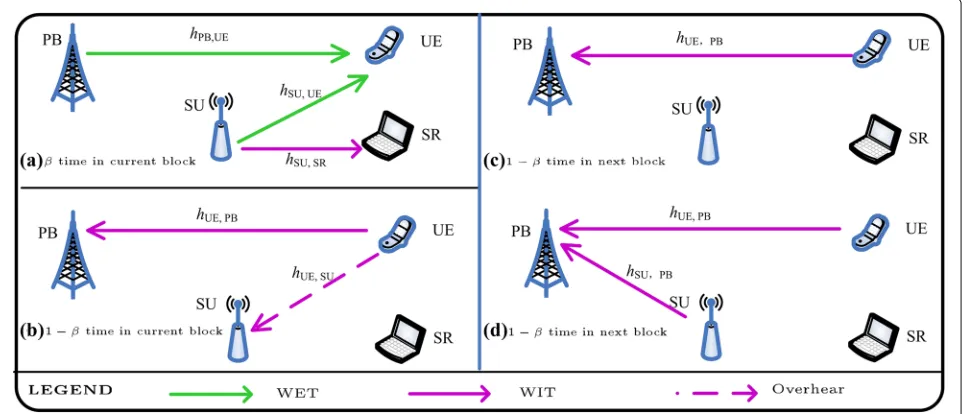
Figure 1 shows the system model of our proposed spec-trum sharing, where a secondary link coexists with a primary link in the same geographic region. In the firstβ time, as shown in Fig. 1a, the PB transfers wireless energy to the UE, and meanwhile the SU communicates with the secondary receiver (SR). The secondary data transmission can be regarded as a source of energy that can be har-vested by the UE. Since the energy signal transmitted by the PB is known to all the terminals, the SR can cancel this
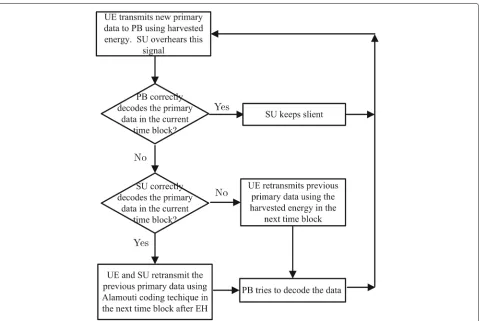
interference to decode its desired secondary data. With the secondary data transmission, the EH efficiency of the UE can be greatly improved, and thus more energy can be available for the primary data transmission. After the WET, as shown in Fig. 1b, the following 1−β time is used for the uplink primary data transmission from the UE to the PB. At the same time, the SU will overhear the UE’s signal and help relay the primary data in case the PB fails to decode it. As illustrated in Fig. 2, according to the decoding statuses of PB and SU, there are three possible transmission policies:
• If the PB correctly receives the primary data in the current block, a new primary data will be transmitted by the UE in the next block after the EH period. • If both PB and SU erroneously receive the primary
data in the current block, the UE will retransmit the primary data in the next block after the EH period, as shown in Fig. 1c.
• If the PB erroneously receives the primary data, but the SU correctly overhears it. The primary data will be retransmitted by UE and SU using the Alamouti coding technique in the next block after the EH period, as shown in Fig. 1d.
The primary data will be discarded if it is still incor-rectly received by the PB after the retransmission. Each channel is assumed to undergo Rayleigh block fading, so the channel fading remains constant in one block, but varies independently from one block to another. The channels are assumed to consist of the small-scale fad-ing and the large-scale path-loss, i.e.,hij = χijd−ijv/2(i,j ∈ {PB, UE, SU, SR}), where v and dij denote the path-loss
Fig. 2The process of primary data cooperation. There are three cases regarding to the decoding statuses of the PB and the SU in the current time block
exponent and the distance between two terminals, respec-tively. The fading coefficientχijis a circularly symmetric complex Gaussian random variable with unit variance. The channel gain |hij|2 is exponentially distributed with the probability density function (PDF) fX(x) =
1
λijexp(−
x
λij), whereE{|hij|
2} = λij = d−v
ij . In each time block, the downlink and uplink channels are assumed to be reciprocial, i.e., the downlink energy transfer from PB and the uplink data transmission from UE suffers from the same channel fading, so |hij|2 = |hji|2. This assumption has been widely adopted in the literatures, such as [18] and [22]. In the cooperative transmis-sion period, we assume that the locations of nodes do not change significantly [28]. The mathematical expec-tation is denoted as E{·}. The (·)∗ and (·)H represent complex conjugate and Hermitian transpose of matrix, respectively.
3 Benchmark primary system without spectrum
sharing
In the non-spectrum sharing scenario, a PB intends to communicate with a UE. The PB has a continuous power supply, while the UE has to harvest the RF energy from
the PB transmissions. This is actually the “Harvest-then-transmit” protocol as proposed in [18]. Each normalized time block consists of two phases. In the firstθ time, the PB transfers energy to the UE over the downlink. In the remaining(1−θ)time, the UE transmits its data to the PB over the uplink using the harvested energy.
In the firstθ time, the amount of energy harvested by the UE is denoted asEuand given as [18, 26]
Eu=ηθpb|hPB,UE|2, (1)
where η ∈ (0, 1) represents the energy conversion effi-ciency andpbdenotes the transmit power of PB.
After harvesting energy in θ time, the primary data is transmitted from UE to PB in the remaining 1−θ time. The transmit power of UE is denoted aspnou and calculated as
pnou = Eu
1−θ. (2)
The achievable rate of primary link is expressed as
CUE,PBno =(1−θ)log2
1+ p
no
u |hUE,PB|2
σ2
whereσ2represents the power of additive white Gaussian
noise (AWGN) and it is the same at different receivers. The throughput of primary system with non-spectrum sharing can be expressed asVp = Pr{CnoUE,PB ≥ R0}R0.
The primary data is assumed to be successfully received by PB if the channel achievable rate is no less than the fixed transmission rateR0. The data success probability can be
derived as stand-alone primary network without spectrum sharing can be obtained viaVmax
p =βmax∈(0,1) Vp.
Since the UE is located far away from the PB, the EH effi-ciency is quite low due to the severe path-loss. Using the small amount of harvested energy, the primary data trans-mission is more likely to fail and the spectrum is wasted for the data retransmission.
4 Throughput of the spectrum sharing
In each normalized time block, the WET is performed in the first β fraction of time. The amount of energy harvested by the UE is denoted asEUEand given as
EUE=ηβpb|hPB,UE|2+ηβpa|hSU,UE|2, (5)
where pa denotes the transmit power of the SU. The transmit power of the UE1can be expressed as
pUE=
EUE
1−β. (6)
After the WET, the UE transmits its own data to the PB in the remaining 1−βtime, and the SU overhears the data from the UE. Based on the decoding status of UE and SU, there exists three transmission cases as follows:
• Case A: If the primary data is correctly received by the PB, the SU will keep silent.
• Case B: If both the PB and the SU erroneously receive the primary data, the primary data will be
retransmitted in the next time block.
• Case C: If the primary data is erroneously received by the PB, but correctly decoded by the SU, the UE and the SU will simultaneously retransmit the primary data in the next time block using the Alamouti coding technique.
The total throughput of primary system includes the above three cases and it can be expressed as
Lp= where the pre-factor 12 accounts that one primary data packet is transmitted in the first time block, and it may be retransmitted in the following time block. The Suc means that the primary data is successfully delivered in a certain case.
4.1 Case A: original data transmission
In the primary data transmission, the achievable rate of the link between UE and PB is denoted asCUE,PB(1) and given
where the pre-factor is applied because the primary data is broadcasted by the UE in 1−βtime. The success probabil-ity of the original primary data transmission is expressed as Pr(Suc, A)=Pr
C(UE,PB1) ≥R0
and calculated as
Pr(Suc, A)=exp 4.2 Case B: primary data retransmission from UE
For the primary data cooperation, the SU overhears the information transmitted from UE. The achievable rate between UE and SU in the current block is denoted as C(UE,SU1) and given as
whereg˜1= |˜hUE,PB|2represents the channel gain between
UE and PB in the retransmission block.
The success probability of primary data transmission is denoted as Pr(Suc, B)and expressed as
In Eq. (13), the first probability can be decomposed as PrCUE,PB(1) <R0,CUE,SU(1) <R0
probabilityBaandBbare presented in Appendix I.
The second probability of (13) can be derived as
Pr
4.3 Case C: cooperative data retransmission with Alamouti coding
After data transmission in the remaining 1−β time, if the primary data is erroneously decoded by the PB, but correctly overheard by the SU, in the next time block, the UE and the SU will simultaneously retransmit the primary data using Alamouti coding scheme. The Alamouti coding scheme does not require channel state information at the transmitter side and can bring space diversity to improve the transmission robustness. The received signal at the PB can be expressed as [27]
Y= wheren1andn2denote the AWGN with zero mean and
varianceσ2. The signals from UE and SU are denoted as x1 andx2, respectively. In the next period, signal−x∗2is
transmitted from UE andx∗1is transmitted from SU, where
E{|x1|2} =E{|x2|2} =1.
The received signals at PB can be modeled as y =
[y1,y∗2]= H[x1,x2]T+n, where n represents the noise
with unit power. The normalized channel matrixHcan be written as
The achievable rate of the distributed Alamouti coding [29] can be calculated as
CAlamouti= (
If the primary data is erroneously received by PB, but it is correctly received by SU in the current time block, then UE and SU will use the Alamouti coding technique to simultaneously retransmit the primary data to PB in the second phase of the next time block. The success probabil-ity of primary data transmission is denoted as Pr(Suc, C) and calculated as
Pr(Suc, C)=Pr
In Eq. (19), the first probability can be calculated as PrCUE,PB(1) <R0,C(UE,SU1) ≥R0 The results of probabilitiesFa,Fb,Fcare presented in
Appendix II.
whereb1= σpa2. The probabilitiesJa,JbandJcare derived
Substituting (22), (23), and (24) into (21), the success probability of primary data retransmission using Alam-outi coding, which is the second probability of (19), can be obtained. According to (19), the success probability of primary data transmission can be obtained.
4.4 Throughput of secondary system
The secondary data is transmitted from SU to SR in each time block with time fractionβ. Since the energy signals are well known by all the terminals, and the SR knows the perfect channel state information (CSI) towards the PB, the SR will retrieve its desired signal through cancel-ing the primary energy signal firstly. This assumption has been widely used in the literatures using the successive interference cancelation technique, such as [10, 31]. The achievable rate of secondary link is expressed as:
CSU,SR=βlog2
The throughput of secondary system can be given as Ls =Pr sents the success probability of secondary data transmis-sion andR1 denotes the transmission rate of secondary
link. The success probability of secondary data transmis-sion can be derived as
PrCSU,SR≥R1
5 Numerical and simulation results
In this section, the simulation results are presented to validate our analysis. The impacts of various parameter settings, such as the time allocation, the distances between terminals, the transmission rates, and the transmission powers, to the system performance are revealed. Unless stated otherwise, the system general parameters are set as the noise powerN0 = −80 dBw, the energy
conver-sion efficiencyη= 0.8, the path-loss exponentv=3, the transmission power of PBpb = −10 dBw, the transmis-sion power of SUpa = −20 dBw, and the transmission rateR0=1 bits/s/Hz.
5.1 Validate the analytical results
With the variation of system parameters, the decoding sta-tus of UE or SU will be changed from one case to another. The total throughput of primary system, as shown in Eq. (7), includes the throughput of Case A, Case B, and Case C together, which have been analyzed in Section 4. We will validate the analytical results using Monte Carlo simulations.
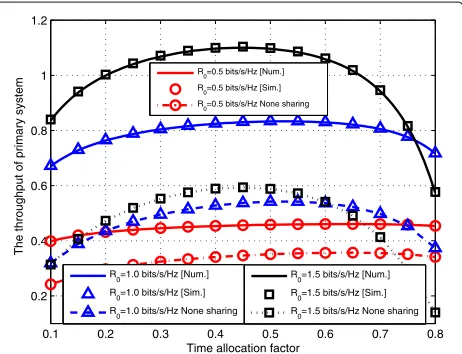
Figure 3 shows the throughput of primary system with respect to (w.r.t.)βfor differentR0. With the increase ofβ,
the throughput of primary system increases until reach-ing the maximal value and then deteriorates. The time allocation factor directly affects the throughput of pri-mary system. The smaller the value ofβ, the less energy
is harvested by UE, which is detrimental to the uplink data transmission. But, on the other hand, the smallerβis beneficial for the primary data transmission as it lasts for a longer time. Moreover, with the increase of the trans-mission rate of primary data, the throughput of primary system gets better.
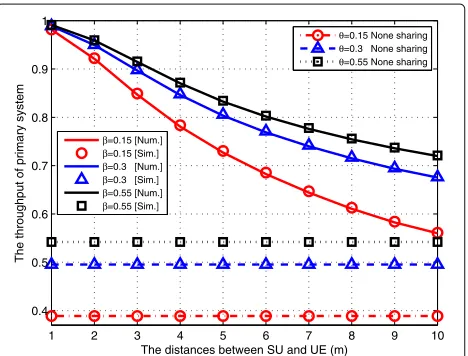
Figure 4 shows the throughput of primary system w.r.t. the distance between SU and UE for different β. In the simulations, the PB is located at the center of a disk, then the locations of UE and SU vary on the edge of the circle, which meansdPB,UEanddSU,PBare the radius of this disk.
For differentβ, the throughput of primary system deteri-orates with the prolongation ofdSU,UE, because the longer
the distance, the worse the average channel quality. Figure 5 shows the throughput of primary system w.r.t. the distance between SU and UE for different transmis-sion powers of SU. The distances are set as dSU,PB =
dPB,UE − dSU,UE. With the energy assistance from SU,
the UE will harvest more energy to support the wireless information transfer (WIT), thereby, the throughput of primary system gets larger with the increase ofpa. Fur-thermore, even if adding up the pa, the throughput of primary system still becomes worse with the increase of dSU,UE.
Figure 6 shows the throughput of primary system w.r.t. the transmission power of SU for different β. The throughput of primary system improves when the trans-mission power of SU gets larger from −30 dBw to 0 dBw. In this figure, we can observe that with the energy assistance of SU, the throughput of primary system can be significantly increased, because more energy can be harvested by UE for the data transmission.
From Figs. 3 to 6, it can be seen that our theoreti-cal results coincide exactly with the simulation results, which can verify the tightness of our analysis. Moreover,
Fig. 4Throughput of primary system w.r.t.dSU,UEfor differentβ. The parameters are set asdPB,UE=dSU,PB=10 m
Fig. 5Throughput of primary system w.r.t.dSU,UEfor different transmission powers of the SU. The parameters are set asβ=τ=0.5
our proposed scheme can greatly improve the throughput compared with the none spectrum sharing.
5.2 Maximal throughput of secondary system
We aim to maximize the throughput of secondary sys-tem, while guaranteeing that the throughput of primary system should not be degraded compared with the non-spectrum sharing model. The optimization problem can be formulated as
max
β∈(0,1) Ls
s. t. Lp≥Vpmax, (27)
whereLpandLsrepresent the throughput of primary
sys-tem and secondary syssys-tem, respectively, in the cooperative
spectrum sharing. Vmax
p denotes the maximal
through-put of the stand-alone primary network without spectrum sharing.
As shown in (9), (13), and (19), the throughput expres-sions of primary system are complicated w.r.t. the power allocation factor. The closed-form solution of the optimal β is not available, but it can be numerically determined according to the optimization problem (27) through the one dimensional search in (0, 1).
Figure 7 depicts the maximal throughput of secondary system w.r.t. dSU,UE for different transmission rates R0.
The distance between SU and PB varies on dSU,PB =
dPB,UE−dSU,UE. We can see that the maximal
through-put of secondary system gets smaller with the increase of dSU,UEandR0. The smallerR0is beneficial to improve the
performance of secondary system as more resources can be allocated for the secondary data transmission.
Figure 8 shows the maximal throughput of secondary system w.r.t. the transmission power of SU for different transmission ratesR1. The maximal throughput of
sec-ondary system improves dramatically with the increase of the transmission power of SU and R1. The reason is
that, with the increase of the transmission power of SU, the primary throughput constraint can be easily satisfied and more resources can be allocated for the secondary data transmission, thereby, the success probability tends to be 1. As a result, the maximal throughput of secondary system will gradually approach the value ofR1.
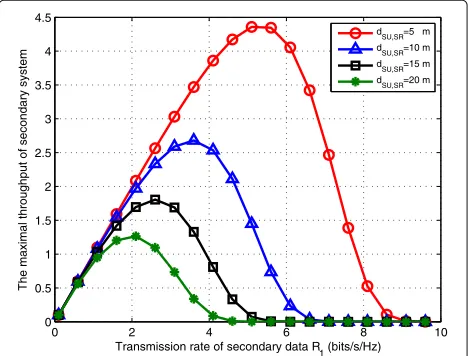
Figure 9 shows the maximal throughput of secondary system w.r.t. the transmission rateR1for differentdSU,SR.
The throughput of secondary system gets better first and then turns worse with the increase ofR1. The reason is
that with the increase of R1, the success probability of
secondary system will decrease and then the maximal
Fig. 7The maximal throughput of secondary system w.r.t.dSU,UEfor different transmission ratesR0. The parameters are set aspb=0 dBw, pa= −20 dBw,R1=3 bits/s/Hz,dPB,UE=20 m, anddSU,SR=10 m
Fig. 8The maximal throughput of secondary system w.r.t. the transmission power of the SU for different transmission ratesR1. The parameters are set aspb=0 dBw,dPB,UE=20 m, and
dSU,UE=dSU,PB=dSU,SR=10 m
throughput of secondary system becomes worse. Fur-thermore, the throughput gets smaller when the SU is departed far away from the SR.
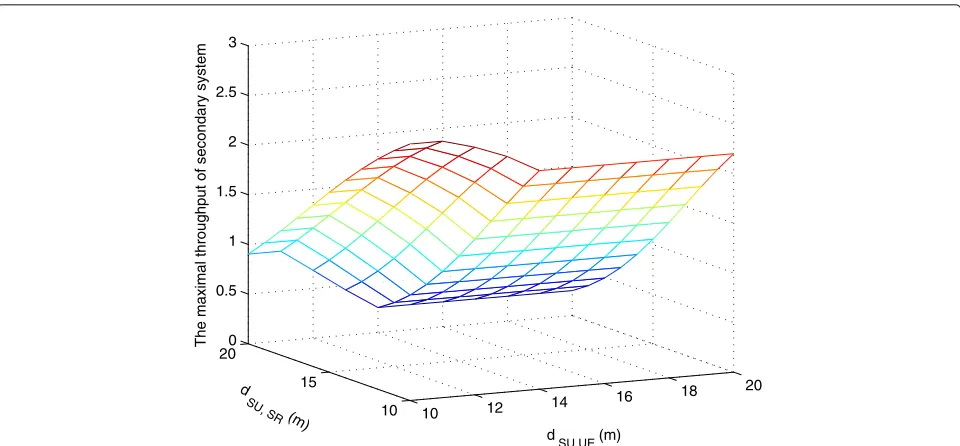
Figure 10 shows the maximal throughput of secondary system w.r.t. dSU,SR and dSU,UE. With the increase of
dSU,SR, the average channel quality becomes worse, so the
maximal throughput of secondary system gets smaller. When the SU is departed far away from the UE, the efficiency of WET becomes worse, so less energy will be harvested by the UE. In this case, less time will be allocated to the WET to satisfy the primary throughput
Fig. 9The maximal throughput of secondary system w.r.t. the transmission rateR1for differentdSU,SR. The parameters are set as
Fig. 10The maximal throughput of secondary system w.r.t.dSU,SRanddSU,UE. The parameters are set aspb=0dBw,pa= −30dBw,dPB,UE=20 m,dSU,PB=10 m, andR1=3bits/s/Hz
constraint. As a result, the maximal throughput of sec-ondary system gets smaller and then stays almost constant with the further increase ofdSU,UE.
Figure 11 shows the maximal throughput of secondary system w.r.t. dPB,UE for different transmission powers of
the SU. The SU is located at the center between PB and UE. We can see that the maximal throughput of secondary system gets worse when dPB,UE grows steadily and the
transmission power of SU goes down. With the increase of dPB,UE, the throughput of primary system deteriorates and
thus more resource will be allocated to meet the primary
Fig. 11The maximal throughput of secondary system w.r.t.dPB,UEfor different transmission powers of the SU. The parameters are set as pb=0dBw,dSU,SR=10 m,R0=2.5bits/s/HzandR1=5bits/s/Hz
throughput constraint. On the another hand, the maximal throughput will be decreased with the declining ofpa.
6 Conclusions
In this paper, we have proposed an energy-harvesting-based spectrum sharing scheme, where the secondary user can transmit its own data along with the energy signal transmission from the primary base station. The inter-ference of secondary data transmission can help improve the energy harvesting efficiency of primary user. Apart from the energy cooperation, the secondary user can also help the primary data relaying, where the Alamouti cod-ing technique is adopted to simultaneously retransmit the primary data. Through using the energy to exchange for the spectrum by the secondary user, the transmission requirements of both systems can be well accommodated. In the future, there are several interesting directions. Firstly, when the numbers of SU vary with time, this sys-tem model can be extended to the multiple SUs scenario. The SU scheduling algorithms should be designed by con-sidering channel conditions. Secondly, the interference management and mode selection can be studied for the smart devices equipped with multiple antennas or radio interfaces (e.g., Wi-Fi, LTE, WiMAX, Bluetooth, etc.) [32, 33]; Thirdly, various coding schemes can be designed to improve the transmission rate and reliability, such as Raptor code for wireless video transmission [34].
Endnote
the control signals. In this process, the PB, UE and SU may consume some energy and time, which is negligible compared with the long-time data transmission [35].
Appendix I: derivation of (14)
In Eq. (14), the intermediate probabilityBais derived as
Ba=1−exp In Eq. (14), the intermediate probabilityBbis derived as
Bb=1−exp
In Eq. (13), the post-intermediate probability can be calculated as
Substituting the results of (14) and (31) into (13), we can obtain the success probability of the primary data retransmission from the UE.
Appendix II: derivation of (20)
The intermediate probability Fa in Eq. (20) is zero if
ρ
In Eq. (20), the intermediate probabilityFbis Fb=Pr In Eq. (33), the intermediate probabilityFb1is
Fb1=
a1, Fb2equals zero, otherwise, the interme-diate probabilityFb2in expression (33) can be calculated
as
Substituting (34) and (35) into (33), the intermediate probabilityFbcan be obtained.
In Eq. (20), the intermediate probabilityFcis
The intermediate probability Fc11, Fc12 and Fc13 in
(37) can be derived as Fc11=1−exp Substituting (38), (39), and (40) into (37), the intermedi-ate probabilityFc1can be obtained.
In Eq. (36), the intermediate probabilityFc2is
Fc2=Pr
(41) can be derived as: Fc21=1−exp
, the intermediate probability Fc22in Eq. (41) is zero, otherwise,Fc22can be expressed
Substituting (42), (43), and (44) into (41), the interme-diate probabilityFc2can be obtained. Summarizing (32),
(33), and (36), the first probability of (20) can be obtained.
Abbreviations
EH: Energy harvesting; MIMO: Multiple-input multiple-output; OFDM: Orthogonal frequency division multiplexing; PB: Primary base station; PU: Primary user; RF: Radio frequency; SWIPT: Simultaneous wireless information and power transfer; SU: Secondary user; SR: Secondary receiver; UE: User equipment; WET: Wireless energy transfer; WIT: Wireless information transfer
Acknowledgements
This work was supported by the National Natural Science Foundation of China (61371188), the Research Fund for the Doctoral Program of Higher Education (20130131110029), the Open Research Fund of the National Mobile Communications Research Laboratory (2012D10), and the Special Funds for Postdoctoral Innovative Projects of Shandong Province (201401013).
Competing interests
The authors declare that they have no competing interests.
Received: 4 August 2015 Accepted: 13 December 2016
References
1. NB Carvalho, A Georgiadis, A Costanzo, H Rogier, A Collado, JA García, S Lucyszyn, et al., Wireless power transmission: R&D activities within Europe. IEEE Trans. Microw. Theory Tech.62(4), 1031–1045 (2014)
2. AM Zungeru, LM Ang, S Prabaharan, KP Seng,Radio frequency energy harvesting and management for wireless sensor networks, Green Mobile Devices and Networks: Energy Optimization and Scavenging Techniques. (CRC Press, Boca Raton, 2012), pp. 341–368
3. I Krikidis, Simultaneous information and energy transfer in large-scale networks with/without relaying. IEEE Trans. Commun.62(3), 900–912 (2014)
4. S Ulukus, A Yener, E Erkip, O Simeone, M Zorzi, P Grover, K Huang, Energy harvesting wireless communications: A review of recent advances. IEEE J. Sel. Areas Commun.33(3), 360–381 (2015)
5. M Gorlatova, A Wallwater, G Zussman, Networking low-power energy harvesting devices: measurements and algorithms. IEEE Trans. Mobile Comput.12(9), 1853–1865 (2013)
6. Powercast, Power harvester brochure. http://www.powercastco.com/ products/powerharvester-receivers/. Accessed 7 June 2015 7. C Song, Y Huang, J Zhou, J Zhang, S Yuan, P Carter, A High-efficiency
8. Y Han, A Pandharipande, SH Ting, Cooperative decode-and-forward relaying for secondary spectrum access. IEEE Trans. Wireless Commun.
8(10), 4945–4950 (2009)
9. K Huang, VKN Lau, Y Chen, Spectrum sharing between cellular and mobile ad hoc networks: transmission capacity trade-off. IEEE J. Sel. Areas Commun.27(7), 1256–1267 (2009)
10. Y Han, SH Ting, A Pandharipande, Cooperative spectrum sharing protocol with secondary user selection. IEEE Trans. Wireless Commun.9(9), 2914–2923 (2010)
11. W Su, JD Matyjas, S Batalama, Active cooperation between primary users and cognitive radio users in heterogeneous ad-hoc networks. IEEE Trans. Signal Process.60(4), 1796–1805 (2012)
12. C Zhai, W Zhang, PC Ching, Cooperative Spectrum sharing based on two-path successive relaying. IEEE Trans. Commun.61(6), 2260–2270 (2013) 13. X Zhou, R Zhang, CK Ho, Wireless information and power transfer:
architecture design and rate-energy tradeoff. IEEE Trans. Commun.61(11), 4754–4767 (2013)
14. DWK Ng, ES Lo, R Schober, Wireless information and power transfer: energy efficiency optimization in OFDMA systems. IEEE Trans. Wireless Commun.12(12), 6352–6370 (2013)
15. K Huang, E Larsson, Simultaneous information and power transfer for broadband wireless systems. IEEE Trans. Signal Process.61(23), 5972–5986 (2013)
16. C Zhai, J Liu, Cooperative wireless energy harvesting and information transfer in stochastic networks. EURASIP J. Wireless Commun. and Network.
2015(44), 1–22 (2015)
17. J Rubio, A Pascual-Iserte, inProc.of IEEE Global, Communications Conference (GLOBECOM). Simultaneous wireless information and power transfer in multiuser MIMO systems (IEEE, Atlanta, 2013), pp. 2755–2760 18. H Ju, R Zhang, Throughput maximization in wireless powered
communication networks. IEEE Trans. Wireless Commun.13(1), 418–428 (2014)
19. K Huang, VKN Lau, Enabling wireless power transfer in cellular networks: architecture, modeling and deployment. IEEE Trans. Wireless Commun.
13(2), 902–912 (2014)
20. S Park, J Heo, B Kim, W Chung, H Wang, D Hong, inProc.of IEEE 23rd, International Symposium on Personal Indoor and Mobile Radio Communications (PIMRC). Optimal mode selection for cognitive radio sensor networks with RF energy harvesting (IEEE, Sydney, 2012), pp. 2155–2159
21. S Lee, R Zhang, K Huang, Opportunistic wireless energy harvesting in cognitive radio networks. IEEE Trans. Wireless Commun.12(9), 4788–4799 (2013)
22. SA Mousavifar, Y Liu, C Leung, M Elkashlan, TQ Duong, inProc.of IEEE 80th. Vehicular, Technology Conference (VTC Fall). Wireless energy harvesting and spectrum sharing in cognitive radio (IEEE, Vancouver, 2014), pp. 1–5 23. G Zheng, Z Ho, EA Jorswieck, B Ottersten, Information and energy
cooperation in cognitive radio networks. IEEE Trans. Signal Process.62(9), 2290–2303 (2014)
24. DT Hoang, D Niyato, P Wang, DI Kim, Opportunistic channel access and RF energy harvesting in cognitive radio networks. IEEE J. Sel. Areas Commun.32(11), 2039–2052 (2014)
25. S Park, D Hong, Achievable throughput of energy harvesting cognitive radio networks. IEEE Trans. Wireless Commun.13(2), 1010–1022 (2014) 26. H Chen, Y Li, JL Rebelatto, BF Uchõa-Filho, B Vucetic,
Harvest-then-cooperate: wireless-powered cooperative communications. IEEE Trans. Signal Process.63(7), 1700–1711 (2015)
27. SM Alamouti, A simple transmit diversity technique for wireless communications. IEEE J. Sel. Areas Commun.16(8), 1451–1458 (1998) 28. L Xiong, L Libman, G Mao, Uncoordinated cooperative communications
in highly dynamic wireless networks. IEEE J. Sel. Areas Commun.30(2), 280–288 (2012)
29. C Hucher, GRB Othman, JC Belfiore, inProc.of IEEE International, Symposium on Information Theory (ISIT). AF and DF protocols based on Alamouti ST code (IEEE, Nice, 2007), pp. 1526–1530
30. IS Gradshteuin, IM Ryzhik,Table of integrals, series, and products (Seventh Edition). (Elsevier, Academic Press, New York, 2007)
31. Z Ding, Z Yang, P Fan, HV Poor, On the performance of non-orthogonal multiple access in 5G systems with randomly deployed users. IEEE Sig. Process. Lett.21(12), 1501–1505 (2014)
32. J Wu, C Yuen, B Cheng, M Wang, J Chen, Energy-minimized multipath video transport to mobile devices in heterogeneous wireless network. IEEE J. Sel. Areas Commun.34(5), 1160–1178 (2016)
33. J Wu, B Cheng, C Yuen, Y Shang, J Chen, Distortion-Aware Concurrent multipath transfer for mobile video streaming in heterogeneous wireless networks. IEEE Trans. Mobile Comput.14(4), 688–701 (2015)
34. J Wu, C Yuen, M Wang, J Chen, CW Chen, TCP-oriented raptor coding for high-frame-rate video transmission over wireless networks. IEEE J.Sel. Areas Commun.34(8), 2231–2246 (2016)
35. S Lee, R Zhang, Cognitive wireless powered network: spectrum sharing models and throughput maximization. IEEE Trans. Cognitive Commun. and Network.1(3), 335–346 (2015)
Submit your manuscript to a
journal and benefi t from:
7 Convenient online submission
7 Rigorous peer review
7 Immediate publication on acceptance
7 Open access: articles freely available online
7 High visibility within the fi eld
7 Retaining the copyright to your article