R E S E A R C H
Open Access
Performance analysis of multiplexing and
error control scheme for body area
networks
Kento Takabayashi
1*, Hirokazu Tanaka
2, Chika Sugimoto
1and Ryuji Kohno
1Abstract
In this paper, we theoretically analyze the performance of a multiplexing and error control scheme for body area networks. In our previous work, we proposed a quality of service (QoS) control optimization method that achieves optimal QoS control by introducing a multiplexing scheme over the media access control (MAC) layer. This multiplexing scheme combines Weldon-based hybrid automatic repeat request (ARQ) with a decomposable error-correcting code. In this paper, we present a theoretical analysis of our proposed scheme as an extension of our previous work. In this proposed system, the decomposable code which has simpler structure is utilized. We then show that our proposed multiplexing layer can achieve optimal performance at Es/N0= 3, 5, and 6 dB in the additive white Gaussian noise (AWGN) channel and at Es/N0= 8, 11, and 14 dB in the Rayleigh fading channel by arbitrarily selecting parameters for the error-correcting code and hybrid ARQ. Then, we show that the proposed system obtains over 1.2 dB gain in the AWGN channel and over 4.2 dB gain in the Rayleigh fading channel than IEEE802.15.6 in the optional pattern.
Keywords: Wearable sensor, Body area network, QoS control, Multiplexing
1 Introduction
Health monitoring systems that employ wearable vital sensors and wireless communication have recently re-ceived significant attention [1–16]. It is expected that wearable sensors will pave the way for a new era of tele-healthcare that may include continuous monitor-ing of physical conditions and the detection of serious consequences. In the field of health-monitoring sys-tems, the body area network (BAN) is a key technol-ogy [1–4, 10–16]. Its standardization activities have been carried out extensively [17–19]. To realize smaller sensor devices and longer battery life, the following tech-nical requirements should be considered.
Ultra-low power consumption
Although this has been considered in the above standards, substantially lower power-consuming
media access control (MAC) and physical layer (PHY) technologies are required.
Coexistence with other networks
The 2.4-GHz industrial, scientific, and medical (ISM) band is globally assigned for common use in local area network (LAN) and personal area network (PAN) devices. This frequency band is potentially a good candidate for BANs; however, when using this band, interference from other systems must be taken into consideration.
Optimal quality of service (QoS) control
A wearable vital sensor can connect various types of sensors, with the data rate of such sensors varying widely. Further, their respective allowable delay times depend on their application. Therefore, optimal QoS control for input data is an important factor in transmitting sensor data.
From the above requirements, we have proposed an optimal QoS control scheme that employs a multiplex-ing layer and a decomposable error control codmultiplex-ing
scheme [20–22]. In [20], we proposed a QoS control
* Correspondence:[email protected]
1Graduate School of Engineering, Yokohama National University, 79-5
Tokiwadai, Hodogaya-Ku, 240-8501 Yokohama, Japan
Full list of author information is available at the end of the article
scheme using Weldon-based hybrid automatic repeat request (ARQ) [23] with Reed-Muller codes. However, the error-correcting capability could not be increased effectively because of characteristics of Reed-Muller codes which we selected in [20]. So, we conducted simulations to evaluate the performance of the
pro-posed system utilizing Weldon’s ARQ with
decompos-able codes based on punctured convolutional codes in the additive white Gaussian noise (AWGN) channel [21] and a wearable BAN channel model [22] by comparing it with IEEE 802.15.6. Assuming that the wearable sensor device has multiple sensors, each
sensor’s input data are transmitted through a
com-mon MAC and PHY layer [21, 22].
Because we evaluated the effectiveness of our pro-posed scheme only via simulation in our previous work, in this paper, we present a theoretical analysis of our proposed scheme in [21] and [22] under the AWGN channel and the Rayleigh fading channel as an extension of our previous work. We have not evaluated and ana-lyzed the case of the Rayleigh fading channel in our pre-vious work. Then, in this proposed system, the structure of our decomposable code is modified to be much sim-pler than that in our previous work [21, 22] in order to analyze it more easily. In general, an evaluation of ARQ requires a large number of simulation trials to fully evaluate the given system; however, we can specifically evaluate the throughput in a stable state by sound theor-etical analysis. More specifically, we can easily obtain de-tailed characteristics of our proposed scheme by this formulization. We derived a lower bound on throughput performance and an upper bound on residual bit error rate in the AWGN channel and the Rayleigh fading channel. In addition, we investigated QoS parameters to
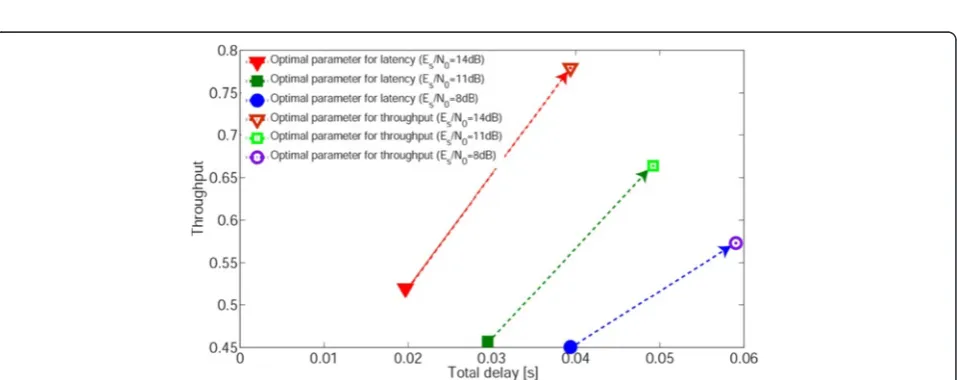
further optimize our system. For example, we identified the optimum parameters according to various policies, as shown in Tables 3 and 4. Figure 8 shows the results of our throughput optimization by using the parameters of Table 4.
The remainder of this paper is organized as follows. In Section 2, we briefly review the system model of our proposed scheme. Section 3 explains the theoret-ical analysis of our proposed scheme under the AWGN channel and the Rayleigh fading channel. Per-formance evaluations by theoretical analysis and
simu-lations are presented in Section 4. Finally, we
conclude our paper and provide directions for future work in Section 5.
2 System model
2.1 System concept
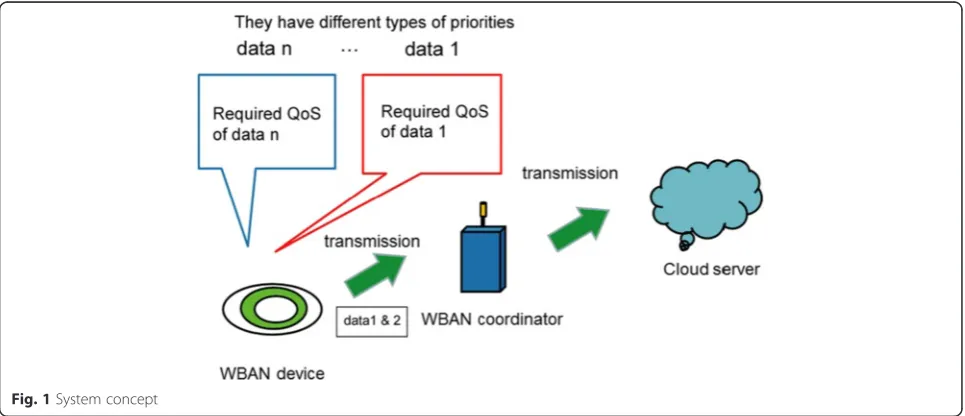
Figure 1 shows the overall concept of our proposed sys-tem. In general, different types of data are input and multiplexed at a single sensor device [19]. Here, we as-sume that the different types of data input and multi-plexed have potentially different QoS requirements. Given the varying QoS requirements, the different types of data have different priorities. These data are multi-plexed and transmitted from a sensor (i.e., a wireless body area network (WBAN) node) to a WBAN coordinator.
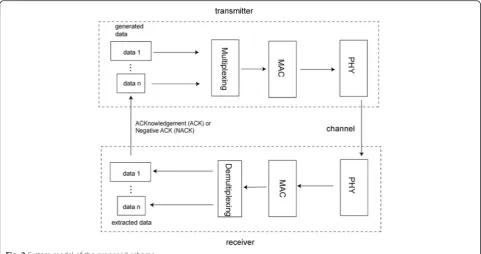
Figure 2 shows the system model. The transmitter consists of a multiplexing module, a MAC module, and a PHY module. The multiplexing module controls the different types of QoS requirements according to the fol-lowing priorities. First, several data are added to user priorities. Then, the header, which includes user priority information (e.g., latency, rate of error control coding,
the number of repetitions in ARQ, etc.), is added to the user priorities in the multiplexing layer. Next, the multi-plexer controller in the multiplexing layer provides instructions to each data depending on predefined pa-rameters. According to the QoS control signal, the mul-tiplexing layer performs error and delay control. Finally, data with different user priorities are multiplexed and sent to the MAC layer.
In the MAC module, the error control process is per-formed according to the instructions from the multiplex-ing module. In the PHY module, this multiplexed data is modulated. In this paper, coherent phase shift keying (PSK) is used for basic analysis. Then, direct sequence spread spectrum (DSSS) is applied to increase robust-ness against multipath fading and multiuser interference. At the receiver, the transmission operation is processed in the reverse order. Finally, after the process at the demultiplexing module is complete, error detection is performed on the data.
2.2 Decomposable code
In our proposed scheme, Weldon’s ARQ [23] is employed
rather than selective repeat ARQ, and decomposable code
is employed as error-correction code for hybrid ARQ. The proposed scheme can provide an error control method that satisfies various QoS requirements by coordinating the number of data copies and changing how the decom-posable code is combined.
As an example of decomposable code, a punctured convolutional code with constraint lengthKset to 3 and coding rates 8/9, 4/5, 2/3, and 1/2 is used. In [21] and [22], we selected coding rates 7/8, 5/6, 3/4, and 1/2. However, those punctured matrices in [21] and [22] are very complicated, and then it is very difficult to analyze its performance in theory. On the other hand, punctured matrices which we select in this paper are quite simple and can be analyzed more easily.
The punctured convolutional code is generated based on the convolutional code with a generator polynomial
of [5, 7] and coding rate R= 1/2. The punctured matrix
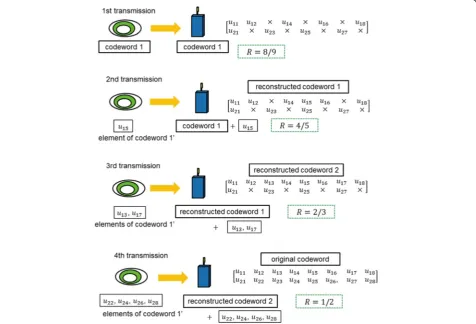
of R= 8/9 is shown in Fig. 3. The two patterns of the
R= 8/9 punctured codes (codeword 1 and codeword 1′)
can be generated using this punctured matrix. More spe-cifically, at the first transmission, codeword 1 is sent; then, to increment the code rate of the punctured code, a part of codeword 1′is sent as the second transmission. Figure 4
illustrates how to increment redundancies and send the sub-codewords exceptu11andu21from the first transmis-sion to the fourth transmistransmis-sion. As shown in the figure, these punctured matrices consist of a subset that is a part of the next punctured matrix. In general, at the ith re-transmission, reconstructed codewords are decoded as error-correction codes with a coding rate set as follows:
Ri¼
The error-correction capability increases as the coding rate decreases in the order 8/9, 4/5, 2/3, and 1/2.
2.3 Procedure of the proposed scheme
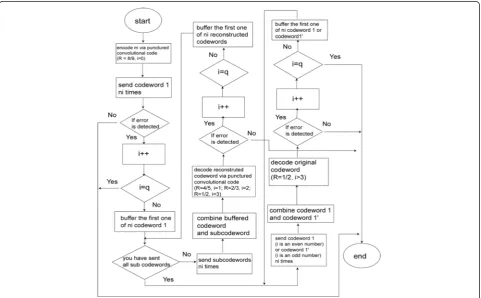
Figure 5 shows a flowchart of the protocol for our pro-posed scheme. In the propro-posed method, retransmission is performed as follows. First, information mis encoded
via the punctured convolutional code whose R= 8/9;
then, codeword 1 in Fig. 4 is transmitted. If errors are detected, the receiver stores the transmitted codeword 1 and the transmitter re-sends the sub-codeword of codeword 1′ ni times in the case 1≤i≤3. At the
re-ceiver, a received sub-codeword and stored codeword
are combined (Fig. 4), and the reconstructed codeword is decoded. After the third retransmission, codeword 1 is
sent n4 times and combined with a buffered codeword.
If errors are detected, one ofn4codeword 1 is buffered in the receiver, and codeword 1′is transmitted n5times and combined with a stored codeword. After that,
code-word 1 and codecode-word 1′ are sent alternately ni times
and stored. When codeword 1 or codeword 1′ is
buff-ered, the first one among nicopies is stored. The
trans-mitter repeats these operations until the data is received correctly or the number of retransmissions reaches the
predefined maximum number of retransmissionsq.
3 Theoretical analysis
We define normalized throughput η=k0/Tas the
num-ber of total communicated bits and uncoded bitsk0. The
number of total communicated bitsT is determined as
follows:
ber of transmitted bits, and ni is the number of copy
blocks of Weldon’s ARQ at the ith transmission. Then,
Pi changes in stages because the received data is
decoded by decomposable codes with coding rates
vary-ing in order of Eq. 1. Note that throughput T is
de-scribed as the above approximate equation due to the maximum retransmission limit.
Next, we consider the upper bounds on error probabil-ity of the punctured convolutional codes used by the
proposed scheme to obtain Pi. These bounds are
ob-tained from the transfer function T(D,N) of the code,
which describes the weight distribution or weight spectrum of the incorrect codewords and the number of bit errors on these paths [24]. The transfer function
T(D,N)is expressed as follows:
T Dð ;NÞjN¼1¼ X
Here, dfree is the free distance of the code, and ad is
the number of incorrect paths or adversaries of the Hamming weight d,d ≤dfree. In addition,cd is the total
number of information bit errors produced by the incor-rect paths of the Hamming weight.
Using T(D,N), the upper bounds on the event error
probabilityPE and the bit error probability PBof a code
with rateRi=k/vare given as follows:
Here,Eb/N0is the energy per bit-to-noise density ratio and Pd is the pairwise error probability in the case of
PSK modulation and unquantized AWGN channels [25].
Then, in case of the Rayleigh fading channel, Pd is
expressed as follows [26]:
Pd¼ð ÞPe d
Further, Piis determined using PB from the following
equation:
Pi¼1−ð1−PBÞLinfo: ð11Þ
Here, Linfo is the number of information bits. In
addition, the upper bound of the residual bit error rate (RBER) is obtained by the following equation:
RBER¼rB;q Yq−1
i¼0
Pi: ð12Þ
Here,rB,qisPBin the case of a code with rateRq.
The transfer functionT(D,N)changes according to the
punctured matrices. Further details of the transfer func-tionT(D,N)are provided in the Appendix.
Table 3Simulation parameters
Parameter Detail
K = 3 convolutional codes
Decoding Soft decision
Viterbi decoding
ARQ protocol Weldon’s ARQ
Linfo 504 bits
Data rate 487 kbps
Roundtrip time 9.84 ms
Table 2Number of copiesnifor each pattern under the
Rayleigh fading channel
i 0 1 2 3 4 q= 5
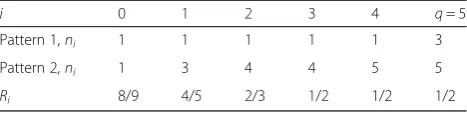
Pattern 1,ni 1 1 1 1 1 3
Pattern 2,ni 1 3 4 4 5 5
Ri 8/9 4/5 2/3 1/2 1/2 1/2
Table 1Number of copiesnifor each pattern under the AWGN
channel
i 0 1 2 3 4 q= 5
Pattern 1,ni 1 1 1 1 2 4
Pattern 2,ni 1 2 2 4 4 6
4 Performance evaluation
4.1 Simulation condition
In this subsection, we evaluate our proposed scheme by theoretical analysis and simulations.
To analyze our proposed scheme, we set two pat-terns under the AWGN channel and the Rayleigh fad-ing channel, as shown in Tables 1 and 2, respectively.
A coding rate of a decomposable code Ri is
deter-mined according to the order of Eq. 1. Then, Ri is a
coding rate after reconstructing a decomposable code. For the required QoS, the residual BER of pattern 1 is more important than its latency, and the latency of pattern 2 is more important than its residual BER. The number of copies of pattern 1 can achieve the
max-imum throughput in a high or middle Es/N0area from
our theoretical formulae. For pattern 2, the number of copies ni is large because the latency is allowed;
how-ever, the residual BER and throughput performance must be significantly improved. Also, pattern 2 is fixed, as the throughput of pattern 2 is higher than that of the high QoS mode defined in IEEE 802.15.6 (hereinafter called the conventional scheme).
Note that another channel model is assumed to be the Rayleigh fading channel, which is one of the channel models for wearable WBANs [27]. Then, IEEE802.15.6 CM3, which is a typical channel model for wearable WBANs [27], is also assumed in order to evaluate actual performance of our proposed system. This model suffers from strong multipath fading and shadowing. The data rate is referenced from the IEEE802.15.6 standard [17], and the roundtrip time is set based on the data rate and twice the maximum packet length defined in IEEE802.15.6. Simula-tion parameters are summarized in Table 3.
4.2 Numerical results
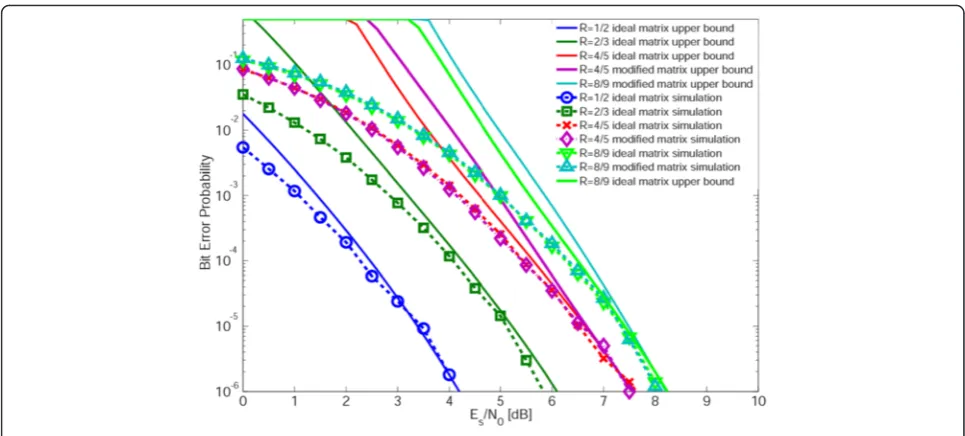
Figure 6 shows the bit error probability of the punctured convolutional codes under the AWGN channel. Our proposed punctured convolutional codes with coding rates of 4/5 and 8/9 have a different upper bound than that of the ideal matrix; however, these differences do not significantly influence the performance of our pro-posed scheme.
Relative to the simulation, the performance of the modified punctured convolutional codes is the same as Fig. 6Bit error probability of punctured convolutional codes under AWGN channel
Table 4Optimal number of copiesnifor minimum latency while
satisfying PER≤10−5. Channel model is the AWGN channel
Es/N0 n0 n1 n2 n3
Table 5Optimal number of copiesnifor maximum throughput
while satisfying PER≤10−5. Channel model is the AWGN channel
that of the ideal punctured matrices, unlike results of the upper bound. This occurs because the number of tri-als in the simulation is not large enough. Further, the difference between the error-correcting capacity of the ideal matrix and that of the modified one is very small in the simulation. Hence, the difference does not clearly emerge in the graph without the huge number of trials. The difference between the upper bound and the simu-lation becomes greater asEs/N0decreases.
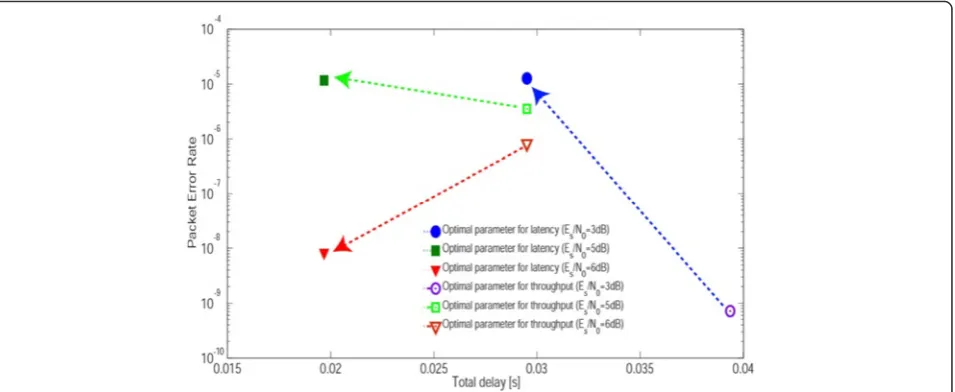
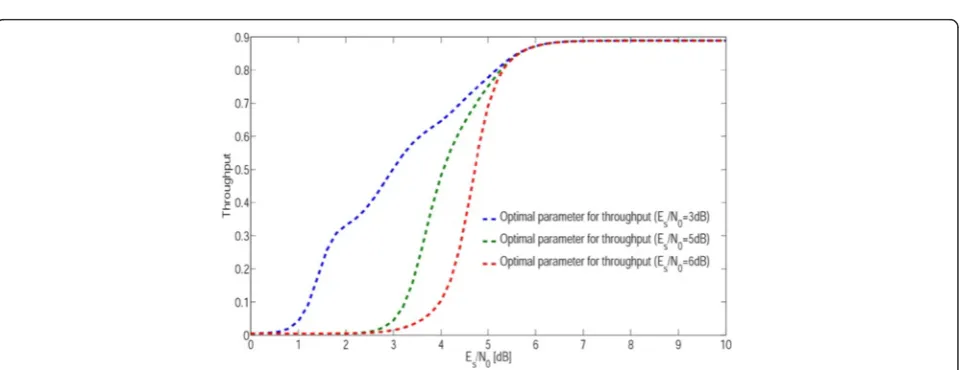
Table 4 shows examples of the optimal number of cop-iesnifor the minimum latency while satisfying PER≤10−5
by a full search under the AWGN channel. Table 5 shows
examples of the optimal number of copies ni for the
maximum throughput while meeting the same condition. Figures 7 and 8 show the theoretical PER and throughput,
respectively, according to parameters of Tables 4 and 5. The parameters of Table 4 satisfy the condition that
PER≤10−5 by a smaller delay than Table 5 in Fig. 7,
whereas those of Table 5 achieve a larger throughput than that of Table 4 even though a large delay is ex-pected in Fig. 8. In other words, performance with non-optimal parameters in each policy can be consid-ered the same as that of sub-optimal parameters. Then, Figs. 9 and 10 present throughput performances with parameters of Tables 4 and 5 as a function ofEs/N0. From these figures, we observe that performance changes substantially depending on the parameters. Especially, Fig. 10 shows that each parameter achieves the maximum throughput with the smallest number of retransmissions andnicopies at eachEs/N0.
Fig. 7PER performance with optimal and sub-optimal parameters under AWGN channel. Parameters of Table 4 are optimal
Fig. 11Throughput performance in the proposed method and the conventional scheme under AWGN channel Fig. 9Throughput performance with parameters of Table 4 under AWGN channel as a function ofEs/N0
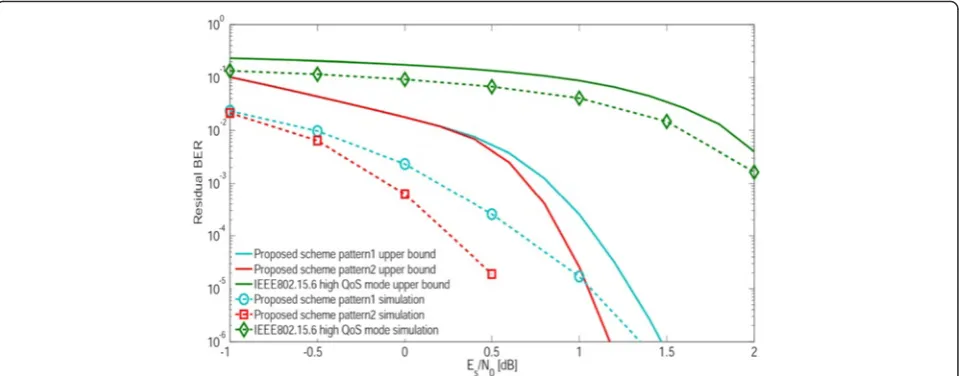
Figures 11 and 12 show the throughput and residual BER performance, respectively, for patterns 1 and 2 of our proposed scheme and the conventional scheme under the AWGN channel. Overall, the residual BER performance of our proposed scheme is better than that of the conventional scheme. In the optional pattern, the proposed system obtains over 1.5 dB gain than IEEE802.15.6 system. The throughput of our proposed scheme is also better than that of the conventional scheme. Then, the gain of the proposed scheme is over 1.2 dB gain than that of IEEE802.15.6 scheme in the op-tional pattern. The throughput and residual BER perfor-mances of pattern 1 are opposite to those of pattern 2 because of the parameter settings shown in Table 1. Note that simulation results differ from bounds shown in Fig. 6. Table 6 shows examples of the optimal number of
copies ni for the minimum latency while satisfying
PER≤10−5 by a full search under the Rayleigh fading
channel. And then, Table 7 shows examples of the
opti-mal number of copiesnifor the maximum throughput
while meeting the same condition. Figures 13 and 14 ex-press the theoretical PER and throughput, respectively,
depending on parameters of Tables 6 and 7. Selected
Es/N0 is higher than that in the case of the AWGN
channel. The reason is that the performance in case of the Rayleigh fading channel is worse than that of the AWGN case. The parameters of Table 6 achieve
the condition that PER≤10−5 by a smaller delay than
Table 7 in Fig. 13, whereas those of Table 7 satisfy a larger throughput than Table 6 even though a large delay is needed in Fig. 14. Then, as the case of the AWGN channel, performance with non-optimal pa-rameters in each policy can be regarded as that of sub-optimal parameters. Figures 15 and 16 also present throughput performances with parameters of Tables 6 and 7 as a function of Es/N0. From these figures, we can show that performance changes highly according to the parameters like the AWGN case. In particular, Fig. 16 shows that each parameter achieves the
max-imum throughput with the smallest number of
retransmissions and ni copies at eachEs/N0.
Figures 17 and 18 present the throughput and residual BER performance, respectively, for patterns 1 and 2 of our proposed scheme and the conventional scheme
Table 6Optimal number of copiesnifor minimum latency
while satisfying PER≤10−5. Channel model is the Rayleigh fading channel
Table 7Optimal number of copiesnifor maximum throughput
while satisfying PER≤10−5. Channel model is the Rayleigh fading channel
Fig. 13PER performance with optimal and sub-optimal parameters under the Rayleigh fading channel. Parameters of Table 6 are optimal
Fig. 14PER performance with optimal and sub-optimal parameters under the Rayleigh fading channel. Parameters of Table 7 are optimal
under the Rayleigh fading channel. On the whole, our pro-posed scheme has better residual BER performance than the conventional scheme. In the optional pattern, the pro-posed system obtains over 4.2 dB gain than the standard system. The throughput of our proposed scheme is also better than that of the conventional scheme. Then, the gain of the proposed scheme is over 4.5 dB gain than that of IEEE802.15.6 in the optional pattern. The throughput and residual BER performances of pattern 1 are also op-posite to those of pattern 2 because of the parameter set-tings shown in Table 2 like the AWGN case. Note that simulation results are different from bounds for the same reason as the case of the AWGN channel.
Figures 19 and 20 show the throughput and residual BER performance, respectively, for two patterns of our proposed scheme and the conventional scheme in the IEEE802.15.6 CM3 channel using simulations as exam-ples of actual performance in a realistic environment. The reason is that it is difficult to theoretically analyze optimal parameters of these schemes in this channel model because the channel model is made by an experi-ment. Here, parameters are set based on Table 1 as a concrete example. In this channel model, the perform-ance of our proposed scheme is better than that of the conventional scheme. Compared with the AWGN channel and the Rayleigh fading channel, however, the Fig. 16Throughput performance with parameters of Table 7 under the Rayleigh fading channel as a function ofEs/N0
Fig. 19Throughput performance in proposed and conventional schemes under IEEE802.15.6 CM3
Fig. 18Residual BER performance in the proposed and the conventional scheme under the Rayleigh fading channel
performance is worse because of the strong multipath fading or shadowing. For this reason, the difference in the performance of our proposed and the conventional schemes is not larger than that of the AWGN channel; however, the tendency of the performance is the same as that of the AWGN channel and the Rayleigh fading channel.
5 Conclusions
In this paper, we presented a theoretical analysis of our proposed scheme to evaluate it under the AWGN chan-nel and the Rayleigh fading chanchan-nel as an extension of our previous work. We investigated QoS parameters to further optimize our system, showing that our proposed system can achieve optimal performance by arbitrarily selecting parameters of the error-correcting code and Hybrid ARQ. Performance evaluations by theoretical analysis and simulations showed that our proposed scheme has greater flexibility for optimizing QoS param-eters according to the required QoS for each input data. Moreover, our evaluations showed that the performance of our proposed scheme is better than that of the con-ventional scheme.
In the future, we will consider a dynamic channel model and situation such as a multiple WBAN environ-ment that can be theoretically analyzed. Then, optimal parameters for that case should also be investigated.
6 Appendix
6.1 Transfer function
To obtain PE and PB, we derive the transfer function
T(D,N) from the state diagram using the transfer func-tion technique [24, 25]. Figure 21 shows the state dia-gram for the punctured convolutional codes.
Here, XaandXbexpress state zero, and the remaining
states are arbitrarily labeled X1, X2, and X3. The
expo-nent of N indicates the number of information bits set
to “1”that causes the transition to occur, and the
expo-nent of Dindicates the Hamming weight on the
transi-tion. From Fig. 21, the matrix equation is given as follows:
Xb¼GXþhXa: ð17Þ
As above, the transfer function is given as follows:
T Dð ;NÞ ¼Xa
Xb¼G I½−A
−1Fþh
¼hþGFþGAFþGA2FþGA3Fþ…:
ð18Þ
Thus, coefficientcdis given as follows:
dT Dð ;NÞ
For coding rate 8/9, we obtain its transfer function using the same procedure:
h¼g00
From the matrices, cdis given in the same way as
fol-lows: þ11239801D7 þ 80280102D8
þ535025955D9þ3323529844D10 þ19393645707D11 þ…:
ð25Þ
For coding rates 1/2 and 2/3, we use the transfer func-tions in reference [25] because their coefficients are the same in the case of ideal punctured matrices. Here,
R= 1/2 is enumerated as follows:
dT Dð ;NÞ
And,R= 2/3 is represented as follows:
Competing interests
The authors declare that they have no competing interests.
Acknowledgements
The first author would like to thank members of Kohno laboratory, Yokohama National University, Japan for their great inspiration and kindness.
Author details
1Graduate School of Engineering, Yokohama National University, 79-5
Tokiwadai, Hodogaya-Ku, 240-8501 Yokohama, Japan.2Graduate School of
Information Sciences, Hiroshima City University, 3-4-1, Ozuka-Higashi, Asa-Minami-Ku, 731-3194 Hiroshima, Japan.
Received: 6 September 2015 Accepted: 18 February 2016
References
1. M Chen, S Gonzalez, A Vasilakos, H Cao, VCM Leung, Body area networks: a survey. Mobile Networks and Applications, Springer16(2), 171–193 (2010) 2. G Acampora, DJ Cook, P Rashidi, AV Vasilakos, A survey on ambient
intelligence in healthcare. Proc. IEEE101(12), 2470–2494 (2013) 3. T Hayajneh, G Almashaqbeh, S Ullah, AV Vasilakos, A survey of wireless
technologies coexistence in WBAN: analysis and open research issues. Wireless Networks, Springer20(8), 2165–2199 (2014)
4. G Fortino, GD Fatta, M Pathan, AV Vasilakos, Cloud-assisted body area networks: state-of-the-art and future challenges. Wireless Networks, Springer 20(7), 1925–1938 (2014)
5. J Zhou, Z Cao, X Dong, X Lin, AV Vasilakos, Securing m-healthcare social networks: challenges, countermeasures and future directions. Wireless Communications, IEEE20(4), 12–21 (2013)
6. J Zhou, Z Cao, X Dong, N Xiong, AV Vasilakos, 4S: a secure and privacy-preserving key management scheme for cloud-assisted wireless body area network in m-healthcare social networks. Information Sciences, Elsevier 314(2015), 255–276 (2014)
7. D He, C Chen, S Chan, J Bu, AV Vasilakos, ReTrust: attack-resistant and lightweight trust management for medical sensor networks. Transactions on Information Technology in Biomedicine, IEEE16(4), 623–632 (2012) 8. Z Zhang, H Wang, AV Vasilakos, H Fang, ECG-cryptography and
authentication in body area networks. Transactions on Information Technology in Biomedicine, IEEE16(6), 1070–1078 (2012)
9. D Lin, F Labeau, AV Vasilakos, QoE-based optimal resource allocation in wireless healthcare networks: opportunities and challenges. Wireless Networks, Springer21(8), 2483–2500 (2015)
10. H Cao, V Leung, C Chow, H Chan, Enabling technologies for wireless body area networks: a survey and outlook. IEEE Comm. Mag.47(12), 84–93 (2009) 11. H Viswanathan, B Chen, D Pompili, Research challenges in computation,
communication, and context awareness for ubiquitous healthcare. IEEE Comm. Mag.50(5), 92–99 (2012)
12. C Bachmann, M Ashouei, V Pop, M Vidojkovic, HD Groot, B Gyselinckx, Low-power wireless sensor nodes for ubiquitous long-term biomedical signal monitoring. IEEE Comm. Mag.50(1), 20–27 (2012)
13. JMLP Caldeira, JJPC Rodrigues, P Lorenz, Toward ubiquitous mobility solutions for body sensor networks on healthcare. IEEE Comm. Mag. 50(5), 108–115 (2012)
14. A Boulis, D Smith, D Miniutti, L Libman, Y Tselishchev, Challenges in body area networks for healthcare: the MAC. IEEE Comm. Mag. 50(5), 100–106 (2012)
15. A Wong, M Dawkins, G Devita, N Kasparidis, A Katsiamis, O King, F Lauria, J Schiff, A Burdett,A 1V 5mA Multimode IEEE 802.15.6/Bluetooth Low-Energy WBAN Transceiver for Biotelemetry Applications. Proceedings of Solid-State Circuits Conference Digest of Technical Papers (ISSCC), 2012 IEEE International, 2012, pp. 300–302
16. T Suzuki, H Tanaka, S Minami, H Yamada, T Miyata,Wearable wireless vital Monitoring Technology for Smart Health Care. Proceedings of 7th International Symposium on Medical Information and Communication Technology (ISMICT): March 2013; Tokyo, Japan, 2013
20. IEEE Standard for Information technology - Telecommunications and information exchange between systems - Local and metropolitan area networks- Specific requirements: Part 15.6: Wireless Medium Access Control (MAC) and Physical Layer (PHY) Specifications for Wireless Personal Area Networks (WPANs) used in or 12 around a body. IEEE (2011)
18. IEEE Standard for Local and metropolitan area networks Part 15.4: Low-Rate Wireless Personal Area Networks (LR-WPANs), Amendment: Alternative Physical Layer Extension to support Medical Body Area Networks (MBANS) services operating in the 2360–2400 MHz band. IEEE (2013)
20. ETSI TC Smart BAN: SmartBAN System Description. TR DTS/SmartBAN-008 V0.1.0 (2014)
20. K Takabayashi, H Tanaka, C Sugimoto, R Kohno,An Error Control Scheme with Weldon’s ARQ Considering Various QoS in Medical and Non-medical Uses for Wireless BANs. Proceedings of 7th International Symposium on Medical Information and Communication Technology (ISMICT): March 2013; Tokyo, Japan, 2013
21. K Takabayashi, H Tanaka, C Sugimoto, R Kohno,Multiplexing and Error Control Scheme with Modified Hybrid ARQ for Body Area Network employing IEEE 802.15.6 in UWB-PHY. Proceedings of 8th International Conference on Body Area Networks (BodyNets 2013): September 2013; Boston, Massachusetts, United States, 2013
22. K Takabayashi, H Tanaka, C Sugimoto, R Kohno,Multiplexing and Error Control Scheme for Body Area Network employing IEEE 802.15.6. Transactions on Communications, IEICE E97-B(03), 2014, pp. 564–570
25. E Weldon Jr, An improved selective-repeat ARQ strategy. IEEE Trans. Comm. 30(3), 480–486 (1982)
24. AJ Viterbi, Convolutional codes and their performance in communication systems. Transactions on Communication Technology, IEEE19(5), 751–772 (1971)
25. D Haccoun, G Begin, High-rate punctured convolutional codes for viterbi and sequential decoding. IEEE Trans. Comm.37(11), 1113–1125 (1989) 26. P Franger, P Orten, T Ottosson, Convolutional codes with optimum distance
spectrum. IEEE Commun. Lett.3(11), 317–319 (1999)
27. KY Yazdandoost, K Sayrafian-Pour,Channel Model for Body Area Network (BAN). IEEE P802.15 Working Group for Wireless Per-sonal Area Networks(WPANs), IEEE P802.15-08-0780-10-0006, 2009
Submit your manuscript to a
journal and benefi t from:
7 Convenient online submission
7Rigorous peer review
7 Immediate publication on acceptance
7Open access: articles freely available online
7 High visibility within the fi eld
7Retaining the copyright to your article