R E S E A R C H
Open Access
Nonlinear estimation for 60GHz millimeter-wave
radar system based on Bayesian particle filtering
Mengwei Sun
1*, Qichao Song
2, Bin Li
1, Long Zhao
1and Chenglin Zhao
1Abstract
In the 60GHz millimeter-wave radar communication systems, the nonlinear power amplifier is inevitable. In order to combat this problem, a promising estimation algorithm based on the particle filtering (PF) is presented here. By employing the conception of Bayesian approximation and sequential importance sampling, this appealing Monte Carlo random sampling method can address this complicated statistic estimation problem. In sharp contrast to the classical linear equalization problem, nevertheless, in the considered situation the PF-based method may become invalid due to the hardware nonlinearity and the resulting non-analytical importance function. To remedy this difficulty, based on the linearization technique a novel PF framework is suggested, and we show in particular how to linearize the involved nonlinearity transform in the formulated discrete dynamic state-space modeling (DSM). The merit of this method is that it can efficiently deal with discrete DSMs that are practically nonlinear and non-Gaussian. Experimental simulations verify the superior performance of our presented PF-based detection scheme, which may properly be applied to 60GHz millimeter-wave radar communication systems.
Keywords:60GHz millimeter-wave communication radar systems, PA nonlinearity, Particle filtering, Taylor series, Linearization technique
1. Introduction
Because of large bandwidth, small size, high-resolution, and all-weather characteristics, 60GHz millimeter-wave radar has widely been used in many fields such as mili-tary communication systems and civilian communica-tion. The most common types of 60GHz millimeter-wave radars include anti-collision radar and 60GHz Quadra-ture Doppler radar [1].
With the growing demand for high-speed wireless transmissions, 60GHz millimeter-wave communication has attracted an increasing amount of interests over the past few years as an effective method of gaining high-speed data rate [2]. In the 60GHz millimeter-wave radar communication, in order to achieve the ultra-high data rate with the regulated transmission bandwidth, high-order modulations have widely been adopted to make ef-ficient use of the spectrum. Two of the most common high-order modulations are QPSK and 16QAM [3,4].
The absorption from oxygen is most obvious in 60GHz band, and therefore, the significant path-loss may have adverse effects on the transmission quality. To compete against the negative effects, high emission power is usually indispensable in 60GHz millimeter-wave communication. Thus, the resulting high peak-to-average power ratio may pose great challenges to the design of radio components. Unfortunately, it seems that the nonlinear characteristics of power amplifier are prac-tically inevitable for 60GHz millimeter-wave radar devices [5]. As a consequence, it is recognized that there is serious distortion in emission signals which may significant increase the bit error ratio (BER) in re-ceiver. To sum up, improving the performance of signal detections in 60GHz millimeter-wave radar communica-tion in the presence of nonlinear power amplifier remains as a significant challenge and has become one of the major concerns in practice.
Currently, there are two commonly used methods for overcoming the nonlinearity of 60GHz millimeter-wave radar systems. One approach is to simply reduce the ra-diation power, and apparently the basic idea of this ap-proach is to alleviate the nonlinear distortions directly
* Correspondence:[email protected]
1
School of Information and Communication Engineering, Beijing University of Posts and Telecommunications (BUPT), Beijing, China
Full list of author information is available at the end of the article
[6]. An important advantage of this method is that it is easy to implement. Unfortunately, such an output power back-off (OBO) method, however, may directly result in the decline of the signal-to-noise ratio (SNR) in receiver. Another compensation approach can be summarized as a variety of linearization techniques [7,8]. The defi-ciency of these techniques is that the complexity is extraordinary and at the same time, the hardware realization is impractical.
In this article, relying on the Bayesian statistical infer-ence and sequential importance sampling (SIS) technique [9,10], we propose a novel signal detection algorithm for 60GHz millimeter-wave radar communication to effect-ively address the involved nonlinearity distortion.
The SIS method aims essentially to establish a Monte Carlo (MC) numerical representation of the desired prob-ability distribution which may be too complicated to de-rive the analytic expression, which primarily consists of a group of discrete particles and the associated weights [11,12]. Then, these particles and associated weights will be recursively updated, which can then be used to numer-ically approximate the desired probability distribution [9]. In other words, the discrete particles with their import-ance weights will provide the Bayesian estimates of the in-put signal sequence. In this investigation, we apply the SIS method to the signal estimation in 60GHz millimeter-wave radar communication systems in the presence of nonlinear distortion. First, in order to derive the practic-ally feasible importance function (or the related likelihood function) by taking the complex nonlinear transform, we introduce the first-order Taylor expansion and develop a new representative dynamic state-space modeling (DSM) system via the local linearization technique.
Therefore, the involved importance function can con-veniently be obtained. And on this basis, the signal detec-tion with nonlinear distordetec-tion is realized by resorting to the particle filtering (PF) technique [13]. The experimental simulations are finally provided, which may essentially demonstrate that our suggested method can effectively solve the nonlinear estimation, and hence provide a pro-mising solution to the emerging problem of 60GHz millimeter-wave radar communication systems.
The merits of our proposed algorithm could be summarized into twofold. First, the new method has the characteristic of real-time process. More specifically, the output estimation could be prepared in time as the new observation arrives without the sequential parameter learning. Second, this approach can significantly reduce the complexity and cost of the hardware. For these reasons, the presented detection algorithm could widely be applied in practice.
The remainder of this article is organized as follows. Section 2 provides a model of considered nonlinear 60GHz millimeter-wave radar communication systems,
i.e., the received signals are seriously distorted by a power amplifier. In Section 3, we briefly review the PF algo-rithm and provide computational details for implementing the method in blind estimation. In Section 4, we propose a novel PF method based on the Taylor expansion which is utilized to linearize the nonlinear model. Computer simulations are provided in Section 5. Finally, conclusions are presented in Section 6.
2. Nonlinear system model 2.1. Nonlinear power amplification
In practice, the power amplification procedure at the transmitter end will inevitably introduce the nonlinear distortion due to hardware imperfections. As a conse-quence, both amplitude and phase of the output signal in receiver will sharply be distorted, and hence the serious detection error will occur by remarkably degrading the transmission performance. The effects of PA nonlinear in-clude the distortion generated by amplitude modula-tion–amplitude modulation (AM–AM) conversion and AM–phase modulation (AM–PM) conversion. In this article, the nonlinear PA model regulated by IEEE 802.11ad task group (TG) is adopted [4].
More specifically, the AM–AM model is expressed as follows: voltage amplitude range in root mean square; g denotes the linear gain and we practically setg = 4.65; σsis the
smoothness factor and σs = 0.81; Vsat is the saturation level and is considered to be 0.58 V.
The AM–PM model is given by
ΨðVinÞ ¼ αVin q1
1þðVin=βÞq2; ð2Þ
where Ψ (Vin) is the additional phase in degrees. The
values of α, β, q1, andq2 are set to be 2560, 0.114, 2.4, and 2.3, respectively. For the convenience of analysis, we assume a set (G, Ψ) = [g, σs,Vsat, α, β, q1, q2] consist of the associative parameters which can denote the
AM–AM and AM–PM models.
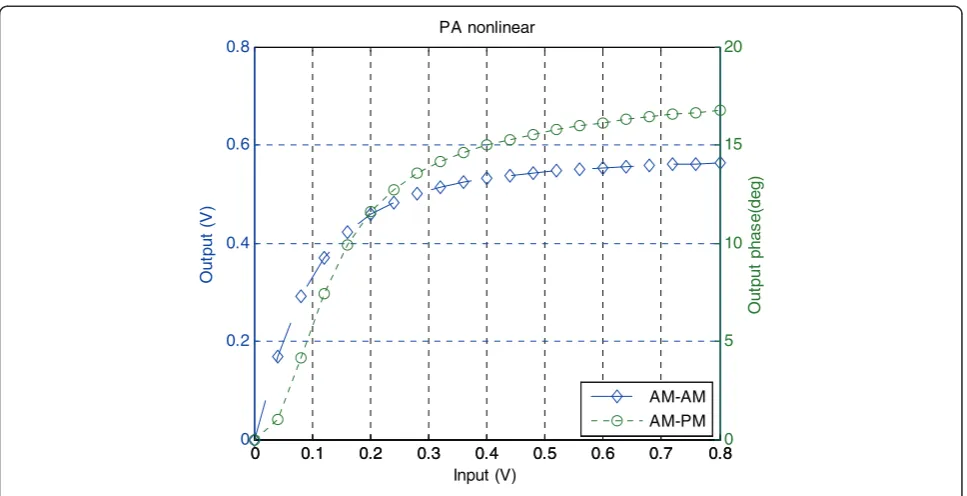
Figure 1 depicts the curves of AM–AM and AM–PM models given output saturation voltage of Vsat. We can ignore the amplitude distortion and phase distortion when the amplitude of input is less than 0.1 V. But when the input signal amplitude is greater than 0.1 V, the amplifier will work in nonlinear region; this may result in severe nonlinear distortion, and therefore the per-formance of the receiver signal will deteriorate seriously.
significant approach is to adopt the OBO mechanism. Back-off power is usually defined as
Rbackoff ¼10 log10ðPsat=PinÞ; ð3Þ
where Psat is the output saturation power, Pinis the
in-put power, andRbackoffis the power back-off value in dB.
Obviously, the greater back-off value means the smaller the output power, and the smaller the output power means the smaller the nonlinear distortion. More specif-ically, the nonlinear distortion may partly be alleviated by reducing the input power Pin. Unfortunately, lower
transmit power will lead to the lower SNR, this will re-sult in decreasing anti-jamming capability. At the same time, the performance of amplifier devices may greatly be deteriorated. Therefore, the power back-off mechan-ism can only avoid the negative effects of nonlinear dis-tortion in a certain extent, but fail to effectively improve the system performance under the nonlinear device. It is difficult to be adopted widely in the practical design.
2.2. Signal model
The transmitter-end block diagram of nonlinear com-munication system considered in this study has been illustrated in Figure 2. For the convenience of analysis, we assume that the wireless propagation channel to be single-path with additive white Gaussian noise (AWGN). However, from our later formulation, it still may be straightforward to extend to multi-path propagation.
The transmitter-end operates as follows. In the begin-ning, the binary source sequence {bi} (i= 0,1,2,. . .) is
se-quentially fed into anM-order linear modulator (such as
M-PSK or M-QAM). Subsequently, the modulated data symbols {xk} (k = 0,1,2,. . .) are passed though a
front-end nonlinear PA, and after this process, we can get the emitted symbols {xk†} whose voltage amplitudes and
phases are seriously distorted. Finally, the emission symbols are propagated through single-path channel with AWGN.
It is noteworthy that, although we mainly consider the single-path Gaussian propagation senior in this article, we may still adopt an extended multi-path model in
0 0.1 0.2 0.3 0.4 0.5 0.6 0.7 0.8
0 0.2 0.4 0.6 0.8
PA nonlinear
Input (V)
Ou
tp
u
t (
V
)
0 0.1 0.2 0.3 0.4 0.5 0.6 0.7 0.80
5 10 15 20
Ou
tp
ut
p
h
a
s
e
(de
g
)
AM-AM AM-PM
Figure 1IEEE 802.11ad PA model.
order to conveniently formulate the dynamic system model in (5) and (6), i.e., this memory model may be al-ways necessary when considering the applications of PF to the specific nonlinear estimation problem. And hence, the generalization to the realistic multi-path channel is also practically feasible. Thus, the observed signals denoted by {yk} (k= 0,1,2,. . .) at the receiving end can be
given by
yk¼hHx†kþvk
¼XL1l¼0hlx†klþvk
¼XL1l¼0hlg xð klÞ þvk; k¼0;1;. . .;K1 ð4Þ
whereLdenotes the length of the communication channel impulse response. The complex symbol xk is a
high-order modulated uniform random variable, i.e., xk∈{A}, k= 0,1,2,. . ., and it is independent from the obvious and future symbols. In practice, we set the prior probability of each transmitted symbol equal. And vk represents the
noise value at time k, whereas it is an AWGN process with zero mean and varianceσ2, i.e.,vk~N(0,σ2). The
co-efficient of channelh is assumed to be invariant and fol-low the Gaussian distribution with the mean vector of h and the covariance matrix Σ, i.e., h∼Nh;Σ, whereas, it can conveniently be represented by the L × 1 vector,
h= [h0,h1,. . .,hL–1]T.
Based on the consideration above, the DSM model can be expressed as follows [14]
xk¼Txk1þuk ð5Þ
yk¼hHgð Þ þxk vk ð6Þ
Equation (5) is usually referred as to the state equation, which essentially describes the evolution process of the hidden state xk [14]. Correspondingly,
uk= [0,0,. . .,xk]Tis anL× 1 vector,Tis theL×L
state-Equation (6) is the observation equation, which gives the relationship between the received (or observed) sig-nal yk and the hidden (or unobserved) state xk. The
nonlinear transform g(.) specifies the mapping between the input signal and output signal of the nonlinear power amplifier.
It should be noted that the focus of this study is the single-path Gaussian propagation channel, so we should
make choice of the value of h and Σ with the purpose that let the generated channel h approach single-path. For this reason, under the nonlinear distortion we may simplify the observation model (6) into (7).
yk¼g xð Þ þk vk; vk∼N0;σ2 ð7Þ
Also, in the formulated model above, the propagation channel is assumed to be time-invariant and the gain is normalized to 1.
3. PF
3.1. Bayesian inference
According to the model given in Equation (6), assume that the coefficient of single-path channel h is known but the transmitted symbols {x0:K} are unknown. From a Bayesian perspective, the optimal signal detection can be achieved by MAP detection of the transmitted x0:K, based on the observed sequence y0:K. The aim of this study is to compute the MAP estimate of state symbols {x0:K} based on the observed symbols{y0:K} and the coef-ficient of channelh. The MAP estimate of the transmit-ted symbols is given by
^xðMAPÞ0:K :¼ arg max x0:K
p x½ 0:kjy0:k;h;ðG;ΨÞg
f ð8Þ
In order to simplify the computation, we can solve this problem sequentially and recursively. More specifically, we can calculate thex0:(MAP)k fromx0:(MAP)k−1 when the recent observation yk is received. The posterior probability
mass function (pmf ) is shown as follows [15]
pðx0:kjy0:k;h;ðG;ΨÞÞ∝pðykx0:k;y0:k1;h;ðG;ΨÞ
Unfortunately, the involved posterior distribution of interest above is often analytically intractable and hard to derive in practice. More specifically, because of the high-dimensional marginalization integration and the nonlinear process, we have to resort to the approxima-tion method.
3.2. Blind estimation using the SIS
Based on the idea of sequential and recursive estima-tion, we can achieve real-time detection via SIS, which is regarded as the extension of importance sampling (IS). According to the SIS algorithm, we may build the state trajectories and compute the importance weights sequen-tially. More specifically, SIS could obtain the estimation of target probability via particlesx(i)with associated weights
e
wð Þi (i= 1,2,. . .,N). On this basis, the MAP estimation (8) could be drawn and marginal data detection at timekare given by [14]
Here,Nrepresents the total number of particles at the same sampling time. δ = 1 if x0:k = x0(i:k) and δ = 0
otherwise.
We begin SIS algorithm by drawing N particles from posterior pmfp(x0:k|y0:k,h,(G,Ψ)). In practice, it is usually
intractable to sample directly from the target distribu-tion p(x0:k|y0:k,h,(G,Ψ)), so we design an important
dis-tributionπ(x0:k|y0:k,h,(G,Ψ)) from which the particles are
more easily to drawn. The design of the important distri-bution is a critical step in PF, and it varies according to the actual situation. We will present the important dis-tribution adopted in Section 4.
With the particles sequentially sampled from the im-portance function as each new observation arrives, the importance weights can be computed recursively in time as follow [16]:
where weð Þi is a set of importance weights. After this step completed, normalize the importance weights using (12):
Unfortunately, as has been illustrated by most investigations and noted from (10), the degeneracy of SIS algorithm is usu-ally inevitable, which is referred to the decrease of import-ance weights over time. Along with a consequence of weight degeneracy, the approximation of posterior prob-ability may seriously deteriorate and even become useless. An efficient approach to alleviate this difficulty is to con-duct a re-sampling procedure in the SIS algorithm. The basic idea of such method is to eliminate particles with small normalized importance weight while concen-trating upon those particles having larger normalized im-portance weight.
A suitable measure to the serious degeneracy can be estimated from
Thus, in practice, whenNeffis below a fixed threshold, the re-sampling procedure is used.
Bayesian signal detection
In this section, we will address the problem of designing the optimal importance function which could be adopted in this nonlinear communication system relying on the local linearization technique. In addition, the implementations of nonlinear equalization are presented.
4.1. PF with local linearization
Because we mainly consider the single-path Gaussian propagation under the nonlinear distortion in this study, we could adopt model (7) to represent the system observations. In order to derive the feasible importance function with the complex nonlinear transform, by performing a Taylor expansion up to first-order of the observation equation at the point xk = xk*, we may
fur-where xk* represents the hypothetical signal with known
value, which can be drawn from the finite alphabet of modulated symbols. It is conveniently to calculate the optimal importance function π(xk|x(i)0:k–1,y0:k,h,(G,Ψ))
with mean m* and covariance Σ* which could be
evaluated for each trajectory using the following formula
πð jxkxð Þ0i:k1;y0:k;h;ðG;ΨÞÞ
≜pð jxkx0ð Þi:k1;y0:k;h;ðG;ΨÞÞ∼N mð ;ΣÞ ð15Þ
Here, the varianceΣ*could be calculated by
Σ1
Thus, after sampling from the importance function π(xk|x0:k-1(i) ,y0:k,h,(G,Ψ)), we may get the particles {xk(i)} at
amplifier and get new particles {xk(i)}whose voltage
ampli-tude and phase are distortional.
After the process of IS, updating the associated weights of the discrete particles should be carried out, the main idea of weight update over nonlinear channel is same as the method over linear system, so the normalized importance weights can be evaluated from (11) and the probability distribution function (pdf )
p(yk|x0:k(i),y0:k–1,h,(G,Ψ))can be expressed for likelihood [9,15], shown in (18)
p ykjxð Þ0i:k;y0:k1;h;ðG;ΨÞ
where Σ is the initial covariance matrix of channel and xk(i)is an L× 1 vector contained by particles at time k–2,k–1, and kin the same trajectoryi. It is import-ant to note thathrepresents the single-path channel, so the value ofhis approximated to be [1 0 0]T.
Notice that, Equation (18) indicates that the likeli-hood function follows a Gaussian distribution, i.e.,
p ykxð Þ0i:k;y0:k1;h;ðG;ΨÞ
and variance calculated from
mð Þki ¼hHg xð Þi
Relying on the likelihood function above, the associated weights of the new particles can be updated by using
e
Then, use Equation (12) to normalize the associated weights intowk(i).
Up to now, the discrete random measures {xk(i), wk(i)}
have been derived, so the MAP criterion should be carried on to get the estimated symbols.
4.2. Implementations
Based on the elaborations above, the Bayesian nonlinear detection algorithm comes in its fullness. At the receiving
end, we may simulate the blind signal detection of nonlinear communication systems in the presence of nonlinear distortions in the following four steps:
fork= 0:K–1
1 DrawNparticles from the importance function
π(xk|x0:k-1(i) ,y0:k,h,(G,Ψ)) ~N(m*,Σ*), and feed these
particles into the nonlinear power amplifier. 2 Compute importance weight of each particle according to (18) and (21), then normalize the weight. 3 Re-sample in accordance with (13).
4 Use the method of MAP estimate (10) to calculate the transmitted symbols.
end for
5. Computer simulation
In this article, we focus on a scenario of a time-invariant nonlinear channel with an impulse response with the extended lengthL= 3. We assumed a Gaussian prior for the channel coefficients, h∼Nh;Σ. The channel mean is assumed to h¼½1 0 0 and the covariance matrix is Σ= diag{δ δ δ} withδ= 10–10. The main reason for this configuration is that it could practically approximate a single-path channel. In our experiment, the transmitted signals {bi} were modulated to {xk} by using 16QAM and
QPSK schemes, respectively, and the prior distribution of {xk} is assumed known.
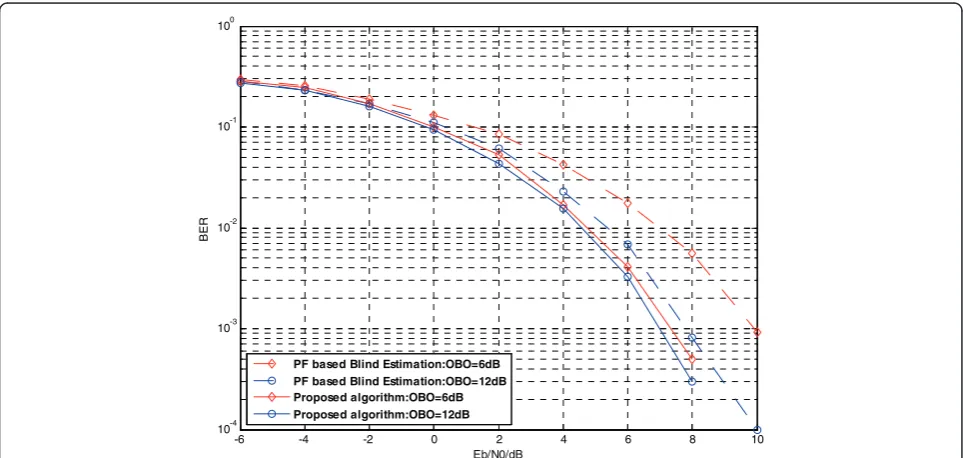
First, we compare the existing PF algorithm proposed for linear estimation problems and the new algorithm developed in this article. Because of the infeasible im-portance function, the estimation performance of the traditional algorithm will apparently be degraded when dealing with the nonlinear communication. From the simulation results in Figure 3, with the high-order modulation 16QAM, it is clear to see that the developed new approach shows the better performance, and the new algorithm can solve the problem of BER floor which is caused by lower power back-off in the presence of nonlinear distortion. Hence, the superiority of this suggested approach in dealing with nonlinear 60GHz millimeter-wave communication systems is rather obvi-ous. In addition, from Figure 4 we may see in a clear logical way that the new algorithm shows better per-formance for the QPSK modulation likewise. For ex-ample, under the same condition of OBO value 12 dB, the desired SNR of new algorithm and traditional method is 5 and 7 dB, respectively, when the BER drops below 10–2.
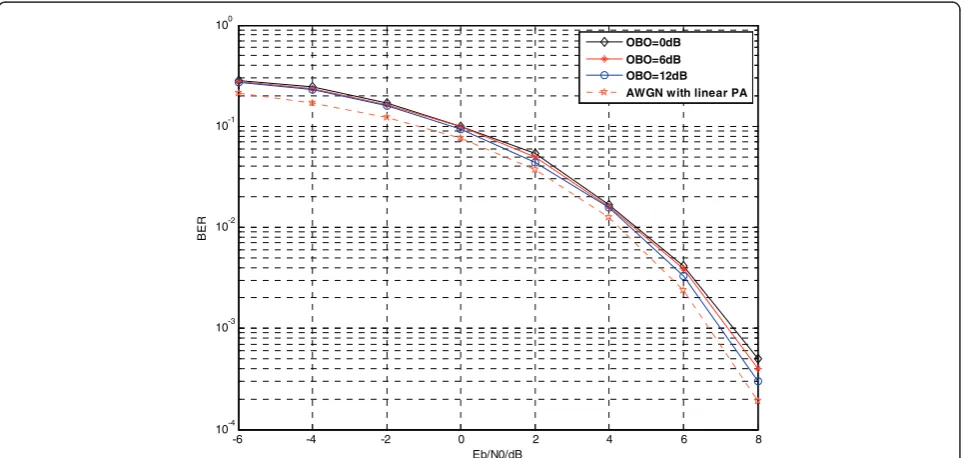
demonstrates that the smaller the output power is, the smaller the nonlinear distortion is produced. When the output power is small enough, the BER curve of PF becomes much close to the theoretical AWGN curve with linear PA. Besides, we may note that even if the OBO is 0 dB, the distorted signals could be estimated accurately as long as the SNR is large enough.
6. Conclusions
In this article, we have designed an effective estimation algorithm, which can conveniently be implemented in receiver-end, for nonlinear 60GHz millimeter-wave radar communication systems based on Bayesian inference. This algorithm is implemented by SIS and Taylor expansion. One of the main features of our
0 5 10 15 20
10-4 10-3 10-2 10-1 100
Eb/N0/dB
BE
R
PF based Estimation:OBO 5dB PF based Estimation:OBO 9dB PF based Estimation:OBO 11dB PF based Estimation:OBO 15dB Proposed algorithm:OBO 5dB Proposed algorithm:OBO 9dB Proposed algorithm:OBO 11dB Proposed algorithm:OBO 15dB
Figure 3Performance evaluations between the classical PF-based linear equalization and the developed nonlinear estimation method with 16QAM modulation.
-6 -4 -2 0 2 4 6 8 10
10-4 10-3 10-2 10-1 100
Eb/N0/dB
BE
R
PF based Blind Estimation:OBO=6dB PF based Blind Estimation:OBO=12dB Proposed algorithm:OBO=6dB Proposed algorithm:OBO=12dB
proposed estimator is that, as a promising solution to address nonlinear estimations, the first-order Taylor expansion is used to approach the involved nonlinear transform, and the associated weight is then recur-sively computed for each data trajectory in PF. The ad-vantage of this method is its capability to estimate transmitted symbols sequentially and timely without a training sequence, even in the presence of nonlinear
distortions due to hardware imperfections. As is shown by the experimental results, the combination of PF with Taylor expansion can effectively combat the nonlinearity distortion in the 60GHz millimeter-wave radar communication systems, which may hence pro-vide a competitive solution to the practical design of 60GHz millimeter-wave communication and other radar communication systems.
0 2 4 6 8 10 12 14 16 18 20
10-4 10-3 10-2 10-1 100
Eb/No/dB
BER
OBO=0dB OBO=2dB OBO=5dB OBO=9dB OBO=11dB OBO=15dB Linear PA
Figure 5Detection performance of 16QAM modulation with different OBO values.
-6 -4 -2 0 2 4 6 8
10-4 10-3 10-2 10-1 100
Eb/N0/dB
BER
OBO=0dB OBO=6dB OBO=12dB AWGN with linear PA
Competing interests
The authors declare that they have no competing interests.
Acknowledgment
This study was supported by the National Natural Science Foundation of China (60972079, 61271180) and the Fundamental Research Funds for the Central Universities (2012RC0103).
Author details
1
School of Information and Communication Engineering, Beijing University of Posts and Telecommunications (BUPT), Beijing, China.2Heilongjiang Institute of Technology, Harbin, China.
Received: 27 November 2012 Accepted: 21 January 2013 Published: 19 February 2013
References
1. Y. Wu, Y. Bao, Z. Shi, J. Chen, Y. Sun, A novel range detection method for 60GHz LFMCW radar, inIEEE 72nd Vehicular Technology Conference Fall (VTC 2010-Fall), Ottawa, 2010, pp. 1–5
2. C.H. Park, T.S. Rappaport, Short-range wireless communications for next-generation networks: UWB, 60-GHz millimeter-wave pan, and zigbee. IEEE Wirel. Common. Mag.14(4), 70–78 (2007)
3. X. Zhang, L. LR, R. Funada, C.S. Sum, H. Harada, Physical layer design and performance analysis on multi-Gps millimeter-wave WLAN System, in Proceedings of the IEEE International Conference on Communication Systems (ICCS), Singapore, 2010, pp. 92–96
4. E. Perahia, M. Park, R. Stacey et al., IEEE P802.11 wireless LANs TGad evaluation methodology, inIEEE 802.11 TGad Technology Report, 2010, pp. 9–15 5. M. Lei, C.S. Choi, R. Funada, H. Harada, S. Kato, Throughput comparison of
multi-Gps WPAN (IEEE 802.12.3C) PHY layer designs under nonlinear 60-GHz power amplifier, inProceedings of the IEEE Symposium on Personal, Indoor and Mobile Radio Communication (PIMRC), Athens, Greece, 2007, pp. 1–5 6. W. Gerhard, R. Knoechel, Improvement of power amplifier efficiency by
reactive Chireix combining, power back-off and differential phase adjustment, inProceedings of the IEEE MTT-S International Microwave Symposium (MTT-IMS), San Francisco, USA, 2006, pp. 1887–1890 7. N. Safari, J.P. Tanem, T. Roste, A Block-based predistortion for high
power-amplifier linearization. IEEE Trans. Microw. Theory Tech.54(6), 2813–2820 (2006) 8. G. Montoro, P.L. Gilabert, E. Bertran, A. Cesari, J.A. Garcla, An LMS-based
adaptive predistorter for cancelling nonlinear memory effects in RF power amplifiers, inProceedings of the Asia-Pacific Microwave Conference(APMC), Bangkok, Thailand, 2007, pp. 1–4
9. J.S. Liu, R. Chen, Sequential Monte Carlo methods for dynamic systems. J. Am. Stat. Assoc.93(443), 1032–1044 (1998)
10. J.S. Liu, R. Chen, Blind deconvolution via sequential imputations. J. Am. Stat. Assoc.90(430), 566–576 (1995)
11. A. Doucet, X. Wang, Monte Carlo Methods for Signal Processing. IEEE Signal Process. Mag.24(5), 152–170 (2005)
12. A. Doucet, S. Godaill, C. Andrieu, On sequential Monte Carlo sampling methods for Bayesian filtering. Stat. Comput.10(3), 197–208 (2000) 13. T. Bertozzi, D. Le Ruyet, G. Rigal, H. Vu-Thien, On particle filtering for digital
communications, inProceedings of the IEEE Workshop SPAWC, Rome, Italy, 2003, pp. 570–574
14. P.M. Djuric, J.H. Kotecha, J.Q. Zhang, Y.F. Huang, T. Chirmai, M.F. Bugallo, J. Miguez, Particle filtering. IEEE Signal Process. Mag.20(5), 19–38 (2003) 15. J. Miguez, P.M. Djuric, Blind equalization of frequency-selective channels by
sequential importance sampling. IEEE Trans. Signal Process.52(10), 2738– 2748 (2004)
16. J. Miguez, P.M. Djuric, Blind equalization by sequential importance sampling, inIEEE International Symposium on Circuits and Systems, Phoenix-Scottsdale, AZ, USA, vol. 1, 2002, pp. I-845–I-848
doi:10.1186/1687-1499-2013-33
Cite this article as:Sunet al.:Nonlinear estimation for 60GHz millimeter-wave radar system based on Bayesian particle filtering. EURASIP Journal on Wireless Communications and Networking20132013:33.
Submit your manuscript to a
journal and benefi t from:
7Convenient online submission 7Rigorous peer review
7Immediate publication on acceptance 7Open access: articles freely available online 7High visibility within the fi eld
7Retaining the copyright to your article