R E S E A R C H
Open Access
The IT convergence framework design in the
internet of things environment
Taijong Yoo and Hangbae Chang
*Abstract
In the Internet of things that could intelligent functions such as communications, context awareness, remote control, and provide services to users by assigning advanced communication functions to things, a convergence process between the general manufacturing industry and the IT industry. In detail, the IT convergence is divided into one for the product itself and one for the product manufacturing process. This study designs a model to objectively measure the IT convergence level for the automobile and shipbuilding industries, which are classified as a typical manufacturing industry, and applies it to them so that it would like to acquire availability of the model as well as to provide the present condition of current IT convergence level.
Keywords:IT convergence, Convergence measurement, Internet of things environment, Ubiquitous environment, Automobile industry, Shipbuilding industry
Introduction
The world economy has been changed into the knowledge-based economy due to the development of new IT technologies, and it is expected that the‘fusion technology age’would come closer after the industrial revolution and the computer/communication revolu-tion [1].
In general, a dictionary definition of the convergence is ‘that two or more different things are gathered to merge into one without distinction’. The convergence is distinguished from the integration means ‘that unifies functions of sub-systems in accordance with the goal while keeping their inherent nature’. And, the conver-gence is a phenomenon that creates functions/products/ services previously non-existed by combining different technologies or industries for improving efficiency and performance. Because it is a process expanding and ma-terializing from science to technology, and from technol-ogy to industry, it is difficult to understand effects of the ‘convergence’ in goods and services that are the final products compared to the ‘convergence’ recognized so-cially. In addition, it is required to understand the precise meaning of the convergence because the meanings of
terms related to the convergence used in the respective countries are slightly different [2,3].
Meanwhile, IT convergence is that facilitates develop-ment of technologies and industries in other fields or creates new industries based on IT’s own advancement, which concentrates resources and capacity selectively [4,5]. In particular, convergence between technologies such as IT and biotechnology, IT and nanotechnology, etc., is emerged as a method to overcome limits of indi-vidual technology and a catalyst to promote industries. In addition, roles of IT are gradually expanded in the key industries such as automobile, shipbuilding, construc-tion, etc., and the importance of IT is increased as means to improve added-values through differentiation.
At this point in time, a study is needed to derive a model, which could measure the IT convergence level by systematically and comprehensively understanding the actual condition of the IT convergence between various industries including IT and manufacturing, and to ob-jectively compare them. Therefore, this study would like to organize diverse concepts of the convergence and to develop a model to measure the IT convergence applic-able to the industry.
* Correspondence:[email protected]
Division of Business Administration, College of Business, Sangmyung University, 20, Hongjimun 2-gil, Jongno-gu, Seoul, South Korea
IT convergence concept design
Literature review
Although each country and organization define the con-vergence, convergence technology, and IT convergence (network convergence), there is no unified opinion. As it is indicated by the terms of ‘interdisciplinary, qualitative changes, common goal, accompanying growth, collapse of boundaries,’ however, they generally coincide with each other in terms of passing the limits of the existing indus-tries and technologies to describe a new phenomenon.
Convergence is defined as follows. The OECD defines
the convergence as “the multiple ways in which
nanotechnologies will combine in the future with other developments in new technology reflecting its genuinely interdisciplinary nature.” Germany defines the conver-gence as “a process of qualitative change that connects two or more existing, previously distinct markets.” The ITU defines the convergence as “much more than the simple blending together of once-disparate industry segments”[6,7].
And, the convergence technology is defined as follows. The EU defines the convergence technology as “enabling technologies and knowledge systems that enable each other in the pursuit of a common goal.”The ITU defines the convergence technology as “a process by which telecommunications, information technology and the media, sectors that originally operated largely independent
of one another, are growing together.” The United States defines the convergence technology as “the synergistic combination of four major NBIC (nano-bio-info-cogno) provinces of science and technology, each of which is cur-rently progressing at a rapid rate: (a) nanoscience and nanotechnology; (b) biotechnology and biomedicine, in-cluding genetic engineering; (c) information technology, including advanced computing and communications; (d) cognitive science, including cognitive neuroscience”[8,9].
Finally, other terms related the convergence are defined as follows. The World Bank defines the IT convergence as “the erosion of boundaries among previously separate services, networks, and business practices in the ICT sector.”And, the OECD defines the network convergence
as “Convergence refers to the process by which
communications networks and services, which were previ-ously considered separate, are being transformed such that: Different network platforms carry a similar range of voice, audiovisual and data transmission services. Different consumer appliances receive a similar range of services. New services are being created.”
IT convergence definition
Organizing the existing common concept of the IT con-vergence, it could be defined as “a phenomenon that innovates products, services, and processes of other in-dustries, or creates new added values by embedding the Table 1 Definition of IT convergence
Convergence level
First-order (stage 1) Second-order (stage 2) Third-order (stage 3)
IT convergence IT convergence IT Convergence
Convergence Type
Convergence between IT technologies and products, or IT technologies and manufacturing processes
Convergence between the partial social IT infrastructure and the IT embedded in products
Convergence between the IT embedded in heterogeneous industrial products through the social IT infrastructure
Automobile/ shipbuilding Industry
Smart (automatic control) vehicle, digital ship
Intelligent transport systems/shipbuilding e-navigation
Advanced smart safety vehicles operated in u-City
IT
Requirement
Embedded software, sensor, wire/ wireless communication devices, data storage devices
Smart road, wire/wireless communication devices between vehicles and roads, compatible communication protocol
u-City, u-Healthcare
sensing, networking, computing, and actuating technolo-gies of IT as components or modules.” This clearly defines the phenomenon converging IT with other and new industries, and describes the effects specifically. However, because it is defined by difficult technical terms to understand for non-professionals, the definition of IT convergence is difficult to understand by the gen-eral public or non-professionals. Even though it is defined specifically, the effectively understood concept is not much different from‘innovation’of ‘other industries’ ‘processes, services, and products’ ‘using IT.’ There is a disparate issue continually between the phenomenon of ‘IT convergence’ and the ‘IT convergence industry’ analyzed substantially. Like this, the existing definition of ‘IT convergence’is a conceptual definition. Arranging the convergence/IT convergence of respective countries, it could be said that the IT convergence is‘advancement of the existing industries’ ‘converging with IT’, and ‘ cre-ation of new products, services and (added) values’ by ‘creating new industries.’
Therefore, this article defines the IT convergence in three stages by integrating the systematic and substantial convergence types and the convergence level study of the operational, competent and strategic convergence level [10,11].
The definition of IT convergence is explained in Table 1. Stage 1 is the convergence between IT technologies and products/business processes, and stage 2 means the con-vergence between the partial social IT infrastructure and the IT embedded in products. And, stage 3 means the IT convergence embedded between heterogeneous industries through the social IT infrastructure.
Design of IT convergence measurement
Methodology for designing IT convergence index
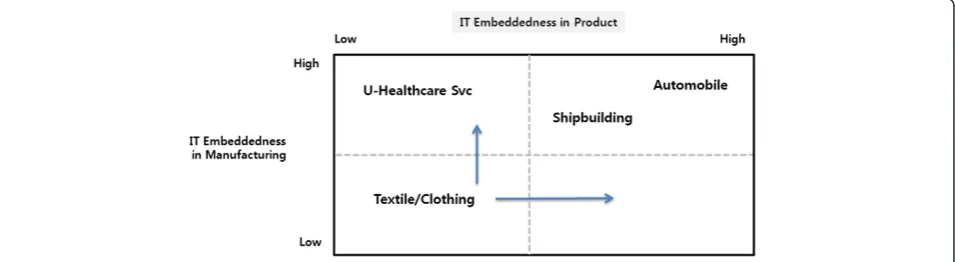
This study separates products and manufacturing processes to develop questions of a survey for the IT convergence in order to measure the extent of convergence between IT and respective industries. Measurements for the first-order could be divided into the extent of converging IT technologies with products representing respective industries and the
extent of converging IT technologies with processes as shown in Figure 1. For the processes, automation in most of offices is a common part for each industry.
In this study, target industries for developing the IT convergence index are automobile and shipbuilding as shown in Table 2.
Design of IT convergence index for products
The methodology of designing a tool to measure the convergence between IT and Products is described as shown in Figure 2. Definition of the convergence be-tween IT and products could be established as the extent of converging IT with functions carried out by core modules or components for each industry. Therefore, core modules or components for each industry are clas-sified for the item category for each industry according to the standard classification system by industry. And, detailed functions performed by core modules or components for each industry are examined to measure the extent of supporting them by IT (the extent of IT convergence).
For key components to measure the convergence level in the automobile industry’s product, a total of 25 components are selected from the safety devices, car body control, convenience devices, infotainment, vehicle communication, and power (train) system. For the safety devices, the convergence level is measured for the elec-tronic stability control (ESC), collision avoidance system, pre-crash safety, tire pressure monitoring system, vehicle black box, side obstacle warning system, night vision system, lane department warning system, lane keeping support, front rear monitoring system, distance control between cars, advanced cruise control, intelligence air-bag, and vehicle position control. And, for the car body control part, the convergence level is measured for the convenience device control and the lamp control. For the convenience devices, the convergence level is measured for the button starter/smart key/door control system, intelligent park assistant/parking assist system, human–machine interface, driving load control for safe driving, and the vehicle AV is measured for the Table 2 Target industries for developing IT convergence index
Strategic industries IT convergence products Note
Automobile industry Smart vehicle Smart (automatic control) vehicle
Shipbuilding industry Smart ship Digital ship
infotainment part. The convergence level of the in-vehicle network is measured for the in-vehicle communica-tion, and for the power (train) system, the convergence level is measured for the engine control unit, transmis-sion control unit, hybrid electric vehicle, fuel cell vehicle and, intelligent battery sensor.
For key components to measure the convergence level in the shipbuilding industry’s product, a total of 12 components are selected from the propulsion power control, sailing control, accommodation and life safety control, and marine environment control sections. For the propelling power control section, the convergence level is measured for the main propulsion engine and the engine room auxiliary equipment. And, for the sailing control, the convergence level is measured for the
cargo stowage, loading and unloading facilities,
anchoring/mooring facilities, and navigation systems. For the accommodation and life safety control section,
the convergence level is measured for the fire
extinguishing and saving equipment and the crew ac-commodation facilities, and for the marine environment control sections, the convergence level is measured for the harmful substance management and the prevention of marine pollution.
Design of IT convergence index for manufacturing processes
The methodology of designing a tool to measure the convergence between IT and manufacturing processes is described as shown in Figure 3. Definition of the conver-gence between IT and manufacturing processes could be established as the extent of converging IT with manu-facturing processes for each industry. First, standard
processes for each industry are investigated for the item category for each industry according to the standard classification system by industry. And, the standard processes in manufacturing are examined according to the standard for each industry. Then, core manufactur-ing processes are classified accordmanufactur-ing to the standard for each industry. Finally, it is measured the extent of supporting the detailed processes in the core manufac-turing processes for each industry by IT (the extent of IT convergence).
In order to measure the convergence level between IT
and manufacturing processes in the automobile
industry’s product, the convergence level is measured for the whole process of developing new products (product planning, development plan, development implementa-tion, etc.), the whole work to establish a production plan (reflection of the sales forecast and demand plan, plan-ning and managing of available capability, management of work schedules, manpower, etc.), the whole produc-tion management work (work order, process control, progress control, etc.) in the business process, and en-gine mission manufacturing, pressing, car body assem-bling, painting and final assembling processes in the whole manufacturing process. And, to measure the IT convergence level for the collaboration between com-panies, the IT convergence level is measured for the pro-duction planning and the changed information of orders.
Figure 3Process of designing a tool to measure the convergence between IT and manufacturing processes.
Table 3 Extent of the convergence between IT and the vehicle stability control system device (example)
Scale point Division Description
7 Full . . .
Table 4 Extent of the convergence between IT and a process before developing a new product (example)
Scale point (5-point scales)
Ratio of supporting the entire process (product planning, development plan, development implementation, etc.) for developing a new product through an information system
In order to measure the convergence level between IT and manufacturing processes in the shipbuilding industry’s product, the IT convergence level is measured for the pro-duction process of the main company in the business process and the collaboration between companies.
Framework to design IT convergence index
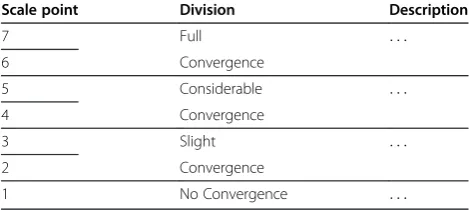
It is divided into the extent of converging IT technolo-gies with products representing each industry (7-point scales) and the extent of converging IT technologies with processes (5-point scales). Table 3 is an example of measurement scales for the convergence between IT and products, which shows measurements for the extent of the convergence between IT and the vehicle stability control system device. First, the IT convergence level for the product is designed as the 5-point scales from non-convergence to full-non-convergence by the corresponding device’s intelligence level.
And, Table 4 is an example of the measurement scales for the convergence between IT and processes, which shows measurements for the extent of the convergence between IT and a process before developing a new product. The IT con-vergence level of the product manufacturing process is designed as the 5-point scales from below 20% to above 80% by the extent of utilizing IT technologies on the process.
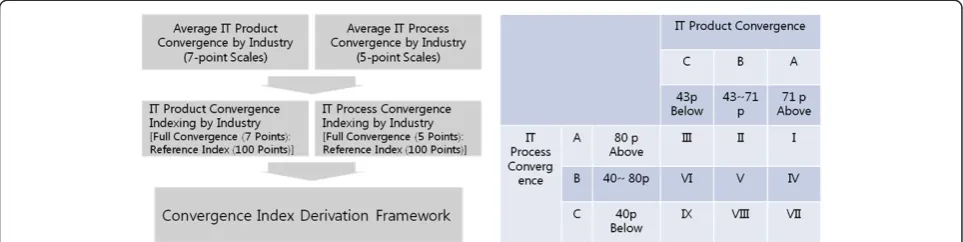
Passing through the framework as Figure 4, the extent of the IT convergence for each industry is derived depending on the corresponding section of I–IX as follows in Table 5.
Empirical analysis of the model to measure IT convergence index
Survey design on IT convergence index
The survey for measuring the IT convergence index was conducted for 129 companies in Korea, which the IT convergence level could be measured, targeting persons responsible for the business of the company having products and processes. For the automobile industry, it was targeted at the manufacturers of the corresponding products above 10 billion won of sales or the major
Figure 4Method to derive the IT convergence index by industry and the framework to derive the convergence index.
Table 5 Description of IT convergence level
1 Product IT Convergence A (Good) Level
Process IT Convergence A (Good) Level
2 Product IT Convergence B (Fair) Level
Process IT Convergence A (Good) Level
3 Product IT Convergence C (Poor) Level
Process IT Convergence A (Good) Level
4 Product IT Convergence A (Good) Level
Process IT Convergence B (Fair) Level
5 Product IT Convergence B (Fair) Level
Process IT Convergence B (Fair) Level
6 Product IT Convergence C (Poor) Level
Process IT Convergence B (Fair) Level
7 Product IT Convergence A (Good) Level
Process IT Convergence C (Poor) Level
8 Product IT Convergence B (Fair) Level
Process IT Convergence C (Poor) Level
9 Product IT Convergence C (Poor) Level
Process IT Convergence C (Poor) Level
Table 6 IT convergence index weights for the automobile and shipbuilding industries
Industry Division IT convergence target Weight
Automobile Product Safety device 0.25
Body control 0.18
Convenience device 0.14
Infotainment 0.11
Vehicle communication 0.21 Power transmission device 0.07
Process OEM 0.67
Cooperative company 0.33 Shipbuilding Product Propulsion power 0.10
Sailing control 0.30
Resident life 0.40
Marine environment management 0.20
Process OEM 0.33
company’s subcontractors. And, for the shipbuilding industry, it was targeted at the major shipbuilders focused on the large companies, manufacturers of the corresponding products among the small medium shipbuilders or the major company’s subcontractors, and the major company’s subcontractors above 30 billion won of sales. And, preparing the questionnaire reflecting characteristics for each industry, it was conducted by letter (e-mail,) telephone, and interview. The questions were weighted through the priority investigation of the survey’s questions and the analytic hierarchy process method was utilized to carry out the data coding reflecting the weight as Table 6 and verification. The analytic hierarchy process (AHP) is a structured tech-nique for organizing and analyzing complex decisions. Based on mathematics and psychology.
Survey results on IT convergence index for product and process IT
Targets for measuring the IT convergence index of the automobile and shipbuilding industries are as follows. For the automobile industry, it measured for safety devices, body control, convenience devices, infotainment, vehicle
communications, power transmission devices, OEM
systems, and cooperation between companies. For the shipbuilding industry, it is measured for propulsion power engine, sailing control, safety control, marine environment management, OEM systems, and cooperation between companies. For example, the Table 7 shows the Extent of the Convergence between IT and the Vehicle Stability Control System Device.
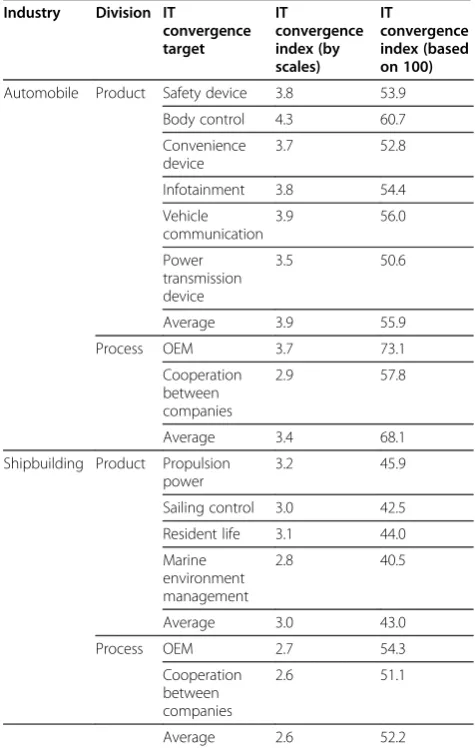
The IT convergence measurement range of automobile industry was the smart (automatic control) vehicle, and the average IT convergence point of each component was indicated as 3.9 points of the 7-point scales, which is a medium level As a result of survey, the Table 8 shows IT convergence index for the automobile and shipbuilding industries.
Table 7 Extent of the convergence between IT and the vehicle stability control system device (example)
Scale point Division Description
7 Full A state that the ESC converged with IT automatically detects every situations related to sudden cornering and cornering (ex: terrain conditions of driving roads, positions of steering, rotational speed of wheels and centrifugal force of vehicles etc.) to automatically control the vehicle’s optimum position (ex: individual driving force control for each wheel, engine power control, antiskid, brake assist and hold, active headrest etc.) for accident prevention and vehicle running stability
6 Convergence
5 Considerable A state that the ESC converged with IT automatically detects partial situations related to sudden cornering and cornering (ex: part of terrain conditions of driving roads, positions of steering, rotational speed of wheels and centrifugal force of vehicles etc.) to automatically control the vehicle’s position depending on the recognized situations for accident prevention and vehicle running stability
4 Convergence
3 Slight A state that the ESC converged with IT automatically detects partial situations related to sudden cornering and cornering, and provides the recognized information (ex: sliding condition levels of road surfaces) to effectively control the vehicle manually by drivers for accident prevention and vehicle running stability
2 Convergence
1 No convergence A state that drivers control the vehicle’s position manually
Table 8 IT Convergence index for the automobile and shipbuilding industries
Automobile Product Safety device 3.8 53.9
Body control 4.3 60.7
Convenience
Process OEM 3.7 73.1
Cooperation
Sailing control 3.0 42.5 Resident life 3.1 44.0 Marine
environment management
2.8 40.5
Average 3.0 43.0
Process OEM 2.7 54.3
Cooperation between companies
2.6 51.1
Figure 5 shows the analysis of the automobile product-IT convergence components. Of the product’s components, the body control device was 4.3 points, which showed the highest IT convergence, in addition, the vehicle safety sys-tem (4.4 points) of the safety devices and the starting and door operating devices (4.7 points) of the convenience devices also indicated the higher IT convergence. However, the infrared camera device (3.2 points) of the safety devices and the safety load control for safe driving (3.0 points) of the convenience devices, etc., showed lower convergence levels than 3.9 points that was the average convergence point of the entire automobile products. The IT conver-gence with truck, digital tachograph (functions to store and provide the vehicle driving records for checking safety and
compliant driving of trucks, etc.), and speed limiting devices showed 3.3, 3.3, and 3.4 points of the 7-point scales, respectively. Figure 6 shows the analysis of the automobile product- IT convergence levels for each detailed item.
In addition, the process-IT convergence level for the automobile was indicated as average 3.4 points of the 5-point scales. The IT convergence level of the OEM system was 3.7 points, which showed relatively high, and it resulted from the high IT convergence of the entire production management work (work order, process control, and progress control etc., 4.4 points) and the pressing process (3.8 points). The IT convergence level of the cooperation system between companies was 2.9 points, which resulted from the low degree of
Figure 5Analysis of the automobile product-IT convergence components.
sharing the OEM production order and order change information with the related companies in real time via an information system.
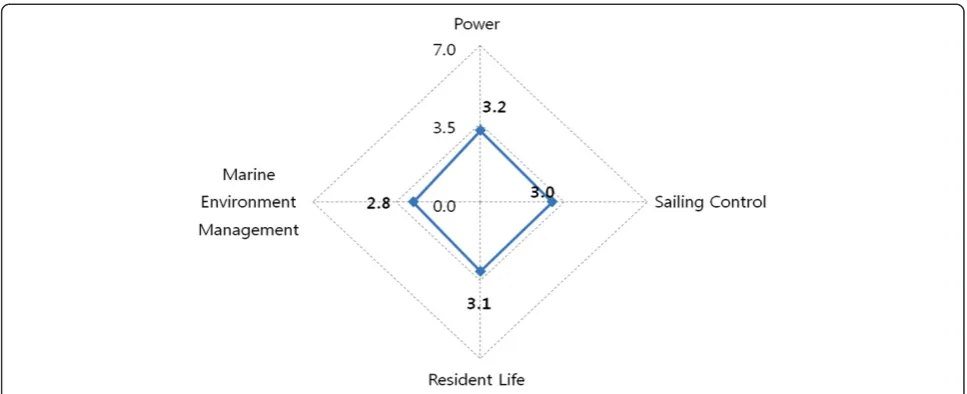
The IT convergence measurement range of shipbuild-ing industry was the smart (digital) ship, and the average IT convergence point of each component was indicated as 3.0 points of the 7-point scales, which is a medium level.
Figure 7 shows the analysis of the shipbuilding product-IT convergence components. Of the product’s components, the power transmission equipment of the propulsion power engine was 3.3 points, which showed the highest IT convergence, in addition, the disaster warning equipment (3.2 points) of the sailing control and the resident equipment (3.2 points) of the safety control, etc., also showed relatively high IT convergence. However, the anchoring and mooring device (2.5 points) of the sailing control, and the waste disposal equipment (2.8 points) of the marine environment management,
etc., showed the lower convergence levels than
3.0 points, the average convergence point of the entire shipbuilding products. Figure 8 shows the analysis of the
shipbuilding product- IT convergence levels for each detailed item.
The process-IT convergence level for the shipbuilding industry was indicated as average 2.6 points of the 5-point scales. The IT convergence level of the OEM system was 2.7 points, the IT convergence of the entire design work (3.5 points) and the entire production management work (3.4 points) were indicated as high, on the other hand, the IT convergence of the assembly process (1.9 points) and the mounting process (2.0 points) showed lower than average. The IT convergence level of the cooperation system between companies was 2.6 points, which showed the real-time sharing of the OEM design change information (2.5 points) and the real-time sharing of the OEM design production sched-ule change information (2.7 points).
Results analysis on IT convergence index at industry level As shown in Figure 9, even though the automobile industry’s IT convergence level is higher than other strategic industries, both of its products and processes are still in the intermediate (V section) level. Of the
Figure 7Analysis of the shipbuilding product-IT convergence components.
automobile products, the products with the highest IT convergence index are the car body control (61) and the vehicle communication (56), which seems that their complexity is so high that their IT convergence is high because they have a strong interworking function with other components or vehicles rather than the products themselves work autonomously.
In detail, it was represented that the lamp control devices (including the front and rear lamp controls and the in-vehicle lamp control) and the in-vehicle commu-nication devices (MOST, CAN, Flexray, etc.) have the highest IT convergence. The lamp control devices’ IT convergence level was represented that the lamps’ oper-ation is automatically controlled such as the lamps integrated with IT automatically recognize partial situations (ex: illumination, etc.) related to the lamp actuation and they operate the front lamp for the certain illumination suitable to the recognized situation. The in-vehicle communication devices’ IT convergence level
was represented that the in-vehicle communication devices integrated with IT provide the recognized infor-mation such as providing the voice manual for connecting with smart-phones for drivers to effectively carry out manual operations by automatically recogniz-ing partial situations related to connections with the in-vehicle communication.
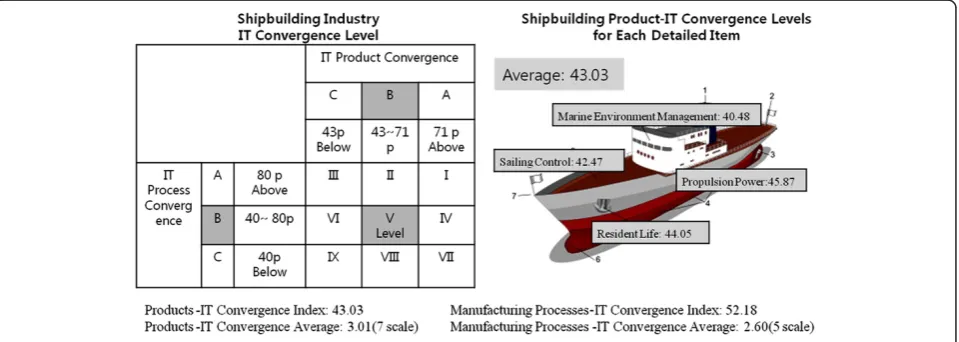
As shown in Figure 10, it was analyzed that the ship-building industry’s IT convergence level is still in the intermediate (V section) level for both its products and processes. Of the shipbuilding industry’s products, it was found that the products with the highest IT convergence index are the propulsion power engine (46) and the safety control (44), which the IT convergence is being carried out focusing on the ship’s main functions, which are related to major devices in the engine room such as the power transmission and the generated voltage, etc., and the crewmen’s safety. Since the cargo stowage or control, and the marine pollution prevention equipment,
Figure 9The automobile industry’s IT convergence level and the IT convergence index for each component.
etc., are different from major functions of ship building and sailing, it seems that their IT convergence is still low.
Conclusion and future study
The development and spread of IT has brought about sweeping changes in life styles by innovating paradigms of the entire society. Particularly, in the automobile industry actively utilizing IT, it is developed the conver-gence products such as the night vision system that automatically delivers actions for drivers to be carried out through images and voice etc. by automatically sens-ing every condition related to safe drivsens-ing such as the distance from the forward vehicle, road profile, arrival distance of fallen objects and expected path using a cam-era being capable of night vision when driving at night. In this way, IT has raised a new issue called the conver-gence with other technologies or industries, and is lying at the center of changes and innovation. However, since the meaning of the term related to the convergence used in various countries is slightly different, it is necessary to understand the exact meaning of the convergence. In addition, it does not sufficiently reflect the industrial structure change by the recent IT paradigm. And, even though there are detailed industries that the IT conver-gence is and is not taken place for the certain industries, it is difficult to understand the current situation for them. In addition, IT has raised a new issue called con-vergence with other technologies or industries, and is located in the center of changes and innovation. How-ever, it was required to understand the precise meaning of the convergence because the meanings of terms related to the convergence used in the respective coun-tries are slightly different. In addition, as demands on the IT convergence have rapidly been increased in every industry, a method was required to produce an IT convergence index, which can systematically and comprehensively understand the real condition of IT convergence between various industries including IT and the manufacturing industry, to compare it objectively.
This article examined and analyzed precedent studies and some nation’s definitions of the convergence to redefine the IT convergence. Furthermore, an IT conver-gence index framework was developed for objectively analyzing the extent of IT convergence. Finally, the em-pirical analysis was carried out for automobile and ship-building industries. Consequently, as the product has higher relation with human life or safety such as the automobile industry’s vehicle communication and the shipbuilding industry’s safety control, and its working activity is more complicated, it shows that the IT conver-gence is higher. And, as the product and process plays a bigger role in the industry and has a more fundamental function such as the automobile industry’s car body
control and the shipbuilding industry’s propulsion power engine, it shows that the IT convergence is higher. In other words, it was analyzed that the IT convergence is proportional to the product/process’s importance in the industry.
For the future study, it is necessary to carry out an objective verification work additionally for the IT convergence level measurement model developed, and it would extend the measurement model to other indus-tries and conduct a comparison between counindus-tries.
Competing interests
The authors declare that they have no competing interests.
Received: 29 December 2012 Accepted: 31 January 2013 Published: 27 February 2013
References
1. K Kubiliusa, Y Mishurab, The rate of convergence of Hurst index estimate for the stochastic differential equation. Stochastic Processes and their Applications122(11), 3718–3739 (2012)
2. S-J Yeon, S-h Hwang, A digital convergence maturity model: the relative importance of factors. Communications in Computer and Information Science264, 316–323 (2011)
3. Y Kim, J Kang, Y Na, H Chang, Study on development of appraisal business performance indicator. Lecture Notes in Electrical Engineering
164, 417–423 (2012)
4. Z Jiangfeng, K Thomas, K Maria, CM Soukoulis, Negative refractive index response of weakly and strongly coupled optical metamaterials. Physical Review B80(3), 1–6 (2009)
5. SL Jack, AR Anderson, The effects of embeddedness on the entrepreneurial process. Journal of Business Venturing17(5), 467–487 (2002)
6. M Shalaby, S El-Kassas, Applying Scrum framework in the IT service support domain. Journal of Convergence3(1), 21–28 (2012)
7. M Karvonen, T Kassi, Patent citation analysis as a tool for analysing industry convergence, inProceedings of the Technology Management in the Energy Smart World (PICMET)(, California, USA, 2011), pp. 1–13
8. T Bjerregaard, Industry and academia in convergence: micro-institutional dimensions of R&D collaboration. Technovation30(2), 100–108 (2010) 9. W Xing, X Ye, L Kui, Measuring convergence of China’s ICT industry: an
input–output analysis. Telecommunication Policy35(4), 301–313 (2011) 10. Johannison et al., The institutional embeddedness of local inter-firm
networks: a leverage for business creation. Entrepreneurship and Regional Development14, 297–315 (2002)
11. C Garcia-Pont, J Ignacio Canales, F Noboa, Subsidiary Strategy, The embeddedness component. Journal of Management Studies
46(2), 182–214 (2009)
doi:10.1186/1687-1499-2013-53
Cite this article as:Yoo and Chang:The IT convergence framework
design in the internet of things environment.EURASIP Journal on Wireless Communications and Networking20132013:53.
Submit your manuscript to a
journal and benefi t from:
7 Convenient online submission 7 Rigorous peer review
7 Immediate publication on acceptance 7 Open access: articles freely available online 7 High visibility within the fi eld
7 Retaining the copyright to your article