15 | P a g e
HEATING CAPACITY AND COEFFICIENT OF
PERFORMANCE ANALYSIS OF THE EATHE
Ravindra Singh Jhala
1, Manoj Mehara
2, Vikas Bansal
3, Rohit Misra
41,2
Maharishi Arvind International Institute of Technology, Kota, Rajasthan, (India)
3
Department of Mechanical Engineering, Rajasthan Technical University, Kota, Rajasthan, (India)
4
Department of Mechanical Engineering, Government engineering college, Ajmer, Rajasthan, (India)
ABSTRACT
Today one of the challenges that human being has to overcome is to reducing environmental emissions. It can only
be achieved by a proper management and energetic efficiency of the processes that exist nowadays. Several
academic works have done which increases the efficiency of the system, further it not only increases the
sustainability but also decreases the environmental impact. One of the processes that require moreattention is the
heating and cooling of buildings because major part of the electric bill is contributes by this process. In this
modernization and on the demand of energy saving a new alternatives earth-air tunnel heat exchanger system has
been used by few countries. In which an ambient air is passed through pipes which is buried under 2 to 3 meters
below the earth. After passing from pipe air gets cooled during summer and heat up during winter because of
temperature difference between ambient air temperature and the ground temperature and this air can be
subsequently injected into the buildings in both season. To predict the thermal performance and cooling and heating
capacity of earth–air tunnel heat exchanger systems a transient and implicit model based on computational fluid
dynamics was developed inside the FLUENT simulation program and validated against experimental investigations
on experimental set up in Ajmer (Rajasthan, India). Good agreement is obtained between experimental data and
simulated results. In this paper the heating capacity and COP of the EATHE system is discussed. This COP may
depend on the velocity of air through pipe and material of the buried pipes and further increases more when coupled
with solar heating duct.
Keywords
–
Earth Air Tunnel Heat Exchanger, Solar Air Heating Duct, FLUENT
I INTRODUCTION
Climate change is one of the biggest issues in front of the today’s society. This climate change not only affects the
diversity but also affect the temperature of the earth. Temperature fluctuation is commonly seen by last few decades.
This temperature fluctuation made human life uncomfortable. Further to make human comfortable by using
16 | P a g e
the electrical energy and depleted the fossils fuel which is used to produce this energy. In most of the region of earthcooling and heating are essential. Some countries uses air conditioning in building to reach their desire goal, but
because of expensive technology most of them are not used this equipment. Now today, to reach the goal of air
conditioning for heating or cooling buildings new alternatives has been used and one of the best is the use of earth-
air tunnel heat exchanger system, which uses earth as a sink or source of energy [1, 2]. Earth-air-tunnel heat
exchanger (EATHE) system is one of the passive heating and cooling system, which provide both heating during
winter season and cooling during summer season. As earth or ground is one of the best heat exchangers, at a
sufficient depth, the ground temperature is always lower in summer and higher than that of the outside air in winter
or we can say that at a depth of 2 to 3 meters the temperature of earth always remains constant throughout the year
and this constant temperature can be used during both the seasons [3].
Vikas Bansal et al. [5] carried out an year round hourly performance analysis of integrated EATHE evaporative
cooling system using multiphase CFD modeling for investigating performance enhancement over simple EATHE
system. Rohit Misra et al. [6] made an attempt in his research to enhance the performance of active cooling system
by coupling it with EATHE in four different hybrid modes and thermal performance of the developed hybrid cooling
system has been investigated experimentally. Yuebin Yu et al. [8] presented an experimental study of a coupled
geothermal cooling system. In this system, an earth-to-air tube is coupled with a solar collector enhanced solar
chimney to achieve free space cooling in summer. Haorong Li et al. [9] investigates an innovative passive air
conditioning system coupling earth-to-air heat exchangers (EAHEs) with solar collector enhanced solar chimneys.
By simultaneously utilizing geothermal and solar energy, the system can achieve great energy savings within the
building sector and reduce the peak electrical demand in the summer. R.Vidhi et al. [10] studied the supercritical
Rankine cycle coupled with an earth-air-heat-exchanger for power generation from low temperature heat sources.
Sanjeev Jakhar et al. [20] in his research present a thermal performance of earth air tunnel heat exchanger (EATHE)
coupled with a solar air heating duct, which has been experimentally evaluated for arid climate of Ajmer city of
northwestern India, during winter season. Maneesh Kaushal et al. [11] investigated the performance of a hybrid
earth to air tunnel heat exchanger under five independent parameters viz., inlet air temperature (Ti), inlet air velocity
(v), thermal conductivity of the soil (k), solar radiation intensity (I) and depth of solar air heater channel (d) and two
output responses, viz., outlet to inlet air temperatures difference (To-Ti) for hybrid and earth to air tunnel heat
exchanger. The thermal performance improvement in the earth to air tunnel heat exchanger can be achieved when
operated with a conventional solar air heater. The conventional solar air heaters are easy to operate as well as
cheaper in cost, hence more productive when operated with earth to air heat exchanger and they concluded that the
hybrid earth to air tunnel heat exchanger can also be used in various thermal applications such as drying of
17 | P a g e
II DESCRIPTION OF EATHE
The Earth-Air Tunnel Heat Exchanger (EAHE) is a passive heating and cooling device or simply called as
underground heat exchanger, which is made by one or more buried pipes in series or in parallel under the ground at
a depth of 2 to 3m from the ground surface [4]. As it is researched by the researchers that at a certain depth the
average temperature of earth remains constant throughout the year means during hot summer day and cold winter
season the surface temperature of earth goes high and low respectively but at a certain depth it remain constant in
both the seasons. Commonly, EATHE are used to provide thermal comfort in building environment by directly
reduce the electric energy consumption. As much more electric energy is used by using air conditioning system. The
EATHE is very simple and efficient system which works on the principle of transfer heat from ambient air to the
soil which surrounds the buried pipes. During winter seasons the cold ambient air is inserted with the help of blower.
When it passes from the buried pipe it gets heat up as the temperature of pipe surface is higher than outside
temperature and we get hot air at exit. Similarly during the summer season, the hot ambient air is sent from inlet and
passes from the buried pipe and gets cooled while passes as it gives its heat to surrounding soil near pipe surface and
we get cooled air from exit as shown in Fig.1 . This makes the building area comfort in both the season. This
technique is used by many western countries even in north western area of Rajasthan, India.
Fig. 1. Earth-Air Tunnel Heat Exchanger
Many researchers work on the design parameters, thermal performance, parametric analysis of EATHE and many
more. Change of climate from last few decades affects the thermal performance of EATHE. During the summer
season western part of India touches the temperature at 48℃ and sometimes even goes higher. Similarly during
winter season same part reaches at a low temperature. Because of tremendous increasing or decreasing this seasonal
18 | P a g e
researchers works on increasing the thermal performance of Earth-Air Tunnel Heat Exchanger by parametricanalysis and some by using coupled system [5, 6, 7, 8]. This paper focused the thermal performance of Earth-Air
Tunnel Heat Exchanger during winter season.
IV
EATHE COUPLED WITH SOLAR AIR HEATING DUCT SYSTEM
The test facility having EATHE coupled with a solar heating duct system is located in the city of Ajmer, Rajasthan
(India) [7, 12]. The climate of this regions are hot semi-arid having mean maximum and absolute maximum ambient
air temperatures during summer season (April to June) as 47℃ and 39℃ respectively with average ambient air
temperature during summer season from 30 to 32℃. And During winters season (November to February), the
climate remains mild and average ambient temperature is in between 15 and 18 ◦C. During winter season, the mean
minimum and absolute minimum temperatures of ambient air are close 9℃ to 4℃ respectively. Further, the annual
average ambient temperature of this region is 26.7℃. Fig. 2 . Shows up of EATHE which is coupled with a solar
heating duct finally connected to test room. This experimental set up consists of 60 m long horizontal PVC pipe
having 0.10 m diameter. This PVC pipe is buried in dry soil at a depth of 3.7 m. The inlet of this PVC pipe is
attached with vertical pipe having ends connected with single phase, 0.75 kW, variable speed motorizes blower
(maximum speed – 2800 rpm and maximum flow rate – 0.0945 m3/s ).
Fig.2. EATHE coupled with solar heating duct
Now, solar heating duct which is in U–shaped made of galvanized iron and having 12.2 m long and 0.0645 m2
cross-section area. This solar heating duct receives solar energy from its lateral wall have surface area 2.6 m2 and top area
3 m2. With the help of T-socket inlet duct is connected to outlet pipe of EATHE. And outlet was connected to some
suitable position at the exit of EATHE as shown in Fig. 3. The exterior surface of the duct was painted with black
color so that maximum solar radiation is absorbed. To regulate the flow of air a dampers is provided at both the ends
19 | P a g e
Fig.3. Schematic diagram of the experimental setup
This experimental test use solar heating duct which is coupled with EATHE system. Now EATHE and solar heating
duct was investigated experimentally by three different arrangements or modes.
The three modes are described as:
(i) Mode-I –without functioning of EATHE and solar heating duct. Only room temperature was monitored. This
mode is a base case and was used as comparison of thermal performance of both other 2 mode.
(ii) Mode-II – solar heating duct was not functioning and exit air is from EATHE was directly supplied to the test
room.
(iii) Mode-III –exit air from EATHE is further heated in solar heating duct and then supplied to test room.
V. PERFORMANCE AND RESULT
Solar heating duct coupled with EATHE system and its performance is evaluated on three winter days of 2013
(14-16 January). Results also show that temperature of 27.4℃ was found at a depth of 3.7 m, almost 11℃ higher than
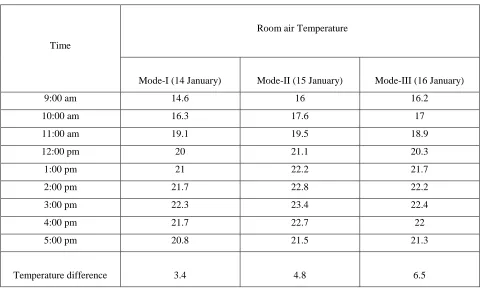
ground surface temperature. From experimental analysis it is found that temperature of in the room was in between
17.7-21.1℃, 17.5-22.3℃ and 17.6-24.1℃ respectively during Mode-I, Mode-II and Mode-III. It can be therefore
say by using solar heating duct which is coupled with EATHE resulted in 1.1-3.5℃ higher temperature than noted in
20 | P a g e
Table 1. Thermal performance of different Modes on three consecutive days
Time
Room air Temperature
Mode-I (14 January) Mode-II (15 January) Mode-III (16 January)
9:00 am 14.6 16 16.2
10:00 am 16.3 17.6 17
11:00 am 19.1 19.5 18.9
12:00 pm 20 21.1 20.3
1:00 pm 21 22.2 21.7
2:00 pm 21.7 22.8 22.2
3:00 pm 22.3 23.4 22.4
4:00 pm 21.7 22.7 22
5:00 pm 20.8 21.5 21.3
Temperature difference 3.4 4.8 6.5
From the table it is clear that EATHE coupling with solar heating duct increases the temperature of air by almost
6.5℃. Therefore Mode-III increases the heating potential of EATHE system significantly. Similar results were
obtained on different dates during winter season.
The heating capacity (kWh) of the EATHE and solar air heating duct is also calculated by using equation
Qh = Ca T ………(1)
Where, is the mass flow rate of air (kg/s), Ca is specific heat of air (kJ/kg K) and T is temperature difference
between ambient air temperature (inlet of EATHE) and outlet temperature of EATHE (in case of Mode-II), while it
is the difference of temperature between duct inlet temperature and outlet temperature in room (in case of Mode-III).
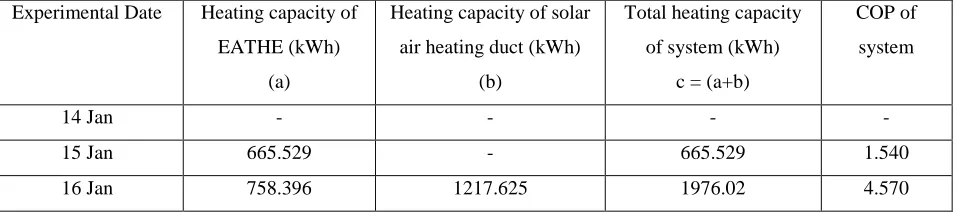
The coefficient of performance (COP) can be calculated as the heating capacity of EATHE (Mode II) or overall
heating capacity of the system (Mode III) is divided by the blower energy consumption of the system as shown in
21 | P a g e
Table 2. Heating capacity and COP of EATHE and Solar air heating duct.Experimental Date Heating capacity of
EATHE (kWh)
(a)
Heating capacity of solar
air heating duct (kWh)
(b)
Total heating capacity
of system (kWh)
c = (a+b)
COP of
system
14 Jan - - - -
15 Jan 665.529 - 665.529 1.540
16 Jan 758.396 1217.625 1976.02 4.570
From experimental test result this proves that the solar heating duct increased the heating capacity and the COP of
the system for equal power consumption.
VI CONCLUSION
A test room prepared where the performance of EATHE evaluated and this system is coupled with solar heating duct
to absorb more solar radiations during the winter season of Ajmer, Rajasthan, India. Climate of this region is arid,
located in northwestern India. This experimental work was done on three different Modes of operations and their
results were observed. Without the operation of EATHE and solar heating duct the Mode of operation is considered
as a Mode –I (base Mode). With the use of EATHE alone is considered as Mode-II. And the operation is carried out
when the EATHE is coupled with solar heating duct consider as Mode- III. While working with all three different
Modes of operation it can be observed that heating capacity improves during working of Mode-III. And heating
capacity of EATHE system got increased by 1217.625 to 1280.753 kWh while working on Mode-III. Temperature
of the test room is increased by 1.1 to 3.5℃which is higher than the Mode-I (base Mode). Further experimental
results confirmed that the coefficient of performance of the EATHE when coupled with solar heating duct during
winter increases up to 4.57 for the same power consumption.
REFERENCES
[1] Sodha MS, Bansal NK, Singh SP, Sharma AK, Kumar A. Evaluation of an earth– air tunnel system for
cooling/heating of a hospital complex. Building and Environment, 20(2), 1985, 115–22.
[2] Bansal NK, Sodha MS. An earth- air tunnel system for cooling buildings. Tunnelling and underground space
technology, 2, 1986, 117–182.
[3] S.P.Singh. Optimization of EAT system for space cooling. Energy conservation and management, 35(8), 1994,
721–725.
[4] Ajmi FAl, Loveday DL, Hanby V. The cooling potential of earth–air heat exchangers for domestic buildings in a
22 | P a g e
[5] Bansal Vikas, Mishra Rohit, Agarwal Ghanshyam Das, Mathur Jyotirmay. Performance analysis of integratedearth air tunnel evaporative cooling system in hot and dry climate. Energy and Buildings,47, 2012, 525–32.
[6] Rohit Misra, Vikas Bansal, G.D.agrawal, J.Mathur, Tarun Aseri. Thermal performance investigation of hybrid
EATHE. Energy and Buildings, 49, 2012, 531–535.
[7] Sanjeev Jakhar, Rohit Misra, Vikas Bansal, M.S.Soni. Thermal performance investigation of earth air tunnel heat
exchanger coupled with a solar air heating duct for northwestern India. Energy and Buildings, 87, 2015, 360–
369.
[8] Yuebin Yu, Haorong Li, Fuxin Niu. Investigation of a coupled geothermal cooling system with earth tube and
solar chimney. Applied Energy, 114, 2014, 209–217.
[9] Haorong Li, Yuebin Yu. Performance of a coupled cooling system with earth-to-air heat exchanger and solar
chimney. Renewable energy, 62, 2014, 468–477.
[10] R.Vidhi, D.Y.Goswami. Parametric study of supercritical Rankine cycle and earth-air-heatexchanger for low
temperature power generation. Energy Procedia, 49, 2014, 1228 – 1237.
[11] Maneesh Kaushal, Prashant D, Satyender, H.Patel. Finite Volume and Response Surface Methodology based
performance prediction and optimization of a hybrid earth to air tunnel heat exchanger. Energy and Buildings,
2015,1–28.
[12] Ravindra Singh Jhala and Vikas Bansal. A comprehensive review on EATHE. International Journal of Advance