Efficient operators for studying higher partial waves
Jia-junWu1,2,,WaseemKamleh1,Derek B.Leinweber1,GerritSchierholz3,Ross D.Young1, and James M.Zanotti1
1Special Research Centre for the Subatomic Structure of Matter (CSSM ), Department of Physics, University of Adelaide, Adelaide, South Australia 5005, Australia
2HISKP (Theory ) and BCTP, University of Bonn, Germany
3Deutsches Elektronen-Synchrotron DESY, 22603 Hamburg, Germany
Abstract. An extended multi-hadron operator is developed to extract the spectra of irreducible representations in the finite volume. The irreducible representations of the cubic group are projected using a coordinate-space operator. The correlation function of this operator is computationally efficient to extract lattice spectra. In particular, this new formulation only requires propagator inversions from two distinct locations, at fixed physical separation. We perform a proof-of-principle study on a 243×48 lattice volume withmπ ≈900 MeV by isolating the spectra ofA+1,E+andT2+of theππsystem with isospin-2 in the rest frame.
1 Introduction
The numerical simulation of quark and gluon fields on a finite lattice enables a study of the hadron spectrum and strong interactions of QCD via first principles. Recently, lattice QCD calculations of the hadron spectrum have achieved tremendous progress [1,2]. High partial wave states are an important topic in hadron physics, yet it is still a challenge to study these states on the lattice. The relevant symmetry group on a 4-dimensional lattice is reduced from the SO(3 ) group of the infinite volume to the cubic group of a finite volume. As a result, the irreducible representation of the cubic group has a nonzero overlap with infinitely many partial wave states which are the basis states of irreducible representations of the SO(3 ) group. Therefore the energy eigenvalues of each irreducible representation will receive the contributions from the phase shifts in an infinite number of partial waves [3,4]. There have been a number of studies outlining the relations between discrete energy levels and phase shifts, including the mixing of high partial waves, e.g. [3–8]. For these reasons, the spectra of irreducible representations of the cubic group are key to studying high partial wave states in a lattice calculation.
The major difficulty lies in the extraction of the spectrum of each unique irreducible representation. In this proceedings, we introduce a novel technique for determining the spectra of various irreducible representations of a 2-body system. The method relies upon constructing an operator that corresponds to a “shell” in coordinate space, which has similarities to the “cube” source employed in [9], where the two body operatorψ is the product of two single particle operators separated by a distanceδ.
As we will show, by summing over lattice rotations, ˆR, we construct an operator,ΨΓ =RˆC( ˆR)ψRˆ, which projects onto a given irreducible representation,Γ. The correlation function of the operatorΨΓ
will generate a clean spectrum of the corresponding irreducible representationΓ. As an exploratory exercise, we study the isospin-2ππsystem, for which several alternative methods have already been explored [10–12]. We demonstrate that we are able to successfully determine energy levels of theA+
1,
E+andT+
2 representations.
2 Formalism
2.1 Ohgroup
In the centre-of-mass (CM ) frame in a finite volume, the basic symmetry group of the cubic lattice for integer spin particles is the cubic group,O. The full symmetry group includes space inversions ˆ
π, therefore, the full group should be the product of the cubic group and spatial inversions, i.e.,Oh = O⊗V2. There are 48 elements in theOhgroup, and they fall into ten different conjugacy classes. There are ten irreducible representations of theOhgroup. The character table of theOhgroup is shown in Table1[6].
Table 1.Character table of theOhgroup.
Γ/Class I 8C3 6C4 6C4 3C24 πˆ 8C3×πˆ 6C4×πˆ 6C4×πˆ 3C42×πˆ
A±
1 1 1 1 1 1 ±1 ±1 ±1 ±1 ±1
A±
2 1 1 −1 −1 1 ±1 ±1 ∓1 ∓1 ±1
E± 2 −1 0 0 2 ±2 ∓1 0 0 ±2
T±
1 3 0 1 −1 −1 ±3 0 ±1 ∓1 ∓1
T±
2 3 0 −1 1 −1 ±3 0 ∓1 ±1 ∓1
In the CM frame, full rotational symmetry is described by theS O(3 ) group, and the familiar basis states denoted by|lm. Herelandmare the usual quantum numbers of total andz-component of an-gular momentum, respectively. However, in the finite volume, anan-gular momentum is no longer a good quantum number since the symmetry reduces to theOhgroup. The ten irreducible representations of Ohin a finite volume are then mixtures of an infinite number of angular momentum states defined in the infinite volume. In Table2, we list the angular momentum states up tol=9 contained in the ten irreducible representations [7].
Table 2.The list of angular momenta,l<10, appearing in each irreducible representation,Γ, ofOh[7].
Γ A+
1 A+2 E+ T1+ T2+
l ( 0, 4, 8, ... ) ( 6, ... ) ( 2, 4, 6, 8, ... ) ( 4, 6, 8, ... ) ( 2, 4, 6, 8, ... )
Γ A−1 A−2 E− T1− T2−
l ( 9, ... ) ( 3, 7, 9, ... ) ( 5, 7, 9, ... ) (1, 3, 5, 7, 9, ... ) ( 3, 5, 7, 9, ... )
2.2 Operator
The standard lattice operator for the pion is :
φ(t;x)≡ a
¯ ua(t;x)γ
As we will show, by summing over lattice rotations, ˆR, we construct an operator,ΨΓ =RˆC( ˆR)ψRˆ, which projects onto a given irreducible representation,Γ. The correlation function of the operatorΨΓ
will generate a clean spectrum of the corresponding irreducible representationΓ. As an exploratory exercise, we study the isospin-2ππsystem, for which several alternative methods have already been explored [10–12]. We demonstrate that we are able to successfully determine energy levels of theA+
1,
E+andT+
2 representations.
2 Formalism
2.1 Ohgroup
In the centre-of-mass (CM ) frame in a finite volume, the basic symmetry group of the cubic lattice for integer spin particles is the cubic group,O. The full symmetry group includes space inversions ˆ
π, therefore, the full group should be the product of the cubic group and spatial inversions, i.e.,Oh = O⊗V2. There are 48 elements in theOhgroup, and they fall into ten different conjugacy classes. There are ten irreducible representations of theOhgroup. The character table of theOhgroup is shown in Table1[6].
Table 1.Character table of theOhgroup.
Γ/Class I 8C3 6C4 6C4 3C24 πˆ 8C3×πˆ 6C4×πˆ 6C4×πˆ 3C42×πˆ
A±
1 1 1 1 1 1 ±1 ±1 ±1 ±1 ±1
A±
2 1 1 −1 −1 1 ±1 ±1 ∓1 ∓1 ±1
E± 2 −1 0 0 2 ±2 ∓1 0 0 ±2
T±
1 3 0 1 −1 −1 ±3 0 ±1 ∓1 ∓1
T±
2 3 0 −1 1 −1 ±3 0 ∓1 ±1 ∓1
In the CM frame, full rotational symmetry is described by theS O(3 ) group, and the familiar basis states denoted by|lm. Herelandmare the usual quantum numbers of total andz-component of an-gular momentum, respectively. However, in the finite volume, anan-gular momentum is no longer a good quantum number since the symmetry reduces to theOhgroup. The ten irreducible representations of Ohin a finite volume are then mixtures of an infinite number of angular momentum states defined in the infinite volume. In Table2, we list the angular momentum states up tol=9 contained in the ten irreducible representations [7].
Table 2.The list of angular momenta,l<10, appearing in each irreducible representation,Γ, ofOh[7].
Γ A+
1 A+2 E+ T1+ T2+
l ( 0, 4, 8, ... ) ( 6, ... ) ( 2, 4, 6, 8, ... ) ( 4, 6, 8, ... ) ( 2, 4, 6, 8, ... )
Γ A−1 A−2 E− T1− T2−
l ( 9, ... ) ( 3, 7, 9, ... ) ( 5, 7, 9, ... ) (1, 3, 5, 7, 9, ... ) ( 3, 5, 7, 9, ... )
2.2 Operator
The standard lattice operator for the pion is :
φ(t;x)≡ a
¯ ua(t;x)γ
5da(t;x), (1)
with a sum over colour indicesa.
In coordinate space, we construct a composite operator with a separationδbetween two pions:
ψ(t;x, δ)≡φ(t;x+δ/2 )φ(t;x−δ/2 ). (2)
This operator is equivalent to any other that is one of the 48 rotation operators, ˆR ∈ Oh group. We then denote the 48 pion-pion operatorsψRˆ as:
ψRˆ(t;x, δ)=PˆRˆψ(t;x, δ) ˆPRˆ−1=ψ(t; ˆR−1x,Rˆ−1δ)=φ(t; ˆR−1(x+δ/2 ) )φ(t; ˆR−1(x−δ/2 ) ). (3)
In this work, we maximize the symmetry available by avoiding equivalent rotations, i.e., ˆRδδ. This simply requiresδx δy δz0. While the coordinate position of each pion should be on the lattice grid, i.e, ˆR(x±δ/2 ) ∈ Z3, the origin of the composite operator need not be on a lattice site. One convenient choice isδ=(1,3,5 ) andx=(1/2,1/2,1/2 ), which keeps the shortest|δ|.
By using the above operators, the |π−(t, x+δ/2 )π−(t, x+δ/2 ) system can be generated as ψ†(t;x, δ)|Ωwhere|Ωis the vacuum state. Correspondingly, 48 different states can be generated according to Eq.(3) through the use of rotation operators. For simplification, we use|ψ†Rˆ(t;x, δ)to replace the|π−(t,Rˆ−1(x+δ/2 ) )π−(t,Rˆ−1(x+δ/2 ) ) system. These pion-pion systems should obey rotational symmetry as follows:
ˆ
PRˆ|ψ†Rˆ(t;x, δ) =
ˆ
R∈Oh
|ψ†Rˆ(t;x, δ)B¯( ˆR)Rˆ
,Rˆ, (4)
where matrixB¯( ˆR)Rˆ
,Rˆ =δRˆRˆ,Rˆ, is an element of the regular representation of the groupOh. We
note that we have introduced the notation where we directly use the 48 rotation operators of theOh group as indices of the matrix ¯B. Furthermore, here “ ¯B” refers to the matrix representation ofB, e.g., the matrix of irreducible representationΓis written as ¯Γ.
The regular representation of theOh group is reducible. Through the similarity transformation matrix, ¯S, all of these 48 matrices, ¯B( ˆR), can be block diagonalised into a matrix ¯A. Each nonzero block matrix is in an irreducible representation:
¯
S−1B¯( ˆR) ¯S =1 ¯A±
1( ˆR)⊕1 ¯A±2( ˆR)⊕2 ¯E±( ˆR)⊕3 ¯T1±( ˆR)⊕3 ¯T2±( ˆR)≡A¯( ˆR). (5) The number before the irreducible representation indicates the number of copies of that representation. Therefore, it is convenient to set the indicies of ¯Aas the group of three numbers, (i,Γ,n), wherei indicates thei-th irreducible representation,Γits name, and nindicates its order. These matrices ¯A can be written as:
¯
AiΓn,iΓn( ˆR)=δiiδΓΓΓ¯n,n( ˆR), (6)
BecauseOhis a finite group, matrices ¯Γcan be chosen as unitary matrices.
As shown in Eq. (4), the matrix ¯B( ˆR) describes the rotations between the 48 states,|ψRˆ . Similarly, the matrix ¯Adescribes rotations between systems classified in terms of the irreducible representations, |Ψ†i,Γ,n, satisfying:
ˆ
PR|Ψ†i,Γ,n= i,Γ,n
|Ψ†i,Γ,n ¯
A( ˆR)i
Γn,iΓn . (7)
The transformation matrix ¯S connects|ψ†Rˆand|Ψ†i,Γ,nas follows:
|Ψ†i,Γ,n= ˆ
R
Correspondingly, pion-pion operators that project onto irreducible representations can be computed:
Ψ†i,Γ,n= ˆ
R
ψ†RˆS¯R,iΓn. (9)
2.3 Correlation Function
Employing the operatorψRat the source and sink yields the following two-point correlation function, GR,ˆRˆ(t;p;x, δ)≡
(y−x)∈Z3
eip·(y−x)Tψ ˆ
R(t;y, δ), ψ†Rˆ(0;x, δ)
=GRˆ−1R,ˆIˆ(t;p;x, δ), (10)
while the correlation function for the two pion operatorΨi,Γ,ncan be written as: ˜
GΓn,Γn(t;p;x, δ)=
(y−x)∈Z3
eip·(y−x)
i
TΨi,Γ,n(t;y, δ),Ψ†i,Γ,n(0;x, δ)
. (11)
Through Eq.(9) and the properties of group, we get: ˜
GΓn,Γn(t;p;x, δ)=δΓ,Γδn,n
ˆ
R χΓ
ˆ
RGR,ˆIˆ(t;p;x, δ)≡G˜Γ(t;p;x, δ), (12)
whereχΓ( ˆR) is the character number of element ˆRof theOhgroup in the irreducible representationΓ.
Our task is to calculateGRˆ−1,Iˆ(t;p;x, δ) as follows:
GRˆ−1,Iˆ(t;p=0;x, δ)
=
(y−x)∈Z3
TrSd(y−,t;x−)S†u(y−,t; x−,0 )
TrSd(y+,t;x+,0 )S†u(y+,t;x+,0 )
+TrSd(y+,t;x−,0 )Su†(y+,t;x−,0 )
TrSd(y−,t; x+,0 )S†u(y−,t; x+,0 )
−TrSd(y−,t;x−,0 )Su†(y+,t;x−,0 )Sd(y+,t; x+,0 )S†u(y−,t;x+,0 )
−TrSd(y+,t;x−,0 )S†u(y−,t;x−)Sd(y−,t; x+,0 )S†u(y+,t; x+,0 )
. (13)
Here,Su(y,t;x,0 )=T(u(y,t),u¯(x,0 ) ) is quark operator, and we introduce the notationx±=x±δ/2 andy±=y±Rδ/ˆ 2. Isospin symmetrySu≡Sdis assumed for the quark propagators. The four terms in Eq. (13) correspond to the Wick contractions as shown in Fig.1.
Figure 1.The diagrams for the Wick contractions ofππ→ππwith isospin-2. Thick and thin lines denote thedd¯
anduu¯contractions, respectively.
From Eq.(10) or Eq.(12), two correlation functions can be calculated. However, the first one will have a very dense spectrum, overlapping (in principle ) with all irreducible representations:
GRˆ−1,Iˆ(t;p;x, δ)∼
i
ZA+1
i e−E
A+ 1 i t+ZA
+ 2
i e−E
A+ 2 i t+ZE
+ 2
i e−E
E+ i t+ZT
+ 1
i e−E
T+ 1 i t+ZT
+ 2
i e−E
T+ 2 i t
Correspondingly, pion-pion operators that project onto irreducible representations can be computed:
Ψ†i,Γ,n= ˆ
R
ψ†RˆS¯R,iΓn. (9)
2.3 Correlation Function
Employing the operatorψRat the source and sink yields the following two-point correlation function, GR,ˆRˆ(t;p;x, δ)≡
(y−x)∈Z3
eip·(y−x) Tψ ˆ
R(t;y, δ), ψ†Rˆ(0;x, δ)
=GRˆ−1R,ˆIˆ(t;p;x, δ), (10)
while the correlation function for the two pion operatorΨi,Γ,ncan be written as: ˜
GΓn,Γn(t;p;x, δ)=
(y−x)∈Z3
eip·(y−x)
i
TΨi,Γ,n(t;y, δ),Ψ†i,Γ,n(0;x, δ)
. (11)
Through Eq.(9) and the properties of group, we get: ˜
GΓn,Γn(t;p;x, δ)=δΓ,Γδn,n
ˆ
R χΓ
ˆ
RGR,ˆIˆ(t;p;x, δ)≡G˜Γ(t;p;x, δ), (12)
whereχΓ( ˆR) is the character number of element ˆRof theOhgroup in the irreducible representationΓ.
Our task is to calculateGRˆ−1,Iˆ(t;p;x, δ) as follows:
GRˆ−1,Iˆ(t;p=0;x, δ)
=
(y−x)∈Z3
TrSd(y−,t;x−)S†u(y−,t;x−,0 )
TrSd(y+,t;x+,0 )S†u(y+,t;x+,0 )
+TrSd(y+,t; x−,0 )S†u(y+,t; x−,0 )
TrSd(y−,t; x+,0 )S†u(y−,t;x+,0 )
−TrSd(y−,t; x−,0 )S†u(y+,t; x−,0 )Sd(y+,t;x+,0 )S†u(y−,t;x+,0 )
−TrSd(y+,t;x−,0 )S†u(y−,t;x−)Sd(y−,t;x+,0 )S†u(y+,t;x+,0 )
. (13)
Here,Su(y,t;x,0 )=T(u(y,t),u¯(x,0 ) ) is quark operator, and we introduce the notationx±=x±δ/2 andy±=y±Rδ/ˆ 2. Isospin symmetrySu≡Sdis assumed for the quark propagators. The four terms in Eq. (13) correspond to the Wick contractions as shown in Fig.1.
Figure 1.The diagrams for the Wick contractions ofππ→ππwith isospin-2. Thick and thin lines denote thedd¯
anduu¯contractions, respectively.
From Eq.(10) or Eq.(12), two correlation functions can be calculated. However, the first one will have a very dense spectrum, overlapping (in principle ) with all irreducible representations:
GRˆ−1,Iˆ(t;p;x, δ)∼
i
ZA+1
i e−E
A+ 1 i t+ZA
+ 2
i e−E
A+ 2 i t+ZE
+ 2
i e−E
E+ i t+ZT
+ 1
i e−E
T+ 1 i t+ZT
+ 2
i e−E
T+ 2 i t
, (14)
where thei indicates a sum over all possible excited states within each irreducible representation. In fact, the ground-state energy ofA+
1 is dominated by anS-wave state with zero momentum in the CM frame. It will therefore have the lowest energy and hence, in principle, the large Euclidean time behavior of this correlator will be saturated by this eigenstate. However, as shown in Eq.(12), it is possible to project directly onto the irreducible representation,Γ, and hence:
˜
GΓ(t;p;x, δ)∼
i ZΓ
ie−E
Γ
it. (15)
In summary, we have shown how it is possible to extract the spectrum of each unique irreducible representation by constructing the appropriate sink-projected correlation function, ˜G.
2.4 Lüscher’s equation for high partial waves
In theππsystem with isospin-2, only positive parity and even angular momentum states are possible. In our following lattice simulation, we are able to extract the ground states of theA+
1,E+ andT2+ representations. Therefore, we limit the angular momentum tol≤4. From Ref. [3], the formulae be-tween partial wave phase shifts and the energy levels can be derived. In the case here, each irreducible representation has two partial waves up tol=4. Thus the eigenvalue equation will have a 2×2 matrix as follows:
det cotδl
1(qΓ)+M11Γ(qΓ) MΓ12(qΓ)
MΓ
12(qΓ) cotδl2(qΓ)+M22A1(qΓ)
=0, (16)
where
MΓ
i j(q)=
s CΓ
i,j,s
Zs0(1;qL2π)
(2s+1 )π3qL 2π
s+1 . (17)
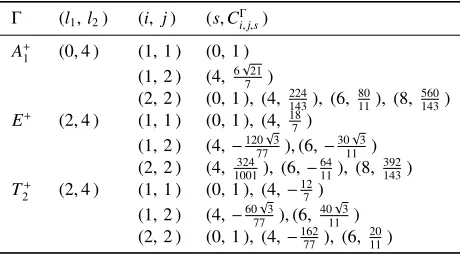
The indicesl1,l2indicate which two angular momenta are contained in the irreducible representation Γq(Γ) is the on-shell momentum of the energy level of irreducible representationΓ, while the function Zs0 is the zeta function defined in Ref. [3]. The indicesl1,l2,sand the coefficientCΓi,j,sare all listed in Table3.
Table 3.The values of indexesl1,l2,sand coefficientsCΓ
i,j,sfor each irreducible representation.
Γ (l1,l2) (i, j) (s,CΓi,j,s)
A+
1 (0, 4 ) (1,1 ) (0,1 ) (1,2 ) (4, 6√721)
(2,2 ) (0,1 ), (4, 224143), (6, 8011), (8, 560143) E+ (2, 4 ) (1,1 ) (0,1 ), (4, 18
7 ) (1,2 ) (4,−12077√3), (6,−3011√3) (2,2 ) (4, 1001324 ), (6,−64
11), (8, 392143)
T+
2 (2, 4 ) (1,1 ) (0,1 ), (4,−127 ) (1,2 ) (4,−6077√3), (6, 4011√3) (2,2 ) (0,1 ), (4,−162
3 Results
3.1 Numerical calculation
As it stands, Eq. (12) implies calculating 48GR,ˆIˆcorrelation functions corresponding to the different rotations ˆR. However, for each measurement, we only require two sources for the quark propagators at positions atx±δ/2. The 48 rotations can be summed over at the sink of the correlation function. This significantly reduces the computational overhead of additional propagator inversions.
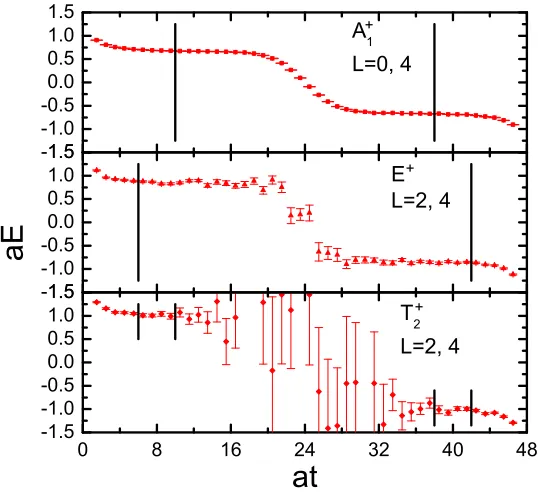
The present calculation is performed on an ensemble with 2 flavours of dynamical O(a )-improved Wilson fermions with (β, κ,V) = (5.29,0.13550,243×48 ), corresponding to (a,mπ = (−0.071 fm,900 MeV ) [13]. Results are collected from 376 configurations using 16 different source locations, with 2 inversions for each compound source. In Fig.2, the plateau of log( ˜GΓ(t)/G˜Γ(t+1) )
are identified in theA+
1, E+ andT2+ representations. By choosing suitable fitting windows, the en-ergy levels are determined. Our (preliminary ) results for the corresponding on-shell momenta are:
pA1L
2π = 0.2455(36 ), pEL
2π = 1.047(13 ), and pT2L
2π =1.457(23 ). As shown in Ref. [7,11], the lowest momentum the non-interacting two-pion state in theA+
1 can have is|pL/2π| = 0, while for E it is
|pL/2π|=1 andT2is|pL/2π|= √2. Our determined momenta appear to indicate a weak repulsion in each of these channels. It is certainly encouraging that the ground-state energies in each of the irreducible representations are being reliably determined.
By using this method, the momentum of each pion has not been specified. Only the total momen-tum of the system is input — for which we have only consideredP =0 in this study. In contrast to formulations that involve a momentum-projected hadron at the sink [9,12], we use the same operator at both source and sink. This method then lends itself to a computationally-efficient technique for extension to a variational analysis [14], where the operator basis can be extended by varyingδ.
3.2 Phase shifts
Equation (16) defines a relationship between phase shifts and the finite-volume energy levels. Since we only have one eigenvalue in each irreducible representation, at three different on-shell momenta, we cannot solve for the phase shifts directly. For illustration, we parameterise the phase shifts in terms of an effective range expansion as follows [11,15–18]:
q2l+1δl=−1
al + 1
2rlq2. (18)
Since the S-wave only appears in theA+
1 irreducible representation, we can solve for this phase shift directly. With the present calculation, the best we can do is then extract the scattering length for l =2,4, neglecting therl terms. In Fig.3, we show the phase shifts based on the determination of the scattering lengths. A strong signal forδ2is observed. The determination ofδ4is clearly pushing the limits of our statistical precision. Clearly we do not anticipate attraction in this channel, yet it is encouraging that we are on the cusp of producing a meaningful signal forl=4. Obviously, extending to a variational analysis to gain access to more excited states, and including boosted states for a more dense spectrum [11] will dramatically improve the available constraints.
4 Summary
3 Results
3.1 Numerical calculation
As it stands, Eq. (12) implies calculating 48GR,ˆIˆcorrelation functions corresponding to the different rotations ˆR. However, for each measurement, we only require two sources for the quark propagators at positions atx±δ/2. The 48 rotations can be summed over at the sink of the correlation function. This significantly reduces the computational overhead of additional propagator inversions.
The present calculation is performed on an ensemble with 2 flavours of dynamical O(a )-improved Wilson fermions with (β, κ,V) = (5.29,0.13550,243×48 ), corresponding to (a,mπ = (−0.071 fm,900 MeV ) [13]. Results are collected from 376 configurations using 16 different source locations, with 2 inversions for each compound source. In Fig.2, the plateau of log( ˜GΓ(t)/G˜Γ(t+1) )
are identified in theA+
1, E+andT2+representations. By choosing suitable fitting windows, the en-ergy levels are determined. Our (preliminary ) results for the corresponding on-shell momenta are:
pA1L
2π = 0.2455(36 ), pEL
2π = 1.047(13 ), and pT2L
2π =1.457(23 ). As shown in Ref. [7,11], the lowest momentum the non-interacting two-pion state in theA+
1 can have is|pL/2π| = 0, while for E it is
|pL/2π|=1 andT2is|pL/2π|= √2. Our determined momenta appear to indicate a weak repulsion in each of these channels. It is certainly encouraging that the ground-state energies in each of the irreducible representations are being reliably determined.
By using this method, the momentum of each pion has not been specified. Only the total momen-tum of the system is input — for which we have only consideredP =0 in this study. In contrast to formulations that involve a momentum-projected hadron at the sink [9,12], we use the same operator at both source and sink. This method then lends itself to a computationally-efficient technique for extension to a variational analysis [14], where the operator basis can be extended by varyingδ.
3.2 Phase shifts
Equation (16) defines a relationship between phase shifts and the finite-volume energy levels. Since we only have one eigenvalue in each irreducible representation, at three different on-shell momenta, we cannot solve for the phase shifts directly. For illustration, we parameterise the phase shifts in terms of an effective range expansion as follows [11,15–18]:
q2l+1δl=−1
al + 1
2rlq2. (18)
Since the S-wave only appears in theA+
1 irreducible representation, we can solve for this phase shift directly. With the present calculation, the best we can do is then extract the scattering length for l =2,4, neglecting therlterms. In Fig.3, we show the phase shifts based on the determination of the scattering lengths. A strong signal forδ2is observed. The determination ofδ4is clearly pushing the limits of our statistical precision. Clearly we do not anticipate attraction in this channel, yet it is encouraging that we are on the cusp of producing a meaningful signal forl=4. Obviously, extending to a variational analysis to gain access to more excited states, and including boosted states for a more dense spectrum [11] will dramatically improve the available constraints.
4 Summary
In this paper, we introduce a new extended operator to extract the spectra of irreducible representa-tions. In coordinate space, the two-particle operator projects onto an irreducible representation by summing appropriately over a spherical shell. The method is computationally effecient, as it only
-1.5 -1.0 -0.50.0 0.5 1.0 1.5
-1.5 -1.0 -0.50.0 0.5 1.0 1.5
0 8 16 24 32 40 48
-1.5 -1.0 -0.50.0 0.5 1.0 1.5
+ +
A
1L=0, 4
+
aE
E
L=2, 4
at
T
2L=2, 4
Figure 2.The effective energyaEofA+
1,E+andT2+representations for the rest frame on a 243×48 lattice with
a=0.071 fm andmπ≈900 MeV. The thick black lines show the limits of the fitting windows.
requires two source inversions per measurement. Having the same operator as source and sink will allow a straightforward implementation of a variational analysis.
For the numerical investigation in this work, we studied the isospin-2ππsystem in the CM frame on a 243×48 lattice with a lattice spacing ofa =0.071 fm andmπ ≈900 MeV. The spectra ofA+
1,
E+andT+
2 irreducible representations of aπ−π−system are successfully extracted. The phase shifts can be calculated through the Lüscher equation with a toy model parameterisation. In the future, this method can also be readily extended to boosted frames, where the rotational symmetries on the lattice are reduced to the little groups.
Acknowledgements
0.0 0.2 0.4 0.6 0.8 1.0 1.2 1.4 1.6 -1.5
-1.2 -0.9 -0.6 -0.3 0.0 0.3 0.6 0.9 1.2 1.5
δ0 (p = 0.177 GeV)
δ
(d
eg
re
e)
p (GeV)
δ
2δ
4pT2~1.05GeV
pE~0.74GeV
m4π~1.5GeV
Figure 3.The fitting result from the spectra in the rest frame with lattice sizeL=24 and spacinga=0.071 fm. The two parametersa2anda4are−0.571±0.155 GeV−5and 0.114±0.100 GeV−9, respectively. The value for
δ0(p=0.177GeV )=−0.190±0.017.
References
[1] C. Liu, PoSLATTICE2016, 006 (2017),1612.00103 [2] R.A. Briceno, J.J. Dudek, R.D. Young (2017),1706.06223 [3] M. Lüscher, Nucl. Phys.B354, 531 (1991)
[4] M. Lüscher, Commun. Math. Phys.105, 153 (1986)
[5] V. Bernard, M. Lage, U.G. Meissner, A. Rusetsky, JHEP08, 024 (2008),0806.4495 [6] M. Göckeler et al., Phys. Rev.D86, 094513 (2012),1206.4141
[7] T. Luu, M.J. Savage, Phys. Rev.D83, 114508 (2011),1101.3347
[8] J.J. Wu, T.S.H. Lee, D.B. Leinweber, A.W. Thomas, R.D. Young, JPS Conf. Proc.10, 062002 (2016),1512.02771
[9] E. Berkowitz et al., Phys. Lett.B765, 285 (2017),1508.00886 [10] J.J. Dudek et al., Phys. Rev.D83, 071504 (2011),1011.6352
[11] J.J. Dudek, R.G. Edwards, C.E. Thomas, Phys. Rev.D86, 034031 (2012),1203.6041 [12] S.R. Beane et al. (NPLQCD), Phys. Rev.D85, 034505 (2012),1107.5023
[13] G.S. Bali et al., Nucl. Phys.B866, 1 (2013),1206.7034 [14] B. Blossier et al., JHEP04, 094 (2009),0902.1265 [15] W. Hoogland et al., Nucl. Phys.B126, 109 (1977)
[16] D.H. Cohen, T. Ferbel, P. Slattery, B. Werner, Phys. Rev.D7, 661 (1973) [17] A. Zieminski et al., Nucl. Phys.B69, 502 (1974)
[18] N.B. Durusoy et al., Phys. Lett.45B, 517 (1973)