216 | P a g e
REVIEW ON IMAGE COMPRESSION TECHNIQUES AND
ADVANTAGES OF IMAGE COMPRESSION
Amanpreet Kaur
1, Dr. Jagroop Singh
21
Ph. D Scholar, Deptt. of Computer Applications, IK Gujral Punjab Technical University,
Jalandhar, Punjab.(India)
2
Associate Professor, Deptt. of Electronics and Communication Engg.,
DAVIET, Jalandhar, Punjab.(India)
ABSTRACT
Image compression is one of the most widespread techniques for applications that require storage of various types
of images and transmission in database. Digital images are large in size and occupy large space. Image
compression is the solution associate with transmission and storage of large amount of information for digital
images. Image compression reduces the data from the image in either lossless or lossy way. This study presents an
overview of compression techniques for image applications. For low power and lossless image compression, the
quality will be measured by comparing certain performances parameters such as Compression Ratio, Peak Signal to
Noise Ratio, Mean Square Error.
Keywords: Image, Image Compression Technique, Lossless and Lossy Image Compression
I INTRODUCTION
Image compression, the art and science of reducing the amount of data required to represent an image is one of the
most useful and commercially successful technologies in the field of digital image processing. The number of
images that are compressed and decompressed daily is staggering and the compression and decompressions
themselves are virtually invisible to the user [1]. Digital images are widely used in a number of various applications.
It is seen that uncompressed digital images would need large storage capacity and wider transmission bandwidth for
effective utilization of picture detail in modern applications. Therefore, the effective image compression solutions
are becoming more critical with the recent growth of data intensive, multimedia based web applications [2]. In the
development of efficient compression techniques will continue to design challenge for future communication system
and advanced multimedia applications. During image compression quality of decompressed image is also criterion
for evaluation of given coding scheme. In the process of compression decompression various artifacts such as
blocking artifacts, blur artifacts, rising or edge artifacts are observed [3]. Blocking artifacts often exist in the images
compressed by standards such as JPEG and MPEG which causes serious image degradation [4]. Blocking artifacts is
217 | P a g e
rate conditions [5]. There are two fundamental components of compression are redundancy and irrelevancy
reduction. Redundancy reduction aims at removing duplication from the signal source.Irrelevancy reduction omits
parts of the signal that will not be noticed by the signal receiver, namely the Human Visual System (HVS). In
general, three types of redundancy can be identified [6].
1.1 Coding Redundancy:
Fewer bits to represent frequently occurring symbols.
1.2 Interpixel Redundancy
:
Neighbouring pixels have almost same value.
1.3 Irrelevant Information
:
Human visual system cannot simultaneously distinguish all colors.
II CLASSIFICATION OF COMPRESSION ALGORITHMS
Data compression a method that takes an input data D and generates the data C (D) with the less number of bits as compared to input data. The reverse process is called decompression which takes the compressed data C (D) and reconstructs the data D’ as shown in figure 1.
Fig. 1 Compression Algorithms
Compression can be divided into two categories, as lossless and lossy compression [7].
Fig. 2 Image Compression Techniques
Compression System
Decompression System
Input data
D C(D) D
218 | P a g e
2.1 Lossless Compression Techniques
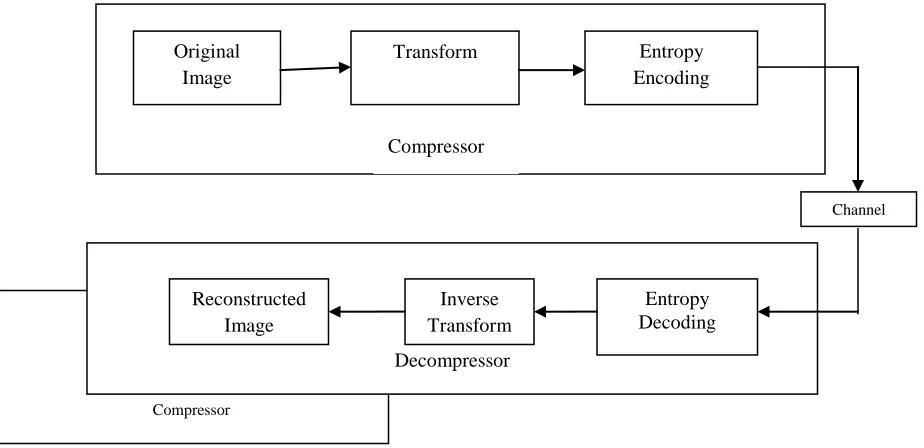
Lossless data compression techniques are applied on text data or scientific data and preferred for artificial images such as technical drawings, icons or comics. Lossless compression method may also be preferred for high value content, such as medical image scans made for archive purposes. Lossless compression is usually two steps algorithm. The first step transforms the original image to some other format in which the inter-pixel redundancy is reduced. The second step uses an entropy encoder to remove the coding redundancy. The lossless decompression is a perfect inverse process of the lossless compressor.
Fig. 3 Lossless Compression Techniques
2.2 Lossy Compression Technique:
Lossy method is especially suitable for natural images such photos in applications where minor loss of fidelity is acceptable to achieve a substantial reduction in bit rate. The lossy compression that produces imperceptible differences can be called visually lossless. Generally, most lossy compression is there steps algorithm. The first stage is a transform to eliminate the inter-pixel redundancy to pack information efficiently. There quantizer is applied to remove psycho-visual redundancy to represent the packed information with a few bits as possible. The quantized bits are then efficiently encoded to get more compression from the coding redundancy.
Compressor
Decompressor Reconstructed
Image
Inverse Transform
Entropy Decoding
Channel
Original Image
Transform Entropy
Encoding
219 | P a g e
Fig. 4 Lossy Image Compression
III TYPES OF IMAGES
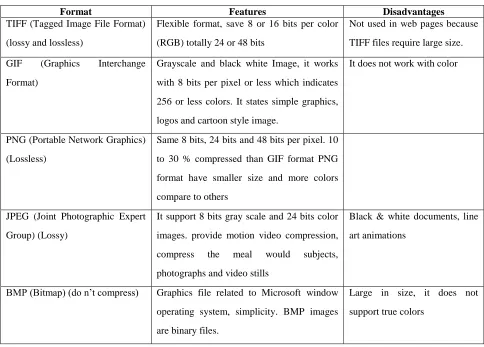
Table: Image formats and its features
Format Features Disadvantages
TIFF (Tagged Image File Format)
(lossy and lossless)
Flexible format, save 8 or 16 bits per color
(RGB) totally 24 or 48 bits
Not used in web pages because
TIFF files require large size.
GIF (Graphics Interchange
Format)
Grayscale and black white Image, it works
with 8 bits per pixel or less which indicates
256 or less colors. It states simple graphics,
logos and cartoon style image.
It does not work with color
PNG (Portable Network Graphics)
(Lossless)
Same 8 bits, 24 bits and 48 bits per pixel. 10
to 30 % compressed than GIF format PNG
format have smaller size and more colors
compare to others
JPEG (Joint Photographic Expert
Group) (Lossy)
It support 8 bits gray scale and 24 bits color
images. provide motion video compression,
compress the meal would subjects,
photographs and video stills
Black & white documents, line
art animations
BMP (Bitmap) (do n’t compress) Graphics file related to Microsoft window
operating system, simplicity. BMP images
are binary files.
Large in size, it does not
support true colors Compressor
Original Image
Transform Entropy
220 | P a g e
RAW (lossless/lossy) File size smaller than TIFF format.
Available on digital cameras
These are not standardized
image and it will be differ for
manufacturers. So these images require manufacture’s software
to view the images.
IV ADVANTAGES OF IMAGE COMPRESSION
There are the following advantages of image compression:
4.1 Size reduction:
The size reduction is most significant benefit of the image compression. It takes up less space on the hard drive and retains the same physical size, unless edit the image’s physical size in an image editor. The file size reduction with the help of internet, to create image rich sites without using much bandwidth or storage space.
4.2 Data Loss:
Some common files like JPEG, which an image shrinks in the size of compression, will discard some of the photo’s
data permanently. So compress the images to ensure that decompressed back up before starting. Otherwise lose the high quality of the original decompressed image permanently.
4.3 Slow Devices:
Various electronics devices may load large compressed image slowly. For example CD devices can only read data at a specific rate and cannot display large images in real time. Also doe some webhost that transfer data slowly compressed images remain necessary for a fully functional websites. Image compression allow for the faster loading of data on slower devices.
V PERFORMANCE PARAMETERS
There are two performance parameters which are used to measure the performance of the image compression algorithm. One is PSNR (Peak Signal to Noise Ratio) and second is MSE (Mean square error)
Mean square error (MSE) is the cumulative difference between the compressed image and original image.
MSE =
PSNR is the measurement of the peak error between the compressed image and original image. The higher PSNR contains better quality of image. To complete the PSNR, first of all MSE is completed [8].
221 | P a g e
R is the relative data redundancy of the representation with b bits
R =
Where, C is compression ration
C =
VI CONCLUSION
This paper constitutes the idea of image compression, numerous technologies, different types of images used within the photo compression. All the image compression techniques are useful in their related areas and every day new compression techniques is developing which gives better compression ratio. Based or different technology, the quality of image can be measured by various important parameters like compression ratio, MSE, PSNR.
REFERENCES
[1] Woods Richard E,Gonzalez Rafael C, “Digital Image Processing”, Pearson Education Singapore Private
Ltd,2008.
[2] Amarunnishad T.M., Govindan V.K. and Abraham T. Mathew, “Use of Fuzzy Edge Image in Block Truncation Coding for Image Compression”, World Academy of Science Engineering and Technology, vol.2,
pp.683-689,2008.
[3] Khambete Madhuri,Joshi Madhuri, “Blur and Ringing Artifact Measurement in Image Compression using Wavelet Transform,” Proceedings of world academy of science, engineering and technology, vol.20,
pp.183-186,2007.
[4] Wanga Ci, Zhou Jun, Liu Shu,“Adaptive non-local means filter for image deblocking”, Signal Processing:
Image Communication, vol.28, pp.522-530,2013.
[5] Zhai Guangtao ,Zhang Wenjun ,Yang Xiaokang ,Lin Weisi,Xu Yi, “No-reference noticeable blackness estimation in images”, Signal Processing: Image Communication, vol.23, pp.417-432,2008.
[6] Woods Richard E,Gonzalez Rafael C, “Digital Image Processing”, Pearson Education Singapore Private
Ltd,2008.
[7] Athira B. Kaimal, S. Manimurugan, C.S.C. Devadass , “Image Compression Techniques: A Survey”,
International Journal of Engineering Inventions, vol. 2, pp 26-28,2013.