MANAGING DEVELOPMENT ORGANISATIONS:
A PROCESS-BASED ASSESSMENT OF
AUSTRALIAN-BASED NON GOVERNMENTAL DEVELOPMENT
ORGANISATIONS
By
Ruth Njoki Kiraka
A thesis submitted in total fulfilment of the requirements for the
Degree of Doctor of Philosophy at Victoria University
School of Management
Faculty of Business and Law
Victoria University
Melbourne Australia
ABSTRACT xiv
DECLARATION xvii
ACKNOWLEDGMENTS xviii
DEDICATION xix
SECTION ONE: INTRODUCTION TO THE STUDY
CHAPTER ONE: INTRODUCTION
1.1 Background to the Study 2
1.2 Problem Statement 5
1.3 Perspectives for Assessing Organisations 10
1.4 Assumptions 15
1.5 Boundaries on the Scope of the Study 16
1.6 Research Aims 16
1.7 Research Questions 17
1.8 Statement of Significance 18
1.9 Overview of the Research Project 21
CHAPTER TWO: FEATURES OF A PROCESS-BASED ASSESSMENT
2.1 Introduction 23
2.2 A Process-Based Analysis of Organisations 23
2.2.1 Defining Organisational Processes 24
2.2.2 Challenges of the Process-Based Perspective 27
2.2.2.1 The Difficulty of Identifying Processes 27
2.2.2.2 Challenges in Managing the Process Approach 30
2.3.1 The External Environment 35
2.3.1.1 The Macro environment-Process Relationship 36
2.3.1.2 The Task environment-Process Relationship 38
2.3.1.3 The Stakeholder-Process Relationship 41
2.3.2 The Internal environment 45
2.3.2.1 The Strategy-Process Relationship 45
2.3.2.2 The Structure-Process Relationship 49
2.4 Conclusion 55
CHAPTER THREE: THE PROCESS-BASED ASSESSMENT AND NGDOS
3.1 Introduction 56
3.2 Defining NGDOs 56
3.3 Why Look at NGDOs 58
3.4 Defining Development 61
3.5 Development Attributes and their Significance to NGDO
Development Processes 65
3.5.1 The ‘Conventional’ Factors 68
3.5.1.1 The Development Goal and NGDOs 68
3.5.1.2 The Global Development Outreach and NGDOs 72
3.5.1.3 The Development Scope and NGDOs 76
3.5.1.4 The Duration of Development Initiatives and NGDOs 78
3.5.2 The Environment and NGDOs 82
3.5.2.1 The Macro Environment 83
3.5.2.1.1 The Political-legal Environment and NGDOs 83
3.5.2.1.2 The Economic Environment and NGDOs 85
3.5.2.1.4 The Technological Environment and NGDOs 90
3.5.2.2 The Task Environment: The Stakeholders and NGDOs 92
3.5.3 The Development Organisation 96
3.5.3.1 NGDO Roles 97
3.5.3.2 NGDO Relationships 100
3.5.3.3 NGDO Capacities 101
3.5.3.4 NGDO Legitimacy and Accountability 102
3.6 Conclusion 104
CHAPTER FOUR: THE OVERSEAS AID SECTOR IN Australia
4.1 Introduction 107
4.2 Rationale for Australia’s Development Assistance 107
4.3 Objective of the Aid Program 109
4.4 The Australian NGDO Community 110
4.4.1 Overview of Scope, Size and Trends 111
4.4.2 Institutional Arrangements 113
4.4.2.1 Committee for Development Cooperation (CDC) 113
4.4.2.2 Australian Council for Overseas Aid (ACFOA) 114
4.4.3 Sources of Support for Australian NGDOs 115
4.4.3.1 The Australian Community 116
4.4.3.2 The Australian Government 117
4.4.3.3 International Agencies 124
4.4.3.4 Corporations 124
4.5 Key Issues for the Australian NGDO Sector 125
4.5.1 Governance and Management 126
4.5.2 Fundraising 128
4.5.3 Delivery of Development Assistance 131
4.6 Conclusion 137
SECTION TWO: THE SET-UP OF THE STUDY
CHAPTER FIVE: THEORETICAL AND ANALYTICAL FRAMEWORK
5.1 Introduction 139
5.2 Significance of the Theoretical Framework 139
5.3 The Theoretical Framework 140
5.3.1 Defining the Variables 141
5.3.1.1 The Internal Environment 142
5.3.1.1.1 Processes 142
5.3.1.1.2 Strategy 143
5.3.1.1.3 Structure 143
5.3.1.2 The External Environment 145
5.3.1.2.1 The Macro Environment 145
5.3.1.2.2 The External Stakeholders 145
5.4 Conclusion 146
CHAPTER SIX: METHODOLOGY
6.1 Introduction 148
6.2 Approval by the Human Research Ethics Committee 148
6.3 Research Process 149
6.3.1 Literature Search 149
6.3.2 Research Design 150
6.3.3 Unit of Analysis 153
6.3.4.1 Telephone Interviews 154
6.3.4.1.1 Selection of the Sample 154
6.3.4.1.2 Design of the Interview Schedule 156
6.3.4.1.3 Data Collection 157
6.3.4.1.4 Response Rate 157
6.3.4.2 Mail Survey 158
6.3.4.2.1 Design of the Questionnaire 158
6.3.4.2.2 Data Collection 159
6.3.4.2.3 Response Rate 160
6.3.4.3 Secondary Data Collection 161
6.3.5 Coding of Data 162
6.3.6 Data Recording and Management 162
6.3.6.1 Processes 162
6.3.6.2 Strategy 163
6.3.6.3 Structure 163
6.3.6.4 The External Environment 164
6.3.7 Data Analysis and Interpretation 166
6.3.7.1 Qualitative data 166
6.3.7.2 Quantitative data 168
6.4 Research Quality 169
6.4.1 Validity 169
6.4.2 Reliability 170
6.4.3 Objectivity 171
6.4.4 Subjectivity 172
6.6 Conclusion 175
SECTION THREE:
THE FINDINGS
CHAPTER SEVEN: THE PROCESS OF SERVICE DELIVERY
7.1 Introduction 178
7.2 The Process of Program Identification and Initial Assessment 180
7.2.1 The Identification Process 181
7.2.2 The Screening Process 182
7.2.3 Project Design 185
7.2.4 Review of Project Design 188
7.3 Program Implementation 191
7.3.1 Signing of Contractual Agreements 191
7.3.2 Building the Capacity of Partners and Clients 192
7.3.3 Quality of Funding Arrangements 195
7.4 Program Monitoring, Evaluation and Impact Assessment 212
7.4.1 Monitoring 212
7.4.2 Evaluation 213
7.4.3 Impact Assessment 218
7.5 Program Sustainability 220
7.5.1 Defining Sustainability 221
7.5.2 Strategies to Promote Project sustainability 221
7.5.3 Indicators to Measure Sustainability 226
CHAPTER EIGHT: ORGANISATIONAL FACTORS INFLUENCING THE SERVICE DELIVERY PROCESS
8.1 Introduction 230
8.2 Organisational Factors and Service Delivery 231
8.2.1 Aid Agency Policies and Service Delivery 231
8.2.2 Strategies and Service Delivery 232
8.2.2.1 Fundraising Strategies and Service Delivery 233
8.2.2.1.1 Individual Donations and Gifts 236
8.2.2.1.2 Australian Agency for International
Development (AusAID) grants 240
8.2.2.1.3 International agencies 247
8.2.2.1.4 Corporations 249
8.2.2.1.5 Other Fundraising Methods 251
8.2.2.2 Service Delivery Strategies and Service Delivery
Process 256
8.2.3 Organisational Structures and Service Delivery 261
8.2.3.1 Geographical Coverage of Agency 261
8.2.3.2 Staffing 264
8.2.3.3 Departmentalisation and Job Specialisation 266
8.2.3.4 Centralisation 269
8.2.3.5 Formalisation of Work Processes 269
8.2.3.6 Reporting and Liaison Relationships 270
8.2.3.7 Liaison with Outsiders 271
8.2.4 Organisational Principles and Service Delivery 274
8.2.5 Situational Factors – Years of Operation of the Agency 275
CHAPTER NINE: EXTERNAL FACTORS INFLUENCING THE SERVICE DELIVERY PROCESS
9.1 Introduction 280
9.2 External Stakeholders 280
9.2.1 Development Clients 281
9.2.2 Partner Agencies 283
9.2.3 Donors 285
9.2.4 Governments 288
9.2.5 Other Aid Agencies 290
9.3 Macro Environment 296
9.3.1 Political-legal Climate 297
9.3.2 Economic Conditions 299
9.3.3 Socio-cultural Climate 301
9.3.4 Technological Factors 302
9.3.5 International Context 306
9.3.6 Natural Disasters 308
9.4 Conclusion 309
SECTION FOUR: DISCUSSIONS AND CONCLUSIONS
CHAPTER TEN: DISCUSSIONS
10.1 Introduction 313
10.2 Summary of Findings 314
10.2.1 Question One: Determining the Relationship between
Processes and Goal Achievement 314
10.2.2 Question Two: Determining the Intervening Effect of
10.2.2.1 The Intervening Effect of Internal Factors 322
10.2.2.2 The Intervening Effect of External Factors 330
10.3 Key Outcomes 336
10.3.1 The Internal Environment 336
10.3.1.1 Organisational Strategies 338
10.3.1.2 Organisational Structures 340
10.3.2 The External Environment 344
10.3.2.1 External Stakeholders 344
10.3.2.2 The Macro environment 346
10.4 Revisiting the Theory 348
10.4.1 Relevance of the Model 348
10.4.2 Limitations of the Model 351
10.5 Significance of the Study to Non-Governmental Aid Agencies 352
10.6 Conclusion 355
CHAPTER ELEVEN: CONCLUSIONS
11.1 Overview of the Study 357
11.2 Organisational Processes of Aid Agencies 359
11.3 Factors Influencing Processes and Agencies’ Responses 360
11.3.1 Internal Environment and the Service Delivery Process 361
11.3.2 External Environment and the Service Delivery Process 361
11.4 Key Issue for Aid Agencies 363
11.4.1 At the Internal Environment 364
11.4.2 At the External Environment 366
11.5 Areas for Further Research 369
REFERENCES 373
APPENDICES 396
Appendix I Human Research Ethics Committee Approval 397
Appendix II Interview guide 401
Appendix III Mail Questionnaire 406
Appendix IV Preliminary Notification to Telephone Interviews 412
Appendix V Schedule of Telephone Interviews 413
Appendix VI Preliminary Notification to Mail Survey 414
Appendix VII Covering Letter to the Mail Survey 415
Appendix VIII Follow Up Letter to the Mail Survey 417
Appendix IX List of Secondary Data Gathered From Respondents 418
Appendix X Responses to Telephone Interviews (Qualitative Data) 421
LIST OF ILLUSTRATIONS
List of Boxes
Box 2.1 NGDOs – What do we need to be doing to get to where we want to be? 42
Box 6.1 Example of data recording 164
Box 7.1 Why we do not allocate funds on a program basis – National
Director of Agency A tells their experience 201
Box 7.2 Timely disbursement of funds – what does it mean? 209
List of Figures
Figure 1.1 Donor-recipient NGDO relationships 5
Figure 1.2 The transformational and transactional components of process 14
Figure 2.1 The organisation-environment relationship 35
Figure 2.2 Transformation of core processes into strategies 48
Figure 2.3 From function-oriented to process-oriented organisational structure 54
Figure 3.1 The development organisation in context 67
Figure 3.2 Stakeholder action matrix 93
Figure 3.3 Vital NGDO linkages 105
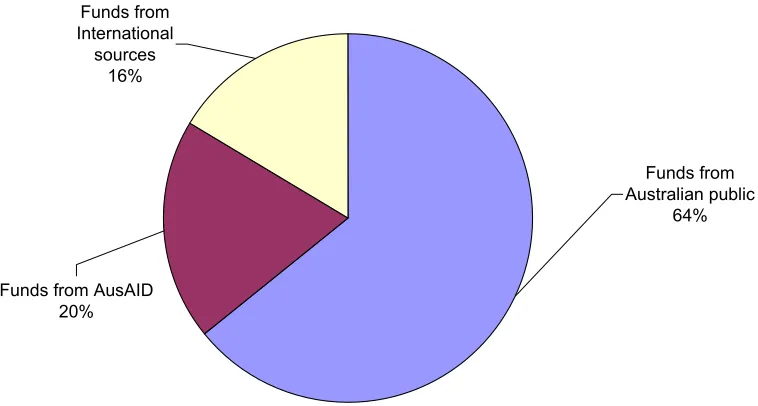
Figure 4.1 NGDO funding sources 116
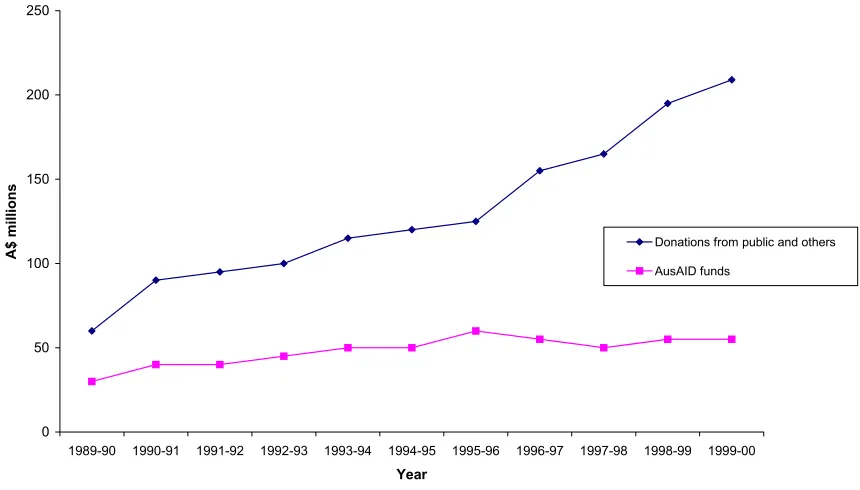
Figure 4.2 Trends in the funding to NGDOs 117
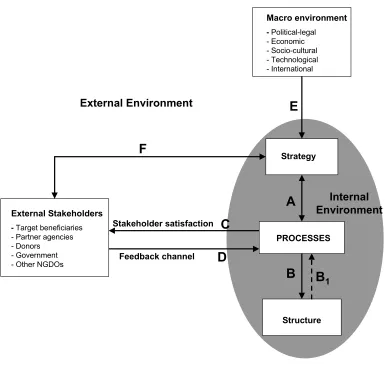
Figure 5.1 Theoretical model showing the relationship between process,
macro-environment, external stakeholders, strategy and structure 141
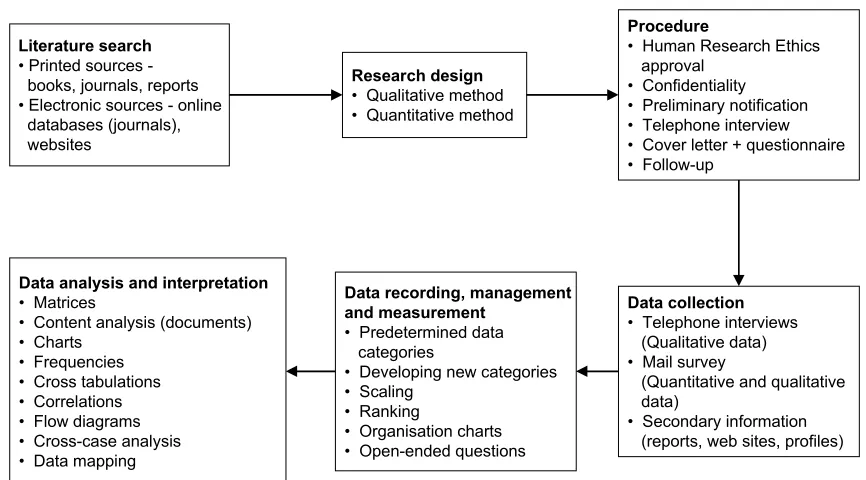
Figure 6.1 The research process 149
Figure 7.1 NGDO relationship with partners and clients 179
Figure 7.2 Project identification and assessment process 190
Figure 7.3 Quality of funding arrangements as defined by duration of project
assistance 206
Figure 7.5 The evaluation process 220
Figure 7.6 Project sustainability process 227
Figure 7.7 Service delivery process showing key activities and actors 228
Figure 8.1 Example of a structure of an agency with no overseas offices 262
Figure 8.2 Example of a structure of an agency with overseas offices 262
Figure 8.3 Organisation structure showing multiple departments and overseas
operations 267
Figure 9.1 Stakeholder expectations 291
Figure 9.2 Compatibility and conflict in stakeholder expectations 293
Figure 11.1 Service delivery process 359
Figure 11.2 Process-based model showing factors affecting processes and
consequently stakeholder satisfaction 364
List of Tables
Table 4.1 Funding available to aid agencies as determined by accreditation
level 122
Table 6.1 Distribution of head offices 154
Table 6.2 Distribution of telephone interview respondents 157
Table 6.3 Distribution of organisations that participated in mail survey 160
Table 6.4 Percentage distribution of respondents 161
Table 8.1 Distribution of income for 1998/99 by source and proportion,
showing percentage number of agencies in each category (from
mail survey) 234
Table 8.2(a) Distribution of income for 1998/99 by source and proportion (in
percentages) (Agencies A – F) 235
Table 8.2(b) Distribution of income for 1998/99 by source and proportion (in
Table 8.3 Correlation between average annual budget, number of paid staff
and level of AusAID funding 243
Table 8.4 Effect of fundraising strategies on the service delivery process 253
Table 8.5(a) Effect of service delivery strategies on the process of project
identification and initial assessment 257
Table 8.5(b) Effect of service delivery strategies on the process of project
implementation 258
Table 8.5(c) Effect of service delivery strategies on the process of project
monitoring, evaluation and impact assessment 259
Table 8.5(d) Effect of service delivery strategies on the process of project
sustainability 260
Table 8.6 Summary of organisational design differences of agencies and
ABSTRACT
This study focused on Australian-based non-governmental development
organisations (NGDOs) (also referred to as non-governmental aid agencies). The
study used a telephone survey of eleven agencies and a mail survey of forty-five
agencies to make inferences about organisational processes of delivering
development assistance, together with an evaluation of the contribution of
organisational factors and external environmental factors to the delivery of that
assistance.
Those aspects of organisational factors that were selected for examination were
restricted to two areas, namely (i) organisational structures, and (ii) strategies for
financial resource mobilisation and service delivery. The external factors selected
were (i) the external stakeholders of non-governmental aid agencies (development
clients, partner agencies, donors, governments, other aid agencies) and (ii) the
macro environment factors.
In examining these issues, the study found that:
2. Within the broad service delivery process variations existed between agencies
in respect of how the steps within each sub-process were managed. The
organisational factors, structures and strategies, accounted for some of these
variations in the processes. In addition, respondents identified organisational
policies, working principles and the learning experiences as accounting for
some of the variation. It was observed that whereas some agencies attempted
to change those organisational factors that they perceived as disabling to the
process of service delivery, others were unable to change owing to resource
constraints.
3. The intervening effect of the external environment on process was also
examined. Whereas all the agencies were faced by a similar external
environment, their responses to the environment were varied, consequently
varying the process of service delivery. External stakeholders were
categorised as having a significant influence on the process, as their
expectations formed the criteria against which the performance of aid
agencies was judged. Within the stakeholders, however, there were the more
powerful donors and governments and the less powerful development clients
and partners. The challenge for the aid agencies was therefore to not only
respond to stakeholder expectations in ways that promoted an effective
service delivery process, but also balance between the stakeholder
expectations, to ensure agencies’ credibility was not undermined. Responding
to the changes in the macro environment was considered especially difficult,
as the task of examining and interpreting trends was complex, and appropriate
responses hard to determine.
projects and on the capabilities of development clients and partner agencies in
developing countries begs half the issue. The context for success or failure is
much broader. A wholistic critical examination of organisational factors within
aid agencies and the contexts within which agencies operate ought to be
included in any assessment of development outcomes. Such an assessment
will enable practitioners to account for mismatches between intentions and
outcomes of development initiatives in a comprehensive way. Any assessment
short of these factors will always be inadequate. The significance of such an
extensive critical evaluation of the outcomes of the work of aid agencies,
would be the development of an elaborate guide to good development
management practices that aid agencies can use to improve on their
performance.
DECLARATION
I declare that this work has not been previously submitted for a degree or diploma in any university. To the best of my knowledge and belief, the thesis contains no material previously published or written by another person except where due reference is made in the thesis itself.
I am grateful to staff in various university departments that have assisted in different ways. These include the School of Management for providing the necessary logistical support, the Postgraduate Research Unit for assistance and guidance through the research process, and the International Branch for providing the necessary information and assisting me to settle down to an international student life in Australia.
Special thanks to my supervisors, Dr. Karen Manning and Associate Professor Anona Armstrong for their availability, consistent advice, encouragement and attention to detail that have guided me through all the steps of the process. A word of thanks to Dr. Stephanie Miller and Dr. David Worland for input at the application for candidature stage and Dr. Wayne Mortensen and Mr. Patrick Foley for their advice in developing the research instruments. Thank you all for the time and effort you invested.
I am very grateful to the eleven organisations that participated in the telephone interviews, for their openness and willingness to discuss a wide range of issues, and to the forty-five organisations that kindly responded to the mail survey. Thank you all for providing me with the rich data and materials necessary for a comprehensive study.
A word of thanks to some very special people: my friends Stephen Kaba, Pam Wong and Malcolm Anderson for their constant support, friendship and care; and to my family David, Samuel, Lydiah, Beth, Fred and Faith, and above all, my dear parents James and Margaret for their love, financial support, encouragement and prayers – and for whom this thesis is dedicated.
DEDICATION
CHAPTER ONE
INTRODUCTION
1.1 Background to the Study
Non-Governmental Development Organisations (NGDOs) form part of a larger community of agencies and organisations involved in international development. Over the past several decades, NGDOs have become major players in the arena of international development (World Bank 2000a). They are playing an important role in the preparation, design and application of development strategies and options. Even though their influence and importance vary according to the context in which they operate, their expansion in size and number in recent years is undeniable, as is their active role in search of development strategies to benefit their various stakeholders (Streeten 1997; Wallace 2000; World Bank 1996). While statistics about global numbers appear incomplete, the World Bank (2000a) estimates that from 1970 to 1985 total development aid disbursed by international NGDOs increased ten-fold. In 1992 international NGOs channelled over US$7.6 billion of aid to developing countries. It is now estimated that between ten and fifteen per cent of total overseas development aid is channelled through NGOs (ODI 1996; World Bank 2000a).
Other sources have documented a similar kind of growth and prominence of the NGDOs in the overseas aid arena. The trend has been towards expansion in number, size and the volume of aid transferred through them to developing countries (Charlton & May 1995; Hulme & Edwards 1997a; Salamon & Anheier 1998; Smillie 1995b; Sogge 1996; The Economist 2000; World Bank 2000a).
Edwards 1997a, 1997b; Lewis & Sobhan 1999; Salm 1999; Sogge 1996; Stirrat & Henkel 1997; Streeten 1997; Turner & Hulme 1997; Wallace 2000).
Northern NGDOs are based in a developed country, and primarily act as funding organisations for program work in developing countries (Sogge 1996). Their principal aim is to contribute to the reduction of human suffering and to the development of poor countries (Streeten 1997). They are therefore legitimised by the existence of the world’s poor (Fowler 1997). Some Northern NGDOs may, however, have program offices in developing countries, thereby acting as both funding organisations and implementers of development programs (Sogge 1996).
Southern NGDOs on the other hand, are based in a developing country and often act as intermediary organisations, through which aid from the North is delivered to target beneficiaries in the South. They are primarily implementers of development programs (Sogge 1996). The relationship between Northern and Southern organisations has therefore predominantly been one of resource transfer to the South (Fowler 1997; Sogge 1996; Streeten 1997).
The current study focuses on NGDOs in Australia and the discussions are therefore mainly about Northern NGDOs. Literature on Southern NGDOs has been used in as far as it discusses the relationships of Southern and Northern organisations.
Writing from an Australian standpoint, however, this geographical dichotomy of North and South seems inappropriate since Australia is a ‘Northern’ country in the South (Staudt 1991). As such, the working terminology ‘donor NGDO’ (representing NGDOs in developed countries) and ‘recipient NGDO’ (representing NGDOs in developing countries) have been used to distinguish between the two categories.
Chapter One Introduction evolve from that implication have hindered the development of authentic partnerships between donors and recipients – partnerships that are crucial for the success of international development (Fowler 1998). However, in practice, there does appear to be a ‘controller’ and a ‘controllee’, and perhaps it is important to acknowledge its existence even though it may not seem acceptable. As observed by Charlton and May (1995:248), ‘periodically, the donor NGOs1 demand that their “partners” open up their books and hearts to explaining what they have been doing with “their” (donors) money. However, recipient NGOs have no such privileges and access to the hearts and minds (and accounts) of the NGOs from which they receive money.’
However, it is not the intention of the researcher to engage in discussion on the merits and demerits of the use of the terms ‘donor’ and ‘recipient’. As such, the terms have been used as defined in the Oxford English dictionary – recipient simply meaning ‘one who receives’ and this may not necessarily mean ‘weaker’ or ‘being controlled’, and the donor simply meaning ‘one who contributes something, such as money, to a cause.’
A simple model of the link and relationship that exists between donor and recipient NGDOs is presented in Figure 1.1 below. The relationship between donor and recipient NGDOs is, as these labels suggest, one in which the donor organisation mobilises resources (funds, personnel and expertise) and these are translated into development programs in developing countries.
1 Most literature on development NGOs refers to them simply as NGOs. In this study, development
Recipient NGDO Donor NGDO
• Information (feedback on development work) • Requests for assistance
• Products and services in response to requests
• Determines policy on development initiatives • Mobilises resources (funds, expertise, personnel)
It is evident from Figure 1.1 that there exists a somewhat mutually dependent relationship. The functions of organisations at one end influence, and are to some extent dependent upon, the outcomes in the other.
1.2 Problem Statement
The existence and growth of NGDOs cited by Charlton and May (1995), Hulme and Edwards (1997), Salamon and Anheier (1998), Streeten (1997), Wallace (2000) and World Bank (2000), both in the developed and developing world has been attributed to a number of factors.
First was the disillusionment with the effectiveness of government agencies as engines of development (Brown 1992; Wallace 2000; Weisbrod 2000). Second has been the alleged level of NGDO successes in mobilising the energies and creativity of the poor to solve their own problems. According to Holloway (1998) NGDOs have received a lot of funding based on the assumption that they are the ones best able to deliver cost-effective services, engage stakeholders, promote participation and effectively represent the needs and interests of the poor. Hulme and Edwards (1997b) and Streeten (1997) also note that they are considered to be innovative, flexible and promote sustainable development. Much money has gone to not only existing NGDOs, but new ones as well, created to avail themselves of the financial boon.
With the growth and expansion has resulted the inevitable scrutiny of NGDOs that according to Moore and Stewart (2000) is a good thing because it implies that the sector is significant enough to raise suspicion and concern, but also to have some influence. And NGDOs have indeed raised suspicion, as questions arise regarding the effectiveness in service delivery they attest to. Questions
abound as to whether they are accountable, and do indeed deliver services in a cost-effective and sustainable manner (Moore and Stewart 2000).
Do NGDOs have what it takes to effectively engage in development work? To what extent have their evolving roles and increasing diversity sharpened or dulled their contribution to international development? As they grow in size and number and probably closer to the world’s elite in government, business and finance, are they becoming more effective agents of change or simply pawns in a development game (May 1995; Ryan 1999; United Nations Research Institute for Social Development [UNRISD] 1999)? These and other questions are shaping debates about factors that may contribute to the current and future role and impact of NGDOs in the international development arena.
To respond to the questions on effectiveness, aid agencies such as the Australian Agency for International Development (AusAID), Organisation for Economic Cooperation and Development (OECD), Overseas Development Institute (ODI) and the World Bank, have either conducted or contracted teams to conduct evaluation studies to determine the extent to which NGDOs live up to expectations and their claims (AusAID 1998; Kruse, Kyllönen, Ojanperä, Riddell and Vielajus 1997; OECD 1992; ODI 1996; World Bank 1998).
Inevitably, this kind of assessment relies on program and project-oriented systems of monitoring and evaluation, and also assesses the work of the recipient organisation as opposed to that of the donor one (Fowler 1997; OECD 1992; ODI 1996).
Monitoring is an ongoing process that aims at comparing actual activities against specifications. It is done for the purpose of management control and accountability and informs operational decision-making on internal management factors such as the costs and timing of inputs and outputs, level of effort and supervision of staff performance (Øvretveit 1997). In program evaluation, an assessment of the outputs, outcomes, impact and relevance of a development initiative and its associated organisational functions is carried out in order to decide how to act (Øvretveit 1997). This may include providing a framework for organisational learning and change so as to improve the services of the organisation (Fowler 1997), or to determine if a program should be stopped, refocussed, diversified, upgraded or modified (McDonald 1999; Scriven 1991).
One important factor to note is that the assessment of development initiatives does include organisational factors. The definition of development and its subsequent translation into practice constitutes a set of processes in organisations, not just tangible inputs and outputs. These sets of processes occur in all organisations involved – both in the developed and developing countries (Eade et al. 2000).
As noted by Krystall, Young and Waithaka (1994, cited in Fowler 1997:168)
What is more, although funders may sometimes acknowledge the extent of their influence, they rarely accept responsibility for its consequences. By and large, donors take the stance of an employer or service contractor in that they control many of the conditions affecting outcomes. However, they typically assign responsibility for results to those whom they finance. They hold grantees accountable for successful delivery of outputs and outcomes specified in negotiated agreements without considering the determinative nature or impact of their own policies, objectives, requirements, timetables and capabilities on grantees’ orientation, scope, capacity and operations [Emphasis in original].
This observation highlights a major limitation in assessing if NGDOs perform well. By keeping themselves out of the picture, funding organisations deny the existence of an important set of factors that determine the overall NGDOs’ achievements and effectiveness.
As Fowler (1996a) explains, there are few areas of development work carried out by recipient NGDOs that are not, to some degree influenced by the quality of donor assistance, in this case donor NGDOs. As a matter of principle, good practice and fairness, the donor dimension needs to be included in any investigation and explanation of NGDO performance. Unless this occurs, learning about NGDOs and their development initiatives will always be inadequate (Australian Development Studies Network [ADSN] 1997; Ball & Dunn 1996; Fowler 1996a, 1996b, 1997; ODI 1996; OECD 1992).
Porter & Clark 1985; Riddell 1990; Riddell et al. 1995; Roche 1999; Smith 1998; Zivetz 1990), and not much on the funding organisation.
This may be because donor NGDOs have been able to keep functioning regardless of the fact that little attention is paid to their organisational assessment, or because when the concept of evaluation has been applied to NGDOs, it has often referred to the development initiatives they carry out (Fowler 1996b). The historically held assumption has been that if services or programs are delivered and have reached people, then they are effective (Navaratnam & Harris 1995). Crucial elements of processes, such as donor NGDOs’ policies, objectives, strategies and organisational capabilities while acknowledged are seldom assessed. Vanhaverbeke and Torremans (1999) note that although processes are central to the functioning of organisations, they have received little attention in management studies and practice because organisations are structured in a functional and product-oriented way. However, according to Ball and Dunn (1996), Jackson and Donovan (1999), Marsden, Oakley and Pratt (1994) and Navaratnam and Harris (1995), this situation is inadequate, unacceptable and unreliable. A deeper analysis is required and questions focusing on the processes of donor NGDOs need to be asked and answered.
As already discussed, the project- and program-oriented systems of monitoring and evaluation have failed to adequately address these issues. Their focus on recipient organisations has resulted in a lopsided analysis of the contributions and impact of donor agencies in the development arena. As such, it is essential, even inevitable to shift focus to donor organisations. But what is it in the donor NGDOs that now becomes the focus of assessment?
The answer, according to Ball and Dunn (1996), Eade (2000) and Wallace (2000) lies in shifting from project assessment to addressing organisational factors as well as external factors that affect donor organisations’ contribution to international development.
Bedeian and Zammuto (1991), Harrison and Shirom (1999) and Robbins and Barnwell (1998) provide some insights into organisational assessment. They define organisations as ‘open systems’ that are in constant interaction with their environment. As open systems, organisations transform inputs into outputs which are subsequently discharged into the external environment. The dynamic interaction of the organisation with its environment is crucial for its survival (Harrison & Shirom 1999).
The background presented of how NGDOs operate and interact with other organisations in developing countries (as represented in Figure 1.1) suggests that the ‘open systems’ model is a valid and valuable way of analysing NGDOs. According to Harrison and Shirom (1999:44-46), the following seven components and key features define an open system:
(i) Inputs (resources)—raw materials, money, people (human resources), equipment, information, knowledge and legal authorisations that an organisation obtains from its environment and that contribute to the creation of its outputs.
(ii) Outputs—products, services and ideas that are the outcomes of organisational action.
(iii) System processing—the ways in which the organisation transforms inputs into outputs. The focus is on the processes that form the link between strategy and operational activities (Braganza & Lambert 2000:177). Process refers to the patterned, purposeful interactions that transform inputs into outputs, which are of value to the end-user. According to Nickols (1998:15), analysing an organisation from this component involves examining:
• The transformations—that define the processes involved within the organisation of converting inputs into outputs.
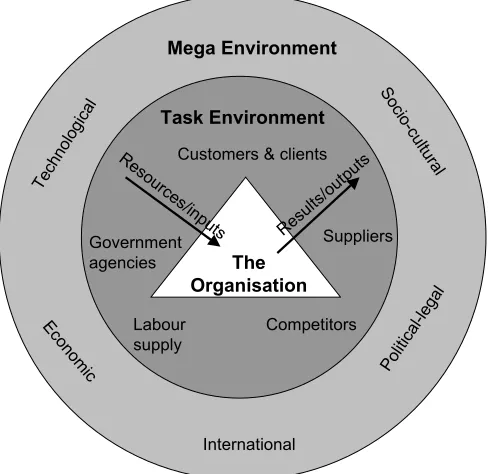
(iv) Environment—the close (task) environment includes all the external organisations and conditions that are directly related to the system’s transformative processes and its technologies. These external organisations and forces encompass funding sources, suppliers, customers, clients, regulators, competitors, strategic partners, and markets. The macro (general) environment includes institutions and conditions having infrequent and long-term impacts on the organisation and its close environment. They include the economy, the legal and political systems, technology, and social and cultural setting within which an organisation operates. An organisational analysis from this component focuses on the organisation’s ability to adapt to its environment, shape that environment, or find a favourable environment in which to operate (Daft 1997; Harrison & Shirom 1999; McKenna 1999; Thompson & Strickland 2001).
(v) Structure—relations between individuals, groups and larger units— including role assignments, grouping of positions, departments, standard operating procedures, and coordination and control processes in the organisation. Organisational designs and structures ought to be a reflection of the complexity and dynamism of the environment in which the organisation operates (Mintzberg 1999).
(vi) Culture—shared norms, values, beliefs and assumptions, as well as the behaviour and artefacts that express these orientations (Dawson 1996; Harrison & Shirom 1999; Lewis 1999).
(vii) System dynamics—includes feedback of information and demands from within the organisation and outside it.
examining the strengths and weaknesses of the organisation as well as the opportunities and threats posed by the environment, and the interaction among these four features. The framework can also be used to analyse the interactions among the levels of the organisation. By tracing relationships throughout the various levels of the organisation, problem areas can be identified in a way that facilitates holistic problem solving involving all the levels of the organisation, rather than just those that may seemingly be affected by the problem. This kind of analysis may also identify discontinuities between the levels of the organisation (Harrison & Shirom 1999:48-50).
The complexity of this analysis of the organisation, which has also been identified as a limitation of the open system framework, is its abstractness (Harrison & Shirom 1999:65). Whereas it may be true to argue that all the parts function together and depend on each other, it is a much more difficult thing to offer suggestions to managers of organisations on what precisely will change and to what degree, if a certain action is taken (Robbins & Barnwell 1998:14).
Another limitation is its extensive nature that could lead to a lot of data gathering that is hard to analyse and use (Harrison & Shirom 1998:51).
The current study is designed to limit its focus to system processing, and to gather and analyse data on the transactional and transformational components of the process. In the study the transactional component is limited to the relationship between the processes, the macro environment and the external stakeholders. The transformational component is limited to the relationship between processes, organisational strategy and structure through which an organisation converts inputs into outputs.
A diagrammatic representation of what is perceived to be the link between these components is presented in Figure 1.2 below.
The process component is at the centre of other organisational components, and an analysis of the process incorporates an analysis of other components of an open system. By keeping the process as the focus of the study, other components can be examined in so far as they affect the process.
This multi-component view of organisations with a focus on process is significant for the current study and for NGDOs. This is because as explicated in the problem statement, a ‘closer look’ into the policies, strategies, operations, requirements and capabilities of donor NGDOs is important for a more comprehensive analysis of their contribution to international development. The transformational component of the process perspective taken in the current study provides an opportunity for such an analysis to be conducted. The transactional component facilitates an examination of the external factors that is equally important in explaining the outcomes of NGDO development initiatives.
Inputs Outputs
Figure 1.2. The transformational and transactional components of process
Transformational component
- linking strategy to operational functions
Process Strategy
Operational activities
Consequently, the problem definition and framework for assessing donor NGDOs leads to a sixfold summary of the focus of the study:
(i) Examining what NGDOs aim to achieve in development initiatives – the goals of international development. These form a backdrop against which processes are defined and evaluated.
(ii) Determining which processes are characteristic of NGDOs in meeting their organisational goals (the transformational component).
(iii) Determining how the relationship between organisational processes and external environment factors impact on development initiatives and outcomes (the transactional component).
(iv) Determining and discussing key issues and implications for management by donor NGDOs as they focus on their service delivery role in the future. (v) Developing a framework that could guide the implementation of good
development practices in the processes that ensure the effectiveness of NGDOs.
(vi) Discussing general directions and areas for further research regarding the future of NGDOs in international development.
1.4 Assumptions
The present study makes the following assumptions:
1. That NGDOs have important processes aimed at adding value to stakeholders, by alleviating poverty and promoting sustainable development. The study seeks to determine and discuss what these processes are.
2. That relationships exist between organisational processes, the external environment, and internal environment of organisations – relationships that impact on the development initiatives of NGDOs.
1.5 Boundaries on the Scope of the Study
This section clarifies the boundaries of the study, clarifying what the study is and what it is not. First the study has covered only the non-governmental development organisations involved in development activities in developing countries. Those organisations whose work is concentrated only in Australia have not been studied. Second, the study has focused on only those organisations involved in long-term development assistance as opposed to short-term humanitarian relief and emergency assistance. Third, the study has been limited to the linkage between organisational processes and some components of the external and internal environments. The specific elements of the external environment are the macro environment and the external stakeholders. The specific elements of the internal environment are organisational strategy and structure. Other internal environment components such as board of directors and staff members while acknowledged are beyond the scope of this study.
1.6 Research Aims
The theme of the study is the significance of a process perspective in assessing and determining how NGDOs function and the outcomes they achieve. In order to guide the study, four aims have been identified. These are to:
1. Identify good development management practices and patterns of behaviour in the processes that determine the effective operation of NGDOs.
3. Enhance the relationship between NGDOs and external stakeholders by adding to the stakeholders’ understanding of the context of operation and the variables that influence the operations and outcomes of the initiatives of donor NGDOs.
4. Develop a conceptual framework for the critical analysis of processes in a NGDOs to guide the implementation of good development management practices.
1.7 Research Questions
The above aims are addressed in the following four research questions:
1. What is the relationship between NGDO organisational processes and the achievement of their development goals?
2. What intervening effect do the internal and external factors have on processes and consequently on goal achievement?
3. What are key issues for NGDOs processes in their context of operation, and what implications do these issues have on the management and functioning of NGDOs in international development?
4. How may NGDOs examine and evaluate their organisational processes in order to promote good development management practices?
The above questions were developed further into sub-questions to guide the data gathering exercise. The interview guide appears in Appendix II and the mail questionnaire in Appendix III.
This study is an examination and evaluation of the organisational processes of nonprofit, non-governmental organisations working within the framework for international development cooperation – referred to as non-governmental development organisations (NGDOs). The results of this study will assist NGDOs to evaluate and improve their effectiveness by addressing the following five areas.
First, as noted in the problem statement, most studies on the assessment of donor NGDOs have focused more on project assessment than on the organisational factors contributing to outcomes. Donor NGDOs have often been assessed on the basis of projects implemented ‘out there’ in the field, and this kind of assessment has been inadequate to fully explain how donor NGDOs do their work owing to a lack of assessment of the contribution of organisational factors on outcomes. The current study addresses itself to this knowledge gap.
Second, the subject of NGDOs covers a wide range of organisations. As noted by Fowler (1997:xii) diversity is inevitable within the NGDO community. It stems from the contrasting values and goals of those who start and lead them, the different times and contexts in which they evolve, the many levels at which they operate, the varied scope of their activities, and the wide mix of resources they mobilise. However, this diversity presents problems in attempts to study, generalise and draw conclusions about NGDO functioning. As such, systematic analysis of the organisational functioning of NGDOs is in short supply. This study, while acknowledging that there is no fail-safe formula for “effective” performance of NGDOs, attempts to examine systematically how NGDOs have functioned and what they have been able to achieve as one way of identifying patterns of behaviour, general principles and practices which leaders and managers regularly use.
and ethical financial resource mobilisation leading to financial independence; (3) the delivery of high quality development assistance; and (4) a commitment to policy advocacy and development education. Part of good management is an evaluation of organisational capabilities. There is also a need for critical self-evaluation of the policies on which decisions are made about project activities (DAC 2000; Kruse et al. 1997; Simons et al 1997). There is need for the sector to promote its financial independence, while remaining ethical and professional in fundraising. This issue needs to be addressed in a systematic way to ensure NGDOs remain autonomous while drawing resources from various sources (ACFOA 2000a; Industry Commission 1995a; Simons et al. 1997).
The sector also needs to address the issue of delivering quality development assistance. In this regard, it is necessary for NGDOs to define and clarify what they perceive as key dimensions of quality in their programs, and come up with credible indicators to assess quality (ACFOA 2000d). Another aspect of quality is to ensure sustainability of project outcomes and benefits, which is only possible if there are practical strategies in place to promote sustainability and indicators to measure it (AusAID 2000a). The dimension of development education is especially important to increase the Australian public understanding of development, and to educate all stakeholders on the significance of their contributions (Wilson 1998). The study is necessary to determine ways in which NGDOs can approach these issues systematically and critically.
The views expressed by Kajese (1987) and Zivetz (1991) are similar to the researcher’s own experiences. There appears to be much disagreement and criticism between donor and recipient NGDOs about what should constitute good development practice. Part of the reason for this is that to the recipients, little information exists about the context in which their funding partners operate. They hardly get an opportunity to ask pertinent questions regarding the whole development process, and do not understand some of the actions or decisions taken by their donors. While the donors ought to be accountable to their recipient partners for their actions, in practice this expectation is not always met. As a result, the relationship between the donors and recipients has been one of tension rather than cooperation. Values such as ‘participation’, ‘partnership’ and ‘accountability’, while appreciated, have not always translated into practice. The researcher has therefore aimed at gather some valuable information to contribute to the debate of bridging this gap between theory and practice, and increasing the understanding between donor and recipient NGDOs.
Fifth, there is a growing interest in a process-based view of organisations. Garvin (1998) notes the significance of a process perspective in addressing a common organisational problem – the lack of cross-functional integration that results in sub-optimal performance. Recent works by Braganza and Lambert (2000), De Bruin et al. (2000), Nickols (1998), Schmidt and Treichler (1998) and Vanhaverbeke and Torremans (1999) point to the need for more empirical studies to identify and analyse business processes and their implications for both strategy and outcomes. These studies seek to address the issue of improving the performance of organisations by evaluating and redesigning organisational processes.
1.9 Overview of the Research Project
This section outlines the contents of subsequent sections and chapters of the thesis. The thesis is set up in four sections and eleven chapters. Chapters Two, Three and Four of Section I provide an overview of the processes perspective and of NGDOs. In Chapter Two the reader is introduced to the features of a process perspective. The chapter provides an overview of the components that make a process perspective a legitimate way to assess organisations.
Chapter Three provides an overview on non-governmental development organisations, defines development and explains the relevance of the process-based assessment to NGDOs. Chapter Four focuses more specifically on the NGDO sector in Australia. It provides a summary of Australia’s development assistance program and demonstrates the relationship between the official development program (as delivered by AusAID) and Australian NGDOs. Such an overview is helpful to the extent that it provides the reader with a context against which the research findings and discussions of the study may be interpreted.
Section II includes Chapters Five and Six and introduces the reader to the study in depth, by explaining how the study is set up. In Chapter Five, a theoretical and analytical framework is developed. The framework defines and operationalises the variables of the study. It forms the basis against which the findings are presented and analysed. In Chapter Six the methodology for conducting the study is presented. It describes the research design and methods used in data collection. It also outlines how the variables are measured and data analysed. Important aspects of research quality such as validity, reliability and objectivity are also addressed.
of the organisational and external environment factors on NGDO processes and consequently goal achievement.
CHAPTER TWO
FEATURES OF A PROCESS-BASED ASSESSMENT
2.1 Introduction
The research theme of the study is on the significance of a process-based perspective to examine and evaluate the achievements of donor non-governmental development organisations (NGDOs). The contention is that a process-based view is useful for identifying good development management practices, by developing an understanding and appreciation of the contribution of organisational components of donor NGDOs to the outcomes of development initiatives.
This chapter develops the concepts involved in using a process perspective. It starts by defining the term ‘organisational processes’, followed by a rationale of the significance of a process-based analysis of organisations. It then reviews some of the difficulties, inadequacies and dilemmas that accompany the process approach, and reviews how the current study intends to address them. This is followed by a review of previous studies to examine the significance of the internal and external environment factors on organisational processes.
2.2 A Process-Based Analysis of Organisations
2.2.1 Defining Organisational Processes
In the broadest sense, processes can be defined as a collection of tasks and activities that together – and only together – transform inputs into outputs (Garvin 1998:33).
Garvin (1998:35) identifies three major approaches to organisational processes. These are (1) work processes focusing on sequences of activities that transform inputs into outputs; (2) behavioural processes focusing on ingrained patterns of
behaviour and ways of interacting; and (3) change processes focusing on
sequences of events over long periods of time. These represent separate but related schools of thought and explore distinct characteristics and challenges of processes. For purposes of the current study, however, the term processes has been used to refer to the first category – work processes – as the study focuses on the accomplishment of tasks that transform inputs into outputs.
Garvin (1998:35) makes a useful distinction between two kinds of work processes: (1) operational processes that create, produce and deliver products and services that customers want, and (2) administrative processes that do not produce outputs for customers, but that are still necessary for the running of an organisation. Operational processes may include the development of new products and services, and service delivery to customers, while administrative processes may include strategic planning, budgeting and performance measurements. While the operational processes produce goods and services for the external customer, the administrative processes generate information and plans for internal groups. However, the aligning and coordination of these two processes is vital if the organisation is to function effectively (Crowston 1997:159).
Davenport (1993:5), for example, defines process as:
A structured, measured set of activities designed to produce a specified output for a particular customer or market. It implies a strong emphasis
on how work is done within an organisation, in contrast to a product
focus emphasis on what is done [Emphasis in original]. It is a specific ordering of work activities across time and place, with a beginning, an end, and clearly identified inputs and outputs: a structure for action.
In their definitions, Hammer and Champy (2001:38), Nickols (1998:16) and Vanhaverbeke and Torremans (1999:42) also use the term ‘process’ to refer to the patterned, purposeful activities through which organisations transform one or more kinds of inputs into outputs, which are of value to the end-user. As demonstrated in Figure 1.2 (Chapter One), Nickols (1998:15) views process as consisting of two components:
• The transactions—that define the relationship between an organisation and its external environment, and the process involved in exchanging outputs for inputs; and
• The transformations—that define the processes involved within the organisation of converting inputs into outputs [Emphasis added].
Braganza and Lambert (2000:177) and Laudon and Laudon (2000:78) define process as the linking of strategy to operational activities. This is achieved by linking together the functions of organisational units, guided by a set of objectives and strategies, to ensure that the overriding task is completely and successfully carried out. They identify three characteristics of processes.
• Processes aim at adding value to stakeholders – In other words, activities constitute a process when linked explicitly to the expectations of internal and external stakeholders.
• Processes cross functional boundaries. That means that departmental or functional operations form part of a process as well as being processes in their own right [Emphasis added].
The definitions presented draw a number of dimensions in identifying, analysing and determining organisational processes:
• Processes involve obtaining from the external environment the necessary
inputs so as to sustain the functioning of the organisation (Nickols 1998:15);
• Processes focus on stakeholder satisfaction – they aim to create an output that is of value to the end-user. This is a major driving force behind the process approach. Stakeholders represent significant justification for developing a process-based view of organisations (Braganza & Lambert 2000; Davenport 1993; Garvin 1998; Hammer & Champy 2001; Nickols 1998; Vanhaverbeke & Torremans 1999);
• Processes involve the conversion of inputs into outputs, tied to strategic intent and actions (Braganza & Lambert 2000; Davenport 1993; Garvin 1995; Edwards & Peppard 1997; Schmidt & Treichler 1998); and
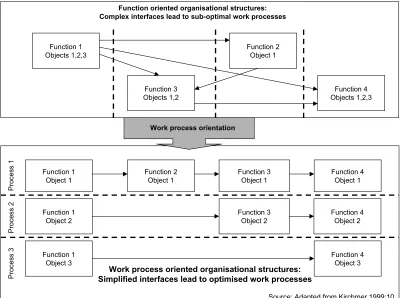
• Processes involve cross-functional linkages that cut horizontally through the organisational structure (Braganza & Lambert 2000; Davenport 1993; Garvin 1998; Hudson 1999; Kirchmer 1999).
As such, the process perspective is becoming popular owing to its focus on meeting the expectations of stakeholders and improving the performance of organisations, through its link to organisational strategy, and an emphasis on cross-functional integration.
2.2.2 Challenges of the Process based perspective
Despite the benefits associated with a process perspective, organisations pursuing it appear to have made only partial or marginal success, and in some cases failure (Crowston 1997; Cook 1996; Davenport 1993; De Cook & Hipkin 1997; Edwards C. et al. 2000; Garvin 1998; Ghoshal & Bartlett 1995; Hall & Rosenthal 1993; Nickols 1998). The problems have been traced to a number of sources. One is in the difficulty of identifying the processes (Davenport 1993; Fowler 1997; Nickols 1998; Rummler & Brache 1995), and a second is the way of managing and redesigning processes (Crabtree et al. 2001; Cook 1996; De Cook & Hipkin 1997; Edwards C. et al. 2000; Garvin 1995, 1998; Ghoshal & Bartlett 1995). These two problems are discussed below.
2.2.2.1 The Difficulty of Identifying Processes
Retracing the arguments back to the problem statement is the premise that the determination of organisational processes forms a crucial component in assessing the achievement of organisational goals. Yet, previous studies point to the fact that organisational processes represent a difficult challenge in identification and analysis because they are often unknown quantities, have no names, are not represented in organisational charts, and examples are often disputed (Nickols 1998:16). The exercise of identifying processes is not always a straightforward one and is often difficult to define or apply (Fowler 1997:166).
Processes are also difficult to identify because their boundaries are often not defined. Processes are selected portions of larger streams of activity. Process boundaries must be set or established in this larger context, before they can adequately be identified [Emphasis in original] (Nickols 1998:18). As boundaries are arbitrary, managers are faced with the task of defining boundaries, and often these definitions will be contested, resulting in discrepancies and internal conflicts (Davenport 1993; Kumar & Nti 1998).
Process identification and analysis is also based on the assumption that the organisation has:
• A well-articulated strategy. Processes have strategic relevance. They are
the way through which strategy is implemented. If the strategy is flawed, process identification is likely to be flawed too, if not impossible (Davenport 1993:31-34);
• Clearly defined end-users. Processes are a set of related activities that
produce a result of value to an end-user (Braganza & Lambert 2000:179; Garvin 1998:33; Nickols 1998:16; Vanhaverbeke & Torremans 1999:42);
• An existing and/or potential resource base (Nickols 1998:15).
The implication is that if an organisation lacks these components, it is not likely to succeed in determining and managing its processes. Organisations therefore need to have these three basics – a strategy, stakeholders and a resource base, which can then become the starting points for process determination and analysis.
coordination in organisations account for the different details within processes. Such diversity can help to build theory on the coordination of organisational processes.
Taking the stakeholder satisfaction approach, processes may be mapped out by identifying existing or potential outputs targeted at stakeholders and then working backward from there to identify the processes or activities that yielded those outputs (Nickols 1998:16).
From a resources perspective, processes could be identified by listing all the resources involved in the various process steps, and then considering the dependencies that exist between them. It could be that one step has to be completed before the next can begin, or that two steps share the same resources, or that the outputs in one step are the resources for another (Crowston 1997:167). In recurring situational detail such descriptions demonstrate how work activities are structured and how particular work processes emerge from the accomplishment of work activities (Crabtree et al. 2001:171).
In process identification, organisations should bear in mind that there are both operational and managerial/administrative processes. Both of these ought to be identified, as the administrative processes support the operational ones and an inadequacy in an administrative process has a possible effect on the operational one (Garvin 1998:35).
2.2.2.2 Challenges in Managing the Process Approach
A focus on organisational processes has been criticised as being prescriptive, simplistic, mechanistic and formulaic (De Cook & Hipkin 1997; Edwards C. et al. 2000) because it fails to acknowledge the existence of multiple factors that influence process determination and outcomes.
For example, the process perspective has been criticised for its failure to reflect on the fact that while managers may express frustration with current inefficient, rigid, and ambiguous systems in their organisations, and may thus be open to a different perceptive, such ambiguities and inefficiencies have their appeal. Under uncertain conditions, the negative consequences of their actions, as well as the causes are difficult to detect and evaluate, thus providing managers with a sense of psychological security (De Cook & Hipkin 1997:666). It can therefore not be assumed that a process perspective will always be welcomed or supported by organisational managers.
Approaches have also failed to appreciate the significance of a shared understanding at senior management levels regarding an appropriate mode of operation and the outcomes that are expected from a process. Unless managers develop consensus on organisational context, an appropriate approach to address organisational needs and strategic interventions, process oriented initiatives are less likely to secure benefits (Edwards C. et al. 2000:30; Hammer & Stanton 1999:110; Rummler & Brache 1885:7).
work as a team player. Changes in decision-making also need to be made so as to involve more levels of the organisational hierarchy (Garvin 1995:84).
The trend towards de-manning has also been linked to the need to respond to stakeholder expectations. The pressure by stakeholders on organisations to reduce costs and maximise profits, coupled with the need by organisations to maintain stakeholder support has been perceived as an important driving force behind supporting process initiatives (De Cook and Hipkin 1997:662). The result has been a trend towards downsizing, reorganising work teams and a move towards increased used of information technology (Crabtree et al. 2001:171; Rummler & Brache 1995:124). This focus on downsizing and profit maximisation may be why some organisations have had failure with the process perspective, as no genuine attempts have been made at process analysis (De Cook & Hipkin 1997; Hammer & Stanton 1999).
Garvin (1998:35) points to another limitation of the process perspective as its almost exclusive emphasis on operational processes, neglecting the ongoing managerial coordination, oversight and control of the reconfigured processes. Operational processes have often been targeted for improvement, while the supporting managerial processes have been overlooked, resulting in incompatibilities and inconsistencies (Garvin 1998:35). Unless, management processes are redesigned too, not much can be gained from the improvement programs. A broader focus in process redesign is therefore essential (Garvin 1998; Harvard Business Review 1995; Hall & Rosenthal 1993).
such as costs, increases in workload, or the number of managers who concur with a particular process, exist in arriving at a process.
Managers therefore need to enter into negotiations and compromises in defining processes in their organisation, based on their existing and tried work practices (p.166-167).
This view is also expressed by Grint (1994) who observes that process determination and evaluation needs to take a holistic view. The fact that a process does not work well, for example, may be due to micro-political conflicts within the organisation, or changes in the marketplace rather than any inadequacies in the process itself. Thus, any evaluation and possible process redesign must take into consideration all relevant major conditions inside and outside the organisation that impact on process outcomes and performance.
Schmidt and Treichler (1998:59) reinforce this view by arguing that a process orientation requires more rationale and planning than currently exists. The approach has often been indiscriminate and superficial. Seldom has an attempt been made at critical conceptualisation (Hall & Rosenthal 1993:122). In an era of a volatile and rapidly changing environment, ‘non-strategic’ improvement programs could generate a much improved process that is no longer relevant to the environment (Harvard Business Review 1995:80). This points to the need to evaluate the changes in the environment so as to identify and plan rationally and realistically whether to redesign existing processes or develop new ones that are relevant to the organisation and its environment (Edwards C. et al 2000:30).
These criticisms of the process perspective are valid because they identify the failure of previous studies to take a multi-dimensional view of processes. They note that previous studies fail to take into account factors such as:
• The internal strategic and management capabilities and decisions in
• The existence of external factors that influence process determination and outcomes (Crabtree et al 2001; Crowston 1997; Grint 1994; Harvard Business Review 1995);
• A critical view of the role of stakeholders in determining process initiatives and outcomes (De Cook & Hipkin 1997);
• A holistic approach towards process initiatives – one that involves elaborate planning and critical conceptualisation (De Cook & Hipkin 1997; Hall & Rosenthal 1993; Schmidt & Treichler 1998).
The conceptualisation of the process perspective brings to light two important issues. One is that organisational processes involve more than simplistic mechanistic steps in doing things – there is strategic planning, managerial coordination, resourcing and the need for consensus on initiatives (Crabtree et al. 2001; Crowston 1997; De Cook & Hipkin 1997; Edwards C. et. al. 2000; Garvin 1995, 1998; Forssén 2001; Ghoshal & Bartlett 1995; Hall & Rosenthal 1993; Hammer & Stanton 1999). Two, that an internal perspective, that is, only looking at processes without linking them to the external organisational context that they intend to respond to, is an inadequate analysis of determining how processes are realising intended outcomes or need to be changed (Crowston
1997; Clemons 1995; Grint 1994; Harvard Business Review 1995; Edwards C.
et al. 2000).
What is required is a conceptual framework that integrates these components – organisational processes, the internal organisation context and the external environment, assesses how processes are determined, and evaluates how process outcomes are influenced by these contexts.
2.3 Factors
Affecting
Organisational Processes
Within an organisational framework, one can formulate a variety of hypotheses concerning the effects of changing contextual conditions on organisational processes. For example, “As condition X changes, Y new patterns or classes of action are predicted (Pentland 1995:553).” This view of organisational processes as being linked to external and internal contextual factors is useful to the extent that it offers structural alternatives for managing organisational operations (Ciborra 1996).
In the current study, the external environment is limited to the macro environment and external stakeholders, while the internal environment is limited to the organisational factors – the strategy, and coordination of tasks through which process outcomes are realised (the structure).
In thinking about the interaction between organisational (internal) and contextual (external) environments of an organisation, however, Pondy and Mitroff (1979, cited in Weick 1995:30) note that in organisational life, people often produce part of the environment they face. Managers construct reality through authoritative acts. When they enact laws, they take undefined space, time and action and draw lines, establish categories and coin labels that create new features of the environment that did not exist before. These new environments then constrain their actions (Weick 1995:30-31).