IJEDRCP1502001
International Journal of Engineering Development and Research (www.ijedr.org)1
Vision Based Intelligent Traffic Analysis System for
Accident Detection and Reporting System
1Gayathri Elumalai, 2O.S.P.Mathanki, 3S.Swetha
1, 2, 3III Year, Student, Department of CSE, Panimalar Institute of Technology Chennai, Tamilnadu, India
_______________________________________________________________________________________________________
Abstract - In this paper, we have proposed a traffic accident detection system that is vision based. This system can (1) detect, (2) record, and (3) report traffic accidents. It uses the idea of picture queuing that is highly applicable to intersections that are widely prone to deadly accidents. This picture queuing is brought by extracting images of the vehicle from video image of the Charge Coupled Devices (CCD) cameras. The main attention is given to the change in the rate of velocity, position, direction, and angle of the moving vehicle. These criteria are taken into account by this accident detection algorithm for making decisions. These images are a replacement for crash data. The interoperability is improved by a metadata registry. The metadata registry is maintained by the Traffic Monitoring Centre(TMC) via Virtual Private Network(VPN).
Keywords - Accident, Image processing,Moving picture, Metadata registry.
________________________________________________________________________________________________________
I.INTRODUCTION
Intersections also tend to experience severe crashes due to the fact that several types of crashes, such as angle and turning collisions. Therefore, accurate and prompt detection of accidents at intersections offers tremendous benefits of saving properties and lives and minimizing congestion and delay. The theory proposed by Yong-Kul Ki for accident detection is used as a base here[1]. Accident detection using computer vision and image processing on freeways has attracted more attention [2]. Another focus on abnormal vehicle behaviors causing incidents (e.g., a traffic accident), traffic jams, fallen-down obstacles, [3]. The proposal gives out a method that employs image-processing techniques and fuzzy theory for predicting an occurrence of an accident before it happens. The decision of whether an accident or an incident has happened or not is made using the “behavioral abnormality” of some related images. There are several techniques that use video footages which are visible even to a range of 2 miles. Unfortunately, however, these methods have rather limited capability to detect accidents at an intersection because the intersection is a very complicated place. Hence, we suggested a new detection algorithm for accidents that occur during heavy traffic using the features of moving vehicles at intersections and devised a system for automatically detecting and recording the before/after Accident Moving Picture (AMP) and reporting it to Traffic Monitoring Center (TMC). The AMP is a more reliable proxy of crash data than the conflict data, and it provides a time efficient method of analyzing intersection collisions compared to a conflict analysis or a continuous videotaping. A system with these properties would assist in determining the cause of accidents. Data processing and electronic data interchange rely heavily on a very reliable, controllable and easily verifiable data recorded in databases. A provision for correct and proper use and interpretation of data is that both users and owners of data have a common understanding of the meaning and representation of the data. To help in better knowledge and understanding, characteristics and attributes of the data have to be defined. The attributes or characteristics of data are known as “metadata”. This part of ISO/IEC 11179 [4] provides for one or more views of the data, such as:
Means of creation of the data Purpose of the data
Time and date of creation Creator or author of the data
A metadata registry is a central location in an organization where metadata definitions are stored and maintained in a controlled method. It is important to note that a metadata registry holds only the definition of structure and semantics of data; it does not hold the actual data. To improve the interoperability of the system, we designed and suggested the metadata registry for the system.
II.BACKGROUND
Related
A number of conventional expressway incident detection algorithms have been developed in the past several decades. Techniques based on decision trees for pattern recognition, time series analysis, Kalman filters, network through OBD-II,
e-NOTIFY system have been attempted, but met with varying degrees of successes intheir detection performance [5 – 10]. On the other hand, only a few researchers have investigated the detection of traffic crashes at intersections.
IJEDRCP1502001
International Journal of Engineering Development and Research (www.ijedr.org)2
The traffic Accident Recording and Reporting System (ARRS) is an image-actuated moving picture recording and reporting system used to analyze and evaluate the occurrence of traffic crashes at intersections. The system consists of a charge coupled device (CCD) camera located on the corner of the intersection to obtain a view of incidents, an image processing unit that detects images which could be related to a traffic crash, a digital video recorder (DVR) that has recorded all the situations of the intersection for the previous two weeks, and a communication unit that send the Accident Moving Pictures (AMPs) to the Traffic Monitoring Centre (TMC). When the ARRS detects an event that could be a collision and captures the Accident Moving Picture (which includes five seconds before the event and five seconds after the event) from the Digital Video Recorder, the AMPs are sent tothe TMC by Virtual Private Network (VPN). This AMP consists of pictures taken five seconds before and after the event which will activate the system. These signal phases are then encoded onto the recorded AMP.III. ACCIDENT DETECTION ALGORITHM VIA IMAGE PROCESSING
Accident detection algorithm generally includes three steps: vehicle extraction, feature extraction of a moving vehicle (MV), and accident detection. Based on vehicle tracking results, we collected traffic images and detected the traffic accidents [10].
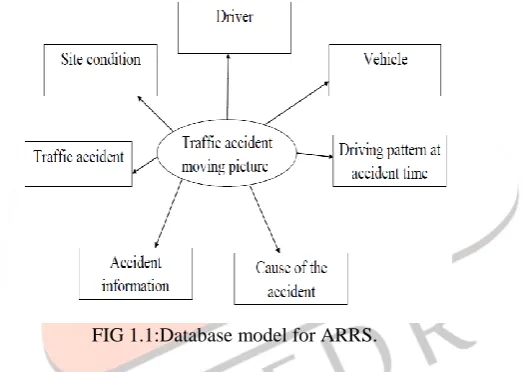
FIG 1.1:Database model for ARRS.
Vehicles are extracted by detecting moving parts in each frame based on a difference equation. This process consists of taking the difference of two continuous frames, binarization, and horizontal and vertical projection, and then extracting parts which exceed the threshold value. For the extraction of moving regions in a video sequence, an input image, a pair of gray-level images, Ik-1 (x, y) and Ik (x, y) acquired at successive time instants τk-1 and τk,respectively. The output is the moving regions in which significant
changes have been detected.
Feature extraction of MV
Depending on the tracking result, the ARRS extractsfeatures for accident detection. Features such as theacceleration, position, area (size), direction of the MV areused for accident detection [10] [11].
Acceleration and retardation
Rapid velocity variation is a useful descriptor of a traffic accident. In general, a traffic accident causes rapid change to vehicle speeds. Hence, we used the variation rate of vehicle speed (acceleration and retardation) for accident detection. In the tracking process, we extracted the speeds of the MVs, calculated the positive or negative accelerations of the vehicles, and used them for accident detection [11].
Variation rate of the position
Positions are useful descriptors of objects within images. An image that represents an object consists of positivea valued pixel that is set against a background of 0-valued pixels. Position refers to the location of the object in the plane. The object’s centroid (or center of mass) is the point that is used to specify its position [11].
IJEDRCP1502001
International Journal of Engineering Development and Research (www.ijedr.org)3
Area is a commonly used descriptor for regions in the plane. Let R denote the region whose points have pixel value 1. One way to calculate the area (S) is simply to count the number of points in R. This can be accomplished with the image algebra statement S = Σ s. When the vehicle moves away from the camera, the size of the MV decreases and as it moves towards the camera, the size of the MV increases; however, its variation rate is small. On the other hand, the size of the moving vehicle has a change. Therefore,we used the variation rate of area as a factor for traffic accident detection [11].Variation rate of the direction
With respect to the extracted part in one frame, the corresponding part in the subsequent frame is searched by cross correlation. Optical flow is defined as the motion vector spanning the two corresponding points in each image i. The mean optical flow is calculated by averaging the normal optical flow of each pixel in the extracted part. It is represented by
Vn, and the motion vector obtained by cross correlation is represented by Vi.
Accident detection algorithm
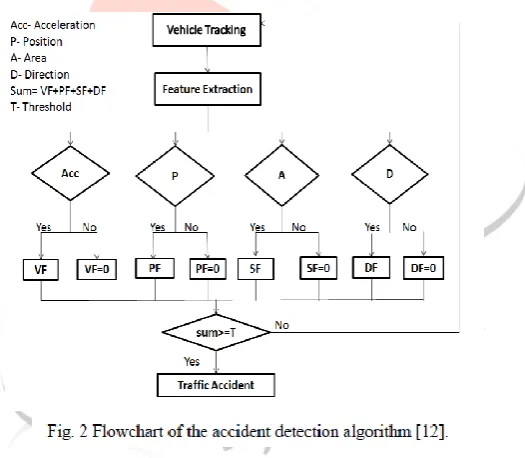
The accident features in each image were calculated in the steps mentioned above. Finally, considering the “Feature indexes” in the sequence, it was determined whether the traffic accident had occurred or not. An outline of this process is shown, and the accident detection algorithm is summarized as follows [12]:
Step 1: Extract the object that is vehicles from the video frame. Step 2: Track the MVs by using the tracking algorithm.
Step 3: Extract the features such as variation rates of velocity, position, area, direction of the MV as the accident index. Step 4: Calculate the sum of the accident index flags (VF+PF+SF+DF).
IV. METADATA REGISTRY FOR ARRS
In order to improvise the interoperability, we go in for a metadata registry that deals with the accident data from ARRS. As given in the table, the proposed registry contains five different categories: identification, definition, relation, presentation and management attribute.
The database is designed based on the entity-relation(E/R) model. As given in the table 1, the proposed model consists of seven categories: traffic accident, accident information, cause of the accident, driver, vehicle, site condition, and driving pattern at accident time.
Table 1: Metadata attributes.
Attribute Category Attribute name of the data element
Identification Attribute
(1) Name (2) Identifier (3) Version
IJEDRCP1502001
International Journal of Engineering Development and Research (www.ijedr.org)4
V. TEST RESULTIn this paper we have suggested vision activation as a basis for detection of accidents. To evaluate the performance of the proposed model in real time, we have developed the ARRS. For testing, the ARRSs were installed at two intersections in Seoul, South Korea. The data obtained from the DVRs were used to relate each crash report to an AMP of ARRS. Information such as the description of the crash, various details about the vehicle such as color, car model and type of crash was used. During the test period, totally 4 traffic accidents were detected and recorded by the AARS.
VI. CONCLUSION
We have demonstrated an innovative approach for an image processing system to automatically detect, record, and report traffic accidents at an intersection. And we have also suggested and designed the metadata registry for the system to improve the interoperability. To calculate the performance of the new model, we developed and placed the ARRS, which is a vision-based accident detection system, at two intersections in Seoul, Korea. During the test period, 4 traffic accidents were detected and recorded by the AARSs. This accident detection and video-verification mechanism will provide a real-time crash warning to the operators and drivers. The video clips are invaluable for safety analysis at intersections.
VII. IMAGE EXAMPLES
(5) Synonymous Name (6) Context
Definition Attribute (7) Definition
Relation Attribute
(8) Classification Scheme (9) Keyword
(10) Conceptual domain
(11) Conceptual domain definition (12) Conceptual domain name (13) Object class
Presentation Attribute
(14) Data type of data element values (15) Maximum size of data element values (16) Minimum size of data element values (17) Permissible data element values (18) Unit of measure
(19) Value meaning name (20) Value meaning definition
Management Attribute
(21) Responsible Organization (22) Registration Status (23) Submitting Organization (24) Comments
(24) Change Date
(25) Change Description Text (26) Create by User Name (27) Create Date
IJEDRCP1502001
International Journal of Engineering Development and Research (www.ijedr.org)5
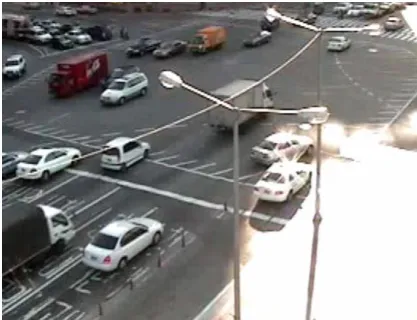
Fig 4(a): Image sent by ARRS before accident. Fig 4(b): Image sent by ARRS during accident.
References
[1] Yong-Kul Ki Department of Computer Science & Engineering, Korea University, RTSA. Accident Detection System using Image Processing and MDR .IJCSNS International Journal of Computer Science and Network Security, VOL.7 No.3, March 2007
[2] W. Hu, X. Xiao, D. Xie, T. Tan, S. Maybank. Traffic Accident Prediction Using 3-D Model-Based Vehicle Tracking. In Transactions on Vehicular Technology, IEEE Vol. 53, No 3, pp. 67, May 2004.
[3] P. Michalopoulos, R. Jacobson. Field Implementation and Testing of Machine Vision Based Incident Detection System. In Transportation Research Record: Journal of the Transportation,Research Board, No. 1394, TRB, National Research Council, Washington, D.C., pp. 17
[4] ISO/IEC JTC 1/SC 32, “ISO/IEC 11179: Information Technology-Metadata registries- Part 3,” 2003,
http://www.jtc1sc32.org/.
[5] D. Srinivasan, W. H. Loo, R. L. Cheu. “Traffic Incident Detection Using Particle Swarm Optimization,” In Proc.Of the IEEE Int. Intelligence Symposium.SIS, pp. 144-151, 2003.
[6] D. Srinivasan, R. L. Cheu, Y. P. Poh. “ Hybrid Fuzzy Logic-Genetic Algorithm Technique for Automated Detection of Traffic Incidents on Freeways,” In Proc. Of the IEEE Intelligent Transportation Systems Conf., Oakland (CA), pp. 352-357, August 2002.
[7] H. Xu, C. M. Kwan, L. Haynes, J. D. Pryor.“Real-Time Adaptive On-Line Traffic Incident Detection,” In Proc.Of the IEEE International Symposium on Intelligent Control, pp. 200-205, September 1996.
[8]T.Shuming,“Traffic Incident Detection Algorithm Based on Non-parameter Regression,” In Proc.Of the IEEE 5th Intelligent Transportation Systems Conf., Singapore, pp. 714-719, 2002.
[9] S. Bhonsle, M. Trivedi, A. Gupta. “Database-Centered Architecture for Traffic Incident Detection, Management, and Analysis,” In Proc. Of the IEEE Intelligent Transportation Systems Conf., Dearborn (MI), pp. 149-154, October 2000.
[10] I. Ohe, H. Kawashima, M. Kojima, Y. Kaneko. “A Method for Automatic Detection of Traffic Incidents Using Neural Networks,” In Proc.Of the IEEE Conf. Vehicle Navigation and Information Systems, pp. 231-235, 1995.
[11] Y. K. Ki, D. Y. Lee, D. K. Baik. “Traffic Accident Detection Model at Intersections via Image Processing,” Presented at 85th Annual Meeting of the Transportation Research Board, Washington, D.C., Jan. 2006.