IJEDR1401228
International Journal of Engineering Development and Research (www.ijedr.org)1281
Audio Steganography Algorithm Using Java
Maitri Patel
Assistant Professor
Department of Computer Engineering,
Sabar Institute of Technology for Girls, Tajpur, Sabarkantha, India.
________________________________________________________________________________________________________
Abstract: Now a day, we are widely using internet for exchanging any kind of data. So, while transmitting our data, protection of our data is very important from unauthorized access. Steganography has literally meaning of “Covered Writing”. Steganography sometimes is used when encryption is not permitted. Or, more commonly, steganography is used to supplement encryption. An encrypted file may still hide information using steganography, so even if the encrypted file is deciphered, the hidden message is not seen. Steganography techniques can be applied to images, a video file or an audio file. In this paper, we introduce new method of Steganography using audio file for transmitting our confidential messages through internet. The algorithm converts the input audio file and the text file which contains our confidential message into binary numbers which can’t be understandable by any user. After this, it hides the message into the input audio file with my own encryption technique and converts it into output audio file which contains our confidential message. The main advantage of this type of technique is the length of input and output file will be same.
Keywords – Steganography, embedding, Stego medium, Key Streams, Cryptography
________________________________________________________________________________________________________
I. INTRODUCTION
Steganography is the art and science of writing hidden messages in such a way that no one, apart from the sender and intended recipient. The goal of Steganography is “to hide messages inside other harmless messages in a way that does not allow any enemy to even detect that there is a second message present". Steganography can be used in a large amount of data formats in the digital world of today. The most popular data formats used are .bmp, .doc, .gif, .jpeg, .mp3, .txt and .wav. These formats are popular because of the relative ease by which redundant or noisy data can be removed from them and replaced with a hidden message.A pure steganography system’s success relies solely on the secrecy of the algorithm.
Essentially, the information-hiding process in a steganographic system starts by identifying a cover medium’s redundant bits (those that can be modified without destroying that medium’s integrity). The embedding process creates a stego medium by replacing these redundant bits with data from the hidden message. It is done in mainly two parts.
Hiding
Hiding a message in Wave samples is very similar to hiding it in the pixels of a bitmap. Again, we use a key stream to skip a number of carrier units (samples/pixels), grab one carrier unit, put one bit of the message into the lowest bit of the carrier unit, and write the changed unit to the destination stream. When the entire message has been hidden like that, we copy the rest of the carrier stream.
Extracting
Again, we use the key stream to locate the right samples, just as we did while hiding the message. Then we read the last bit of the sample and shift it into the current byte of the message. When the byte is complete, we write it into the message stream and continue with the next one.
Audio Steganography
In a computer-based audio Steganography system, secret messages are embedded in digital sound. The secret message is embedded by slightly altering the binary sequence of a sound file. Steganography can be implemented using Audio files like MP3, Wave.Human ears are not able to easily find the difference between the original sound and the resultant sound. You might miss the files that can hide lots of bytes without becoming larger, and can be generated in a few seconds, so that you don't have to store the original files on your disk. It is time to add Wave Audio to the list.
Need for Steganography
IJEDR1401228
International Journal of Engineering Development and Research (www.ijedr.org)1282
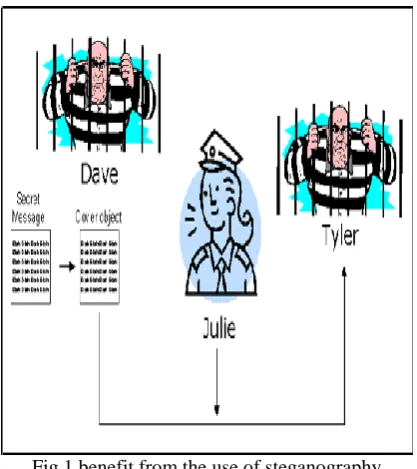
Fig 1 benefit from the use of steganographyTyler and Dave are in prison. They are trying to communicate an escape plan, but unfortunately have one major problem: Warden Julie has access to ALL correspondence that passes between the two prisoners. Relying solely on encryption is out of the question since it would arouse Julie's suspicion and result in Dave and Tyler eating only bread and water for six weeks. They also would not be allowed to watch cable television during that time period. So, to avoid being caught, the two prisoners must devise a way to pass messages that appear harmless to Julie; the two prisoners might set up a code language beforehand. Then perhaps Dave may write a message to Tyler that says "Hey, I hear those new mint flavored Oreo's are delicious!" Tyler would know to interpret that to mean "Lets, hide in the trash dumpster and escape when the garbage truck comes on its weekly pick-up." That might work, but there is always the possibility that Julie intercepts the message, figures out the code, and changes the message before sending it on to Tyler. Tyler would have no idea, and Julie would be able to trick him and Dave so that they are caught in the attempted escape.
In order to give people like Dave and Tyler more flexibility in their steganography system and prevent Julie from catching on so quickly, multiple protocols of steganography exist, each with their own set of strengths and weaknesses. The three main protocols are pure steganography, secret key steganography, and public key steganography.
II. THE PROPOSED TECHNIQUE
IJEDR1401228
International Journal of Engineering Development and Research (www.ijedr.org)1283
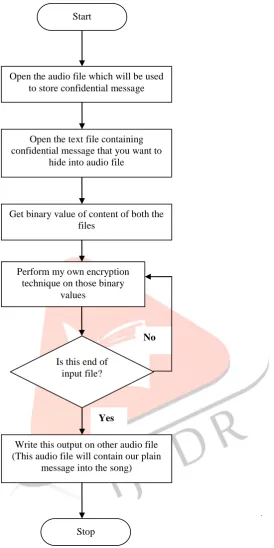
Fig 2 The structure for the implemented technique
Methods of code
1. Available () - Returns the number of bytes of input currently available for reading.
2. Read () - Returnsthe integer representation of the next available byte of input. -1 is returned when the end of the file is encountered.
3. toBinaryString() - Returns the string that contains the binary equivalent of given argument.
4. toCharArray() - Returns array of characters for the entire string given as an argument.
5. charAt() - Returns the character at the specified location from a given string.
III. THE EXPERIMENT ANALYSIS
Select one input audio file named “AIRTEL.mp3” of size 255 KB and one text file containing confidential message of size 1 KB. I will hide the confidential message into our audio file and convert it into output audio file named “India.mp3” with “SAME LENGTH” i.e. 255 KB. I’ll Show the binary values of input audio file, text file containing confidential message and output audio file.
Open the audio file which will be used to store confidential message
Get binary value of content of both the files
Perform my own encryption technique on those binary
values
Is this end of input file?
Yes
Stop
No
Start
Open the text file containing confidential message that you want to
hide into audio file
Write this output on other audio file (This audio file will contain our plain
IJEDR1401228
International Journal of Engineering Development and Research (www.ijedr.org)1284
Following is the outcome of my experimental analysis with same audio file and different confidential message:Confidential Message: Hi,How r u???? Size of input audio file:260885
Size of text file containing confidential message:20
Confidential Message: Password is tango charlie. Size of input audio file:260885
Size of text file containing confidential message:32 Binary values of audio and text file containing
confidential message: 1001000 1101001 101100 1001000 1101111 1110111 100000 1110010 100000 1110101 111111 111111 111111 111111 1101 1010 1101 1010 1101 1010 11111111111111111111111111111111 Binary values of output audio file: 11111111 11111010 01010000 11000101 00000000 00000000 00000000 00000001 00000001 00000000 00000001 00000000 00000000 00000001 00000001 00000000 00000001 00000001 00000000 00000000
Binary values of audio and text file containing confidential message: 1010000 1100001 1110011 1110011 1110111 1101111 1110010 1100100 100000 1101001 1110011 100000 1110100 1100001 1101110 1100111 1101111 100000 1100011 1101000 1100001 1110010 1101100 1101001 1100101 101110 1101 1010 1101 1010 1101 1010 11111111111111111111111111111111 Binary values of output audio file: 11111111 11111010 01010001 11000100 00000000 00000000 00000000 00000001 00000001 00000000 00000000 00000000 00000000 00000001 00000001 00000001 00000001 00000000 00000000 00000001 00000001 01011001 01101001 01101111 01100110 00000000 00000001 00000001 00001111 00000001 00000001 00000100 01010011 00000001 00000011 11111011 00010101 00000000 00000011 00000101 00000111 00001001 00001101 00001111 00010001 00010100 00010110 00011001 00011010 00011101 00100001 00100010 00100100 00100111 00101010 00101100 00110001 00110010 00110100 00110110 00111010 00111100 IV. CONCLUSION
IJEDR1401228
International Journal of Engineering Development and Research (www.ijedr.org)1285
REFERENCES[1] http://www.snotmonkey.com/work/school/405/overview.html [2] http://en.wikipedia.org/wiki/Key_(cryptography)
[3] http://www.webopedia.com/TERM/S/steganography.html [4] http://en.wikipedia.org/wiki/Steganography