Toward Developing Intelligent Mobile Obe System
In Higher Learning Institution
abdifatah Farah Ali, rusli Haji Abdulah, mohamed M. Mohamed
Abstract: The rapid growth in Mobile application users has made the researchers and practitioners to think of intelligent tools that can help the users and applications in delivering quality of services. Therefore, intelligent agent is expected to become the tool for development of mobile outcome based education (OBE) particularly in higher learning Institutions (HLI). In this context, there is a lacking of OBE intelligent agent in assisting the academicians to use in OBE management for mobile application system environment. This paper presents the conceptual design and development of a mobile intelligent agent based on mobile OBE called as i-MOBE. Since that, i-MOBE that we developed is considered very important for academicians and students to facilitate them in using for academic purpose in HLI particularly in helping them to monitor the performance in teaching and learning (T&L). The system architecture will be covering the conceptual design and its interaction as well as the system configuration in helping the academicians to use the system in their T&L toward effective and efficiency also can be applied in monitoring based on scenarios such as test, assignment and projects and so on.
Keywords: outcome based education; mobile application; mobile agent; higher learning institution; teching and learning. ————————————————————
1.
INTRODUCTION
The flexibility, programmability, and extensibility (accepting significant extensions or amendments of functionalities without a fresh re-writing of code or gross change in the architecture), are major things found lacking in today’s Internet systems, especially for supporting applications and other new services which are interconnect on separate or distinct networks. Hence we need to introduce intelligent tools to overcome the problem efficiently. The subject of software agent being a new technology paradigm in the areas such as artificial intelligence and computing system, they facilitates these features in Internet service and application development [1-3]. It is projected that agents will dominate next generation components in software due to its inherent behavior and structure supporting CBSE (Component based software engineering) [4, 5]. Agents are programs, which are autonomous and are situated within an environment; they achieve their goals actively by sensing the entire environment. They use internal world state information and also inference engine in computing the action to be performed on the environment by sensing the reception messages from other users or the environment. [9]. they also have special characteristics, which differentiate them from standard programs: mandatory and optional properties. The orthogonal properties of the agents, provides a strong notion of the agents in turn [9, 10]. These properties are enumerated below:
Autonomy: Operation of agents is done without direct intervention of humans or otherwise, with some kind control on their actions and their internal state.
Decision Making: Here we have it in two perspective, first is the reactive decision making which is implemented by direct mapping from sensors input (sensing the environment) to actions by using some rules. While in proactive decision-making, can use BDI architecture (Belief Desire Intension) [11]. The facts of an agent are the model of its domain, its desires provides sort of ordering between states, and its intensions are things it decided to do. The intensions are defined at various levels of abstraction.
Temporal continuity: Here agents are continuously running processes by either running active in the foreground or passive/sleeping in the background.
Goal oriented: In this case, the agent is capable of handling a task in meeting its desired goal.
This paper is organized as follows: The background knowledge and related work will be described in Section II. In Section III, the research methodology is discussed related to the intelligent agent in OBE research. In Section IV, is the overview of proposed of conceptual design and its implementation. The scenarios based implementation from academician and student prospective is presented in Section V. In Section VI, is the data analysis for system evaluation and discussion. This paper is concluded in Section VII.
2.
LETRAURE
REVIEW
A. Outcome based education (OBE)
Outcome based education approach (OBE) has implemented or adopted by a number of countries such as Australia, Malaysia or USA for many years. OBE can be defined as ―a comprehensive approach to organizing and operating an education system that is focused in and defined by the successful demonstration of learning sought from each student‖[12]. OBE is an education approach that focuses on the learning outcome after completing an academic programme [13, 14]. OBE is a process that involves evaluation and assessment process in education to reflect the attainment of expected teaching and learning [15]. The process can be done through assessment method which consist of tests, assignments, presentations and projects. The development of learning outcome following the hierarchy of unit outcomes, lesson outcome, course outcome, exit outcome and program outcome especially in HIL [16].
B. Mobile application
A mobile application is a software application development especially for use on small computing devices such as tablets, smartphones rather than computers or laptops. These devices could be used to make phone calls, multimedia messages and send texts. These devices have the ability to connect people via wireless networks also has many features that help peoples to organize their time and resources and make the mobile phone suitable channels for educating, learning, development and training. Therefore, using mobile
__________________________
[email protected], [email protected]@simad.edu.so
1, Faculty of Computing, SIMAD UNIVERSITY, Mogadishu, Somalia
phone in HLI is an innovative opportunity that offers existing learning channels [17]. Hence, mobility is seen by researchers as a new opportunity for education and it provides for learners to personalize their learning process, enhance collaboration and social interactions with others at anytime and anywhere in the learning context [18].
C. Mobile Agent
It’s amazing that Mobile agents (MA’s) are found to be exciting and as a new programming paradigm, which are applied in many domains of computing systems like: information filtering, mobile computing, network management systems and in electronic commerce system, they are found to have many advantages in all the aforementioned domains. Systems implementing mobile agents have been in existence for quite some years, platforms supporting mobile agents are now available from industries and other research communities [19-21]. However, production environments applications are lacking the paradigm and it has acquired the reputation of being ―a solution looking for a problem‖ [22]. Grossly, the delivery of the technology could not meet the initial deliverables expected by researchers or research environment. Mobile agents are independent programs having ability to move from one computer system to the other in a given network, and to other components/locations of their choice. State of running programs is saved in such that they are transmitted to the destination. The program process is resumed at the destination from the saved state. They are capable of providing an efficient, convenient and robust framework for implementation of distributed applications and as well gives smart environment for several reasons, like: latency and bandwidth improvements of client server systems and also reduction of vulnerability to network disconnection. As a matter of fact, these mobile agents posses numerous advantages in developing various services at smart environment as well not just only distributed application systems.
3.
METHODOLOGY
In order to formulate and propose the intelligent agent architecture of OBE system implementation for HLI as system architecture and its application, there are few steps that has been taken and conducted based on a series of sequence as shown in Figure 1.
Figure 1: Research Design approach
The methodology of the research is started by performing the analysis of literature review (step1) regarding on OBE, mobile application and intelligent agent, then followed by conducting a preliminary survey (step2) through the expert opinion interviewed that based on those who are really involved in HLI such as academicians (Teachers) and students. At this stage, i-MOBE system for HLI as proposed conceptual system design and its architecture which closed to OBE system development (step3). After that, we described for the scenario-based implementation from two types of uses based on proposed platform (step4), then followed by the simple measurement OBE for mobile application that comprises three sections which are general information, user adoptive evaluation and system’s capability as a conceptual system and its application system design model is also analyzed (step5) in determining the best criteria of Mobile Application for Android environment (step6) as an ending stage which also including the conclusion stage.
4.
A
PROPOSED
CONCEPTUAL
SYSTEM
DESIGN
D. The OBE Intelligent Paradigm
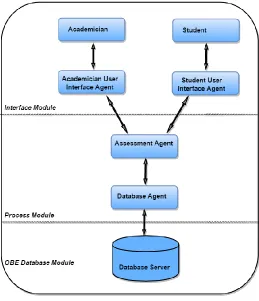
The OBE intelligent paradigm consists of four agents: academic interface agent, student interface agent, assessment agent and database agent as shown in Figure 2. The overall architecture consists of three high level modules:
Figure 2: OBE Intelligent Paradigm Systems
1. Interface Module :
The interface module deals with the academic and student agent that are publicly visible. It provide mechnisms for
Step 6: Conclusion Step 1: Literature Review
Step2: Expert Opinion
Step 3: Conceptual Design Formulation
Step 4: Scenario-based Implementation
interacting with agent and supports inter-agent collaboration and communication.
2. Process Module :
The process module is restricted only to the agent that is directly manipulating the contents of the module with access privilege. This module contains methods that implement a variety of functions and processes using which agent can respond to request from other agents and also provide the services that may necessary in solving particular problem.
3. OBE Database Module :
The OBE Database Module is restricted only to the agent that is directly manipulating the contents of the module with access privilege. This domain provide domain specific relevant to problem solving. It’s responsible for keeping track of what data are stores in the main database and also responsible for retrieving the necessary data requested by assessment agent through database agent.
E. The i-MOBE System architecture
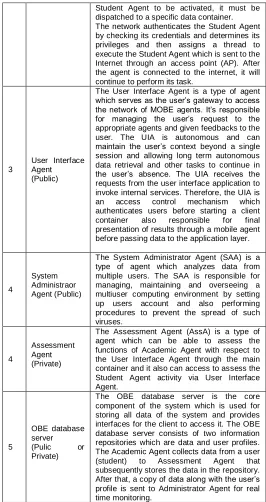
The i-MOBE system architecture consist of six architectural features: Academic Agent (AA), Student Agent (SA), User interface Agent (UIA), System Administrator Agent (SAA), Assessment Agent (AssA) and OBE database server. The communications between agent collaboration are shown in Figure 3. The functions of each agent are described in Table 1.
Table 1: Agent Functions and its accessibility
No Agent/
accessibility Functionality
1
Academic Agent (Public)
The Academic Agent (AA) is used by the academician (Teachers), enabling them in managing and evaluating a wide variety of assessment of their courses. In this unit, the academician can use their mobile devices to access the information or any other aspect of instructions at anytime and anywhere. For an Academic Agent to be activated, it must be dispatched to a specific data container. The network authenticates the Academic Agent by checking its credentials and determines its privileges and then assigns a thread to execute the Academic Agent which is sent to the Internet through an access point (AP). After the agent is connected to the internet, it will continue to perform its task.
2 Student Agent (Public)
The Student Agent (SA) is used by the students, enabling them in seeing a wide variety of assessment of their courses. In this unit, the students can use their mobile devices to access the information provided by the academician at anytime and anywhere. For
Student Agent to be activated, it must be dispatched to a specific data container. The network authenticates the Student Agent by checking its credentials and determines its privileges and then assigns a thread to execute the Student Agent which is sent to the Internet through an access point (AP). After the agent is connected to the internet, it will continue to perform its task.
3
User Interface Agent (Public)
The User Interface Agent is a type of agent which serves as the user’s gateway to access the network of MOBE agents. It’s responsible for managing the user’s request to the appropriate agents and given feedbacks to the user. The UIA is autonomous and can maintain the user’s context beyond a single session and allowing long term autonomous data retrieval and other tasks to continue in the user’s absence. The UIA receives the requests from the user interface application to invoke internal services. Therefore, the UIA is an access control mechanism which authenticates users before starting a client container also responsible for final presentation of results through a mobile agent before passing data to the application layer.
4
System Administraor Agent (Public)
The System Administrator Agent (SAA) is a type of agent which analyzes data from multiple users. The SAA is responsible for managing, maintaining and overseeing a multiuser computing environment by setting up users account and also performing procedures to prevent the spread of such viruses.
4
Assessment Agent (Private)
The Assessment Agent (AssA) is a type of agent which can be able to assess the functions of Academic Agent with respect to the User Interface Agent through the main container and it also can access to assess the Student Agent activity via User Interface Agent.
5
OBE database server (Pulic or Private)
5.
SCENARIOS
BASED
I-MOBE
IMPLEMENTATION
The proposed intelligent system architecture distinguishes two types of user: Academician (Teacher) and Student. The academician wants to perform a routine assessment on his student through a user interface on his mobile application and he/she request the UIA to collect his/her student’s information. Upon receiving the request, the UIA launches and delegates the job to the Academic Agent. In the meantime, the Academic Agent surfs the logical networks to acquire the needed information. When the needed information found, the Academic agent asks or requests the assessment agent to retrieve the data. The Academic Agent continues delivering messages until it has searched all relevant information. After receiving the request notification, the Assessment Agent sends a query to the OBE database server for the relevant data. The OBE database server sends the data back to the Assessment Agent. After that, the assessment Agent sends the result back to the academic Agent. When the Academic Agent has collected all the required data, it returns to the client container which created it and sends the data to UIA. Finally, the UIA displays the data on the User interface of mobile Application. The process of scenarios based implementation as shown in the Figure 4.
6.
DATA
ANALYSIS
AND
DISCUSSION
F. Profile of respondent
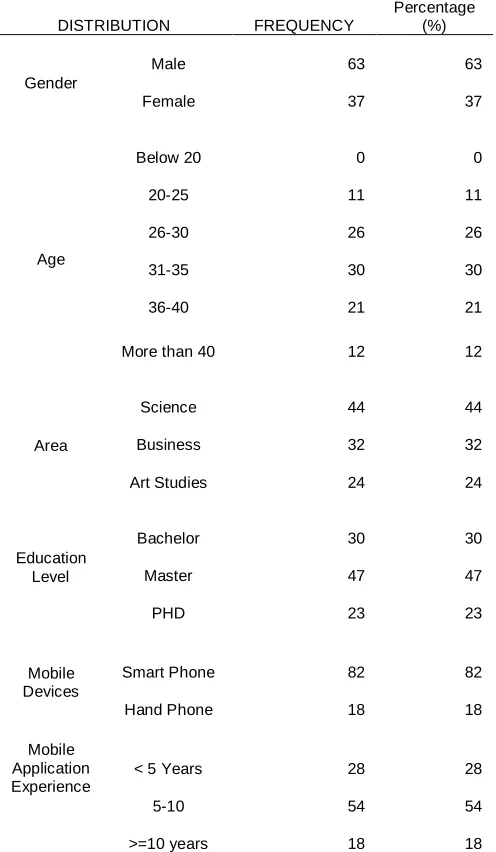
A sample of 100 randomly selected respondents, as shown in the Table 2, 63% of respondents were male and 37% were female, 30% of respondents were aged between 31 and 35 years old. Those in Sciences made up the largest group of respondents (44%), those in Business studies were 32% and lastly those in art studies were only 24%. In terms of education level, most of respondents were in Master level (47%), 82% of the participant declared that they own smart phone and 18 % own a simple Hand phone. Regarding the use of mobile application, 28% have less than 5 years of experience; 54% have experience between 5 and 10 years of use. Thus, it indicates that the respondents are familiar with the subject matter and suitable for this study.
Table 2: Demographic Data
DISTRIBUTION FREQUENCY
Percentage (%)
Gender
Male 63 63
Female 37 37
Age
Below 20 0 0
20-25 11 11
26-30 26 26
31-35 30 30
36-40 21 21
More than 40 12 12
Area
Science 44 44
Business 32 32
Art Studies 24 24
Education Level
Bachelor 30 30
Master 47 47
PHD 23 23
Mobile Devices
Smart Phone 82 82
Hand Phone 18 18
Mobile Application Experience
< 5 Years 28 28
5-10 54 54
>=10 years 18 18
G. User adoptive evaluation
The instrument dimensions of adaptive user evaluation as shown in Figure 5 and Figure 6, compares by their sections and the participants have given the Agent efficiency 94% that is good signed and also the Agent quality information provided by the system around 85% as well as accepts to be
used the system in their environment. In the context of the Agent ease of use of mobile application they were given around 93%, also for the Agent usefulness (89%) and that is shows the participants accept of the mobile application implementation and their performing well to apply it in their teaching and learning environment.
Figure 5: Adoptive user evaluation
Figure 6: System's Capability
7.
CONCLUSION
AND
FUTURE
WORK
population of academics may be limited. Therefore, future research can be examine how academician and student could be communicated remotely without face to face communication. Secondly, They are also considered not only within institution but together with other institutions or organizations called Multi- Institution.
REFERENCE
[1] UMBC Agent Web, http://www.cs.umbc.edu/agents. [2] S. Funfrocken, F. Mattern, Mobile agents as an
architectural concept for Internet-based distributed applications, Proc. IEEE Open Arch. (2001) http://citeseer.nj.nee.com/14154.html.
[3] S. Schmidt, A. Scott, QoS support within active LARAþþ routers, http://citeseer.nj.nee.com/schmid00qos.html. [4] M.L. Griss, G. Pour, Accelerating development with agent
components, IEEE Comput. Mag. 34 (5) (2001) 37–43. [5] N.R. Jennings, An agent-based approach for building
complex software systems, Commun. ACM 44 (2001) 35–41.
[6] S. Franklin, A. Graser, Is it an agent or just a program, Proceedings of the International Workshop on Agent Theories, Architectures and Languages, 1996, http://citeseer.nj.nec.com/32780.html.
[7] N. Jennings, Developing agent-based systems, IEE Proc. Softw. Eng. 144 (1) (1997).
[8] J. Bradshaw, Software Agents, AAAI Press, California, 2000.
[9] T. Magedanz, K. Rothermel, S. Krause, Intelligent agents: an emerging technology for next generation telecommunications, Proc. IEEE Globecom, London, UK (1996) 464–472.
[10] H.S. Nwana, Software agents: an overview, Knowl. Eng Rev. (1996).
[11] G. Weiss, Multiagent systems a modern approach to distributed artificial intelligence, MIT Press, Boston, 2001. [12] Spady, William G. (1994). Outcome-Based Education:
Critical Issues and Answers: ERIC
[13] Barr, Ronald E, Krueger, Thomas J, & Aanstoos, Theodore A. (2006). Continuous outcomes assessment in an introduction to mechanical engineering course. Paper presented at the Frontiers in Education Conference, 36th Annual.
[14] Mansor, W, Hashim, H, Abdullah, S, Kamaluddin, MU, Latip, M, Yassin, AI Mohd, . . . Kamal, M Md. (2008). Preliminary results on the implementation of outcome-based education on the non-examinable computer engineering modules. Paper presented at the Frontiers in Education Conference, 2008. FIE 2008. 38th Annual. [15] Mokhtar, Shamsul Anuar, Anuar, Siti Mashitah Shamsul,
& Puteh, Sayani. (2014). Information system model for the measurement of learning outcome attainment. Paper presented at the Engineering Technology and Technopreneuship (ICE2T), 2014 4th International Conference on.
[16] Tshai, K. Y., Ho, J. H., Yap, E. H., & Ng, H. K. (2014). Outcome-based Education–The Assessment of Programme Educational Objectives for an Engineering Undergraduate Degree. Engineering Education, 9(1), 74-85.
[17] Nyíri, K. (2002). Towards a philosophy of m-learning. In Wireless and Mobile Technologies in Education, 2002. Proceedings. IEEE International Workshop on (pp. 121-124). IEEE.
[18] Laouris, Y., & Eteokleous, N. (2005, October). We need an educationally relevant definition of mobile learning. In Proceedings of the 4th World Conference on Mobile Learning (pp. 290-294).
[19] Baumann, J., Hohl, F., Rothermel, K., & Straßer, M. (1998). Mole–Concepts of a mobile agent system. world wide web, 1(3), 123-137.
[20] Breugst, M., Choy, S., Hagen, L., Höft, M., & Magedanz, T. (1999). Grasshopper—an agent platform for mobile agent-based services in fixed and mobile telecommunications environments. In Software Agents for Future Communication Systems (pp. 326-357). Springer Berlin Heidelberg.
[21] Lange, D. B., & Mitsuru, O. (1998). Programming and Deploying Java Mobile Agents Aglets. Addison-Wesley Longman Publishing Co., Inc..