International Journal in Management and Social Science (Impact Factor- 4.358)
“THE EFFECTIVENESS OF ONLINE ADVERTISING ON CONSUMER BEHAVIOUR IN MODERN AGE”Dr.Rohtash Kumar Garg, Asst.Prof.DIRD,New Delhi
Ms.Himani Goel, Asst. Prof., Delhi Technical campus, Bahadurgarh
Dr.Supreet Singh,Associate Prof.,Delhi School of Professional Studies and Research,New Delhi
Abstract:
Advertisers are expected to shift and spend millions in internet advertising in the coming years than TV, print ads and other traditional advertising media. With the rapid growth in technology, the internet is becoming an important one stop point for consumers in finding most of their needs. Be it communication, entertainment, shopping, information search, internet serves as a panacea for all their requirements.
Many consumers are online every day for their personal work, but do they notice the ads, banners displayed on that webpage and most important their recall value. The study sought to determine the effectiveness of internet advertising on reach and creation of awareness; to establish the reliability of internet advertising through recall; and to determine the relationship between internet advertising and purchase decision.
The study found that internet advertising was effective on reach and creation of awareness due to diverse usage, and established that its reliability as an advertising media was low compared to TV. Internet advertising has significant relationship with purchase decision of the consumers and therefore is a key determinant in influencing consumer behaviour.
The study determined that there is a positive relationship between internet advertising and consumer purchase decision and further recommends that companies should conduct a market research on the different markets in various countries to ensure that the internet advertising initiatives being implemented suits the targeted markets to improve product purchases.
International Journal in Management and Social Science (Impact Factor- 4.358)
INTRODUCTIONOnline Marketing refers to a set of powerful tools and methodologies used for promoting products and services through the Internet. Online marketing includes a wider range of marketing elements than traditional business marketing due to the extra channels and marketing mechanisms available on the Internet. It is also called Internet marketing.
Internet Marketing is any means you use to market your business online. How to market to people has radically changed over the last few years and it can be very confusing to businesses. Social media in particular is an area that has radically changed how you market your business. Consumers are much smarter and are not as interested in messages being broadcast to them and are therefore engaging more with social networks. Through these they are finding out what products to buy, services to use, and so on, based on trusted.
Online marketing can deliver benefits such as: Growth in potential
Reduced expenses Elegant communications Better control
Improved customer service Competitive advantage
Online marketing is also known as Internet marketing, Web marketing, digital marketing and search engine marketing (SEM). The broad online marketing spectrum varies according to business requirements. Effective online marketing programs leverage consumer data and customer relationship management (CRM) systems.
Online marketing connects organizations with qualified potential customers and takes business development to a much higher level than traditional marketing/advertising. Online marketing synergistically combines the Internet's creative and technical tools, including design, development, sales and advertising, while focusing on the following primary business models: E-commerce
Lead-based websites Affiliate marketing Local search
Online marketing has several advantages, including:
Low costs: Large audiences are reachable at a fraction of traditional advertising budgets, allowing businesses to create appealing consumer ads.
Flexibility and convenience: Consumers may research and purchase products and services at their leisure.
Analytics: Efficient statistical results are facilitated without extra costs.
International Journal in Management and Social Science (Impact Factor- 4.358)
Internet marketing is becoming a hot topic in every business sector, and gradually plays a truly important role in any company’s multi-channel marketing strategy. However, how to apply Internet marketing especially how to utilize it to attract more visitors to a certain website is still a big question for a number of advertisers. The thesis mainly covers the acquisition process of Internet marketing after touching upon the basic knowledge of Internet marketing, how the Internet adapts to the marketing mix, as well as companies’ and consumers’ perspectives in pursuing Internet marketing. The two main purposes of this study are to bring a general picture of Internet marketing to its readers and dig into how to drive traffic or attract customers to the Flashgame4fun.com website. The information in the theory part is acquired through many textbooks, articles and websites by using qualitative research method, meanwhile quantitative method is used to collect all important data supporting the case study analysis. The effectiveness of the acquisition process is tested. There is an incredible boost of visits to the website after applying Search engine optimization and link building activities. However, all activities of acquisition process should be combined and implemented continuously to maximize quality visitors. Concerning the Internet there have been many ideas and theories. Due to the fact that the Internet is rather a new phenomenon there is yet room for evolvement. At first marketers, quite naturally, considered online media as extensions of the space and time media—TV, radio, and print. Advertisements during most of online advertising's first 10 years filled measured spaces on web pages with variously sized banners, rectangles, buttons, or leader boards. In fact, a good amount of early advertising industry work focused on defining such spaces, called Interactive Marketing Units, in order to standardize practices for the sale and delivery of paid advertising.The Concept of Internet Advertising
Internet advertising is a form of promotion that uses the Internet and World Wide Web for the expressed purpose of delivering marketing messages to attract customers. Examples of online advertising include contextual ads on search engine results pages, banner ads, Rich Media Ads, Social network advertising, online classified advertising, advertising networks and e-mail marketing, including e-mail spam. Online video directories for brands are a good example of interactive advertising. These directories complement television advertising and allow the viewer to view the commercials of a number of brands. If the advertiser has opted for a response feature, the viewer may then choose to visit the brand’s website, or interact with the advertiser through other touch points such as email, chat or phone. Response to brand communication is instantaneous, and conversion to business is very high. This is because in contrast to conventional forms of interruptive advertising, the viewer has actually chosen to see the commercial.
International Journal in Management and Social Science (Impact Factor- 4.358)
The Concept of Consumer BehaviourThe term "consumer behavior" refers to actions and decisions that factor into a customer's purchase. Researchers, businesses and marketers study consumer behavior to understand what influences a consumer's shopping preferences and selection of products and services. Multiple factors affect consumer behavior, among them economic status, beliefs and values, culture, personality, age and education (Kotler, 2004). Findings on consumer behavior are used to develop methods and products that will boost company performance and sales.
Customers are becoming more powerful, more knowledgeable and more sophisticated, and research into modern consumer behaviour is increasingly important for businesses according. Advertising to attract consumers, providing better environment, product, services and policies is important in improving today’s consumer experience to support businesses in retaining customers. This study seeks to determine and explain the effectiveness of internet advertising in stimulating consumer response.
Major Characteristics of Online Consumers –The typical Internet user of the twentieth century is young, professional, and affluent with higher levels of income and higher education (Palumbo and Herbig,(1998). They value time more than money which automatically makes the working population and dual-income or single-parent households with time constraints better candidates to be targeted by non-store retailers (Burke, 1997). Actually, both demographics and personality variables such as opinion leadership or risk aversive ness are very important factors that are considered in studies trying to determine the antecedents of Internet purchases (Kwak et al., 2002). Confirmatory work shows that income and purchasing power have consistently been found to affect consumers’ propensity to shift from brick-and-mortar to virtual shops (Co-mor, 2000). Internet usage history and intensity also affect online shopping potential. Consumers with longer histories of Internet usage, educated and equipped with better skills and perceptions of the Web environment have significantly higher intensities of online shopping experiences and are better candidates to be captured in the well known concept of flow in the cyber world (Sisk, 2000; Hoffman and Novak, 1996; Liao and Cheung, 2001). Those consumers using the Internet for a longer time from various locations and for a higher variety of ser-vices are considered to be more active users (Emmanouilides and Hammond, 2000). As Bellman et al. (1999) mention, demographics are not so important in determining online purchasing potential. Whether the consumer has a wired lifestyle and the time constraints the person has are much more influential. Risk taking propensity is also a powerful factor. E-shoppers have higher risk taking tendencies.
Online Shopping Behavior–Identifying pre-purchase intentions of consumers are the key to understand why they ultimately do or do not shop from the Web market. One stream of research under online consumer behavior consists of studies that handle the variables influencing these intentions. A compilation of some of the determinants researchers have examined are: transaction security, vendor quality, price considerations, information and service quality, system quality, privacy and security risks, trust, shopping enjoyment, valence of online shopping experience, and perceived product quality. (Liao and Cheung, 2001; Saeed et al., 2003; Miyazaki and Fernandez, 2001; Chen and Dubinsky, 2003).
Uncertainties about products and shopping processes, trustworthiness of the online seller, or the convenience and economic utility they wish to derive from electronic shopping determine the costs versus the benefits of this environment for consumers (Teo et al., 2004). Further studies aiming to complete the full set of factors influencing consumers’ pre-purchase intentions are still much awaited.
International Journal in Management and Social Science (Impact Factor- 4.358)
have a long run presence on the Web. There are two approaches taken to induce loyalty into consumers in an online context.One approach is to focus on concrete factors. For example, creating a convenient and well-designed online store and offering secure transactions are the keystones of satisfying e-consumers (Szymanski and Hise, 2000). However, all satisfied consumers do not become loyal. Personalization attempts and increasing the social value of online experiences are very important to make consumers build strong brand relationships in the cyber world. Although Nunes and Kambil (2001) argue the opposite, some studies find that personalized Web sites and customer communities are highly influential on the consumer brand relationship especially for experienced Internet consumers (Thorbjornsen, 2002). Besides, businesses that can create trust and increase the perceived value of online shopping can turn their satisfied consumers into loyal ones in the e-marketing environment, too (Anderson and Srinivasan, 2003).
Advantages and Disadvantages of Going Online – The excitement created by the unique and innovative characteristics of the Web created a tendency to focus on the advantages created by the medium at first. However, contrary points also emerged rapidly and the pros and cons of going online began to be discussed simultaneously. The operational advantages of being online mentioned by many studies create an extensive list: becoming easily accessible from different parts and time zones of the world, being introduced to global business opportunities, decreased red tape in international operations, possibility to conduct personalized, effective and interactive advertising, the availability of marketing research and analysis tools, lower capital and overhead costs, lower operating costs, decreasing cost of capital, tax advantages, increased efficiency in business-to-business transactions, flexible ordering, better order tracking, leveling the playing field with other firms, enhancing the firm’s image by appearing to be on the cutting edge of technology, and reaching a larger audience of prospective clients (Paul, 1996; Rosen and Howard, 2000; Rozgus, 2000; Elfrink et al., 1997).
However, the disadvantages of going online are just as prevalent and, therefore, the authors of studies that discuss the pros of e-business have shown an equal effort to note the negative sides of going cyber. Privacy and security problems, various operational, strategic and cost-based disadvantages, the difficulty of controlling online transactions and measuring outcomes, high costs of entering e-business, the difficulty of setting prices at an international level, intensified competition, cultural differences,
differences in international trade laws, changes between the telecommunication infrastructure and technical standards of different countries, high costs of individual delivery, the difficulty of dealing with virtual transactions, problems about disintermediation, the fear of technology most consumers experience, the lack of socialization and tactility are only some of the most commonly encountered disadvantages of becoming an online business (Paul, 1996; Rosen and Howard, 2000).
Current Issues in Online Marketing
As the discussions until this point clearly show, Online marketing has become a new avenue for examining many of the traditional principles, models and theories of 20 marketing with a different perspective. However, there are many studies that tackle more current issues in an online context and cannot be grouped under the other major headings in the framework. Therefore, they are compiled in this section as hot topics receiving research attention in recent years and deserving further contributions.
International Journal in Management and Social Science (Impact Factor- 4.358)
which is the most fundamental requirement of any CRM plan. This opportunity has triggered the need to explore how customer relationships can be built and maintained in the online environment. Adopting and implementing online CRM systems have innumerable advantages. Reduction in customer service costs, tightened customer relationships, personalized marketing messages, and mass customization opportunities are some of the benefits offered to customers through e-CRM applications (Johnson, 2002). Research findings shows that customers attribute great importance to being satisfied during and after the sales process compared to the importance they attach to satisfaction from the purchased offering (Khalifa et al., 2002). This heightens the criticality of investing in e-CRM and managing the experience of the customer successfully (Seybold, 2000).Online Marketing Research– The global and continuously interactive nature of the Internet makes it a very fertile platform for performing worldwide online marketing research and both primary and secondary research can easily be conducted through this environment (Karakaya and Karakaya, 1998; Kannan et al., 1998). It can be used for capturing personal, environmental, consumer and competitive intelligence through various online data collection techniques as well as applying more current and hi-tech methods such as virtual shop simulations (Bradley, 1999; Burke, 1996). Past research about multimedia computer representations shows that these techniques can realistically represent people, products, and situations (Urban et al., 1997) and that dynamic consumer behavior can be tracked just as successfully through computer-simulated environments as real research platforms (Burke et al., 1992), thus, increasing the confidence that can be built in collected data through the online environment.
Factors Influencing the Consumers’ Online Information
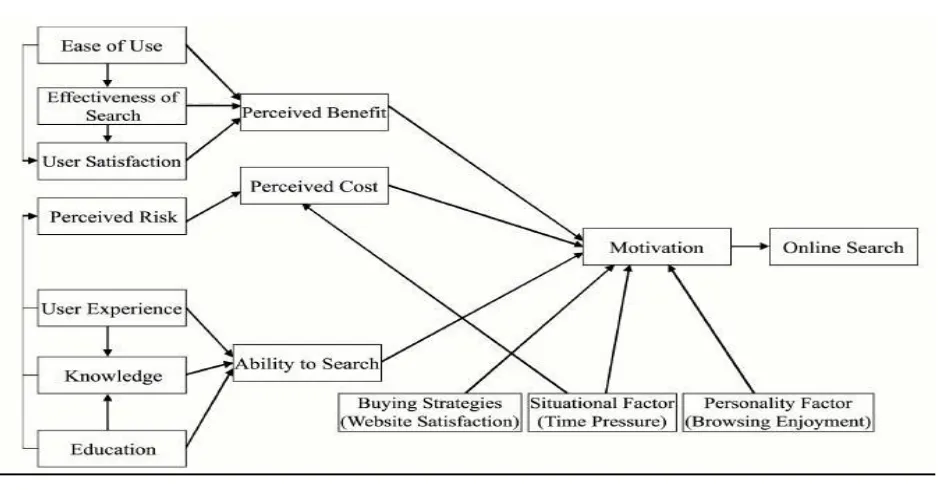
The Web allows for the amassing, analysis, and control of large quantities of specialized data, which enables comparison shopping and speeds the process of finding items. The Web also facilitates trials and can provide instant gratification; customers can test products online, which may stimulate purchase. Ease of use of technology, effectiveness of online search, and user satisfaction are antecedents of the perceived benefits of information search (Kulviwat et al., 2004). Each of these factors is shown in below Figure.
International Journal in Management and Social Science (Impact Factor- 4.358)
1) Ease of Use: Ease of use in the context of online search includes Web design, format, template, and user- friendly program. One key feature is interactivity, which allows consumers to personalize their information search, thereby increasing the perceived benefits of a search.2) Effectiveness of Search: Effectiveness of search can be defined as the consumer’s ability to acquire and utilize relevant information from the external environment (Punj & Staelin, 1983). Interactive decision aids on the Internet (e.g. a wide variety of software tools including search
engines), help consumers locate useful information (Bradlow & Schmittlein, 2000; Haubl & Trifts, 2000), such as screening alternatives and organizing pieces of messages to form a viable consideration set (Alba et al, 1997).
3) User Satisfaction: User satisfaction can be defined as an individual’s positive and/or negative reactions to the use of information or computer technology (Bailey and Pearson, 1983). Information search requires less effort online than offline. Alba
et al. (1997) contends that a significant benefit of online search and shopping is the vast number of alternatives accessible to consumers without physical strain in a brick and- mortar retail environment. For example, it takes far less time and effort to visit a virtual store than a local retail outlet.
4) Perceived Cost of Information Search: Perceived costs consist of monetary, temporal (time), mental, psychological, and behavioral (physical) effort required in a search process. Studies (Punj & Staelin, 1983; Srinivasan, 1990) found that search costs negatively affected search activity as predicted by theory (Stigler, 1961). After all, online search is not effortless
5) Ability to Search: In addition to perceived benefit and cost, ability to search is a major determinant of information search online. Capability to search is related to knowledge education and experience (Schmidt & Spreng, 1996).
6) Buying Strategies: Buying strategies can be conceptualized as either simplifying or optimizing in information gathering. Kiel and Layton (1981) found that consumers satisfied with their previous purchases searched less information for the next purchase. Also, people seem to visit fewer stores online despite the fact that they are “just a mouse click away” from other stores. This is consistent with the idea that consumers are limiting their search to just a few of the most popular sites. Johnson et al. (2000) found that the top 1 percent of Web sites captures 50 percent of all visits to the Web. (Ibid)
7) Situational Factor: Urgency and time pressure are situational variables. An immediate need shortens purchase decision time and therefore reduces information seeking. Time pressure reflects the consumer’s perception of time availability and sacrifice (e.g. ability to do something else or delayed use of the product).
Main potential drivers for consumer adoption of online marketing
1) Accessibility and convenience: The possibility to shop anytime, from anywhere is the most obvious and most commonly cited advantage of online marketing, and was found to be the most important perceived consumer benefit of internet shopping in empirical studies by Jarvenpaa and Todd (1996-1997) and Kangis and Rankin (1996).
International Journal in Management and Social Science (Impact Factor- 4.358)
including a wider availability of hard-to-find products (Benjamin & Wigand 1995. Hoffman et al. 1995. Alba et al 1997).3) Online delivery: For digital products, the whole commercial cycle, including distribution, can be conducted via a network, providing instant access to products immediately when a need arises.
4) Test and trial online: Digital products can be tested over the internet prior to making purchase decisions, reducing uncertainty.
5) The real time nature of the medium: The internet can provide consumers with up-to-the minute information on prices; availability, etc. (cf. Franz 2000)
6) Time savings: Consumers may benefit from the sho-pping process being faster in the market space than in the market place as a result of the rapidity of the search process and the transactions (Wigand & Benjamin 1995, Krause 1998).
7) Possibilities for comparison shopping: By allowing consumers to shop in many places and conduct quick comparisons of offerings and prices (Hoffman et. Al. 1995, Hart et al. 2000), Internet market places have the ability to reduce search costs for price and product information (Bakos 1998, Strader & Shaw 1999, Rowley 2000, Bhatt & Emdad 2001).
Main potential inhibitors for consumer adoption of online marketing
1) Quality evaluation: On the internet, it is more or less impossible to make sure, beyond doubt, that (tangible) products have the desired features (e.g. design, material, color, fit), giving rise to a quality evaluation barriers to online marketing. Empirical findings by Kangi and Rankin (1996) showed that the need to feel a touch was the dominating disadvantage for all home-shopping services.
2) Security risks: It has been suggested that transaction security (such as the credit Card number being picked up by the third party hackers) is mostly a perceptual problem in online marketing (Rose et al. 1999). Nevertheless, the fact remains that it may be one of the more complex barriers to be overcome (Zwass 1996. Alridge et al. 1999, Reddy et al 2000). As studies show that adopters as well as non-adopters of internet shopping have security worries (Furnell & Karweni 1999. Udo 2001. Fenech & O’Cass 2001).
3) Lack of trust in virtual sellers: The fear of fraud and risk of loss has commonly been cited as a significant barrier to B2C e-commerce, with empirical research findings supporting this assumption (Jarvenpaa and Todd (1996-1997), Furnell & Karweni 1999. Hoffman et. Al. 1999, Vijayasarathy & Jones 2000).
4) Delivery times: In tangible product categories, any home-shopping method involves a delivery time which means that the internet is a disadvantage to physical stores as it fails to meet the customers need for instant gratification (Vassos 1996). Consumers may thus be reluctant to wait for the delivery of ordered goods for days/weeks if the same product can be collected immediately in physical outlets.
International Journal in Management and Social Science (Impact Factor- 4.358)
6) Lack of enjoyment in shopping: Many consumers find the shopping experience-looking, feeling, comparing- in retail stores relaxing and enjoyable Jones (1999). As the feeling of amusement and relaxation is unlikely to be as marked in electronic settings, e-shopping can hardly be seen as a substitute for the leisure experience associated with conventional shopping (Phan & Poon 2000).Advantages of online marketing
1) Empowering effect: One of advantages of online marketing is related with its enabling effect especially on small businesses since "internet can extent market reach and operational efficiency of small and medium enterprises (SMEs)3"(Dholekia and Kshetri, 2004: 311). In fact internet creates a kind of democratized environment in which marketing has been restructured in such a way that even small businesses are given a good chance to promote and brand their products on a much more larger scale.
2) Internet Marketing Can Reach Targeted Customers More Effectively: One of the key characteristics of full Internet marketing is that these digital marketing tools were designed to target specific sets of customers or audiences. Unlike traditional mass media marketing where advertisements are broadcasted to anyone, even those who do not like or are not interested in a particular product or service. Internet marketing which is a form on inbound marketing attracts targeted customers who are specifically looking for the brands, products or services a particular digital marketing campaign is focused on.
3) Internet marketing delivers better results: Internet marketing as an inbound marketing tool delivers better result and revenues than traditional marketing channel. This is because an outbound marketing such as newspapers, consumer magazine, radio and TV are getting out of style, whereas inbound marketing tools such as mobile media, social media, social networks and search engines are on the rise.
4) Internet Marketing Delivers Immediate Results: Real-time marketing tools can bring businesses more benefits than other tools. Internet marketing is characterized with real-time interactions that can connect your business much more effectively with targeted customers. What you get are immediate results for your marketing efforts. The results are above-average conversions to either leads or sales every time a targeted customer visits your landing pages or websites.
5) Internet Marketing is Cost Effective: Compared to traditional mass media marketing, Internet marketing is much more cost-effective. Internet marketing also does not require ridiculously large amounts of investment as what businesses have done in the past with mass media marketing. Internet marketing channels are cheaper compare to traditional media channels, and in many cases websites can generate traffic even for free.
6) Internet Marketing Can Reach a Wider or Even International Audience: Since most Internet marketing activities are done online, businesses are not bound by brick-and-mortar limitations when it comes to reaching out to a wider audience. The world just became smaller with Internet marketing, allowing businesses from one part of the world market to another as if they’re just a few blocks away from each other. Geographical distances are now meaningless with Internet marketing, allowing businesses to reach and interact with targeted customers more than they could ever will using traditional marketing methods.
International Journal in Management and Social Science (Impact Factor- 4.358)
easily gauge which particular Internet marketing tool will work for them and bring the best results. On top of that, Internet marketing analytics data can also give digital marketers a better insight about their targeted customers purchasing behavior among other things.Disadvantages Of Online Marketing
1) Internet Marketing Campaigns Can Be Copied: One of the dangers in Internet marketing is that a particular campaign can easily be copied by a competitor, and many have done so with utter disregard for the legal ramifications their actions may bring. Trademarks or logos can be used to defraud customers and take away a sizeable market share from you. Not only that, these can also be used for perpetrating negative and erroneous information about your brand, product or service that will ruin your online reputation – and lose valuable targeted customers.
2)Internet Marketing Can Get Drowned by Too Much Online Ad Clutter: With both legitimate businesses and questionable entities like trolls, spammers and scammers present in the digital marketplace, the Internet is flooded by lots of online clutter. It would really be doubly hard for Internet marketers to get noticed by their targeted customers. Some consumers now have the tendency to simply ignore Internet advertising, making legitimate businesses lose valuable traffic and of course revenues in the process.
3) Internet Marketing Will Not be Taken Seriously if Not Done Professionally: Business owners and digital marketers should focus on bringing their Internet marketing campaigns to professional levels, otherwise they will not be taken seriously by their targeted customers. First impressions really matter whether you use traditional or Internet marketing and advertising channels so it would be to your greatest advantage to stay consistent and professional in whatever channel you are using for your campaigns.
4) Internet Marketing May Not Be Appropriate for Your Product: Some brands, products or services have targeted audiences that may not be reached by Internet marketing channels. Some products and services target the elderly and only a few percentages are tech savvy and may not have access or do not even know how to get online. If that’s the case, you will only be wasting time and resources marketing your products or services through Internet means.
5) Internet Marketing Involves Too Much Competition: Just like the proliferation of online ads, Internet marketing is faced with a great challenge of too much competition. Digital marketers are scrambling to get into a better position for optimum visibility for their marketing and advertising campaigns, and with the presence of too much competition, will make it doubly hard and expensive to get the attention of targeted audiences.
International Journal in Management and Social Science (Impact Factor- 4.358)
ConclusionThe rapid development of online computing technology makes it imperative for businesses to seriously consider the Internet to avoid losing competitive advantage. A Web site gives direct contact between the organization and the consumer. However, product characteristics play an important role in whether the organization benefits from utilizing the Web as a means of direct sales w33x. The research builds upon the literature in both electronic commerce and past research in marketing with the objective of understanding what factors have the most impact on a product’s adaptability to online marketing. the product and service characteristics of to the company cases collected. Among the four functions, logistics has the dominant effect on the channel selection decision because digital products can take advantage of using the Internet for both transaction and delivery processes. The second important function is the product customization potential of the products or services, and that is followed by the transaction complexity and the importance of product availability. where most successful online marketing companies belong to either companies that provide digital products or services or physical products with high customization potential. This outcome matches well with Peterson’s prediction.
References:
Ahmad, Iftikhar and Aatur, Rahman, Chowdhary (2008) ‘‘Electronic Customer Relationship Management (Ecrm)’’ Examined Customers’ Perception Of
Alba, J.W and Hutchinson, J.W. (1987), “Dimensions of consumer expertise”, Journal of Consumer Research, Vol. 13, No.4, pp.411-54.
Alba, J.W., Lynch, J., Weitz, B., Janiszewski, C., Lutz, R., Sawyer, A. and Wood, S. (1997), “Interactive home shopping: consumer, retailer, and manufacturer
incentives to participate in electronic marketplaces “Journal of Marketing, Vol. 61, No.7 , pp. 38-53.
Aldridge, A.; Forcht, K. and Pierson, J. (1997), “Get Linked or Get Lost: Marketing Strategy for the Internet”, Internet Research, Vol.7, No.3, pp. 161-9.
Athyaman, Adee (2002), “Internet Users Intention To Purchase Air Travel Online: An Empirical Investigation” Marketing Intelligence & Planning, Vol. 20, No. 4, pp. 234-242.
Badnjevic, Jasmina and Padukova, Lena (2006), " ICT Awareness in Small
Entreprises in the Indian tourism Branch” Master Thesis. Lulea University of Technology. Available at www.essays.se.
Bakos, J.Y. (1991), “A strategic analysis of electronic marketplaces”, MIS Quarterly, No.3, pp. 295-310.
Bakos, J.Y. (1998), “The Emerging Role of EM on the Internet”, Communications of the ACM, Vol.41, No. 8, pp. 35-42.
Bakos, J.Y. and Brynjolfsson, E. (1999), “Bundling Information Goods: Pricing, Profits And Efficiency”,
Management Science, Vol. 45, No. 12, pp.1613-30.
International Journal in Management and Social Science (Impact Factor- 4.358)
Bakos, Yannis (1997), “Reducing Buyer Search Costs: Implications for Electronic Marketplaces”Management Science, Vol. 43, No. 12, 1676-1692.
Brown, M., Pope, N. and Voges, K. (2003), “Buying or Browsing? An Exploration of
Shopping Orientations and Online Purchase Intention,” European Journal of Marketing, Vol. 37, No. 11/12, pp. 1666-1685.
Chary, Satyanarayan T. and Christopher, Moses T. (2003), “E-commerce and Indian
Consumer” Indian Journal of Marketing, Vol. XXXIII, No. 4, pp. 29-31.
Christian, R. (2001), “Developing an Online Access Strategy: Issues Facing Small-To
Medium-Sized Tourism Hospitality Enterprises”, Vacation Marketing, Vol. 7, No. 2, pp.170-78.
Davis, F.D. (1989), “Perceived Usefulness, Perceived Ease of Use and User Acceptance of Information Technology”, MIS Quarterly, Vol.13, pp. 319-340.
Deng, Shengliang, “Travel Agents’ Attitudes towards Automation and the Delivery of Service,” Asia Pacific Journal of Marketing and Logistics, pp. 60-72. .
Available at www.emeraldinsight.com.
Driver, J.C. (1999), “Developments in airline marketing practice”, Journal of 51
Marketing Practice: Applied Marketing Science”, Vol. 5 No.5, pp. 134–150.
Gilmore, Audrey; Gallagher, Damian and Henry, Scott (2007), “E-marketing and
SMEs: Operational Lessons for the Future” European Business Review, Vol.
19 No.3, pp. 234-247, retrieved from www.emeraldinsight.com/0955- 534X.htm.
Guda, Neeraja (2005), “E-Business-Trends and Issues,” Indian Journal of Marketing,