Journal of Pain Research 2017:10 1991–1996
Journal of Pain Research
Dove
press
submit your manuscript | www.dovepress.com 1991
O R i g i n a l R e s e a R c h
open access to scientific and medical research
Open Access Full Text Article
Disability from posttraumatic headache is
compounded by coexisting posttraumatic
stress disorder
louise s Roper1–3
Peter nightingale4
Zhangjie su5,6
James l Mitchell1–3
antonio Belli5,6
alexandra J sinclair1–3
1institute of Metabolism and
systems Research, college of Medical and Dental sciences, University of Birmingham, 2centre
for endocrinology, Diabetes and Metabolism, Birmingham health Partners, 3Department of neurology, 4Wolfson computer laboratory,
University hospital Birmingham nhs Foundation Trust, 5institute of
inflammation and ageing, college of Medical and Dental sciences, University of Birmingham, 6health
Research surgical Reconstruction and Microbiology Research centre, Birmingham, UK
Background: Posttraumatic headache (PTH) occurs in up to 82% of patients with traumatic
brain injury (TBI). Posttraumatic stress disorder (PTSD) occurs in 39% of those with PTH. This study evaluates whether PTSD affects PTH disability.
Methods: Eighty-six patients with TBI were prospectively evaluated in a secondary care trauma center. Headache disability was assessed using the Headache Impact Test version 6 and signs indicative of PTSD using the PTSD Check List Civilian version.
Results: Increased PTSD-type symptoms were significantly associated with increased headache disability (p<0.001), as were employment status and loss of consciousness (p=0.049 and 0.016, respectively). Age was negatively correlated with headache disability (Spearman’s correlation rho=0.361, p=0.001).
Conclusion: Increased severity of PTSD-type symptoms is significantly associated with
increased headache disability in patients with chronic PTH. Managing PTSD symptoms in patients with chronic PTH may facilitate headache management.
Keywords: chronic headache, traumatic brain injury, neurotrauma
Introduction
PTH is defined as a headache with onset within 7 days of head trauma or within
7 days of regaining consciousness following head trauma.1 It has been reported to
occur in 37%–82% of patients with TBI.2–4 Of these headaches, 47%–95% will
per-sist for >3 months and are defined as chronic PTH.5 Chronic PTH is often persistent over at least 12 months,2,6 with >40% of patients with TBI reporting disability that
persists at 1 year post-injury.7 Phenotypically, PTH resembles migraine in 49% of
cases and tension-type headache in 40%, whereas 11% are undefined.6 Migraine
is the seventh most disabling disease worldwide, and migraine following TBI is a
major cause of disability.8 Subjects with new-onset PTH have decreased ability in
memory tasks, slower reactions, and struggle in returning to their previous physical and social functions following TBI. Thus, PTH has a profound emotional, social,
and economic impact.3,9,10
Headache disability following trauma may be worsened by the presence of comorbid PTSD and has already been documented as more pronounced in those with
preexist-ing primary headaches.9–11 Pre-injury migraine may be the greatest predictor of PTH
frequency and severity,4,6,7,12 with chronic migraineurs being at greater risk than those
with episodic migraine.13 Gender, age, and severity of TBI have also been shown to
influence PTH.4,6,7,11,12,14 Gender and severity of injury interact and have a complex
correspondence: louise s Roper institute of Metabolism and systems Research, college of Medical and Dental sciences, University of Birmingham, edgbaston, West Midlands, Birmingham B15 2TT, UK
email [email protected]
Journal name: Journal of Pain Research Article Designation: Original Research Year: 2017
Volume: 10
Running head verso: Roper et al
Running head recto: Coexisting posttraumatic headache and posttraumatic stress disorder DOI: http://dx.doi.org/10.2147/JPR.S129808
Journal of Pain Research downloaded from https://www.dovepress.com/ by 118.70.13.36 on 24-Aug-2020
For personal use only.
This article was published in the following Dove Press journal: Journal of Pain Research
21 August 2017
Dovepress
Roper et al
effect on PTH. In the case of mild TBI, there is no difference
in the incidence of PTH between men and women;6 however,
PTH is reported to be more prevalent and persistent in women
who have suffered moderate/severe injuries.4,7,11,12 Women
may have greater headache-associated disability than men at
12 months,4,7 and differences in reporting of PTH between
men and women persist at 11 years postinjury.12 Older
patients have less incidence of PTH, but this may represent underreporting in this age group6 and hence requires further investigations.
Patients who have suffered TBI may have symptoms of PTSD. PTSD is a syndrome defined by the DSM-IV as a dis-order related to actual or perceived harm to the individual or a close relative/friend or repeated exposure to aversive details of a traumatic event. Symptoms include intrusive memories, distressing dreams, flashbacks, psychological distress, and
physiological adverse reactions.15 Reported prevalence of
PTSD symptoms following TBI varies widely from 6% to 39% across both military and civilian populations.3,12,16 Head-ache may hinder recovery from the cognitive and behavioral
consequences of TBI.6 Patients frequently have both PTH
and PTSD symptoms,3,6,12,16 but the relationship between the symptoms is less defined.
In this study, we primarily hypothesize that headache disability following TBI is worsened by PTSD. Furthermore, we look at other factors that are associated with headache disability post-TBI.
Methods
Consecutive patients with a history of TBI were prospec-tively seen in the TBI outpatient clinic at University Hospital Birmingham NHS Foundation Trust, UK, a secondary care trauma center, from December 2012 to July 2014. All patients with a TBI were eligible for this study. Patients were excluded if they failed to complete the headache or PTSD question-naires. Ethical approval was given for the collection and use of these data by the Research and Audit Department of the University Hospital Birmingham, Queen Elizabeth. Verbal informed consent was obtained from all participants in this study. Data were collected over 19 months, but the data for each individual related to a single time point. Although informed consent was obtained from patients in order to col-lect these data and analyze them, express permission was not obtained to make the raw data public. The datasets are anony-mous and can be provided as additional files if requested.
Headache disability was assessed using the Headache Impact Test version 6 (HIT-6).17 Scores were categorized into the following groups: severe impact (score ≥60), substantial
impact (score 56–59), limited impact (score 50–55), and little
to no impact (score ≤49).17 PTSD symptoms were assessed
using PTSD Check List Civilian version (PCL-C).18,19 A score of >30 indicates the presence of PTSD symptoms.20 PCL-C is sanctioned by the National Institute for Health and Care
Excel-lence for use in evaluating PTSD symptoms.21 It was chosen
for use in this study due to its relatively few number of items and simple scoring system, which increases its reliability.22
Other factors investigated were the following: gender; educational level (high school or university); ethnicity; employment status (categories based on those used by the
Office of National Statistics, UK23); interval from
admis-sion to hospital to filling in the questionnaire; whether an LOC occurred, either at the time of injury or subsequently up to and including the time of admission; whether seizures occurred, either associated with the injury or within 24 hours
post-injury; GCS on admission (a score of <13 at
admis-sion defined a moderate/severe TBI);1,24 GOS;24 whether the patient was intoxicated with alcohol at the time of the injury; MOI (fall, road traffic accident, attack, home accident, self-harm, sports injury, or unknown mechanism); and severity of the injury on neuroimaging, quantified by the Marshall grading of patient’s first CT scan (scoring 1–6, with 1 being
minimal injury and 6 being considerable).25
Statistical analyses were undertaken on IBM SPSS (ver-sion 20.0, released 2011). Data were not normally distributed, with the exception of age; therefore, nonparametric tests were employed in the main analysis. HIT-6 and PCL-C scores (noncategorical data) were assessed using Kruskal–Wallis and Mann–Whitney U-tests as appropriate. Spearman’s correlations were used to quantify the association between HIT-6 and PCL-C scores. HIT-6 and PCL-C categories (as described earlier) were used for graphical representation but not for statistical analysis. A Bonferroni correction was applied to account for multiple analyses. Data were further evaluated using a multiple linear regression model. Statistical
significance was considered at p≤0.05.
Results
In total, 151 consecutive patients with TBI were approached in a TBI clinic. Twelve patients were not recruited due to the inability to engage with the study. The remaining 139 patients were recruited, but 53 were excluded because they did not complete the headache and PTSD questionnaires, which reflect the primary aims of this study. Therefore, data from 86 patients were analyzed (Figure 1). The majority of
our cohort were white males (n=65, 75.6%) aged 45 ± 20
years. Patients in this study were evaluated at a median time
Journal of Pain Research downloaded from https://www.dovepress.com/ by 118.70.13.36 on 24-Aug-2020
Dovepress coexisting posttraumatic headache and posttraumatic stress disorder
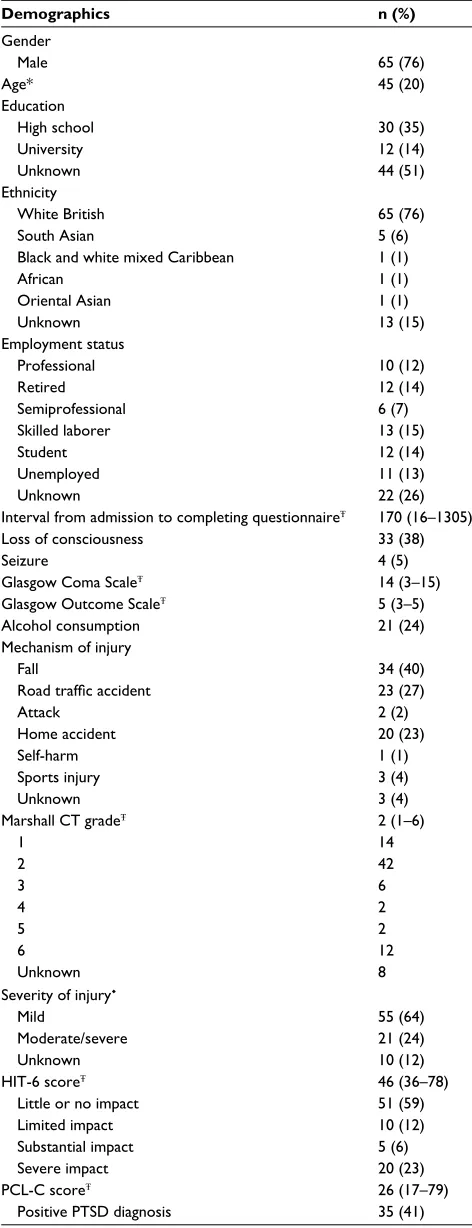
of 5.6 months (170 days) post-injury in an outpatient clinic. Results are displayed in Table 1 and discussed further.
Fifty-five patients (64%) had a mild TBI, and 21 patients (24%) had suffered moderate/severe TBIs (data on severity of injury were not recorded in 10 participants). The median HIT-6 score was 46 (range 36–78). Fifty-one patients (59%) suffered “little or no impact” from their headache; 35 patients (41%) had PTHs, and of these, 25 patients (29%) suffered “severe or substantial impact” as defined by the HIT-6 score (Figure 2A).
Of the 21 patients who sustained moderate/severe TBI, seven (33%) suffered a severe impact from their PTH, whereas of the 55 patients with mild TBI, only 10 (18%) suffered a severe impact of headache (Figure 2A). Conse-quently, we found that there was a trend to a greater severity of headache disability in those with a more severe head injury.
The median PCL-C score was 26 (range 17–79). In our study, 35 participants (41%) had a PCL-C score that indicated a diagnosis of PTSD. Among those with substantial or severe headache disability (HIT-6 score >56), the majority also had PTSD (72%). Among those with low headache disability
(HIT-6 score <49), only 24% had PTSD (Figure 2B).
Thirty participants (35%) had discontinued full-time edu-cation after high school, 29 (34%) were employed, 12 (14%) were retired, and 12 were students.
Thirty three patients (38%) suffered a LOC, either at the time of the injury or on admission. The median GCS on presentation was 14 (range 3–15), the median GOS was 5 (range 3–5), and only four patients (<5%) had a seizure. The median Marshall grade of the CTs of these patients was 2 (range 1–6, mode 2). Falls were the most common mechanism of TBI (34 patients; 40%) in this study.
We assessed factors that were associated with headache disability. PTSD was significantly correlated with headache disability (HIT-6; rho=0.583, p<0.001; Figure 3). Moreover,
151 patients consented for data collection
139 patients completed the data collection process
12 patients excluded due to the inability to engage with data collection
53 patients excluded due to incomplete HIT-6 and PCL-C questionnaires Data from 86 patients
analyzed
Figure 1 Diagram showing the selection of study patients.
Abbreviations: hiT-6, headache impact Test version 6; Pcl-c, PTsD check list civilian version; PTsD, posttraumatic stress disorder.
Table 1 Participant demographics
Demographics n (%)
gender
Male 65 (76)
age* 45 (20)
education
high school 30 (35)
University 12 (14)
Unknown 44 (51)
ethnicity
White British 65 (76)
south asian 5 (6)
Black and white mixed caribbean 1 (1)
african 1 (1)
Oriental asian 1 (1)
Unknown 13 (15)
employment status
Professional 10 (12)
Retired 12 (14)
semiprofessional 6 (7)
skilled laborer 13 (15)
student 12 (14)
Unemployed 11 (13)
Unknown 22 (26)
interval from admission to completing questionnaireŦ 170 (16–1305)
loss of consciousness 33 (38)
seizure 4 (5)
glasgow coma scaleŦ 14 (3–15)
glasgow Outcome scaleŦ 5 (3–5)
alcohol consumption 21 (24)
Mechanism of injury
Fall 34 (40)
Road traffic accident 23 (27)
attack 2 (2)
home accident 20 (23)
self-harm 1 (1)
sports injury 3 (4)
Unknown 3 (4)
Marshall cT gradeŦ 2 (1–6)
1 14
2 42
3 6
4 2
5 2
6 12
Unknown 8
severity of injury
Mild 55 (64)
Moderate/severe 21 (24)
Unknown 10 (12)
hiT-6 scoreŦ 46 (36–78)
little or no impact 51 (59)
limited impact 10 (12)
substantial impact 5 (6)
severe impact 20 (23)
Pcl-c scoreŦ 26 (17–79)
Positive PTsD diagnosis 35 (41)
Notes: *age: mean and standard deviation are shown. ŦMedian and range are
shown for interval from admission to completion of questionnaire, glasgow coma scale, glasgow Outcome scale, Marshall cT grade, hiT-6 score, and Pcl-c score. As defined by the International Classification of Headache (Beta 3 version). Abbreviations: cT, computed tomography; hiT-6, headache impact Test version 6; Pcl-c, PTsD check list civilian version; PTsD, posttraumatic stress disorder.
Journal of Pain Research downloaded from https://www.dovepress.com/ by 118.70.13.36 on 24-Aug-2020
Dovepress
Roper et al
LOC was associated with headache disability (p=0.016). Age
was negatively correlated with HIT-6 scores (rho=−0.361,
p=0.001). Employment status was significantly
associ-ated with both headache disability and PTSD symptoms
(p=0.049 and 0.046, respectively). MOI was associated with
PTSD symptoms (p=0.021), but not headache disability.
No significant association between headache disability and the following factors was found: gender, educational level, ethnicity, interval from admission to completion of the ques-tionnaire, seizures, GOS, presence of alcohol consumption, MOI, and Marshall CT grade. After applying a Bonferroni correction, only age and PTSD were significantly correlated with headache disability. Data were further evaluated in a multiple linear regression model, which highlighted that it was predominantly the PCL-C score (p<0.001) that explained the variability in the HIT-6 score. Furthermore, age was a secondarily significant variable in the multiple linear regres-sion model (p=0.002).
Discussion
In this study of patients with TBI, we primarily evaluated the relationship between headache disability and PTSD symptoms. In addition, we analyzed patient demographics and variables at the time of injury. Patients in this study were evaluated at a median time of 5.6 months (170 days) post-injury, which is consistent with the diagnosis of chronic
PTH (defined as a PTH continuing after 3 months).1 As
hypothesized, we found that, in our cohort of patients, the factor most significantly associated with headache disability was the presence of comorbid PTSD symptoms. This is in keeping with studies of military patients where the Migraine Disability Assessment Score has been found to be associated with the presence of PTSD, despite these military patients sustaining more severe head injuries than patients in our
cohort (64% LOC vs 38% LOC in our cohort).3 Our study
identifies a comorbidity prevalence rate of 40% for PTSD symptoms and PTH, which concurs with the results reported
from another recent work.9
Contrary to the findings of Walker et al,4 we did not find any association between gender and PTH severity. Despite having a similar gender distribution as our study, the study by Walker et al showed that women reported headache symptoms
with 1.89 times more severity than men.4 However, Walker et
al used a different tool to calculate the “headache density”, whereas we quantified the disability associated with our cohort’s headaches.17 Similarly, Ahman et al found that PTSD was more common in women than in men, and that the grad-ing of women’s symptoms was likely to be higher than that of
men’s symptoms.12 This was not the case in our study cohort
as PCL-C scores were evenly distributed across the genders. Furthermore, our additional analyses highlighted that age impacted on PTH. This is in agreement with the results reported by Lucas et al6 who found that patients older than 60
HIT-6 score category
A B
Frequency of patient
s
Little to no impac t
20 40
Moderate/severe TBI Mild TBI
60
0
Limited impact
Substantial impactSevere impac t
HIT-6 score category
Frequency of patient
s
Little to no impac t
20 40
No diagnosis of PTSD PTSD diagnosis 60
0
Limited impact
Substantial impactSevere impac t
Figure 2 The number of patients with little, limited, substantial, and severe impact from PTH, as defined by their HIT-6 score. (A) subcategorization by the number of patients with mild or moderate/severe TBi. (B) subcategorization by the number of patients whose Pcl-c scores indicate the presence/absence of PTsD symptoms. Abbreviations: PTh, posttraumatic headache; hiT-6, headache impact Test version 6; TBi, traumatic brain injury; Pcl-c, PTsD check list civilian version; PTsD, posttraumatic stress disorder.
40 60 80
HIT-6 score
PCL-C score
20 40 60 80
Figure 3 HIT-6 and PCL-C scores correlated significantly (rho=0.583, p<0.001). Abbreviations: hiT-6, headache impact Test version 6; Pcl-c, PTsD check list civilian version; PTsD, posttraumatic stress disorder.
Journal of Pain Research downloaded from https://www.dovepress.com/ by 118.70.13.36 on 24-Aug-2020
Dovepress coexisting posttraumatic headache and posttraumatic stress disorder
years were significantly less likely to report PTH. The mean age of their cohort and ours is similar (44–46 and 45 years, respectively).6 Building on this finding, we show that older age correlated significantly with decreased PTH severity. To ascertain why this is the case, further work is needed; how-ever, we suggest that it may be because primary headaches
are also less common in the elderly26 or because of lower
reporting of headaches in the elderly.
This study is limited by the collection of data at a single time point, and future studies evaluating longitudinal changes will be valuable. Moreover, it is important to understand that although we have identified that the degree of headache dis-ability after brain trauma is associated with PTSD symptoms, this does not imply causation; however, it would be of interest to evaluate whether treatment of PTSD improves headache disability. Furthermore, it would have been interesting to note familial and prior history of migraine, although this was not the primary focus of this study. In future research, a collection of prospective headache diaries, which includes monitoring of headache frequency and severity over time in relation to severity of PTSD symptoms, would be valuable.
Conclusion
We demonstrate, in a population with predominant mild TBI, that headache disability is greatest in those with PTSD symptoms. This is in agreement with studies suggesting that
emotional health can impact headache disability.27
More-over, headache disability is increased in individuals who are younger or lose consciousness at the time of injury. We suggest that in patients with chronic PTH, identifying and treating PTSD may be beneficial for headache management.
clinical implications
• Patients with chronic PTH have greater headache
dis-ability if they also have PTSD.
• Younger patients who lose consciousness at the time of
injury may have the most disability from chronic PTH.
• In patients with chronic PTH and PTSD, headache
dis-ability might be improved if PTSD is actively managed alongside headache management.
Abbreviations
CT, computed tomography
DSM-IV, Diagnostic and Statistical Manual of Mental
Dis-orders, version IV
GCS, Glasgow Coma Scale GOS, Glasgow Outcome Scale HIT-6, Headache Impact Test version 6
LOC, loss of consciousness MOI, mechanism of injury
PCL-C, PTSD Check List Civilian version PTH, posttraumatic headache
PTSD, posttraumatic stress disorder TBI, traumatic brain injury
Acknowledgments
The authors thank Ahmed Al-Jabir for providing technical support.
Author contributions
Louise Roper contributed to data cleaning, data coding and analysis, and writing of the article. Peter Nightingale contributed to statistical analysis. Zhangjie Su contributed to study design, data collection, and review of the article. James Mitchell contributed to review and writing of the article. Antonio Belli contributed to study design and data collection. Alexandra J Sinclair contributed to writing of the article. All authors contributed toward data analysis, drafting and critically revising the paper and agree to be accountable for all aspects of the work.
Disclosure
Dr Alexandra J Sinclair was financially supported by an NIHR Clinician Scientist Fellowship (NIHR-CS-011-028) and by the Medical Research Council, UK (MR/K015184/1). Professor Antonio Belli and Dr Zhangjie Su were financially supported by the National Institute for Health Research Surgical Reconstruction and Microbiology Research Centre. The views expressed are those of the authors and not neces-sarily those of the National Health Service, the NIHR or the Department of Health. The authors report no other conflicts of interest in this work.
References
1. Headache Classification Committee of the International Headache Society (IHS). The International Classification of Headache Disorders, 3rd edition (beta version). Cephalalgia. 2013;33(9):629–808. 2. Lew HL, Otis JD, Tun C, et al. Prevalence of chronic pain,
post-traumatic stress disorder, and persistent postconcussive symptoms in OIF/OEF veterans: polytrauma clinical triad. J Rehabil Res Dev. 2009;46(6):697–702.
3. Rosenthal JF, Erickson JC. Post-traumatic stress disorder in U.S. soldiers with post-traumatic headache. Headache. 2013;53(10):1564–1572. 4. Walker WC, Marwitz JH, Wilk AR, et al. Prediction of headache
severity (density and functional impact) after traumatic brain injury: a longitudinal multicenter study. Cephalalgia. 2013;33(12):998–1008. 5. Defrin R. Chronic post-traumatic headache: clinical findings and
pos-sible mechanisms. J Man Manip Ther. 2014;22(1):36–44.
6. Lucas S, Hoffman J, Bell K, et al. Characterization of headache after traumatic brain injury. Cephalalgia. 2012;32(8):600–606.
Journal of Pain Research downloaded from https://www.dovepress.com/ by 118.70.13.36 on 24-Aug-2020
Dovepress
Journal of Pain Research
Publish your work in this journal
Submit your manuscript here: https://www.dovepress.com/journal-of-pain-research-journal The Journal of Pain Research is an international, peer reviewed, open access, online journal that welcomes laboratory and clinical findings in the fields of pain research and the prevention and management of pain. Original research, reviews, symposium reports, hypoth-esis formation and commentaries are all considered for publication.
The manuscript management system is completely online and includes a very quick and fair peer-review system, which is all easy to use. Visit http://www.dovepress.com/testimonials.php to read real quotes from published authors.
Dove
press
Roper et al
7. Hoffman JM, Lucas S, Dikmen S, et al. Natural history of headache after traumatic brain injury. J Neurotrauma. 2011;28(9):1719–1725. 8. Steiner TJ, Stovner LJ, Birbeck GL. Migraine: the seventh disabler.
J Headache Pain. 2013;14(1):1.
9. Kjeldgaard D, Forchhammer H, Teasdale T, et al. Chronic post-traumatic headache after mild head injury: a descriptive study. Cephalalgia. 2014;34(3):191–200.
10. Monteith T, Borsook D. Insights and advances in post-traumatic headache: research considerations. Curr Neurol Neurosci Rep. 2014;14(2):428. 11. Mihalik JP, Register-Mihalik J, Kerr ZY, Marshall SW, McCrea MC,
Guskiewicz KM. Recovery of posttraumatic migraine characteris-tics in patients after mild traumatic brain injury. Am J Sports Med. 2013;41(7):1490–1496.
12. Ahman S, Saveman BI, Styrke J, Björnstig U, Stålnacke BM. Long-term follow-up of patients with mild traumatic brain injury: a mixed-method study. J Rehabil Med. 2013;45(8):758–764.
13. Peterlin BL, Tietjen G, Meng S, Lidicker J, Bigal M. Post-traumatic stress disorder in episodic and chronic migraine. Headache. 2008; 48(4):517–522.
14. Gladstone J. From psychoneurosis to ICHD-2: an overview of the state of the art in post-traumatic headache. Headache. 2009;49(7):1097–1111. 15. Hull AM, Curran SA. Be vigilant for post-traumatic stress reactions.
Practitioner. 2016;260(1793):19–23.
16. Cifu DX, Taylor BC, Carne WF, et al. Traumatic brain injury, posttrau-matic stress disorder, and pain diagnoses in OIF/OEF/OND Veterans. J Rehabil Res Dev. 2013;50(9):1169–1176.
17. Yang M, Rendas-Baum R, Varon SF, Kosinski M. Validation of the Headache Impact Test (HIT-6™) across episodic and chronic migraine. Cephalalgia. 2011;31(3):357–367.
18. Smith M, Redd W, Duhamel K, Vickberg SJ, Ricketts P. Validation of the PTSD Checklist-Civilian Version in survivors of bone marrow transplantation. J Trauma Stress. 1999;12(3):485–499.
19. Blanchard EB, Jones-Alexander J, Buckley TC, Forneris TC. Psy-chometric properties of the PTSD Checklist (PCL). Behav Res Ther. 1996;34(8):669–673.
20. Using the PTSD Checklist for DSM-IV (PCL). 2015. Available from: https://www.ptsd.va.gov/professional/assessment/documents/ PCL_handoutDSM4.pdf. Accessed June 6, 2017.
21. National Collaborating Centre for Mental Health (UK). Post-Traumatic Stress Disorder: The Management of PTSD in Adults and Children in Primary and Secondary Care. NICE Clinical Guidelines No. 26. Leicester: Gaskell; 2005.
22. Brewin CR. Systematic review of screening instruments for the detection of posttraumatic stress disorder in adults. J Trauma Stress. 2005;18(1):53–62.
23. SOC2010 volume 1: structure and descriptions of unit groups. 2015. Available from: http://www.ons.gov.uk/ons/guide-method/classifica- tions/current-standard-classifications/soc2010/soc2010-volume-1-structure-and-descriptions-of-unit-groups/index.html. Accessed December 19, 2015.
24. Bigler E, Maxwell W. Neuropathology of mild traumatic brain injury: relationship to neuroimaging findings. Brain Imaging Behav. 2012;6(2):108–136.
25. Watadani T, Sakai F, Johkoh T, et al. Interobserver variability in the CT assessment of honeycombing in the lungs. Radiology. 2013; 266(3):936–944.
26. Martins KM, Bordini CA, Bigal ME, Speciali JG. Migraine in the elderly: a comparison with migraine in young adults. Headache. 2006;46(2):312–316.
27. Abu Bakar N, Tanprawate S, Lambru G, Torkamani M, Jahanshahi M, Matharu M. Quality of life in primary headache disorders: a review. Cephalalgia. 2016;36(1):67–91.
Journal of Pain Research downloaded from https://www.dovepress.com/ by 118.70.13.36 on 24-Aug-2020