The Social Cognitive Actor
A multi-actor simulation of organisations
ACTOR X
Cognitive Architecture Knowledge Shared Personal Construct Goals
C
o
m
m
it
s
_
to
ACTOR Y
Cognitive Architecture
Knowledge
Goals C
o
m
m
it
s
_
to
Language action Content information
Social construct
Part_of Part_of Expressed as
Commits_to Influences Commits_to
Influences
Signs Signs
Context / Organization
Exists_in Exists_in
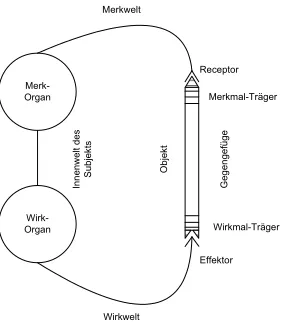
Umwelt
Shared Personal Construct
Postbus 334
2984 AX Ridderkerk The Netherlands Tel: 0180-463962
Printed by: Offsetdrukkerij Ridderprint B.V., Ridderkerk
ISBN-10: 90-5335-100-0 ISBN-13: 978-90-5335-100-0
© 2006, Martin Helmhout
All rights reserved. No part of this publication may be reproduced, stored in a retrieval system of any nature, or transmitted in any form or by any means, electronic,
mechanical, now known or hereafter invented, including photocopying or recording, without prior written permission of the publisher.
RijksUniversiteit Groningen
The Social Cognitive Actor
A multi-actor simulation of organisations
Proefschrift
ter verkrijging van het doctoraat in de Bedrijfskunde
aan de Rijksuniversiteit Groningen op gezag van de
Rector Magnicus, dr. F. Zwarts, in het openbaar te verdedigen op donderdag 30 november 2006
om 13.15 uur
door
Jan Martin Helmhout
Prof. dr. R. J. Jorna
Preface
The dissertation that is in your hands is the fruit of the last four years of research done in the eld of Multi-Agent Systems, Articial Intelligence, Informatics, Cognitive Science, Social Science and Organisation Studies. Bringing together different disciplines has been a challenging and a complex task. The outcome, put together in a simulation model, will hopefully help others discover new ways of practising the art of cognitive and social modelling.
My background as a mechanical engineer may not seem to be in line with the research that I am currently involved in. Indeed, constructs of the philoso-phy of the mind, social construction, multi-actor software programs, and social behaviour seem to differ, in essence, from mechanical engineering.
However, this dissertation focuses on the process of construction as in me-chanics. Only this time, the focus is on social construction. It is probably the topic of social construction that (re-)constructed my thoughts about the (social) world we live in.
I want to thank my promoters Prof. Henk Gazendam and Prof. Ren´e Jorna for this change in looking at the world around me. Although the many discus-sions I had about the functional structure of the mind and how social constructs, shared by people, inuence behaviour even at the lower level of thinking that complicated my vision of the world, they also challenged me to the extent of developing a workable model.
ered in this dissertation. In the early phase of my PhD, I worked together with Diederik Kraaikamp, Luit Gazendam, Ren´e Jorna, Tomas Klos, Jos Schreine-makers and Bart Nooteboom on Agent-Based Computational Transaction Cost Economics. I thank all of them for the fruitful discussions I had with them that delivered new ideas and experience of how a cognitive (social) actor should be modelled (see Kraaikamp, 2003).
Next, a period of programming started that resulted in a software package which can be downloaded from http://sourceforge.net/projects/act-rbot. The software programming consumed many hours of dedication not only by me but also Gijs Roest. Our joined efforts resulted in the RBot-Project (see Roest, 2004) in which Gijs concentrated at creating a new memory model that incorporated the ACT-R model successfully. Gijs, thank you for being such a critical and inventive colleague.
The people who probably understand my work the best are Henk Gazen-dam and Ren´e Jorna. Henk GazenGazen-dam is to be admired, because he not only reviewed my theoretical work, but also my software by transforming his SmallTalk skills into JAVA. He is to be complimented on assimilating many classes and lines of software code. Henk was a constructive reviewer. He not only provided comments like 'onzin' (nonsense) on my work, but also shared ideas and gave detailed arguments that helped improve my work tremendously. Henk, thank you very much for your detailed feedback.
My second supervisor Ren´e is an intelligent and very active researcher who is interested in the cognitive actor; according to Ren´e, an actor is not an (eco-nomic) agent. As a researcher and a cognitive psychologist, he managed to open up the world of cognition to me. As a managerial actor, Ren´e always tried to nd a way to make things possible, be it for research purposes or others, and I have to admit, he always found a way. Ren´e, thank you for sharing your cognitive skills and your passion for research with me.
I also want to thank my promotion committee: Prof. Kecheng Liu as an or-ganisational semiotician and applied informatics expert, Prof. Arndt Sorge as an organisational sociologist and Prof. Ron Sun as a cognitive scientist and cog-nitive multi-agent modeller. I am grateful to them for their suggestions, time and the careful reading of my manuscript. I also would like to thank Prof. John Michon who as a cognitive scientist and Prof. Ron Stamper who as an expert in organisational semiotics provided valuable insights.
Larissa, Ruben, Jan, Filippo, Jacques, Thomas, Bert, Herman, Simon, Hans, Hans, Gert, Gijs, Nick, Mark, Petra, Xander, Sonja, Wander, Kees, Frank, Jo-hanna, Roger, Jan, Willem, Derk-Jan, Marjolein, Wim, Marina and of course the secretaries Sonja, Hennie, Monique, Tanja, Annet and Durkje.
A special thank you goes out to Niels, one of my paranimfen, who always was in for discussions, solved programme puzzles and was a great support throughout my PhD years.
Next, I want to thank my friends in Utrecht and Heerenveen, as well as my family. In particular, I want to dedicate this work to my uncle, a pure scientist (a physicist), who loved academic work as much as I do. I would also like to thank my mother Jannie, Jans, Hanita, Rolf, Mark and Frank who had to bear the burden of listening to many stories about the challenges of doing a PhD. Besides that I want to thank my family in law Polat, G ¨ulten, Banu, Alper, Ilay, C¸igdem and Ali.
And nally, I want to thank my wife Ays¸e. Ays¸e gave me so much, not only her love and care, but also academic support and the consistency of her bright mind.
Groningen, 24 October 2006
Contents
List of Figures v
List of Tables ix
1 Introduction 1
1.1 Motivation . . . 1
1.2 Research background . . . 4
1.3 Methodology . . . 6
1.3.1 The design-based approach . . . 8
1.3.2 Life cycle of a simulation study . . . 9
1.4 Research questions and objectives . . . 11
1.5 Dissertation outline . . . 14
2 Multi-Agent Systems 17 2.1 Agency . . . 21
2.1.1 Weak notion of agency . . . 22
2.1.2 Strong notion of agency . . . 22
2.2 Agent components and architecture . . . 24
2.2.1 Perception and attention . . . 24
2.2.2 Action . . . 25
2.2.3 Interaction between perception and action . . . 25
2.2.4 Cognition . . . 28
2.2.4.1 Memory . . . 28
2.2.4.2 Learning . . . 29
2.2.4.3 Goal-directed behaviour, meta-cognition and emotion . . . 31
2.2.4.4 Environment, communication, language and social ability . . . 32
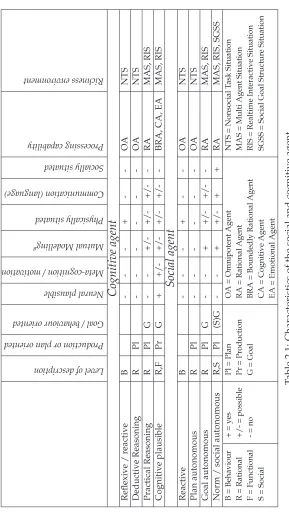
2.3 The cognitive and the social agent . . . 33
2.3.2 The reasoning agent . . . 34
2.3.3 The reective agent . . . 35
2.3.4 The social agent . . . 36
2.3.5 The complete cognitive and social agent . . . 37
2.4 The environment of the agent . . . 42
2.5 Agent and Coordination . . . 45
2.5.1 Cooperation and Conict . . . 45
2.5.2 Coordination mechanisms . . . 48
2.5.2.1 The economic perspective . . . 49
2.5.2.2 The DAI perspective . . . 50
2.6 Multi-Agent System Applications . . . 58
2.6.1 Multi-Agent decision systems . . . 59
2.6.2 Multi-Agent simulation systems . . . 60
2.7 Discussion . . . 60
3 The Social Actor 63 3.1 Social constructivism . . . 65
3.2 Social construction of organisation and society . . . 69
3.3 Social Environment and Semiotics . . . 71
3.3.1 Umwelt . . . 71
3.3.2 Communication and Semiotics . . . 74
3.4 Semiotic level, social constructs and the social actor . . . 83
3.4.1 The situated actor and the semiotic level . . . 83
3.4.2 Social constructs . . . 85
3.4.3 Social constructs and organisation . . . 90
3.4.4 Social constructs: creation, evolution, control and ending . 93 3.5 Discussion . . . 97
4 The Cognitive Actor 101 4.1 Cognitive science . . . 102
4.1.1 Levels of description . . . 103
4.1.2 Connectionism and embodied cognition . . . 105
4.2 The Cognitive Architecture . . . 109
4.2.1 SOAR and ACT-R . . . 110
4.2.1.1 Summary of SOAR . . . 110
4.2.1.2 Summary of ACT-R . . . 112
4.3 Comparing SOAR and ACT-R: selecting a cognitive architecture . 113 4.3.1 Selection of a cognitive architecture . . . 115
4.4 ACT-R . . . 121
4.4.1 Perception and Motor module . . . 123
4.4.2 Goal module . . . 124
4.4.3 Declarative module . . . 125
4.4.3.1 Activation, base-level learning and context of chunks . . . 125
4.4.3.2 Retrieval parameters of declarative chunks . . . 130
Contents
4.4.4 Procedural module . . . 133
4.4.4.1 Procedures and symbolic procedural learning . . 136
4.4.4.2 Procedures and sub-symbolic procedural learning138 4.4.5 The cognitive engine . . . 143
4.4.5.1 Matching (Step 1) . . . 145
4.4.5.2 Conict Resolution (Step 2) . . . 145
4.4.5.3 Execution (Step 3) . . . 147
4.4.5.4 Credit assignment (Step 4) . . . 147
4.4.5.5 Check end-state (Step 5) . . . 149
4.5 Evaluation of ACT-R . . . 149
4.5.1 Multi-Agent System . . . 149
4.5.2 Social behaviour: social interaction and social constructs . 151 4.5.3 The rational and functional level . . . 153
4.6 Discussion . . . 156
5 RBot: Architecture and Design 159 5.1 General Requirements and Overview of the Architecture . . . 160
5.1.1 Patterns . . . 161
5.1.2 Overview of the architecture . . . 162
5.2 The cognitive actor architecture . . . 166
5.2.1 The Memory . . . 168
5.2.1.1 Memorymap, buffer and stack . . . 169
5.2.1.2 Memory Components . . . 171
5.2.2 Controllers and handlers . . . 181
5.2.2.1 Goal Feeder and Goal Handler . . . 182
5.2.2.2 Perception . . . 188
5.2.2.3 Action :: physical memorymap and position handler . . . 189
5.2.2.4 Action :: message memorymap and message handler . . . 190
5.2.2.5 Memory components and estimating the sub-symbolic properties . . . 191
5.2.2.6 Social construct handler . . . 191
5.2.3 View and control of the model . . . 193
5.3 Backend server . . . 194
5.4 The Mixed-Tier . . . 195
5.4.1 Server: control, registration, synchronisation and communication . . . 196
5.4.1.1 Control of the simulation task environment . . . 196
5.4.1.2 Registration of actors . . . 196
5.4.1.3 Synchronisation of processes . . . 196
5.4.1.4 Communication among actors & between actors and task environment . . . 200
5.4.2 The task environment . . . 202
5.4.3 The client: graphs and data presentation . . . 205
6 Demonstrative experiments with RBot and MRS 209
6.1 Verication, Validation and Testing . . . 209
6.1.1 Validation methods and techniques . . . 213
6.1.2 The combined cycles of RBot and MRS . . . 215
6.2 Demonstrative experiments . . . 215
6.2.1 Experiment 1: RBot vs. ACT-R . . . 216
6.2.1.1 The addition-problem . . . 216
6.2.1.2 Results of the addition-problem experiment . . . 219
6.2.1.3 Discussion . . . 222
6.2.2 Experiment 2: Emergence of Social Constructs and Organisational Behaviour . . . 222
6.2.2.1 Description of the experiment . . . 223
6.2.2.2 The model of the experiment . . . 225
6.2.2.3 Results . . . 226
6.2.2.4 Discussion . . . 229
6.2.3 Experiment 3: Social construct as coordination mechanism 231 6.2.3.1 Description of the experiment . . . 232
6.2.3.2 Results . . . 234
6.2.3.3 Discussion . . . 236
6.3 Discussion and Conclusion . . . 237
7 Discussion and Conclusions 241 7.1 Research ndings . . . 241
7.1.1 Theoretical conclusions . . . 244
7.1.2 Implementation and experimental conclusions . . . 247
7.2 New questions raised . . . 250
7.2.1 Questions concerning RBot . . . 251
7.2.2 Questions concerning MRS . . . 253
7.2.3 Questions concerning simulation and application . . . 254
7.3 Further work . . . 255
A Apendix: Addition Productions 259
Bibliography 263
Author Index 283
Index 289
Summary 297
List of Figures
1.1 The logic of simulation as a method. . . 7
1.2 Life Cycle of a Simulation Study. . . 10
1.3 Structure of the dissertation. . . 15
2.1 History of contemporary approaches of (social) simulation theo-ries and technique. . . 17
2.2 Taxonomy of memory types. . . 28
2.3 Agent with components. . . 33
2.4 Nesting of environments. . . 43
2.5 Typology of coordination relationships. . . 45
2.6 The three states of CDPS. . . 51
2.7 Causal network for commitment to joint goal. . . 54
2.8 ARCHON (GRATE*) agent architecture. . . 55
3.1 Social constructivism and overview of levels and theories. . . 65
3.2 Functional circle. . . 73
3.3 Communication model. . . 77
3.4 Components of the actor. . . 80
3.5 Social constructs present at three levels. . . 84
3.6 Social constructs, actors and context. . . 91
3.7 Four meanings of a social construct. . . 99
4.1 The subsumption architecture. . . 108
4.2 Relationship between theory, architecture, models, actor and cog-nition. . . 110
4.3 Architectural structure of SOAR. . . 112
4.4 The organisation of information in ACT-R 5.0. Information in the buffers associated with modules is responded to and changed by production rules. . . 123
4.6 Example chunk, accessed at times 10 and 28. . . 127
4.7 Activation spread between goal chunk and three chunks in memory.128 4.8 Procedure pattern. . . 134
4.9 Example of a procedure pattern. . . 134
4.10 ACT-R engine and interaction. . . 145
4.11 Conict resolution / credit assignment. . . 146
5.1 Patterns for component interaction and distribution. . . 163
5.2 Tier client-server architecture; Multi-RBot System (MRS). . . 164
5.3 Example of a MVC pattern. . . 166
5.4 RBot; comparable with ACT-R. . . 168
5.5 Three types of memorymaps. . . 170
5.6 Example of a buffer / memorymap. . . 171
5.7 Example of a memory structure. . . 173
5.8 Memory components class diagram. . . 174
5.9 Structure of the procedure. . . 176
5.10 Classes that implement the social construct. . . 181
5.11 GoalFeeder & nite state machine of the GoalHandler. . . 183
5.12 Goalstack. . . 185
5.13 Positionhandler. . . 189
5.14 Social constructs and the impact on utility of procedures. . . 192
5.15 User interface of RBot: view and control. . . 193
5.16 Possible database connection models. . . 195
5.17 Registration of an actor. . . 197
5.18 The next-event time-advance approach. . . 197
5.19 The xed-increment time advance. . . 198
5.20 Multi-actor synchronisation clock. . . 199
5.21 Timer communication mechanism. . . 199
5.22 A task environment in action. . . 203
5.23 Server controls who perceives what. . . 203
5.24 Communication between actor and environment. . . 204
5.25 User interface that presents data from the database in a graph. . . 206
6.1 Life Cycle of a Simulation Study; see also chapter 1. . . 211
6.2 The two development cycles of RBot and MRS. . . 215
6.3 A multi-column addition problem. . . 218
6.4 Activation: base level learning and retrievals of chunk 1+1 = 2 and chunk 5+ 7 = 12. . . 220
6.5 Creation of a chunk and the merger of a chunk. . . 221
6.6 Norm selection as a coordination game. . . 224
6.7 Nash equilibrium development over time. . . 224
6.8 Game Frame of two actors trying to pass each other. . . 226
6.9 States and state changes of the productions of an actor. . . 226
6.10 Actor1 & 2: Utility, Successes, Failures of procedure `Left' & `Right'.228 (a) Actor1: Successes, Failures Left . . . 228
(b) Actor1: Successes, Failures Right . . . 228
List of Figures
(d) Actor1: Utility Right . . . 228
(e) Actor2: Successes, Failures Left . . . 228
(f) Actor2: Successes, Failures Right . . . 228
(g) Actor2: Utility Left . . . 228
(h) Actor2: Utility Right . . . 228
6.11 Y coordinates of both actors per time step. . . 229
6.12 The extension of the cognitive engine with social constructs. . . . 232
6.13 Actor1 & 2: Utility, Successes, Failures of procedure `Left' & `Right'.235 (a) Actor1: Successes, Failures Left . . . 235
(b) Actor1: Successes, Failures Right . . . 235
(c) Actor1: Utility Left . . . 235
(d) Actor1: Utility Right . . . 235
(e) Actor2: Successes, Failures Left . . . 235
(f) Actor2: Successes, Failures Right . . . 235
(g) Actor2: Utility Left . . . 235
(h) Actor2: Utility Right . . . 235
List of Tables
2.1 Characteristics of the social and cognitive agent. . . 41
2.2 Classication of interaction scenarios. . . 47
2.3 Strategic form of game theory; the prisoner's dilemma. . . 49
3.1 Jakobson's six functions of languages. . . 76
3.2 Explanations of communicative functions. . . 78
3.3 Similarity between two approaches of communication. . . 80
3.4 KQML dialogue. . . 82
4.1 Levels of description of various cognitive scientists. . . 103
4.2 Comparison of SOAR and ACT-R. . . 118
4.3 Time scale of human action. . . 151
5.1 Example of a procedure and a goalchunk in XML. . . 179
5.2 Format of message chunk. . . 190
5.3 General markup of the actor message. . . 201
5.4 Content of RBot message. . . 201
6.1 Operational Validity Classication. . . 214
6.2 Goal stack addition problem. . . 219
CHAPTER
1
Introduction
M
ULTI-AGENTSYSTEMS (MAS) is a eld of research that is concerned withthe design, analysis and implementation of computational decision and simulation systemsa collection of agents that work in conjunction with each otherto enhance one's understanding of how people cooperate and coordi-nate their actions to solve problems. Upon its foundation in the mid-nineties, MAS propagated in the elds of cognitive science and social science, and was adopted, more specically, in cognitive modelling and modelling of multi-agent interaction as in, for instance, social simulation (Conte & Gilbert, 1995; Troitzsch, 1997). However, there has not been enough interaction between these two elds, and tools that try to connect both elds have not been sufciently developed (Sun, 2006b). In our research, we will address this problem and make an attempt to bring both eldscognitive science and social sciencecloser together.
This chapter is structured as follows. Section 1.1 discusses the motivation for selecting organisational, social and cognitive theories and the need for the deve-lopment of a cognitive agent-based computational social simulation model. Sec-tion 1.2 presents the research background of the dissertaSec-tion. In secSec-tion 1.3, we will elaborate on the methodology applied in this research. Next, the research questions and objectives are outlined in section 1.4 and we end this chapter with section 1.5 that provides an outline of the dissertation.
1.1 Motivation
Moss (2006) states that science that eschews observation in favour of formalism is rife in social science. His claim is that agent-based models can capture inde-pendent validation by . . . ensuring that the specication is well veried with respect to formal models from cognitive science understanding that those for-mal models are themselves well validated experimentally and observationally (ibid., p. 398).
According to Castelfranchi (2001), Articial Intelligence (AI) and, in particu-lar, MASthe cognitive modelling of agents and its learning aspectscan con-tribute to the simulation of articial societies1. On the other hand, cognitive
sci-ence needs Multi-Agent Systems, social simulation, and social scisci-ences in gen-eral (Sun, 2006b). There is a real need for new complex cognitive models that take into account social factors in cognition. In other words, there is a shortage of good ideas and theories that address socio-cultural concepts/signs/symbols within social structures from a cognitive standpoint (Sun, 2001). Cognitive agent-based social simulations have adopted MAS to give insights into social-level phenomena based on the individual agent's actions, i.e. the cognitive social-level. The aim of this dissertation is to design and implement a cognitive agent-based computational social simulation model agent-based on a selection of social and cognitive theories in an attempt to satisfy the need for a complex cognitive-social model. In comparison to models emanating from traditional cognitive-social (and economic) sciences, cognitive-social models enable one to gather, organise, and interpret observations and data more directly and test various factors more thor-oughly (Sun, 2006b). Furthermore, such models are validated by incorporating behavioural descriptions and previously validated concepts from cognitive sci-ence and social psychology at the micro level, and by capturing the statistical output of (longitudinal) studies in the eld of social science at the macro level (Moss, 2006).
The motivation for this research is twofold: (1) to reveal the constituents of MAS and the social cognitive agent (cf. Conte & Castelfranchi, 1995a) based on theoretical considerations to (2) construct a simulation model that plausi-bly explains the interactive social behaviour of agents in a physical and socially situated environment (cf. Gilbert & Troitzsch, 1999). The aim is to relate the be-haviour of individuals (micro level) that form a group or an organisation to the behaviour and performance of a group or organisation as a whole (Alexander & Giesen, 1987; Van den Broek, 2001). This rests on the `methodological individu-alism' assumption that supports MAS methodology:
all description and explanation of social phenomena should ul-timately be in terms of individuals, their properties, and their in-terrelations in terms of these properties (Franssen, 1997) (Van den Broek, 2001, p. 26).
Similarly, it is established in social constructivism (Mead, 1934) that society and all its related issues, such as money and marriage, are products of (sym-bolic) social interaction between individuals. These interactions are caused by
1.1. Motivation
actions of individuals as part of a group. Accordingly, the individual and its interactions with others are the objects of study in this dissertation. Semiotics, as a study of signs and sign systems, is also addressed in this dissertation and is concerned with the `symbolic interaction' of individuals and the (shared) mean-ing that they assign to constructs (i.e. semiotic codes) which they create through semiosis2.
In MAS, it is common to dene varying levels of description; for instance from the biological, cognitive, rational to the social level of description (Newell, 1990). Social and economic sciences often operate at the social level. This is accept-able so far as the properties of actors at lower levels are assumed to be constant (Gilbert, 2006). However, when the analysis of lower levels constrains that at higher levels, or when there is a need to model the social and cognitive levels, then a `mixed-level' analysis is necessary (Sun, 2006b). Under that circumstance, descriptions at one level can be applied to other levels (Gilbert, 2006).
In this dissertation, a mixed-level analysis is performed, in which the follow-ing levels are discerned in descendfollow-ing order:
1. The social level is involved with social laws and overall behaviour of the social system. The advantage of such a level is that it enables the overall system's behaviour to be studied without having to delve into the imple-mentation of the individual [actors] (Jennings & Campos, 1997, p. 3), e.g. it can be explained with the help of population statistics or social net-work characteristics. However, we argue, as this dissertation will make clear, that the individual and other levels of description are important for a better explanation, understanding and prediction of social behaviour (methodological individualism).
2. The semiotic level3, which describes the use of language and signs in
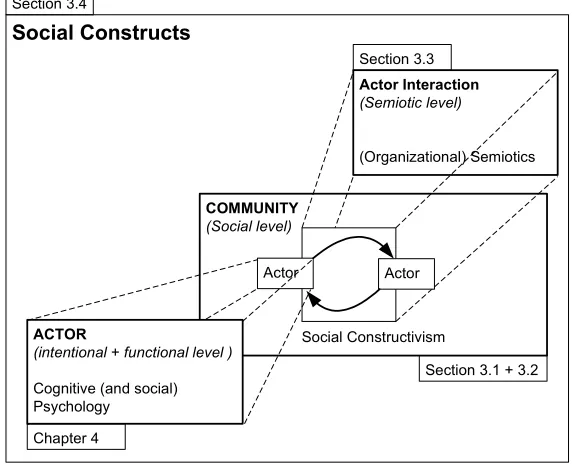
com-munication, interaction and negotiation in order to agree on social con-structs (e.g. common plans, or contracts) (Gazendam, 2004; Helmhout et al., 2004; Helmhout, Gazendam, & Jorna, 2005b).
3. The intentional level, which ascribes beliefs, desires and intentions to actors. Intentions of others, inferred from knowledge about others' beliefs and desires, enable the examination of others' actions (Dennett, 1987).
4. The functional level describes learning and cognitive mechanisms of the actor and is grounded in an empirically validated theory (cf. Anderson & Lebiere, 1998).
5. The physical/physiological level is a level described by appealing to physics, biology and chemistry. It predicts or explains behaviour in terms of phys-ical laws or physiologphys-ical properties (Dennett, 1987).
2Semiosis encompasses the triadic notion of meaning processes, i.e. the interaction between rep-resentamen, the object and the interpretant (Peirce, 1931).
A complete design and implementation of a MAS has to incorporate the ba-sic aspects of all the levels listed above. As signs and symbols are common to all levels, MAS and its agents should support the processing of signs and symbols. The implication for the overall system is that:
1. The actor should be able to process and create signs and symbols, i.e. a cognitive plausible agent is a requirement.
2. The environment should support:
(a) Physical objects that represent signs and symbols.
(b) A communication and social environment that provides an infras-tructure for the transfer of signs and symbols and allows actors to interact in a coordinated manner.
3. The actor must have the capabilities to (socially) construct the world and use a common medium, or language, to exchange, negotiate and reach agreements about (social) constructs with other actors.
A simulation with a MAS can provide (1) valuable insights into and de-scription of organisational behaviour, cognitive and social phenomena (for in-stance, emergence of organisations), (2) locate errors and gaps in verbal theories, (3) demonstrate which theoretical propositions are logically consistent, (4) pre-dict the state of an agent or system in the future, and (5) discover, formalise and test (new) theories based on the simulation outcomes (Carley, Prietula, & Lin, 1998; Gilbert & Troitzsch, 1999).
In this dissertation, we will provide a selection of theories that are applicable for the design of a MAS. We will construct a model of a MAS, named MRS (Multi-RBot System) and a cognitive and social actor, named RBot, by drawing on these theories. An overview of these theories is provided in the following section.
1.2 Research background
This research draws on many theories or research elds such as organisational behaviour and structures, Computational & Mathematical Organization The-ory (CMOT) (Carley & Prietula, 1994a; Carley & Gasser, 1999), organisational semiotics (Gazendam & Liu, 2005), cognitive science/articial intelligence, so-cial constructivist theory and MAS.
CMOT enables the modelling of business organisations, its organisational and authority structures, organisational skills and procedures depending on the position the agent takes in the organisation (Sawyer, 2003). With the help of CMOT, researchers create a formal model to make predictions about an organi-sation as an adaptive system composed of agents who themselves are adapting (Carley et al., 1998).
1.2. Research background
science (Gazendam, 2004). It develops this perspective using the established discipline of semiotics, the theory of signs. The strength of semiotics lies in the theory of signicant symbol processing (sense making, interpretation, know-ledge, information, and culture) and provides a (systematic) way of looking at issues of meaning, interpretation and knowledgea theory of human culture (Van Heusden & Jorna, 2001). The adjustment to one another of the acts of differ-ent human individuals within the human social process (semiosis) takes place through communication by gestures and signicant symbols (Mead, 1934, p. 75). This symbol, clearly present in organisational semiotics, contributes to the explanation of the social and organisational processes and facilitates a deeper understanding of specic aspects related to organisational representation and behaviour.
Apart from the organisational aspect, cognitive science and articial intelli-gence and, more specically, cognitive architecturesthe design and organisa-tion of the mindhave been studied. Theories of cognitive architectures strive to provide a unied/generalised theory of cognitive systems, a description of the functions and its capacities and a set of principles for constructing a set of models, rather than a set of hypotheses to be empirically tested (Sloman, 1999). The two streams of architectures that can be distinguished are the sym-bolic and the connectionist stream of cognitive modelling. The rst architecture is based on a production system4, e.g. SOAR (Lehman, Laird, & Rosenbloom,
2006; Newell, 1990), and the second is based on (neural) networks, in which processing is highly distributed. In contrast to the symbolic architecture, there are no task related modules, discrete symbols, or explicit rules present that gov-ern operations (Rumelhart, McClelland, & PDP Research Group, 1986).
According to Sloman (1996, 1999), hybrid architectures, e.g. ACT-R (Ander-son, 1983; Anderson & Lebiere, 1998) and CLARION (Sun, 2003) that combine elements of both streams, are necessary, because symbolism tends to be capa-ble of manipulating variacapa-bles in a way that matches human competence. On the other hand, connectionism tends to be better in detecting similarities and contiguity5as well as people's ability to deal with and integrate many pieces of
information simultaneously.
In this dissertation, a hybrid architecture is chosen for modelling the actor in order to create a more realistic basis for understanding the impact of individual behaviour in articial societies. Apart from this division in cognitive architec-tures, there is a division in streams within AI. One is the classical approach in which the agent holds a symbol system or internal representation of the envi-ronment to which the agent applies rules, frames, semantic nets or logics, to reason about itself and its (social) position in the environment. The other ap-proach is the situated, or behaviour-oriented apap-proach (Brooks, 1991b; Steels, 1994). The situated or behaviour-oriented approach denes intelligence in the form of observed behaviour and without explicit representation of symbols and without abstract reasoning such as symbolic AI. The systems often have a set
4Production systems are computer languages that are widely employed for representing the pro-cesses that operate in models of cognitive systems (Newell & Simon, 1972; Newell, 1973).
of stimulus-response reactions, i.e. depending on the situation a proper action repertoire is chosen. Situated AI is closely connected to the environment and therefore is often referred to as embodied cognition6. However, the type of
sit-uatedness of embodied cognition is often physical and not social-cultural. The social constructivist theory lls in the void of limited social-cultural situated-ness.
The social constructivist theory (cf. Blumer, 1969; Mead, 1934; Vygotsky, 1962, 1978) can provide the theoretical support for bridging the gap between the behavioural and the classical approach, and introduce social aspects to AI. The social constructivist theory explains how the individual, the mind and the self become part of the society through interaction with others and how the society becomes part of the self7 (Mead, 1934). There is a growing interest in
social situatedness and the social construction of reality (e.g. Brooks & Stein, 1994; Dautenhahn, 1995; Dautenhahn, Ogden, & Quick, 2002; Edmonds, 1998; Lindblom & Ziemke, 2003). Social factors in cognition are being introduced to models to advance their cognitive basis in relation to their social environment, e.g. CLARION (Sun, 2002, 2003).
In this dissertation we also apply theories of Multi-Agent Systems (MAS), which originates from the eld of Distributed AI (DAI) (Bond & Gasser, 1988; O'Hare & Jennings, 1996). In DAI, most systems have a centralised control sys-tem, but with the birth of Internet and multi-processor platforms, researchers have started to experiment with decentralised control structures, in which ev-ery node has its own autonomy8. This notion of autonomy marked the start of
the current commonly-used term agent or actor; an agent is situated in an envi-ronment and is capable of autonomous action in that envienvi-ronment (Wooldridge, 1999).
Multi-Agent Systems deal with autonomous agents that have control over their internal state and the way their actions inuence the environment. In this dissertation, we are interested in the (socially constructed) interactions between agents and the organisational aspects as regards coordination and cooperation. The eld of MAS also claries how models for investigating the behaviour of societies and organisations can be designed and built.
But before building a model, rst an appropriate methodology needs to be selected. In the next section, we discuss the methodology that is applied in this dissertation.
1.3 Methodology
As mentioned before, the aim of this dissertation is to develop an instrument or simulation model. The development of our model requires a
methodologi-6Embodied Cognition is a growing research program in cognitive science that emphasises the formative role that the environment plays in the development of cognitive processes (Cowart, 2006). 7In the interaction with society, the individual internalizes not only the character of the individual but also the roles of all others with whom he has interaction, the so called `generalized other' (Mead, 1934, p. 154).
1.3. Methodology
cal approach that supports the development of an (simulation) instrument. In general, we can distinguish two approaches to conduct research: the empirical cycleexplaining phenomena by developing theory, and the regulative cycle solving real, existing problems in a well-dened, step-by-step manner using theoretical frameworks and models to derive a solution to the problem under scrutiny(Homburg, 1999, pp. 2223)9.
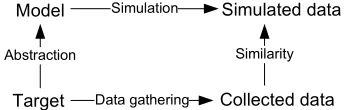
The following distinction makes the difference and the resemblance between those two approaches clear (see Gilbert & Troitzsch, 1999). Statistical modelling conforms to the empirical cycle in which the researcher develops a model based on theory, a set of hypotheses or equations that results in a measurement model thereby creating an abstraction of the real world. The next step is to nd out whether the model generates the predictions by comparing them to data that have been collected in practise (typically assessed by means of tests of statistical hypotheses). In comparison to statistical modelling, the logic of simulation as a method (see gure 1.1) is quite similar. However, in this case, the aim is to develop an instrument10whose methodology is similar to that of the regulative
cycle.
Model Simulated data
Target Collected data
Simulation
Similarity
Data gathering Abstraction
Figure 1.1: The logic of simulation as a method (Gilbert & Troitzsch, 1999).
First, the researcher creates a model of the target (the problem situation), but instead of using statistical equations, the modeller builds a computer program (instrument) that is able to simulate the target (e.g. a social or cognitive process). Next, the computer program generates an amount of data that can be compared to the collected data and thereby validates the model. The main difference be-tween both approaches is that simulation models address the mechanisms that lie behind the processes that determine the nal outcome, whereas statistical models typically aim to explain correlations between variables measured at one single point in time (Gilbert & Troitzsch, 1999, p. 17).
9The empirical cycle contains the following steps: (1) Observationthe exploration of phenom-ena, (2) Inductiondesign of an exploratory model, (3) Deductiondeduction of testable hypothe-ses, (4) Testingconfrontation of hypotheses with empirical data, and (5) Evaluationrejection, revision or corroboration of the model. The regulative cycle contains the following steps: (1) Pro-blem denitionperceived discrepancy between an actual and normative situation, (2) Diagnosis formulation of the problem, (3) Plandesign of solutions, (4) Interventionimplementation of the solution proposed, and (5) Evaluationtest if the gap between actual and normative situation has narrowed (cf. Mietus, 1994; Homburg, 1999; Faber, 2006).
1.3.1 The design-based approach
Simulation models require a different approach than statistical models. In sta-tistical models, the techniques applied for validating stasta-tistical models are well known by researchers in the eld of social sciences and psychology and their corresponding tools are often supplied by software vendors (e.g. SPSS11) or
open-source foundations (e.g. the R project12).
The techniques of computer simulation and more specically the use of multi-agent simulations is not so widespread among researchers in the elds of psychology and social sciences. The use of programs to simulate outcomes of a model is known from the engineering disciplines, e.g. informatics, system engineering and articial intelligence.
When creating statistical models, researchers apply off-the-shelf software that provides tools for analysing outcomes, whereas researchers that create sim-ulation models develop their own programs (possible with help of existing tools) that require a different approach, i.e. it requires an engineering/design-based approach. The development of a program is similar to the engineering ap-proach of constructing a building. First an architect creates a design (the design requirements), then an engineer creates the actual design, and nally, construc-tion people build it. During the design process, from architect till construcconstruc-tion worker, the necessary tests are carried out for verication and validation of the construction, resulting in iteration, redesign and a possible change of plans and design.
As a methodology to design and implement a Multi-Agent System, we have adopted the design-based approach (similar to the regulative cycle) (Beaudoin, 1994; Wright, Sloman, & Beaudoin, 1996), which species that:
1. The requirements of the system need to be specied;
2. Proposals of design need to satisfy those requirements;
3. Designs need to be implemented in a computer-simulation or in hardware;
4. The manner and the extent to which the design meets the requirements, and how the simulation embodies the design need to be analysed; and
5. The space of possible designs surrounding the proposed model should be studied and the design, which originates from an iterative process leading to the attainment of all its requirements, should be reconsidered.
The development of a model is described by Gilbert and Troitzsch (1999) as follows:
One starts by identifying a `puzzle', a question whose answer is not known and which it will be the aim of the research to re-solve. . . This leads us to the [specic] denition of the target for mod-elling [stage 1]. [Next,] some observations [or collections of data] of
1.3. Methodology
the target will be required in order to provide the parameters and initial conditions for our model. One can then make some assump-tions and design the model [stage 2], probably in the form of a com-puter program [stage 3]. The simulation itself is performed by ex-ecuting this program and the output of the simulation is recorded. [Next, w]e need to ensure that the model is correctly implemented and working as intended. This is verication[a step in which the program is debuggedand]. . . validation[stage 4], ensuring that the behaviour of the model does correspond to the behaviour of the tar-get. Finally, one needs to know how sensitive the model is to slight changes in the parameters and initial conditions: sensitivity analysis. (Gilbert & Troitzsch, 1999, pp. 1718)
The development of a simulation model is not a strict linear process but rather a cyclical process whereby, after stage 4, stage 5 is entered and the de-velopment of the model often starts of again by adjusting the requirements or changing the computer model. This process is called the life cycle of a simula-tion study (Balci, 1998).
1.3.2 Life cycle of a simulation study
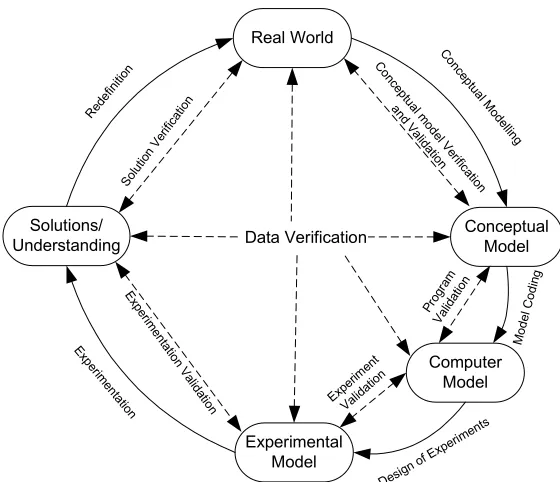
The life cycle of a simulation study exists out of several stages as pointed out in the previous section. This cycle is shown in gure 1.2 (cf. Bosman, 1977; Mitroff, Betz, Pondy, & Sagasti, 1974; Robinson, 2004; Balci, 1998).
The stages or phases in the model are comparable to the design stages dis-cussed in the previous section. The Real World is the idea, situation and/or phenomena to be modelled; the stage in which the requirements are speci-ed basspeci-ed on the real world. Then, the Conceptual Model is the mathemati-cal/logical/verbal representation of the problem; proposals of the design are created that attempt to satisfy the requirements. The Computer Model (e.g. RBot, ACT-R or CLARION) is the implementation of the conceptual model as a pro-gram in a computer. The Experimental Model or models are specic implementa-tions of the computer model that suits a particular study of the real problem, e.g. after the creation of a computer weather model, the experimental model of the weather in Groningen (Netherlands) is the specic application of the weather model to the situation in Groningen. The next stage is doing simulation runs and generating experimental data, and the interpretation, presentation and un-derstanding of the data produced by the experimental model. The data can be compared to the real situation after which the model (and theory) can be rede-ned. The developmental cycle should not be interpreted as strictly sequential, i.e. the circle is iterative in nature and reverse transitions are expected (Balci, 1998).
Real World Conceptual Model Solutions/ Understanding Computer Model Red efin ition C on ce ptu
al M od
ellin g
Mo de
l C od ing E xp erim enta tion Pro gram Val idat ion Sol utio
n V erifi catio n C on ce ptu
al m od
el V er ific ation an d V alida tion E xp erim en ta tio n V alida tion Experimental Model Desig n of E
xperi ments Expe rimen t Valid atio n Data Verification
Figure 1.2: Life Cycle of a Simulation Study (adapted from Balci, 1998; Robinson, 2004).
model. In case of an abstract model (in our case RBot/MRS, see chapter 5), we follow a similar path in developing a model. However, the emphasis is not on a perfect t with specic observed data, but more on the t of mechanisms and phenomena that can possibly match with some real social phenomena.
Gilbert and Troitzsch (1999, p. 19) state that there is a continuum from de-tailed to abstract modelling and that abstract modelling13is research on
`arti-cial societies', i.e. simulation without reference to any specic `real world' target. Or as stated by Epstein and Axtell (1996, p. 4):
We view articial societies as laboratories, where we attempt to `grow' certain social structures in the computeror in silicothe aim being to discover fundamental local or micro mechanisms that are sufcient to generate the macroscopic social structures and collective behaviours of interest.
In our demonstrative experiments (see chapter 6; experiment 2 and 3), we also create an articial society and study social behaviour based on interaction between cognitive plausible actors (RBot), i.e. the actor's cognitive mechanisms are based on ACT-R, which is validated with help of empirical data. However,
1.4. Research questions and objectives
the social phenomena that evolve from interactions between those actors are without reference to the real world.
The aim of our dissertation is to develop an abstract model or toolkit, whose purpose is threefold:
1. It can be applied for modelling and understanding of social and cognitive mechanisms that occur between actors and within actors, i.e. the simula-tion toolkit should allow for easy modelling (create experimental models) of interactive situations between actors delivering results that explain be-haviour at the following levels: the social and interactive level between individuals, the level of the individual and the intra-individual (cognitive) level.
2. The second obvious step (and beyond the scope of this dissertation) is the modelling of specic situations that occur in reality, i.e. the gathering of data of interactions between organisations or people in the real world and comparing those with the simulation outcomes.
3. The third option is the application of the model in the virtual world of for instance e-business, gaming industry and many more situations. In these situations, the simulation program becomes an (pro) active agent that takes part in a virtual organisation or articial society of interacting agents.
The design of our model aims to full the rst purpose and thereby sup-ports other specic research as mentioned in point two and three, i.e. the design (RBot/MRS explained in chapter 5) is an abstract model or tool (purpose 1) that allows for the creation of many models that are suited to specic situations (pur-pose 2 and 3) to which those models should apply. The requirements of the ab-stract model are that they allow for the design of Multi-Agent Systems in order to explain interactive social behaviour between and based on cognitive plausible actors. The abstract model should give freedom for the creation of a range of diverse modelssimple as well as complex models.
1.4 Research questions and objectives
As mentioned before, the aim of the dissertation is to design and implement a cognitive agent-based computational social simulation model to explain in-teractive (social) behaviour based on a selection of theories. This leads to the following research questions that are divided into (1) theoretical research ques-tions and (2) design and implementation quesques-tions.
1 What are the aspects of actors that plausibly explain interactive (social) behaviour?
To answer this question, we need theories, models and requirements that address the individual as well as the interaction between individuals. The fol-lowing three sub-questions will elaborate this:
1.1 What type of a model can explain interactive (social) behaviour?
Methodological individualism and social constructivism argue that social behaviour should be explained in terms of individuals, their properties and their interrelations in terms of these properties. Multi-Agent System as a model and methodology (see chapter 2) supports this view and can serve to explain in-teractive social behaviour; MAS is concerned with the study of behaviour, and the modelling of a collection of agents that interact with each other and their environment (Sycara, 1998).
1.2 What is required for an actor to exhibit (stable) social behaviour?
For an actor to exhibit social behaviour, it requires to create, interpret and exchange signs and meaning with other actors. Although theories of MAS ad-dress coordination, cooperation and negotiation issues, they focus only on social structures and overlook processes that describe how these structures emerge, stabilise and disappear. Whereas social constructivism and organisational semi-otics (see chapter 3) consider that (stable) social behaviour requires (1) the cre-ation of shared knowledge and the social construction of reality (cf. Berger & Luckmann, 1967), and (2) semiotic resources such as signs/symbols/social con-structs that refer to social structures, institutions and habits of action.
1.3 What kind of an actor can plausibly handle signs, relations and social constructs?
An actor that handles signs, relations and social constructs needs to have a system that supports representations and mechanisms that manipulate these representations and exhibit intelligent action. More strongly, a general intelli-gent actor (system), whatever additional structures and processes it may have, will contain a physical symbol system (Newell & Simon, 1976; Newell, 1980). Therefore, the actor should be equipped with a cognitive architecture (see chap-ter 4). Such a cognitive plausible actor is able to generate and process symbols, create and `understand' social constructs and build relations with other actors.
1.4. Research questions and objectives
A simulated environment that provides a physical, communication and social environment for actors to live in.
Social constructs, which are signs that serve as holders for sharing and reinforcing social norms, structures and institutions.
A plausible cognitive agent that consists of a symbol system and cogni-tive/learning mechanisms that support the creation, manipulation, trans-fer of symbols/signs and is able to exhibit intelligent action.
Against this background, we can design and implement a multi-actor sys-tem. This task can be expressed in the form of the following research question.
2 How can (cognitive and social) plausible actors be implemented in a Multi-Agent System?
First, the cognitive actor, which is the main component of a MAS, is con-structed. A production system is chosen from a selection of different approaches that are possible within AI (cf. Ferber, 1999, p. 125). It is the most elaborate choice that matches the necessary requirements for an actor to be a rational pro-blem solver. A realistic computerised model of a cognitive plausible actor could be created with two cognitive architectures, either SOAR (Lehman et al., 2006; Newell, 1990) or ACT-R (Anderson & Lebiere, 1998). ACT-R was chosen here as the architecture to model the individual actor (see chapter 4 for a discussion). In its most recent release, ACT-R is an architecture of a single agent for which no multi-agent architecture version is yet available. Therefore, the ACT-R ar-chitecture is transformed and extended into a new arar-chitecture, named RBot. Together with a newly created MAS environment (Multi-RBot System or MRS), it is possible to incorporate multiple actors in a task environment.
In order to test the validity of a cognitive actor (RBot) as part of the new model (MRS), a comparison14with ACT-R is made in this dissertation.
Conse-quently, the accompanying question is:
2.1 Is RBot comparable to ACT-R as a valid cognitive plausible actor?
After modelling the single actor and the platform on which to run multiple actors, a test is performed to see whether social constructs can emerge from the interaction of actors. The accompanying task environment is based on a well known experiment of trafc laws (Shoham & Tennenholtz, 1992a, 1995). In our task environment, actors face each other and need to pass each other to make progress. They have two choices. They can either drive left or drive right. Colli-sion detection allows actors to react to each other's behaviour and, if necessary, to correct their behaviour.
Computational & Mathematical Organization Theory serves as an enlighten-ing example of how organisational and social aspects (e.g. the trafc laws) can
be modelled with the help of MAS. CMOT is a multi-level system that is de-scriptive at the individual levelcognitive plausible actors as boundedly ratio-nal individuals (March & Simon, 1958)and normative at the second level, i.e. the rules of the game such as dening different roles and authority structures. However, models of CMOT such as Radar-Soar (Carley et al., 1998) have the drawback that the macro-features of the model are pre-programmed (off-line) and do not emerge during interactions. The approach in this dissertation is to see whether behaviours, i.e. social constructs, can emerge from the interactions of agents, without the need to pre-program behaviour. An experiment is desig-ned based on the proposed task environment to demonstrate the emergence of social constructs. The question that the experiment tries to answer is:
2.2 Is it possible that social constructs and organisational beha-viour can emerge from social interaction?
In many situations, the interaction between agents is guided by social con-structs that are formed as a habit between actors. The society is lled with rules (March, Schulz, & Zhou, 2000) that emerge from interactions, take on an im-plicit or exim-plicit form and survive until they are no longer exercised. Coordina-tion and cooperaCoordina-tion is only possible when agents that interact with each other are aware of each other's social needs. In other words, the actor should have not only a representation of itself and the environment, but also that of (i.e. the needs of) the others; the society as a whole. The model of the cognitive agent is enhanced by adding a normative level of social constructs as representations to the actor rather than to the overall system. The question that the last demon-strative experiment tries to answer is the following:
2.3 Is a social construct a coordination mechanism that can inu-ence the behaviour of interacting related actors towards a cer-tain desired behaviour?
The objective of the design and implementation questions (2.1 until 2.3) is to address the mechanisms inside the actor that are inuenced by interactions with other actors and thereby socially constructed. The underlying assumption is that the actor is socially connected to others on a continual basis. The second objective is that these questions are simultaneously design questions. First, the requirements are drawn up. Second, the design or model is constructed. This is followed by an implementation of the system, and fourth, demonstrative ex-periments show its working. The design questions guide the construction of a model that attempts to bridge the gap between cognitive and social sciences (cf. Sun, 2006a).
1.5 Dissertation outline
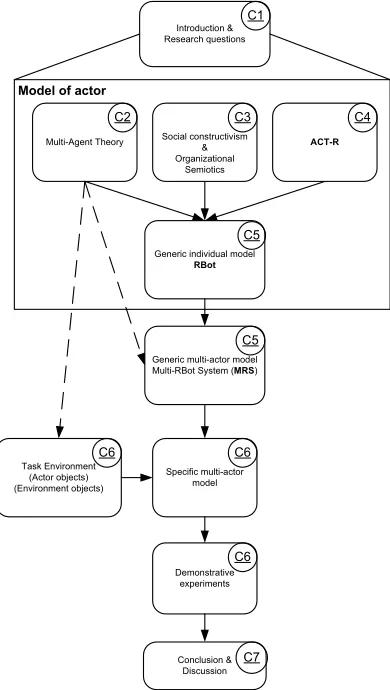
1.5. Dissertation outline
Chapter 2 commences with a general introduction to Multi-Agent Systems. The chapter explains the notion of agency regarding different types of agents and how these agents interact with each other in an environment. It gives the reader an overview of the literature in the area of MAS.
ACT-R
Generic individual model
RBot
Social constructivism & Organizational
Semiotics
Generic multi-actor model Multi-RBot System (MRS)
Specific multi-actor model
Model of actor
Task Environment (Actor objects) (Environment objects) Demonstrative experiments Multi-Agent Theory Conclusion & Discussion Introduction & Research questions C1 C3 C4 C5 C5 C2 C6 C6 C6 C7
Figure 1.3: Structure of the dissertation. Chapter 3 introduces the social
ac-tor and explains several theories in-cluding the social constructivist the-ory and organisational semiotics that bridge the gap between social (beha-vioural) and cognitive science. The theory describes how actors can be em-bedded in organisations and society. Secondly, based on these theories, a model of the social actor is presented, i.e. a model that is reactive, pro-active and socially and physically situated in the environment.
In chapter 4, the selection of a cog-nitive architecture is discussed. The cognitive architecture ACT-R is selec-ted as the architecture for constructing a computer model (RBot) of a cognitive plausible actor. ACT-R is discussed in detail, because it is the main contribu-tor to the new RBot model. The sub-sumption architecture (Brooks, 1986) is drawn upon as a supporting theory to implement social behaviour at a nor-mative level.
In chapter 5, the design chapter, we will discuss (1) the architecture of the social and cognitive actor (RBot), and (2) the multi-agent environment (MRS). First, the actor is modelled in a bottom-up approach starting with the memory model, then the controller and handlers, followed by the imple-mentation of social constructs. Second,
the server (as part of MRS) is modelled in which a controller regulates (1) reg-istration of actors, (2) the time synchronisation between actors happens, (3) the communication between actors with the help of a message-based architecture is regulated, and (4) the physical, communication and social environment is main-tained.
behaves similar to ACT-R in solving this problem, i.e. with help of a goal stack, a set of procedures and a declarative memory.
The other two experiments demonstrate the working of RBot as well as its benets in explaining the emergence and inuence of social constructs as a coor-dination mechanism. The rst one of these two experiments is a trafc situation in which two actors confront and try to pass each other. Both actors have a sim-ilar set of procedures. However, they have a choice of selecting either the left or the right side to pass the oncoming driver/actor. The interaction between the actors and the individual experience of success and failure in passing the other emerge into a stable behaviour over time. The assumption is that both actors/drivers build up a preference, or come to a tacit mutual agreement that is in favour of both actors. The other, and the last, experiment is an extension of the previous trafc situation. However, in this experiment, one of the actors acts as an authority (a policeman assigned by society) to communicate laws or social constructs to other actors. Compared to the previous experiment, the authorita-tive actor in the last experiment is equipped with a mechanism that supports it in conveying the `rules of the game' to inuence the behaviour of others when rules are not abided by.
CHAPTER
2
Multi-Agent Systems
T
HE rst chapter has discussed the issue of how cognitive science can con-tribute to social sciences in order to explain interactive social behaviour. In chapter 5, we will develop a new cognitive agent-based computational social simulation model (RBot) in an attempt to satisfy the need for new theories and models. In this chapter, we will discuss Multi-Agent Systems (MAS) as one of the theories for the development of such a new model.Multi-Agent Systems (MAS) is the name for a new approach of design-ing, analysing and implementing complex adaptive software systems (Jennings, Sycara, & Wooldridge, 1998). This approach has emerged out of a history of the-ory and applications in the area of (social) simulation models.
Differential equations 1700
1900
1940
1950
1960
1970
1980
1990
2000
System dynamics
World dynamics
Stochastic Processes
Microsimulation Queueing models
Workflow BPR CA models Cellular Automata Game theory
Artificial Intelligence (AI)
Distributed AI
Distributed Problem Solving (DPS)
Multi-Agent Systems (MAS) Discrete Event
Simulation
Informatics (Cognitive) psychology Social science
Economics
Figure 2.1 shows a selection of simulation theories and techniques that have been developed over the years and many of them have been applied in the eld of MAS and social simulations. The early development of simulation techniques at the left side of the gure are primarily based on mathematics. Moving to the right, there are simulations and theories that exist because of the introduction of the computer and at the bottom right, we can see the inuence of Internet on the upcoming popularity of Distributed AI and Multi-Agent Systems.
Mathematical theories, e.g. differential equations and stochastic processes, require specic skills for describing deterministic and stochastic processes in an attempt to predict or describe phenomena such as the dynamics of populations (Volterra, 1926). Game theory, discussed later on in this chapter, is a form of ap-plied mathematics to understand economic behaviour based on interactions or games between rational agents who try to maximise their prots. Game theory still has great inuence in describing outcome strategies in simulations.
In the 1960s, the rst computer simulation models were developed with help of queueing models, discrete-event simulations (Birthwistle, Dahl, Myhrhaug, & Nygard, 1973) and system dynamics (Forrester, 1991). Around the same time, micro-simulation or micro-analytical simulation models (MSMs) emerged as a simulation technique.
[MSMs have] been used to predict individual and group effects of aggregate political measures which often apply differently to dif-ferent persons. . . [They] consist of at least two levels: the level of in-dividuals or households (or the level of enterprises) and the aggre-gate level (for example, the population or national economy level). (Gilbert & Troitzsch, 1999, pp. 5355)
Another approach that emerged was cellular automata whose behaviour emerges from properties of local interactions. The basic model of a cellular au-tomata is a two-dimensional grid of cellsthe structure of squared paperin which a cell reacts only with its neighbouring cells. The simulation uses a time-step generator and at every time-time-step, every cell reacts to its neighbours accord-ing to a set of rules. In this way a stepwise reaction will ow through the grid and inuences the overall behaviour of the system.
To summarise, cellular automata model a world in which space is represented as a uniform grid, time advances by steps, and the `laws' of the world are represented by a uniform set of rules which compute each cell's state from its own previous state and those of its close neighbours. (Gilbert & Troitzsch, 1999, p. 122)
in its core the `blackboard'a place where the KSs can share their knowledge and which is managed by a separate control device that has the task to prevent and coordinate conicts of access between these KSs. Around the same time another type of control system (cf. Lenat & Brown, 1984; Lenat, 1975) came up that solved problems with help of a community of specialists. Hewitt (1977) de-scribed control structures in which he did not consider processes as a sequence of choices, but he tended to think in terms of distributed systems considering control structures as patterns of message passing between active entities called actors (Ferber, 1999, p. 25)1.
The roots of DAI are the foundations of today's two approaches in DAI: Distributed Problem Solving (DPS) and Multi-Agent Systems (MAS) (Bond & Gasser, 1988). DPS takes a pure engineering approach to distributed systems, i.e. it is concerned with how to build functioning, automated, coordinated pro-blem solvers for specic applications (Bond & Gasser, 1988, p. 4) (as cited by Van den Broek, 2001, p. 21). The approach taken by DPS is a top-down approach in which tasks are decomposed into smaller tasks appointed to specialists.
A DPS is. . . a top-down designed system, since agents are desig-ned to conform to the problem-solving requirements specied at the top. Within this top-down task decomposition approach, the indi-vidual components are considered to be of secondary importance to the need of the overall system. The agents themselves have limited autonomy because their role in solving the overall problem is usually designed-in, with coordination rules included. (emphasis added: Van den Broek, 2001, p. 22)
On the other hand, a MAS is constructed taking the bottom-up approach. The agent itself is now the centre of attention and not the system as a whole. In a MAS, the agent has more autonomy, and control is delegated to the agent, i.e. the overall outcome of solving the problem is not determined by a strictly top-down organised control system, as in the case of DPS, but by (social) interactions between independent and rational agents making decisions that satisfy their own (be it social) goals.
1There is not a clear denition about or difference between the terms `actor' and `agent'. For instance, Hewitt gives the following description of the actor: The actor metaphor for problem sol-ving is a large human scientic society: each actor is a scientist. Each has her own duties, specialties and contracts. Control is decentralized among actors. Communication is highly stylized and formal using messages that are sent to individual actors (Hewitt, 1977, p. 350). Apart from the description, he gives the following remark: The reader should keep in mind that within the actor model of computation there is no way to decompose an actor into its parts. An actor is dened by its behavior; not by its physical representation (Hewitt, 1977, p. 327).
In this dissertation we adopt MAS as theory and methodology for simulating organisations for the following reason:
. . . [M]ultiagent systems applied within the natural systems ap-proach[2] provide the required methodological position in
simulat-ing organisations. The multiagent system approach exploits the full potential of the DAI paradigm because of its emphasis on the emer-gence of a system level and a strong notion of [agency3] resulting in
higher autonomy levels in agents. In this way, the agents become more socio-realistic in that they might compete and disagree with other agents, and generally act in their own best interest. The re-sult is that coordination among the agents is necessary in order to achieve coherent collective behavior. Hence, multiagent models per-ceived in this way are bottom-up models of coordinated problem solving. (Van den Broek, 2001, p. 24)
In other words, MAS can supply us with the means to study what the aspects of actors are that plausibly explain interactive (social) behaviour (see chapter 1; research question 1). Hence, MAS is concerned with the behaviour of a col-lection of distributed autonomous (heterogeneous) agents aiming at solving a given problem. The characteristics of a generic MAS are (Jennings et al., 1998):
Each agent has incomplete information, or capabilities for solving the pro-blem, thus each agent has a limited viewpoint;
There is no global system control;
Data is decentralised; and
Computation is asynchronous
Inferred from these characteristics, the main component studied in Multi-Agent Systems is the autonomous agent and its associated behaviour in an envi-ronment.
The approach taken in this chapter is to explain MAS starting with the in-dividual agent and subsequently going towards a system of (cognitive) social agents that considers relations, coordination and interaction between agents. The purpose of the chapter is not to provide a detailed review of the eld of MAS, but to accustom the reader with the paradigm MAS4.
This chapter is structured as follows. First, in section 2.1, the notion of agency is discussed to clarify the term agent. The term agent is applied in many research elds, e.g. biology, economics, cognitive science, social science and so on, and therefore has become somewhat blurred. In section 2.2, we ap-proach the agent as a human-like entity in which components, e.g. perception,
2A natural systems approach. . . stud[ies] the strategies and representations that people use to coordinate their activities, in much the same way the cognitive scientists investigate individual cog-nition in people (Van den Broek, 2001, p. 23).
3The strong notion of agency will be explained in the next section.
2.1. Agency
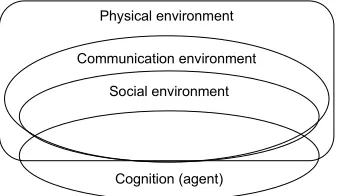
cognition, action and so on, form the basis for constructing an agent architec-ture. Section 2.3 describes two agent typologies: the cognitive agent commonly used in AI and the social agent. Whereas the cognitive approach focuses on the internal working of the agent, the social approach studies how (socially) well an agent is embedded in its social-cultural environment. The environment plays an important role in the design of an agent; it, in part, denes how many degrees of freedom an agent possibly can have. In section 2.4, the distinction between a physical, communication, social and task environment is described. An environment allows agents to interact with other agents and at the same time, scarcity of space, time and objects in an environment can create conicts between agents. In section 2.5, several types of coordination mechanisms are discussed that enable conicting agent to negotiate and cooperate. Many sit-uations in our daily life are solved with the help of coordination mechanisms. For instance, trafc lights function because we understand the meaning of the coordination mechanism. Such understanding solves problems that otherwise would occur when several cars want to occupy the same space (crossroad) at the same time. Section 2.6 discusses the applications that are implemented in the eld of MAS. They vary from simple desktop applications for consumers, to-wards complicated distributed real-time systems in the industry. Applications of MAS areespecially on the Internetwidespread and have proven them-selves a worthy competitor to alternative systems, i.e. due to the Internet, MAS applications are more wanted than ever before and can be the answer to many of today's coordination problems. Finally, section 2.7 closes the chapter with a discussion about what kind of agent and theory is important for our research, i.e. the type of agent will be selected from a variation of agents that differ in the way they are constructed, from simple to very complex. The complexity of such a construction depends on the philosophical ideas behind the design of the agent and its environment, and the amount of complexity we need in order to answer the research questions.
2.1 Agency
2.1.1 Weak notion of agency
The weak notion is a general way to describe the term agent as a hardware or software-based computer system with the following properties:
Autonomy: agents operate without direct intervention of humans or others,
and have some kind of control over their actions and internal state (Castel-franchi, 1995).
Social ability: agents interact with other agents (and possibly humans) via
some kind of agent-communication language (Genesereth & Ketchpel, 1994).
Reactivity: agents perceive their environment and respond in a timely fashion
to changes that occur in it.
Pro-activeness: agents do not simply act in response to their environment, they
are able to exhibit goal-directed behaviour by taking the initiative. The weak notion is applied in situations where behaviours, in contrast to the strong notion, are described at a high level of abstraction.
2.1.2 Strong notion of agency
In the eld of AI, the notion of agency is stronger and apart from the charac-teristics of the weak notion, agents have additional properties, such as mental attitudesknowledge, beliefs and so onor representations (Jorna, 2002), i.e. an agent is . . . an entity whose state is viewed as consisting of mental com-ponents such as beliefs, capabilities, choices, and commitments. These compo-nents are dened in a precise fashion,. . . (Shoham, 1993, p. 52). Strong agents are often dened in more detail and can be described at the intentional or the functional level of description. Dennett (1987, 1978) introduced a distinction in various levels of description. He discerned a physical, a functional and an intentional level (or stance) of description.