R E V I E W
Primary Resistance Pattern of
Helicobacter pylori
to
Antibiotics in Adult Population: A Systematic
Review
This article was published in the following Dove Press journal: Infection and Drug Resistance
Gebremicheal
Gebreslassie Kasahun 1 Gebre Teklemariam Demoz 2 Desilu Mahari Desta 3
1Pharmacoepidemiology and Social
Pharmacy Unit, School of Pharmacy, College of Health Science, Aksum University, Aksum, Ethiopia;2Clinical
Pharmacy Unit, School of Pharmacy, College of Health Science, Aksum University, Aksum, Ethiopia;3Clinical
Pharmacy Unit, School of Pharmacy, College of Health Science, Mekelle University, Mekelle, Ethiopia
Background:Helicobacter pyloriis a spiral-shaped gram-negative bacteria associated with peptic ulcer, gastritis and gastric cancer. The global burden and occurrence of H. pylori
infection remains prevalent and worldwide. Despite this, the trend of the bacterial resistance is not recently studied which can help in the adoption of global, regional and local prevention strategies.
Objective: The aim of the study was to systematically review the existing published literature that presents the estimate ofH. pyloriantibiotic resistance.
Methods: A protocol was primarily registered in PROSPERO International prospective register of systematic reviews and has given a registration number CRD42017068710. It was registered after checking whether there was similar study being conducted. A database search (PubMed/Medline and Google scholar) was used to collect relevant articles. A standardized form was prepared for the extraction of relevant data from studies which fulfilled the eligibility criteria. A National Institute for Health research (NIH)-based quality assessment tool was utilized to assess the quality of studies included in the study.
Results:Our searching process has retrieved a total of 288 publications which later resulted in 38 articles for full-text review. Among the 38 articles reviewed in full text, 14 studies were included which fulfilled the inclusion criteria.H.pylori-pooled overall prevalence rate of antibiotic resistance was found to be 4.55% (95% confidence interval (CI): 3.96–5.22%) to amoxicillin, 27.22% (95% CI: 25.89–28.58%) to clarithromycin, 39.66% (95% CI: 38.20–41.15%) to metronidazole, and 22.48% (95% CI: 21.24–23.76%) to levofloxacin.
Conclusion:The primary antibiotic resistance pattern ofH. pyloriis increasing worldwide. Thus, implementation of local drug susceptibility surveillance program, rational prescribing and use of antibiotics are necessary.
Keywords:H. pylori, primary antibiotics resistance, drug resistance, systematic review
Background
Helicobacter pylori is a spiral-shaped gram-negative bacteria which colonize the gastric or intestinal mucosa of humans and induce histologic inflammation.1,2It is
associated with peptic ulcer, gastritis and cancer.2,3 The infection of H. pylori
remains a prevalent and worldwide chronic disease. It causes more than 90% and
80% of duodenal and gastric ulcers, respectively.1,4This shows the world
popula-tion is highly infected with H. pylori. About one-third of the adult population
residing in Northern Europe and Northern America were found infected with
H. pylori. Moreover, above 50% of population living in Southern and Eastern
Correspondence: Gebremicheal Gebreslassie Kasahun
Tel +251-914 586 170
Email [email protected]
Infection and Drug Resistance
Dove
press
open access to scientific and medical research Open Access Full Text Article
Infection and Drug Resistance downloaded from https://www.dovepress.com/ by 118.70.13.36 on 24-Aug-2020
Europe, South America and Asia were infected with H. pylori. This was over pronounced in immigrants coming from countries with higher prevalence ofH. pylori.5
Worldwide, various eradication strategies are proposed
for the treatment of H. pylori infection including triple
therapy, sequential therapy, concomitant therapy,
quadru-ple therapy and hybrid therapy.6,7 The Maastricht IV
Florence Consensus report overemphasized, eradication of H. pyloriinfection produces a long-term relief of dys-pepsia. However, a long-term treatment with proton pump inhibitors is associated with the development of a corpus-predominant gastritis which accelerates to the develop-ment of atrophic gastritis.8
Antibiotic resistance is nowadays the challenging issue in the treatment of bacterial infections. It is still continuing
as global public health threat specifically in most of the
major microbial pathogens.9,10 Similar to other bacterial
resistances, H. pylori drug resistance is also the main
factor affecting the efficacy of current treatment
regimens.11 Various resistance mechanisms are described
earlier however, point mutation on the surface of bacterial chromosome is described as the main causes of treatment failure due to drug resistance.12
H. pyloriresistance to antibiotics is the major cause of treatment failure.13Patients with sensitive isolates of clar-ithromycin (CLR) isolates have shown 100% eradication compared to none of patients with CLR resistant isolates.14 This indicates CLR resistance was responsible for the treat-ment failure. In addition to this, there are different mechan-isms of resistance the bacteria can remain unharmed. These includes redox intracellular potential, pump efflux systems and membrane permeability for medications including to CLR, metronidazole (MTR), Quinolones, amoxicillin
(AMX) and tetracycline.15 Prolonged hospitalization and
use of antibiotics without prescription were also indicated as major reasons for the increased incidence of bacterial resistance.16
In vitro antibiotic susceptibility tests ofH. pylori need standard culture because it is a relatively fastidious and
slow-growing microaerophilic microorganism.17 Antibiotic
sus-ceptibility test helps in the proper prescribing and use of medications, and increase patient treatment outcome. Despite this, the trend of bacterial resistance is not yet recently studied which helps in the adoption of appropriate global and regional prevention strategies. Therefore, the pur-pose of this review was to systematically review and analyze existing published literature that presents estimates of pri-mary antibiotic resistance ofH. pyloriin adult population.
Methods
Search Strategy
Before beginning of the study, the recent publication of the research question was checked to prevent over duplication in PROSPERO International prospective register of systematic reviews and had registered with a registration number; CRD42017068710. A comprehensive systematic search was done using searching key terms;H. pyloriantibiotic resistance, amoxicillin, clarithromycin, metronidazole, and levofloxacin adding Boolean terms OR, AND, and NOT to gather relevant articles of a consecutive three years (2015 to 2017). A search engines; PubMed/Medline and Google scholar were used to collect relevant literature (Supp 1 record identification).
Eligibility Criteria
Studies conducted in adult age group greater than
eigh-teen, bacteria confirmed on endoscopic
observation/diag-nosis from gastric/duodenal biopsy, previously never taken
H. pylori treatment, H. pylori infection without gastric/ duodenal cancer, had no prior 2-weeks history of acid secretion inhibitors drug intake (proton pump inhibitors or H2-blockers), had not undergone gastric surgery and pub-lished in English language between 2015 and 2017 were the eligibility criteria for inclusion in the study.
Selection and Extraction of Data
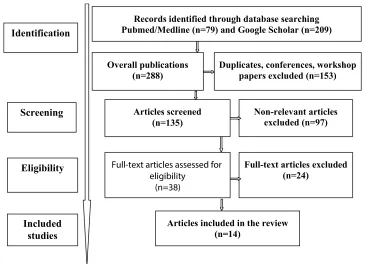
Data were extracted using a standardized pre-prepared table to collect similar evidence from each literature. The evidence extracted includes: author/s name and year of the study, study area or country, number of study participants, study period and prevalence estimate of antibiotic resis-tance. This was based on the Preferred Reporting Items for Systematic Review and Meta-analysis (PRISMA) state-ment for reporting systematic reviews and meta-analyses of studiesflow chart (Figure 1).18
Statistical Analysis
An initial extraction and estimation of pooled prevalence using Wilson method of double arcsine transformations were
done to estimate a confidence interval for a proportion of
studies in Excel.19 A pooled overall prevalence rate was
estimated with 95% confidence interval (CI). This was inter-preted and compared among countries and continents.
Quality Assessment
Two reviewers (GGK and GTD) carried out the initial screening of the citations retrieved in the searches based
Infection and Drug Resistance downloaded from https://www.dovepress.com/ by 118.70.13.36 on 24-Aug-2020
on titles and abstracts followed by a full-text assessment of any article identified as being potentially eligible. Any dis-crepancies during the assessment had resolved by the team. Both reviewers have made a methodological quality assess-ment on the included eligible studies. The National Institute for Health research (NIH) based Quality Assessment Tool for Observational Cohort and Cross-Sectional Studies was used to assess the methodological quality of studies included in the systematic review rating; good = 2, fair = 1 and poor (cannot be determined, not reported or not applicable) = 0.20
Results
Search results
Our searching process has retrieved a total of 288 publica-tions which later resulted in 38 articles for full-text review. Among 38 articles reviewed in full text, 14 studies have
been included for the study which fulfilled the inclusion
criteria.21,24–36The selection and screening process is pre-sented in detail (see Figure 1).
Characteristics of Studies
Primary Resistance to Amoxicillin
Among patients (n=4218) previously never taken the treat-ment regimen, no resistance was reported in Europe and
North America for AMX. In contrast to this, higher resis-tance rate was reported from Africa (17.7%). Asian and Latin American studies also reported comparable resis-tance pattern of 3.9% and 4.4%, respectively. A study conducted in Egypt, among 46 study participants almost half of them were non-susceptible to AMX. Similar to this, a study conducted in Nigeria and Peru reported one-third ofH. pyloripositive patients were non-susceptible. But, no resistances were seen in Morocco, Poland, Turkey, America, Canada and Nepal.
Primary Resistance to Clarithromycin
Clarithromycin (CLR) is a Macrolide derivative used in
the treatment ofH. pylori eradication. CLR resistance has
shown an association in predicting treatment failure of
H. pylori eradication therapy.22 Comparable resistance rate was reported in Europe (31.3%) and Asia (30.9%) respectively. Within this the bacterial non-susceptibility rate was reported as 26.7% in Africa. Low rate of resis-tance was obtained in North America (18.5%) and South America (19.4) in comparison to other continents. Above half patients were non-susceptible in Poland, Egypt and
China. H. pylori resistance of CLR has significantly
increased in 2009–10 and 2013–14 as a study reported
from china.21 Screening
Records identified through database searching Pubmed/Medline (n=79) and Google Scholar (n=209)
Included studies Eligibility
Overall publications (n=288)
Articles included in the review (n=14)
Full-text articles assessed for eligibility
(n=38)
Identification
Articles screened (n=135)
Duplicates, conferences, workshop papers excluded (n=153)
Full-text articles excluded (n=24)
Non-relevant articles excluded (n=97)
Figure 1PRISMAflow chart representation showing the overall searching and article selection process of a studyHelicobacter pyloriprimary resistance pattern to antibiotics. Note:Adapted from Moher D, Liberati A, Tetzlaff J, Altman DG, The PRISMA Group (2009) Preferred Reporting Items for Systematic Reviews and Meta-Analyses: The PRISMA Statement. PLoS Med 6(7): e1000097.https://doi.org/10.1371/journal.pmed.1000097.18
Infection and Drug Resistance downloaded from https://www.dovepress.com/ by 118.70.13.36 on 24-Aug-2020
Primary Resistance to Metronidazole
Metronidazole (MTR) is an alternative for
penicillin-allergic candidates during H. pylori eradication therapy.8
Almost half of Asian patients were non-susceptible
(48.9%) to MTR-based H. pylori treatment and higher
rate of resistance was reported in Nigeria, Nepal, China, Peru and Poland with a prevalence rate of 99.1%, 88.1%, 66.8%, 61.8% and 56.7%, respectively.
Primary Resistance to Levofloxacin
It is a promising Fluoroquinolones derivative used in the eradication ofH. pyloriinfection.23However, a substantial prevalence of resistance was observed especially in North America and Asia; 29.2% and 29.9%, respectively. In addition to this, indispensable primary resistance rate was reported in other continents; Europe (13.0%), South America (7.2%), and Africa (5.7%) in descending order.
Primary Dual and Multiple Antibiotic Resistances
A higher multiple antibiotic resistance rate was reported from Turkey (n=98) CLR-MTR-LVX 18.1% and out of
110 AmericanH. pyloripositive patients, 1.8% were
resis-tant for CLR-MTR-LVX and for CLR-MTR, 5.5% for
CLR-LVX and MTR-LVX.23In Poland among 67
partici-pants 32.5%, 1.5%, and 4.5% individuals were non-susceptible for CLR-MTR, CLR-LVX and MTR-LVX,
respectively.25 Above the multiple drug resistance,
a higher dual resistance rate was also seen in Turkey (n=98); 45.4% and 27.2% to MTR and to
CLR-LVX resistance rate were reported, respectively.23 In
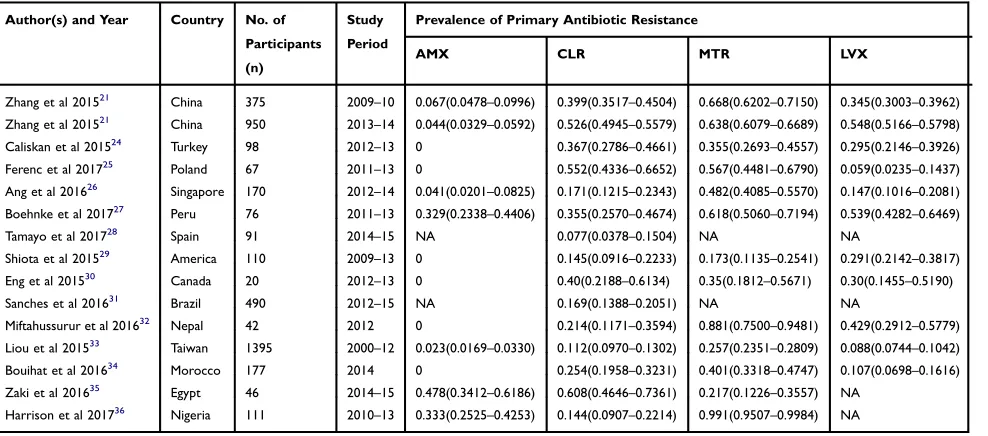
addition, dual resistance pattern of 1.8% was reported to MTR/CLR in Singapore. About10.5% (n=76) of Peruvian patients were resistant for AMX/CLR which are parts of the standard triple therapy regimen (Table 1).
Overall Resistance
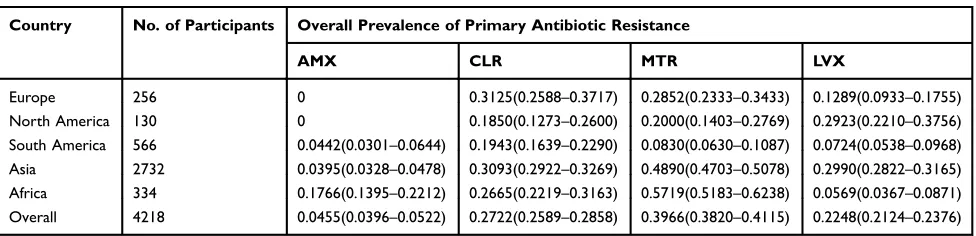
From a total of 14 studies retrieved with a total of 4218 study participants ofH. pyloripositive patients, the overall pooled
primary resistance was found; 4.55% at 95% CI: 3.96–5.22%
for AMX, 27.22% at 95% CI: 25.89–28.58% for CLR,
39.66% at 95% CI: 38.20–41.15% for MTR, and 22.48% at
95% CI: 21.24–23.76% for LVX. These studies were from
different continents including from Europe, North America, South America, Asia and Africa. These studies had used
different methods of testing antibiotic susceptibility
(Table 2).
Discussion
The treatment success of H. pylorieradication achieved by
first-line treatment with a proton pump inhibitor, CLR and
AMX have decreased to 70–85% due to increasing CLR
resistance.6Unlike De Francesco et al15consideration where improved knowledge in drug resistance strategies can result in better infection control, the safe and effective way of bacterial infection prevention and control seems difficult to touch.
The present study found higher resistance rate of CLR recorded in Europe, Asia and Africa. In addition, highest rate of non-susceptibility was seen in Asia for MTR and LVX. Concurrent to this, other worldwide systematic review
Table 1Primary Resistance Pattern ofHelicobacter pylorito Antibiotics Across Different Countries 2015–2017
Author(s) and Year Country No. of
Participants
(n)
Study
Period
Prevalence of Primary Antibiotic Resistance
AMX CLR MTR LVX
Zhang et al 201521 China 375 2009–10 0.067(0.0478–0.0996) 0.399(0.3517–0.4504) 0.668(0.6202–0.7150) 0.345(0.3003–0.3962)
Zhang et al 201521 China 950 2013–14 0.044(0.0329–0.0592) 0.526(0.4945–0.5579) 0.638(0.6079–0.6689) 0.548(0.5166–0.5798) Caliskan et al 201524 Turkey 98 2012–13 0 0.367(0.2786–0.4661) 0.355(0.2693–0.4557) 0.295(0.2146–0.3926)
Ferenc et al 201725 Poland 67 2011–13 0 0.552(0.4336–0.6652) 0.567(0.4481–0.6790) 0.059(0.0235–0.1437)
Ang et al 201626 Singapore 170 2012–14 0.041(0.0201–0.0825) 0.171(0.1215–0.2343) 0.482(0.4085–0.5570) 0.147(0.1016–0.2081)
Boehnke et al 201727 Peru 76 2011–13 0.329(0.2338–0.4406) 0.355(0.2570–0.4674) 0.618(0.5060–0.7194) 0.539(0.4282–0.6469)
Tamayo et al 201728 Spain 91 2014–15 NA 0.077(0.0378–0.1504) NA NA
Shiota et al 201529 America 110 2009–13 0 0.145(0.0916–0.2233) 0.173(0.1135–0.2541) 0.291(0.2142–0.3817)
Eng et al 201530 Canada 20 2012–13 0 0.40(0.2188–0.6134) 0.35(0.1812–0.5671) 0.30(0.1455–0.5190)
Sanches et al 201631 Brazil 490 2012–15 NA 0.169(0.1388–0.2051) NA NA
Miftahussurur et al 201632 Nepal 42 2012 0 0.214(0.1171–0.3594) 0.881(0.7500–0.9481) 0.429(0.2912–0.5779) Liou et al 201533 Taiwan 1395 2000–12 0.023(0.0169–0.0330) 0.112(0.0970–0.1302) 0.257(0.2351–0.2809) 0.088(0.0744–0.1042)
Bouihat et al 201634 Morocco 177 2014 0 0.254(0.1958–0.3231) 0.401(0.3318–0.4747) 0.107(0.0698–0.1616)
Zaki et al 201635 Egypt 46 2014–15 0.478(0.3412–0.6186) 0.608(0.4646–0.7361) 0.217(0.1226–0.3557) NA
Harrison et al 201736 Nigeria 111 2010–13 0.333(0.2525–0.4253) 0.144(0.0907–0.2214) 0.991(0.9507–0.9984) NA
Abbreviations:AMX, amoxicillin; CLR, clarithromycin; LVX, levofloxacin; MTR, metronidazole; NA, not analyzed.
Infection and Drug Resistance downloaded from https://www.dovepress.com/ by 118.70.13.36 on 24-Aug-2020
reported, the overall rate of H. pylori antibiotic resistance was found 11.2% to AMX, 17.2% to CLR, 26.7% to MTR, and 16.2% to LVX. The prevalence rate of CLR, MTR and
LVX resistance was significantly increased from Europe to
Asia, Northern America and Africa.13This might be due to
irrational use of antibiotics. Similarly, other study also
addressed the rate of H. pylori antibiotic resistance were
14.7% to AMX, 19.7% to CLR, 47.2% to MTR, and 18.9% to LVX. The prevalence rate of MTR and AMX resistance was higher in Africa, while CLR and LVX resistance was
higher in North America and Asia, respectively.37Compared
to these studies, the primary resistance rate towards CLR
substantially increased from 17.2%13 19.7%37 to 27.2%.
LVX resistance was also increased from 16.2%13to 22.5%.
Despite the over consumption of AMX and MTR the fre-quency of non-susceptibility rate of these antibiotics was found decreased. This was in contrary to previous studies.13,37This might be due to the recent implementation of antimicrobial stewardship and rational antimicrobial prac-tice awareness creation.38However, even in the recent imple-mentation of the programs the other above mentioned antibiotics resistance rate is substantially increased which necessities other studies to be undertaken.
Country specific systematic review studies reported
16.0%, 22.4%, 61.6%, and 5.3% in Iran;39 9.7%, 24.8%,
33.7%, and 23.8% in Turkey;38 4%, 12%, and 53% in
Latin America (no for LVX);41 3.1%, 28.9%, 63.8%,
and 28.0%, in China42 to AMX, CLR, MTR and LVX,
respectively. The resistance pattern for MTR and LVX was diffused and higher especially to MTR. AMX resis-tance in Latin America and China was comparable how-ever Turkish and Iranian reviews reported double and
almost four times higher from the present study.39–42
This shows the antibiotic susceptibility pattern of
H. pylori could not be predicted arbitrary in any country
mandating that implementation of local drug
susceptibility surveillance program and appropriate or rational prescribing and use of antibiotics is necessary.
Individual and dual antibiotic resistance significantly infl u-ences the successful eradication of the bacterial infection. The Maastricht V 2016 guideline report articulates resistance to CLR affect the efficacy of both sequential and triple treatment methods and resistance to MTR affects the treatment success by sequential therapy. Moreover, the report also had reported resistance to CLR and MTR affects the efficacy of sequential, hybrid and concomitant therapy ofH. pylorieradication treat-ment protocols. According to this empirical triple therapy is discouraged. When the resistance ofH. pyloriis greater than 15% towards CLR at the specified area the treatment should be based on susceptibility pattern to other antibacterials.43
Multi-resistant strains of H. pylori result in life-long infection that might lead to death.44,45 With the reserved treatment alternatives,43,46a study conducted by Olleik et al on temporin-SH and its analogs resulted in good activity against resistant strains ofH, pyloriwhich should be taken as promising treatment alternatives for the eradication of resistantH. pyloriinfection.47
Appropriate surveillance programs, improved antimicro-bial regulations and increased public awareness to region-specific resistance rate of H. pylori isolates are possible
mechanisms of prevention for H. pylori associated drug
resistance.41,48,49Therefore, drug susceptibility result of these antibiotics is necessary to select the appropriate drug for the successful eradication of the infection. This fosters rational drug prescribing practice improve patient treatment outcome and avoid unnecessary medical and nonmedical expenditure.
Conclusion
The primary antibiotic resistance ofH. pyloriis increasing worldwide. The overall resistance rate was found to be
4.55% at 95% CI (3.96–5.22) for amoxicillin; 27.22% at
95% CI (25.89–28.58) for clarithromycin; 39.66% at 95%
Table 2 Overall Primary Resistance Pattern of Helicobacter pylori to Antibiotics in Adult Population Across Different Continents 2015–2017
Country No. of Participants Overall Prevalence of Primary Antibiotic Resistance
AMX CLR MTR LVX
Europe 256 0 0.3125(0.2588–0.3717) 0.2852(0.2333–0.3433) 0.1289(0.0933–0.1755) North America 130 0 0.1850(0.1273–0.2600) 0.2000(0.1403–0.2769) 0.2923(0.2210–0.3756) South America 566 0.0442(0.0301–0.0644) 0.1943(0.1639–0.2290) 0.0830(0.0630–0.1087) 0.0724(0.0538–0.0968) Asia 2732 0.0395(0.0328–0.0478) 0.3093(0.2922–0.3269) 0.4890(0.4703–0.5078) 0.2990(0.2822–0.3165) Africa 334 0.1766(0.1395–0.2212) 0.2665(0.2219–0.3163) 0.5719(0.5183–0.6238) 0.0569(0.0367–0.0871) Overall 4218 0.0455(0.0396–0.0522) 0.2722(0.2589–0.2858) 0.3966(0.3820–0.4115) 0.2248(0.2124–0.2376)
Infection and Drug Resistance downloaded from https://www.dovepress.com/ by 118.70.13.36 on 24-Aug-2020
CI (38.20–41.15) for metronidazole; and 22.48% at 95% CI (21.24–23.76) for levofloxacin. The antibiotic susceptibility pattern of theH. pyloricould not be predicted arbitrary in any country mandating that implementation of local drug sus-ceptibility surveillance program and appropriate or rational prescribing and use of antibiotics as necessary.
Abbreviations
AMX, amoxicillin; CLR, clarithromycin; H. pylori,
Helicobacter pylori; LVX, levofloxacin; MTR, metronida-zole; NHS, National Institute for Health research.
Data Sharing Statement
The datasets used for this study should be accessed from the corresponding author on reasonable request.
Author Contributions
All authors made substantial contributions to conception and design, acquisition of data, or analysis and interpreta-tion of data; took part in drafting the article or revising it
critically for important intellectual content; gave final
approval of the version to be published; and agree to be accountable for all aspects of the work.
Disclosure
The authors declare they have no conflicts of interest in
this work.
References
1. CDC. Helicobacter Pylori. Fact Sheet for Health Care Providers. Department of Health and Human Services. 1–4.1998.
2. Blanchard TG, Nedrud JG. Laboratory maintenance of Helicobacter
species.Curr Protoc Microbiol.2012;24:8B.1.1-8B.1.19. doi:10.1002/ 9780471729259.mc08b01s24
3. Smith SM, O’morain C, Mcnamara D. Antimicrobial susceptibility testing for Helicobacter pylori in times of increasing antibiotic resistance.World J Gastroenterol.2014;20:9912. doi:10.3748/wjg.v20.i29.9912
4. Chey WD, Wong BC. American College of Gastroenterology guideline on the management ofHelicobacter pyloriinfection.Am J Gastroenterol. 2007;102:1808. doi:10.1111/j.1572-0241.2007.01393.x
5. Eusebi LH, Zagari RM, Bazzoli F. Epidemiology of Helicobacter pylori infection.Helicobacter.2014;19:1–5. doi:10.1111/hel.12165 6. Fuccio L, Laterza L, Zagari RM, Cennamo V, Grilli D, Bazzoli F.
Treatment of Helicobacter pylori infection.BMJ.2008;15:337. 7. Chey WD, Leontiadis GI, Howden CW, Moss SF. ACG clinical
guide-line: treatment of Helicobacter pylori infection.Am J Gastroenterol. 2017;112:212–239. doi:10.1038/ajg.2016.563
8. Malfertheiner P, Megraud F, O’morain CA, et al. Management of
Helicobacter pyloriinfection, the Maastricht IV/Florence consensus report.Gut.2012;61:646–664. doi:10.1136/gutjnl-2012-302084 9. Levy SB, Marshall B. Antibacterial resistance worldwide: causes,
chal-lenges and responses.Nat Med.2004;10:S122–S129. doi:10.1038/nm1145
10. Graham DY, Shiotani A. New concepts of resistance in the treatment of Helicobacter pylori infections. Nat Clin Pract Gastroenterol Hepatol.2008;5(6):321–331. doi:10.1038/ncpgasthep1138
11. Nishizawa T, Suzuki H. Mechanisms ofHelicobacter pylori antibio-tic resistance and molecular testing. Front Mol Biosci. 2014;1. doi:10.3389/fmolb.2014.00019
12. Wu W, Yang Y, Sun G. Recent insights into antibiotic resistance in
Helicobacter pylori eradication. Gastroenterol Res Pract. 2012;2012:1–8. doi:10.1155/2012/723183
13. De Francesco V, Giorgio F, Hassan C, et al. WorldwideH.pyloriantibiotic resistance: a systematic review.J Gastrointestin Liver Dis.2010;19. 14. Lee JW, Kim N, Kim JM, et al. Prevalence of primary and secondary
antimicrobial resistance of helicobacter pylori in Korea from 2003 through 2012.Helicobacter.2013;18:206–214. doi:10.1111/hel.12031 15. De Francesco V, Giorgio F, Ierardi E, et al. Primary clarithromycin
resistance inHelicobacter pylori: the multicentric Italian clarithro-mycin resistance observational (MICRO) study. J Gastrointestin Liver Dis.2011;20:235–239.
16. Alzoubi K, Ayoub N, Al-Sakaji S, Al-Azzam S, Mhaidat N, Masadeh M. Awareness of bacterial resistance among physicians, pharmacists and nurses. Int J Occup Med Environ Health. 2009;22:363–372. doi:10.2478/v10001-009-0034-3
17. Owen R. Molecular testing for antibiotic resistance inHelicobacter pylori.Gut.2002;50:285–289. doi:10.1136/gut.50.3.285
18. Moher D, Liberati A, Tetzlaff J, Altman DG, The PRISMA Group (2009) Preferred Reporting Items for Systematic Reviews and Meta-Analyses: The PRISMA Statement. PLoS Med 6(7): e1000097. https://doi.org/10.1371/journal.pmed.1000097.
19. Barendregt JJ, Doi SA, Lee YY, Norman RE, Vos T. Meta-analysis of prevalence. J Epidemiol Community Health. 2013;67:974–978. doi:10.1136/jech-2013-203104
20. Available from:https://www.nhlbi.nih.gov/health-topics/study-quality -assessment-tools. Accessed May 4, 2020.
21. Zhang YX, Zhou LY, Song ZQ, Zhang JZ, He LH, Ding Y. Primary antibiotic resistance ofHelicobacter pyloristrains isolated from patients with dyspeptic symptoms in Beijing: a prospective serial study.World J Gastroenterol.2015;21:2786. doi:10.3748/wjg.v21.i9.2786 22. Agudo S, Pérez-Pérez G, Alarcón T, López-Brea M. High prevalence
of clarithromycin-resistant Helicobacter pyloristrains and risk fac-tors associated with resistance in Madrid, Spain.J Clin Microbiol. 2010;48:3703–3707. doi:10.1128/JCM.00144-10
23. Rispo A, Capone P, Castiglione F, Pasquale L, Rea M, Caporaso N. Fluoroquinolone-based protocols for eradication of Helicobacter pylori.World J Gastroenterol.2014;20.
24. Caliskan R, Tokman HB, Erzin Y, et al. Antimicrobial resistance of
Helicobacter pyloristrains tofive antibiotics, including levofloxacin, in Northwestern Turkey.Rev Soc Bras Med Trop.2015;48:278–284. doi:10.1590/0037-8682-0027-2015
25. Ferenc S, Gnus J, Kościelna M, et al. High antibiotic resistance of
Helicobacter pyloriand its effect on tailored and empiric eradication of the organism in Lower Silesia, Poland. Helicobacter.2017;22: e12365. doi:10.1111/hel.12365
26. Ang TL, Fock KM, Ang D, Kwek ABE, Teo EK, Dhamodaran S. The changing profile ofHelicobacter pyloriantibiotic resistance in Singapore: a 15 year study.Helicobacter.2016;21:261–265. doi:10.1111/hel.12291 27. Boehnke KF, Valdivieso M, Bussalleu A, et al. Antibiotic resistance
among Helicobacter pylori clinical isolates in Lima, Peru. Infect Drug Resist.2017;10:85–90. doi:10.2147/IDR.S123798
28. Tamayo E, Montes M, Fernández-Reyes M, et al. Clarithromycin resistance inHelicobacter pyloriand its molecular determinants in Northern Spain, 2013–2015.J Glob Antimicrob Resist.2017;9:43–46. doi:10.1016/j.jgar.2016.12.019
29. Shiota S, Reddy R, Alsarraj A, El-Serag HB, Graham DY. Antibiotic resistance ofHelicobacter pyloriamong male United States veterans.
Clin Gastroenterol Hepatol. 2015;13:1616–1624. doi:10.1016/j. cgh.2015.02.005
Infection and Drug Resistance downloaded from https://www.dovepress.com/ by 118.70.13.36 on 24-Aug-2020
30. Eng NF, Ybazeta G, Chapman K, et al. Antimicrobial susceptibility of Canadian isolates ofHelicobacter pyloriin Northeastern Ontario.
Can J Infect Dis Med Microbiol. 2015;26:137–144. doi:10.1155/ 2015/853287
31. Sanches BS, Martins GM, Lima K, et al. Detection ofHelicobacter pyloriresistance to clarithromycin and fluoroquinolones in Brazil: a national survey.World J Gastroenterol.2016;22:7587. doi:10.3748/ wjg.v22.i33.7587
32. Miftahussurur M, Shrestha PK, Subsomwong P, Sharma RP, Yamaoka Y. Emerging Helicobacter pylori levofloxacin resistance and novel genetic mutation in Nepal.BMC Microbiol.2016;16:256. doi:10.1186/s12866-016-0873-6
33. Liou JM, Chang CY, Chen MJ, et al. The primary resistance of
Helicobacter pyloriin Taiwan after the national policy to restrict antibiotic consumption and its relation to virulence factors—a nationwide study.
PLoS One.2015;10:e0124199. doi:10.1371/journal.pone.0124199 34. Bouihat N, Burucoa C, Benkirane A, et al.Helicobacter pyloriprimary
antibiotic resistance in 2015 in morocco: a phenotypic and genotypic prospective and multicenter study.Microb Drug Resist.2016. 35. Zaki MES, Sherif DM, Ali MA, et al. molecular study of primary
clarithromycin resistant Helicobacter pylori strains from Egyptian Centre.Int J Curr Microbiol App Sci.2016;5:165–173. doi:10.20546/ ijcmas.2016.501.014
36. Harrison U, Fowora MA, Seriki AT, et al. Helicobacter pylori strains from a Nigerian cohort show divergent antibiotic resistance rates and a uniform pathogenicity profile. PLoS One. 2017;12:e0176454. doi:10.1371/journal.pone.0176454
37. Ghotaslou R, Leylabadlo HE, Asl YM. Prevalence of antibiotic resistance in Helicobacter pylori: A recent literature review.World J Methodol.2015;5:164. doi:10.5662/wjm.v5.i3.164
38. Barlam TF, Cosgrove SE, Abbo LM, et al. Implementing an anti-biotic stewardship program: guidelines by the Infectious Diseases Society of America and the Society for Healthcare Epidemiology of America. Clin Infect Dis. 2016;62:1197–1202. doi:10.1093/cid/ ciw217
39. Khademi F, Poursina F, Hosseini E, Akbari M, Safaei HG. Helicobacter pylori in Iran: A systematic review on the antibiotic resistance.Iran J Basic Med Sci.2015;18.
40. Kocazeybek B, Tokman HB. Prevalence of primary antimicrobial resistance of H. pylori in Turkey: a systematic review.
Helicobacter.2016;21:251–260. doi:10.1111/hel.12272
41. Camargo MC, García A, Riquelme A, et al. The problem of Helicobacter pylori resistance to antibiotics: a systematic review in Latin America.Am J Gastroenterol.2014;109:485–495. doi:10.1038/ ajg.2014.24
42. Hu Y, Zhu Y, Lu NH. Primary antibiotic resistance of helicobacter pylori in China.Dig Dis Sci.2017;1–9.
43. Malfertheiner P, Megraud F, O’morain C, et al. Management of Helicobacter pylori infection, the Maastricht V/Florence consensus report.Gut.2016;1–25.
44. Acar JF. Consequences of bacterial resistance to antibiotics in med-ical practice.Clin Infect Dis.1997;24:17–18. doi:10.1093/clinids/24. Supplement_1.S17
45. Friedman ND, Temkin E, Carmeli Y. The negative impact of anti-biotic resistance. Clin Microbiol Infect. 2016;22:416–422. doi:10.1016/j.cmi.2015.12.002
46. Miftahussurur M, Waskito LA, Syam AF, et al. Alternative eradica-tion regimens for Helicobacter pylori infeceradica-tion in Indonesian regions with high metronidazole and levofloxacin resistance. Infect Drug Resist.2019;12:345. doi:10.2147/IDR.S187063
47. Olleik H, Baydoun E, Perrier J, et al. Temporin-SHa and its analogs as potential candidates for the treatment of helicobacter pylori.
Biomolecules.2019;9:598. doi:10.3390/biom9100598
48. Shmuely H, Domniz N, Yahav J. Regional antibiotic resistance of helicobacter pylori.JSM Gastroenterol Hepatol.2016;4:1074. 49. Seck A, Burucoa C, Dia D, et al. Primary antibiotic resistance and
associated mechanisms in Helicobacter pylori isolates from Senegalese patients. Ann Clin Microbiol Antimicrob. 2013;12:3. doi:10.1186/1476-0711-12-3
Infection and Drug Resistance
Dove
press
Publish your work in this journal
Infection and Drug Resistance is an international, peer-reviewed open-access journal that focuses on the optimal treatment of infection (bacterial, fungal and viral) and the development and institution of preventive strategies to minimize the development and spread of resis-tance. The journal is specifically concerned with the epidemiology of
antibiotic resistance and the mechanisms of resistance development and diffusion in both hospitals and the community. The manuscript manage-ment system is completely online and includes a very quick and fair peer-review system, which is all easy to use. Visit http://www.dovepress.com/ testimonials.php to read real quotes from published authors.
Submit your manuscript here:https://www.dovepress.com/infection-and-drug-resistance-journal
Infection and Drug Resistance downloaded from https://www.dovepress.com/ by 118.70.13.36 on 24-Aug-2020