DESIGN, OPTIMIZATION, AND STATISTICAL EVALUATION OF ORAL RECONSTITUTED
SUSPENSION OF CLARITHROMYCIN USING ION-EXCHANGE RESINS
KOMAL S
1*, HARIKRISHNAN N
21Department of Pharmaceutics, Faculty of Pharmacy, Dr. M.G.R. Educational and Research Institute, Chennai, Tamil Nadu, India. 2Department of Pharmaceutical Analysis, Faculty of Pharmacy, Dr. M.G.R. Educational and Research Institute, Chennai, Tamil Nadu, India.
Email: [email protected]
Received: 21 November 2019, Revised and Accepted: 08 January 2020
ABSTRACT
Objectives: The objective of the present study is taste masking of bitter clarithromycin using Indion 204, Indion 234, and Tulsion 335 as ion-exchange resins, which forms insoluble complexes, inhibiting the drug release in saliva as ion-exchange resins are cross-linked polymers, water-insoluble that contains salt-forming groups in repeating positions on the polymer chain. Drugs that are bitter and cationic get adsorbed onto weak cationic exchange resins of carboxylic acid functionality such as Indion 204, Indion 234, and Tulsion 335 to form non-bitter complexes.
Methods: The drug-resin complex loading process was optimized for the resin content, activation, swelling time, stirring time, influence of pH, and temperature for maximum drug loading and the formed complex was evaluated by differential scanning calorimetry (DSC) to confirm complex formation. The drug-resin complex was also characterized by their micromeritic and rheological properties. These complexes were used to prepare oral reconstituted suspensions and the taste was evaluated. The formulation was evaluated for various parameters such as sedimentation volume, pH, redispersibility, viscosity, drug content, and in vitro drug release.
Results: Acid-activated resins comprising Indion 204, Indion 234, and Tulsion 335 with the drug:resin ratio of 1:2, stirred in a solution of pH 7–8 at 70° for 6 h had a maximum drug loading and masked the bitter taste of clarithromycin. DSC of the drug-resin complex (DRC) revealed that there was interaction leading to complex formation. The drug-resin complex was formulated into suspension formulations (S1-S9) and evaluated. Various parameters were found to be within permissible limits. Formulations S3, S6, and S9 containing 1:2 ratios of the drug-resin complex of Indion 204, Indion 234, and Tulsion 335 revealed maximum taste masking. This was further confirmed by treatment of taste evaluation scores obtained from the volunteers by ANOVA, Dunnett’s multiple comparison test, and Tukey’s multiple comparison test. All the three optimized formulations had a significant difference of p<0.001 when compared to control S10. S6 formulation was widely accepted.
Conclusion: Ion-exchange complexation could efficiently mask the bitter taste of clarithromycin and achieve palatable taste suitable for pediatric use. Keywords: Ion-exchange resins, Drug-resin complex, Taste masking, Indion 204, 234, Tulsion 335, Dunnett’s test, Tukey’s test, ANOVA.
INTRODUCTION
The ease of administration is the criterion for the preference of oral dosage forms. The bitterness of active pharmaceutical ingredients (API) is one of the significant issues of the pharmaceutical industry during the formulation of dosage form, thereby leading to poor patient compliance. A majority of drugs are bitter due to the presence of amine functional groups, thereby rendering unpleasant taste to the formulation [1]. Hence, it becomes a challenge to the formulator to ensure that the bitterness and obnoxious taste of drugs is masked particularly in pediatric and geriatric formulations dosage form thereby ensuring that the formulation is patient compliant and has product value [2].
Ion-exchange resins are economical and can be incorporated in the development of a basic, rapid, and profitable method of taste masking [3]. Ion-exchange resins are polymeric cross-linkage chains containing salt forming groups in repeating position, which have an affinity for oppositely charged counter ions, thus adsorbing and binding the ions into the polymer matrix in an equilibrium process. The bound drug is desorbed or eluted from the drug-resin complex during the process of absorption into the body [4,5]. The versatility of IER as drug delivery vehicles has attracted pharmaceutical research [6]. Ion-exchange resins are used for masking of taste, sustained release, targeted drug delivery, and drug stabilization [7]. Weak cationic exchange resin of carboxylic acid is used for masking bitter cationic drugs to form a non-bitter complex [8].
Clarithromycin is a macrolide antibiotic used in the treatment of common pediatric infections of the middle ear and upper respiratory tract as well as certain forms of pneumonia that affect the elderly [9]. However, the drug is very bitter making oral administration of the drug [10]. It is a practically water-insoluble drug and shows polymorphism and the problem of stability by hydrolysis when it is in a liquid formulation for a long time [10]. Commercially, it is available as a tablet and suspensions but these formulations possess a problem of drug release in the saliva. Hence, it is an objective of the present research to provide an oral reconstituted suspension of clarithromycin which can deliver pharmaceutically acceptable and stable dosage form of API and provides the public with a useful and economic formulation.
MATERIALS AND METHODS Materials
Clarithromycin was obtained as a gift sample from Ind-Swift Laboratories Limited, Punjab. Indion 204 and Indion 234 were gifted by Ion Exchange India Ltd., Mumbai. Tulsion-335 was gifted by Thermax Ltd., Pune. Xanthan gum was obtained from HiMedia, Mumbai. Sodium Benzoate, sucrose, sodium citrate, and flavor were purchased from S.D Fine-Chem. Ltd., Mumbai. Aspartame was purchased from NutraSweet Company and all the chemicals were used of either pharma or analytical grade.
© 2020 The Authors. Published by Innovare Academic Sciences Pvt Ltd. This is an open access article under the CC BY license (http://creativecommons. org/licenses/by/4. 0/) DOI: http://dx.doi.org/10.22159/ajpcr.2020.v13i3.36438
Taste evaluation of formulation was performed by volunteers within the age group of 21–25 years. Prior explanation of the study protocol and written consent was obtained from the volunteers [11].
Methods
Standard calibration curve of clarithromycin
The samples of different concentrations of range 20–120 µg/mL were prepared with chloroform. To 10 mL of each dilution taken in separating funnel, 5 mL concentrated hydrochloric acid was added followed by 10 mL of acetone and reaction mixture was shaken gently for 5 min for the formation of a stable orange-colored complex [12]. The upper orange-red colored layer was separated and the absorbance measured at 486 nm against reagent blank [12].
Complexation with ion-exchange resin Optimization of drug-resin complexation
The loading of the drug onto the resin was optimized for various parameters during processing, including activation conditions, swelling time, stirring time, pH, temperature, and drug:resin ratio [13].
Effect of activation conditions on resin drug loading capacity
Activation of Indion 204, Indion 234, and Tulsion 335 was done by washing the individual resins with deionized water, 1N HCl and 1N NaOH in separate processes. The resin was further subjected to repeated washing with water until neutral pH was reached. Drug-resin complexes (DRC) were prepared by adding 100 mg of activated resin that was swollen for 45 min into a beaker containing 50 mL of distilled water and 100 mg of the drug. The mixture was prepared as a slurry with the aid of magnetic stirrer for 6 h at 60°C. The residue of the mixture was washed with 100 mL of chloroform and filtered. From this solution, 0.5 mL was taken and diluted to 10 mL with chloroform. The unbound amount drug in the filtrate was estimated spectrophotometrically at λmax 486 nm [12,13].
Optimization of resin concentration for maximum drug loading Acid activated swollen resins and drugs were added in the ratio of 1:1, 1:1.5, and 1:2–100 mL of deionized water in separate beakers and stirred using a magnetic stirrer for 6 h at 60°C. The mixture residues were filtered and were washed with chloroform. The drug-loading efficiency of the resin was estimated [12,13].
The optimized resin concentration for the maximum loading of the drug was estimated spectrophotometrically (Table 1).
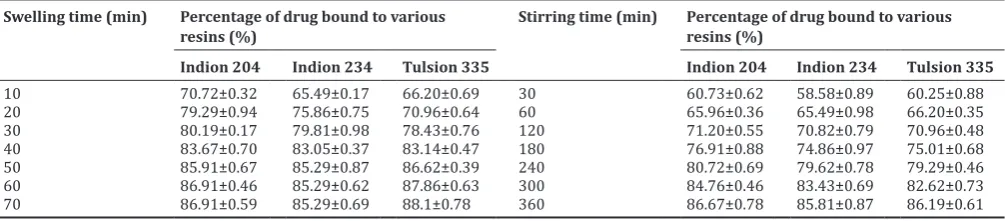
Optimization of swelling time of resin for maximum drug loading Various batches of acid-activated resins were soaked in 100 mL quantity of deionized water for 10, 20, 30, 40, 50, 60, and 70 min at 60°C temperature in separate beakers. To each beaker drug and resin were added at 1:2 ratio and mixtures were stirred for 6 h at 60°C. Resin drug-loading efficiency was estimated [12,13]. The optimized swelling time of resin required for maximum drug loading was estimated spectrophotometrically (Table 2).
Optimization of stirring time for maximum drug loading
1:2 ratio of drug-resin complexes of separate batches was slurred in 100 mL of deionized water for 30, 60, 120, 180, 240, 300, and 360 min with the aid of magnetic stirrer at 60°C. Resin drug-loading efficiency was estimated [12,13]. The optimized stirring time required for maximum drug loading was estimated spectrophotometrically (Table 2).
Optimization of processing temperature for maximum drug loading 1:2 ratio of drug-resin complexes of separate batches was slurred in 100 mL of deionized water at different temperatures, namely, 25°, 30°, 40°, 50°, 60°, and 70°C using temperature controlled magnetic stirrer for 6 h. The amount of resin drug-loading efficiency was estimated spectrophotometrically from the bound drug. The optimized processing temperature was obtained [12,13] (Table 3).
Optimization of pH for maximum drug loading
1:2 ratio of drug-resin complexes of separate batches were slurred in 100 mL of standard solutions of hydrochloric acid and sodium hydroxide having pH 1.2, 2, 5, 6, 7, and 8 and stirred using a magnetic stirrer for 6 h at 60°C. The drug-loading efficiency was estimated and pH was optimized for maximum drug loading [12,13] (Table 3).
Preparation of drug-resin complexes
Based on optimization study results, batches of drug-resin complexes at 1:1, 1:1.5, and 1:2 ratio were prepared at optimized conditions for maximum loading capacity and subjected to further evaluation [13].
Evaluation of the optimized drug-resin complexes for drug content The drug content was determined by eluting the 250 mg of DRC with continuous stirring in 100 mL 1N HCl for 1 h to ensure complete elution [13]. The solution was filtered. After suitable dilution, the drug content was determined spectrophotometrically at λmax 486 nm and the
readings were taken in triplicate.
Table 1: Effect of activation conditions and resin concentration for maximum drug loading Resins Percentage of drug bound to resin in various
activation conditions (%) Percentage of drug bound to various resins (%)
Inactivated Acid Base 1:1 1:1.5 1:2
Indion 204 45.26±0.68 66.92±0.83 52.16±0.34 67.15±0.28 75.01±0.40 86.67±0.26
Indion 234 44.59±0.77 66.30±0.72 50.54±0.64 67.87±0.56 75.01±0.29 86.81±0.36
Tulsion 335 44.30±0.48 67.06±0.39 50.73±0.65 70.01±0.63 77.39±0.58 87.14±0.45
Results are mean±standard deviation (n=3)
Table 2: Optimization of swelling time and stirring time for maximum drug loading Swelling time (min) Percentage of drug bound to various
resins (%) Stirring time (min) Percentage of drug bound to various resins (%)
Indion 204 Indion 234 Tulsion 335 Indion 204 Indion 234 Tulsion 335
10 70.72±0.32 65.49±0.17 66.20±0.69 30 60.73±0.62 58.58±0.89 60.25±0.88
20 79.29±0.94 75.86±0.75 70.96±0.64 60 65.96±0.36 65.49±0.98 66.20±0.35
30 80.19±0.17 79.81±0.98 78.43±0.76 120 71.20±0.55 70.82±0.79 70.96±0.48
40 83.67±0.70 83.05±0.37 83.14±0.47 180 76.91±0.88 74.86±0.97 75.01±0.68
50 85.91±0.67 85.29±0.87 86.62±0.39 240 80.72±0.69 79.62±0.78 79.29±0.46
60 86.91±0.46 85.29±0.62 87.86±0.63 300 84.76±0.46 83.43±0.69 82.62±0.73
70 86.91±0.59 85.29±0.69 88.1±0.78 360 86.67±0.78 85.81±0.87 86.19±0.61
Evaluation of the prepared drug-resin complexes for drug release The drug release studies were performed by the USP Type XXIII tablet dissolution apparatus. DRC equivalent to 250 mg of clarithromycin was taken in 900 mL of 0.1 N HCl. The temperature and speed of the apparatus were maintained at 37±0.5°C and 75 rpm, respectively. Aliquots were withdrawn after every 2 min for 30 min and were filtered with Whatman filter paper no. 41 and were analyzed spectrophotometrically at λmax 486 nm. Triplicate readings were taken [13,14].
Differential scanning calorimetry (DSC) was carried out for the characterization of the complex formed. All the DRCs were subjected to DSC and the thermograms were studied for drug-polymer complex formation [13-15].
Micromeritics: The DRCs were evaluated for the angle of repose, Carr’s index, tapped and bulk density, and Hausner’s ratio [13].
Formulation of the prepared drug-resin complexes into dry powder suspension
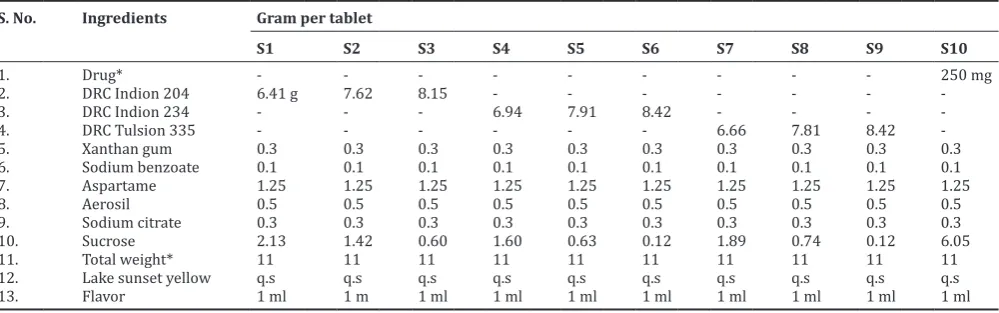
Accurately weighed amounts of the prepared complexes of clarithromycin resinates (Indion 204, Indion 234, and Tulsion 335) at 1:1, 1:1.5, and 1:2 drug:resin ratios equivalent to 250 mg of clarithromycin were mixed with other excipients such as suspending agents, sweetener, flavoring agent, preservative, anti-caking agent, and buffer by conventional technique [16,17]. All the ingredients were passed through 44# and mixed. The dry suspension is reconstituted up to 100 ml with distilled water before use.The formulations S1-S9 represented with DRC and S10 represented without DRC (Table 4).
Evaluation parameters
The angle of repose, Carr’s index, as well as the Hausner’s ratio for drug powder and dry powder suspension, were determined and compared [13].
Evaluation of the prepared oral reconstituted suspensions 100 mL of a reconstituted oral suspension of clarithromycin was prepared and fully evaluated for color and odor, viscosity, pH, sedimentation rate, redispersibility, and particle size [16-18].
Furthermore, drug content, drug leaching into the suspension, and in vitro dissolution studies of the drug from the prepared suspensions were determined and compared [17-19].
Assessment of the bitter taste of drug (bitterness threshold) The bitter taste threshold value of clarithromycin was determined based on the bitter taste recognized by six volunteers. Before measurement, informed written consent was taken from each volunteer[20].
Various concentrations (10–100 μg/mL) of the drug were prepared in phosphate buffer pH 6.7. The buffer solution was used for rinsing the mouth and then, l0 mL of the most dilute solution was swirled in the mouth near the base of the tongue for 30 s and tasted. After 30 s, if the bitter sensation was no longer felt in the mouth, the solution was spat out and wait for 1 min to ascertain whether this is due to delayed sensitivity. Then rinse with safe drinking water. The recording was.
“−” = Did not detect any difference in taste
“+” = Detected some difference but was not able to specify about the taste and
“++” = Detected a bitter taste.
The next highest concentration should not be tasted until at least 10 min have passed. The threshold of the bitterness of the drug is defined as the concentration at which more than half of the volunteers detected bitterness when holding the drug in their mouth. The threshold value was correspondingly selected from the different drug concentrations as the lowest concentration that had a bitter taste[21] (Table 5).
In vivo evaluation of the bitter taste of the formulations
Gustatory sensation tests of prepared suspensions were done using the equivalent density examination method [21]. The pure drug formulation was kept as control during the study. Before the experiment, the study protocol was explained and written consent was obtained from volunteers (n=6; three males and three females). Prepared formulae were kept in the mouth by each volunteer and the bitterness level was recorded against a standard using a numerical scale. The standard quinine hydrochloride concentrations used were 0.01, 0.03, 0.10, 0.30, Table 3: Optimization of processing temperature and pH for maximum drug loading
Temperature (°C) Percentage of drug bound to various resins (%) pH Percentage of drug bound to various resins (%)
Indion 204 Indion 234 Tulsion 335 Indion 204 Indion 234 Tulsion 335
25 74.25±0.69 72.82±0.58 74.25±0.53 1.2 49.26±0.86 48.07±0.38 54.74±0.57
30 76.87±0.47 74.9±0.46 74.97±0.58 2 54.50±0.35 51.17±0.55 59.26±0.78
40 79.73±0.53 78.06±0.73 80.44±0.33 5 68.30±0.35 68.30±0.59 75.92±0.77
50 82.34±0.98 82.87±0.59 83.06±0.98 6 76.63±0.65 75.20±0. 87 79.25±0.46
60 86.39±0.53 85.77±0.28 86.39±0.46 7 86.15±0.69 84.01±0.59 85.44±0.68
70 89.48±0.27 87.72±0.85 88.77±0.92 8 88.53±0.58 86.39±0.66 87.58±0.35
Results are mean±standard deviation (n=3)
Table 4: Formulation table for oral reconstituted suspension S. No. Ingredients Gram per tablet
S1 S2 S3 S4 S5 S6 S7 S8 S9 S10
7. Aspartame 1.25 1.25 1.25 1.25 1.25 1.25 1.25 1.25 1.25 1.25
8. Aerosil 0.5 0.5 0.5 0.5 0.5 0.5 0.5 0.5 0.5 0.5
9. Sodium citrate 0.3 0.3 0.3 0.3 0.3 0.3 0.3 0.3 0.3 0.3
10. Sucrose 2.13 1.42 0.60 1.60 0.63 0.12 1.89 0.74 0.12 6.05
11. Total weight* 11 11 11 11 11 11 11 11 11 11
12. Lake sunset yellow q.s q.s q.s q.s q.s q.s q.s q.s q.s q.s
13. Flavor 1 ml 1 m 1 ml 1 ml 1 ml 1 ml 1 ml 1 ml 1 ml 1 ml
and 1.00 mM and the corresponding bitterness scores were defined as 0, 1, 2, 3, and 4, respectively. Before testing, the volunteers are given the standard quinine solutions and asked to swirl in their mouths and were told the concentrations and bitterness scores of each solution [22]. After tasting a test formulation suspended in water, they were asked to give the sample a bitterness score in comparison to the standard. All samples were kept in the mouth for 15 s. After testing the sample, the volunteers rinsed their mouths well and waited for at least 20 min before tasting the next sample. The average scores for bitterness, flavor, mouthfeel, and overall acceptability for each formulation were calculated and also the standard deviation was arrived (Table 6).
Statistical analysis
The scores were then interpreted by one-way ANOVA [23] using GraphPad Prism Version 5.0 Software. Dunnett’s multiple comparison test was used for comparing all the formulations (S1-S9) with the control formulation (S10). The statistical significance was then interpreted. Tukey’s multiple comparison tests are used for comparing the scores within the groups with different ratios of the same resins, and then the formulations having the highest significance levels from each group were compared [24].
RESULTS AND DISCUSSION
Optimization of drug-resin complexation and resin concentration for maximum drug loading is presented in Table 1. Optimization of swelling time and stirring time of resin for maximum drug loading is shown in Table 2. Optimization of processing temperature and pH for maximum drug loading is presented in Table 3. The loading capacity of the resin for clarithromycin was higher in the acid-activated condition when compared to alkaline conditions. This could be explained by the stoichiometric exchange nature reaction between drug and resin in solution. All resins displayed an increase in drug loading capacity with an increase in swelling time. It was found that as the time of stirring of the solution increased, the drug loading also increased and maximum drug loading was achieved within 6 h.
The effect of temperature for optimization is necessary, as, at higher temperatures, the ion diffusion increased. The percent drug-loaded increased with the rise in pH, which was due to the nature of the used resins and drug where the ionization was favored at pH 8. DRC
comprising Indion 204, Indion 234, and Tulsion 335 at maximum drug-resin ratio (1:2) exhibited drug content in a range of 92.10±0.59%, 89.01±0.55%, and 89.01±0.46%, respectively, and faster dissolution when compared to the pure drug (Fig. 1).
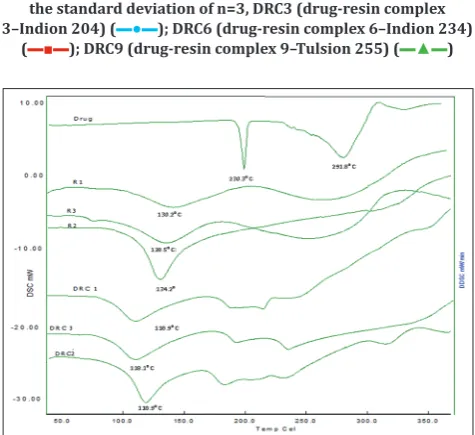
DSC thermograms of drug, resin, and DRC are depicted in Fig. 2.
DRC displayed good micromeritic properties with the angle of repose ranging from 26° 12±0.57 to 29° 38±0.47, bulk density values of 0.419±0.01–0.472±0.01 g/cm3, tapped density of 0.505±0.07–
0.575±0.07 g/cm3, percent compressibility index of 13.461±0.89–
17.913±0.73, and Hausner’s ratio of 1.155±0.08–1.218±0.07. Dry powder suspension parameters were evaluated. The powder displayed angle of repose from 22° 59±0.88 to 25° 69±0.73, bulk density of 0.442±0.01– 0.479±0.04 g/cm3, tapped density of 0.52±0.06–0.541±0.07 g/cm3,
percent compressibility index values from 10.800±0.69 to 15.163±0.55, and Hausner’s ratio ranging from 1.121±0.06 to 1.78±0.07. The dry powder displayed good micromeritic properties with the angle of repose ranging from 22° 59±0.88 to 25°69±0.73, bulk density values of 0.442±0.01–0.479±0.04 g/cm3, tapped density of 0.520±0.06–
0.543±0.08 g/cm3, percent compressibility index of 10.800±0.69–
15.163±0.55, and Hausner’s ratio of 1.121±0.06–1.160±0.08.
Table 6: Preference points for standard bitterness and palatability
4 Very creamy Very good Very good
Table 5: Determination of bitterness threshold of clarithromycin
Fig. 1: In vitro dissolution release profiles of resin complex exhibiting maximum drug release. Errors bars represent the standard deviation of n=3, DRC3 (drug-resin complex 3–Indion 204) (▬●▬); DRC6 (drug-resin complex 6–Indion 234)
(▬■▬); DRC9 (drug-resin complex 9–Tulsion 255) (▬▲▬)
Fig. 2: The DSC thermograms of clarithromycin and thermograms of the drug-resinate mixtures. Drug-clarithromycin; R1–Indion; R2–Indion; R3–Tulsion; DRC3–Drug:resin Indion 204 (1:2); DRC6–
All the prepared oral reconstituted suspensions (S1-S10) were subjected to evaluation. The ranges of viscosity was found to be 225.6±0.76–273.2±0.44 cps, pH was found to be 7.1±0.04–7.4±0.06, sedimentation rate was found to be 0.95–0.99 on 0th day and 0.93–0.98
on 7th day, redispersibility was found to be + on 0th day and + on 7th day,
and drug content was found to be 97.57±0.69–98.99±0.66%, and particle size was found to be 97.89±0.57–168.97±0.97 µm.
All the formulations comprising DRC displayed rapid drug release when compared to S10 formulations. S3, S6, and S9 formulations exhibited a release 98.64±0.356%, 99.05±0.239%, and 98.85±0.303% in 14 min, respectively, other formulations exhibited release within 16–24 min. S10 formulations displayed a release of 98.02±0.432% after 24 min (Fig. 3). Thus, from the release studies, it was evident that the ion-exchange resins can also act as dissolution enhancers apart from taste masking.
The threshold for the bitterness of clarithromycin was detected by varying its concentration, and threshold value was obtained from volunteers (n=6) (Table 5). The reference points for standard bitterness and palatability are shown in Table 6.
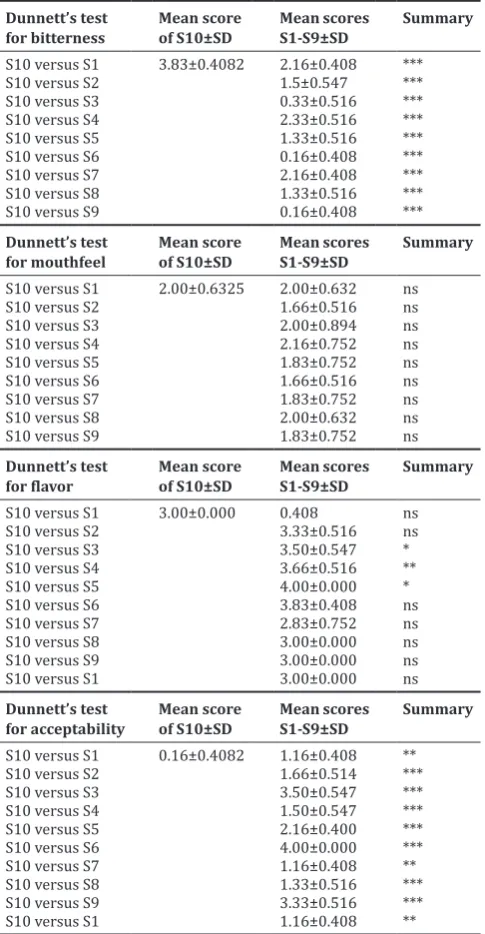
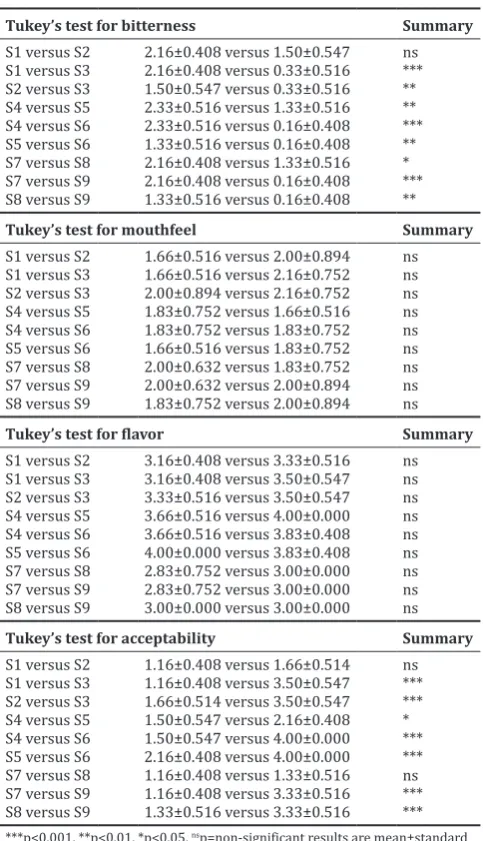
Dunnett’s test was performed to evaluate bitterness and overall acceptability of S1-S9 in comparison to S10 formulation without DRC (Table 7). Tukey’s test was performed to evaluate bitterness and overall acceptability by selecting one formulation which was significantly different from each of the three groups, i.e., S3 (from group of S1, S2, and S3), S6 (from group of S4, S5, and S6), and S9 (from group of S7, S8, and S9), as shown in Table 8. The drug loading capacity of the resin was increased in acidic activated conditions than in alkaline activated conditions and this is due to the cationic nature of the used resin (Indion 204) since the COO- group of the Indion is loaded by H+ of the acid but not OH- of the base. As the polymer concentration increased, the amount of drug-loaded onto all the resins also increased due to the stoichiometric exchange nature of the reaction in solution between drug and resin.
All the resins displayed an increase in drug loading capacity with an increase in swelling time; therefore, the time of swelling has to be established. The rate and extent of the ion-exchange process are increased if the resin is swollen and hydrated. In the unswollen resin matrix, the exchangeable groups are latent and remain coiled toward their backbone. Swelling increases the surface area and these groups are oriented toward outside. It was found that maximum drug loading was achieved within 6 h with an increase in the time of stirring the solution.
Fig. 3: In vitro cumulative percentage drug released from suspensions versus time. Optimized formulations versus control.
Errors bars represent the standard deviation of n=3, S3 (▬●▬); S6 (▬■▬); S9 (▬▲▬); S10 (▬ ▼ ▬ )
Table 7: Dunnett’s test for bitterness, mouthfeel, and overall acceptability evaluation for all the formulations statistical data
analysis Dunnett’s test
for bitterness Mean score of S10±SD Mean scores S1-S9±SD Summary S10 versus S1 3.83±0.4082 2.16±0.408 ***
S10 versus S2 1.5±0.547 ***
for mouthfeel Mean score of S10±SD Mean scores S1-S9±SD Summary S10 versus S1 2.00±0.6325 2.00±0.632 ns
S10 versus S2 1.66±0.516 ns
for flavor Mean score of S10±SD Mean scores S1-S9±SD Summary
S10 versus S1 3.00±0.000 0.408 ns
S10 versus S2 3.33±0.516 ns
for acceptability Mean score of S10±SD Mean scores S1-S9±SD Summary S10 versus S1 0.16±0.4082 1.16±0.408 **
S10 versus S2 1.66±0.514 ***
***p<0.001, **p<0.01, *p<0.05, nsp=non-significant results are mean±standard
deviation (n=3). SD: Standard deviation
accepted by the volunteers. In the case of Dunnett’s test and Tukey’s test for mouthfeel evaluation, S1-S9 when compared to S10 showed no significant difference. Hence, all the formulations have significantly same mouthfeel when compared to S10. This concludes that the addition of resins to the formulation did not alter the mouthfeel of the suspensions. From the above data, it can be concluded that ion-exchange complexation of clarithromycin with Indion 204, Indion 234, and Tulsion 335 could efficiently mask the bitter taste and achieve palatable taste suitable for pediatric use.
CONCLUSION
Taste masking could be effectively achieved by the use of ion-exchange resins as it was found to be a safe, commercially inexpensive and easy method to achieve taste-masked complex of a bitter drug with a smooth feel. The taste-masked complex was successfully developed as an oral reconstituted suspension that can be considered as the geriatric and pediatric friendly dosage form.
ACKNOWLEDGMENT
The authors express deep gratitude to Ind-Swift Laboratories Limited, Punjab, for providing the gift sample of the drug Clarithromycin and Ion Exchange India Ltd., Mumbai, for Indion 204 and Indion 234 and Thermax Ltd., Pune, for Tulsion-335. The authors are also immensely grateful to Dr. M.G.R. Educational and Research Institute, Velappanchavadi, for providing all the facilities required to carry out the research work.
AUTHORS’ CONTRIBUTIONS All authors contributed equally.
CONFLICTS OF INTEREST There are no conflicts of interest.
AUTHORS FUNDING
No funding was provided for this research.
REFERENCES
1. Sharma S, Lewis S. Taste masking technologies: A review. Int J Pharm Pharm Sci 2010;2:6-13.
2. Sohi H, Sultana Y, Khar RK. Taste masking technologies in oral pharmaceuticals: Recent developments and approaches. Drug Dev Ind Pharm 2004;30:429-48.
3. Roy GM, editor. Modifying Bitterness: Mechanism, Ingredients, and Applications. Boca Raton, Florida: CRC Press; 1997.
4. Borodkin S, Sundberg DP. Polycarboxylic acid ion-exchange resin adsorbates for taste coverage in chewable tablets. J Pharm Sci 1971;60:1523-7.
5. Borodkin S, Yunker MH. Interaction of amine drugs with a polycarboxylic acid ion-exchange resin. J Pharm Sci 1970;59:481-6. 6. Rajesh MA, Bhatt SA, Ramana GV, Brahmbhatt H, Gajjar K,
Tripathi CR, et al. Taste masking by functional cross-linked copolymers and sustain release of drug through interpenetrating polymer network with sodium alginate and k-carreganeen biopolymers. Int J Pharm Pharm Sci 2014;6:352-9.
7. Anand V, Kandarapu R, Garg S. Ion-exchange resins: Carrying drug delivery forward. Drug Discov Today 2001;6:905-14.
8. Borodkin S. Ion exchange resins delivery systems. In: Tarcha PJ, editors. Polymers for Drug Delivery. 1st ed. Boca Raton: CRC Press; 1991. p. 215-30.
9. Venkateswaramurthy N, Sambathkumar R, Vijayabaskaran M, Perumal P. Clarithromycin mucoadhesive microspheres for anti-Helicobacter pylori therapy: Formulation and in vitro evaluation. Int J Curr Pharm Res 2010;2:24-7.
10. Lu MY, Borodkin S, Woodward L, Li P, Diesner C, Hernandez L, et al. A polymer carrier system for taste masking of macrolide antibiotics. Pharm Res 1991;8:706-12.
11. Yu X, Liu H, Sun C, Shi S, Fu X, He Y. A simple and novel method for preparing the taste masking levofloxacin microsphere suspension. Afr J Pharm Pharmacol 2012;6:1617-24.
Table 8: Tukey’s test for bitterness, mouthfeel, and overall acceptability evaluation for all the formulations statistical data
analysis
Tukey’s test for bitterness Summary
S1 versus S2 2.16±0.408 versus 1.50±0.547 ns S1 versus S3 2.16±0.408 versus 0.33±0.516 *** S2 versus S3 1.50±0.547 versus 0.33±0.516 ** S4 versus S5 2.33±0.516 versus 1.33±0.516 ** S4 versus S6 2.33±0.516 versus 0.16±0.408 *** S5 versus S6 1.33±0.516 versus 0.16±0.408 ** S7 versus S8 2.16±0.408 versus 1.33±0.516 * S7 versus S9 2.16±0.408 versus 0.16±0.408 *** S8 versus S9 1.33±0.516 versus 0.16±0.408 **
Tukey’s test for mouthfeel Summary
S1 versus S2 1.66±0.516 versus 2.00±0.894 ns S1 versus S3 1.66±0.516 versus 2.16±0.752 ns S2 versus S3 2.00±0.894 versus 2.16±0.752 ns S4 versus S5 1.83±0.752 versus 1.66±0.516 ns S4 versus S6 1.83±0.752 versus 1.83±0.752 ns S5 versus S6 1.66±0.516 versus 1.83±0.752 ns S7 versus S8 2.00±0.632 versus 1.83±0.752 ns S7 versus S9 2.00±0.632 versus 2.00±0.894 ns S8 versus S9 1.83±0.752 versus 2.00±0.894 ns
Tukey’s test for flavor Summary
S1 versus S2 3.16±0.408 versus 3.33±0.516 ns S1 versus S3 3.16±0.408 versus 3.50±0.547 ns S2 versus S3 3.33±0.516 versus 3.50±0.547 ns S4 versus S5 3.66±0.516 versus 4.00±0.000 ns S4 versus S6 3.66±0.516 versus 3.83±0.408 ns S5 versus S6 4.00±0.000 versus 3.83±0.408 ns S7 versus S8 2.83±0.752 versus 3.00±0.000 ns S7 versus S9 2.83±0.752 versus 3.00±0.000 ns S8 versus S9 3.00±0.000 versus 3.00±0.000 ns
Tukey’s test for acceptability Summary
S1 versus S2 1.16±0.408 versus 1.66±0.514 ns S1 versus S3 1.16±0.408 versus 3.50±0.547 *** S2 versus S3 1.66±0.514 versus 3.50±0.547 *** S4 versus S5 1.50±0.547 versus 2.16±0.408 * S4 versus S6 1.50±0.547 versus 4.00±0.000 *** S5 versus S6 2.16±0.408 versus 4.00±0.000 *** S7 versus S8 1.16±0.408 versus 1.33±0.516 ns S7 versus S9 1.16±0.408 versus 3.33±0.516 *** S8 versus S9 1.33±0.516 versus 3.33±0.516 ***
***p<0.001, **p<0.01, *p<0.05, nsp=non-significant results are mean±standard
deviation (n=3)
12. Goyal A, Singhvi I. Visible spectrophotometric methods for estimation of clarithromycin from tablet formulation. Indian J Pharm Sci 2006;68:656-7.
13. Helmy A, Kady ES, Khames A, Abd-elbary A. Preparation, characterization and in-vitro/vivo evaluation of Indion-based chewable tablets of paracetamol and ibuprofen for pediatric use. J Am Sci 2011;7:831-44.
14. Yewale CP, Rathi MN, Kore GG, Jadhav GV, Wagh MP. Formulation and development of taste masked fast-disintegrating tablets (FDTs) of chlorpheniramine maleate using ion-exchange resins. Pharm Dev Technol 2013;18:367-76.
15. Dahima R, Sharma R. Comparitive study of ion exchange resin Indion 204 and Indion 214 for taste masking of metoclopramide hydrochloride and formulation of rapid disintegrating tablets. Asian J Pharm 2010;4:110-5.
16. Jain DK, Darwhekar GN, Choudhary N. Formulation and evaluation of reconstitutable oral suspension of ambroxol HCl and azithromycin. Int J PharmTech Res 2011;3:741-6.
17. Shanbhag PP, Bhalerao SS. Development and evaluation of oral reconstitutable systems of cephalexin. Int J PharmTech Res 2010;2:502-6.
18. Sana S, Rajani A, Sumedha N, Mahesh B. Formulation and evaluation
of taste masked oral suspension of dextromethorphan hydrobromide. Int J Drug Dev Res 2012;4:159-72.
19. Devrim B, Bozkir A, Canefe K. Formulation and evaluation of reconstitutable suspensions containing ibuprofen-loaded eudragit microspheres. Acta Pol Pharm 2011;68:593-9.
20. Ishizaka T, Okada S, Takemoto E, Tokuyama E, Tsuji E, Mukai J, et al. The suppression of enhanced bitterness intensity of macrolide dry syrup mixed with an acidic powder. Chem Pharm Bull (Tokyo) 2007;55:1452-7.
21. Oza N, Sagar S. Design and optimization of pediatric cefuroxime axetil dispersible tablet containing ion-exchange resin. Int J Appl Pharm 2019;11:325-32.
22. Pawar HA, Joshi PR. Development and evaluation of taste masked granular formulation of satranidazole by melt granulation technique. J Pharm 2014;2014:1-7.
23. Tavakoli N, Ghodrati M, Ghassemi-Dehkordi N, Sadeghi-Aliabadi H. Formulation and evaluation of a new herbal tablet from strawberry and grape leaves. Jundishapur J Nat Pharm Prod 2008;3:19-25.