Exploring processes of adaptation in a group of
post-2004 Polish migrants in the UK: An interpretative
phenomenological analysis
By
Paul O’Brien
Submitted in partial fulfilment of the requirements
of the University of East London for the degree of
Doctor of Psychology
School of Psychology
University of East London
1
Contents
Acknowledgments
... 4Abstract
... 5Chapter 1
–
Introduction
... 6Psychological impact of migration... 7
Identity process theory... 11
Coping and adaptability... 12
Polish migration to the UK... 14
Life in the UK... 16
Reception by host community... 17
Polish migrants and mental health... 17
Summary and rationale... 19
Chapter 2
–
Methodology
...22Research aim...22
Research paradigm...22
Situating the research: An overview of research paradigms in counselling psychology... 22
Rationale for a qualitative approach using interpretative phenomenological analysis... 24
Theoretical underpinnings of interpretative phenomenological analysis... 25
Method...26
Participants... 26
Procedure... 27
Data collection... 28
Analysis... 29
Validity... 31
Ethical issues... 32
Reflexive statement... 33
Chapter 3 – Analysis
... 342
Relating to Poland (Master theme 1)...34
Freeing self from Poland...35
Attachment to Poland... 37
Tension and conflict... 38
Relating to the UK (Master theme 2)...40
Valuing openness... 40
Feeling disconnected... 43
Impact on self (Master theme 3)...47
Personal challenge... 47
Personal development... 49
Adaptive ability (Master theme 4)... 52
Personality factors... 52
Previous experience... 57
Language matters... 58
Coping strategies... 59
Chapter 4 – Discussion
... 63Relating to Poland (Master theme 1)...63
Freeing self from Poland...63
Attachment to Poland... 66
Tension and conflict... 67
Relating to the UK (Master theme 2)...70
Valuing openness... 70
Feeling disconnected... 72
Impact on self (Master theme 3)...74
Personal challenge... 74
Personal development... 75
Adaptive ability (Master theme 4)...77
Personality factors... 77
Previous experience... 80
Language matters... 81
3
Summary and conclusion...86
References
... 91Appendices
...106Appendix 1 – Flyer...106
Appendix 2 – Information sheet... 107
Appendix 3 – Consent form... 108
Appendix 4 – Interview schedule... 109
Appendix 5 – Debriefing form...110
Appendix 6 – Research diary (sample excerpts)...111
Appendix 7 – Example of early analytic process: Excerpt from Ewa... 113
Appendix 8 – Master table of themes (excerpt)... 114
Appendix 9 – Participant transcripts (CD – Word documents)...(see inner cover) List of tables Table 1 – Participant group demographics...27
4
Acknowledgments
I would firstly like to thank the participants for generously giving their time to this study and for providing such rich research material.
Special thanks go to my family and friends for providing ongoing support and encouragement. I am particularly grateful to Claudia, and to Cordelia and Rockey, for providing me with sustenance along the way.
5
Abstract
6
Introduction
This chapter introduces the topic of migration and provides an outline of important migration related concepts. The psychological impact of migration is discussed, including reference to the prevalence of mental health problems amongst migrant groups, related stressors and the role of coping. Identity process theory is introduced and its relevance to providing understanding of the psychological processes involved in adaptation is discussed. This is followed by an overview of previous and current Polish migration to the UK, with reference made to the changing social context and the resulting impact on psychological health and adaptation. The chapter ends with a summary and a rationale for the study.
Migration, the act of leaving one habitat and relocating to another for a permanent or prolonged period, has been an aspect of human behaviour for millennia. From communities of nomadic hunter-gatherers on the move in search of food, to business executives relocating offices, migration has been and continues to be a part of life for many. Migration can be internal, i.e. movement within a country, or external, i.e. between countries, and usually implies a stay of at least twelve months (United Nations, 1998). In recent years, globalisation, world politics, and increased accessibility to low cost travel, are some of the factors which have contributed to the increase in number of people migrating internationally. Current world migration levels are at their highest since records began. According to the United Nations’ (UN) most recent report ontrends in world population (UN, 2009), there are approximately 214 million international migrants worldwide at present, constituting over 3 per cent of the global population. In the United Kingdom (UK), the Office for National Statistics’ (ONS) most recent report on migration found that in 2008, an estimated 590,000 people migrated to the UK compared to 565,000 in 2005 (ONS, 2009a). According to the same report, in 2008 approximately 427,000 people left the UK. The International Organization for Migration (IOM) reports an annual growth rate of international migration of 2.9 per cent (IOM, 2005). Clearly, the movement of people from one culture to another is a significant feature of human experience.
7
political persecution. Though the examples perhaps support a distinction between ‘voluntary’ and ‘forced’ migration, the difference between the two categories is not always clearly definable, and the decision to migrate may be influenced by circumstances which include aspects of both ‘voluntary’ and ‘forced’ types of migration (Kristiansen et al., 2007). Whilst acknowledging this categorical caveat, the focus of this study is on the type of migration that would generally be considered ‘voluntary’.
Different theories of migration, particularly regarding trends and motivating factors, are in abundance though dominant concepts exist (Castles and Miller, 2009). One of the earliest theoretical models of migration was developed by Ernst Ravenstein in the late nineteenth century. Ravenstein cited several ‘push/pull’ factors involved in the process of migration, for example, referring to people being ‘pushed’ away from an overcrowded or oppressive area and being ‘pulled’ to a new location by the prospect of increased economic opportunity (Ravenstein, 1889). Later and contemporary theories of migration have largely centred on the original ‘push/pull’ concept but have been modified to incorporate further factors such as personal, social and geo-political circumstances (Castles and Miller, 2009). Despite the current prevalence of research, migration theory remains highly complex and lacks a single theoretical framework. Partly this is due to the diversity of migration experiences, which traditional, positivist modes of enquiry have been insufficient in accurately representing (Castles, 2010).
Psychological impact of migration
8
psychiatric services for most immigrants in the UK. And, Krupinski (1967) reported a high incidence of psychiatric disorders amongst non-British immigrants to Australia.
More recent research suggests a less certain correlation between migration and psychological disorder. In a review of recent studies on mental health and migration, though Bhugra (2004) found the same higher prevalence of schizophrenia in migrants, particularly African-Caribbean people, as was found in earlier investigations, such studies have been challenged by others who have perceived them to be methodologically flawed (e.g. Iley and Nazroo, 2001; Sashidharan, 1993). Regarding the prevalence of common mental disorders, e.g. anxiety and depression, a survey conducted by the Department of Health (2002) found only modest differences between migrants and the general population, and found lower rates of mental health diagnoses for South Asian migrants compared to non-migrants. It has been acknowledged that results from such studies may be distorted by the application of Western models of mental health assessment to people of non-Western background (Bhugra and Ayonrinde, 2004). Though migration clearly has inherent stressors, not all migrants will develop mental health problems. Some may perceive migration as a catalyst for personal growth or reinvention. Others may be encouraged by new opportunities that arise in the new culture. What is perhaps more likely is that migration will be experienced as consisting of both positive and negative factors (Ward et al., 2001). For asylum seekers and refugees, whose experience of migration may encompass exceptionally traumatic circumstances, rates of psychiatric problems are more likely to be elevated (De Jong et al., 2000; Murphy et al., 2002). Though most migrants are not fleeing from conflict or severe hardship, this does not preclude them from enduring psychological difficulties however, since all types of migration are potentially stressful (Bhugra et al., 2001). The conclusion is that the impact of migration includes a wide range of possible outcomes.
9
voluntary or forced, preparation and relevant experience, skills and educational attainment, language ability, pre-existing physical and mental health conditions, social and economic circumstances, and personality. Also relevant at this stage is the development of expectations regarding the host culture, for example, McKelvey and Webb, (1996), and Murphy (2003), have highlighted the role of pre-migratory expectations in post-migratory mental health. Their findings suggest an association between unmet expectations or misreckoning regarding the host culture, and emotions such as anger, disappointment and frustration, which may lead to more pronounced psychological problems, such as anxiety and depression. Landau-Stanton (1990) argues that congruence between expectations and outcomes is a major factor in the subsequent psychological health of most immigrants. The second phase of migration represents the journey and process of leaving one country and entering another. This may be traumatic and dangerous, for example, leaving suddenly without having the opportunity to make adequate preparations, making a perilous boat trip, not possessing valid travel visas, or may simply involve flying comfortably from one destination and freely entering another. Post-migration represents the final phase of the process and relates to how the migrant adapts and responds to the social, cultural and practical circumstances of the new culture. The focus of this study is on how this final stage is experienced.
Each stage of the migratory process incorporates a range of factors affecting the process of adaptation. Specific aspects of the post-migration stage that influence the psychological response include external factors such as social status, poverty, cultural differences and cultural misinterpretation, how a person (or group) is received by the resident society, language problems, social support, employment, finance and housing (Berry, 1992; Littlewood, and Lipsedge, 1989). Additionally, internal factors such as personality and one’s ability to adapt are also relevant (Bhugra et al., 2004). The many different variables involved, which may act individually or in combination, make fully understanding the post-migration outcome complex.
10
and marginalisation. Integration is understood as participating in and engaging with the new culture whilst maintaining the old; assimilation refers to abandoning the old culture in favour of the new; separation involves maintaining the original culture whilst rejecting the new; and marginalisation refers to distancing from both cultures, leading to alienation (Berry, 2003). Berry perceives the four different responses as ‘strategies’ which are chosen by the migrant and influenced by his or her willingness to adapt and by the similarity of the two cultures. Acculturation can be measured by observing changes in cultural behaviour patterns, for example, how the migrant relates to the religion, food, social norms and attitudes of the new culture (Berry, 1992). Such concepts are closely associated with identity and with self-esteem. According to Berry, the vast majority of studies have found the most effective adaptive strategy to be integration and the least effective, marginalisation, and both marginalisation and separation are found to be associated with increased levels of stress (Berry et al., 2002). Whilst acknowledging the influence of acculturation theory, Berry’s concept has received significant criticism. For example, Rudmin (2003) argues that acculturation theory makes the invalid assumption that all migrants can be characterised equally. Furthermore, Phinney (2003) challenges Berry’s contention that migrants actively choose an acculturation strategy, and argues that social context may determine the outcome.
11
Identity process theory
Though migration may not necessarily lead to the development of major psychological problems, a greater certainty is that the process of moving from one culture to another will result in some form of personal change (Ward et al., 2001). A perspective from which the impact of significant life events and transitions upon the individual can be studied lies in theories of identity. The significance of moving from one culture to another, becoming an outsider, and being exposed to a different language and different social rules, means that individual identity is likely to be affected in some way. Recognition of this relationship is seen in the prevalence of academic literature, journals and centres of learning, devoted to exploring the relationship between migration and identity, which, in addition to the concepts of stress and coping, is a major focus of research in the field of migration (Ward et al., 2001).
Definitions of identity abound and differ according to the theoretical paradigm from which they originate. Breakwell (1986) was interested in exploring the substance of identity and developed identity process theory (IPT) in an attempt to create a coherent understanding of identity formation across the life-span, bringing together established theories, and focusing specifically on the psychological and social processes involved in identity development. Breakwell proposes that such processes are particularly apparent when identity is in some way challenged, for example, when individuals experience a significant life event and/or come into contact with social phenomena that causes them to question their self-concept.
12
information from the social world is received into the identity structure, i.e. how new material is absorbed (assimilation) and how the existing identity structure adjusts (accommodation) to make way for new material. The process of evaluation relates to the value and meaning ascribed to each specific content element, representing the value dimension of identity structure.
According to Breakwell, the desired identity structure is guided by specific principles, i.e. continuity, distinctiveness, self-efficacy, and self-esteem. While the possible cultural specificity of these principles is acknowledged, Breakwell considers them to be appropriate for Western capitalist cultures (Breakwell, 2010). Social context plays an important role in determining identity, and changes within that context will provoke some form of adjustment within the identity structure. Breakwell contends that where the processes of assimilation/accommodation are unable to meet the guiding principles, this results in a threat to identity. In order for the individual to avert such threats some form of action will be necessary. Attempts to remove or modify the threat are referred to as coping strategies, and these may operate at the interpersonal, intergroup, or intra-psychic level. The study of coping strategies features strongly in research that is concerned with how migrants respond to stress, and is explored further in the following section.
It would be expected that threats to identity are more likely to occur when an individual moves between significantly different social contexts, where guiding principles such as self-efficacy may be challenged. Migration represents a pertinent example of a potentially threatening social transition, though it may not be perceived as threatening by all individuals. The apparent prevalence of mental health problems amongst migrant groups, particularly amongst ‘forced migrants’, suggests that the chances of identity being somehow threatened are high however. Where the host and home cultures are similar, this may result in fewer threats to identity though this is an under researched topic.
Coping and adaptation
13
experiences. Research suggests that how migrants respond to the numerous challenges of migration differs for each individual, and it is likely that migrants’ psychological responses to challenges are closely related to their adaptability and to the coping strategies they adopt (Bhugra, 2004).
The general literature on coping is extensive (Zeidner and Ender, 1996). Coping strategies can be understood as active responses to difficult circumstances and may be highly personalised, though three common strategies have been identified: appraisal focused, problem focused, and emotion focused approaches (Weiten and Lloyd, 2006). Examples of appraisal focused strategies include cognitive reframing, e.g. perceiving difficulties as learning experiences. Problem focused strategies refer to targeting the problem directly, for example, developing new skills and seeking support to assist in overcoming the difficulty. Emotion focused strategies are concentrated on managing the emotional effect of a difficulty, for example, engaging in relaxation activities, distraction, and seeking emotional support. Less functional coping strategies include the use of drugs and alcohol, and separation, which may exacerbate existing problems. Endler and Parker (1990) have further identified avoidance focused strategies, of which these latter examples are representative. Clearly a range of different coping responses exist, some more helpful than others. One key finding is the effectiveness of flexibility as an adaptive response to challenging situations (Zeidner and Endler, 1996).
Coping strategies, as defined in the wider literature, share similarities with those described by Breakwell in identity process theory. For example, Breakwell (1986) notes the use of cognitive and emotion focused strategies, e.g. acceptance of change or revision of an existing value. Breakwell also recognises active, passive and avoidant strategies as responses to threats to identity. Breakwell goes further by distinguishing the context in which strategies are employed, i.e. steps taken to reduce threat to the identity structure, in order to maintain the principle of self-esteem, can be aimed at the intrapersonal, interpersonal or intergroup level.
14
new culture. These strategies can be related to Breakwell’s conceptualisation of responses to identity threat, e.g. an individual may respond to the potential threat of a novel social context by avoidance (separation and marginalisation) or may choose to assimilate and integrate new aspects of the social environment into the present identity (assimilation and integration).
How migrants adapt to the new culture will depend on a range of factors, including the individual’s past experiences, motivation, cultural outlook, coping strategies, self-concept/self-esteem, early attachments, preparation, language ability, social support, occupational status and personality factors (Bhugra, 2004). Though personality factors likely play an important role, few studies have identified conclusively, specific traits associated with successful adjustment. Ward et al. (2004) refer to a study from 2000 which focused on Australian migrants to Singapore and measured the ‘Big Five’ factor model of personality traits, i.e. openness, conscientiousness, extraversion, agreeableness and neuroticism (McCrae and Costa, 1987). Though they found a strong association between neuroticism and difficulties in acculturation, only a weak association between conscientiousness, extraversion, agreeableness, and psychological adjustment was observed (Ward et al., 2004). Whilst not discounting the value of exploring the relevance of personality, the use of personality tests may be problematic, and the Big Five model specifically has received criticism from various sources. For example, it has been argued that five traits represents an insufficient measurement of personality and that significant concepts such as honesty and humour are disregarded (e.g. Ashton et al., 2004). Furthermore, it is contended that the model lacks cross-cultural consensus, and the replicability of the big five model outside the context of Westerm post-industrialist cultures has been challenged (e.g. Matthews et al., 2009).
Polish migration to the UK
15
[image:16.595.108.447.493.663.2]other central and Eastern European countries, collectively referred to as the ‘A8’, joined the European Union (EU), and the UK opened its borders to the citizens of those countries. Of the eight countries that joined the EU at this time, Poland represents by far the largest migrant group with 71% of A8 migrants of Polish nationality (ONS, 2010). Following accession, the number of Polish people moving to the UK grew rapidly and reached its peak in 2007 with an estimated 96,000 citizens migrating. A 2008 survey carried out by the Institute for Public Policy Research found that the vast majority of A8 migrants are aged between 16 and 39, are single, and are in employment (Pollard et al., 2008). The same survey looked at the reasons for migrating and found the main motivation to be economic, though learning English and broadening horizons were also noted as significant factors. According to Home Office figures, the number of Polish people living in the UK rose from 75,000 in 2003 to 520,000 in 2009 (ONS, 2010). Since 2007 the rate of migration from Poland to the UK has declined and settled. This is likely due to a reduction in unemployment rates and increased economic prospects in Poland, as well as strategies by Polish institutions to encourage Poles abroad to return home (Pollard et al., 2008). The graph below (Figure 1.), reproduced from the Office for National Statistics, shows the trend of Polish people in employment in the UK from 2003 to 2010.
Figure 1. Polish-born people in employment in the UK, 2003-2010.
*Source: Office for National Statistics (2010).
16
(Pollard et al., 2008). Conflicting reports exist regarding whether Poles are returning or staying in the UK, and it may be a few years before the picture becomes clearer (Burrell, 2009). Accurate assessment will be further complicated by forthcoming changes in EU immigration laws. For example, from April 2011 Germany and Austria will grant A8 countries the same access to their labour markets as the UK has done since 2004. Given the closer proximity of Germany to Poland, this may affect migration trends.
Life in the UK
Although most Poles are attracted to London and the South East, recent Polish migrants contrast with previous migrant groups in having ventured beyond the capital in search of work. As Rabindrakumar reported (2008), after examining data from national insurance number applications, Polish people can now be found living in non-traditional migrant areas, including rural settings, and are represented in every local authority in the UK. The focus of this study is on Polish migrants residing in London.
17
twelve months created insecurity, which may potentially have lead those who were vulnerable and lacking social support to homelessness.
Reception by host community
How post-2004 Poles have been received by the UK population is difficult to determine with certainty. It has been suggested in the literature on acculturation that greater cultural similarity between home and host countries eases post-migration adjustment (e.g. Bhugra and Becker, 2005). Of further note, difference in skin colour between migrants and the receiving community has been associated with increased risk of alienation (e.g. Vazquez et al., 1997). That Polish people are predominantly white and Christian therefore may suggest that the acculturation process is eased, and that threats to identity are minimal.
Fomina and Frelak (2008) in their analysis of the news media discovered reports containing perceptions of Poles ranging from positive and praiseworthy to fearful and threatening. The Federation of Poles in Great Britain (FPGB) appealed to the Press Complaints Commission regarding it’s perception of anti-Polish sentiment in certain newspapers, for example, the
Daily Mail (Brook, 2008). According to a BBC news report, 42 racially motivated attacks were reported by Poles in the UK in 2007 compared to 28 in 2004 (BBC News, 2008). A more recent report in The Independent (Silverman, 2009) expressed concerns of the FPGB that the economic downturn had seen an increase in anti-Polish crime, though this was disputed by police representatives.
Polish migrants and mental health
18
UK is uncertain. The migrants of these studies represent previous waves of Polish migration and, it could be argued, endured greater hardships, for example, war, poverty, and permanent separation from families, each representing potentially significant sources of stress (Burrell, 2009). The most recent migrants, in contrast, freely move from Poland without having had to overcome many of the obstacles faced by their predecessors. Furthermore, the profile of the most recent Polish migrants differs from previous generations, for example, they are younger and more of them are university graduates (Burrell, 2009). It is helpful to elaborate further on this distinction by providing some socio-historical context. Since 1989 Poland has been a democratic country and since 2004 a member of the EU. During this time the country, through a policy of economic liberalisation, has seen consistent economic growth and increasing privatisation; in essence, becoming more and more like the established capitalist societies of Western Europe, which the UK, of course, represents. It is possible therefore that recent Polish migrants are better equipped, both psychologically and practically, to adapt to life in the UK. Indeed, this was put forward in a recent study by Weishaar (2010), who found recent Polish migrants in Scotland to be highly adaptive.
19
(2008) identified elevated levels of psychological stress amongst recently arrived Polish manual workers in Scotland. It seems that general impact of migration for recent Poles is mixed.
Summary and rationale
Migration is a significant life event involving the individual in a complex process of responding and adapting to a new environment. As has been highlighted, the process of migration has inherent stressors (e.g. Bhugra, 2004; Misra, 1992), and compared to the general population, higher levels of mental health problems have been consistently found among migrant groups (e.g. Berry, 1992; Bhugra, 2004; Cochrane, 1977; Garza-Guerrero, 1974; Ward et al., 2001).
Though similarly elevated levels of psychological disorder have been found in previous studies of Polish migrants (e.g. Cochrane, 1977; Evert, 1996), suggesting a prevalence of problematic adaptation, the same cannot be said of post-2004 Polish migrants to the UK, due to the lack of extensive research, though small scale studies and anecdotal reports have suggested that recently arrived Poles are similarly at increased risk of experiencing psychological problems (e.g. Lakasing and Mirza, 2009; Kozłowska et al. 2008). Clearly the circumstances associated with the most recent wave of Polish migration, i.e. beginning from April 2004, are significantly different to those of earlier generations, and it may be that current Polish migrants are more prepared and consequently more able to adapt to life in the UK, though this is, as yet, difficult to determine with certainty.
An awareness of the psychological difficulties experienced by previous migrant groups, together with the lack of clarity and understanding of how recently arrived Poles have adapted, provides a strong rationale for exploring their post-migration experiences. Furthermore, the possibility that post-2004 Polish migrants may be exposed to stressors relating to their distinct circumstances is worthy of investigation.
20
interest in all areas of human experience and is concerned with how significant life events and experiences shape one’s identity and psychological self. Its application ranges from working with people who are in distress and who present in clinical settings, to focusing on self-development with those who are less impaired. Gaining a deeper knowledge of the processes of adaptation that are relevant for a particular group, e.g. the role of personal and social context, enables counselling psychologists to understand those clients better so that clients can correspondingly understand themselves more fully. In the current case, this involves developing understanding of the specific circumstances surrounding the experience of migration for a group of post-2004 Poles, bringing into consideration relevant recent changes in the political, social, and economic context, and exploring how such factors impact on the individual. This serves as a timely evaluation of the current Polish migrant experience, which is distinct from previous Polish migrations in many ways. It is pertinent that counselling psychologists are informed and up-to-date with all significant factors that may impact on the individuals they are working with.
The most significant and influential research on migration has been in the form of large scale surveys conducted by government agencies assessing population trends, and epidemiological studies assessing the prevalence of psychiatric disorder in specific communities (Burrell, 2009). Such research has been immensely valuable in highlighting patterns of migration and in drawing attention to the mental health needs of migrants. Furthermore, such studies have generated substantial discussion and theory regarding the psychological impact of migration and the processes that may lead to mental health problems.
21
capturing nuanced reflections of personal meaning, that quantitative approaches do not permit due to their methodological constraints (Smith et al., 1995; Willig, 2008). Using a qualitative approach this research represents an attempt to understand the processes of migration and the impact on the individual.
22
Methodology
This chapter outlines the aims of the research and provides an overview of theoretical concerns in order to situate and clarify the epistemological and methodological position. A detailed summary of the research procedure is presented and issues concerning reliability, reflexivity, validity and ethical practice are considered.
Research aim
The aim of this research is to explore the lived experiences of a group of Polish migrants in the UK, focusing on those Polish people who moved to the UK following Poland’s accession to the EU in May 2004. Whilst essentially an exploration of the process of adaptation, it is additionally concerned with the psychological impact of migration on the individual, how challenges are experienced, and factors influencing participants’ experiences of life in the UK.
Research paradigm
Situating the research: An overview of research paradigms in counselling psychology
23
Research in counselling psychology, like in other disciplines of psychology, has for the most part followed the positivist tradition. However, over the past twenty years there has been a steady rise in the use of an alternative approach to psychological enquiry, namely qualitative research, which differs from quantitative research in several respects (Creswell, 2003; McLeod, 2001; Woolfe, 2003). Where a quantitative approach is concerned with numerical data, qualitative research is concerned with language. Quantitative research is deductive, i.e. concerned with testing existing theories, whereas qualitative studies are inductive, i.e. concerned with theory building. Qualitative studies are without hypotheses requiring verification or falsification, and have significantly smaller sample sizes to enable a richer, idiographic analysis of a phenomenon. Quantitative research has earned a reputation as a highly credible approach to scientific enquiry due to its rigorous and replicable design, large data sets and generalisability. However, this approach has also been criticised for ignoring the individual, her or his social context, and concepts such as personal meaning (Guba and Lincoln, 2004; Smith et al., 1995).
Where quantitative research is generally associated with a positivist or post-positivist epistemology, qualitative approaches have greater variation and flexibility in their epistemological positioning, which is dependent on the aims of the research and on the philosophical underpinnings of the particular qualitative method employed (Willig, 2008). Thus it is possible for a qualitative study to be epistemologically located anywhere on a spectrum from positivism at one end to extreme relativism, i.e. the view that there are no absolute truths, at the other. Between these extremes lie epistemologies defined by the extent of their acceptance or rejection of these two paradigms.
Of the qualitative methodologies to emerge, ‘grounded theory’, with its hypothesis making and view of reality as objective and obtainable from the data, is epistemologically positioned closest to positivism (Madill, 2000). In recent years different versions of grounded theory have developed, which also emphasise a social constructionist ontology (Charmaz, 2006).
24
shaped or ‘constructed’ by social phenomena such as history, language and culture. Stopping short of an extreme relativist position, social constructionism asserts the existence of several realities or truths rather than one objective truth (Willig, 2008). Discourse analysis, conversation analysis and narrative analysis are common constructionist methodologies that are associated by an interest in how language is used to construct reality.
Phenomenology is both a philosophy and a methodology and is concerned with understanding and describing lived experience, the essence of which is perceived as being accessible via the analysis of narrative accounts. It is epistemologically associated with empiricism, i.e. the idea that knowledge arises from experience (Willig, 2008). Interpretative phenomenological analysis (IPA) (Smith, 2008) is a research approach which has its roots in phenomenology, though IPA is also strongly influenced by hermeneutics and social constructionism.
Rationale for a qualitative approach using interpretative phenomenological analysis
The research is concerned with exploring the processes of adaptation in a sub-group of migrants. It attempts to reach this objective by getting as close as possible to the essence of the participants’ lived experiences, by attempting to understand through their eyes, taking into account social and cultural context. Since quantitative methods of research do not permit exploration of personal meaning beyond the measurement of quantifiable entities such as the extent or frequency of an attitude or emotion, they are incompatible with the research aim of the current study.
The research objective, to obtain a perception of an experience, necessitates a research methodology that is focused on exploring the experiential and one that acknowledges the significance of social and political context in shaping that experience. Though it can be argued that several qualitative approaches share this aim, in interpretative phenomenological analysis this is emphasised (Moran, 2000; Smith, 2008).
25
between the relationship of participant and researcher in phenomenological approaches and that of client and therapist in humanistic psychotherapy (a major influence on counselling psychology), in which the therapist’s role is one of ‘being with’ rather than ‘doing to’ the client (Woolfe et al., 2003). As in counselling psychology, IPA emphasises the diversity and variability of human experience (Eatough and Smith, 2008).
Theoretical underpinnings of interpretative phenomenological analysis
Smith (2008) describes IPA as not strictly a methodology but rather an approach that is guided by a particular ontology and epistemology. Though the approach was developed in the 1990s, the roots of IPA can be found much earlier in phenomenology and in hermeneutics.
The concept of ‘experience’ in IPA is considered a ‘phenomenal reality’ rather than a ‘direct reality’ as the reality of an experience is subjective, not objective (Eatough and Smith, 2008). IPA is therefore not attached to a realist epistemology but rather to an epistemological position in which subjective versions of reality exist. Though social phenomena are understood to be incorporated into a person’s version of reality, they are not solely defined by this, unlike discursive approaches. IPA can therefore be considered to be a weak version of social constructionism (Eatough and Smith, 2008). Though it is phenomenological, i.e. the phenomenon is perceived as being accessible both to the person and the researcher, the reality that is available is considered socially contextualised. It is perhaps helpful to understand IPA as lying somewhere between critical realism and social constructionism on an epistemological spectrum.
In attempting to understand a phenomenon Smith (2007) argues that it is impossible to do so without making an interpretation. IPA therefore brings together two traditions of accessing knowledge, i.e. the descriptive (phenomenology) and the interpretative (hermeneutics). In IPA an analysed description of reality represents an interpretation by the person recounting the experience, and a further interpretation by the researcher engaging with the data in attempting to understand it. This can be referred to as a ‘double hermeneutic’ (Smith, 2007).
26
acknowledge the potential influence of the researcher’s values and experiences on the findings. Discussion of this phenomenon and how it is managed is referred to as reflexivity (McLeod, 2001). Smith et al. (1999; 2007) advocate a transparent approach in which the researcher makes it clear how his or her experiences shape, and are shaped by, the research process. Indeed this forms an integral part of the interpretative journey. Approaching the study of phenomena, a qualitative researcher will be influenced to some extent by pre-conceived ideas regarding the topic of enquiry. This issue is likely to be of particular relevance in the current study which seeks to explore the experiences of people whose cultural background is quite different to the researcher’s.
Smith (2008) recommends small sample sizes for IPA research since the aim is to explore phenomena in detail. Adopting an idiographic approach the researcher is able to obtain a richer understanding of the material, which goes some way to ensuring the validity of the research (Ponterotto, 2005). With small sample sizes, immediate generalisability is unexpected. Though this may be seen as a criticism it should be understood in the context of IPA’s epistemological underpinnings, which perceive the study of experience as the starting point for understanding human beings (Eatough and Smith, 2008). Generalisability is made possible by the accumulation and convergence of related studies of small sample sizes. Although this process is slow it can provide a richer, more humanistic and potentially more reliable understanding of a phenomenon.
Method
Participants
27
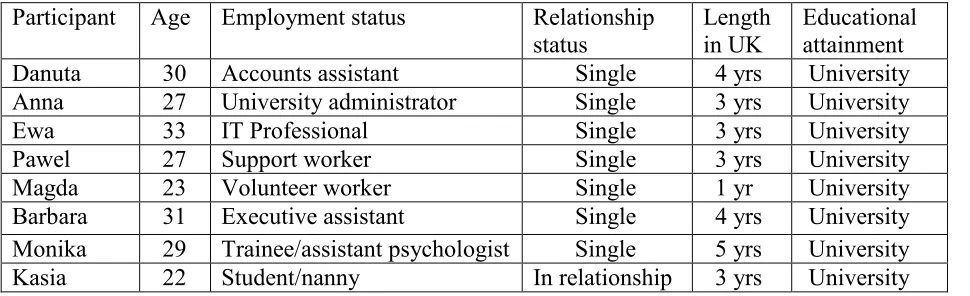
[image:28.595.66.551.369.517.2]referred to above, it was thought that an additional layer of interpretation might require an extended analysis and point of discussion beyond the scope of this research. Instead, interviews were conducted in English, acknowledging the possible limitations of expressive ability. Finally, an age criterion of 18-40 was implemented. The decision to limit the focus to younger Polish people was made in order to introduce age-related homogeneity since it was considered that the experiences of older generation Poles may be influenced by significantly different factors. Furthermore, this age bracket is representative of the typical age of post-2004 Polish migrants to the UK (Pollard et al., 2008). Small sample sizes are encouraged in IPA in order to achieve depth rather than breadth (Smith, 2008). Accordingly, eight participants were recruited. All participants were fully conversant in English. All bar one of the participants were female. Table 1. below provides basic demographic information for the group:
Table 1. Participant group demographic. (Pseudonyms are used).
Participant Age Employment status Relationship status
Length in UK
Educational attainment Danuta 30 Accounts assistant Single 4 yrs University Anna 27 University administrator Single 3 yrs University Ewa 33 IT Professional Single 3 yrs University Pawel 27 Support worker Single 3 yrs University Magda 23 Volunteer worker Single 1 yr University Barbara 31 Executive assistant Single 4 yrs University Monika 29 Trainee/assistant psychologist Single 5 yrs University Kasia 22 Student/nanny In relationship 3 yrs University
Procedure
The initial phase of data collection involved conducting a pilot interview in order to test out the interview schedule and to make any necessary revisions. The participant, Magda1, was recruited through word of mouth. Following this, a research flyer was designed [Appendix 1] and placed on notice boards in Polish shops, churches, Polish cultural centres, and in local libraries, all in London. After several weeks without a single response, alternative methods of advertisement were considered. A combination of word of mouth and advertising on university bulletin boards provided four people, and an advertisement in a Polish psychology interest group’s newsletter provided the three further participants. On receiving a request of
1
28
interest, participants were contacted by the researcher and arrangements were made regarding the time and location of the prospective interview. Six of the interviews took place during the summer of 2009, one occurred in January 2009, and the pilot interview took place during the summer of 2008. An interview room was made available within the School of Psychology at the University of East London campus. If this was inconvenient for participants, care was taken to ensure that the location, in which interviews were conducted, was in appropriate surroundings, i.e. emphasising privacy, comfort, quiet, and freedom from distraction.
Data collection
Data was collected through individual, face-to-face, semi-structured interviews, conducted by the researcher. Before the interview commenced, participants were informed of the nature of the research and were asked to provide consent. The interviews were carried out in accordance with the ethical guidelines described below. Basic demographic information was collected, i.e. age, employment and relationship/family status. Interviews were audio recorded using a digital recorder and the average length of interviews was approximately one hour. All interviews were followed by a debriefing period in which participants had the opportunity to ask further questions and to discuss their experience of participation.
The interview schedule [Appendix 4] was designed to facilitate rich reflections and to encourage participants to talk freely about their migratory experiences. A flexible, open interview style was applied in order to allow the interview to develop naturalistically so that unexpected themes were permitted to emerge. The interview schedule served as a guide rather than a list of questions to be strictly adhered to. The implications of this approach encompassed occasional drifting away from the schedule, which was rationalised as maximizing potential for exploration and enabling the interview to develop in unanticipated directions.
29
Analysis
IPA is conceptualized more as an approach than a prescriptive, step-by-step method for analysing data (Smith, 2009). The overarching guiding principle is a commitment to understanding the lived experience of the participant by attempting to make sense of the individual’s perspective (Reid et al., 2005). This is achieved through an inductive and iterative process, whereby the researcher engages in a dialogue with the data as the analysis develops, moving from the descriptive to the interpretative. The outcome of this process is the researcher’s interpretation of the participant’s sense-making, i.e. the double hermeneutic, which offers a tentative understanding of the phenomenon under consideration.
Though there is no set way of carrying out an IPA study, a number of procedural strategies that encourage meaningful engagement with the data have been suggested, (e.g. Smith et al., 1999; 2009). These suggestions were followed by the researcher and are presented here in a series of stages.
Stage 1
30
Stage 2
The second stage of analysis consisted of generating themes and noting these in the right hand margin. This process involved encapsulating the comments made in the initial stage and identifying the essential meaning of a section of text, whilst referring to its context in the transcript as a whole. The process of achieving understanding by relating to both the particular and the whole reflects the hermeneutic circle (Smith, 2007). In accordance with IPA, themes that were developed went beyond the descriptive in attempting to attain a deep and meaningful understanding. An interpretative approach was applied, encouraging a reflection of the conceptual relevance and the psychological implications of the particular section of transcript, and involving the researcher’s professional knowledge and personal response, and linking this with the text. An example of this process is provided in the appendices [Appendix 7].
After completing this process for the whole transcript work began on organising the emerging themes. The themes were written on separate pieces of paper and spread out on the floor. The spatial perception of this suggested technique (Smith et al., 2009) facilitated a strong sense of how themes were linked together and this assisted the grouping process. As the stage evolved, themes were collapsed, discarded and merged until a sense of coherence was reached. This was formulated into a table of super-ordinate themes and related sub themes, with page and line number references linking relevant extracts from the transcript. As with earlier phases of the research, reflections on this process were noted in a research diary.
Stage 3
31
Following the application of this process to each transcript, eight tables of themes were generated and these were laid out on the floor to provide a visual representation for the whole group. Reflecting on connections and patterns, similarities and differences, slowly led to grouping, organising and relabeling and eventually to the gradual development of a master table of themes, an excerpt of which is provided in the appendices [Appendix 8]. Throughout this process, emerging themes were discussed and reflected on with research peers and in supervision in order to maintain analytic legitimacy.
Validity
32
influencing processes are in the awareness of the researcher and are made clear in the write-up (Smith, 2007). Steps taken to maintain reflexivity included having regular consultations with my research supervisor, sharing ideas with research peers, and keeping a research diary in order to note reflections occurring during the whole course of the research process, from pre-data collection to write-up. Additionally, a reflexive statement was developed and is presented at end of this chapter, in order to elucidate my personal relationship with the research subject. I have used the above principles as guidance throughout the research in order to ensure quality and validity. It is hoped that these characteristics are evident both implicitly and explicitly in the thesis.
Ethical issues
33
Reflexive statement
34
Analysis
An interpretative phenomenological analysis of the eight interview transcripts led to the development of four master themes and eleven subordinate themes:
Master Themes
1) Relating to Poland
i. Freeing self from Poland ii. Attachment to Poland iii. Tension and conflict
2) Relating to the UK
i. Valuing openness ii. Feeling disconnected
3) Impact on self
i. Personal challenge ii. Personal development
4) Adaptive ability
i. Personality factors ii. Previous experience iii. Language matters iv. Coping strategies
Each master and subordinate theme is presented below using quotations taken from the participant transcripts to illustrate the researcher’s findings.
1) Relating to Poland
35
hold both positive and negative views of Poland. Positive perspectives are closely associated with family attachments, which are identified by the researcher as contributing to pressure to return to Poland.
Freeing self from Poland
The sense of Poland being experienced as a constraining society, that inhibits individual growth, is a strong theme to emerge from the study. This is expressed by all eight participants and is referred to as an important motivating factor in the migrants’ decision to migrate. For example, Kasia2 describes perceiving Poland as restrictive and rigid:
…Poland is such a pessimist country [LAUGHS]. It’s kind of like, and it’s very kind of like, there’s, I think there’s more opportunities in England and er in Poland I kind of felt like er there are certain ways that everyone goes and you have to go that way, there’s not much choice in what you can be, what you can do, so, I don’t think I kind of felt that I could do, that I actually possibly, realistically do something that I wanted to do. (Kasia, 3: 97-102).
The sense of restriction is described by Kasia as originating from a perceived national attitude of pessimism and by a societal inflexibility. Danuta describes a similar sense of restriction and constraint, linking it with the power of Polish political organisations:
…I start realising that it is hard in Poland, there are still the same people with, with a social mindset who might, you know, block me because yeh I’m working for the European Institution but someone is telling me, well if you don’t join the ‘blar’ political party then you’re not going any further… (Danuta, 15: 673-677).
In its broad sense the theme of constraint is inclusive of a range of perspectives and experiences. A perception of Poland as being intolerant of difference and lacking openness is frequently mentioned by participants. Ewa provides an example of feeling stifled by Poland’s homogeneity, something which she feels unable to tolerate for prolonged periods:
I can’t be there for too long because the society is so homogenous, you know, it’s just one type of people, everyone thinks the same, everyone looks the same, and if you, I don’t know, if you, even, if you would wear something different, you’ll be like, ‘what!’, you know, they, you wouldn’t feel accepted…(Ewa, 5: 202-206).
2
36
Here there is a sense that individual freedom of expression is constrained by cultural norms and expectations. Inherent is a suggestion that to adopt a position outside of societal convention is to risk being ostracised. Magda continues with this theme, linking the sense of a repressive homogeneity to Poland’s communist past:
…because we were under communism for so many years and I, I think like sometimes Polish society is like a grey mass, like everyone is the same, everyone does very similar things and, and if you find a job, y’know, you should do your best to keep this job and not change it because it’s not good. (Magda, 8:322-325).
A different example of constraint is provided by Barbara who describes a sense of being constrained in employment opportunities due to gender discrimination:
In Poland it’s completely different, er, it’s hierarchy everywhere, women sometimes are discriminated, not everywhere but the tendency is rather, you know, if you’re a woman it’s difficult to find a job or more difficult to find a job. (Barbara, 5: 202-205).
Pawel uses powerful imagery of confinement in expressing his experience of feeling trapped in Poland. His description of being stuck on a trajectory offers a sense of the inflexibility and lack of opportunity that he experienced of his native country. In migrating to the UK it is as if he is freeing himself from his imagined prison:
I wasn’t happy in the city. I felt that I’m just, you know, I’m just, too much I felt like in prison. I just seen my future like straight line and, so this was the main er feeling, just to change it. (Pawel, 1: 4-7).
37
Attachment to Poland
Despite the prevalence across the sample of negative perceptions of Poland, specifically regarding the inhibition of personal freedoms, all participants, except Kasia, describe a strong attachment to Poland. A dominant component of this attachment appears to be principally connected with relationships with family and friends. Although Pawel refers to feeling at times like an outsider in Poland he also describes a close connection with family and friends and he describes a strong bond with the physical landscape. It seems that there exists a sense of attachment to Poland that transcends all criticism of the homeland, for example, Monika remarks:
Poland annoys me right, and it’s…but I feel at home. (Monika, 3:118).
In the following quotation Monika describes a sense of a prior attachment she experienced to Poland, using the image of an ‘umbilical cord’. She describes what might be perceived as an unhealthy attachment as she explains how it felt necessary to break the cord, by migrating to the UK, in order free herself and to allow her own identity to develop. This idea is closely linked with the previous theme:
…although I wasn’t living with my parents for a good few years and I was living in a different place of Poland, but there was still this umbilical cord, what do you call it, the kind of…and I, I think that not before I came here, it just, I just had to do it to actually just get some sense of identity really… (Monika, 3: 103-107).
Anna refers to her sense of home being in Poland, evidencing the strong bond that exists between her and her country of origin. She understands this attachment as relating to the significance of her family:
Of course it is and will be always, my family’s there. (Anna, 4: 166).
In Anna’s response there is a sense of certainty that the powerful link with Poland will remain as long as her family is there.
38
It’s still home yeh there are friends that I er share experiences with life so this is…erm yeh so erm…Well I want to go back there because erm I would like, I would like to have my own family, I have to have my own children in Poland and er and I have two brothers, one of them will be getting married soon and then they’ll have children so I don’t wanna be erm, I want to be, I don’t want to be unknown person for their family and er my parents will need my help one day or my grandma who still lives there and might need my help and er, I want to value those relationships even more than a good job here. (Danuta, 14: 633-638).
Magda describes a sense of attachment that causes her to miss Poland, and she refers to the importance of her friends:
Magda: I think there is always something in your er home country that you miss even if you are here so…
Researcher: What kind of things would that be, do you think, if you could name them?
Magda: Erm, I think people erm, I, I miss my friends a lot. (Magda, 9: 374-377).
The excerpts and comments above provide a sense of the profound nature of attachments that participants hold towards Poland. At the same time as voicing their discontent and dissatisfaction with life in their native country, the majority of participants describe a strong and robust connection with Poland, which they associate with their relationships with family and friends. Only Kasia differs in the lack of attachment she expresses towards family in Poland, which appears to relate to an individualist outlook:
I’m more individualistic in my way of thinking, or more career oriented rather than family oriented. (Kasia, 4: 173-174).
Tension and conflict
39
I’m sort of, you know, I’m torn, one, one feet, one leg in Poland and one is here. (Anna, 19: 849).
The evocative use of language communicates a sense of the discomfort associated with being pulled in opposing directions. Barbara similarly refers to a tension between her obligations towards her family and the independent life that she desires and has developed in the UK. She describes the close bond that she has with her family and acknowledges experiencing feelings of guilt due to a sense of not fulfilling obligations towards them:
I feel that I’m, I think I’m missing on something, erm, my relationship with my parents is very strong, erm I think they do need me and it’s kind of sometimes a sense of guilt that maybe I shouldn’t be here, erm, maybe I should be with them, but in the other hand I think it’s my life (Barbara, 4: 176-179).
As highlighted in the previous section, Danuta is clear about her intentions to return to Poland in order to be close to her family, to not miss out, similarly to Barbara, and to have children. Though the intention to move back to Poland seems clear, Danuta goes on to acknowledge the potential difficulties inherent in that decision, thus revealing a tension:
I would prefer to be in Poland but, you know, when I stop fantasise, you know, about my wonderful life in Poland and I start realising that it is hard in Poland. (Danuta, 15: 672-674).
Monika describes a tension around deciding where to live in the long term. Though she describes wanting to stay in the UK and not wanting to return to Poland, at the same time she feels reluctant to consider retiring or being buried in the UK. Since neither option is satisfactory, it appears that she is left with the feeling of an uneasy dilemma:
I’m in two minds about it because both options seem not very appealing, so, if I think about having my, like being buried in England, you know, like if we’re talking, I wanna stay here I don’t feel like going back there but then I think, ‘is this the country I wanna be buried in’, like, I want, I wanna like, I don’t know, retire’? And I don’t think so, but then I think, ‘do I wanna go back to Poland’? And the answer is ‘no’ because there’s not much I have there. (Monika, 5: 225-230).
40
related to the sense of constraint that they associate with the Poland that they may be returning to, as referred to in the first theme. Where lives with fewer constraints have been developed and to some extent normalised during their time in the UK, it is perhaps understandable that thoughts of returning to Poland might include trepidation regarding potential loss of personal freedoms.
2) Relating to the UK
Participants’ ways of relating to the UK differ depending on which aspect of their UK experience they are referring to. Their descriptions fall into positive and negative categories, which are organised into two main subordinate themes, valuing openness and feeling disconnected.
Valuing openness
All participants describe valuing the experience of openness in the UK, which may be heightened in response to the feelings of constraint associated with Poland. Openness is described in various ways, for example, participants refer to experiencing tolerance, flexibility, optimism, and a sense of freedom and opportunity in the UK. Examples of such experiences are abundant throughout the group. Magda refers to the sense of opportunity and describes how it has contributed to her becoming more open-minded and engaging more with life:
…in Poland we used to, we used to say, ‘you have to do this, you have to do that’, and here it’s ‘you can do this’ and you know, you have another opportunity and if only you want, and it’s more about focusing on yourself, your needs, and I think it, it gave me a lot of courage, you know, for explore many things so I participated in many trainings and yeh I think I became, I’ve become more open-minded in myself. (Magda, 7: 312-317).
Magda goes further in offering an understanding of how she values the sense of freedom she experiences in the UK and how she believes this enables her individual needs to be met:
41
Kasia describes in a similar way how the freedom and opportunity she experiences in the UK enables her to fulfil her ambitions, which positively influences her mood:
I mean, to be honest, if I wouldn’t come here, I wouldn’t, I wouldn’t have a degree that I actually enjoy, I wouldn’t actually er, I wouldn’t have met my boyfriend, I wouldn’t have met my friends, so actually I think everything has changed and yeh I think I’m much happier person now, much, I feel like my, actually I, like I’m fulfilling my needs, I’m actually, you know, like making my dreams come true, yeh. (Kasia, 5: 206-211).
Ewa describes living in the UK as an inspirational feeling that nurtures her creativity: …whenever I go away and I come back, I was like, I breathe in the air and it’s like, wow, there is this kind of creativity, inspiration somewhere around. I don’t know, it’s just something really special, I really like it. (Ewa, 3: 116-119).
The powerful imagery used by Ewa of ‘breathing in the air’ gives a sense of embracing and embodying the special atmosphere. Ewa goes on to describe the features that make up that special place, including cultural centres and the attitude of the people. Again there is a sense of embodiment and also nurturing in the imagery of ‘feeding’ on cultural offerings:
…you’re surrounded by really nice things, you have all the museums, galleries, all the places where you can go to and can sort of feed on interesting stuff, and also people you meet and erm just yeh. I think people basically are really nice and just not yeh, I don’t know…just open, nice and yeh. (Ewa, 3: 125-128).
Barbara refers to valuing openness in describing her experience of tolerance in the UK, which she compares to Poland. She describes how this positive experience strongly influenced her decision to stay in the UK, signalling the importance she attaches to this characteristic. Of further relevance is the difficulty she imagines of returning to Poland, which she associates with diminished levels of tolerance:
42
An aspect of openness that participants refer to and value is the experience of warmth and friendliness, particularly from officials. Similarly to previous examples, it is likely that this positive experience is heightened by the contrast of participants’ experiences of dealing with officials in Poland. Describing his experience of managing bureaucracy, Pawel regards this as much easier in the UK due to, as he perceives, the friendlier people:
Well there’s a kind different culture here, which I really appreciate. There is more culture, ‘nice to be nice’, and in Poland it’s, I am official and you are, you want something. (Pawel, 3: 125-127).
Pawel and Danuta refer to a culture of mistrust and suspicion in Poland, which makes trusting others difficult. This is contrasted with their experiences in the UK, for example, Danuta perceives the cordiality of officials as a distinct and appreciated experience:
...a lot of people are nice and we think that they are nice, but they’re just doing their job, but this is ok, this is ok, this is how it should be, ‘cause there shouldn’t be all those negative people who want to exploit other people. (Danuta, 8: 358-360).
Valuing openness is also referred to by half of the participants when describing their appreciation of diversity in London. Ewa attaches much importance to this experience:
…the best thing about London for me is erm the mixture of people that is here and I, I find it surprising how this all can work, you know, how all these people can function sort of in one place and just, just enjoy sort of, you know, I perceive it as enjoyment. (Ewa, 5: 198-201).
Inherent in Ewa’s enjoyment of diversity is a sense of liberation. It is likely that this is enhanced by her perception of life in Poland as stiflingly homogenous, as mentioned earlier, when she refers to the constraints she experienced there.
43
…maybe there’s just something to do with London, because there are so many different people from literally all over the world, so actually you sort of merge, you disappear, you’re just part of, you know, colourful London, erm, you’re just, you’re just, you know, part of it. (Anna, 8: 363-366).
Anna also describes valuing being exposed to a culturally diverse population because of the learning experience she gains from this:
Actually whenever, whenever I think of any country in the world, and I just walk down the street, and I think to myself, and I just think er it’s very possible I’m actually meeting person from, you know, Burkina Faso, for instance, you know, just, just walking down the street, especially living in Brixton. So erm, I just, I just like it, I just like the place. It really opens my mind, broaden, well broaden my horizons and er I’m really thankful for that. Erm my friends back in Poland, I really have great friends and they, before they, they used to ask me erm, when are you coming back? And now they ask me, are you coming back? (Anna, 3: 130-137).
Anna links the significance attached to this experience to the increasing connection she feels with the UK, a relationship shift that her friends in Poland observe. For all participants the drive to feel free to pursue and to be able to realise ambitions is of great importance and is central in the decision to migrate. Since all participants describe having the experience of living in a society in which one feels relatively uninhibited to function and to develop according to one’s individual needs, it is understandable that this would lead to an increased connection with that society.
Feeling disconnected
Though valued positive experiences are clearly apparent amongst the participant group, six participants describe experiencing a feeling of disconnection and report missing closeness, which they associate with living in the UK. Monika refers to this disconnection in distinguishing between Polish and British concepts of friendship, where Polish friendship is perceived as being more profound, and British more superficial:
44
term ‘acquaintances’ or something like that, or I don’t know, colleagues or, so…(Monika, 6: 255-260).
In addition to conceptual differences of friendship, Monika considers a perceived aloofness of British people as contributing to her sense of disconnection:
I think that there is something about different way of maybe socialising. Erm, maybe there’s something about English people…I, I don’t really think that, it’s like, this is a brilliant country