CSEIT172462 | Received : 18 July 2017 | Accepted : 29 July 2017 | July-August-2017 [(2)4: 335-339]
International Journal of Scientific Research in Computer Science, Engineering and Information Technology © 2017 IJSRCSEIT | Volume 2 | Issue 4 | ISSN : 2456-3307
335
Quality of Service Oriented Virtual Base Station Maintenance
System for Empowered Cloud RAN
Swaroopa Shastri,
Viraj Biradar, Sarvesh Javali
Department of Studies in Computer Application (MCA) VTU Center for PG Studies Kalaburagi, Karnataka, India
ABSTRACT
Now a days the demand in networks has been amplified, that is increase in users which forces mobile operators to give large capacity for users. Overall which will result in the amplification of base stations, which poses a issue includes energy consumption. In DRAN, every base station consist of two parts digital and radio unit. Digital used for baseband and radio is used for transmitting signals. The DU should be kept on, which result in consumption of power during off peak time. The other resources used to keep the DU working will cost in capital and power consumption such cooling machines. The new plan has been introduced to reduce the power consumption that is cloud-ran. The new plan is costlier than the old as it simplifies the operations of network, maintenance and upgrade by being in one location for processing. Here the DU are located from scattered base position to DU cloud which provide service for more group of radio units. By using public interface the DU and RU transmit digitized signal. The proposed system makes the process of using the cloud RAN architecture and how one use it to save the energy of the digital unit which is a part of the cloud RAN. If the digital unit is used with efficiency, the architecture is workable for a longer period of the time thus providing the full-fledged service the network user. By the proposed system one can observer that the energy utilization using current technique is far better than the existing one.
Keywords: Cloud, Energy Efficiency, cloud RAN, optical access, DRAN,ILP, PON, VBS
I.
INTRODUCTION
Lately, the expanding traffic request in radio get to systems (RAN) has prompted impressive development in the quantity of base stations, representing a genuine adaptability issue, together with the vitality utilization of BSs. Optical get to empowered Cloud RAN has been as of late considered as a cutting edge get to organize. In CRAN, the advanced unit (DU) of an ordinary cell place is isolated starting the radio unit (RU) and stirred to the "cloud" (DU) for concentrated flag handling and administration. Every one of DU RU match trades transmission capacity serious digitizeds base-band motions fromanvisual get to organize. Division Multiplexing with Time Wavelength for Passive Optical Network is a talented fronthaular arrangement because of its little vitality utilization and morelimit. Here, we provide the idea of using the virtual-base-station concept, which is progressively shaped for every cell by doling out simulated organize assets, i.e., a virtualized fronthaul interface associating the DU and RU, and virtualize useful elements doing baseband
preparing in DU cloud. We define and understand the VBS development (VF) advancement issue utilizing an Integer Linear Program(ILP).Here we consider novel vitality sparing plans abusing VF for both the system arranging phase and traffic building stage. Broad reenactments demonstrate that CRAN with our proposed VF plans accomplishes significant vitality funds contrasted with conventional RAN and CRAN without VF.
Problem Statement
assets of the DU can't be mutual by RUs in different BS, along these lines, all DUs in the RAN need to stay dynamic, creating vitality squander in RAN amid off pinnacle periods. Besides, every BS needs free vitality expending "lodging" offices (cooling frameworks, and so forth.) for its DU, and all these vitality devouring segments need to remain dynamic constantly. In this manner, DRAN does not speak to a future verification and versatile answer for cutting edge RAN.
Objective of Study
Minimization of general vitality use by the RAN, by making the DU to deal with the cloud Boosting the lifetime of the RAN, making it use the vitality in helpful way. The multifaceted nature of the base station is diminishing.
Scope of the Study
In empowering advancements are proposed to spare vitality in alloptical systems. In any case, these vitality sparing methodologies can't straightforwardly implies to CRAN. A vitality prominent improvement issue with asset task and control distribution in CRAN is considered here. Avitality efficient DU group tried for CRAN is created, yet it didn't propose the vitality sparing in front haul.
II.
METHODS AND MATERIAL
Base Station Pool - A unified pool of processing assets to give the flag handling and coordination usefulness required by all cells inside the region; Optical Fronthaul Optical fiber joins conveying digitized portrayals of the baseband information prepared for transmission in the RAN; Remote Radio Heads RRHs are light weight radio units and unloading wires that client gear interfaces with by means of the RAN. The plan of the units implies that they can be found anyplace. Where a conventional base station requires a pole and lodging for the baseband preparing unit, RRHs require just the space for the receipt wire and get to to some type of fronthaul. RRHs can be utilized as a part of place of any size of cell from large scale down to femto’s and pico’s Organize heterogeneity and related developments are additionally difficult the conventional perspective of the cell as the focal idea of versatile system outline. Handing off, composed multipoint and disseminated reception apparatus
frameworks all depend upon coordination amongst cells and U-E gadgets not acting in a customer limit.In the creators give a point by point portrayal to fronthaul necessity in CRAN. In the first place, large scale cells normally harvest up to 15.0RUs for each site. Then, CPRI is a consistent piece rate interface, which entails information rates from 613.9 Mbps to max of 10.237 Gbp’sconsidering bit blunder proportion on the fronthaul connect smaller than 10 to 12. Lastly the base-band handling at DU ought to be under 1ms. The round-excursion time devoted to fronthaul’s and to the visual system section ought to be under 500 µs. At last, the CPRI connection ought to contribute under ±2.0ppb to the general recurrence precision prerequisite reporting in real time interface for LTE. An itemized examination on achievability of the proposed design is an open issue, however the necessities as far as cost-sparing engineering contrasted with DRAN as it simple organize process, support, and redesign by gathering in a solitary area for RAN handling and organization hardware. More interestingly, CRAN has bring down cost at cell destinations, for example, littler impression and power utilization of outside gear, and can progressively share foundation in DU cloud, as indicated by the traffic variety. Notwithstanding costrelated benefits, CRAN additionally facilitates usage of cutting edge radio-coordination methods, for example,uninvolved optical systems (PON) for separations up to 40 km and different misfortune spending plans.
Literature Survey
Existing System
Vitalizing the processing assets of each DU, DU can be powerfully mutual by various cells. Cloud IQ demonstrated that pooling assets can decrease the general cost of a system, in any case it depended on statically distributing assets (as opposed to progressively reallocating assets as indicated by changing burdens), and it didn't consider vitality sparing in CRAN. DU virtualization and displayed it as a canister pressing issue. Asimulatedway for DU cloud, that those base-band handling in a DU is simulated as utilitarian elements, cell preparing and client handling (UP), all of which can be simulated and reconfigured in a DU for a phone that a client, individually.
Proposed System
To utilize just "simply enough" assets to bolster current movement requests. Not at all like stagnant case, where movement heaps for a time are considered in advance and stay unaltered, in unique case, activity problems are not known apriori, or are liable to factual vulnerability. Presently, when an association ask for arrives, the brought together controller needs to settle on an online choice for in what way to arrangement it promptly just how and anywhere to set up.
An occasion driven test system has been produced to think about the two methodologies on the expansive topology, with a similar info settings utilized for the static situation. The design, we proposed a novel idea, virtual base-station (VBS), which is a mix of a virtualized front-haul connect and numerous virtualized utilitarian substances of base-band preparing. By adaptably shaping a VBS for every cell, arrange assets can be successfully shared to spare vitality in CRAN.
System Design
Figure 1. System Design
III.
RESULTS AND DISCUSSION
The screen shots will help us to know the flow.
User Login
About: User has to login to cloud
Figure 2. User Login
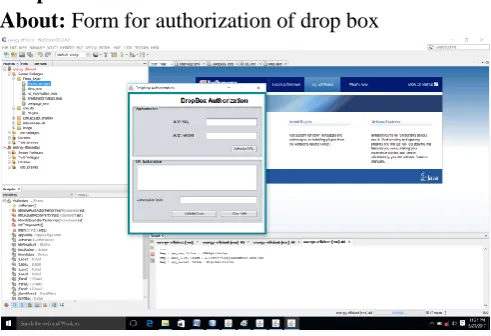
Drop box Authorization
About: Form for authorization of drop box
Figure 3.a. Dropbox authorization
About: User should input the app key and secret key
About: The user should also input the authorization code
Figure 3.c. Authorization code
Base Station
About: Activation of base station
Figure 4. Activate Base Station
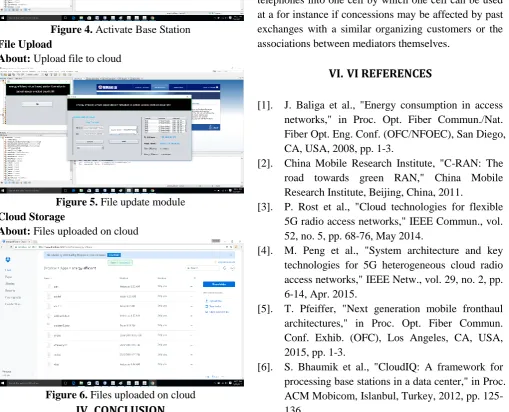
File Upload
About: Upload file to cloud
Figure 5. File update module
Cloud Storage
About: Files uploaded on cloud
Figure 6. Files uploaded on cloud
IV.
CONCLUSION
The proposed system makes the process of using the cloud RAN architecture and how one use it to save the energy of the digital unit which is a part of the cloud RAN. The digital unit is a very important part of the system which is used for making the architecture work for a longer period of time. If the digital unit is used with efficiency, the architecture is workable for a longer period of time thus providing the full fledged service to the network user. By the proposed system one can observer that the energy utilization using the current technique is far better than then the existing one.
V.
FUTURE ENHANCEMENT
The investigation presented in this work is a wandering stone towards imperativeness capability. As future work, we plan to continue examining on what makes customer to control the essentialness usage. In particular, we are furthermore captivated by examining if there are distinctive segments that could similarly expect a section in this, for example, joining all telephones into one cell by which one cell can be used at a for instance if concessions may be affected by past exchanges with a similar organizing customers or the associations between mediators themselves.
VI.
VI REFERENCES
[1]. J. Baliga et al., "Energy consumption in access networks," in Proc. Opt. Fiber Commun./Nat. Fiber Opt. Eng. Conf. (OFC/NFOEC), San Diego, CA, USA, 2008, pp. 1-3.
[2]. China Mobile Research Institute, "C-RAN: The road towards green RAN," China Mobile Research Institute, Beijing, China, 2011.
[3]. P. Rost et al., "Cloud technologies for flexible 5G radio access networks," IEEE Commun., vol. 52, no. 5, pp. 68-76, May 2014.
[4]. M. Peng et al., "System architecture and key technologies for 5G heterogeneous cloud radio access networks," IEEE Netw., vol. 29, no. 2, pp. 6-14, Apr. 2015.
[5]. T. Pfeiffer, "Next generation mobile fronthaul architectures," in Proc. Opt. Fiber Commun. Conf. Exhib. (OFC), Los Angeles, CA, USA, 2015, pp. 1-3.
[7]. M. Qian et al., "Baseband processing units virtualization for cloud radio access networks," IEEE Wireless Commun. Lett., vol. 4, no. 2, pp. 189-192, Apr. 2015.
[8]. B. Haberland et al., "Radio base stations in the cloud," Bell Labs Tech. J., vol. 18, no. 1, pp. 129-152, May 2013.
[9]. C. Liu et al., "A novel multi-service small-cell cloud radio access network for mobile Backhaul and computing based on radio-over-fiber technologies," IEEE/OSA J. Lightw. Technol., vol. 31, no. 17, pp. 2869-2875, Sep. 2013.