Learning Database Content for Spoken Dialogue System Design
Joseph Polifroni and Marilyn Walker
The Department of Computer Science University of Sheffield
Regent Court Sheffield, S1 4DP UNITED KINGDOM
[email protected] [email protected]
Abstract
Spoken dialogue systems are common interfaces to backend data in information retrieval domains. As more data is made available on the Web and IE technology matures, dialogue systems, whether they be speech- or text-based, will be more in demand to provide user-friendly access to this data. However, dialogue systems must become both easier to configure, as well as more informative than the traditional form-based systems that are currently available. We present techniques in this paper to address the issue of automating both content selection for use in summary responses and in system initiative queries.
1.
Introduction
One of the most common applications for spoken dialogue systems is as an interface to structured databases, where database entities are represented in terms of a set of at-tributes and their values. For example, in the restaurant domain, attributes for the restaurant entity include cuisine, neighborhood, food quality, price and neighborhood (Po-lifroni et al., 2003; Walker et al., 2004). To provide ac-cess to such databases, many spoken dialogue systems are configured to have an initial information-gathering phase, where the values for certain attributes are elicited from the user. The attributes (also referred to as ”constraints”), as well as a default order of elicitation, are specified by a system developer familiar with the domain. The goal of the information gathering phase is to reduce the number of database tuples to a subset of the data that can be easily de-scribed. Any information-providing utterances by the sys-tem are thus delayed until the syssys-tem has elicited enough constraints to query the database. Table 1 shows an ex-ample of such a system, modelled after the strategy de-scribed in (Levin et al., 2000). Note that user utterances User1, User2, and User3 successively narrow the restau-rant selections, until there are only two matching tuples in the database.
Furthermore, as shown by utterance System4, the information-providing utterances in such systems usually take the form of descriptions of individual entities within the database. The attributes to be mentioned in these de-scriptions are also specified by a system developer familiar with the domain.
Dialogue systems designed in this way have several seri-ous limitations. First, users may wish to browse the data, either because they are unfamiliar with the domain or be-cause they do not have strong preferences. Second, this type of dialogue interaction often leads to the generation of overspecific constraints with unsatisfiable queries. Third, a default order of constraint elicitation may encourage the user to provide information that will not narrow down their choices in the most efficient way.
Our hypothesis is that these limitations can be addressed in
User1: I’d like to know about restaurants in London. System1: Are you interested in a particular
neighbor-hood?
User2: I’d like an expensive restaurant.
System2: Are you interested in a particular neighbor-hood?
User3: I’d like an Italian restaurant.
System3: Are you interested in a particular neighbor-hood?
User4: Do you know of any near Leicester Square? System4: I know of the following two Italian
restau-rants near Leicester Square. Quo Vadi, on Dean Street, serves contemporary Italian cui-sine. Signor Zilli, on Dean Street, serves tra-ditional Italian cuisine.
Table 1: An example dialogue showing a traditional spo-ken dialogue management strategy, where constraints are elicited in a particular order (which the user is free to ig-nore) and no information is given to the user until a small number of database tuples is identified.
a domain independent way by applying statistical learning techniques to the automation of constraint order elicitation and content selection. We have applied these techniques to dialogue management and the resulting data-driven system responses are illustrated in Table 2. Section 2 describes in a general way the basic idea of how to automatically generate such responses using entropy and tree-induction. Section 3 describes the generation algorithms in more de-tail in the context of Bruiser (B
¯rowsing R¯estaurants U¯sing I
User1: What do you know about restaurants in Lon-don?
System1: There are 592 restaurants in London in total. Most are expensive There are medium-priced restaurants near South Kensington tube sta-tion and in Chelsea. Is there a tube stasta-tion or street you’re interested in?
User2: How about Soho?
System2: Soho has many medium-priced restaurants with good food quality. I know of some ex-pensive restaurants with very good food qual-ity near Leicester Square tube station. Do you have a preference for cuisine?
Table 2: Example dialogue responses automatically derived using tree-induction and entropy.
2.
Generating responses in dialogue systems
using Entropy and Tree Induction
We want to be able to generate two different types of re-sponses, intensional summaries and data-specific queries in a data-specific and domain-independent way. Intensional summaries allow the system to speak about the domain data at an abstract level of generalization by using intensional knowledge. These summaries require selection of appro-priate pieces of information from the backend database to present to the user.
An example of intensional summary responses can be seen in Table 2. The two responses contain no extensional in-formation at all; no specific instances of database tuples are contained within it. However, the answers do summarize the existing tuples into a statement containing information about their neighborhoods and price ranges.
The second type of response we are interested in generating is a data-specific system initiative (question). For example, if a user is browsing restaurants in Boston and has told the system s he is interested in the North End neighborhood of the city, a follow-on query about cuisine would be almost redundant–89% of the restaurants in the North End are Ital-ian. A better strategy might be to alert the user to this fact in a summary response and ask for another attribute in the system initiative. Although the user is free to ignore the system initiative and ask about any other attribute that the system knows about, the system initiative provides a useful hint, especially for new users, about what constraints the system knows about and how the user might proceed. To generate these types of responses, the dialogue manager must query the database at every turn in the dialogue where the user has specified or refined a set of preferences. The database is filtered based on the user preferences and the re-sulting tuples are used to determine the content of the sum-mary and system initiative responses. Both response types make use of a measure of entropy, or information gain. In a multivariate space, entropy calculates the amount of information that is gained by choosing a particular path at any given point in the exploration of that space (Wit-ten and Frank, 2000). Entropy will (Wit-tend to score highly those attributes that have a large number of distinct
val-ues. For example, in a restaurant domain, the attribute street will typically have a larger entropy value than the attribute for neighborhood, given that most cities have a far greater number of unique streets than unique neighborhoods. To automatically learn potential summary information about the backend, and enable more descriptive answering behavior, we use tree induction to discover rules about the data in focus at each turn in the dialogue. Decision tree induction has long been used in data-mining and has been shown to be an efficient way to compute association rules among attributes (Kamber et al., 1997; Liu et al., 2000). Our main purpose in applying tree induction to spoken di-alogue systems was as a way of learning generalizations over our backend data tuples that could serve as useful sum-maries. Because the purpose of any tree-induction algo-rithm is to discover those association rules with the highest coverage, the resulting rules are used to form the basis for system responses.
The specific instantiation of the tree-induction algorithm used here is C4.5 (Quinlan, 1993). C4.5 is robust in cases where there is missing data among the attributes to con-sider, and it is able to deal with both scalar and symbolic values for attributes. Both of these were important to insure that the technique will be applicable to multiple domains. Furthermore, c4.5 performs quite efficiently, meaning that association rules for most simulated dialogue data can be computed while preserving the requirement for real-time dialogue performance.
3.
Implementation in Bruiser
We have designed and implemented a dialogue manager that makes use of entropy and tree induction to produce re-sponses in the Bruiser system, targeting the London restau-rant domain. Control is table-driven and proceeds in se-quence through a set of operations (Seneff et al., 1999) gov-erning a four-step process:
Filtering the data to match user constraints
Computing entropy on the resulting data
Generating association rules using tree induction
Selecting from the association rules an appropriate set for presentation to the user
3.1. Filtering data
The first step involves filtering database tuples to match the user’s constraints as specified up to that point in the dia-logue. In our system, the dialogue manager interacts with the backend database to filter data. All subsequent deci-sions on what to speak are based on the subset of the data.
3.2. Computing entropy
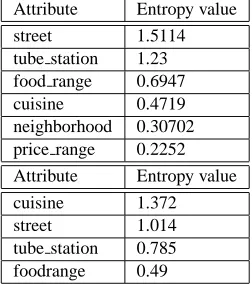
As mentioned above, we wish to produce a system initia-tive at every point in the dialogue. A menu-driven system initiative strategy works through a set of constraints in a pre-determined order in every dialogue. To maintain an automated and data-driven dialogue management, the di-alogue manager chooses the value with the highest entropy and enters it into the response frame being constructed. The natural language generation component of the system (Bap-tist and Seneff, 2000) will later construct a query to the user to determine if s he has a preferred value for that at-tribute. Entropy values for a set of attributes representing the entire set of London restaurants are shown in Table3. As mentioned above, attributes with many distinct values score higher for entropy.
By using the attribute with the highest entropy value as the system initiative (e.g., street in Table3 for all restaurants), we reasoned that we could query the user for the value that would reduce the search space most effectively. Because an individual attribute may continue to appear at the top of the entropy measure until a user has specified a value for it, our system maintains a record of attributes it has asked about. If an attribute has been asked about already in the dialogue, the system will choose, in the following turn, the attribute with the next entropy value to use in the system initiative.
3.3. Generating association rules using tree induction
In the third step of the content selection process, tree-induction is performed by another server using the C4.5 algorithm. Trees are generated iteratively, beginning with a randomly selected subset of the data. Multiple trees are built and later pruned to simplify the trees. Entropy values, calculated earlier, are sent to the C4.5 server and used in the construction of the trees.
Trees are built to predict a dependent variable (i.e., the leaf node) and we use the entropy values to select the depen-dent variable for each tree. We experimented with vari-ous ways of using entropy and finally decided on using the attribute with the lowest entropy value (e.g., price range in Table 3 for the set of all restaurants). When we used values with high entropy, we found that are rules were far too specific. For example, the attribute street often has the highest entropy value, as evidenced from the values for en-tropy computed for the first query in Table3. A tree de-signed to predict a set of restaurants based on street, how-ever, finds few clusters of restaurants. (Although there are many streets in London with multiple restaurants, associa-tion rules that predict street in combinaassocia-tion with other tributes find few restaurants.) In a browsing domain, at-tributes with high entropy actually make for the best gen-eralizations. When there are just four possible values for a particular attribute, as is the case for price range (quan-tized in our implementation into bins representing very ex-pensive, exex-pensive, medium priced, and cheap), association rules find larger clusters of restaurants to speak about.
3.4. Selecting from the association rules for presentation to the user
Each set of association rules in the tree is given a score rep-resenting the number of database tuples it correctly identi-fies minus the number of tuples that it incorrectly identiidenti-fies,
through multiple iterations. The resulting rules are ordered by score and returned to the dialogue manager for the fourth and final step of content selection.
The dialogue manager examines the association rules and determines the best set to send on to the natural language generation module. Currently, we are only looking at the best-scoring rules, i.e., the rules that account for the most data. The top-scoring rule is always selected and subse-quent rules are examined to find a set that both accounts for a large number of tuples and includes a range of predicate types. The system is configured to choose at most three rules, for reasons of conciseness. If adjacent rules account for the same predicate types, preference is given to lower scoring rules that describe different predicates. A thresh-olding parameter gives precedence to rules whose scores are close in value and penalizes rules whose scores are very different from the immediately preceding one. Once rules are selected by the dialogue manager, predicates with iden-tical values are aggregated to make the resulting response string less verbose. In order to avoid annoying the user by continually asking for the same attribute in the system initiative, the dialogue manager, as a final step, examines its history of system initiative attributes and may decide to choose one with a lower entropy value if the user seems uninterested in the one that has been asked about.
Table 2 shows an example of system behavior using the al-gorithms described above. With no constraints on the data (all restaurants are in London), the database attribute with the lowest entropy value was price range, which was used as the dependent variable in constructing the tree used in content selection. The first sentence in the response (Sys-tem1) is a generated form of the top-scoring rule, which included the single attribute price range. The second sen-tence is a representation of the next two rules, chosen be-cause they have a similar score and represent different sets of predicates (i.e., tube station and neighborhood). Since both rules have the same value for “price,” it is spoken just once in the resulting string. The rules used to construct this response are shown in Table4.
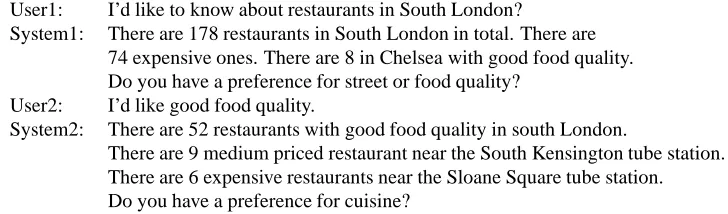
User1: I’d like to know about restaurants in South London?
System1: There are 178 restaurants in South London in total. There are 74 expensive ones. There are 8 in Chelsea with good food quality. Do you have a preference for street or food quality?
User2: I’d like good food quality.
System2: There are 52 restaurants with good food quality in south London.
There are 9 medium priced restaurant near the South Kensington tube station. There are 6 expensive restaurants near the Sloane Square tube station. Do you have a preference for cuisine?
Table 6: Another dialogue pair showing responses automatically derived using tree-induction and entropy.
All three systems use the same architecture, giving us a unique opportunity to derive dialogues using the same input queries and backend data. We are performing these experi-ments in an “overhearer” mode, where judges are presented with three separate responses for each user query and asked to rate each response.
An exploratory study showed that users prefer either the Di-rectedDialogue baseline system or the Bruiser system. We were surprised at the number of people who preferred the directed dialogue approach, but feel that this is in keeping with the assumption that successful dialogue strategies are dependent on user preferences and knowledge (Kass and Finin, 1988). In cases where a user is unfamiliar with the knowledge contained in the backend database, responses that provide more information might be preferred. If users are familiar with the data, they may feel that a directed di-alogue strategy will more efficiently allow them to reach their goals. Individual differences related both the user’s knowledge and their “degree of hastiness” (Komatani et al., 2003) could also play a role in the perceived efficacy of the strategy types. We plan to run more experiments to deter-mine the effect of these dialogue strategies on user satisfac-tion.
5.
Related work
The summarization strategy here differs considerably from the view of a summary as a condensed version of an original document or set of documents. In this respect, our strategy is closer to indicative summarization. Indicative summa-rization (Kan et al., 2001b) has been used to provide in-sight in the contents of documents and help guide the user to a specific document that can then either be summarized using other techniques, or retrieved as a whole. Features of individual documents are examined to determine useful summaries, in much the same way that features of individ-ual database tuples can be examined to determine useful aspects to summarize. Tree structures have been used to characterize topic information, although these tree struc-tures have been determined using section headers, for ex-ample, in structured documents (Kan et al., 2001a). One important difference is our use of automatically computed association rules among tuples in the database to give users insight into generalizations that may be inherent in the data but not obvious to even someone experienced with the do-main.
Another motivation in adopting this approach to content selection comes from the field of cooperative answering.
The ability to process existing data to enable generalization and summarization has been proposed as a mark of intelli-gent answering (Han et al., June 1996), as well as the abil-ity to browse the data (Motro, 1996). The user should be able to explore what is contained within a backend with-out necessarily having a clear goal in mind. The techniques described in this paper automate these capabilities for dia-logue systems.
The field of data visualization contains unexpected similar-ities with dialogue system design (for database access), in that both concern themselves with making sense of large corpora of data with the purpose of providing a sensible in-terface to users. Early work in this field (A. Buja and Stuet-zle, 1991; Buja et al., 1996) concerned itself with selecting subsets of the data to focus users on particular aspects of a problem. Later work treats the problem of data visualiza-tion as one of data summarizavisualiza-tion (Lesh and Mitzenmacher, 2004), as we do here. The emphasis in much of the data vi-sualization literature is in the interface to the user, including an iterative interaction via a GUI that seems very like a di-alogue. Our work complements this approach by adding a generation component for a natural language rendering of the summarizations, as well as a speech and natural lan-guage input capability.
6.
Summary and future directions
We have reported here on our initial attempts at using machine learning techniques for automatically determin-ing both summary attributes and system initiative for dia-logue system responses. We have implemented these tech-niques in the context of a restaurant domain for London and are currently running an evaluation experiment. In fu-ture work, we will expand the dialogue manager to incor-porate these algorithms as part of a strategy for generating fallback responses in cases where the database returns no tuples matching the user’s request.Since our original motivation was to provide useful and helpful information to the user, user modelling will fit in well with our goals. We intend to examine the application of user modelling to help guide content selection from both the entropy values and the association rules we derive from our dialogue manager.
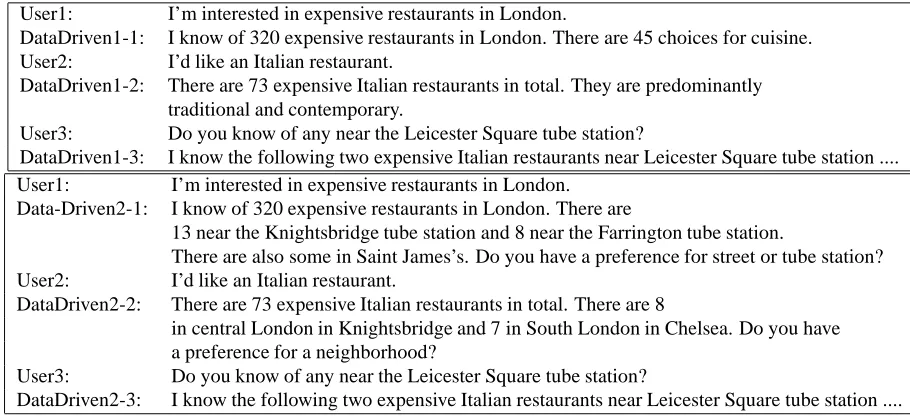
User1: I’m interested in expensive restaurants in London.
DataDriven1-1: I know of 320 expensive restaurants in London. There are 45 choices for cuisine. User2: I’d like an Italian restaurant.
DataDriven1-2: There are 73 expensive Italian restaurants in total. They are predominantly traditional and contemporary.
User3: Do you know of any near the Leicester Square tube station?
DataDriven1-3: I know the following two expensive Italian restaurants near Leicester Square tube station .... User1: I’m interested in expensive restaurants in London.
Data-Driven2-1: I know of 320 expensive restaurants in London. There are
13 near the Knightsbridge tube station and 8 near the Farrington tube station.
There are also some in Saint James’s. Do you have a preference for street or tube station? User2: I’d like an Italian restaurant.
DataDriven2-2: There are 73 expensive Italian restaurants in total. There are 8
in central London in Knightsbridge and 7 in South London in Chelsea. Do you have a preference for a neighborhood?
User3: Do you know of any near the Leicester Square tube station?
DataDriven2-3: I know the following two expensive Italian restaurants near Leicester Square tube station ....
Table 7: Example dialogue responses illustrating the differences between the DataDriven1 approach to content selection and response generation (at top) and the Bruiser system (at bottom).
are interested in domains both different in scope from tra-ditional data-retrieval domains and with a compelling rea-son for a dialogue interface. We are currently conducting a preliminary study using the techniques described above to simulate a dialogue interface to a large corpus of annotated news articles.
7.
References
J. Michalak A. Buja, J. A. McDonald and W. Stuetzle. 1991. Interactive data visualization using focusing and linking. In Proc. of IEEE Visualization ’91, pages 156– 163, San Diego, California.
L. Baptist and S. Seneff. 2000. Genesis-ii: A versatile sys-tem for language generation in conversational syssys-tem ap-plications. In Proc., ICSLP 2000, Beijing.
A. Buja, D. Cook, and D. Swayne. 1996. Interactive high-dimensional data visualization. Journal of Computa-tional and Graphical Statistics, 5:78–99.
J. Han, Y. Huang, N. Cercone, and Y. Fu. June, 1996. In-telligent query answering by knowledge discovery tech-niques. IEEE Transactions on Knowledge and Data En-gineering, 8(3):373–390.
M. Kamber, L. Winstone, W. Gong, S. Cheng, and J Han. 1997. Generalization and decision tree induction: effi-cient classification in data mining. In Proc. 7th Interna-tional Workshop on Research Issues in Data Engineering (RIDE ’97), pages 111–121.
M.-Y. Kan, K.R. McKeown, and J. Klavans. 2001a. Apply-ing natural language generation to indicative summariza-tion. In Proceedings of the Eighth European Workshop on Natural Language Generation.
Min-Yen Kan, Kathleen R. McKeown, and Judith L. Kla-vans. 2001b. Domain-specific informative and indica-tive summarization for information retrieval. In Pro-ceedings of the Document Understanding Conference, New Orleans, U.S.A.
R. Kass and T. Finin. 1988. Modelling the user in natural language systems. Computational Linguistics, 14:5–22. K. Komatani, S. Ueno, T. Kawahara, and H. Okuno. 2003.
Flexible guidance generation using user model in spoken dialogue systems. In Proc. ACL, pages 256–263, Sap-poro, Japan.
Neal Lesh and Michael Mitzenmacher. 2004. Interac-tive data summarization: an example application. In Proc., Working Conference on Advanced Visual Inter-faces, pages 183–187, Gallipoli, Italy.
E. Levin, S. Narayanan, R. Pieraccini, K. Biatov, E. Boc-chieri, G. Di Fabbrizio, W. Eckert, S. Lee, A. Pokrovsky, M. Rahim, P. Ruscitti, and M. Walker. 2000. The att-darpa communicator mixed-initiative spoken dialog sys-tem. In Proc.ICSLP, Beijing.
B. Liu, Y. Xia, and P. Yu. 2000. Clustering through deci-sion tree construction. IBM Research Technical Report RC21695.
Amihai Motro. 1996. Cooperative database systems. In-ternational Journal of Intelligent Systems, II:717–731. J. Polifroni, G. Chung, and S. Seneff. 2003. Towards the
automatic generation of mixed-initiative dialogue sys-tems from web content. In Proceedings of Eurospeech, pages 193–196.
J.R. Quinlan. 1993. C4.5: Programs for Machine Learn-ing. Morgan Kaufmann, San Mateo, CA.
S. Seneff, R. Lau, and J. Polifroni. 1999. Organization, communication, and control in the galaxy-ii conversa-tional system. In Proc. Eurospeech ’99, pages 1271– 1474, Budapest.
M. Walker, S.J. Whitaker, A. Stent, P. Maloor, J. Moore, M. Johnston, and G. Vasireddy. 2004. Generation and evaluation of user tailored responses in multimodal dia-logue. Cognitive Science, 28:811–840.