Geocoding Multilingual Texts: Recognition, Disambiguation and Visualisation
Bruno Pouliquen, Marco Kimler, Ralf Steinberger, Camelia Ignat, Tamara Oellinger, Ken
Blackler, Flavio Fluart, Wajdi Zaghouani, Anna Widiger, Ann-Charlotte Forslund, Clive Best
European Commission - Joint Research Centre Via Enrico Fermi, 1
21020 Ispra (VA), Italy
Email: [email protected]; URL: http://www.jrc.it/langtech; http://press.jrc.it/NewsExplorer
Abstract
We are presenting a method to recognise geographical references in free text. Our tool must work on various languages with a mini-mum of language-dependent resources, except a gazetteer. The main difficulty is to disambiguate these place names by distinguishing places from persons and by selecting the most likely place out of a list of homographic place names world-wide. The system uses a number of language-independent clues and heuristics to disambiguate place name homographs. The final aim is to index texts with the countries and cities they mention and to automatically visualise this information on geographical maps using various tools.
1.
Introduction
Geocoding texts is one aspect of Named Entity Recogni-tion, which is a known research area (see MUC confer-ences). Our method differs from previous work in that the tool currently recognises geographical information in 16 languages (ar, cs, da, de, en, es, et, fi, fr, it, nl, pt, ro, ru, sl, sv)1. Additionally, instead of simply stating that a
cer-tain string is a place, we aim at disambiguating homo-graphic place names. The current tool uses new disam-biguation procedures (Kimler, 2004) compared to our previous exploratory work (Pouliquen et al, 2004). It is part of an operational application called NewsExplorer (http://press.jrc.it/NewsExplorer) which currently auto-matically builds up knowledge from newspaper articles in 13 languages (soon 15). In the course of daily news analysis (analysing 15,000 articles per day), the NewsEx-plorer system identifies places and other named entities. This information is then analysed to calculate relation-ships between entities, e.g. the most important people mentioned in the context of a certain country. Moreover, the geographical information allows to display informa-tion on a geographical map. NewsExplorer currently uses three different visualisation techniques that are explained in this paper.
2.
Place Name Recognition
The place name recognition software is part of a larger text analysis and Named Entity Recognition software toolset, where person and organisation names are identi-fied first and place names are identiidenti-fied only if they have not already been identified as other name types. This helps to avoid wrong hits in strings like ‘George Bush’ or ‘Kofi Annan’, where we do not want to identify the strings ‘Bush’ (city of Louisiana) and ‘Annan’ (small city in Scotland) as place names.
In our system, place names are identified exclusively through gazetteer lookup procedures and subsequent dis-ambiguation or elimination. Contextual patterns are not used because, unlike for person names, geographical
1 Most of the Commercial systems, like MetaCarta
(http://www.metacarta.com/), are monolingual.
erences have no or extremely weak contextual clues (Mikheev et al. 1999). For European languages, only up-percase words are looked up and matched against the da-tabase of names, while for languages like Arabic or Farsi, which do not distinguish case, every word needs to be looked up in the database to see whether it is a potential place name. An additional step allows us to use specific rules to handle declensions of place names (e.g. Parisului
in Romanian means ‘of Paris’ where only ‘Paris’ is in our gazetteer). Those rules can even handle some frequent inhabitant names (e.g. Les Parisiens), or even more
com-plicated rules like the Arabic string نﻮ ﺴﻳرﺎﺒﻟا [alba-Riziu:n] (the Paris inhabitants), which is automatically transformed into ﺲﻳرﺎ ﺑ [baRi:z] (Paris). These rules are currently implemented as a set of regular expression sub-stitutions.
As our system relies mainly on the content of the gaz-etteer, we combined the content of three sources to build our own database:
Global Discovery database of place names (Global Discovery 2006), which contains over half a Million place names world-wide, in both English and the local language (but only in Roman script). It also contains latitude, longi-tude and size-category information.
The multilingual KNAB database (KNAB 2006), which contributed with large numbers of exonyms (place name in languages other than the local ones – Venice/ Venise/Venedig), historical (Constantinople/Istanbul) and linguistic (Istamboul/Istanbul/İstanbul) variants.
A European commission internal document that lists, for each country, the name of the capital and of the in-habitant names, the currency, and the country adjective in the previous 11 official languages (e.g. France/French/Paris, Francia/Francese/Parigi)2.
3.
Disambiguation / Filtering
Geocoding is not only a lookup of every single word of a text in a gazetteer. The result of the place name lookup (geoparsing) then needs to be disambiguated.
The full disambiguation process uses (1) the fact that the place name is part of a known person name, (2) the
2 This document is partially available at
Figure 1: Visualisation using Worldkit, as used on the publicly accessible NewsExplorer system (http://press.jrc.it/NewsExplorer).
In order to display more precise information, we have chosen to leave out the small places (classes 4 to 6).
5.3 Interactive SVG Maps
Finally, a JRC-internal, interactive map uses the Support Vectors Graphics format (Eisenberg 2002) to highlight places on a map and to let users access the textual infor-mation interactively (Figure 3). Additionally, the high-lighted countries and dots of varying sizes for cities found, plus people’s names and subject domain-specific terminology found in the text can be listed on the map (Ignat et al., 2005).
6.
Conclusion
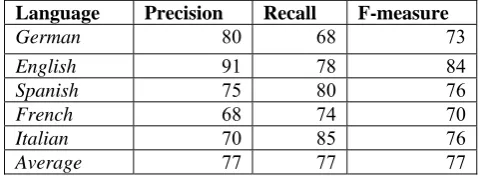
The tool is now used on a daily basis in the NewsExplorer application. We have proved that it can easily be adapted to new languages (Arabic for example). Even if the geo-coding performance could still be improved, the evalua-tion has shown that we already have achieved acceptable results compared to the complexity of the task.
The various geographical maps are well perceived by users as classifying news by location is rather intuitive. It helps users to get a quick overview of what is happening in the world. Additionally, the visualisation also helped us to iteratively improve our recognition methods.
In addition to the visualisation on geographical maps, the geocoding of news adds useful meta-information to each article, which then allows NewsExplorer to display the countries most mentioned in the news or the latest stories about a country/place. Using other extracted in-formation like person names, we can also display the per-sons most mentioned in news about a country/place, or the countries mentioned in stories about a defined person.
We would like to adapt our tool, in order to compare its performance with other approaches (as presented at
MUC 1998 or GeoCLEF 2006). Currently the tool does not recognise places like streets, airports, etc.
Our database currently contains country names and cities only. We plan to add administrative unit names (California, Sicily, Bali, Cornwall etc.), and sea, river, island and mountain names (Channel, Danube, Elba, Mont-Blanc), which is another challenge because some of them belong to more than one country. This would also help us avoid errors. Examples are Lombardia (Brazilian city and Italian region) or Montenegro (city in Brazil but mainly used to design the republic of ex Yugoslavia).
7.
Acknowledgment
Many thanks to Peeter Päll for providing us with the KNAB database, and all the persons who contributed with their language-specific knowledge.
8.
References
Best, C., van der Goot, E., de Paola, M., Garcia, T. & Horby, D. (2002). Europe Media Monitor – EMM. JRC Technical NoteNo. I.02.88. Ispra, Italy.
Bronstein, I. N., K. A. Semendjajew, K.A., Musiol, G, and Muhlig, H. (1999). Taschenbuch der Mathematik (4 ed.). Frankfurt am Main, Thun: Verlag Harri Deutsch.
Eisenberg, J.D. (2002). SVG Essentials. O’Reilly and Associates.
GeoCLEF (2006), Cross-Language Geographical Re-trieval task, CLEF campaign, available athttp://ir.shef.ac.uk/geoclef/flyers/geoCLEF2006.pdf, last visited 06/03/2006.
Global Discovery 2006, digital world reference map, Eu-ropa Technologies, available at http://www.europa-tech.com/gd.htm, last visited 02/03/2006.
Ignat, C., Pouliquen, B., Steinberger, R. & Erjavec T., (2005). A tool set for the quick and efficient explora-tion of large document collecexplora-tions. In Proceedings of ESARDA workshop, London.
Kimler M. (2004). Geocoding: Recognition of geographi-cal references in unstructured text, and their visualisa-tion. Thesis submitted to the University of Applied Sci-ences in Hof, Germany, in August 2004. 85 pages. KML 2.0, (2006), http://www.keyhole.com/kml/docs/
Google_Earth_KML.pdf, last visited 15/02/2006. KNAB 2006, Place Names Database of EKI, Institute of
the Estonian language, Tallinn, available at http://www.eki.ee/knab/knab.htm, last visited 02/03/2006.
Leidner, J.L. (2004) Towards a reference corpus for automatic toponym resolution evaluation. In Proceed-ings of Geographic Information Retrieval workshop, ACM SIGIR-2004, Sheffield.
Mikheev, A., Moens, M., and Gover, C. (1999) Named Entity Recognition without Gazetteers, In Proceedings of EACL99 Bergen, Norway.
MUC-7 (1998) Named Entity Task Definition. In pro-ceedings of the 7th Message Understanding Conference
(MUC-7), April 1998.
Pouliquen, B., Steinberger, R., Ignat, C. & de Groeve, T. (2004). Geographical Information Recognition and Visualisation in Texts Written in Various Languages. In Proceedings of ACM (SAC2004), Nicosia, Cyprus
Sinnott, R. W. (1984). Virtues of the Haversine. Sky and Telescope 68 (2), 159.
WorldKit (2006), http://brainoff.com/worldkit/, last vis-ited 06/03/2006.
Figure 2: Geographical map browsing using Google Earth, the left image showing the various ways to browse the information, the right one showing how we can highlight the news about a certain region of the world.
Figure 3: Geographical map using interactive SVG maps which can display the text passages where the place was found (here Bangladesh).