A Com pact Arabic Lexical Semantics Language Resource Based on
the Theory of Semantic Fields
M. Attia
1, M. Rashwan
1, A. Ragheb
1, M. Al-Badrashiny
1, H. Al-Basoumy
11
The Engineering Company for the Development of Computer Systems; RDI, Egypt 6th floor of Bank Missr building, 171st Al-Haram Av., 12111, Giza, Egypt
E-mails: {m_Atteya, Mohsen_Rashwan, Ragheb, Mohammed.Badrashiny, Basoumy}@RDI-eg.com
Abstract
Applications of statistical Arabic NLP in general, and text mining in specific, along with the tools underneath perform much better as the statistical processing operates on deeper language factorization(s) than on raw text. Lexical semantic factorization is very important in that aspect due to its feasibility, high level of abstraction, and the language independence of its output.
In the core of such a factorization lies an Arabic lexical semantic DB. While building this LR, we had to go beyond the conventional exclusive collection of words from dictionaries and thesauri that cannot alone produce a satisfactory coverage of this highly inflective and derivative language.
This paper is hence devoted to the design and implementation of an Arabic lexical semantics LR that enables the retrieval of the possible senses of any given Arabic word at a high coverage.
Instead of tying full Arabic words to their possible senses, our LR flexibly relates morphologically and PoS-tags constrained Arabic lexical compounds to a predefined limited set of semantic fields across which the standard semantic relations are defined. With the aid of the same large-scale Arabic morphological analyzer and PoS tagger in the runtime, the possible senses of virtually any given Arabic word are retrievable.
1.
Introduction
This paper presents an Arabic lexical semantics LR that is composed of the following four logical components: 1- A compact basis set of predefined semantic fields; i.e.
word senses.
2- Lexical semantics relational data base (RDB) where the Arabic lexical compounds from a given lexicon are one-to-many mapped to semantic fields both in the forward and backward directions.
3- A set of predefined standard semantic relations; e.g. antonymy, hyponymy, entailment ... etc.
4- An RDB connecting the semantic fields to one another via none, one, or multiple standard semantic relations.
In what follows; the need for this LR is first manifested in sec. 2. Next, the criteria that governed the design of the LR is manifested in sec. 3, hence the design itself is dissected in sec. 4 and the process of building the LR is explained in sec. 5.
Finally, sec. 6 compares this LR to the Arabic Word Net (AWN) which seems to be the most relevant one to ours.
2.
Need for this LR
While the wide spectrum of text mining applications might perform patterns detection/comparison for many tasks by directly processing raw text, performance gets better and better as the mining is done on deeper and deeper linguistic analysis of this text given the same algorithms, training corpora, and computational power. Mathematically, as we delve deeper in linguistic analysis (e.g. from morphological, to semantic …) resolving more and more complex relations, the raw text is factorized into more fundamental - and typically less numerous - atomic
entities to be dealt with. This in turn reveals more concentrated statistical correlations and reduces the dimensionality of the problem, which both sharpen the effectiveness of the mining process. (Hearst, 1999; Jurafsky & Martin, 2000; Riloff & Jones, 1999; Schütze & Manning, 2000)
The importance of language factorization gets more and more magnified as the vocabulary and structure of the subject language gets richer. In fact, while Arabic is on the extreme of richness as per its vocabulary when regarded as full-form words, this language is also on the extreme of compactness of atomic building entities due to its systematic and rich derivative and inflective nature. (Attia, 2005; Attia, 2000; Dichy & Hassoun, 2005; Sulayman Fayyaadh, 1990) This positions language factorization not only as a performance boosting enhancement to Arabic text mining tasks, but also as a necessity for producing workable applications with useful output. Among the most fundamental and feasible factorizations in this regard comes Arabic morphological analysis, Part-of-Speech (PoS) tagging, and lexical semantic analysis.
3.
Design Criteria of the LR
In order to maximally satisfy the abovementioned need, our Arabic lexical semantic analyzer had to rely on an Arabic lexical semantics LR built according to the following criteria:
2- Widest coverage of possible Arabic lexical compounds, and semantic relations. Unless the highly derivative and inflective nature of Arabic is effectively handled, the runtime retrieval miss ratio of input words vs. the (inevitably limited) terms explicitly covered by the source of raw Arabic lexical semantics would be unacceptably high. So, this LR must go beyond the simplistic vocabulary-based model for maximally covering input Arabic terms and tying them to their possible senses/semantic fields.
3- Compactness of the resulting LR. Such an LR should never be huge in size not only in order to avoid prohibitive development, reviewing, and updating cost & time, but also to keep the LR development process from being excessively error-prone. So, this LR should be cleverly designed with a pacified growth of lexical/semantic relations versus the size of lexicon entries and semantic fields.
4- Independence and simplicity of the LR. Just like any professionally built LR; independence from the applications and from any LR development tools, as well as the simplicity of the LR format, are vital implicit aspects of this LR design.
5- Minimum implementation and updating cost. Less than 100 man-months within 2 calendar years had been allocated for building, refining, and verifying this LR. So, design decisions were always made in favour of the smaller, the clearer, the cleaner, and the faster choices. It was not always straightforward to satisfy this aspect together with the other ones of the criteria.
4.
Design Description of the LR
To produce a sound Arabic lexical semantics LR complying with the abovementioned criteria, the implemented design relied on the following key concepts and choices:
4.1 Source of Raw Arabic Lexical Semantics
The published literature had been surveyed for sound semantic knowledge bases crafted originally for the Arabic language by specialized Arabic linguistics teams led by credible experts; (Dichy & Hassoun, 2005; Hanna Ghaleb, 2003; Ibraheem Al-Yazijy; La Rousse, 1988; Mahmoud I. Siny et al., 1993; Mukhtaar Umar et al., 2002; Rafael Nakhla; Sulayman Fayyaadh, 1990; Wagdy R. Ghaly, 1996).Neatly based on the theory of semantic fields (Lehrer, 1974; Mukhtaar Umar, 1998), the Grand Thesaurus (Mukhtaar Umar et al., 2002) containing over 35,000 explicit Arabic lexical entries and relying on around 1,800 semantic fields has been elected to be our initial source of raw Arabic lexical semantics. Other sources are also used for the refinement and enrichment of the LR.
4.2 Arabic Lexical Compounds & Morpho-PoS
Constraining
In order to avoid a prohibitively high runtime retrieval miss-ratio of input Arabic words versus the terms covered by the source(s) of raw Arabic lexical semantics,1 Arabic lexical compounds and morpho-PoS constraining are introduced as two powerfully flexible concepts for taming the highly inflective and derivative nature of Arabic. Instead of full-form words, the units of the lexical side in the lexical semantics DB of the LR are encoded as lexical compounds composed of the underlying morphemes that are flexible to be fully or partially matched against the morphemes composing the input words.
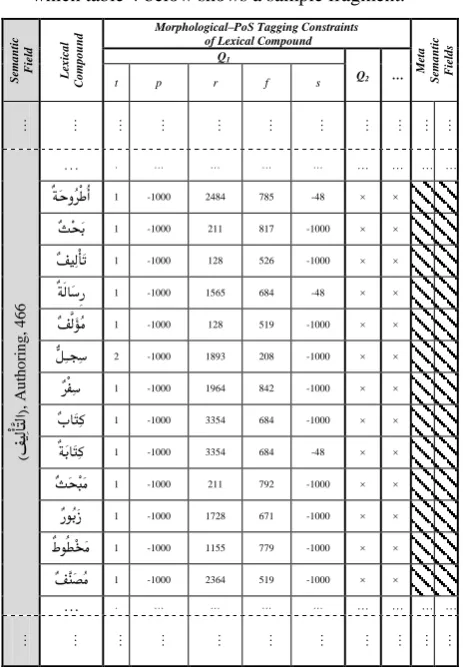
A morpheme code is explicitly mentioned only if its exact existence in the lexical compound is necessary to imply the semantic field(s) tied to this lexical compound. If the existence of any morpheme containing a certain PoS tag is only necessary to imply those semantic field(s), the code of this PoS tag with a negative sign is mentioned in place of that morpheme. A don’t-care code (assigned -1000) in some place signifies that the morpheme at that place is semantically neutral.
Illustrative examples on morpho-PoS constrained lexical compounds are provided in tables 4 and 5 in sec. 5 below. To realize such design concepts, RDI’s Arabic morphological and PoS tagging factorization models are adopted in this LR. (Attia, 2005; Attia, 2000; Attia & Rashwan, 2004)
4.2.1.
Arabic Morphological & PoS-Tagging
Factorization Models from RDI
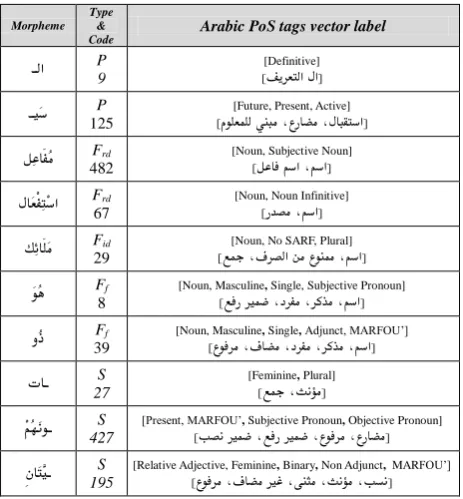
This Arabic morphological model assumes the canonical structure uniquely representing any given Arabic word w to be a quadruple of morphemes that w→q = (t: p, r, f, s) where p is prefix code, r is root code, f is pattern (or form) code, and s is suffix code. The type code t can signify words belonging to one of the following 4 classes: Regular Derivative (wrd), Irregular Derivative (wid),
Fixed (wf), or Arabized (wa).
Prefixes & suffixes; P and S, the 4 classes applied on patterns; Frd, Fid, Ff, and Fa, and only 3 classes applied on
roots2; Rd, Rf, and Ra constitute together the 9 categories of
morphemes in this model. The total number of morphemes of all these categories in this model is around 7,800. With such a limited set of morphemes, the dynamic coverage exceeds 99.8% measured on large Arabic text corpora excluding transliterated words.
While table 1 on the start of the next page shows this model in application on few representative sample Arabic words, the reader is kindly referred to (Attia, 2000) for the detailed documentation of this Arabic morphological factorization model and its underlying lexicon along with
the dynamics of the involved morphological
analysis/synthesis algorithms.
1
The size of lexical entries in any such source has an order of magnitude of O(104.5) while that of the generable Arabic lexical compounds via inflection and derivation is O(107).
2 The roots are common among both the regular and irregular
Given that S<<V`<<V; where V` is the number of core lexical compounds mentioned explicitly in our LR, the size complexity of the indirect semantic mapping approach is then O(S2+S·V`)=O(S·V`) which is much more tractable than O(V2) of the direct semantic mapping.
5.
The Building Process of the LR
The sources of raw Arabic lexical semantics knowledge base are usually organized so that the semantic fields/word senses are the primary keys that recall the terms belonging to them. Assuming such sources, the process of building our Arabic lexical semantics LR proceeds as follows:
1- After adding each distinct semantic field in the raw source to the basis set of semantic fields, the terms belonging to each field are linguistically reviewed to explicitly add/remove any missing/irrelevant terms under this semantic field.
2- Each of these Arabic terms is analyzed to obtain its morphological as well as PoS-tagging factorization, and is hence encoded as a morpho-PoS constrained lexical compound as previously explained in sec. 4.2. 3- This lexical semantic knowledge base obtained so far is then formally structured as an RDB with the semantic fields acting as the primary keys. This is called the forward Arabic lexical semantics RDB of which table 4 below shows a sample fragment.
S
ema
n
ti
c
F
ield
L
ex
ic
al
Co
m
p
ou
n
d Morphological–PoS Tagging Constraints of Lexical Compound
M
eta
S
eman
ti
c
F
ields
Q1
Q2 …
t p r f s
… … … …
(
فوِ
لْأَّتل
ا
)
,
A
u
th
o
ri
n
g
,
4
6
6
... . … … … … …
ٌةَحوُرْطُأ 1 -1000 2484 785 -48 × × ٌثِحَب 1 -1000 211 817 -1000 × × ٌفوِلْأَت 1 -1000 128 526 -1000 × × ٌةَلاَسِر 1 -1000 1565 684 -48 × × ٌفَّلَؤُم 1 -1000 128 519 -1000 × × ٌّلِـجِس 2 -1000 1893 208 -1000 × × ٌرْفِس 1 -1000 1964 842 -1000 × × ٌباَتِك 1 -1000 3354 684 -1000 × × ٌةَباَتِك 1 -1000 3354 684 -48 × × ٌثَحِبَم 1 -1000 211 792 -1000 × × ٌروُبَز 1 -1000 1728 671 -1000 × × ٌطوُطِخَم 1 -1000 1155 779 -1000 × × ٌفَّنَصُم 1 -1000 2364 519 -1000 × ×
… . … … … … … … … …
… … … …
Table 4: A fragment of the forward lexical semantic RDB.
The detailed documentation of the building process of this forward Arabic lexical semantics RDB, (written by Attia et al.) is freely downloadable at:
http://www.rdi-eg.com/rdi/Downloads/Process_of_ building_the_forward_Arabic_Lexical_Semantic_ DB.pdf.
4- Using SQL operations, this forward RDB is
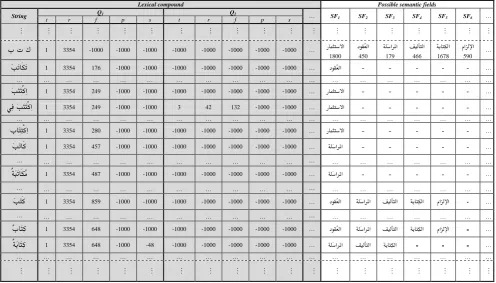
automatically inverted so that the lexical compounds act as the primary keys. A sample fragment of this inverse lexical semantic RDB is shown by table 5 on the next page.
5- While building the inverse RDB, a special back-off row is inserted per each distinct root in the inverse RDB in order to further attenuate the runtime retrieval miss ratio of input words. The lexical compound of a back-off row mentions only the root morpheme explicitly, and all the other morphemes (prefix, pattern, and suffix) as don’t care.
If an input word matches none of the explicitly registered derivatives of some root in the inverse RDB, the corresponding back-off row is resorted to. The recalled semantic fields of such a row are the union of the recalled semantic fields of all the registered derivatives of its root in the inverse RDB. 6- The basis set of semantic fields are interrelated via a
matrix per each predefined standard semantic relation. So far, in addition to relatedness the following 20 semantic relations (Mukhtaar Umar et al., 2002) are defined in our Arabic lexical semantic LR:
1- Antonymy.
2- Approximate Synonymy. 3- “Whole→Part” relation. 4- “Part→Whole” relation.
5- Hyponymy; “is-a-special-type-of” relation. 6- Inverse of no. 5: “is-a-general-type-of” relation. 7- Hyponymy; “is-a-member-of” relation.
8- Inverse of no. 7: “includes-several” relation. 9- Hyponymy; “is-originated-from” relation. 10- Inverse of no. 9: “is-the-origin-of” relation. 11- Hyponymy; “is-integrally-included-in” relation. 12- Inverse of no. 11: “includes-integrally” relation. 13- Causality: “is-a-cause-of” relation.
14- Inverse of no. 13: “due-to” relation.
15- Conditionality; “is-conditional-on” relation. 16- Inverse of no. 15: “is-a-condition-for” relation. 17- Temporal locality: “is-a-time-for” relation. 18- Inverse of no. 17: “occurs-during” relation. 19- Spatial locality: “is-a-place-of” relation. 20- Inverse of no. 19: “takes-place-in” relation. 7- The totality of these matrices is then unified in one
Lexical compound Possible semantic fields
String Q1 Q2 …
SF1 SF2 SF3 SF4 SF5 SF6 …
t r f p s t r f p s
… … … …
بذتذك 1 3354 -1000 -1000 -1000 -1000 -1000 -1000 -1000 -1000 … ذرامثتسلاا 1800
دوقُعلا ذ
450 ةلَسارلما ذ
179 فولأتلا ذ
466 ةباتِكلا ذ
1678 مازللإا ذ
590 …
َبَتاَكَت 1 3354 176 -1000 -1000 -1000 -1000 -1000 -1000 -1000 … ذدوقُعلا - - - …
… … … …
َبَتَتْكِا 1 3354 249 -1000 -1000 -1000 -1000 -1000 -1000 -1000 … رامثتسلاا - - - …
يِػذَبَتَتْكِا
ذ 1 3354 249 -1000 -1000 3 42 132 -1000 -1000 … رامثتسلاا - - - …
… … … …
باَتِتْكِا 1 3354 280 -1000 -1000 -1000 -1000 -1000 -1000 -1000 … رامثتسلاا - - - …
َبَتاَك 1 3354 457 -1000 -1000 -1000 -1000 -1000 -1000 -1000 … ذةلَسارلما - - - …
… … … … … … …
ٌةَبَتاَكُم 1 3354 487 -1000 -1000 -1000 -1000 -1000 -1000 -1000 … ذةلَسارلما - - - …
… … … … … … …
َبَتَك 1 3354 859 -1000 -1000 -1000 -1000 -1000 -1000 -1000 … ذدوقُعلا ذةلَسارلما فولأتلا ةباتِكلا ذمازللإا - …
… … … … … … …
ٌباَتِك 1 3354 648 -1000 -1000 -1000 -1000 -1000 -1000 -1000 … ذدوقُعلا ذةلَسارلما فولأتلا ةباتِكلا ذمازللإا - … ٌةَباَتِك 1 3354 648 -1000 -48 -1000 -1000 -1000 -1000 -1000 … ذةلَسارلما فولأتلا ةباتِكلا - - - …
… … … …
… … … …
Table 5: A sample fragment of the inverse Arabic lexical semantic RDB.
6.
Comparison with AWN
Disseminated LR’s relevant to ours, esp. Word Nets and Thesauri are surveyed. (Black et al., 2006), (Diab, 2004), (Ghonaimy, 2003), (Vossen, 2002), (Visual Thesaurus; http://www.VisualThesaurus.com)
Among those LR’s; the beta release of the Arabic
Word Net (AWN) www.GlobalWordNet.org/AWN/,
www.LDC.UNPENN.edu, announced in Mar. 2007, has apparently been found closest and hence been thoroughly investigated and compared to our Arabic lexical semantics LR.
Feature AWN Our LR
Underlying
theories
Semantic Fields, and
Componential Analysis of Semantic Fields
Semantic Fields, and
Componential Analysis of Semantic Fields
Format of LR Hierarchical RDB
Current no. of
lexical entries ≈ 12,038 ≈ 40,000
Current no. of
semantic fields 5,861 1,824
Semantic
relations defined Hyponymy only
20 semantic relations (see sec. 5 above)
Auxiliary
technologies None
Morphological and
PoS-Tagging
factorization
Back-off upon
mismatches None
To the semantic fields of the root
Mapping to
other languages Many; esp. English None
Table 6: AWN vs. our Arabic Lexical Semantics LR.
Interestingly, each of the two has shown superior/inferior complementary aspects to the other. While the AWN has a richer taxonomized set of semantic fields, and can also map to sister Word Nets in other languages (esp. English), our LR on the other hand has much richer semantic relations, much more explicit lexical entries, and much lower miss-ratio versus input words due to lexical compounds, morph-PoS constraining as well as the back-off.
A concise comparison between the two LR’s is given in table 6 on the opposing column.
7.
Conclusion
This paper has presented a large-scale Arabic lexical semantics LR with a wide coverage of the huge generable Arabic vocabulary. Based on the theory of semantic fields, the raw source content of this LR is primarily drawn from the best experts’ works crafted originally for the Arabic language.