Crowdsourcing for Evaluating Machine Translation Quality
Shinsuke Goto, Donghui Lin, Toru Ishida
Department of Social Informatics, Kyoto University Yoshida-Honmachi, Sakyo-Ku, Kyoto 6068501, Japan [email protected],{lindh, ishida}@i.kyoto-u.ac.jpAbstract
The recent popularity of machine translation has increased the demand for the evaluation of translations. However, the traditional eval-uation approach, manual checking by a bilingual professional, is too expensive and too slow. In this study, we confirm the feasibility of crowdsourcing by analyzing the accuracy of crowdsourcing translation evaluations. We compare crowdsourcing scores to professional scores with regard to three metrics: translation-score, sentence-score, and system-score. A Chinese to English translation evaluation task was designed using around the NTCIR-9 PATENT parallel corpus with the goal being 5-range evaluations of adequacy and fluency. The experiment shows that the average score of crowdsource workers well matches professional evaluation results. The system-score comparison strongly indicates that crowdsourcing can be used to find the best translation system given the input of 10 source sentence.
Keywords:Evaluation, Crowdsourcing, Machine Translation
1.
Introduction
The demand for translation evaluations has been growing due to the increasing number of machine translation sys-tems. While many methods have been developed to eval-uate translation quality, the traditional technique remains manual evaluations by bilingual professionals.
Quality assessment has several objectives. In many cases, evaluation score of each translation is used to indicate the quality of translation (Banerjee and Lavie, 2005). Shi et al. uses an automatic evaluation method to select the best translation among those generated by multiple machine translators (Shi et al., 2012). Goto et al. conducted an eval-uation task of 5-range evaleval-uation to compare the quality of translation systems by using the average score on each source sentence (Goto et al., 2011).
In addition, some studies have focused on the automatic evaluation of translations (Papineni et al., 2002) (Banerjee and Lavie, 2005). Their proposals offer good correlation with professionals, but require multiple reference transla-tions to work well. Several studies have pointed out the lim-itations of automatic translation evaluation methods (Zhang et al., 2004) (Callison-Burch et al., 2006).
In this study, we propose to use crowdsourcing to achieve low-cost evaluations with the same quality as professional 5-level evaluations. Crowdsourcing enables employers to allocate tasks to anonymous workers on the Web. Unlike professionals, crowdsourcing can yield quick and low-cost evaluations. A good example of crowdsourcing-based eval-uation was provided by Chen et al., who used crowdsourc-ing to measure the QoE (Quality of Experience) of net-works (Chen et al., 2010). If these approaches are appli-cable to the translation domain, we can create easy and low-cost methods for creating evaluation sets of machine translation or machine translation corpora.
However, there are no criteria for evaluating non-expert evaluations since manual evaluation is considered as the standard for evaluation. Translation evaluation is used in several ways, but it remains unclear how to use crowdsourc-ing and what kind of evaluations are possible. In addition, the quality of workers in crowdsourcing is generally not
guaranteed. Tasks in crowdsourcing do not require work-ers of special ability, and the resulting quality is assured only by redundancy in most cases. Redundancy is achieved by majority voting, so more than half the workers need to be accurate. An analysis of the applicable fields of trans-lation is also required. Of particular note, the crowdsourc-ing market is bedeviled by spammers, who aim to gain il-licit rewards. Existing works of crowdsourcing translation evaluation require reference translations made by experts, and does not expect workers to have professional ability (Callison-Burch, 2009) (Bentivogli et al., 2011).
evaluation score output by the professional. Based on this definition, the three scores compared are given below.
Translation-score : Compares the translation-score using all source sentences and all translation outputs.
Stranslation(e) =
{s11(e), . . . , s1n(e), . . . , smn(e)} (1)
Stranslation(e)displays the vector of all translations
by evaluator e. Comparison of translation score is made in order to determine whether the absolute eval-uation of the professional is the same as that obtained by crowdsourcing. The comparison of translation-score is based on the MAE (mean absolute error) value of each translation-score. A lower MAE indicates a closer score.
Sentence-score : Sentence-score uses the relative corre-lation among transcorre-lation systems for one source sen-tence. Different from sentence-score, it is the correla-tion between crowdsourcing and professional for the translations of sentences.Ssentence(i, e), which is the
set of evaluations for source sentence i evaluated by e, is obtained as below:
Ssentence(i, e) ={si1(e), si2(e), . . . , sin(e)} (2)
Sentence-score compares the ranking results of two evaluation methods for a given source. Correlation co-efficient is adopted to compare sentence-scores be-tween crowdsourcing and professional.
System-score : System-score comparison uses the arith-metic mean of each translation system for all source sentences. Namely,
Ssystem(e) =
{
Pm
i=1si1(e)
m , . . . ,
Pm
i=1sin(e)
m } (3)
Ssystem(e)contains the score for each translation
sys-tem by averaging the score for all source sentences. System-score comparison can determine the useful-ness of the ranking in machine translation systems. Along with sentence-score, the system-score compar-ison is based on correlation coefficients.
Based on the three scores we obtain the crowdsourcing score and evaluation. Evaluation metrics are based on ad-equacy and fluency, as detailed in Section 4.
4.
Experiment Design
To analyze the feasibility of crowdsourcing evaluation, a Chinese-to-English translation experiment was conducted. An evaluation task of Chinese-to-English translation was created, and crowdsource workers performed the evaluation task. In this experiment, we used Amazon Mechanical Turk (AMT)1as the platform for crowdsourcing. AMT is one of the largest crowdsourcing platforms, and focuses mainly on microtasks.
1
https://www.mturk.com/mturk/welcome
NTCIR-PATENT data set was used for this experiment. It was created for translating international patent sentences among three languages: Japanese, English, and Chinese (Goto et al., 2011). The data was taken from international patent description sentences, and they don t resemble each other too closely. Documents were translated by 23 transla-tion systems and each translatransla-tion was evaluated by a bilin-gual professional. The metrics for evaluation were ade-quacy and acceptability. Preliminary training evaluated 100 translations by three professionals, so that they have a com-mon understanding toward evaluation. This experiment ex-tracted 10 source sentence data and 23 translations for each source sentence. After extraction, we tasked a English na-tive speaker with assigning fluency scores. Crowdsource workers performed the evaluation task for a total of 230 translations.
The reason of conducting Chinese to English translation is the number of workers. Number of Chinese-English bilin-gual worker is much larger than Japanese-English bilinbilin-gual in AMT. Annual report of U.S. Immigration Enforcement Actions says the most Asian people migrates from China2. Preliminary experiment of Japanese-to-English translation evaluation task resulted in six workers in five days, which makes impossible to collect enough data. The purpose of this experiment is the translation evaluation by bilingual workers, so we offered the task that expected to hire the most number of workers.
First, crowdsource workers were instructed as below:
• Please read each Chinese sentence and its English translation.
• Please evaluate the translation in terms of adequacy (or fluency).
• Finally, please reply to the questionnaires.
Also, here are the criteria given to workers (White et al., 1994).
Adequacy: the degree to which information present in the original is also communicated in the translation.
Fluency: the degree to which the target is well formed ac-cording to the rules of Standard Written English.
Both adequacy and fluency have 5-range standards, which indicate better qualities in higher score. Table 1 provides an example of the adequacy evaluation task. The source sentence and machine translation are shown along with the scores of a crowdsource worker. Each task includes 23 translations. Each crowdsource worker performs 10 tasks for a total of 230 translations.
Workers see the Chinese source sentence and it s transla-tions in English. The reference translation is not provided in the task. Therefore, workers are required to have a bilingual ability. The reason for conducting Chinese to English trans-lation is the number of workers. The number of Chinese-English bilingual worker is much larger than Japanese-English bilingual in AMT. Annual report of U.S. Immi-gration Enforcement Actions says the most Asian people
Table 2: Example of different evaluation professional and crowdsourcing by adequacy
Source sentence Machine translation
Professional adequacy
Crowd adequacy
ਟԕ⨶䀓ˈк䘠㌫㔏ϯϬϬ⺞؍ᰐ䇪օᰦᇒᡧ
ㄟᓄ⭘〻ᒿᇎֻॆ⁑ᔿॆ㊫රⲴᇎֻԕׯ؍ ᆈ൘ᆈۘѝˈ䈕ᇒᡧㄟቡ㜭䇯䰞⁑ᔿवDŽ
It is to be understood that the above-described system 300 ensures that whenever a client application instanciation modes, examples of the types to be stored in the memory, the client can access mode.
2 3.5
Reference: It is to be understood that the above described system 300 ensures that whenever the client application instantiates an instance of a schematized type for per-sistence in a store, the client has access to the schema package.
It is to be understood that the above-described system 300 to ensure that whenever the client application instantiated schematized types ofExamplesto stored in storage , the client can access mode packets .
5 2.83
Table 3: Example sentences of different evaluation between professional and crowdsourcing by fluency
Source sentence Machine translation Professionalfluency fluencyCrowd
ഐѪyϯ઼yϰнク䗷ؑਧਈᦒঅݳˈ
ᡰԕ㠚Ⲵ༠䚃䝽㖞ؑѪϬDŽ
Since X3 and X4 does not pass through the sig-nal conversion unit, so that respective channel configuration information 0.
1 3.22
Reference: Since X3 and X4 do not pass through signal converting units, each chan-nel configuration information becomes 0.
Because X3 and X4 do not pass through the signal translation unit, therefore the respective sound track configuration information is 0.
4 2.6
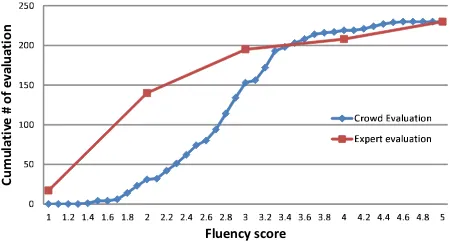
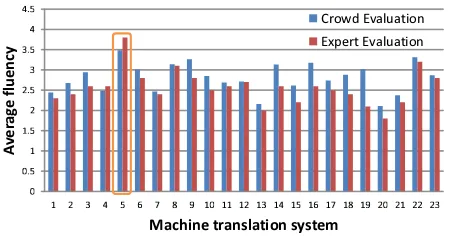
was biggest in the sentence-score evaluation. This is due to the impact of source sentence; the professional had a wider score distribution. In Section 6, we explain how this differ-ence occurred.
6.
Discussion
The result of the comparison between crowdsourcing and professional evaluation showed the feasibility of system score, and showed the difficulties of utilizing sentence-score and translation-sentence-score. This section explains a specific example of useful and useless translation to validate the use case of crowdsourcing, In addition, we refer to the cost and time for crowdsourcing for practical use.
Comparison between Adequacy and Fluency
We display some examples to show the difference between crowdsourcing evaluation and professional evaluation in Table 2. The machine translation omits some information of the reference translation such as “schematized” and “pack-age”. However, crowdsource workers gave higher scores then the professional because the translation is grammat-ically correct. On the other hand, the machine translation result below was scored 5 by the professional, and the av-erage of the crowdsource workers was 2.83. The workers focused on the grammatical errors even though they had little impact on adequacy (Bold type in the sentence). As for fluency, the upper translation of Table 3 was eval-uated as “Incomprehensible” by the professional. This is because the later translation clause lacks a verb. However, crowdsourcing workers took the prior correct expression into account, so the average fluency was 3.22. The lower translation was scored 4 by the professional. However, the
crowdsourcing workers considered the mistranslation of sound track , so the fluency score was 2.6.
From these examples, the instructions given to the work-ers should distinguish adequacy and fluency explicitly, to eliminate their misunderstanding. Also, the workers were negatively impacted by their lack of knowledge about the patent domain. Future improvement could be achieved by combining monolingual workers who have patent knowl-edge and bilingual workers who have language knowlknowl-edge. Also, towards the practical use of translation evaluation by crowdsourcing, a discussion about cost and time is needed in addition to quality.
Cost and Time
In this experiment, two dollars were spent to evaluate 23 translations. This equates to an hourly rate of 18 dollars per worker. A survey reported that a questionnaire task that re-quired no special ability cost about 1.71 dollars (Paolacci et al., 2010). Compared to this task, our experiment is more costly. This is because we employed more workers regard-less of cost. For a comparison with professionals, the Japan Association of Translators 3 says that English to Japanese translation 3 costs 3,000 to 10,000 yen (about 30 to 100 dollars) per page.
As for consumed time, we collected 14 workers during the two week experiment. This is mostly because of the dif-ficulty of the qualification test. Also, time cost is affected by various factors. Examples are monetary cost, translation language pairs, and the difficulties of the qualification test. As mentioned in Section 4., most workers accessed from the U.S.A. or India, so few workers will participate in tasks
3
non-pact of hit design on comparative system ranking. In Proceedings of the 34th international ACM SIGIR con-ference on Research and development in Information Re-trieval, pages 205–214. ACM.
Lin, D., Murakami, Y., Ishida, T., Murakami, Y., and Tanaka, M. (2010). Composing human and machine translation services: Language grid for improving local-ization processes. InProceedings of the Seventh Confer-ence on International Language Resources and Evalua-tion (LREC’10), volume 10, pages 500–506.
Little, G., Chilton, L. B., Goldman, M., and Miller, R. C. (2010). Turkit: human computation algorithms on me-chanical turk. InProceedings of the 23nd annual ACM symposium on User interface software and technology, pages 57–66. ACM.
Paolacci, G., Chandler, J., and Ipeirotis, P. G. (2010). Run-ning experiments on amazon mechanical turk. Judgment and Decision making, 5(5):411–419.
Papineni, K., Roukos, S., Ward, T., and Zhu, W. J. (2002). Bleu: a method for automatic evaluation of machine translation. InProceedings of the 40th annual meeting on association for computational linguistics, pages 311– 318. Association for Computational Linguistics. Ross, J., Irani, L., Silberman, M., Zaldivar, A., and
Tomlin-son, B. (2010). Who are the crowdworkers?: shifting de-mographics in mechanical turk. InCHI’10 Extended Ab-stracts on Human Factors in Computing Systems, pages 2863–2872. ACM.
Shi, C., Lin, D., Shimada, M., and Ishida, T. (2012). Two phase evaluation for selecting machine transla-tion services. In Proceedings of the Eighth Interna-tional Conference on Language Resources and Evalua-tion (LREC’12), pages 1771–1778.
White, J., O’Connell, T., and O’Mara, F. (1994). The arpa mt evaluation methodologies: evolution, lessons, and fu-ture approaches. InProceedings of the 1994 Conference, Association for Machine Translation in the Americas, pages 193–205.
Zaidan, O. and Callison-Burch, C. (2011). Crowdsourcing translation: Professional quality from non-professionals. InProceedings of the 49th Annual Meeting of the Asso-ciation for Computational Linguistics: Human Language Technologies, pages 1220–1229.