Topic Model for Identifying Suicidal Ideation in Chinese Microblog
Xiaolei Huang1, Xin Li1, Lei Zhang2, Tianli Liu3, David Chiu4, Tingshao Zhu*5,6 1Computer Network Information Center, Chinese Academy of Sciences (CAS), China,
{xlhuang,lixin}@cashq.ac.cn
2Jinan University, China,[email protected]
3Inst. of Population Research, Peking University, China,[email protected] 4Dept. of Math and Computer Science, University of Puget Sound, USA,
5Inst. of Psychology, CAS China,[email protected] 6Inst. of Computing Technology, CAS China
Abstract
Suicide is one of major public health problems worldwide. Traditionally, suicidal ideation is assessed by surveys or interviews, which lacks of a real-time assessment of personal men-tal state. Online social networks, with large amount of user-generated data, offer opportu-nities to gain insights of suicide assessment and prevention. In this paper, we explore potentiality to identify and monitor suicide expressed in microblog on social networks. First, we identify users who have commit-ted suicide and collect millions of microblogs from social networks. Second, we build suicide psychological lexicon by psychologi-cal standards and word embedding technique. Third, by leveraging both language styles and online behaviors, we employ Topic Model and other machine learning algorithms to iden-tify suicidal ideation. Our approach achieves the best results on topic-500, yielding F1 − measureof80.0%, Precision of87.1%, Re-call of73.9%, and Accuracy of93.2%. Fur-thermore, a prototype system for monitoring suicidal ideation on several social networks is deployed.
1 Introduction
Suicide is a severe health problem worldwide, which is one of leading causes of youth death in the world, especially in China. In the latest report (Organiza-tion and others, 2014) from World Health Organi-zation (WHO), over800,000people committed sui-cide in 2012, including 120,730 Chinese; and it is very likely that the data is underestimated.
In-deed, there are many more people who attempt sui-cide every year. Instead of calling health services or seeking for help in-person, choosing social networks is a preferable choice for some suicide because of privacy and facilitating sharing similar experiences among peers (Luxton et al., 2011).
Social network sites (SNS), such as Twitter, Sina Weibo, have become popular platforms for peo-ple to express themselves. Sina Weibo is a Chi-nese leading social network akin to Twitter. Ac-cording to the latest Sina Weibo User Activity Report (http://data.weibo.com/report/
reportDetail?id=215), Weibo now has more
than 70 million active users per day, and over 160 million active users per month. It becomes a great platform for sharing opinions, emotions, and even to breaking news or public events. Recent work (Fu et al., 2013) showed that SNS not only enhanced our connections with others, but also facilitated selec-tive self-presentation of undesirable behaviors, such as suicide.
The association between social media and suicide has drawn public attention recently, since several actual suicidal cases were reported in Sina Weibo, e.g., (http://news.sina.com.cn/zl/
zatan/2014-12-02/18032759.shtml).
However, new approaches towards online suicide ideation monitoring and prevention are still under development. (Fu et al., 2013) suggested that dif-fusion of microblogs about one’s suicidal ideation or behaviors on social networks might serve as an early indication of a person’s mental state. These indicators include one’s writing through style, format, selection of specific words, and general
553
structure. It would therefore be desirable to build an appropriate suicide-monitoring system, to identify people who gave expressed suicidal ideation onSNS and provide follow-up support and services.
In this paper, we propose to detect suicide ideation in Chinese SNS and explore the possibil-ity of using Topic Model (Blei et al., 2003). In particular, we first collect and evaluate suicidal mi-croblogs by psychological standards. Second, we construct our psychological lexicons using word em-bedding techniques and explore the differences of online behaviors between suicide and none-suicide Weibo users. Then, in order to avoid the adverse outcomes that high dimensions of lexicon feature, which could weaken both efficiency and accuracy of classifiers, we model features of microblog in so-cial networks and utilize the popular unsupervised model, Topic Model. Finally we design, develop, and test a model that can effectively identify suici-dal ideation inSNS.
To summarize, our research has three main con-tributions: first, we use word embedding technique to construct psychological lexicons to enable utiliza-tion of suicide online behaviours; second, we em-ploy Topic Model with lexicon knowledge and hy-brid approaches for suicidal ideation identification on real-world datasets; third, a real-time application of suicide ideation prototype monitoring system is deployed online.
2 Related Work
Psychologists’ researcheson suicide cases in social networks started in recent years. Research (Fu et al., 2013) found that social media not only can spread suicidal ideation very quickly, but it also can be used to identify suicidal ideation in its early stages. Psy-chologists (Jashinsky et al., 2013) implied that eval-uating suicidal risk factors in Twitter can be used to prevent suicide. Undoubtedly, previous research (Li et al., 2014b; Guan et al., 2014; Li et al., 2014b) also have dug interesting patterns for suicide prevention, however, these patterns can not be deployed on large population to provide timely service.
“Sentiment Analysis”(Pang and Lee, 2008) has been researched on various corpus for years, such as product reviews (Wang et al., 2010), movie re-views (Whitelaw et al., 2005). The core method in
most of previous works (Pestian et al., 2010; Pes-tian et al., 2012) in this field is using N −Gram
(Brown et al., 1992) to model clinical suicide note. Another promising approach to learn sentiment from microblogs is LDA (Blei et al., 2003), a unsuper-vised algorithm that takes documents as a mix-ture of topics. It can discover latent semantics in documents and compute documents into a low-dimensional topic distributions. The potentiality of using topic models also has been applied in senti-ment analysis (Mei et al., 2007; Lin and He, 2009).
Mental Health problems have been attracted much attention from researchers all over the world. Wuet al.(Wu et al., 2005) mined depressive symp-toms from psychiatric consultation records. Re-searches on depression inSNShave been studied in single depression case (Wang et al., 2013), multi-media content of depressive microblogs (Lin et al., 2014), depression research in Twitter (De Choud-hury et al., 2013) or mining emotion labels from so-cial texts (Yu and Ho, 2014). Researchers (Resnik et al., 2013) appliedLDAon essay’s depression judge-ment among college students and compared its ef-fectiveness withLIWC.
Given much research have been done on suicide ideation and sentiment analysis, and they have pro-duced much promising results, which inspire us to investigate efficient methods to better understand and identify suicidal ideation onSNS.
3 Data Collection
We trained model on data collected through our Java-based crawler from Sina Weibo. We collected publicly reported suicide cases from 2011 to 2014, and spent another 6 months collecting and tagging their data. Based on evaluation criteria (Rudd et al., 2006), six experts first summarized and evaluated 12 warning signs of suicide, such as threatening to hurt or kill themselves. Those experts were trained to ensure the lowest biased tagging. They spent sig-nificant time in assessment and diagnosis of suicide risk. Before tagging data, the experts were tested by tagging 50 microblogs independently; and the test’s interrater agreement coefficient1is 0.819.
1
For each piece of microblog, only if it was voted by more than half of the experts, it would be tagged as suicidal microblog. During tagging process, each suicidal microblog has three levels: there is suicide warning sign, but no suicide plan; microblog indi-cates suicide plan, but author is not going to commit it; microblog indicates the author is going to commit suicide. Since we only focus on binary classification in this study, all three levels will be consider as sui-cide. Finally,664suicidal microblogs were obtained from over30,000microblogs.
Table 1: The composition of experiment data All Suicide Non-suicide
7,314 664 6,650
To perform 10-fold cross validation, we randomly sampled6,650microblogs from a Weibo User Pool (WUP) (Li et al., 2014a) with 1.06 million active users’ microblogs, which share the same time inter-val. Statistics of the data is illustrated in Table 1.
Time retweet critics like
Microblog content Retweet
Content
Mention: Social Relations
Figure 1: Detail Descriptions of One Microblog
Microblogs were segmented and tokenized us-ingAnsj(Sun, 2014), a Chinese segmentation tool. URLswere removed by regular expression rules. In Fig. 1, we present an example of microblog. For each microblog, we extracted both content related features and meta features (i.e., time, like,etc).
3.1 Traditional & Simplified Chinese Conversion
Currently, there are two types of Chinese encoding: Simplified Chinese and Traditional Chinese. Words have the same meaning but different encodings, so
computer program treats them differently. We con-verted Traditional Chinese into Simplified Chinese in our research.
4 Lexicons Construction
Primarily, we took advantage of existing sentiment dictionary, the latest version ofHowNet(Dong and Dong, 2003), which is a Chinese-based emotional-words resource for sentiment analysis. HowNet is designed for general sentiment analysis.
Intuitively, words with similar contexts or co-occurrence may share similar meanings (Turney and Pantel, 2010). In order to extended our existing sui-cide lexicons and take advantage of words contex-tual information, we run word2vec (Mikolov et al., 2013) over 100 millions microblogs from WUP by the following steps: first, we segmented and tok-enized corpus, and trained vector features for each word; top 5 semantic synonyms were chosen empir-ically for each word in our existing lexicons (each synonym was chosen if at least half of our experts reached agreement); we elaborately collected words into our extended suicide dictionary. Examples of suicide dictionary are shown in Table 2.
Table 2: Suicide Lexicon Table Type Number Example Suicide Words 3453 insomnia, stilnox Suicide Phrases 3763 disapear+myself
We categorized suicide words and phrases accord-ing to 12 suicide warnaccord-ing signs, which differs from categories in previous work (Gao et al., 2013). De-tails of 12 potential suicide warning signs can be found in (Rudd et al., 2006), such as “Acting reck-less” . Because when we associate each word or phrase with one or more warning signs, words or phrases become more interpretable and might de-scribe more details of suicide.
pre-fer to mention their families or other suicidal vic-tims. The statistics of reference comparison between suicide and none suicide is shown in Table 3.
Table 3: Statistics of Reference Comparison Type Self-reference Other-reference
Suicide 71% 29%
None Suicide 26% 22%
Example I, myself Dad, mother
5 Modeling
5.1 Knowledge-based Modeling
In order to take advantage of domain knowledge from psychology, the extended suicide lexicons was also used. These features are based on its subjectiv-ity, sentiments or categories. It contains both pos-itive and negative words. In addition, we added reference including both self-reference and other-reference as an independent category in the model-ing process. For any input sentence, we count the numbers of positive, negative, suicide words, refer-ence words according to our lexicon resources.
5.2 Syntactic Features
Syntactic features contains dependency relation, Part of Speech (POS) tagging, etc. Considering that some types of words or their POS(e.g., ad-verbs, adjectives, etc) are likely to convey senti-ments, we obtained POS features by counting the numbers of words with the following POS tags: ad-jective (VA), adverb (AD), noun (NN/NR/NT), verb (VV/VE/VC), pronoun (PN) and preposition (P). Those tagging signs are from Chinese Penn Tree-bank Tag Set2.
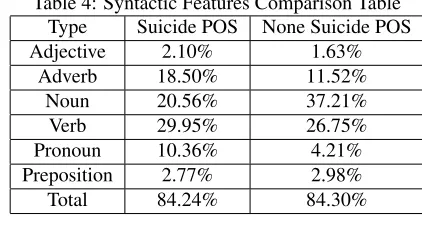
Table 4: Syntactic Features Comparison Table Type Suicide POS None Suicide POS Adjective 2.10% 1.63%
Adverb 18.50% 11.52%
Noun 20.56% 37.21%
Verb 29.95% 26.75%
Pronoun 10.36% 4.21%
Preposition 2.77% 2.98%
Total 84.24% 84.30%
2
http://www.cis.upenn.edu/\˜chinese/ posguide.3rd.ch.pdf
We applied Stanford Parser (Toutanova et al., 2003) to acquire the statistics of POS. The statis-tics of data is illustrated in Table 4. Two observa-tions were derived from the Table 4: in suicide mi-croblogs, the users prefer to mention self-reference or other people than in none suicidal microblogs; more adverb, more verb and adjective appear in sui-cidal microblogs may suggest people with suisui-cidal ideation would like to express more about their emo-tions or behaviors in their microblogs.
5.3 Topic Modeling
Another approach we used in our experiment is La-tent Dirichlet Allocation (LDA) (Blei et al., 2003). It can generate predefined topics over the “bag of words” and infer topic distributions in new docu-ments. We are interested in incorporating sentiment dictionary with topic models to make topics more in-terpretable. Part of LDA-induced topics are shown in Table 5.
Table 5: Part of LDA-induced topics related to suicide Themes Topic Words
Depression me, depression, leave, bye Stress & death, I won’t love Negative fear of death, to die
Anxiety long, desperate, take medicine Family Mother, Father Sadness & dead, don’t, one day
Hopeless pain, past, wrong Reference me, we, myself, you
5.4 Topic Model with More Layers
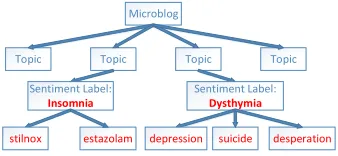
In this paper, we hypothesize that non-sentiment words around implicit sentiment words could be affected, which may be interpreted as sentiment-propagation from word-to-word. Derived from LDA, sentiment associated the topic will also be re-flected by its associated sentiment words. Motivated by these observations, we implemented a new ap-proach, which adopts sentiment dictionaries into the topic model.
Nw refers to the number of words associated with
kthtopic.
Given the normalized sentiment matrix at step 7, we incorporate it with original topic multinomial distribution in step 8. We recompute the topic multinomial distribution to simulate the sentiment-diffusion process as shown back in Fig. 2.
5.5 Meta Features within Microblogs
Although previous work (Lin et al., 2014) reported detecting depression from pictures in microblog, in our dataset, microblogs rarely contain pictures, thus we mainly focused on text content. We also ob-served that the number of critics, like, retweet surged after the suicide was reported publicly. Thus, we took three meta features into consideration: posting type,posting timeandsocial relationship. Detail de-scriptions can be found in Fig. 1.
5.5.1 Posting Type
The posting type refers to one microblog’s origin, eitheroriginal creationorretweet. In our research, it appears that suicidal users prefer to post original sui-cide notes instead of retweeting. The comparisons in experimental data are shown in Fig. 4.
Figure 4: Comparisons in Microblog’s Type
5.5.2 Posting Time
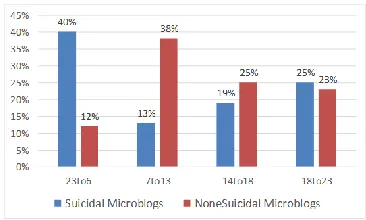
We also found that temporal features matter. Em-pirically, we separated 24 hours into four periods: 23:00 to 06:00, 07:00 to 13:00, 14:00 to 18:00, and 18:00 to 23:00. The result shows that suicidal mi-croblogs are posted more frequently during 23:00 to 06:00 and less in the morning, which is in con-trast to none suicidal microblogs. Specific details can be gleaned from Fig. 5. A plausible explanation
might be that some suicidal users suffer from insom-nia, which hypnotic pills appear in their microblogs, such as tranquillizers or stilnox.
Figure 5: Comparisons in Microblogs’ Time
5.5.3 Social Relationships
Microblogs also contain much useful information like social relationships, which connect microblogs to microblogs, or microblogs to users, as shown in Figure 6.
Microblog Microblog Microblog
Suicide Topic
Figure 6: Social Relations within Microblogs
6 Experiment and Discussion
6.1 Experiment Approach
In the experiment, we run LDA (implemented by Mallet (McCallum, 2002)) to inferk-topic probabil-ities and alphabet associated with each topic. Mal-let’s parameters were set with default values, and stoplist was extended by Chinese punctuations. We trainedSVMclassifier by usingLibSVM(Chang and Lin, 2011) package. TheSVM classifier in our ex-periments used aRBFkernel and was trained by de-fault parameter values. Weka (Hall et al., 2009), an useful machine learning tools, was also employed in our experiment for training and testing.
We run 10-fold cross validation to avoid evalua-tion bias. In Table 6, we list all features that were selected for training classification models in our ex-periment.
Table 6: Summarization of Features in Experiment
Feature Compute Method
Knowledge-based Features Count * Lexicon polarity
Syntactic Features Count
Topic Model Topic Distributions
Advanced Topic Model Topic Distributions
Posting Type Binary Value
Posting Time Intervals
Social Relationships Binary Value
N-gram Count
The performance of classification are measured by “Precision”, “Recall”, “F1−measure”, “Accu-racy”. “Precision” refers to the ratio of true suici-dal microblogs against all microblogs predicted as suicidal. “Recall” refers to the fraction of suici-dal instances retrieved by trained models. “Accu-racy” refers to all predictions match their labels re-gardless whether they are suicidal microblogs or not.
“F1−measure” is defined as follows 2.
F1−measure= 2∗
precision∗recall
precision+recall (2)
6.2 Comparison between Lexicons andLDA
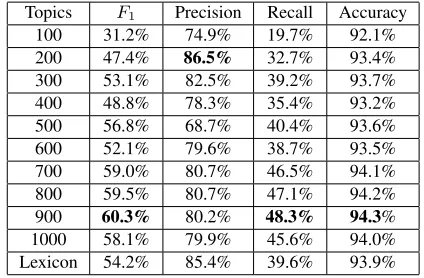
The Lexicon approach uses psychological lexicons, described in Section 3, to extract lexicon features and train the classifiers. We runLDA with number of topics from 100 to 1000 topics with increment of 100 (i.e. 100, 200, ..., 1000). Comparison of classi-fication performance is presented in Table 7.
Table 7: Comparison between Prior-knowledge-based Features andLDAapproach
Topics F1 Precision Recall Accuracy
100 31.2% 74.9% 19.7% 92.1%
200 47.4% 86.5% 32.7% 93.4%
300 53.1% 82.5% 39.2% 93.7%
400 48.8% 78.3% 35.4% 93.2%
500 56.8% 68.7% 40.4% 93.6%
600 52.1% 79.6% 38.7% 93.5%
700 59.0% 80.7% 46.5% 94.1%
800 59.5% 80.7% 47.1% 94.2%
900 60.3% 80.2% 48.3% 94.3%
1000 58.1% 79.9% 45.6% 94.0%
Lexicon 54.2% 85.4% 39.6% 93.9%
Table 7 shows that more topic features can im-prove the performance of classification. The highest
F1−measureis 60.3% with900topics inLDA.
Al-though in the low topic dimensions LDA performs poorer than Lexicon approach, LDA could perform better than Lexicons when assigned a high topic value.
6.3 Experiment with advanced Topic Model
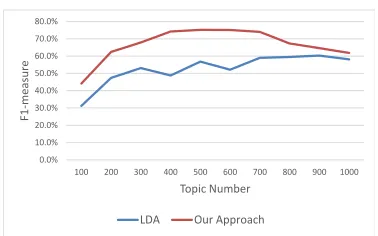
To test our proposed method in Section 5.4, we also conducted experiments with the same topic number and default parameter settings as in Section 6.2, and the results are shown in Table 8. Table 8 shows that compared withLDAin Table 7, our approach works better.
Table 8: Cross-validation performance on Topic Model after adding psychological lexicons
Topics F1 Precision Recall Accuracy
100 44.1% 95.9% 28.6% 93.4%
200 62.4% 89.6% 47.9% 94.8%
300 67.9% 93.2% 53.4% 95.4%
400 74.2% 96.8% 60.1% 96.2%
500 76.2% 94.6% 63.9% 96.4%
600 75.1% 98.8% 60.5% 96.3%
700 74.0% 95.0% 60.5% 96.1%
800 67.3% 84.0% 56.2% 95.1%
900 64.6% 76.1% 56.2% 94.4%
1000 61.8% 72.3% 53.9% 93.9%
The best performance is on 500 topics, withF1−
measureat 76.2%, Recall at 63.9%, Accuracy over
0.0% 10.0% 20.0% 30.0% 40.0% 50.0% 60.0% 70.0% 80.0%
100 200 300 400 500 600 700 800 900 1000
F1
-measur
e
Topic Number
LDA Our Approach
Figure 7: Comparisons inF1−measurebetweenLDA and Advanced Topic Model
Compared with previous approaches both in lex-icons and LDA, we obtained around 25% improve-ment in F1-measure. Fig. 7 presents a more detailed comparison betweenLDA(in blue) and our approach (in red) onF1−measure.
6.4 Results with Meta Features
To further improve the performance, we add meta features described in Section 5.5 with topic500. We runSVMand several classifiers in Weka (Hall et al., 2009): Logistic, J48 classifier, Random Forest(RF), Random Tree(RT), Decision Table(DT). All classi-fiers are trained and tested with default parameters, and performances are presented in Table 9.
Table 9: Cross-validation performance of Different clas-sifiers
F1 Precision Recall Accuracy
SVM 76.8% 96.8% 63.7% 96.5%
Logistic 53.0% 59.2% 48.0% 92.3%
J48 80.0% 87.1% 73.9% 93.2%
RF 71.3% 98.2% 56.0% 93.6%
RT 67.7% 71.0% 64.6% 94.4%
DT 74.6% 92.0% 62.7% 96.1%
Clearly, J48 attains the best F1 − measure (80.0%) and Recall (73.9%). Compared with Ta-ble 8, we acquired a better performance after inte-grating meta features.
We found that there are still about nearly one fourth suicidal microblogs that were not identified correctly. There might be several reasons: first, the complexity and ambiguity of language on the Inter-net, especially the SNS; second, the psychological lexicon is quite limited.
This research has a number of potential applica-tions. The trained model can be used to build a
suicide monitoring system to help professionals ex-ecute suicide intervention in time. If this system was effective in detecting suicide ideation in microblogs fromSNS, it might also help psychologists investi-gate how linguistic and behavioral patterns are cor-related with suicide thoughts and provide them with advanced decision support.
7 Conclusion
In this paper, for the purpose of identifying suici-dal ideation of microblogs on social networks, first, we build a suicidal domain lexicons and develop hy-brid approaches combined both contextual and meta information for suicidal ideation identification; sec-ond, we run Topic Model for feature selection with less than 1,000 dimensions left, and achieve more than38%accuracy increased over lexicon approach; furthermore, we deploy a real-time engine to detect suicide ideation in microblogs for monitoring sui-cide, which might be helpful for professional orga-nizations to assess people’s suicide ideation; finally, from psychological perspective, we found that writ-ing styles and time variations are highly correlated with suicidal ideation. A prototype system3has been deployed online to detect suicide ideation ofSNSin real-time.
The performance of model is limited by several is-sues as follows: first the model has been trained and tested on small size data sample; second, we need to try more advanced machine learning algorithms. Our future work is undertaken in two directions: im-proving performance and mining latent social rela-tionships.
8 Acknowledge
We would like to thank Google Summer of Code 2014 and Portland State University for sponsoring the open-source development of this project. The authors acknowledge the support from National High-tech R&D Program of China (2013AA01A606), National Basic Research Pro-gram of China (2014CB744600), and Key Research Program of Chinese Academy of Sciences (KJZD-EWL04). Thank anonymous reviewers for their valuable comments to improve quality of the paper.
3It can be visited at http://ccpl.psych.ac.cn/
Mandrusiak, Kimberly Van Orden, and Tracy Witte. 2006. Warning signs for suicide: Theory, re-search, and clinical applications. Suicide and Life-Threatening Behavior, 36(3):255–262.
Jian Sun. 2014. Ansj Chinese Lexical Analysis System. Website.http://ansj.org/.
Kristina Toutanova, Dan Klein, Christopher D. Man-ning, and Yoram Singer. 2003. Feature-Rich Part-of-Speech Tagging with a Cyclic Dependency Net-work. InNorth American Chapter of the Association for Computational Linguistics.
Peter D. Turney and Patrick Pantel. 2010. From Fre-quency to Meaning: Vector Space Models of Seman-tics. Computing Research Repository, abs/1003.1. Hongning Wang, Yue Lu, and Chengxiang Zhai. 2010.
Latent aspect rating analysis on review text data: a rat-ing regression approach. In Proceedings of the 16th ACM SIGKDD international conference on Knowl-edge discovery and data mining, pages 783–792. ACM.
Xinyu Wang, Chunhong Zhang, Yang Ji, Li Sun, Lei-jia Wu, and Zhana Bao. 2013. A depression de-tection model based on sentiment analysis in micro-blog social network. In Trends and Applications in Knowledge Discovery and Data Mining, pages 201– 213. Springer.
Casey Whitelaw, Navendu Garg, and Shlomo Argamon. 2005. Using appraisal groups for sentiment analysis. In Proceedings of the 14th ACM international con-ference on Information and knowledge management, pages 625–631. ACM.
Chung-Hsien Wu, Liang-Chih Yu, and Fong-Lin Jang. 2005. Using semantic dependencies to mine depres-sive symptoms from consultation records. Intelligent Systems, IEEE, 20(6):50–58.