The Role of the Adversary Model in Applied Security
Research
1
Quang Do1, Ben Martini1, Kim-Kwang Raymond Choo2,1,*
1
School of Information Technology & Mathematical Sciences, University of South Australia, Adelaide, SA 5095, Australia
2
Department of Information Systems and Cyber Security, University of Texas at San Antonio, San Antonio, TX 78249, USA
* [Corresponding Author] [email protected]
Abstract
Adversary models have been integral to the design of provably-secure cryptographic schemes or protocols. However, their use in other computer science research disciplines is relatively limited, particularly in the case of applied security research (e.g., mobile app and vulnerability studies). In this study, we conduct a survey of prominent adversary models used in the seminal field of cryptography, and more recent mobile and Internet of Things (IoT) research. Motivated by the findings from the cryptography survey, we propose a classification scheme for common app-based adversaries used in mobile security research, and classify key papers using the proposed scheme. Finally, we discuss recent work involving adversary models in the contemporary research field of IoT. We contribute recommendations to aid researchers working in applied (IoT) security based upon our findings from the mobile and cryptography literature. The key recommendation is for authors to clearly define adversary goals, assumptions and capabilities.
1
Introduction
Modeling the role of attackers is an integral concept in cyber defense for helping to ensure that security evaluations are scientifically valid, particularly for conceptual contributions that may not be able to be practically tested or where extensive testing is impractical.
An adversary model is a formalization of an attacker in a computer or networked system. Depending on how complete this formalization is, the adversary may be an algorithm or may simply be a series of statements with regards to capabilities and goals. There are a number of approaches in various fields of computer security that fit within this umbrella.
Adversary models are crucial in the field of cryptography where they are used in the security proof of a particular cryptographic scheme or protocol. Adversaries may be constructed with a varying number of capabilities—each of these customized adversaries is defined as a different type of attacker with different skillsets, advantages and disadvantages. Adversary models have also been used to formalize an attack on a system or protocol. One of the first and most widely used adversary models is the Dolev-Yao Model [1]. It is considered to be one of the most well-known adversary models in the field. The Dolev-Yao adversary has the ability to listen to all traffic on a network and initiate a connection with
1 This is the pre-print version, and please refer to the following for the final version.
Do Q, Martini B and Choo K-K R. The Role of the Adversary Model in Applied Security Research.
(and send data to) any other client on the network. The combination of these two powerful capabilities means that the adversary is, essentially, acting as a man-in-the-middle (MITM).
Many scientific fields in computer security currently utilize adversary models for verification of protocols, systems and schemes. Although this is the case, we believe that there are still many fields that can benefit from the inclusion of adversary models. For example, digital forensics is a contemporary field that benefits from the use of adversary models to prove that a forensic process is “forensically sound”. McKemmish [2] defined forensic soundness in the context of digital evidence as the combination of four criteria: meaning, errors, transparency and experience. Forensic soundness is integral to the admissibility of evidence, and is analogous to the aim of maintaining data security in cryptographic models (i.e. a cryptographic protocol is flawed if data security cannot be maintained, and a forensic process is flawed if forensic soundness is not maintained). An adversary model can be used to model limitations on the abilities of a forensic practitioner to those that are permitted within the theoretical context of forensic soundness in a similar manner to the limitations of an attacker in a traditional model.
The definitions of adversary models can range from highly detailed to vague descriptions. This may end up being a problem for future researchers who wish to reuse and refine these adversary models in their own research. In fact, Bellare et al. [3] noted that due to the sometimes informal and ambiguous nature of adversary specifications (e.g. a lack of adversary goals, assumptions or capabilities), the presented protocols may not be fully proven by the formalization. They state that a “proper foundation” would be required in order to produce rigorous and strong schemes. Furthermore, the authors remarked that such foundations would need to be built up piece by piece as the usage of these models increases. Canetti and Krawczyk stated that “[i]n order to talk about the security of a protocol we need to define the adversarial setting that determines the capabilities and possible actions of the attacker” [4, p. 6] and Woo and Lam [5] noted that without explicit assumptions regarding the capabilities and execution environment of an adversary, it is very difficult to decide when to use a particular protocol and what its final state will be.
Few fields outside of secure communications (e.g. cryptography and networking) make use of fully formalized adversaries. The use of a similarly strong formalization of adversary capabilities, assumptions and goals would aid in proving the rigor of any adversarial study (e.g. proposed attack techniques and their ensuing countermeasures).
This survey paper looks at adversary models in the field of computer security beginning with the query-enhanced Bellare-Rogaway Model [6], a popular model for public key protocols in the field of cryptography. In order to determine the current state of adversary models in this field and postulate on the usage of these adversary models in both this field and its sub-fields, we perform an in-depth review of the relevant literature. Papers were selected using the following criteria:
Paper publication date: our survey begins with the introduction of the query-enhanced adversary model of Bellare and Rogaway in 1993, with the vast majority of research works selected being published after 2000.
Paper publication venue: with regards to comprehensiveness and inclusivity of papers, high quality papers published by prominent computer science venues were favored for this survey.
We examine the adversary models employed by researchers in three different fields of computer security, namely: cryptography, mobile, and Internet of Things (IoT). Cryptography is examined as it is the seminal field for use of adversary models and therefore has a solid foundation of research works. Mobile security and IoT security were selected as they are relatively contemporary topics within computer security. IoT security, particularly, is a research field in its infancy.
A chronological and in-depth examination of adversary models used in the field of
cryptography and the evolution of this model over time. A formal adversary model definition is also proposed, which is divided into three parts.
An initial prototype of a mobile app-based adversary model classification, which is founded on the commonly used malicious app attacker. This model can be used to classify and compare a significant number of mobile security studies.
A series of recommendations, based on the literature, with regards to the use, classification and design of future adversary models in IoT research.
In Section 2, we provide an in-depth background on the adversary. Section 3, similarly, provides a chronological background of the use and evolution of the cryptographic adversary model. Section 4 examines and classifies adversary models used in mobile research, with an emphasis on app-based studies and Section 5 surveys adversary models used in IoT research and provides a generalized adversary model for use in future research. Lastly, we conclude the paper and discuss future research directions in Section 6.
2
Background: The Adversary
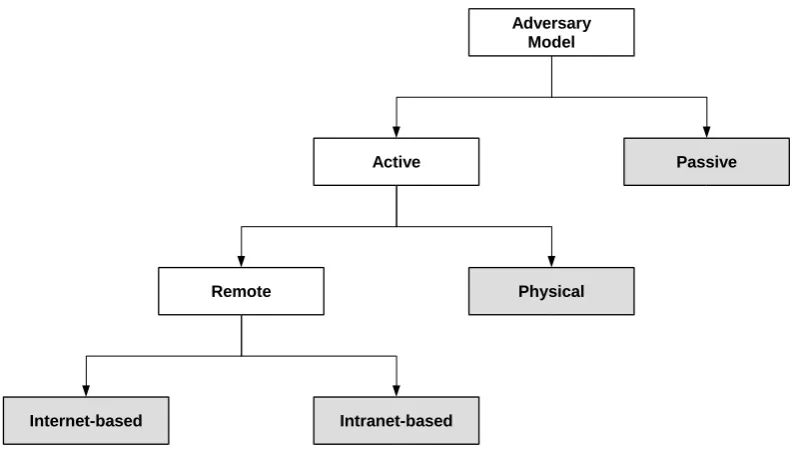
An adversary, within the field of security, refers to an attacker, often with malicious intent, undertaking an attack on a system or protocol. Typically, the goal of the adversary is to disrupt or prevent proper operation of a secure system (e.g. by violating the confidentiality, data integrity or availability of the system). Examples of non-malicious (i.e. benign) adversaries include ‘guardians’ (e.g. system administrators) seeking to detect decoded or encrypted packets on their own networks. There is a need to consider an adversary when designing a secure system or demonstrating the proof of a secure system in order to evaluate and benchmark the proposed system’s security. Formalization of this adversary allows for the system (and adversary) to be utilized and compared, respectively to other adversaries and systems. Adversaries can be roughly divided into two categories: passive (also known as semi-honest or honest-but curious) and active (also commonly known as malicious attackers) [7].
One of the earliest formalized adversaries in the computer era was in the field of public key cryptography, with the introduction of the adversary model by Dolev and Yao [1]. This model, which we refer to as the “Dolev-Yao Model”, allowed for different cryptographic protocols to be benchmarked and proven under a powerful adversary, and its principles are still in use today. Bellare and Rogaway [6, 8] (together with Pointcheval in [9]) presented a more general model, which we refer to as the “Bellare-Rogaway Model” in this paper, that allowed for modeling of different types of attackers (e.g. a benign passive attacker or a malicious active attacker) [6, 8, 9]. They also introduced the notion of queries, which are actions that the adversary may perform, including: Send (a message), Reveal (a secret, such as a session key) and Corrupt (a device, for example to obtain the internal state of the protocol participant), along with the definitions of these queries. Queries accept a number of parameters, as input, and output a result upon execution. These queries are known as adversary capabilities in this paper.
Due to the vast nature and differing types of adversaries, there is a need to model them using a method that can be customized to fit the scenario. Furthermore, different adversaries should be comparable with regards to their capabilities, goals and assumptions. Due to the overwhelming capabilities of the Dolev-Yao Model [1], it may be impractical to use this model in other areas of study (e.g. systems utilizing trusted third parties such as key escrow). Thus, we have selected the adversary model proposed by Bellare and Rogaway [6, 8, 9] as the standard for the adversary’s capabilities, goals and assumptions due to the model’s flexibility.
mathematically defined using algebraic concepts) or loosely defined (e.g. textual descriptions), with the former being more rigorous and the ideal standard.
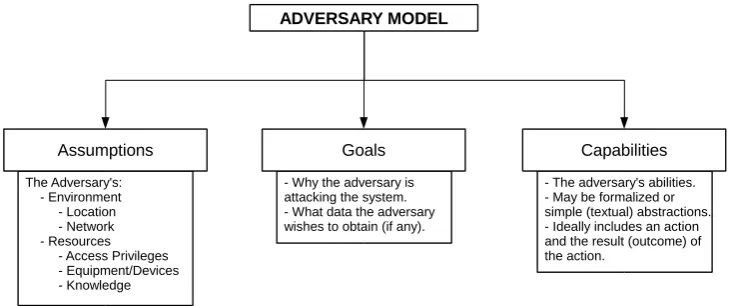
Figure 1: The three components of our adversary model definition.
By separating the adversary into three distinct parts, each part could be independently changed in order to change the strength of an adversary in the three distinct components. For example, an adversary’s goal may change as a result of encountering a certain defense mechanism, such as in the context of an air-gapped system, and therefore the adversary may wish to target a different system on the same network that has Internet access. The adversary’s capabilities and assumptions may also change as a result of the change in objective. The adversary components are described below.
2.1
Adversary Assumptions
An adversary’s assumptions are the conjectures as to the adversary’s environment, resources and equipment. For example, an adversary could be external to a system or internal (i.e. performing an insider attack) and may have privileged access on a network by virtue of being an employee (or ex-employee). It may also be the case that the adversary has access to a large number of compromised devices allowing for attacks on availability. Another aspect of the adversary assumptions are the inferences of the adversary’s competency or knowledge. For example, the adversary may know a required passphrase or have knowledge of the locations of critical infrastructure (in the case of a physical attacker).
Without a clear set of assumptions, there is great ambiguity in attempting to determine how powerful an adversary is. The security proof of a protocol utilizing such an adversary would not provide much assurance to protocol implementers in practice. Furthermore, precise assumptions aid in the comparison of diverse security schemes (e.g. two protocols using the same adversary assumptions could be benchmarked in terms of their security level).
2.2
Adversary Goals
An adversary’s goals refer to the adversary’s intentions and to the particular sets of data the adversary is attempting to obtain (if any). An adversary may instead need to exfiltrate data they already hold in a covert manner (e.g. using steganography or inaudible sound waves). A proper set of goals is essential in building a strong and rigorous adversary model. Some general works (such as frameworks or models) may intentionally withhold an adversarial goal in order to make the proposed model more general (e.g. see [8]). In the field of cryptography, it is often the case that an adversary is modeled as a challenger to a “game” [10] whereby in order for the protocol or scheme to be considered secure, there must not exist an adversary that can win the game with a non-negligible advantage.
The Adversary's: - Environment - Location - Network - Resources
- Access Privileges - Equipment/Devices - Knowledge
- The adversary's abilities. - May be formalized or simple (textual) abstractions. - Ideally includes an action and the result (outcome) of the action.
- Why the adversary is attacking the system. - What data the adversary wishes to obtain (if any).
ADVERSARY MODEL
Goals
Without a distinct goal, an adversary is simply a malicious entity intent on wreaking havoc on the system. This, of course, is still a legitimate adversary but such an adversary is difficult to model and use to compare different studies.
Some other works may refer to the proposed system’s goals and instead have an adversary seeking to hinder these system goals. A commonly used set of system goals is the CIA(A) Triad [11] which refer to the principals of confidentiality, integrity, availability (and authenticity).
2.3
Adversary Capabilities
Finally, an adversary’s capabilities are the most essential part of an adversary model. These capabilities provide the adversary with tangible interactions within the context of a secure protocol or a system. Without capabilities, adversaries are may not provide sufficient means of replicability and comparability with other research in the field.
The field of cryptography employs several placeholder names to refer to different types of attackers. For example, a passive attacker (i.e. one that does not actively modify data) is often referred to as “Eve”. These placeholder attackers can be mapped to adversary capabilities. For example, “Eve” may have the
Listen capability that allows her to read traffic flowing through a network and “Mallory” may be a MITM attacker that is able to receive and transmit data on the network.
As previously stated, the Bellare-Rogaway Model introduced the notion of adversary queries (or capabilities). A number of commonly used adversary capabilities are as follows: Send, Reveal and
Execute. Another commonly used adversary capability is the Corrupt capability, which allows an adversary to take control of a target and learn its internal state—an extremely powerful capability, and one that allows the modeling of a malicious insider within a system.
It should be noted that the adversary capability definition used depends heavily on the requirements of the particular adversary and that there is no overwhelming reason to use a particular standard. For example, it may not be feasible to formally define a particular action that the adversary may take due to the differences that an environment may make on the adversary. Take, for example, an adversary seeking to exfiltrate data from a mobile device by exploiting a flaw on the device, such as a root exploit. A black box style capability could be used to provide the attacker with the flaw as different devices, which may run different versions of operating systems, would have different vulnerabilities. Such vulnerabilities could also exist in different locations on the device (e.g. the bootloader or userland) or even be unknown at the time (e.g. when an attacker is targeting an unreleased device).
2.4
Threat Models
Threat models are an approach to modeling possible attacks on a system, and can be designed based on the perspectives of either a defender (e.g. an asset-centric threat model) or an attacker (e.g. an attacker-centric threat model) [12, 13]. Logically, attacker-attacker-centric threat models are the most closely related to adversary models, but the primary difference is that attacker-centric threat models are intended to model distinct attacks in detail (e.g. the steps required to perform a spoofing attack on a system). These attacks are modeled with great detail to allow the developers of a system to reinforce the system from such threats.
Adversary models represent a complete attacker with regards to their goals, assumptions and capabilities. This means that adversary models represent a much more general approach to modeling attacks on a system and, as a result, we consider the applications of threat models and adversary models to be distinct—each formalization is designed to fulfil different needs. As such, this paper does not focus on threat models.
power and level of system control. This classification is very close to the common definition for an adversary model.
3
Background: Adversary Models in Cryptography
In this section, we provide a chronological review of the literature in order to provide the following sections (i.e. mobile and IoT adversary models) with a historic context and to aid us in providing a number of relevant recommendations.
The aim of cryptography is to provide secure communications over channels that may be insecure or have adversaries seeking to uncover these communications. Provable security, the formal proofs that demonstrate a system to be secure, plays a major role in the design of modern cryptographic protocols or scheme [6, 15]. To show that a cryptographic protocol or scheme is secure, it must be proven that a formalized adversary (with certain capabilities and assumptions/goals) can only defeat the protocol by solving a computationally infeasible problem. For example, in the well-known public key system RSA, an adversary must determine the integer factors of the public key in order to derive the plain text [16].
Oppliger [17] stated that a secure cryptographic system must provide a definition for security. He provided the minimal two questions that must be answered with regards to the adversary:
“What are the capabilities of the defined adversary?”
“What problem must the adversary solve in order to break the system?”
Although cryptography has been utilized and researched for an extensive period of time, the first formalized adversary model did not appear until 1983, with the introduction of the seminal Dolev-Yao model [1]. Dolev and Yao note that (in 1983) public key systems are often effective against attackers that passively eavesdrop on the system but may be vulnerable to active attacks. They proposed the use of an active adversary model for modeling these attacks and describe the capabilities of this adversary model. The adversary has almost limitless power in that it has complete control of the communication network whilst simultaneously being a legitimate user of the system. This, in turn, means that it can send messages to and receive messages from any other user. This “all or nothing” adversary model (or some aspects of it) has been used to benchmark, analyze and prove the security of many public key cryptographic protocols (e.g. see [18-22]).
In order to model, arguably, more varied adversaries, several researchers have since proposed alternative or enhanced models, with one of the most notable models being that of Bellare and Rogaway, in 1993, with their query-enhanced adversary model [6, 8, 9]. One noteworthy aspect of this adversary model is that it allows for the modeling of adversaries with varying levels of power, as opposed to the singularly powerful adversary of Dolev and Yao [1]. A fully capable (i.e. with all defined capabilities) Bellare-Rogaway adversary model [6, 8, 9] is actually more powerful than a Dolev-Yao adversary. This is primarily due to the Corrupt and Reveal capabilities (i.e. queries) that allow the attacker to take control of the device to learn its internal state and to obtain the long-term secret key and current session key, respectively. These capabilities correspond with the modeling of an insider attack on an target and a communication session, respectively.
Other noteworthy adversary models that have been employed heavily in cryptography include the Canetti-Krawczyk Model [4] and Al-Riyami and Paterson’s model for certificateless cryptography [23]. These adversary models have been utilized, specialized, extended and modified by numerous researchers. We now examine the evolution of each of these models in detail and also explore other adversary models that have been used in the field of cryptography.
3.1
The Bellare-Rogaway Model
Bellare-Rogaway Model would become a catalyst towards a revolution of adversary models in cryptography. As Bellare, Rogaway and (in 2000) Pointcheval continued to extend the original 1993 Bellare-Rogaway Model [8, 9], numerous other researchers also implemented their own extensions in the many areas of cryptography. These areas included group key exchange and intrusion-resilient key exchange [24]. It should be noted that Bellare and Rogaway’s models [6, 8] from 1993 and 1995 were constructed for key distribution protocols and Bellare, Rogaway and Pointcheval’s model [9] in 2000 was designed for password-based key exchange protocols.
Half a decade later, in 2005, Abdalla et al. [25] extended the adversary model of Bellare et al. [9], which they refer to as the “Find-Then-Guess Model”, and proposed the “Random-Or-Real Model” in order to prove the security of their password-based authenticated key exchange protocol in a three-party setting. Password-based authenticated key exchange protocols are designed to be secure even when secrets are selected from a limited set (e.g. passwords could be specified to be alphanumeric). The authors proved that their own Random-Or-Real Model is stronger than the Bellare-Rogaway Model even though their model has access to fewer adversarial queries. The Random-Or-Real Model is occasionally referred to as the “AFP Model” in the literature. Wang and Hu [26] later extended the Random-Or-Real Model of Abdalla et al. [25] in order to allow for the modeling of hidden or covert attacks. The adversary, which has full control of the communication network, is able to perform a number of queries. Specifically, passive, active server, active client and misuse of session key attacks are modeled by the authors.
Abdalla and Pointcheval [27] also proposed a new three-party password-based authentication protocol and provided a security proof in the Random-Or-Real Model (or the AFP Model). Initial adversary assumptions, including the state of each protocol participant, are provided along with a formal definition of the adversary’s advantage (i.e. the adversary’s goal). This adversary model has only a subset of all the capabilities in the original Bellare-Rogaway Model [6, 8, 9], thus making the adversary significantly weaker. Farash and Attari [28] later utilized an adversary with full control of the communication network in the security proof of their three-party password-based authenticated key exchange protocol, where the adversary model was constructed from the adversary model used by Abdalla and Pointcheval [27].
Authenticated group key exchange protocols allow a group of users in a network to share a common secret and also be guaranteed that they are sharing this secret with the intended recipients [29]. In this sub-field, in 2001, Bresson et al. [30] presented a security model for group Diffie-Hellman authenticated key exchange protocols. The authors utilized an adversary model that was derived from that of Bellare et al. [9]. The authors suggested that their model was one of the first formal security models for group Diffie-Hellman authenticated key exchange. Roughly a year later, in 2002, Bresson et al. [31] made further modifications to this evolved model and also used concepts from the adversary model of Bellare et al. [9]. This heavily evolved model defined a number of adversarial queries and was used in their research in order to model an adversary with the ability to perform dictionary brute-force attacks. In 2005, Byun and Lee [32] considered an N-party Diffie-Hellman key exchange scenario involving the use of different passwords for each party, similar to the group key exchange protocols previously mentioned. As part of this specific use case, they contributed a specialized adversary model based on the combination of the adversary model of Bresson et al. [30] and the model of Bresson et al. [31]. Subsequently, in 2007, Bresson et al. [33] extended their previous adversary model [31] (which was, in turn, an extension of Bellare, Pointcheval and Rogaway’s model [9]) in order to provide a security proof for Diffie-Hellman key exchange in IEEE 802.11 ad-hoc mode. Abdalla and Pointcheval [34] utilized this adversary model [33], which was published a year after this work, for their group key exchange protocol. The authors note that their model does not take into account the Corrupt adversary query as defined by Katz and Yung [29] and considered this a significant limitation of their proposed model.
This adversary model was further extended in that it also had specific capabilities (based on the variables used by Bellare et al. [9]). A weaker, passive adversary was also defined with a subset of the capabilities.
Other works that derive from or extend the Bellare-Rogaway Model include the work of Cash et al. [24], who directly extended the adversarial queries of Bellare, Pointcheval and Rogaway’s model [9] in order to demonstrate their intrusion-proof authenticated key exchange protocol. As a consequence of their study, the authors introduced a new capability to the Bellare-Rogaway Model: the Intrude
capability. Chen et al. [35] utilized a modified version of the Bellare-Rogaway Model [6] to analyze the security of a number of identity-based key agreement protocols that exist in the literature. Inspired by this approach, Zhang et al. [36] proposed their own adversary model based on that of Chen et al. [35] for use specifically in certificateless cryptography.
Interestingly, in the 2010s, there exist a number of works that directly modify the original Bellare-Rogaway Model [6] in their works (i.e. directly extending or modifying the 1993 Model and they do not utilize any of the extended models that were derived from the previous decade). For example, in 2011, Brzuska et al. [37] presented a framework to aid in the security analysis of cryptographic protocols, specifically by using a game-based approach. The authors utilized an adversary model that was heavily based on the Bellare-Rogaway Model [6, 8, 9], and made use of their adversarial queries.
More recently, in 2015, Dowling et al. [38] provided an analysis of the security of the Transport Layer Security (TLS) version 1.3 protocol involving a Bellare-Rogaway style query-based adversary model that was based on the work by Brzuska et al. [37]. The adversarial queries provided were constructed specifically for TLS 1.3. Jager et al. [39] also examined the security of TLS and provided a formal security proof for cipher suites that were based on Diffie-Hellman key exchange [40] (known as TLS-DHE). The adversary model utilized was based on the Bellare-Rogaway Model [6], and a set of formal goals (denoted as “games”) and assumptions (denoted as the execution environment). Krawczyk et al. [41] later analyzed the security of the TLS handshake protocol using a generalized approach. Part of this approach involved the construction of a modular adversary model, which was heavily based on that of Bellare and Rogaway [6] and Jager et al. [39].
3.2
The Canetti-Krawczyk Model
Bellare et al. [42] presented a framework for the analysis and creation of realistic cryptographic protocols in 1998. Two adversary models, called the “Authenticated Links Model” and “Unauthenticated Links Model”, were proposed where the former adversary cannot modify messages on the network but may choose to withhold incoming and outgoing messages to clients. The latter adversary is able to fully control the communications network, similar to the Dolev-Yao model. The adversaries do not have any explicit goals or assumptions, which may be due to the fact that the work proposed by the authors is a general framework used for the construction of protocols rather than a proposed protocol and its security evaluation.
noted that some commonly used models, such as those of Wang and Hu [26] and Abdalla et al. [25], may not fully consider certain security notions such as that of forward secrecy. Lippold et al. [45] presented an extension to the work of Swanson [46], which was in itself an modification of the extended Canetti-Krawczyk Model of LaMacchia et al. [43]. The adversary in this model is more powerful than the original eCK Model adversary in that it is able to compromise a system whilst having less secret knowledge (the eCK Model original worked with four “pieces” of information whilst this model had a total of six). Although Lippold et al. [45] proposed a model for certificateless key exchange protocols, they did not utilize the original certificateless cryptography adversary model of Al-Riyami and Paterson [23]. Swanson and Jao [47] later proposed another modification of the extended Canetti-Krawczyk Model [43]. The authors divided adversaries into either inside or outside attackers. Inside attackers have access to the master secret key can cannot replace the public key of users. Outside attackers do not have access to the master secret key and are able to replace the public key of users. The authors also explained one of the major differences between their extension and that of Lippold et al. [45] was that their model was strictly weaker.
Other modifications to the eCK Model include those of Wang and Zhang [48] who made use of the authenticated and unauthenticated links adversary models for their certificateless session initiation protocol. Adversary goals were specified as a series of security goals and a definition of the adversarial advantage for the protocol. Although Wang and Zhang’s work was based on the concept of certificateless public key cryptography, which was introduced by Al-Riyami and Paterson [23], it utilized a disjoint adversary model.
3.3
The Al-Riyami-Paterson Model
In 2003, Al-Riyami and Paterson [23] proposed the concept of a certificateless public key system, which removed the need for a key escrow to have knowledge of the private key. In this work, the authors defined a number of adversary capabilities in their adversary model, which they refer to as algorithms, and considered the case of a general adversary who utilizes all defined capabilities along with two (weaker) adversaries that employed different constrained subsets of these capabilities. Of these weaker adversaries, the Type I adversary is able to request and replace public keys whilst the Type II adversary does not have this ability. The defined algorithms are specified precisely for an adversary targeting a certificate-less public key system and, as such, may not be applicable in other areas. For instance, the adversary is able to extract a subset of the victim’s private key, which may not be feasible in a typical public key system. We refer to this model as the Al-Riyami-Paterson Model.
Yum and Lee [49] provided a generic security model for the certificateless cryptographic protocol proposed by Al-Riyami and Paterson [23] (which, they noted, was lacking such a model). Their model extended on the definitions of the Type I and Type II adversaries, which were originally offered by Al-Riyami and Paterson [23]. Hu et al. [50] later determined that the certificateless security model provided by Yum and Lee [49] was, in fact, insecure against a specific type of key replacement attack. The authors provided a modified adversary model that, not only, resolved the flaw but also assisted in simplifying the model.
Huang et al. [51] also determined that the model provided by Al-Riyami and Paterson [23] for certificateless cryptography was insufficient in terms of fulfilling the security requirements of certificateless cryptography. They provided an extension to the Type I and Type II adversary models proposed by Al-Riyami and Paterson [23]. Zhang et al. [52] later noted that the security assumption of the adversary of Huang et al. [51] may, in fact, be too strong to be considered reasonable in practice.
the ability to perform decryption without the knowledge of the secret key. The weaker Type I− adversary instead cannot perform decryption without knowledge of this secret key.
Dent [55] performed a survey of the literature with regards to schemes and security models used within certificateless cryptography. The survey begins with the first work in this area, that of Al-Riyami and Paterson [23], up to works performed in 2008. The author categorized the typical Type I and Type II adversaries used in certificateless cryptography into, ultimately, six different types of adversaries: four Type I adversaries and two Type II adversaries.
3.4
Other Cryptographic Adversary Models
It is often the case that researchers choose to utilize their own adversary models, which have specialized capabilities and resources, in order to complement their research. For example, Hopper and Blum [56] presented several defined goals suitable for use in secure human identification and demonstrated the feasibility of these definitions. The authors utilized two adversary models in the course of their proof: a passive adversary and a malicious adversary (referred to by the authors as an arbitrary adversary). The malicious adversary used was able to control the communications between all parties. Unlike the previously described adversary models, specific adversary capabilities or queries were not outlined in this model.
Bellare et al. [3] presented their own adversary model as part of their foundations for dynamic group signature-based protocols. Similar to the Bellare-Rogaway Model, the adversarial queries were fully modeled in this study.
Huang et al. [57] categorized adversaries into three levels in increasing order of adversarial knowledge. For example, in their analysis of the short proxy signature security scheme, a Type I adversary has only the public keys of A and B, whilst a Type II adversary has, in addition, the secret key of B and a Type III adversary has, instead, the secret key of A. The aim of each of the adversaries was to forge a new valid signature. Wu et al. [58] also utilized a three level adversary model that was based on the archetype proposed by Huang et al. [57] in their identity-based proxy signature scheme.
Barbosa and Farshim [59] applied an alternate categorization of adversaries and also categorized them as Type I and Type II in their certificateless cryptography system. A Type I adversary in this work is a typical user of the system and does not possess any secret keys. The Type II adversary in this model was an honest-but-curious adversary.
Aumann and Lindell [60] argued that there may be security scenarios where passive or honest-but-curious adversaries may be too weak, but malicious adversaries may conversely be too strong to defend against. They introduced the notion of a “covert” adversary which is an active adversary that seeks to hide their existence from the target of their attack. The primary assumption with regards to the covert adversary is that any messages that it sends would be indistinguishable from an honest user’s messages within the network.
Geng and Zhang [61] noted that a number of protocols would be insecure when used with modular models such as those of Bellare and Rogaway [6] and Canetti and Krawczyk [4] (as determined by Lippold et al. [45]). Thus, the authors proposed a new formalized security model for protocols that are not dependent on pairing. Two types of adversaries are modeled: Type I adversaries do not have the master key but have the ability to replace the public key of any user with a key of their choice and Type II adversaries have access to the master key but cannot replace public user keys. Each type of adversary was also given a number of queries reflecting their capabilities as previously described.
an improvement to this group key agreement protocol. The adversary model utilized by Zhao et al. [63] was comparable to the Dolev-Yao Model.
3.5
Trends in Cryptography
What began as a paradigm shift into the modeling of adversaries in order to prove the security of cryptographic protocols in 1983 with the Dolev-Yao Model [1] has developed into fully fledged query-enabled adversaries such as those of Bellare, Rogaway [6, 8] and Pointcheval [9]. These models have been further modified to support the requirements of different sub-fields, such as authenticated key exchange [29] and TLS [38, 39, 41], and to model new attacks (e.g. intrusions [24]). These additions sometimes included the inclusion of new adversary queries, such as the Intrude capability proposed as part of the model of Cash et al. [24].
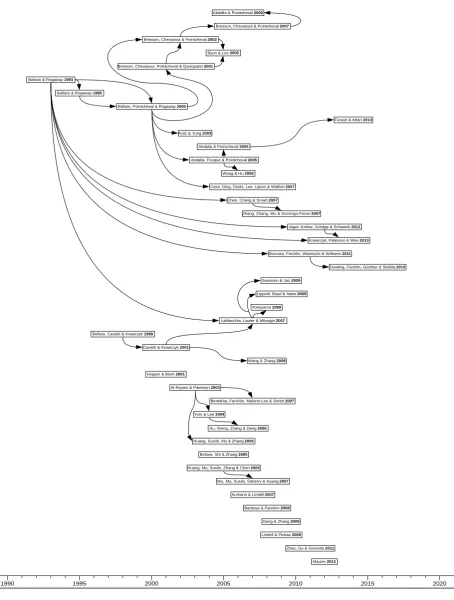
Figure 2 presents the above review of the literature in a chronological flowchart format.
It is important to note that there is no complete advantage or disadvantage to a certain adversary model utilizing (or not utilizing) a particular component – additional features may serve to make a model more detailed whilst simultaneously reducing the flexibility and reusability of the adversary model. On the other hand, a simple adversary model may be easier to understand and more suitable for use in other research.
From our review, it is clear that adversary models have matured and are a crucial aspect of cryptographic research, particularly in the security proofs of protocols. Other security-based research should look to cryptographic protocols as the gold standard for adversary models as the vast majority of adversary models used in this field are fully realized.
Figure 2: The evolution of the adversary model in cryptography research.
1990 1995 2000 2005 2010 2015 2020
Bellare & Rogaway 1993
Bellare & Rogaway 1995
Bellare, Pointcheval & Rogaway 2000
Bellare, Canetti & Krawczyk 1998
Canetti & Krawczyk 2001
Hopper & Blum 2001
Katz & Yung 2003
Al-Riyami & Paterson 2003
Huang, Mu, Susilo, Zhang & Chen 2005
Aumann & Lindell 2007
Wu, Mu, Susilo, Seberry & Huang 2007
Barbosa & Farshim 2008
Lindell & Pinkas 2009
Zhao, Gu & Gorantla 2011
Jager, Kohlar, Schäge & Schwenk 2012
Maurer 2012
Krawczyk, Paterson & Wee 2013
Brzuska, Fischlin, Warinschi & Williams 2011
Dowling, Fischlin, Günther & Stebila 2015
Wang & Zhang 2008
Bresson, Chevassut, Pointcheval & Quisquater 2001
Byun & Lee 2005
Bresson, Chevassut & Pointcheval 2002
Cash, Ding, Dodis, Lee, Lipton & Walfish 2007
Bresson, Chevassut & Pointcheval 2007
Abdalla & Pointcheval 2006
Abdalla, Fouque & Pointcheval 2005
Wang & Hu 2006
LaMacchia, Lauter & Mityagin 2007
Yoneyama 2008
Lippold, Boyd & Nieto 2009
Swanson & Jao 2009
Huang, Susilo, Mu & Zhang 2005
Bentahar, Farshim, Malone-Lee & Smart 2007
Geng & Zhang 2009
Yum & Lee 2004
Hu, Wong, Zhang & Deng 2006
Bellare, Shi & Zhang 2005
Abdalla & Pointcheval 2005
Farash & Attari 2014
Chen, Cheng & Smart 2007
4
Mobile Adversary Models
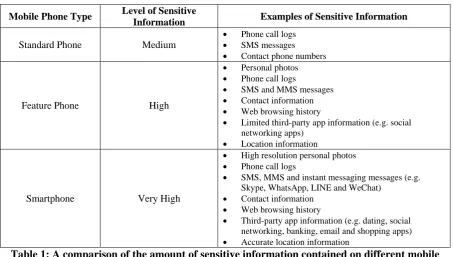
Mobile security research can, roughly, be divided into two periods with the point of division being the introduction of the modern smartphone. Smartphones are defined as mobile phones that have complete support of third-party apps and the capabilities that this entails (see Table 1). Our review focuses on research performed targeting and utilizing contemporary smartphones, such as Android and iOS devices. In this section, we consider adversary models used within the field of mobile research and not the similarly termed mobile adversary model proposed by Ostrovsky and Yung [65], which involves the modeling of adversaries interested in the destruction of systems (i.e. viruses).
Mobile Phone Type Level of Sensitive
Information Examples of Sensitive Information
Standard Phone Medium
Phone call logs
SMS messages
Contact phone numbers
Feature Phone High
Personal photos
Phone call logs
SMS and MMS messages
Contact information
Web browsing history
Limited third-party app information (e.g. social networking apps)
Location information
Smartphone Very High
High resolution personal photos
Phone call logs
SMS, MMS and instant messaging messages (e.g. Skype, WhatsApp, LINE and WeChat)
Contact information
Web browsing history
Third-party app information (e.g. dating, social networking, banking, email and shopping apps)
Accurate location information
Table 1: A comparison of the amount of sensitive information contained on different mobile phone types.
4.1
App-Based Adversary Models
Mobile malware is a common area of research in mobile security that makes use of adversary models. Adversary models are very useful in this area of research as they provide researchers with a framework and capabilities with which an attack may be modeled and therefore, potentially, prevented. Mobile malware research can be categorized as research into mobile device or app vulnerabilities and associated countermeasures or systems to detect or prevent malware infections on devices.
Third party apps are one of the primary attack vectors in smartphone security research. This may be due to the prevalence of these apps and the fact that they are easily obtainable by the end user. This lead to the development of the app-based adversary model.
In their more recent work, Bugiel et al. [67] proposed a system which was capable of monitoring communications between apps in an effort to detect and prevent privilege escalation attacks on Android devices. The authors categorized privilege escalation attacks into two types, namely: confused deputy attacks and attacks via application collusion. The former attack type involved a malicious app misleading a previously installed benign app in order to access resources which the malicious app was not originally permitted. The latter refers to a number of malicious apps colluding in order to gain permission or resource sets unapproved by the user. Similarly, Luyi et al. [68] considered a malicious app adversary model that initially requested no dangerous permissions but may later request dangerous permissions via an app update. This model was used by the authors to demonstrate a privilege escalation attack on Android devices.
On mobile operating systems, such as Android, apps are often required to request a specific permission to a protected resource before that app is granted access to this resource. This system works as a whitelist—by default, no permissions are granted to an app. For example, a camera app would require, at the very least, permission to use the device’s camera and to write to device storage. Resource permissions on most mobile platforms, such as the Android operating system, can be categorized into either “normal” or “dangerous” permissions, with the former concerning access to data with little risk to the user’s privacy and the latter relating to access of potentially privacy-endangering resources. The permissions presented to a user upon installation of an app consist solely of dangerous permissions and normal permissions are implicitly granted when requested by an app [69].
4.1.1
The Proposed App-based Adversary Model Classification
We have observed that app-based adversary models used in the literature can be categorized into three types, namely: adversaries that request zero permissions, adversaries that request only normal permissions and adversaries that request dangerous permissions (along with normal permissions). The level of permission inherently limits the capabilities of the adversaries and could be formalized as a query-based adversary model (ala Bellare-Rogaway). We provide an initial formalization of this particular adversary model classification in Table 2 and examine its use cases below.
App-based Adversary Model Classification
Adversary Assumptions
Adversary assumptions for the app-based adversary model can be classified into one of three increasingly powerful categories, namely: zero permission, normal permission and dangerous permission. The classification depends wholly on the permissions required by the app-based adversary model (analogous with the adversary capabilities in the case of this proposed adversary model).
In addition to the above three classifications, adversary assumptions include the target operating system (e.g. Android or iOS), OS version (e.g. iOS 9.0 or Android 6.0) and device model (e.g. iPhone 6S or Galaxy S7).
Furthermore, the app-based adversary may be a remote (e.g. Internet or LAN-based) or a physical attacker.
Adversary Goals
This particular section of the proposed adversary model differs greatly based on the research objective. Examples of common adversary goals in the literature include the collection of sensitive user information and user files.
Adversary Capabilities
In many cases, app-based adversaries are able to perform many tasks even without requiring access to any system permissions (e.g. accessing files stored on the device’s external storage). This is due to the fact that the model encompasses the capabilities of an app installed on a particular system, and apps often require a certain level of access to system resources in order to be functional.
Table 2: The proposed app-based adversary model for classifying models used in the literature.
The value of this adversary model classification comes from the fact that it allows different studies to be compared with each other based on the type of app-based adversary model used. Furthermore, the classification allows us to determine and catalogue the defining characteristics of app-based research in the field. We now adopt the zero, normal and dangerous permission app-based adversary model approach for categorizing and classifying the existing research in this field in the remainder of the paper. The studies discussed in the following subsections do not all explicitly use an adversary model, however we have classified their technical approaches based on the adversary model proposed above.
4.1.2
Zero Permission Adversaries
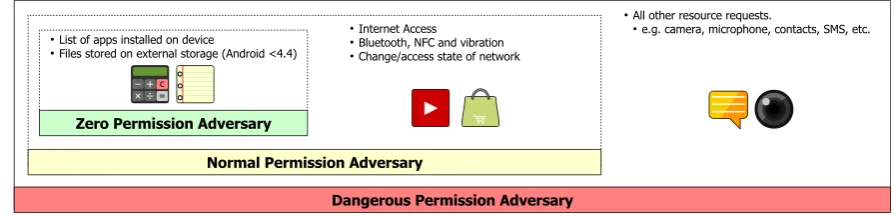
Zero permission adversaries are, seemingly, some of the least commonly used app-based adversary models in the literature. These adversaries cannot request any direct resources that are enforced by the operating system and are only granted permission to basic resources. For example, obtaining a list of installed apps on an Android device requires no explicit permissions to be requested by an app and producing sound via the device speaker typically does not require the use of a system permission [70]. Implicitly, due to the nature of the permissions system, normal permission adversaries have access to the capabilities of zero permission adversaries and dangerous permission adversaries have access to the capabilities of both the zero and normal permission adversaries (see Figure 3).
Figure 3: A comparison of the app-based adversary models used in the literature.
It should be noted that zero permission apps running on Android versions below 4.4 KitKat, released in mid-2014, are able to access the device’s external storage whilst apps running on Android version 4.4 and above require a (dangerous) permission to perform the same task [71]. Such changes mean that zero permission adversaries considered before this alteration may be vastly more powerful than those proposed after Android 4.4. Furthermore, Android 6.0 moved app permission requests to run-time (e.g. when an app is launched) instead of when an app is installed [72]. In addition, the user is given the ability to deny or allow certain permissions when the app is launched. As a result, the app-based adversary model would require that its adversary assumptions reflect this requirement.
In 2013, Zhou et al. [73] demonstrated that sensitive user information (such as information that could be used to infer the user’s location) could be obtained from an Android device via a malicious app which requested no permissions. This zero permission malicious app formed the basis of their adversary model. This app was able to collect and analyze information contained on the device (which it was able
List of apps installed on device
Files stored on external storage (Android <4.4)
Zero Permission Adversary
Normal Permission Adversary
Dangerous Permission Adversary Internet Access
Bluetooth, NFC and vibration Change/access state of network
All other resource requests.
to access whilst simultaneously requiring zero resource permissions). One of the capabilities of the adversary was a zero permission method which could transmit data via the Internet using HTTP GET payloads.
A zero permission malicious app adversary was also utilized by Diao et al. [74] in their proposed Android-based attack which made use of the preloaded Google Voice Search service, present on the majority of Android smartphones, to obtain sensitive user information. This attack was feasible as Android does not require an app to request permission to transmit sound via the speaker and as such the attackers were able to issue voice commands to the phone via this channel. Another covert attack was implemented by Lipp et al. [75] who performed a number of non-root covert channel attacks on Android devices. These attacks aimed to collect and exfiltrate user data, such as keystrokes, in order to infer sensitive user information. They considered a malicious app adversary model with no requested permissions executing on a non-rooted device which, in addition, did not exploit Android version-specific vulnerabilities.
Meanwhile, Meng et al. [76] introduced a type of power charging attack for smartphones which they referred to as “juice filming attacks”. The attack involved performing automatic screen-captures of the device, during device charging, of sensitive information such as PINs, patterns or passwords. The authors considered three adversary scenarios in their adversary model, namely: a public charging station, a semi-public charging station (e.g. a hotel or rented apartment) and a borrowed charger. The screen capturing itself did not require any permissions or apps to be installed onto the device in order to function and perform the attack but a physical attack vector was necessary (i.e. the charging station). In another side-channel attack, Spreitzer et al. [77] demonstrated that a zero permission adversary could accurately infer sensitive information (e.g. websites visited by the owner of a device) via analysis of the proc filesystem (procfs) present in many operating systems, including Android.
The zero permission adversaries discussed thus far can be classified under our definition of the zero permission adversary model (described in Section 4.1.1). These models are summarized in Table 3. Furthermore, all of the adversary models discussed were textually defined without explicit adversary queries or capabilities (e.g. see Section 2). We have discovered that a number of researchers refer to the “latest version of the OS” or the device model instead of providing specific OS version numbers. As a result, the adversary assumptions made by these researchers is unclear and must be determined based on circumstantial details (e.g. time of publication and the default version available to the specified device model). Zero permission adversaries can be considered the most restricted as well as the most difficult to defend against, from the point of view of an OS developer, as a user cannot arbitrarily change the permissions that the app has access to due to the fact that it does not explicitly request any granular permissions.
Zero Permission
Adversary Model Adversary Assumptions/Capabilities Adversary Goals
Zhou et al. [73]
Android 4.1.1 was, presumably, considered by the authors based on the devices they utilized. This means that, for example, the adversary is able to read files on external storage.
Collect sensitive user information.
Diao et al. [74]
Android 4.1 and newer were, presumably, considered by the authors as, according to the authors, only such systems are able to run Google Voice Search.
Collect sensitive user information.
Lipp et al. [75]
Android 4.4.1 to 5.0.1+ (based on the devices utilized by the authors). The authors do not specifically state the versions of the Android OS for the devices under consideration.
Collect user keystrokes and touchscreen inputs.
Meng et al. [76]
A compromised charger or charging station is assumed by the authors—no app-based adversary model is utilized in this study.
Collect user
Spreitzer et al. [77]
Android 7 (N) and Android 8 (O) systems. Two Android phones and one emulator were used in this study.
Infer user activities, including web browsing, videos watched, etc. Table 3: A summary of the zero permission adversary models reviewed.
4.1.3
Normal Permission Adversaries
Normal permission app-based adversary models refer to the use of malicious apps that do not request sensitive (i.e. dangerous) permissions from the user. This classification is based on that used by Google’s Android OS [69]. Although this classification is rather nebulous, it allows researchers to construct an adversary model that is stronger than a zero permission adversary but without the level of power available to a dangerous adversary. It should be noted that both the normal and dangerous permission adversaries are capable of accessing resources outside of an app’s sandbox—the zero permission adversary model is the only model constrained to the sandbox by the OS. Examples of permissions commonly considered to be at the “normal” level include: Bluetooth, Internet, NFC and device vibration. As is immediately apparent, these permissions are not quite benign.
Zhou and Jiang [78] studied two specific vulnerabilities that allowed apps to obtain sensitive data and to modify in-app configurations. In order to perform their attacks, the authors proposed an adversary model consisting of a malicious app which did not request any Android-designated dangerous permissions, but was allowed to request “normal” permissions. This work, published in 2013, seems to be one of the earliest examples of the use of a normal permission app-based. Wu and Chang [79] demonstrated indirect file leakage in mobile apps on both Android and iOS devices. They made use of an adversary model comprising three distinct adversaries, namely: an installed app with zero or few permissions, a local network (i.e. LAN) attacker and an Internet-based attacker.
An indispensable smartphone app is the software keyboard and, on Android devices, the keyboard app can be changed by the user. Diao et al. [80] studied the potential for adversaries to obtain the user’s customized dictionary, stored by their keyboard app, via cross-app injection attacks. The authors utilized the malicious app adversary model with the app requiring the WAKE_LOCK and INTERNET permissions (two “normal” permissions). Furthermore, the adversary’s operating environment (e.g. Android 2.3.7 and up to Android 5.0) and aims (to collect the user’s commonly used words or sensitive words) were provided by the authors.
Cheng et al. [81] introduced a method for obtaining a subset of the root privileges available on Android without requiring the device be rooted (e.g. unlocking of the bootloader or via an exploit). The authors considered the situation where a malicious app (with only Internet access) would use this method in order to attack the device and modeled this with the help of a loosely defined adversary model.
Covertly obtaining device screenshots in order to acquire sensitive on-screen information is a common attack vector in mobile security research. Lin et al. [82] proposed Screenmilker, a malicious app that was able to periodically and covertly take screenshots of the device in order to obtain sensitive user information that was displayed on-screen. As with many normal permission adversaries, a malicious app adversary model with the INTERNET permission was utilized by the authors.
Vendor customization is often considered by researchers to be a potential attack vector for malicious attackers. Aafer et al. [84] examined the inadvertent threat of Android operating system vendor customizations by analyzing 97 different vendor factory images. These customizations could allow for malware to exploit a device and obtain sensitive user data. As with some other mobile security works, the authors considered a malicious app adversary model, specifically a normal permission adversary that requested network communication capabilities in order to transmit the sensitive user data obtained.
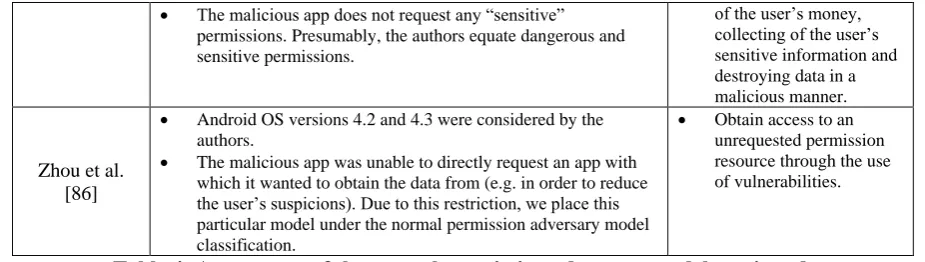
Similar to the work of Aafer et al. [84], Wu et al. [85] considered the effects of vendor customization on the security of the Android operating system. The authors analyzed a total of ten different Android OEM images and noted a number of vulnerabilities. They utilized the malicious app adversary model with the malicious app able to request any non-sensitive permission. The adversary’s goal was to exploit vulnerable vendor apps and indirectly obtain sensitive information in this manner. Likewise, Zhou et al. [86] also considered the dangers of OS customization by manufacturers. They specifically looked at what types of sensitive information could be obtained from a malicious app adversary model where the app itself was not allowed to request the permission which it sought to obtain sensitive data from. For example, the malicious app may try to obtain audio recordings of the user but may not request the (dangerous) RECORD_AUDIO permission in order to do so. The app was allowed to request other unrelated permissions.
We observed that there are significantly more normal permission adversary models proposed in the literature than zero permission adversary models. Furthermore, the collection of sensitive user information and files is the primary goal of the vast majority of the research surveyed thus far. These findings are summarized and categorized in Table 4.
Normal Permission
Adversary Model
Adversary Assumptions/Capabilities Adversary Goals
Zhou and Jiang [78]
Android 4.2 is presumed to be the OS utilized based on the devices examined.
A malicious app which was allowed to request any non-dangerous permission.
Collect sensitive user information and modify app settings.
Wu and Chang [79]
iOS 7 and 8, and an unknown version of Android were considered by the authors.
The adversary also does not perform any screenshot attacks.
Collect sensitive user files.
Diao et al. [80]
Android versions 2.3.7 up to 5.0 were considered by the authors. It is unclear if all versions in this range were utilized by the authors.
The INTERNET and WAKE_LOCK (normal) permissions are required in order to exfiltrate the data and allow this to occur even whilst the device screen is off, respectively.
Collect user dictionaries in order to infer sensitive information (e.g. passwords and usernames).
Cheng et al. [81]
Android 4.x to 5.x were specified by the authors as the platforms utilized.
The malicious app requests only the INTERNET permission.
No formal adversary goal was provided by the authors.
Lin et al. [82]
Android 4.1.1 was specified by the authors.
The malicious app requests only the INTERNET permission.
Collect device screenshots containing sensitive user data.
Naveed et al. [83]
Android 4.2 was specified as the platform considered by the authors.
The malicious app requests two normal permissions: BLUETOOTH and BLUETOOTH_ADMIN.
Collect sensitive user information.
Inject fake data into device apps.
Aafer et al. [84]
Android versions 4.0.4 up to 5.0.2 were examined.
A total of 97 vendor stock images were examined by the authors and, as such, the adversary assumptions of the adversary would change based on the OS.
Collect and exfiltrate sensitive user information.
Wu et al. [85] A number of Android OS versions between 4.0.3 to 4.3 were considered.
The malicious app does not request any “sensitive” permissions. Presumably, the authors equate dangerous and sensitive permissions.
of the user’s money, collecting of the user’s sensitive information and destroying data in a malicious manner.
Zhou et al. [86]
Android OS versions 4.2 and 4.3 were considered by the authors.
The malicious app was unable to directly request an app with which it wanted to obtain the data from (e.g. in order to reduce the user’s suspicions). Due to this restriction, we place this particular model under the normal permission adversary model classification.
Obtain access to an unrequested permission resource through the use of vulnerabilities.
Table 4: A summary of the normal permission adversary models reviewed.
4.1.4
Dangerous Permission Adversaries
The dangerous permission app-based adversary model is another popular model used in the literature. This model allows for the simulation of a typical smartphone app, which can be considered one of the most common attack vectors on mobile devices. Typically, users download and install apps from official (and unofficial) app stores and these apps are highly likely to request access to sensitive resources. The apps must explicitly request this resource and the user is required to agree to these resource requests upon installation of the app. Some versions of the Android OS allow for the user to block requests to certain device resources in a fine-grained manner. Resources which are considered dangerous include: reading/writing contacts data, sending/receiving SMS messages, initializing phone calls and recording of microphone audio.
One of the earliest works to use this particular adversary model was Luo et al. [87] who, in 2011, considered two such models: a malicious app and a malicious webpage, in their research which examined webview attacks on Android. As opposed to other malicious app adversary models, which tried to directly attack the device, this particular adversary model targeted specific web applications (e.g. Facebook). The malicious webpage model, meanwhile, sought to attack benign apps in order to coerce the victim app into opening the attacker’s webpage (as opposed to the legitimate web application). The goal of the adversary, beyond the compromising of the targeted web application, was unclear.
Due to the widespread reliance on app sandboxing on mobile operating systems, this in turn has become a common attack vector for malicious apps. A number of works have endeavored to strengthen the mobile operating system’s sandboxing defenses. AirBag [88] is a virtualization technique for malware resistance on Android devices. Apps on the device were executed in an isolated environment to prevent them from leaking sensitive data or infecting the operating system itself. An adversary model involving malicious apps that attempted to exploit device vulnerabilities was considered by the authors. Permissions requested by the malicious apps were not considered by the authors as their system was able to completely isolate an app and therefore sandbox the app at a lower level than the permissions system, but (presumably) apps would be able to request any legitimate permission.
available to third party apps, but this requires the user to manually configure this setting in the Settings app.
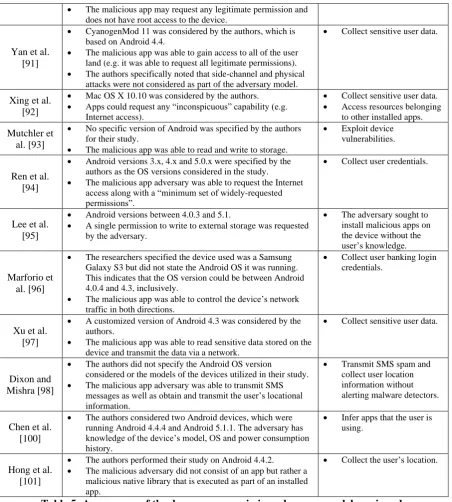
Similarly, AppCage, introduced by Zhou et al. [90], was a system for complete sandboxing of third-party Android apps in order to protect devices against privacy leaks. As with many other protections for app data leakage, the authors made use of the malicious app adversary model. Due to AppCage operating as a wrapper containing the malicious third-party app, the malicious app was able to request any resource permission. However, the authors did not specifically provide the goal of the malicious app. Yan et al. [91] presented SplitDroid, another OS-level modification to the Android OS that enhanced device security by providing an isolated environment for app execution. The system was designed around an app-based adversary model involving a malicious app with the ability to compromise all parts of the user space. Presumably, this app was able to request any non-system resource permissions. Meanwhile, Xing et al. [92] examined cross-app resource attacks on iOS and OS X devices (which also employed app sandboxing). The authors utilized a malicious app adversary model involving a malicious app, requesting a small number of innocuous permissions, which was uploaded to the Apple app store and underwent Apple’s reviewing process. The adversary’s goal was to collect sensitive user data and access data owned by other installed apps.
Mutchler et al. [93] investigated the dangers of Android apps which employed webviews (embedded browsers inside apps with, possibly, reduced functionality). The authors considered three adversaries in their adversary model: a malicious app adversary, a malicious network adversary and a restricted web adversary. The restricted web adversary was capable of setting up an unlimited number of malicious web sites but the mobile device user was only able to navigate websites that were allowed by the app. This model differed from typical web adversaries in that it was able to employ any number of websites and could assume that a user would visit these websites. A mobile user interacting with a webview does not necessarily have full browser functionality (e.g. there may not be a URL bar) and therefore the user must act in accordance with the app’s functionality within the webview. The malicious app adversary was capable of writing to and reading from the device’s (presumably) external storage and, hence, requires at the very least this dangerous permission.
Ren et al. [94] determined that many versions of the Android operating system were vulnerable to an attack known as “task hijacking”. Such an attack takes place when a malicious app hijacks a user’s app session with their own malicious user interface and misleads the user into providing personal details. They also used the malicious app adversary model, with the permission requirements including Internet access and “other commonly requested permissions”. We classified this particular adversary model under the dangerous permission category. A similar study into hijacking was performed by Lee et al. [95]. They, instead, examined app installation hijacking via the use of an app which requested a single dangerous permission—WRITE_EXTERNAL_STORAGE. The authors demonstrated that it was possible to silently install malicious apps through the use of this single permission and analyzed over 1000 Android device images in their study.
Marforio et al. [96] proposed a system to detect illegitimate (i.e. counterfeit) apps on an Android device. They considered an adversary with the goal of obtaining legitimate user details by performing a phishing attack. The adversary was able to mislead the user into installing a malicious app and the adversary was also able to control and read all network traffic on the mobile device. As a direct result, the malicious app requested a number of dangerous permissions.